, to see if you have full access to this publication.
Monograph No access
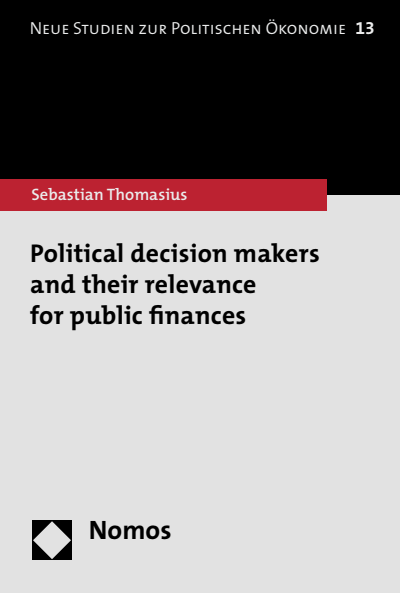
Political decision makers and their relevance for public finances
- Authors:
- Series:
- Neue Studien zur Politischen Ökonomie, Volume 13
- Publisher:
- 2013
Summary
Politische Erfolge und Misserfolge werden in der öffentlichen Debatte oft einzelnen Politikern und deren Kompetenz zugeschrieben. Für die Fiskalpolitik liegt nun eine erste umfassende Untersuchung vor, welche die Relevanz der politischen Entscheidungsträger und ihres persönlichen Hintergrunds für die öffentlichen Finanzen analysiert.
Die empirische Analyse basiert auf drei neuartigen Datensätzen, welche die Fiskaldaten von Kommunen, Bundesländern und EU-Staaten mit den Biographien der jeweiligen Entscheidungsträger verknüpfen. So wird der Einfluss der persönlichen Qualifikation (u.a. Bildungs- und Berufshintergrund) und Präferenzen (u.a. Parteizugehörigkeit) auf die Entwicklung der öffentlichen Finanzen untersucht.
Search publication
Bibliographic data
- Edition
- 1/2013
- Copyright Year
- 2013
- ISBN-Print
- 978-3-8487-0814-7
- ISBN-Online
- 978-3-8452-5005-2
- Publisher
- Nomos, Baden-Baden
- Series
- Neue Studien zur Politischen Ökonomie
- Volume
- 13
- Language
- English
- Pages
- 167
- Product Type
- Monograph
Table of contents
ChapterPages
- Titelei/Inhaltsverzeichnis No access Pages 2 - 9Authors:
- List of figures No access Pages 10 - 10Authors:
- List of tables No access Pages 11 - 12Authors:
- List of abbreviations No access Pages 13 - 14Authors:
- Motivation No access Pages 15 - 18Authors:
- Contribution and main findings No access Pages 18 - 20Authors:
- Candidate characteristics and election outcomes No access Pages 21 - 24Authors:
- Economic policy and economic growth No access Pages 24 - 24Authors:
- Monetary policy No access Pages 24 - 26Authors:
- Spending priorities and public good provision No access Pages 26 - 27Authors:
- Changes in the form of government No access Pages 27 - 27Authors:
- Corporate performance No access Pages 27 - 27Authors:
- Theoretical considerations No access Pages 27 - 28Authors:
- Empirical evidence No access Pages 28 - 32Authors:
- Introduction No access Pages 33 - 36Authors:
- Politics and public finances at the local level in Germany No access Pages 36 - 37Authors:
- Description of our data set No access Pages 37 - 40Authors:
- Sharp regression discontinuity design No access Pages 40 - 44Authors:
- Fuzzy regression discontinuity design No access Pages 44 - 45Authors:
- Education and incumbency experience on electoral success No access Pages 45 - 48Authors:
- Education and incumbency experience on fiscal outcomes No access Pages 48 - 52Authors:
- Specific professions on fiscal outcomes No access Pages 52 - 55Authors:
- Validity of the regression discontinuity design No access Pages 55 - 57Authors:
- Conclusion No access Pages 57 - 58Authors:
- A Appendix: Parametric and non-parametric implementation No access Pages 58 - 61Authors:
- B Appendix: Figures and tables No access Pages 61 - 70Authors:
- Introduction No access Pages 71 - 73Authors:
- Germany's federal design and political parties No access Pages 73 - 74Authors:
- Fiscal federalism in Germany No access Pages 74 - 76Authors:
- Budgeting procedures in Germany No access Pages 76 - 76Authors:
- Budgetary preferences of the finance minister No access Pages 76 - 78Authors:
- Ability of the finance minister No access Pages 78 - 80Authors:
- Traditional theories on budget deficits as control variables No access Pages 80 - 81Authors:
- Model specification No access Pages 81 - 82Authors:
- Description of the data set No access Pages 82 - 86Authors:
- Estimation methods No access Pages 86 - 88Authors:
- Estimation results No access Pages 88 - 94Authors:
- Robustness checks No access Pages 94 - 97Authors:
- Conclusion No access Pages 97 - 98Authors:
- A Appendix No access Pages 98 - 100Authors:
- Introduction No access Pages 101 - 103Authors:
- Public finances and the finance minister's ability No access Pages 103 - 107Authors:
- Public finances and the finance minister's preferences No access Pages 107 - 109Authors:
- Specification of the econometric model No access Pages 109 - 111Authors:
- Description of the data set No access Pages 111 - 116Authors:
- Results related to the finance minister's ability No access Pages 116 - 124Authors:
- Results related to the finance minister's preferences No access Pages 124 - 125Authors:
- Robustness checks No access Pages 125 - 128Authors:
- Conclusion No access Pages 128 - 130Authors:
- A Appendix No access Pages 130 - 136Authors:
- Main results and contribution No access Pages 137 - 141Authors:
- Different results and fiscal institutions and attitudes No access Pages 141 - 143Authors:
- Different empirical methods No access Pages 143 - 144Authors:
- Policy implications No access Pages 144 - 145Authors:
- Further research No access Pages 145 - 146Authors:
- Concluding remarks No access Pages 146 - 148Authors:
- References No access Pages 149 - 158Authors:
- Kurzfassung in deutscher Sprache No access Pages 159 - 167Authors: