, to see if you have full access to this publication.
Edited Book No access

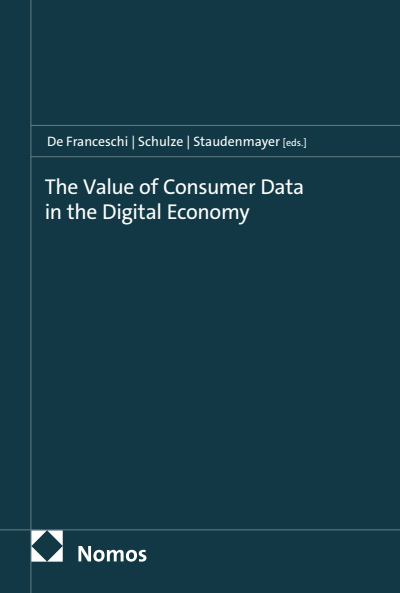
The Value of Consumer Data in the Digital Economy

Editors:
Publisher:
 2026

Summary

Consumer data has long been the currency of the digital economy – but how is its value determined, who is permitted to trade it, and when do ‘free’ offers come at a price? This volume provides a comprehensive overview: the GDPR and the Data Act, common law perspectives, the review of terms and conditions (‘ius pretium’), and the implications of monetisation for contract types and structures. In addition, the volume addresses issues of fairness beyond consumer protection, IoT data, market failure in the B2C sector, and the determination of data values (assets, data trading, databases).


Bibliographic data

Edition
1/2026
Copyright Year
2026
ISBN-Print
978-3-7560-1934-2
ISBN-Online
978-3-7489-4827-8
Publisher
Nomos, Baden-Baden
Language
English
Pages
251
Product Type
Edited Book

Table of contents

ChapterPages
  1. Preface No access
  2. Authors:
    1. I. Overview No access
        1. a) The tension between the Data Act and the General Data Protection Regulation No access
        2. b) Contract law and data protection No access
        3. c) The Common Law Perspective No access
        1. a) Judicial price review No access
        2. b) Consequences of ‘monetisation’ No access
      1. 3. The Value of Consumer Data in and Beyond the Data Act No access
      2. 4. The Determination of the Value of Data No access
    2. III. Conclusion No access
    1. Authors:
      1. I. Introduction No access
      2. II. Personal Data: An object of trade – not of transfer No access
        1. 1. Can Art. 4 and 5 DA serve as a legal basis for processing? No access
        2. 2. No legal basis in Art. 6 (2) lit. b DA No access
        1. 1. Necessity for the fulfillment of the contract, Art. 6 (1) lit. b GDPR No access
        2. 2. Processing as a legitimate interest, Art. 6 (1) lit. f GDPR No access
        3. 3. Consent to the processing, Art. 6 (1) lit. a / Art. 9 (2) lit. a GDPR No access
        1. 1. Voluntariness of consent No access
        2. 2. Informed consent No access
        3. 3. Consent for specific purposes No access
      3. VI. Conclusion No access
    2. Authors:
        1. Why a “common law perspective”? No access
      1. II. The status of data in English Law No access
      2. III. The Economic Value of Data: Contracts and Consideration No access
      3. IV. The Regulatory Context No access
      4. V. The Data (Use and Access Act 2025) No access
        1. Unfair Terms and Consumer Data Access Agreements No access
        2. Contract Classification No access
      5. VII. Conclusion No access
    1. Authors:
      1. I. From late antique price reviews to natural law codifications No access
      2. II. Economic liberalism and Adam Smith's market ideology of ‘natural prices’ No access
      3. III. Replacement of the laesio enormis by usury in 19th century No access
      4. IV. A ‘renaissance’ of laesio enormis in the 20th century No access
      5. V. Criticism from the economic analysis of law No access
      6. VI. Need to differentiate from administrative price controls No access
      7. VII. Prices set by standard terms and judicial price review No access
      8. VIII. Prices of SEPs: FRAND Requirements No access
        1. 1. Value of data in the early digital age No access
        2. 2. Personal data No access
        3. 3. Product-generated non-personal data: FRAND again No access
      9. X. Overall findings and outlook for judicial price review No access
    2. Authors:
        1. 1. GDPR separates privacy from contract (Separation Principle) No access
        2. 2. Recent EU legislation confirming the Separation Principle No access
        3. 3. First Consequences No access
        1. 1. Controlling personal data No access
          1. a. General rules on data access obligations (Artt. 8–13 DA) No access
          2. b. Holding IoT device data (Artt. 3–7, 13 DA) No access
        2. 3. The position of the third-party data recipient No access
        3. 4. Implications for data use by the data holder No access
        4. 5. Consequences No access
        1. 1. Indications by GDPR No access
        2. 2. Indications by the Data Act No access
          1. a. Transfer of data as kind of payment by the consumer No access
          2. b. Supply of data as supply of digital content to the consumer No access
        3. 4. Conclusions No access
      1. IV. Ancillary duties and data contracts No access
      2. V. Mixed contracts as the new normal No access
      3. VI. General Conclusions No access
    1. Authors:
        1. I.1. Goals and scope of the Data Act: the blurred distinction between personal and non-personal data No access
        2. I.2. Data Act and consumer protection: an initial assessment No access
        1. II.1. The unfairness problem in the B2B data sharing market: a structural, relational, and functional problem No access
        2. II.2. - Consumers in the Data Act No access
      1. III. Combating unfairness in data sharing: beyond consumer protection No access
    2. Authors:
      1. I. Introduction No access
        1. II.1. Economics of IoT data governance and the data use contracts about IoT data No access
        2. II.2. Market failure problems on markets for personal data No access
        3. II.3. Market failure problems for data use contracts about personal and non-personal data of IoT devices No access
        4. II.4. Intermediate results and conclusions No access
        1. III.1. Introduction No access
        2. III.2. Competition law, market dominance, data protection law, and choice No access
        3. III.3. Tying prohibition in data protection law, "consent or pay" models, and the EDPB Opinion 08/24 No access
        4. III.4. More choice: Recent developments in Californian privacy law No access
        5. III.5. Choice of consumers regarding personal data: Some critical reflections No access
        1. IV.1. Introduction No access
        2. IV.2. Direct compensation for personal / non-personal IoT data No access
          1. IV.3.1. Reasons why consumers do not have sufficient choice regarding their IoT data and IoT devices No access
          2. IV.3.2. A right for data collection-free IoT devices: A case for applying "consent or pay" models in B2C IoT contexts? No access
          3. IV.3.3. Minimum standards of choice for users of IoT devices: More granular choice and termination rights No access
          4. IV.3.4. More far-reaching solutions for the control of consumers over their IoT devices and IoT data No access
      2. V. Conclusions No access
    1. Authors:
      1. I. Data as a cornerstone of markets and as an asset allowing its holder to take profit-maximizing actions No access
        1. 1. Data as a public good No access
        2. 2. Data is the lifeblood of AI No access
          1. i) Network effects and data network effects No access
          2. ii) Negative externalities in data interactions No access
          3. iii) Policy measures available for correcting data negative externalities No access
      2. IV. Data assets are remarkably complex to value No access
      3. V. Conclusions No access
    2. Authors:
      1. 1. The case No access
      2. 2. The outcome of Case C-693/22 No access
      3. 3. The open issues No access
        1. a) Some comparative insights No access
        2. b) Databases and accountancy rules No access
        3. c) Contractual solutions No access
    3. Authors:
      1. I. The aims of the Data Act: efficient use of data and fair reward No access
      2. II. Markets: we should wait and see whether they work No access
      3. III. Problems with market solutions No access
      4. IV. Are there alternatives? No access
      5. V. Re-introducing the fair share No access

Similar publications

from the topics "Europarecht & Internationales Recht & Rechtsvergleichung"
Cover of book: Casebook European Data Law
Edited Book No access
Rolf Schwartmann, Marek Steffen Jansen, Moritz Köhler
Casebook European Data Law