, to see if you have full access to this publication.
Monograph No access
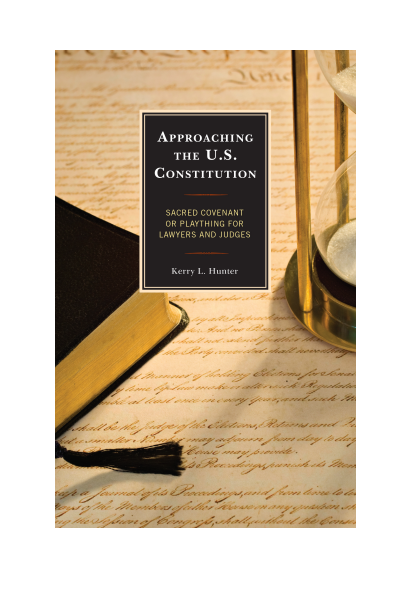
Approaching the U. S. Constitution
Sacred Covenant or Plaything for Lawyers and Judges
Authors:
Publisher:
2014
Summary
By reminding readers that early Supreme Court justices refused to reduce the Constitution to a mere legal document, Approaching the U.S. Constitution provides a definitive response to Reading Law by Antonin Scalia and Bryan Garner. Turning to the vision of Alexander Hamilton found in Federalists No. 78, Hunter argues that rather than seeing the judiciary as America’s legal guardian, Hamilton looked to independent individuals of integrity on the judiciary to be the nation’s collective conscience. For Hamilton, the judiciary’s authority over the legislature does not derive from positive law but is extra-legal by 'design' and is purely moral.
By emphasizing the legal expertise of judges alone, individuals such as Justice Scalia mistakenly demand that judges exercise no human ethical judgment whatsoever. Yet the more this happens, the more the “rule of law” is replaced by the rule of lawyers. Legal sophistry becomes the primary currency wherewith society’s ethical and moral questions are resolved. Moreover, the alleged neutrality of legal analysis is deceptive with its claims of judicial modesty. It is not only undemocratic, it is dictatorial and highly elitist. Public debate over questions of fairness is replaced by an exclusive legalistic debate between lawyers over what is legal. The more Scalia and Garner realize their agenda, the more all appeals to what is moral will be effectively removed from political debate. 'Conservatives' lament the 'removing God from the classroom,' by 'liberals,' yet if the advocates of legalism get their way, God will be effectively removed from the polis altogether.
The answer to preserving both separation of powers and the American commitment to unalienable human rights is to view the Supreme Court in the same way early founders such as Hamilton did and in the way President Abraham Lincoln urged. The Court’s most important function in exercising the power of judicial review is to serve as the nation’s conscience just as it did in Brown v. Board of Education.
Keywords
Search publication
Bibliographic data
Edition
1/2014
Copyright Year
2014
ISBN-Print
978-0-7391-9082-1
ISBN-Online
978-0-7391-9083-8
Publisher
Lexington, Lanham
Language
English
Pages
153
Product Type
Monograph
Table of contents
ChapterPages
Contents No access
Preface No access
Acknowledgments No access
1 The Political Power of the Supreme Court No access Pages 1 - 28
2 American Utopian Constitutionalism No access Pages 29 - 58
3 Hamilton’s Court as Conscience No access Pages 59 - 90
4 The Umpire Has No Clothes No access Pages 91 - 120