, to see if you have full access to this publication.
Edited Book No access
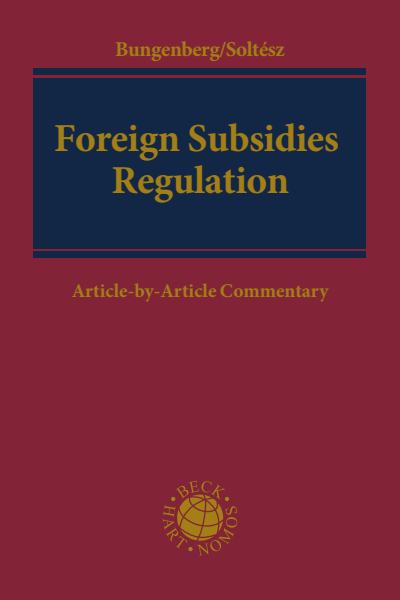
Foreign Subsidies Regulation
Article-by-Article Commentary- Editors:
- |
- Publisher:
- 2026
Summary
The EU's Foreign Subsidies Regulation (FSR) is a powerful instrument for regulating third country subsidies, which has quickly become a central control instrument in the areas of European foreign trade, state aid, competition, antitrust and public procurement law.
The commentary on the FSR The English commentary by Marc Bungenberg and Ulrich Soltész presents the legal problems and practical implications of the new regulation for legal practitioners and academics for the first time. The commentaries offer, article by article, a concise presentation of the respective legislation, connecting factors for legal protection in court with regard to disputes relating to the FSR as well as analyses of the geopolitical and economic background.
Search publication
Bibliographic data
- Edition
- 1/2026
- Copyright Year
- 2026
- ISBN-Print
- 978-3-7560-1511-5
- ISBN-Online
- 978-3-7489-2046-5
- Publisher
- Nomos, Baden-Baden
- Language
- English
- Pages
- 819
- Product Type
- Edited Book
Table of contents
ChapterPages
- Preface No access
- General Background of this Volume and the FSR No access
- The Commission’s Emerging Assessment Framework No access
- Acknowledgements No access
- Authors No access
- Literature No access
- Abbreviations No access
- Authors: |
- A. Introduction No access
- I. A brief economic history of the past 80 years No access
- II. The economic pivot to Asia in the 21st century No access
- III. Digitalization, AI and the decarbonization of the economy No access
- IV. From efficiency and global value chains to resilience and reliability No access
- V. The rise of State capitalism and new industrial policies No access
- C. The international economic system in 2025 No access
- D. ‘Taming the dragon’ No access
- E. The EU’s trade strategy in times of geoeconomics No access
- F. The FSR as part of the EU’s strategy No access
- G. Conclusion and outlook No access
- Authors: | | | | |
- A. Introduction: the FSR in the context of a global subsidy race? No access
- B. Policy objectives and relevant trade-offs in foreign subsidy assessment No access
- C. Overview of key economic issues expected in FSR enforcement No access
- I. Existence of a foreign subsidy (Article 3 FSR) No access
- II. Distortions in the internal market (Article 4 FSR) No access
- III. Categories of foreign subsidies most likely to distort the internal market (Article 5 FSR) No access
- IV. Balancing test (Article 6 FSR) No access
- V. Commitments and redressive measures (Article 7 FSR) No access
- Authors: |
- A. Overview No access
- I. Procedure No access
- a) Reviewable subject matter No access
- b) Applicants No access
- c) Time limit No access
- d) Legal grounds No access
- e) Standard of review No access
- f) Consequences of the decision No access
- aa) Measures of investigation No access
- bb) Decision to initiate the in-depth investigation No access
- cc) Closure of the preliminary review No access
- dd) Reopening the preliminary review No access
- aa) Measures of investigation No access
- bb) Interim measures No access
- cc) Final decisions No access
- aa) Notification requests No access
- bb) Derogation from the suspension of concentrations No access
- cc) Revocation decisions No access
- dd) Decisions imposing transparency and reporting obligations No access
- ee) Disclosure decisions No access
- a) Member States No access
- aa) Interest in bringing proceedings No access
- bb) Examples No access
- aa) Scope of potential applicants No access
- bb) Direct and individual concern No access
- cc) Examples No access
- 1. General overview No access
- a) Member States and other EU institutions No access
- aa) Ex officio tool No access
- bb) Concentration and public procurement tool No access
- c) Third parties No access
- a) Procedure and admissibility No access
- b) Substantial requirements No access
- 2. Relevance with regard to the FSR No access
- 1. Admissibility No access
- 2. Substantial Requirements No access
- VI. Preliminary reference procedure – Art. 267 TFEU No access
- 1. Investigations No access
- a) Principles governing public procurement procedures No access
- b) Calculation of value No access
- c) Transfer of the notification or declaration to the Commission No access
- d) Declaration of irregularity and rejection of the tender No access
- e) Suspension of the award of the contract No access
- 1. General criteria No access
- 2. Recent developments No access
- 1. Starting point: FSR measures as potentially WTO-relevant actions No access
- a) Standing to bring a complaint No access
- b) Respondent No access
- c) FSR measures as a viable subject of challenge and potential breaches of WTO law No access
- aa) Consultation phase (Article 4 DSU) No access
- bb) Establishment of a panel (Article 6 DSU) No access
- cc) Panel proceedings (Article 12 DSU) No access
- dd) Appellate proceedings (Article 7 DSU) No access
- ee) Implementation and surveillance (Article 21 DSU) No access
- a) Compatibility with the Agreement on Subsidies and Countervailing Measures (ASCM) No access
- b) Compatibility with the General Agreement on Tariffs and Trade (GATT 1994) No access
- c) Compatibility with the Agreement on Trade Related Measures (TRIMs) No access
- d) Compatibility with the General Agreement on Trade in Services (GATS) No access
- e) Interface between the FSR and the Agreement on Government Procurement (GPA) No access
- f) Relationship with the Dispute Settlement Understanding and systematic assessment No access
- 4. Overall assessment No access
- 1. Overview No access
- 2. Investment disputes before international dispute settlement institutions and arbitral tribunals No access
- a) Personal scope of investment protection No access
- b) Material scope of investment protection No access
- c) The distinction between pre- and post-establishment investment protection No access
- d) State measures as the subject matter of investment disputes No access
- e) Attribution of measures adopted under the FSR to EU Member States or the EU No access
- f) Limitations on investment protection in respect of subsidy measures No access
- aa) Legitimate expectations No access
- bb) Transparency and procedural fairness No access
- cc) Coercive measures and (dis-)proportionality No access
- aa) National treatment No access
- bb) Most-favored-nation treatment No access
- c) Expropriation No access
- d) Right to transfer capital and profits No access
- e) Umbrella clauses No access
- III. Outlook No access
- Authors:
- A. Overview No access
- B. Subject matter No access
- I. Overview No access
- II. Personal scope No access
- III. Material scope No access
- Authors: |
- A. General information No access
- B. Undertakings No access
- 1. Pecuniary interest/renumeration No access
- 2. Enforceable fulfilment obligation No access
- 3. Selection Decision of the contracting authority No access
- a) Public supply contracts No access
- aa) Execution of works in connection with one of the activities listed in Annex II No access
- bb) Execution of a work No access
- cc) Construction services by third parties No access
- c) Public service contracts No access
- 5. Procurement purpose No access
- II. Supply, works and service contracts within the meaning of Article 2 No. 1 Directive 2014/25/EU No access
- III. Contract within the meaning of Article 1 No. 2 Directive 2009/81/EC No access
- 1. Remunerability No access
- a) Market Risk No access
- b) Amortisation Risk No access
- c) Payment of an additional fee No access
- 1. Open procedure No access
- 2. Restricted procedure No access
- 3. Negotiated procedure with prior publication No access
- 4. Competitive dialogue No access
- 5. Innovation partnership No access
- 6. Negotiated procedure without prior publication No access
- II. Procedure for awarding works and service concessions in accordance with Directive 2014/23/EU No access
- III. Procedure in accordance with Directive 2009/81/EC No access
- IV. Procurement procedures based on international procedural rules No access
- V. Award procedures for the conclusion of (public) contracts or for the award of concessions No access
- 1. State and regional or local authorities No access
- aa) Tasks in the general interest No access
- bb) Non-commercial character No access
- b) Legal personality No access
- c) Qualified affinity to the state No access
- 3. Associations No access
- II. Article 3 Directive 2014/25/EU No access
- III. Article 6 Directive 2014/23/EU No access
- IV. Article 1 point 17 Directive 2009/81/EC No access
- 1. Contracting authorities pursuing a sectoral activity No access
- 2. Public undertakings No access
- 3. Contracting entities on the basis special or exclusive rights No access
- II. Article 7 Directive 2014/23/EU No access
- III. Article 1 point 17 Directive 2009/81/EC No access
- I. Article 28–32 Directive 2014/24/EU and Article 46–50 Directive 2014/25/EU No access
- II. Article 51, 52 Directive 2014/25/EU No access
- III. Multi-stage concession award procedures within the meaning of Directive 2014/23/EU No access
- IV. Multi-stage award procedures within the meaning of Directive 2009/81/EC No access
- Authors: |
- A. Introduction No access
- I. Economic definition of a subsidy can be based on the existence of a benefit No access
- II. Definition of a subsidy in the FSR No access
- III. Definition of a subsidy under the FSR and WTO Agreement on Subsidies and Countervailing Measures both centred around benefits No access
- I. Broad scope of financial contributions under the FSR might help capturing benefits but comes at a cost No access
- II. Direct and indirect provision of financial contribution expand broad scope further No access
- III. Early FSR cases illustrate that beneficial financial contributions are mostly financial transactions No access
- I. When is an economic assessment of benefits necessary? No access
- 1. “Pari passu” transactions No access
- 2. Competitive tenders No access
- 3. Adjusting existing benchmarks No access
- 4. Cost benefit analysis No access
- 5. Challenges when identifying appropriate benchmarks No access
- III. Notifications obligations of financial contributions are not based on benefits No access
- E. Relevance of a benefit may depend on its selectivity No access
- Authors: |
- A. Overview No access
- 1. Practical importance No access
- 2. Criticism No access
- 3. International trade law and EU State aid law influences No access
- II. Financial contribution (Art. 3 para. 2 subpara. 1) No access
- a) Third country No access
- b) Government and public authorities (lit. a) No access
- aa) Distinction between public and private entities No access
- bb) Public entities/undertakings (lit. b) No access
- cc) Private entities (lit. c) No access
- a) Relevance unclear No access
- b) Analogous application of EU State aid law standards No access
- 3. Examples and practical implications No access
- 1. Moment of granting No access
- 2. Quantification of amount No access
- 1. Benefit in general No access
- aa) Pari passu transactions No access
- bb) Provision or purchase of goods or services carried out following a comparative, transparent, and non-discriminatory tender procedure No access
- aa) Benchmarking No access
- bb) Adjusted or alternative benchmarks No access
- 3. Indirect and passing-on of benefits No access
- 4. Assessment of benefit in the cases of non-cooperation No access
- 5. Benefits resulting from unlimited guarantees, political support and special or exclusive rights – the e&/PPF Telecom decision No access
- 1. Concept of undertaking in general No access
- 2. Dealing with group of companies as the relevant undertaking No access
- 3. Undertaking in public procurement procedures No access
- 4. Economic activity within the internal market No access
- 5. Undertakings from third countries with which the EU has concluded bilateral agreements containing specific rules on subsidy control No access
- 6. Undertakings engaged in trade in goods No access
- 1. The concept of specificity in general No access
- 2. Specificity test: derogation from the reference system No access
- 3. De jure specificity No access
- 4. De facto specificity No access
- 5. Non-specificity and notification obligation No access
- Authors: |
- A. Introduction No access
- B. What is competition and why does it matter? No access
- C. Foreign subsidies may distort competition and thus reduce welfare No access
- D. Theories of harm and potential distortion No access
- E. Exemplary theories of harm No access
- I. Indicators in Article 4 para. 1 FSR No access
- II. Further indicators beyond Article 4 para. 1 FSR No access
- Authors:
- A. General remarks No access
- I. Amount of the foreign subsidy No access
- II. Nature of the foreign subsidy No access
- III. Situation of the undertaking, including its size and the markets or sectors concerned No access
- IV. Level and evolution of economic activity on the internal market No access
- V. Purpose and conditions attached to the foreign subsidy as well as its use on the internal market No access
- VI. Other indicators No access
- 1. Inspiration from and differences with State aid No access
- 2. Establishing the ‘link’ with the economic activity in the internal market No access
- 1. ‘Targeted foreign subsidies’: ‘direct’ indicators of their expected use No access
- 2. ’Non-targeted foreign subsidies’: indirect indicators of use in economic activities in the internal market No access
- 3. Closing remarks No access
- 1. Principles No access
- 2. Theories of harm No access
- 3. Relation between the improvement of the competitive position and the negative effects on competition No access
- 1. Change in behaviour of the undertaking No access
- 2. Effects on competitive dynamics in the internal market No access
- I. Foreign subsidies amounting to less than EUR 4 million over 3 years No access
- II. Foreign subsidies qualifying as de minimis No access
- 1. Preliminary remarks No access
- 2. Interpretation under State aid law No access
- 3. Application under the FSR No access
- I. Cumulative assessment No access
- II. Outcome of distortion assessment No access
- Authors: |
- A. Introduction No access
- B. Ailing undertaking No access
- C. Unlimited guarantee No access
- D. Export subsidy No access
- I. Same-acquisition counterfactual No access
- II. No-acquisition counterfactual No access
- III. Different-acquisition counterfactual No access
- I. Causal link between foreign subsidy and submission of unduly advantageous tender No access
- II. How to identify unduly advantageous tender in practice No access
- III. Economic effects of foreign subsidies on procurement No access
- IV. Relevant cases No access
- G. Rebuttal of distortion No access
- Authors:
- A. General remarks No access
- a) Foreign subsidy granted to an ailing undertaking No access
- b) Restructuring plan No access
- c) Own contribution No access
- a) Is the foreign subsidy ‘most likely to be distortive’ actually distortive? No access
- b) Can a foreign subsidy to an ailing undertaking but not ‘most likely to be distortive’ be distortive? No access
- 1. Definition No access
- 2. Assessment No access
- a) Export financing measures No access
- b) Export financing measures not in line with the OECD Arrangement No access
- 2. Assessment No access
- a) Distortions in concentrations and public procurement procedures No access
- aa) Relation to improvement of competitive position and change of behaviour No access
- bb) Relation to negative effects on competition No access
- aa) Direct facilitation of concentrations No access
- bb) Enabling of unduly advantageous tenders No access
- a) Improvement of competitive position in the concentration or public procurement procedure No access
- b) Negative effects on competition in the concentration or public procurement procedure No access
- I. Burden and standard of proof No access
- II. Procedural considerations, nature and level of redressive measures and outcome of balancing test No access
- Authors: | |
- A. Introduction No access
- I. Anti-subsidy trade defence: the Union interest test No access
- II. Antitrust (and merger control): efficiencies and the recent focus on sustainability No access
- III. State aid control: the other ‘balancing test’ No access
- C. Key similarities and differences with the FSR No access
- D. What analysis could be used to apply the balancing test under the FSR? No access
- E. Conclusion No access
- Authors: |
- I. Introduction No access
- II. Legislative background No access
- III. Interpretation No access
- IV. Practical Relevance No access
- I. Negative effects No access
- 1. Positive effects on the development of the relevant economic activity on the internal market No access
- a) Relevant policy objectives No access
- b) Consideration of positive effects occurring outside the EU No access
- c) Consideration of non-EU policy objectives? No access
- d) Consideration of other positive effects to avoid unjustified discrimination? No access
- 3. Application of the state aid framework with regard to positive effects No access
- I. Lack of precedents and established guidance No access
- 1. Balancing test under EU State aid law No access
- 2. Incompatibility of the EU State aid balancing test with the FSR No access
- 1. Discretionary application of the balancing test No access
- 2. Application of the balancing test to foreign subsidies most likely to distort the internal market (Art. 5 para. 1 FSR) No access
- 3. Weighing of effects with different temporal dimensions No access
- 4. Burden of proof No access
- 5. Standard of proof No access
- 6. Timeframe for the provision of information No access
- IV. Outcome and legal consequences No access
- D. Outlook No access
- Authors: | |
- A. Introduction No access
- I. Anti-subsidy trade defence No access
- II. State aid control No access
- III. Comparison of these areas with the FSR No access
- I. The e&/PPF case and the final commitments accepted by the Commission No access
- II. Economic assessment of the proposed commitments in e&/PPF No access
- III. The ADNOC/Covestro case and the final commitments accepted by the Commission No access
- IV. Economic assessment of the proposed commitments in ADNOC/Covestro No access
- I. The use of remedies in state aid outside of recovery No access
- II. How much can we learn from state aid remedies in the context of the FSR? No access
- III. What principles to follow to devise robust and effective remedies under the FSR? No access
- IV. The approach to distortions in the FSR Guidelines can provide a basis to identify remedies, but the indicator-based assessment is likely insufficient on its own for the purpose of designing remedies No access
- V. Examples of approaches to designing and calibrating remedies based on theories of harm in other FSR cases No access
- E. Conclusion No access
- Authors:
- I. Terminology No access
- II. Comparison of FSR remedies system to other areas of competition law No access
- III. Relationship of Art. 7 FSR to special provisions for different FSR instruments No access
- I. Discretion in relation to commitments/redressive measures No access
- 1. Full and effective remedy of the distortion No access
- 2. Proportionality No access
- 1. Limits arising from other provisions of EU law No access
- 2. Priority of commitments over redressive measures No access
- I. Introduction No access
- 1. Repayment of foreign subsidies (Art. 7 para. 4 lit. h) FSR) No access
- 2. Behavioural measures No access
- 3. Structural measures No access
- III. Monitoring and reporting (Art. 7 para. 5 FSR) No access
- 1. Case FS. 100011 – e&/PPF Telecom Group No access
- 2. Case FS. 100156 – Adnoc/Covestro No access
- I. Who can offer commitments to the Commission? No access
- II. No ‘phase I-commitments’ No access
- a) Time limits for the submission of commitments No access
- b) Formal requirements No access
- 2. Market test No access
- 3. Effects of commitment decisions No access
- E. Enforcement and sanctions No access
- F. Judicial review of decisions imposing redressive measures / accepting commitments No access
- Authors:
- A. Introduction No access
- I. Decisions pursuant to articles 11, 25, 31 No access
- II. Necessity and proportionality No access
- I. Content of the information obligation No access
- II. Limitation of temporal scope No access
- D. Enforcement and sanctions No access
- Authors: | |
- A. Overview No access
- B. Articles 9–12 FSR No access
- I. Overview No access
- II. Ways of obtaining information under the FSR No access
- 1. Enforcement authority No access
- 2. Wide discretion of the EC No access
- 3. Principle of necessity No access
- 4. Principle of proportionality No access
- 5. Right to good administration No access
- 6. Fundamental rights No access
- 7. Extraterritoriality and conflicting foreign laws No access
- D. Revocations (Article 18 FSR) No access
- Authors:
- A. Overview No access
- B. Scope No access
- C. Procedure No access
- D. Discretion and Principle of Official Investigation No access
- Authors:
- A. Overview No access
- B. Proceedings No access
- I. Sufficient indications No access
- II. Insufficient indications No access
- D. Time limits No access
- E. Judicial Protection No access
- Authors:
- A. Overview No access
- I. Investigative Powers No access
- II. Rights of Defence and procedural safeguards No access
- III. Advisory Committee No access
- IV. Consequences of Non-Cooperation No access
- V. Commitments No access
- VI. Conclusion of the in-depth investigation No access
- I. Decision with redressive measures No access
- II. Decision with commitments No access
- III. No-objection decision No access
- D. Time limits No access
- E. Judicial Protection No access
- Authors:
- A. Overview No access
- 1. Sufficient indications of a foreign subsidy distorting the internal market No access
- 2. Risk of serious and irreparable damage to competition No access
- II. Forms of interim measures No access
- III. Procedure No access
- C. Decision No access
- D. Judicial review No access
- Authors: |
- A. Introduction No access
- B. Formal requirements No access
- I. Initial suspicion No access
- II. Necessity No access
- III. Proportionality No access
- 1. Right not to self-incriminate No access
- 2. Business secrets No access
- 3. Legal professional privilege No access
- 4. Extraterritoriality No access
- 5. Conflicting legal obligations No access
- I. Undertakings under investigation and other undertakings No access
- II. Member States No access
- III. Third countries No access
- E. Enforcement No access
- F. Interviews No access
- Authors: |
- A. Introduction No access
- I. Adressees of inspection No access
- II. Form and content of inspection decision No access
- III. “Production” of inspection decision No access
- IV. Notice to Member State No access
- V. Judicial authorization No access
- VI. Presence of legal counsel No access
- I. Sufficient initial suspicion No access
- II. Necessity and proportionality No access
- D. Scope of the EC’s right to conduct inspections No access
- E. Limitations of the EC’s authority to conduct inspections No access
- I. Assistance to the EC No access
- II. Enforcement assistance from national authorities No access
- III. Own inspections and fact-finding missions No access
- Authors: |
- A. Overview No access
- I. Inspection decision No access
- II. Notification of the Third Country No access
- III. No objection by the Third Country No access
- IV. Objection by the undertaking under investigation No access
- C. Addressees No access
- D. Inspection powers of the EC under Article 15 No access
- Authors: |
- A. Overview No access
- I. Non-Cooperative actors No access
- 1. Providing incomplete, incorrect or misleading information (Article 16 para. 1 lit. a) No access
- 2. Failing to provide the information requested within the time limit prescribed (Article 16 para. 1 lit. b) No access
- 3. Refusing to submit to the EC’s inspection within or outside the Union ordered under Article 14 or 15 (Article 16 para. 1 lit. c) No access
- 4. Otherwise impeding the preliminary review or the in-depth investigation (Article 16 para. 1 lit. d) No access
- I. Facts available decision (Article 16 para. 1) No access
- II. Disregard of incorrect or incomplete information (Article 16 para. 2) No access
- III. Presumption of benefit from a financial contribution (Article 16 para. 3) No access
- IV. Less favourable decision (Article 16 para. 4) No access
- V. Procedural considerations No access
- D. General Principles of EU Law and fundamental rights No access
- Authors: |
- A. Overview No access
- I. Undertakings and associations of undertakings under investigation No access
- II. Other undertakings and associations of undertakings No access
- III. Natural persons No access
- IV. Member States and third countries No access
- C. Procedure No access
- I. Article 17 para. 1 No access
- II. Article 17 para. 5 No access
- I. Fines and periodic penalty payments under Article 17 para. 1 No access
- II. Fines and periodic penalty payments under Article 17 para. 5 No access
- III. Calculations No access
- IV. Concrete amounts of fines and periodic penalty payments No access
- F. Statute of limitations No access
- G. Procedural safeguards No access
- Authors:
- A. Overview No access
- B. Scope No access
- I. Non-compliance with commitments or redressive measures No access
- II. Provision of incomplete, incorrect, or misleading information No access
- III. Ineffectiveness of Commitments or Redressive Measures No access
- D. Procedure No access
- E. Procurement No access
- Authors:
- A. Background for the introduction of the ‘concentration control tool’ in chapter 3 No access
- I. Notion of concentration (Art. 20 FSR) No access
- II. Jurisdictional thresholds No access
- III. Notification, review process and stand‑still obligation No access
- IV. Sanctions No access
- C. Substantive differences between EUMR and FSR concentration control No access
- D. Relationship of chapter 3 proceedings to ex officio proceedings No access
- Authors:
- A. Introduction No access
- I. Subsidies ‘in a concentration’ No access
- II. Time-limitation for relevant subsidies No access
- 1. General principles for the assessment of distortions No access
- a) Position of the European Commission No access
- b) Dissenting view: limitation to the concentration as defined in Article 21 FSR as separate ‘economic activity’ No access
- 1. Distortions in the acquisition process No access
- 2. Distortions related to post-concentration activities in the internal market No access
- C. Balancing test No access
- Authors:
- A. Overview No access
- I. Merger No access
- II. Acquisition of control No access
- III. Creation of joint venture No access
- IV. Exceptions No access
- I. Establishment in EU No access
- 1. Only EU turnover relevant No access
- 2. Only turnover generated by the target or the joint venture relevant No access
- III. Foreign financial contributions No access
- Authors:
- A. Overview No access
- 1. Filing prior to implementation required and sufficient No access
- 2. Notifiability: post-signing and pre-signing? No access
- II. Notifying parties (para. 3) No access
- I. Notifiable concentrations not complying with obligation to notify (para. 4) No access
- II. Non-notifiable, i.e. below thresholds concentrations (para. 5) No access
- I. General remarks No access
- 1. Background No access
- 2. High risk FFCs No access
- 3. Other reportable FFCs No access
- 4. Summary No access
- Authors:
- I. Purpose No access
- II. Interpretation No access
- I. Definition of turnover No access
- II. Net turnover No access
- III. Intra-group turnover No access
- 1. Last financial year No access
- 2. Adjustments No access
- V. Geographical allocation No access
- VI. Currency conversion No access
- I. Partial acquisition No access
- II. Staggered acquisition No access
- I. Credit institutions and other financial institutions No access
- II. Leasing companies No access
- III. Insurance undertakings No access
- IV. Geographical allocation No access
- I. Purpose No access
- II. Undertaking concerned No access
- III. Attributable undertakings No access
- IV. Attribution of turnover and notion of control No access
- V. State-owned undertakings No access
- VI. Investment funds No access
- I. Joint ventures between undertakings concerned No access
- II. Joint ventures between an undertaking concerned and a third party No access
- Authors:
- I. Purpose No access
- II. Interpretation No access
- 1. Definition No access
- 2. No exceptions No access
- 3. WTO Agreement on Subsidies and Countervailing Measures No access
- II. Granted by third countries No access
- I. Undertakings concerned No access
- 1. Partial acquisition No access
- 2. Staggered acquisition No access
- 1. Attributable undertakings according to Article 22 para. 4 No access
- 2. Jointly controlled joint ventures No access
- IV. Structural changes No access
- V. State-owned undertakings No access
- VI. Investment funds No access
- I. Relevant period No access
- II. Currency conversion No access
- Authors:
- A. Overview and purpose No access
- I. General rules No access
- 1. Extensions of the 25 working days time limit No access
- 2. Extensions of the 90 working days time limit No access
- I. Applicability No access
- II. Implementation No access
- III. Exceptions for acquisitions through public takeover bids and exchanges (para. 2) No access
- IV. Derogations (para. 3) No access
- V. Sanctions (paras. 7, 8, Article 26) No access
- Authors:
- A. Overview No access
- I. Reference to procedural rules of ex officio proceedings (para. 1) No access
- II. Time limits (paras. 2, 4, 5) No access
- III. Preliminary review (para. 1, Article 10) No access
- 1. No objection decision No access
- 2. Clearance with commitments No access
- 3. Prohibition decisions No access
- V. Remedies to the implementation of concentrations breaching the FSR (para. 6) No access
- VI. Extended power to adopt interim measures (para. 7) No access
- VII. Revocation of decisions (Article 18) No access
- VIII. Third parties No access
- I. Acts subject to judicial review No access
- II. Standing No access
- III. Standard of review No access
- IV. Standard of proof No access
- V. Consequences of annulment of Commission decisions No access
- Authors:
- A. Overview and purpose No access
- B. Fining procedure No access
- C. Intent or negligence No access
- D. Reference to Article 17 (para. 1) No access
- E. Provision of incorrect or misleading information in a notification (para. 2) No access
- F. Failure to notify prior to implementation (para. 3 lit. a) No access
- G. Premature implementation of a notified concentration (para. 3 lit. b) No access
- H. Implementation of a prohibited concentration (para. 3 lit. c) No access
- I. Circumvention of the notification requirements (para. 3 lit. d) No access
- Authors:
- A. General introduction No access
- I. Lack of reciprocity in international procurement markets No access
- II. Unequal competitive conditions as a result of foreign subsidies No access
- I. Consideration of EU State aid in the award procedure No access
- II. Regulatory gap No access
- I. Overview of the procedure No access
- II. Administrative burden No access
- III. Types of procurement procedures subject to review No access
- Authors:
- A. Scope of the provision No access
- I. General principles No access
- II. Indicators and categories (Article 4 and 5 FSR) No access
- 1. Unduly advantageous tender vs abnormally low tender No access
- 2. What constitutes an undue advantage? No access
- 3. Establishing causality No access
- C. Balancing test in the context of Article 27 FSR No access
- Authors:
- A. General remarks No access
- I. Affected public procurement procedures No access
- a) (Public) contracts No access
- b) Framework agreements No access
- c) Concession contracts No access
- d) Relevant date for the valuation No access
- a) Economic operators No access
- b) Subsidiary companies without commercial autonomy No access
- c) Holding companies No access
- d) Main subcontractors and main suppliers No access
- C. Division into lots (para. 2) No access
- D. Procedures for the award of contracts in the fields of defence and security (para. 3) No access
- E. Negotiated procedure without prior publication for reasons of extreme urgency (para. 4) No access
- F. Supplies or services that can be supplied only by a particular operator (para. 5) No access
- G. Reference to the notification obligation by the contracting authority or entity (para. 6) No access
- Authors:
- A. General remarks No access
- 1. Foreign subsidies most likely to distort the internal market No access
- 2. Estimated aggregate amount of other financial contributions No access
- 1. Individual foreign financial contribution of EUR 1 million or more No access
- 2. Individual foreign financial contribution under EUR 1 million No access
- 3. Total amount per third country is lower than EUR 200,000/300,000 No access
- C. Transfer to the Commission (para. 2) No access
- D. Missing notification or declaration (para. 3) No access
- E. Examination by Commission and incomplete notification (para. 4) No access
- F. Entities affected by the notification obligation (para. 5) No access
- G. Submission by main contractor (para. 6) No access
- H. Suspected presence of foreign subsidies and examination through contracting authorities or entities (para. 7) No access
- I. Request for notification by the Commission (para. 8) No access
- Authors: |
- I. Notifications of financial contributions in public procurement procedures No access
- II. Responsibility of DG GROW for reviews of notified financial contributions in public procurement procedures No access
- III. Time limits for FSR reviews of notifications of financial contributions in public procurement procedures No access
- I. Overview No access
- II. Preliminary review No access
- III. In-depth investigation No access
- IV. Requests for information No access
- V. Inspections No access
- VI. Non-cooperation No access
- VII. Revocation No access
- VIII. Aggregation of financial contributions No access
- C. Time limits for preliminary review (Article 30 para. 2) No access
- D. Initiation of an in-depth investigation (Article 30 para. 3) No access
- E. New information (Article 30 para. 4) No access
- F. Time limits for an in-depth investigation (Article 30 para. 5) No access
- G. Time limits for multi-stage public procurement procedures (Article 30 para. 6) No access
- Article 31 Commission decisions No access Pages 652 - 654Authors: |
- Authors:
- A. Object and purpose of Article 32 No access
- I. Suspension from the start of the procurement procedure No access
- II. Legal consequences of a premature award of the contract No access
- C. Suspension of the award of the contract after opening the in-depth investigation No access
- D. Suspension of the award of the contract in case of a declaration No access
- E. Award of the contract in case of decision prohibiting the award No access
- F. Award of contract in case of commitment decision or decision not to object No access
- I. Loyal cooperation between contracting authorities/entities and the Commission No access
- II. Applicability of basic procurement principles No access
- III. Start of time limits No access
- Authors:
- A. Object and purpose of Article 33 No access
- B. General enforcement tools of fines and periodic penalty payment No access
- I. Requirements for fining No access
- II. Legal consequence: fine No access
- I. Requirements for fining No access
- II. Legal consequence: severe fine No access
- Authors:
- A. Introduction No access
- B. Legal Framework for re-examination of financial contributions No access
- Authors:
- A. Sources of information for FSR investigations No access
- B. The Legal Obligation of Member States to Transfer Information to the Commission No access
- C. Transfer of Information by Private Parties No access
- D. Establishment of a database No access
- E. Timing for Submitting Information and Form of Transmission No access
- Authors:
- A. Introduction No access
- B. Conducting the market investigation No access
- C. Publication of a report No access
- D. Use of the information obtained No access
- Authors:
- A. Overview No access
- B. Third-country dialogue No access
- Authors:
- A. Introduction No access
- I. Ex-officio investigation (para. 1) No access
- II. Imposition of fines and periodic penalties (para. 2) No access
- III. Enforcement of fines and periodic penalties (para. 3) No access
- IV. Maximum limitation period (para. 4) No access
- V. Suspension (para. 5) No access
- Authors:
- A. Introduction No access
- I. Concept of circumvention under the FSR (para. 1) No access
- II. Circumvention investigation (para. 2) No access
- Authors:
- A. Purpose and context No access
- B. Decisions to initiate an in-depth investigation (Article 40 para. 1) No access
- C. Other decisions (Article 40 para. 2) No access
- D. Protecting confidential information (Article 40 para. 3) No access
- Authors:
- A. Decisions addressed to (associations of) undertakings (Article 41 para. 1) No access
- B. Public procurement decisions (Article 41 paras. 2 and 3) No access
- Authors: |
- I. General Principles of EU Law No access
- II. Article 41 CFR No access
- 1. Ex officio review No access
- 2. Concentrations No access
- 3. Public procurement No access
- 4. Interim measures No access
- a) Time limits No access
- b) Transmission of statement No access
- a) Fair hearing No access
- b) Written procedure No access
- 3. Consequences of an infringement of the right to submit observations No access
- I. Normative framework No access
- II. Scope of the right to access to the files No access
- III. Opposing rights of third parties No access
- a) Requirements for external experts No access
- aa) Technical conditions and place of access to the files No access
- bb) Exclusion of certain documents No access
- cc) Exceptionally disclosure of document of paragraph 2 No access
- a) Legal requirements under Art. 20 para. 6 FSR IR No access
- b) Legal Consequences No access
- V. Relation to other provisions No access
- D. Concluding assessment No access
- Authors: |
- A. General overview No access
- B. Purpose limitation of Article 43 para. 1 FSR No access
- I. Personal scope No access
- a) Warning function of Article 19 para. 2 FSR IR No access
- b) Cooperation obligation of concerned undertakings (Article 19 paras. 3–5 FSR IR) No access
- c) Disclosure decision of the Commission No access
- d) Legal protection of concerned undertakings No access
- 2. Sanctions for unlawful Commission decisions No access
- D. Publication of statistics (Article 43 para. 3 FSR) No access
- E. Security interests of member states (Article 43 para. 4 FSR) No access
- Authors:
- I. The relationship to competition law (Article 44 paras. 1 and 7 FSR) No access
- II. The relationship to EU State aid rules (Article 44 para. 1 FSR) No access
- III. The relationship to the countervailing duty rules (Article 44 para. 2 FSR) No access
- IV. The relationship to the screening of foreign direct investment (Article 44 para. 3 FSR) No access
- V. The relationship to public procurement rules (Article 44 paras. 4 and 8 FSR) No access
- VI. Cases where the FSR rules take precedence (Article 44 paras. 5 and 6 FSR) No access
- I. Relationship to the ASCM (Article 44 para. 9 sent. 3 FSR) No access
- II. Relationship to other bilateral and multilateral trade agreements (Article 44 para. 9 sent. 2 FSR) No access
- Authors:
- A. Overview No access
- 1. Jurisdiction No access
- 2. Parties to the action No access
- 3. Time limit No access
- 1. General criteria No access
- 2. Appeals No access
- III. Standard of proof No access
- IV. Consequences of the decision No access
- Authors:
- A. General information No access
- I. Scope and practical relevance of guidelines (Article 46 para. 1) No access
- II. Obligatory consultation with stakeholders and Member States (Article 46 para. 2) No access
- III. Guidelines shall be built on experience gained in the course of implementing and enforcing the FSR (Article 46 para. 2) No access
- IV. Binding effect of guidelines No access
- Authors:
- A. General information No access
- I. Empowerment of the Commission (Article 47 para. 1) No access
- II. Reference to Article 48 para. 2 (Article 47 para. 2) No access
- III. Publication of a draft before the adoption of the final implementing act (Article 47 para. 3) No access
- IV. Adoption of first implementing act by 12 July 2023 (Article 47 para. 4) No access
- C. Implementing Regulation (EU) 2023/1441 of 10 July 2023 No access
- Authors:
- A. General information No access
- I. Committee within the meaning of Regulation (EU) No 182/2011 No access
- II. Advisory procedure according to Art. 4 of Regulation (EU) No 182/2011 No access
- Authors:
- A. General information No access
- I. Amendments in relation to the turnover threshold for notifiable concentrations within the meaning of Article 20 para. 3 lit. a (Article 49 paras. 1–4) No access
- II. Amendments in relation to the contract value thresholds for public procurement proceedings as set out in Article 28 para. 1 lit. a and para. 2 (Article 49 paras. 5–8) No access
- III. Reduction of timelines (Article 49 para. 9) No access
- IV. Conclusion No access
- Authors:
- A. General information No access
- I. Duration of the power to adopt delegated acts (Article 50 paras. 2 and 3) No access
- II. Possibility of revocation (Article 50 para. 4) No access
- III. Consultation with Member States (Article 50 para. 5) No access
- IV. Involvement of European Parliament and Council (Article 50 paras. 6 and 7) No access
- Article 51 Separate delegated acts for different delegated powers No access Pages 772 - 773Authors:
- Authors:
- A. General information No access
- I. Annual report (Article 52 para. 1) No access
- II. Triennial Report (Article 52 paras. 2 and 3) No access
- Authors:
- A. General information No access
- I. Retroactive effects in relation to foreign subsidies and foreign financial contributions No access
- II. No retroactive effects in relation to concentrations and public procurement procedures No access
- Authors:
- A. General information No access
- I. Entry into force and applicability of the FSR No access
- II. Derogations from Article 54 para. 2 No access
- Index No access Pages 781 - 789