, to see if you have full access to this publication.
Edited Book No access
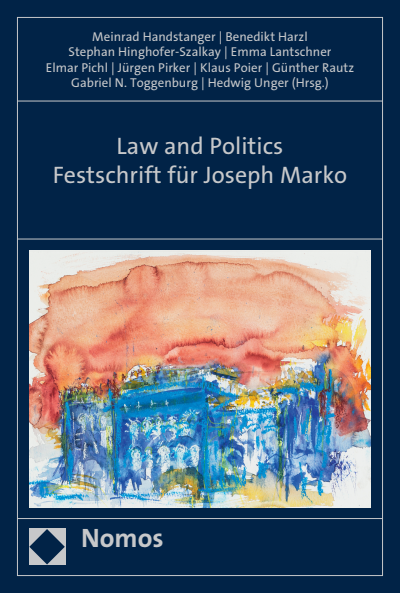
Law and Politics
Festschrift für Joseph Marko- Editors:
- | | | | | | | | |
- Publisher:
- 2022
Keywords
Search publication
Bibliographic data
- Copyright Year
- 2022
- ISBN-Print
- 978-3-8487-8517-9
- ISBN-Online
- 978-3-7489-3311-3
- Publisher
- Nomos, Baden-Baden
- Language
- German
- Pages
- 1188
- Product Type
- Edited Book
Table of contents
ChapterPages
- Titelei/Inhaltsverzeichnis No access Pages 5 - 18
- Joseph Marko: A Scholar Who Supports Others’ Scholarship No access Pages 21 - 24Authors:
- Authors:
- A. Beobachtung und Teilnahme No accessAuthors:
- B. Methoden No accessAuthors:
- C. Dimensionen No accessAuthors:
- D. Fazit No accessAuthors:
- Authors:
- Vor § 1 Anspruch und Wirklichkeit der Rechtswissenschaften No accessAuthors:
- § 1 ultra posse nemo obligatur No accessAuthors:
- § 2 Weder Schicksal noch Zufall No accessAuthors:
- § 3 Mehr als ein Beispiel No accessAuthors:
- § 4 ars boni et aequi No accessAuthors:
- § 5 Thinking like a Lawyer No accessAuthors:
- § 6 Strukturen No accessAuthors:
- § 7 Wider das Wiederkäuen No accessAuthors:
- § 8 It’s not Rocket Science No accessAuthors:
- § 9 tolle lege No accessAuthors:
- § 10 ex cathedra No accessAuthors:
- § 11 …alles, was der Fall ist … No accessAuthors:
- § 12 Realität statt Realismus No accessAuthors:
- § 13 Die Wahrheit ist den Studierenden zumutbar No accessAuthors:
- § 14 Vom Mehrwert des Unterschieds No accessAuthors:
- § 15 Die Unmittelbarkeit der Vermittlung No accessAuthors:
- § 16 Kritische Haltung No accessAuthors:
- § 17 Über Methode spricht man No accessAuthors:
- § 18 Die Weite des Blicks No accessAuthors:
- § 19 Jenseits der Grenze No accessAuthors:
- § 20 Freiheit im Grundsatz No accessAuthors:
- § 21 Theorie in der Praxis No accessAuthors:
- Nach § 21 Vorbildliche Geisteshaltung No accessAuthors:
- Authors:
- 1. Introduction No accessAuthors:
- 2. The undervaluation of legal merit in empirical research on courts No accessAuthors:
- 3. The revaluation of legal merit in empirical research on courts No accessAuthors:
- 4. Conclusion: the position of lawyers in interdisciplinary research No accessAuthors:
- Authors:
- I. Einleitung No accessAuthors:
- Authors:
- II.1. Eine überkommene Disziplin? No accessAuthors:
- II.2. Struktureller Konservatismus und Rückbindung an positives Recht No accessAuthors:
- III. Divergierende Funktionen der Staatslehre No accessAuthors:
- Authors:
- IV.1. Staatslehre als Einfallstor politikwissenschaftlicher Erkenntnis und Konzepte No accessAuthors:
- IV.2. Staatslehre als Element und Untersuchungsgegenstand der Politikwissenschaft No accessAuthors:
- V. Schlussfolgerungen No accessAuthors:
- Authors: |
- Authors: |
- a. Setting Requisites and Conditions for Happiness No accessAuthors: |
- b. An Independent Vision of the Good and the Politics to Promote it No accessAuthors: |
- Conclusion No accessAuthors: |
- Authors: |
- Authors: |
- John Stuart Mill: No accessAuthors: |
- Internet Sources No accessAuthors: |
- Authors:
- Rechtsstaat und Politik: Versuch einer Annäherung No accessAuthors:
- Die vier Funktionen des Rechts und die Idee der Gewaltenteilung No accessAuthors:
- Role Model: Joseph Markos Verbundenheit mit den Ideen und Errungenschaften des politischen Liberalismus in Lehre und Praxis No accessAuthors:
- Verwaltungsgerichte erster Instanz zur „Herrschaftskontrolle“ No accessAuthors:
- Über die (besondere?) Lage als (Verwaltungs-)Richter im Umweltrecht No accessAuthors:
- Pars pro toto: Vom „Semmering Basistunnel neu“ … No accessAuthors:
- … über das „Pumpspeicherkraftwerk Koralm“ No accessAuthors:
- … zur „3. Piste am Flughafen Wien“ No accessAuthors:
- P.S.: Das Richterbild des Aristoteles als Annäherungsideal No accessAuthors:
- Authors:
- Introduction No accessAuthors:
- Authors:
- 1.1. Populism is a Symptom, Not a Cause No accessAuthors:
- Authors:
- 2.1. Legitimacy and Legitimization No accessAuthors:
- 2.2. Rationality No accessAuthors:
- 2.3. Populism Is Not an Ideology but a Tool No accessAuthors:
- Authors:
- Die Pariser Friedensverhandlungen No accessAuthors:
- Die Pariser Friedenskonferenz in der Rezeption des „Kikeriki“ No accessAuthors:
- Die deutschösterreichische Delegation in Paris und die Berichterstattung im „Kikeri“ No accessAuthors:
- Abschließende Betrachtungen No accessAuthors:
- Authors:
- 1. Einleitung No accessAuthors:
- 2. Der territorial gegliederte Staat und das Subsidiaritätsprinzip No accessAuthors:
- 3. Berufliche Selbstverwaltung, Sozialpartnerschaft und Dialog No accessAuthors:
- 4. Wirtschaftliche Grundrechte und soziale Markwirtschaft No accessAuthors:
- 5. Grund- und Menschenrechte No accessAuthors:
- 6. Sonn- und Feiertagsruhe No accessAuthors:
- 7. Schluss No accessAuthors:
- Authors:
- I. Einleitung No accessAuthors:
- Authors:
- a. Repräsentative Demokratie und direkte Demokratie als Gegensatz No accessAuthors:
- b. Direkte Demokratie als Ergänzung der repräsentativen Demokratie No accessAuthors:
- c. Direkte Demokratie als Korrektiv No accessAuthors:
- d. Zwischenergebnis No accessAuthors:
- III. (Haupt-)Typen der Instrumente der direkten Demokratie No accessAuthors:
- Authors:
- 1. Absicherung des Status quo No accessAuthors:
- 2. Legitimierung besonders bedeutsamer Veränderungen No accessAuthors:
- 3. Legitimierung von Regierungsentscheidungen No accessAuthors:
- 4. Mobilisierung, Emotionalisierung für Regierungspolitik No accessAuthors:
- 5. Heraushalten von Themen aus dem Wahlkampf No accessAuthors:
- 6. Herbeiführung einer Entscheidung bei Nichteinigung im Repräsentativsystem No accessAuthors:
- 7. Mobilisierung, Emotionalisierung gegen Regierungspolitik No accessAuthors:
- 8. Durchsetzen politischer Forderungen gegen Regierungsmehrheit No accessAuthors:
- 9. Veto gegen Regierungsentscheidungen No accessAuthors:
- 10. Einbringen neuer Ideen, Chance für neue Gruppierungen No accessAuthors:
- 11. Partizipation an sich, diskursive/deliberative Demokratie No accessAuthors:
- V. Resümee No accessAuthors:
- Authors:
- I. Governance – kein rechtswissenschaftlicher Begriff No accessAuthors:
- II. Die Energieunion No accessAuthors:
- III. Das Kompetenzproblem No accessAuthors:
- Authors:
- 1. Die vier wichtigen Ziele No accessAuthors:
- Authors:
- Authors:
- a) Inhalt No accessAuthors:
- b) Verfahren No accessAuthors:
- 2.2. Die Langfrist-Strategie No accessAuthors:
- Authors:
- a) Fortschrittsbewertung No accessAuthors:
- Authors:
- 3.1. Der „weiche“ Mechanismus der Governance No accessAuthors:
- 3.2. Die Rolle der Öffentlichkeit No accessAuthors:
- 3.3. Die Entparlamentarisierung durch den Governance-Prozess No accessAuthors:
- IV. Ausblick No accessAuthors:
- Authors:
- Kontrolle No accessAuthors:
- Der Landesrechnungshof Steiermark und die Merkmale einer unabhängigen öffentlichen Finanzkontrolle No accessAuthors:
- Der Landesrechnungshof Steiermark und die Prüfungsmaßstäbe einer unabhängigen öffentlichen Finanzkontrolle No accessAuthors:
- Indikator einer erfolgreichen Arbeit No accessAuthors:
- Authors:
- Literaturverzeichnis No accessAuthors:
- Authors:
- I. Einleitung No accessAuthors:
- II. Die erste Phase: Nachkriegsjahre No accessAuthors:
- III. Ein erster Höhepunkt: die 70er Jahre und Ausläufer No accessAuthors:
- Authors:
- A. Das „Flaggschiff“: Das Verfassungsvergleichungsseminar No accessAuthors:
- B. Weitere Lehrveranstaltungen No accessAuthors:
- V. Gesamthafter Überblick No accessAuthors:
- VI. Die Methodik der Verfassungsrechtsvergleichung bei Joseph Marko No accessAuthors:
- VII. Schlusswort No accessAuthors:
- Authors:
- 1. Minority rights, language rights and Joseph Marko’s contribution No accessAuthors:
- Authors:
- 2.1. The Trajectory of International Minority Rights’ Influence and its Reasons No accessAuthors:
- 2.2. New statism and current challenges No accessAuthors:
- Authors:
- 3.1. Updating the identity paradigm No accessAuthors:
- 3.2. Old and new challenges for language rights No accessAuthors:
- 4. From language rights to society as a whole. Ljubljana Guidelines and Commentary on the scope of application No accessAuthors:
- 5. Concluding remarks No accessAuthors:
- Authors:
- 1. Introduction No accessAuthors:
- Authors:
- 2.1 The Hungarian language in Austria No accessAuthors:
- 2.2 The Võro and Seto languages in Estonia No accessAuthors:
- 2.3 The Karelian and Estonian languages in Finland No accessAuthors:
- 2.4 The Estonian language in Germany No accessAuthors:
- 2.5 The North Sámi and the Kven language in Norway No accessAuthors:
- 2.6 The Hungarian language in Slovenia No accessAuthors:
- 2.7 The Finnish and Meänkieli languages in Sweden No accessAuthors:
- 3. Some first conclusions on the position of multilingualism and of language diversity in the legal systems examined No accessAuthors:
- 4. The prevalence of the non-discrimination paradigm No accessAuthors:
- 5. The prevalence of the principle of territoriality No accessAuthors:
- 6. The blurred distinction between private and public sphere No accessAuthors:
- 7. Conclusions No accessAuthors:
- Authors:
- 1. Introduction No accessAuthors:
- 2. Norm contestation processes and linguistic rights of national minorities No accessAuthors:
- 3. Norm contestation processes about the role of languages in Ukraine No accessAuthors:
- Authors:
- Authors:
- Case law No accessAuthors:
- List of acronyms No accessAuthors:
- Authors:
- A. Introduction No accessAuthors:
- Authors:
- I. Article 7 of the 2017 Education Law as a Means to Promote the Role of Ukrainian as Language of Education No accessAuthors:
- II. The Assessment of the Venice Commission in its Opinion No. 902/2017 No accessAuthors:
- III. The Reaction of the Ukrainian Authorities: The 2019 State Language Law No accessAuthors:
- IV. The Assessment of the Venice Commission in its Opinion No. 960/2019 No accessAuthors:
- Authors:
- I. The Present Contents of Article 13 FCNM No accessAuthors:
- II. The potential new role of Article 13 FCNM No accessAuthors:
- D. Concluding Remarks No accessAuthors:
- Authors:
- Introduction No accessAuthors:
- Relevant International Norms that Prescribe Minority Language Use in Shared Public Space No accessAuthors:
- Croatian Legal Provisions that Guarantee the Display and Use of Minority Language and Scripts in Shared Public Space No accessAuthors:
- Statute of the City of Vukovar of 14 July 2009 No accessAuthors:
- Statutory Decision on Amendments to the Statute of the City of Vukovar in 2013 No accessAuthors:
- Constitutional Court Decisions U-II-6110/2013 and U-VIIR-4640/2014 of 12 August 2014 No accessAuthors:
- Statutory Decision on Amendments to the City of Vukovar Statute and the Statutory Decision on the Exercise of Equal Official Use of the Language and Script of the Serbian National Minority of 17 Augus... No accessAuthors:
- Constitutional Court Decision U-II-1818/2016 of 2 July 2019 No accessAuthors:
- Conclusions No accessAuthors:
- Authors:
- 1. „Autonomie und Integration“ No accessAuthors:
- Authors:
- 2.1. Differenzierung und Sonderstatus im Rahmen No accessAuthors:
- 2.2. Machtteilung und Komplexität als innerstaatliche Folge von Autonomie No accessAuthors:
- 2.3. Zwei parallele Dimensionen: Pluralismus und Gebietsverwaltung No accessAuthors:
- Authors:
- 3.1. Die Entwicklung eines nachhaltigen Minderheitenschutzsystems in Europa No accessAuthors:
- 3.2. Europäische Standards für lokale und regionale Selbstverwaltung No accessAuthors:
- 3.3. Die Herausforderung: Europäische Standards für Sezession? No accessAuthors:
- 4. Eine (west)europäische Methode: Überzeugung durch ständigen Dialog auf verschiedenen Ebenen No accessAuthors:
- Authors:
- Authors:
- „Vom Nationalitätenstaat zum Nationalstaat“ No accessAuthors:
- „Von der Assimilation zur Integration“ No accessAuthors:
- „From minority protection to multiple diversity governance“? No accessAuthors:
- II. Erinnerungspolitik im Minderheitenrecht: Die nationale Frage in Kärnten No accessAuthors:
- Authors:
- (1) Stufen des Minderheitenschutzes No accessAuthors:
- (2) Minderheitenrechte und Sprachförderung No accessAuthors:
- (3) Grenzübergreifende Dialoge No accessAuthors:
- Authors:
- Ethnopolitics – a possible framing No accessAuthors:
- Minority rights and ethnopolitics No accessAuthors:
- Authors:
- 1. Introduction No accessAuthors:
- 2. Disentangling the Alleged Dichotomy between Old and New Minorities No accessAuthors:
- 3. Old and New Minority Rights: Setting the Grounds No accessAuthors:
- 4. A Common but Differentiated System of Protection for Old and New Minorities No accessAuthors:
- 5. State Responses to Diversity: The Human Rights Model for Diversity Governance No accessAuthors:
- 6. Conclusions: Beyond the Old/New Minority Dichotomy No accessAuthors:
- Authors:
- Introduction No accessAuthors:
- § 1 The Austrian Tradition after Kelsen and the Paradigm of ‘Juristenpolitologie‘ No accessAuthors:
- § 2 Nation and Minorities: the Triadic Structure of Identity, Equality and Difference No accessAuthors:
- § 3 Minority Integration in Europe: South-Eastern Europe and the Method of ‘Multiple Diversity Management‘ No accessAuthors:
- Conclusion No accessAuthors:
- Authors:
- 1. Einleitung No accessAuthors:
- Authors:
- 2.1. Idealtypische Formen der Akkulturation menschlicher Koexistenz No accessAuthors:
- 2.2. Idealtypische Modelle für ein friedliches interethnisches Zusammenleben No accessAuthors:
- Authors:
- 3.1. Einheit und Vielfalt auf Europäischer Ebene No accessAuthors:
- 3.2. Einheit und Vielfalt im Anwendungsbereich des EU Grundrechteschutzes No accessAuthors:
- 3.3. Einheit und Vielfalt in den Instrumenten zur Entscheidungsfindung No accessAuthors:
- Authors:
- Authors:
- Urteile und Stellungnahmen: No accessAuthors:
- Authors:
- 1. Who stood at the cradle of the still-born EU motto? No accessAuthors:
- 2. Why at all to be “united in diversity”? No accessAuthors:
- 3. What sort of diversity are we actually talking about? No accessAuthors:
- 4. United in diversity – a hopeless European paradox? No accessAuthors:
- Authors:
- 1. Political utopias and the need for a ‘Black Book‘ for the Western Balkans No accessAuthors:
- 2. The necessity for statehood and integration No accessAuthors:
- 3. A trilateral vicious cycle: Serbia, Kosovo and the EU No accessAuthors:
- Authors:
- „Behandle andere so, wie du selbst behandelt werden willst!“ No accessAuthors:
- Frauen, die aufbegehrten, dass ihnen das Wahlrecht ebenso wie Männern zusteht, dass ihnen der gleichberechtigte Zugang zu Universitäten offenstehen muss. No accessAuthors:
- Homosexuelle Menschen, die sich aufgrund ihrer gleichgeschlechtlichen Liebe nicht mehr verstecken und Gefängnisstrafen in Kauf nehmen wollten. No accessAuthors:
- Schwarze Menschen, die nicht mehr hinnehmen wollten, dass sie eigene Schulen besuchen, in eigenen Vierteln wohnen mussten und als Menschen zweiter Klasse behandelt wurden. No accessAuthors:
- Menschen mit Behinderungen, die ihre Stimme erhoben und begehrten, nicht von der Gesellschaft weggesperrt zu werden, sondern aktiver Teil der Gesellschaft zu sein. No accessAuthors:
- Authors:
- 1. Algorithmische Diskriminierung? Betrifft mich das überhaupt? No accessAuthors:
- 2. Das Problem mit der Intransparenz No accessAuthors:
- 3. Bestehende rechtliche Rahmenbedingungen No accessAuthors:
- 4. Algorithmische Diskriminierung durch hoheitliches Handeln No accessAuthors:
- 5. Algorithmische Diskriminierung zwischen Privaten No accessAuthors:
- 6. Forschungsfelder für die Zukunft No accessAuthors:
- Authors: | |
- I. Einleitung oder Der Impact-Faktor des Jubilars No accessAuthors: | |
- II. Schulische Segregation als Herausforderung No accessAuthors: | |
- Authors: | |
- A. Amsterdam No accessAuthors: | |
- B. Jefferson County No accessAuthors: | |
- C. Stamford No accessAuthors: | |
- D. Montgomery County No accessAuthors: | |
- E. Zürich No accessAuthors: | |
- Authors: | |
- A. Allgemeines No accessAuthors: | |
- B. Magnet Schools No accessAuthors: | |
- C. Elterninitiativen No accessAuthors: | |
- D. MPDU-Programm No accessAuthors: | |
- V. Conclusio No accessAuthors: | |
- Authors:
- 1. Introduction No accessAuthors:
- Authors:
- 3. Translocal identities No accessAuthors:
- 3.1. A part of and apart from: Growing up in South Tyrol No accessAuthors:
- 3.2 Being different: translocality as an obstacle No accessAuthors:
- 3.3 Being different: Translocality as an opportunity No accessAuthors:
- Authors:
- Bibliography No accessAuthors:
- Authors:
- 1. Introduction No accessAuthors:
- Authors:
- 2.1 Processes of ‘othering‘ No accessAuthors:
- 2.2 Regionalist parties as ‘ethnic identity entrepreneurs‘ No accessAuthors:
- 3. The construction of South Tyrol as a ‘minority region‘ No accessAuthors:
- 4. Data and methodology No accessAuthors:
- Authors:
- Authors:
- 5.1.1 Unwanted migrants No accessAuthors:
- 5.1.2 Neutral No accessAuthors:
- 5.1.3 Wanted migrants No accessAuthors:
- Authors:
- Bibliography No accessAuthors:
- Authors: |
- 1. Introduction No accessAuthors: |
- 2. Policy changes through the MSF lens No accessAuthors: |
- 3. The ECBM: a paradigm shift in EU cohesion policy? No accessAuthors: |
- Authors: |
- 4.1 Recognising and framing the problem No accessAuthors: |
- 4.2 Defining the solution No accessAuthors: |
- 4.3 The solution encounters politics No accessAuthors: |
- Authors: |
- References No accessAuthors: |
- Authors:
- US migration politics after 9/11: the war on terrorists/migrants No accessAuthors:
- Spanish migration politics after 11-M: bringing labor No accessAuthors:
- Authors:
- USA: a country of migrants and anti-migrants No accessAuthors:
- Spain: migrants and prosperity No accessAuthors:
- Conclusions: when does an event become political? No accessAuthors:
- Authors:
- 1. Introduction No accessAuthors:
- 2. The Latin American context No accessAuthors:
- 3. The recognition of Indigenous Peoples and their rights in Latin American Constitutions and domestic legal orders No accessAuthors:
- 4. The protection of Indigenous rights provided by the Inter-American human rights system No accessAuthors:
- 5. Concluding remarks No accessAuthors:
- Authors:
- 1. Introduction: the experience of transformative constitutionalism in the recent transition in Nepal No accessAuthors:
- 2. The fundamental principle of pluralism in the Nepali constitutional context No accessAuthors:
- 3. The ruling in Sunil Babu Pant and Others v. Nepal Government No accessAuthors:
- 4. Concluding remarks: the third gender as a new minority? No accessAuthors:
- Authors:
- 1. Introduction No accessAuthors:
- Authors:
- 2.1 Religious Symbols and the Public Space No accessAuthors:
- 2.2 Achbita: Facts of the Case No accessAuthors:
- 2.3 The Emphasis on “Neutrality” No accessAuthors:
- 3. Critical Assessment: On “Subjectivity” of Religious Beliefs No accessAuthors:
- 4. Concluding Remarks No accessAuthors:
- Authors: |
- 1. Rahmenbedingungen No accessAuthors: |
- 2. „Integration durch interreligiöse Bildung“ – Anliegen und Struktur No accessAuthors: |
- 3. Modellversuch „Christlich-Islamischer Religionsunterricht im Team-Teaching“ No accessAuthors: |
- 4. Islamische Religionspädagogik – Katalysator und Entwicklungsfaktor No accessAuthors: |
- 5. Fazit No accessAuthors: |
- Authors:
- Introduction No accessAuthors:
- The classic Islamic-law doctrine for the governance of religious diversity No accessAuthors:
- The concept of al-dhimma No accessAuthors:
- Autonomy vs. discrimination No accessAuthors:
- From dhimmi to millet No accessAuthors:
- The conundrum of legal Pluralism and rights of religious minorities in Egypt and Lebanon No accessAuthors:
- Authors:
- Bibliography No accessAuthors:
- Authors:
- Authors:
- Die Gründung No accessAuthors:
- Der Sitz: Straßburg / Strasbourg No accessAuthors:
- Die Mitgliedschaft No accessAuthors:
- Das Kerngeschäft No accessAuthors:
- Die statutarischen Organe No accessAuthors:
- Der Menschenrechtsgerichtshof No accessAuthors:
- Authors:
- Brauchen wir den Europarat noch? No accessAuthors:
- Quod non est in mediis, non est in mundo No accessAuthors:
- Verbindlichkeit und „Lästigkeit“… No accessAuthors:
- … und schwierige Mitglieder No accessAuthors:
- Vorläufig / vermeintlich abgewendeter „Ruxit“ No accessAuthors:
- Suspendierung und Ausschluss Russlands No accessAuthors:
- 70 Jahre Europarat No accessAuthors:
- Der Europarat und „Corona“ No accessAuthors:
- Authors:
- Zur Religionsfreiheit allgemein No accessAuthors:
- Der Inhalt der Religionsfreiheit No accessAuthors:
- Authors:
- Kreuze in Schulklassen und Hörsälen No accessAuthors:
- Kündigung seitens kirchlicher Arbeitgeber No accessAuthors:
- Blasphemie vs. Herabwürdigung religiöser Lehren No accessAuthors:
- Pussy Riots No accessAuthors:
- Religiöse Motive in der Werbung No accessAuthors:
- Hostienmissbrauch No accessAuthors:
- Authors:
- Literatur: No accessAuthors:
- Authors:
- Innovation Human Security No accessAuthors:
- Authors:
- Legitimizing interventionism No accessAuthors:
- Caring rather than empowering No accessAuthors:
- Authors:
- Sustainable Interpretation of Human Security 1 – Against Interventionism No accessAuthors:
- Sustainable Interpretation of Human Security 2 – The Subject as Foundation of Political Power No accessAuthors:
- Current perspective No accessAuthors:
- Authors:
- 1. Introduction No accessAuthors:
- 2. The Intellectual Ground for Conservatism in Russia No accessAuthors:
- 3. Law and Politics: Can They Be Disconnected? No accessAuthors:
- 4. Human Rights Against the Backdrop of Sovereignty No accessAuthors:
- 5. The Nature and Implications of Russian Conservatism No accessAuthors:
- 6. Human Rights, Legal Principles and Exceptions No accessAuthors:
- 7. Conclusion No accessAuthors:
- Authors:
- Weiterführende Literatur No accessAuthors:
- Authors:
- 1 Einleitung No accessAuthors:
- 2 Zugänge zu Diversität No accessAuthors:
- 3 Verrechtlichung No accessAuthors:
- 4 Konstruktion mit Folgen No accessAuthors:
- 5 Der Georgisch-Abchasische Konfliktfall als Anschauungsbeispiel No accessAuthors:
- 6 Conclusio No accessAuthors:
- Authors:
- Introduction No accessAuthors:
- Studying Nationalism No accessAuthors:
- Rethinking Self-Determination No accessAuthors:
- The Object No accessAuthors:
- Territory No accessAuthors:
- Finding a way forward No accessAuthors:
- Authors:
- 1. Introduction No accessAuthors:
- 2. Theory: Absolute and Indivisible Sovereignty as a Contested Idea No accessAuthors:
- 3. Law: Sovereignty in Constitutional Law and its Implications in Practice No accessAuthors:
- 4. Politics: Sovereignty as Battle Cry, Sovereignty as Desired Outcome after Secession? No accessAuthors:
- 5. Conclusion No accessAuthors:
- Authors:
- Staat versus Nation No accessAuthors:
- Österreich in Südosteuropa No accessAuthors:
- Von der Neutralitätspolitik zur Anerkennungspolitik No accessAuthors:
- Eine Südosteuropastrategie No accessAuthors:
- Authors:
- Globaler Referenzbogen No accessAuthors:
- EU und Euro-Atlantischer Referenzbogen No accessAuthors:
- Regionaler Referenzbogen No accessAuthors:
- Lokaler Referenzbogen No accessAuthors:
- Ausblick No accessAuthors:
- Authors:
- Einleitung: Recht und Politik, ein Spannungsverhältnis No accessAuthors:
- Recht und Politik in Südosteuropa No accessAuthors:
- No accessAuthors:
- Das dreifache Erbe Südosteuropas – Kommunismus, Krieg, Neokolonialismus No accessAuthors:
- „State capture“, Schein-Politik und Europas angebliche Mittäterschaft No accessAuthors:
- Europas Demokratiedilemma am Beispiel Nordmazedoniens No accessAuthors:
- „Modell Skopje“? No accessAuthors:
- Der EU-Beitrittsprozess als technokratische Rettung schwacher Rechtsstaaten? No accessAuthors:
- Illiberale Demokratien – der schleichende Tod des europäischen Modells? No accessAuthors:
- Authors:
- 1. Mapping the Problem No accessAuthors:
- Authors:
- a) Logic of consequences No accessAuthors:
- b) Logic of Appropriateness No accessAuthors:
- c) The Missing Link No accessAuthors:
- Authors:
- a) New social movements and green/alternative parties in the Balkans No accessAuthors:
- b) The role of non-political actors No accessAuthors:
- Authors:
- Bibliography No accessAuthors:
- Authors:
- I. Introduction No accessAuthors:
- Authors:
- A. The Rise of Territorial Autonomy No accessAuthors:
- B. The Fall of Territorial Autonomy No accessAuthors:
- Authors:
- A. Power Sharing as a Feature of Dysfunctional States No accessAuthors:
- B. Towards a More Nuanced Power Sharing? No accessAuthors:
- IV. Conclusions No accessAuthors:
- Authors:
- 1. Introduction No accessAuthors:
- 2. Political Capture of the Institutions and the Normative Framework No accessAuthors:
- 3. The “Rule of Fear” instead of the Rule of Law – notorious discrimination in schools No accessAuthors:
- Authors:
- References No accessAuthors:
- Authors:
- 1. Einleitung No accessAuthors:
- 2. Der bestehende Rechtsrahmen No accessAuthors:
- Authors:
- 3.1. Aufgaben der Regionen (Art 9 – 11) No accessAuthors:
- Authors:
- 3.2.1. Der Regionalrat (Art 13 – 20) No accessAuthors:
- 3.2.2. Der Vorsitzende (Art 21 – 25) No accessAuthors:
- 3.2.3. Der Kontrollausschuss (Art 26 – 27) No accessAuthors:
- 3.2.4. Der Rat der Gemeinden (Art 28) No accessAuthors:
- Authors:
- 3.3.1. Das nachträgliche Referendum (Art 36) No accessAuthors:
- 3.3.2. Das konsultative Referendum (Art 37) No accessAuthors:
- 3.3.3. Die Volksinitiative (Art 41) No accessAuthors:
- 3.4. Die Regionalverwaltung (Art 42 – 51) No accessAuthors:
- 3.5. Die Finanzierung der Regionen und deren Vermögen (Art 52 – 55) No accessAuthors:
- 3.6. Die Zusammenarbeit der Regionen mit den Gemeinden, den anderen Regionen und den staatlichen Organen (Art 58 – 62) No accessAuthors:
- 3.7. Die staatliche Aufsicht (Art 63 – 64) No accessAuthors:
- 3.8. Die Änderungen des Gebietes, des Namens und des Sitzes einer Region (Art 65 – 66) No accessAuthors:
- 4. Fazit No accessAuthors:
- Authors:
- I. Einleitung No accessAuthors:
- Authors:
- 1. Die Beschränkung der Zahl der Funktionsperioden nach der UG-Nov 2021 No accessAuthors:
- 2. Vergleich und Analyse No accessAuthors:
- III. Die Wiederbestellung des Rektors gem § 23b UG No accessAuthors:
- IV. Eine Kommission findet sich: Neuerungen in der Findungskommission No accessAuthors:
- Authors:
- 1. Der „unterregulierte“ Senat No accessAuthors:
- 2. Demokratie und Gleichheit: Das Kurienwahlrecht am Prüfstand No accessAuthors:
- VI. Fast, faster, fastest (tenure) track: Die abgekürzten Berufungsverfahren der §§ 99 und 99a UG No accessAuthors:
- VII. Conclusio No accessAuthors:
- Authors:
- 1. Eine Hinführung zur Ratio der Relationen No accessAuthors:
- 2. Über Definitionen und „Traditionen“ No accessAuthors:
- 3. Über den qualitativen „Backstage“-Bereich einer „quantitativen Qualitätskennzahl“ No accessAuthors:
- 4. Über Richtwerte in Österreich und internationale Vorbilder No accessAuthors:
- 5. Die Betreuungsrelationen und ihre Anwendungen in der Universitätsfinanzierung NEU No accessAuthors:
- 6. Ausblick: Von einer Qualitäts- zu einer Qualitätspotenzial- bzw Kapazitätskennzahl No accessAuthors:
- Authors:
- 1. Einleitung No accessAuthors:
- 2. Überlegungen zum Wortlaut und der Entstehungsgeschichte einschlägiger Bestimmungen No accessAuthors:
- 3. Überlegungen zur Systematik des UG No accessAuthors:
- 4. Vergleich des UG mit dem Vorgängergesetz UOG 1993 No accessAuthors:
- 5. Keine Ausschreibungspflicht in den Übergangsbestimmungen des UG No accessAuthors:
- 6. Vergleich des UG mit dem Hochschulgesetz 2005 (HG 2005) No accessAuthors:
- 7. Keine Pflicht zur Ausschreibung auf Grund des B‑GlBG No accessAuthors:
- 8. Anordnung einer Ausschreibungspflicht durch die Satzung problematisch No accessAuthors:
- 9. Suche nach Kandidatinnen und Kandidaten durch Ausschreibung auf Wunsch des Rektors zulässig No accessAuthors:
- 10. Ergebnis: Universitätspolitik und Recht im Einklang No accessAuthors:
- Authors:
- Strukturelement der Universitätsautonomie No accessAuthors:
- Authors:
- a. Organkreation No accessAuthors:
- b. Strategisch-begleitende Kontrolle No accessAuthors:
- c. Wirtschaftlich-begleitende Kontrolle No accessAuthors:
- d. Berichtspflichten No accessAuthors:
- Die Universitätsleitung – ein wackeliger Sessel auf drei Beinen? No accessAuthors:
- Authors:
- I. Einleitung: Joseph Marko und die Ideen der Universität No accessAuthors:
- Authors:
- II.1. Begriff und Funktion No accessAuthors:
- II.2. Die Humboldt’sche Universitätsidee als Inbegriff der klassischen Universität No accessAuthors:
- II.3. Die Vielfalt aktueller Universitätsideen No accessAuthors:
- Authors:
- III.1. Die Verankerung der Humboldt‘schen Universitätsidee No accessAuthors:
- III.2. Verfassungsrechtliche Parameter: Autonomie und Wissenschaftsfreiheit No accessAuthors:
- III.3. Die Universitätsideen im Universitätsgesetz No accessAuthors:
- IV. Fazit No accessAuthors:
- Verzeichnis der Autorinnen und Autoren No access Pages 1177 - 1188