, to see if you have full access to this publication.
Monograph No access
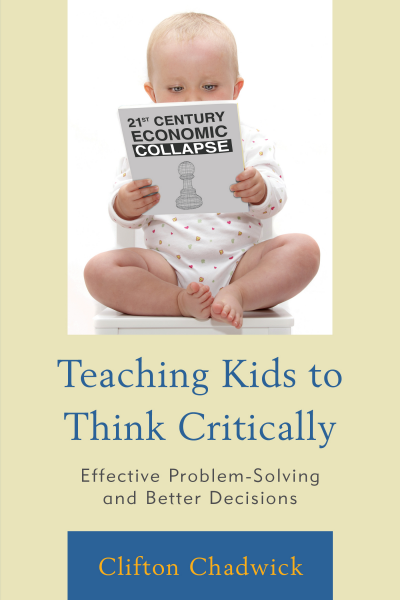
Teaching Kids to Think Critically
Effective Problem-Solving and Better Decisions
Authors:
Publisher:
2014
Summary
This book is based on a simple series of psychological concepts. While ability to think has always been important, the knowledge economy significantly increases the demand for higher order thinking and problem-solving abilities. Parents should take a much more active role in teaching their children to think. Early preschool years are critical because long-term attitudes and early strategies are learned then. Approaches and perspectives on learning to think can be clearly communicated to parents in ways which will make it possible for them to use the correct strategies to stimulate their students to think more clearly and critically.
There are five elements involved in good, logical, critical, and creative thinking:
1. The skills involved in effective, efficient, and lasting learning, or commonly referred to as cognitive processing strategies
2. The mastery of logic and structure of what is being learned
3. Awareness of what one knows and does not know, and how one knows and how one thinks
4. The standards or guidelines for the validity and reliability of what one knows, called intellectual standards
5. The knowledge and skills involved in critical thinking and solving problems in different subjects or domains
Search publication
Bibliographic data
Edition
1/2014
Copyright Year
2014
ISBN-Print
978-1-4758-1066-0
ISBN-Online
978-1-4758-1067-7
Publisher
Rowman & Littlefield, Lanham
Language
English
Pages
176
Product Type
Monograph
Table of contents
ChapterPages
Contents No access
Chapter One. Introduction No access Pages 1 - 18
Chapter Two. Learning and the Structure of Knowledge No access Pages 19 - 40
Chapter Three. Developing Skills for Effective Learning No access Pages 41 - 94
Chapter Four. Metacognition: Awareness for Thinking No access Pages 95 - 104
Chapter Five. Dispositions, Motivation, Attitudes: Desire to Think No access Pages 105 - 128
Chapter Six. Developing and Establishing Intellectual Standards for Thinking No access Pages 129 - 140
Chapter Seven. Problem-Solving Skills No access Pages 141 - 166
Chapter Eight. High-Quality Critical Thinking: Wrapping Up No access Pages 167 - 170