, to see if you have full access to this publication.
Monograph No access
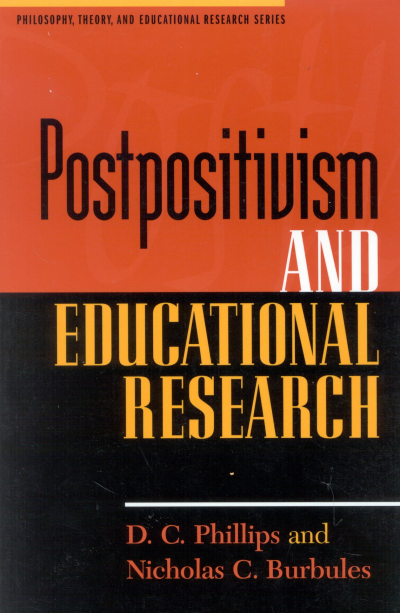
Postpositivism and Educational Research
Authors:
|
Publisher:
2000
Summary
This volume presents in a forthright and lively way, an account of the philosophical position generally identified as 'Postpositivistic' that undergirds much of mainstream research in education and the related social sciences. The discussion throughout is informed by recent developments in philosophy of science. Authors D. C. Phillips and Nicholas C. Burbules cite a number of interesting examples from the educational research and evaluation literature to illustrate the value of a scientific approach. Many educational researchers aspire to carry out rigorous or disciplined inquiry aimed at producing accurate (and generally 'truthful') accounts of educational phenomena and the causal psychological or social processes that lay behind them. However, many recent critics have argued that it is a mistake to believe that research can yield theories, or advance claims that are true, objective, and value-neutral. In other words, that researchers always work within frameworks that embody important (and often questionable) assumptions about values and the nature of human knowledge. This book argues that , while there is much to be learned from recent critiques, traditional scientific values and assumptions are not outmoded. The authors show students how to implement and benefit from the scientific method in ways that take into account recent critiques.
Search publication
Bibliographic data
Edition
1/2000
Copyright Year
2000
ISBN-Print
978-0-8476-9121-0
ISBN-Online
978-1-4422-0270-2
Publisher
Rowman & Littlefield, Lanham
Language
English
Pages
101
Product Type
Monograph
Table of contents
ChapterPages
Contents No access
Illustrations No access
Series Preface No access
Acknowledgments No access
1 What is Postpositivism? No access Pages 1 - 28
2 Philosophical Commitments of Postpositivist Researchers No access Pages 29 - 44
3 Objectivity, Relativity, and Value Neutrality No access Pages 45 - 64
4 Can, and Should, Educational Inquiry be Scientific? No access Pages 65 - 96