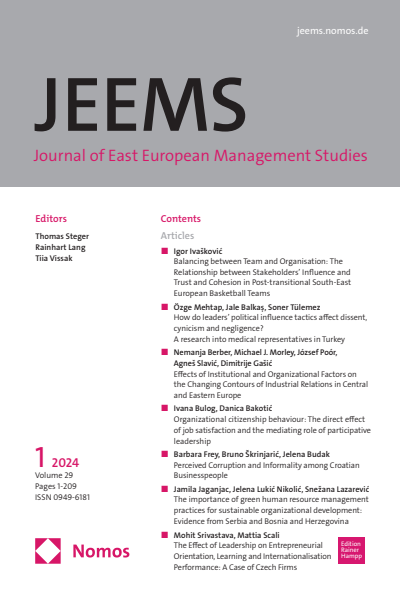
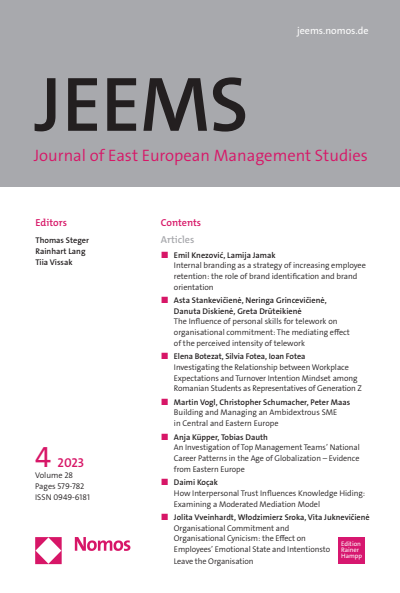
The Journal of East European Management Studies aims to promote dialogue and cooperation among scholars seeking to examine,explore and explain the behaviour and practices of management within the transforming societies of Central and Eastern Europe. The theoretical interests of the journal are organisational and management change, Central and East European societies (including those on the fringes of Europe) undergoing processes of transition or transformation, and scientific issues of business, management and organisation that arise in such contexts. The JEEMS aims to attract social scientific contributions from scholars of any nation and region, but particularly wishes to encourageauthors from those countries directly experiencing transformational change. Its potential readership is international, comprising academicsand practitioners with an involvement or interest in the management of change in transforming societies in Central and Eastern Europe.
In this study, we investigate whether SMEs are locked in relationships with their banks. We combine data concerning Polish SMEs, including a survey about relationships with main banks. After estimating dynamic panel models, we find that the length...
The purpose of this study is to investigate which job and organisational attributes incoming first-year students prefer in a job, and whether their preferences differ from those of newly-hired employees. Factor analysis of the job attributes reveal...
Drawing on self-determination theory, this study focuses on the relationship between job crafting and work alienation and the moderating effect of perceived supervisor support. Based on theoretical discussions, this study examines (1) whether a...
Institutional investors have contributed to the development of capital markets in transition economies, including Poland’s. Since they leverage detailed fundamental analysis and actively seek the highest possible returns on investments, their...
The paper analyses the financial indicators of 546 Slovak firms that received support from the European Structural and Cohesion Funds (ESCF) in the period of 2013-2015. Two support schemes were analysed: one for innovations (technology transfer) and...
The main aim of this paper is to synthesize the research results based on the developed multidimensional model of activities in family companies aimed at achieving employee engagement. Furthermore, this research outlines the components that impact...
This study explores the relevance of different soft skills for entrepreneurs, focusing on entrepreneurs from Portugal and Serbia. The study identifies a total of 38 soft skills from the European Entrepreneurship Skills Framework (EntreComp) and...