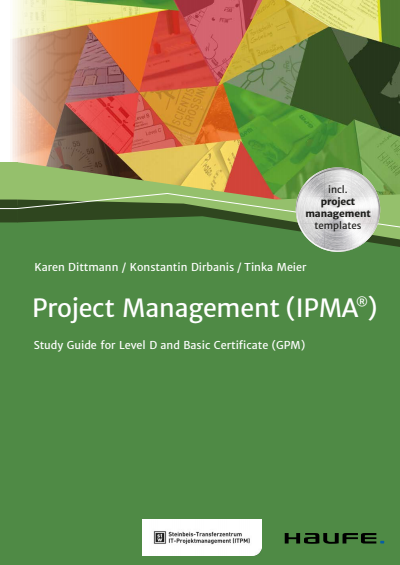
Project Management (IPMA®)
Study Guide for Level D and Basic Certificate (GPM)- Authors:
- | |
- Publisher:
- 2021
Summary
This book contains the complete learning scope for the certification to IPMA® Level D, as well as the scope for obtaining the Basic Certificate. It offers numerous examples and templates for project management methods and practical tips. It also aims to show that professionally executed project management can actually be enjoyable and is probably one of the most versatile and exciting professions imaginable.
The IPMA® (International Project Management Association) defines standards for professional project management worldwide. With its five-level model, it provides the certification framework for project managers, with a strong focus on its transfer into the daily routine of project management. The approach does not limit itself to procedures and process models but covers all competencies important for project management.
Contents:
Defining the terms, standards and types of projects
Corporate culture and values in projects
Personal and social skills for project managers
Methodical-technical know-how for projects: initialization, planning, requirements and goals, control, completion
Search publication
Bibliographic data
- Edition
- 1/2021
- Copyright Year
- 2021
- ISBN-Print
- 978-3-648-14830-3
- ISBN-Online
- 978-3-648-14832-7
- Publisher
- Haufe Lexware, Freiburg
- Language
- English
- Pages
- 239
- Product Type
- Monograph
Table of contents
- Titelei/Inhaltsverzeichnis No access Pages 1 - 12
- 1.1 CE Strategy (4.3.1) No access
- 1.2.1 Definition: Project No access
- 1.2.2 Definition: Project Management No access
- 1.2.3 Project Management Standards No access
- 1.2.4 Project Types No access
- 1.2.5 Project Management Manual No access
- 1.2.6 Project Portfolio No access
- 1.3.1 Identify and Ensure that the Project Complies with All Relevant Legislation No access
- 1.3.2 Data Protection and Data Security No access
- 1.3.3 Safety, Health, and Environmental Regulations No access
- 1.3.4 Hazard Analysis/Risk Assessment No access
- 1.4.1 Definition of Power No access
- 1.4.2 Authorization and Motivation No access
- 1.4.3 The Pyramid of Needs (Maslow) No access
- 1.4.4 Analysis of Interests No access
- 1.5.1 Align the Project with the Formal Culture and Corporate Values of the Organization No access
- 2.1.1 Eisenhower Matrix No access
- 2.1.2 Reflecting on Your Own Team Role No access
- 2.1.3 The Johari Window No access
- 2.1.4 Personal Development of Competence in Project Management No access
- 2.2.1 Reliability and Trust No access
- 2.2.2 Fault Culture No access
- 2.3.1 The Iceberg Model: Content and Relationship Aspects No access
- 2.3.2 Communication Channels and Disruptions No access
- 2.3.3 Receiving Information: Active Listening No access
- 2.3.4 The Art of Asking: Interview Techniques No access
- 2.3.5 Feedback No access
- 2.3.6 Meetings No access
- 2.3.7 Communicating Effectively in Virtual Teams No access
- 2.4 CE Relationships and Engagement (4.4.4) No access
- 2.5.1 Leadership Styles No access
- 2.5.2 Management Concepts No access
- 2.6.1 Stages of Team Development (Tuckman) No access
- 2.6.2 Team Rules No access
- 2.6.3 Team Roles (Belbin) No access
- 2.7.1 Definition: Conflict and Crisis No access
- 2.7.2 Symptoms of Conflict No access
- 2.7.3 Causes of Conflict No access
- 2.7.4 Conflict Styles No access
- 2.8.1 Moderation Techniques to Stimulate an Open and Creative Environment No access
- 2.8.2 Analytical Techniques to Analyze Data and Situations No access
- 2.8.3 Creativity Techniques to Solve Problems No access
- 2.9 CE Negotiation (4.4.9) No access
- 2.10.1 Results Orientation in Project Management No access
- 2.10.2 Requirements for the Project Manager No access
- 2.10.3 Guidelines to Results Orientation No access
- 2.10.4 Results Orientation in Practice No access
- 3.1.1 Documents in the Initialization and Definition Phase No access
- 3.2.1 CE Project Design (4.5.1) No access
- 3.2.2 Phase Planning No access
- 3.2.3 Start the Project and Achieve Commitment No access
- 3.2.4 CE Organization (4.5.5) No access
- 3.2.5 CE Stakeholders (4.5.12) No access
- 3.2.6 CE Information and Documentation (4.5.5) No access
- 3.2.7 CE Risk and Opportunity (4.5.11) No access
- 3.2.8 CE Requirements and Objectives (4.5.2) No access
- 3.3.1 CE Scope (4.5.3) No access
- 3.3.2 CE Time (4.5.4) No access
- 3.3.3 CE Resources (4.5.8) No access
- 3.3.4 CE Finance (4.5.7) No access
- 3.4.1 CE Plan and Control (4.5.10) No access
- 3.4.2 Assess, Agree, and Implement Changes No access
- 3.4.3 CE Quality (4.5.6) No access
- 3.4.4 Progress Measurement No access
- 3.4.5 Manage Transition into a New Phase No access
- 3.4.6 Reports No access
- 3.4.7 CE Procurement (4.5.9) No access
- 3.4.8 CE Change and Transformation (4.5.13) No access
- 3.5.1 Project Evaluation and Lessons Learned No access
- 3.5.2 Acceptance No access
- Abbreviations No access Pages 227 - 228
- Acknowledgements No access Pages 229 - 229
- About the Authors No access Pages 230 - 230
- References No access Pages 231 - 231
- Index No access Pages 232 - 239