, to see if you have full access to this publication.
Monograph No access
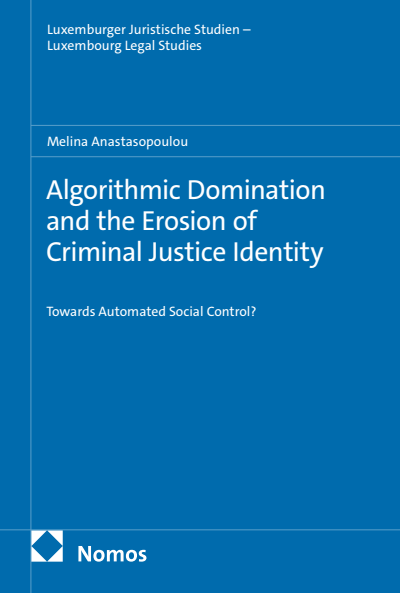
Algorithmic Domination and the Erosion of Criminal Justice Identity
Towards Automated Social Control?- Authors:
- Series:
- Luxemburger Juristische Studien - Luxembourg Legal Studies, Volume 29
- Publisher:
- 2026

Summary
Predictive AI systems are increasingly transforming criminal justice from a reactive system grounded in culpability and due process into a pre-emptive regime organised around risk calculation, surveillance, and algorithmic classification. This book develops a critical and interdisciplinary analysis of how predictive policing, algorithmic risk assessment, and data-driven governance reshape fundamental rights, democratic legitimacy, and the rule of law within constitutional democracies. Moving beyond reformist approaches centred on transparency and bias, it advances a normative response through the concepts of a right to freedom from algorithmic classification and the principle of anti-surveillance immunity against algorithmic domination.
Search publication
Bibliographic data
- Edition
- 1/2026
- Copyright Year
- 2026
- ISBN-Print
- 978-3-7560-3916-6
- ISBN-Online
- 978-3-7489-6940-2
- Publisher
- Nomos, Baden-Baden
- Series
- Luxemburger Juristische Studien - Luxembourg Legal Studies
- Volume
- 29
- Language
- English
- Pages
- 301
- Product Type
- Monograph
Table of contents
ChapterPages
- Dedication No access
- Acknowdelegement No access
- List of Abbreviations No access
- A. Theoretical and Conceptual Background No access
- B. Aim and Scope No access
- C. Analytical Approach No access
- D. Structure of the Book No access
- A. Introductory Remarks No access
- I. The Emerging Focus of Pre-Crime and the Crisis of Criminal Justice No access
- II. Theoretical Legitimations of Pre-emptive Criminal law: Revisiting the Dangerous Logic of Enemy Criminal Law No access
- 1. The Threat of Terrorism as Catalyst for the Pre-emptive Turn No access
- 2. Big Data, AI, and the Construction of Predictive Criminal Justice No access
- 1. The merge between External and Internal Security. No access
- 2. Blurring Intelligence and Policing: Data Revolution and Normalisation of the Widespread Data Collection No access
- 1. Emotional Facial Recognition: Emotion Detection and Facial Recognition: The New Affective Surveillance No access
- 2. Surveillance Eye in the Sky: Expanding the Visual Architecture of Control No access
- 1. Decision Making and the Law under Uncertainty No access
- 2. The Precautionary Principle in Criminal Law: Use of Criminal Law to Social Control? No access
- I. Principle of Legality: Criminalisation of Undesirable Behaviours? No access
- II. Right to Liberty and Security, Article 5 of the ECHR No access
- 1. Presumption of Guilt No access
- 2. Right to confrontation and right to examine a witness in the digital age No access
- 3. The Right to Remain Silent...Unless Guilt is Algorithmically Reconstructed No access
- IV. Right to Respect for Private and Family Life and New technologies: Two Incompatible Realities? Article 8 ECHR No access
- V. Prohibition of Discrimination: Bias in, Bias out. Article 14 ECHR No access
- A. Introductory Remarks No access
- I. Artificial Intelligence as a Governance Tool: Expansion of Surveillance and Secrecy No access
- II. The Move Towards Algorithmic Governance No access
- 1. The Introduction of New Evidentiary Challenges in the Criminal Justice System No access
- 2. Beyond Transparency: The Right to Contest AI? No access
- IV. Rule of Law or the Code Rules? No access
- V. Algorithmic Justice in the Profiling Era: Governing the “Others” No access
- I. Algocracy and Algorithmic Reasoning: Data-Driven Analytics and New Practice of Knowledge Creation No access
- II. Predictive Policing and Actuarial Risk Assessments No access
- 1. The Apocalypse of Deepfakes No access
- 2. Deepfakes and Political Implications No access
- 1. Deepfakes in Crime Control and Criminal Justice No access
- 2. When Deepfakes meet Generative AI: Criminal Justice in a Generative AI Reality No access
- I. Intentional Opacity: From Corporate Secrecy to "Confidentiality Creep" No access
- II. Public Scrutiny as a Democratic Imperative No access
- A. Introductory Remarks No access
- I. Deconstructing the Dominance Discourse on Digital Sovereignty: From Control to Individual Autonomy and Freedom No access
- 1. A right to Freedom from Algorithmic Classification No access
- 2. Principle of Anti-Surveillance Immunity: A way to Preserve Autonomy in Algorithmic Society No access
- I. Algorithmic Surveillance Capitalism and the Individual: The Digital Empires and the Imbalance of Power No access
- 1.The Managerial Turn: How Risk Regulation Redefines Law in the Age of AI No access
- 2. Artificial Intelligence Act as a Market-Driven Instrument: A Critical Appraisal of Risk, Standards, and Fundamental Rights No access
- 3. The Hidden Threats to Criminal Justice Orientation and Fundamental Rights: Persistent Gaps and Emerging Challenges No access
- I. From Political Arithmetic to Statistics No access
- II. The Scientific Pursuit of Predicting Criminality No access
- III. Neuroprediction and AI: The New Face of Predictive Rationality and Its Normative Blind Spots No access
- I. Evading Responsibility: The Erosion of Accountability? No access
- II. Prediction of “Dangerous” Individuals or Groups and Disruption of Procedural Fairness No access
- III. Distorting the Conception of What Justice is: Visualising Justice and Punishment through the Lens of Probabilities? No access
- I. Freedom in the Age of Algocracy No access
- II. Respect of Individual Autonomy and the Right to an Individual Treatment No access
- I. Civil Society and Activism in Policy Formation: Theoretical Foundation of Democratic Engagement No access
- II. Beyond Code: From Grassroots to Influencing Digital Policy No access
- Conclusion No access Pages 247 - 254
- References No access Pages 255 - 300