, um zu prüfen, ob Sie einen Vollzugriff auf diese Publikation haben.
Monographie Kein Zugriff
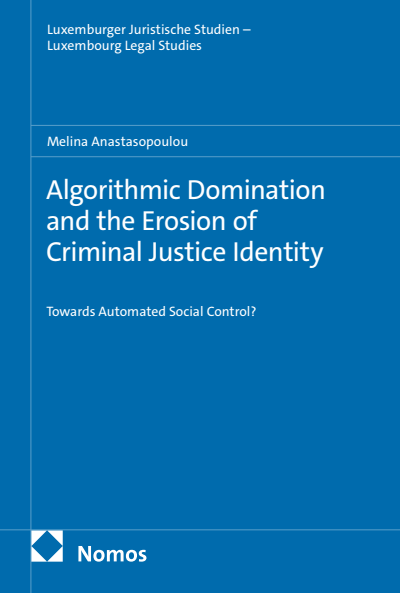
Algorithmic Domination and the Erosion of Criminal Justice Identity
Towards Automated Social Control?- Autor:innen:
- Reihe:
- Luxemburger Juristische Studien - Luxembourg Legal Studies, Band 29
- Verlag:
- 2026

Zusammenfassung
Prädiktive KI-Systeme verändern das Strafrecht zunehmend von einem reaktiven, auf Schuld und rechtsstaatlichen Garantien beruhenden System hin zu einem präemptiven Regime der Risikoberechnung, Überwachung und algorithmischen Klassifikation. Das Buch entwickelt eine kritische und interdisziplinäre Analyse dazu, wie Predictive Policing, algorithmische Risikobewertung und datengetriebene Governance Grundrechte, demokratische Legitimität und Rechtsstaatlichkeit in konstitutionellen Demokratien verändern. Jenseits reformistischer Ansätze zu Transparenz und Bias entwickelt es eine normative Antwort durch das Recht auf Freiheit von algorithmischer Klassifikation sowie das Prinzip der Anti-Überwachungs-Immunität gegen algorithmische Dominanz.
Publikation durchsuchen
Bibliographische Angaben
- Auflage
- 1/2026
- Copyrightjahr
- 2026
- ISBN-Print
- 978-3-7560-3916-6
- ISBN-Online
- 978-3-7489-6940-2
- Verlag
- Nomos, Baden-Baden
- Reihe
- Luxemburger Juristische Studien - Luxembourg Legal Studies
- Band
- 29
- Sprache
- Englisch
- Seiten
- 301
- Produkttyp
- Monographie
Inhaltsverzeichnis
KapitelSeiten
- Dedication Kein Zugriff
- Acknowdelegement Kein Zugriff
- List of Abbreviations Kein Zugriff
- A. Theoretical and Conceptual Background Kein Zugriff
- B. Aim and Scope Kein Zugriff
- C. Analytical Approach Kein Zugriff
- D. Structure of the Book Kein Zugriff
- A. Introductory Remarks Kein Zugriff
- I. The Emerging Focus of Pre-Crime and the Crisis of Criminal Justice Kein Zugriff
- II. Theoretical Legitimations of Pre-emptive Criminal law: Revisiting the Dangerous Logic of Enemy Criminal Law Kein Zugriff
- 1. The Threat of Terrorism as Catalyst for the Pre-emptive Turn Kein Zugriff
- 2. Big Data, AI, and the Construction of Predictive Criminal Justice Kein Zugriff
- 1. The merge between External and Internal Security. Kein Zugriff
- 2. Blurring Intelligence and Policing: Data Revolution and Normalisation of the Widespread Data Collection Kein Zugriff
- 1. Emotional Facial Recognition: Emotion Detection and Facial Recognition: The New Affective Surveillance Kein Zugriff
- 2. Surveillance Eye in the Sky: Expanding the Visual Architecture of Control Kein Zugriff
- 1. Decision Making and the Law under Uncertainty Kein Zugriff
- 2. The Precautionary Principle in Criminal Law: Use of Criminal Law to Social Control? Kein Zugriff
- I. Principle of Legality: Criminalisation of Undesirable Behaviours? Kein Zugriff
- II. Right to Liberty and Security, Article 5 of the ECHR Kein Zugriff
- 1. Presumption of Guilt Kein Zugriff
- 2. Right to confrontation and right to examine a witness in the digital age Kein Zugriff
- 3. The Right to Remain Silent...Unless Guilt is Algorithmically Reconstructed Kein Zugriff
- IV. Right to Respect for Private and Family Life and New technologies: Two Incompatible Realities? Article 8 ECHR Kein Zugriff
- V. Prohibition of Discrimination: Bias in, Bias out. Article 14 ECHR Kein Zugriff
- A. Introductory Remarks Kein Zugriff
- I. Artificial Intelligence as a Governance Tool: Expansion of Surveillance and Secrecy Kein Zugriff
- II. The Move Towards Algorithmic Governance Kein Zugriff
- 1. The Introduction of New Evidentiary Challenges in the Criminal Justice System Kein Zugriff
- 2. Beyond Transparency: The Right to Contest AI? Kein Zugriff
- IV. Rule of Law or the Code Rules? Kein Zugriff
- V. Algorithmic Justice in the Profiling Era: Governing the “Others” Kein Zugriff
- I. Algocracy and Algorithmic Reasoning: Data-Driven Analytics and New Practice of Knowledge Creation Kein Zugriff
- II. Predictive Policing and Actuarial Risk Assessments Kein Zugriff
- 1. The Apocalypse of Deepfakes Kein Zugriff
- 2. Deepfakes and Political Implications Kein Zugriff
- 1. Deepfakes in Crime Control and Criminal Justice Kein Zugriff
- 2. When Deepfakes meet Generative AI: Criminal Justice in a Generative AI Reality Kein Zugriff
- I. Intentional Opacity: From Corporate Secrecy to "Confidentiality Creep" Kein Zugriff
- II. Public Scrutiny as a Democratic Imperative Kein Zugriff
- A. Introductory Remarks Kein Zugriff
- I. Deconstructing the Dominance Discourse on Digital Sovereignty: From Control to Individual Autonomy and Freedom Kein Zugriff
- 1. A right to Freedom from Algorithmic Classification Kein Zugriff
- 2. Principle of Anti-Surveillance Immunity: A way to Preserve Autonomy in Algorithmic Society Kein Zugriff
- I. Algorithmic Surveillance Capitalism and the Individual: The Digital Empires and the Imbalance of Power Kein Zugriff
- 1.The Managerial Turn: How Risk Regulation Redefines Law in the Age of AI Kein Zugriff
- 2. Artificial Intelligence Act as a Market-Driven Instrument: A Critical Appraisal of Risk, Standards, and Fundamental Rights Kein Zugriff
- 3. The Hidden Threats to Criminal Justice Orientation and Fundamental Rights: Persistent Gaps and Emerging Challenges Kein Zugriff
- I. From Political Arithmetic to Statistics Kein Zugriff
- II. The Scientific Pursuit of Predicting Criminality Kein Zugriff
- III. Neuroprediction and AI: The New Face of Predictive Rationality and Its Normative Blind Spots Kein Zugriff
- I. Evading Responsibility: The Erosion of Accountability? Kein Zugriff
- II. Prediction of “Dangerous” Individuals or Groups and Disruption of Procedural Fairness Kein Zugriff
- III. Distorting the Conception of What Justice is: Visualising Justice and Punishment through the Lens of Probabilities? Kein Zugriff
- I. Freedom in the Age of Algocracy Kein Zugriff
- II. Respect of Individual Autonomy and the Right to an Individual Treatment Kein Zugriff
- I. Civil Society and Activism in Policy Formation: Theoretical Foundation of Democratic Engagement Kein Zugriff
- II. Beyond Code: From Grassroots to Influencing Digital Policy Kein Zugriff
- Conclusion Kein Zugriff Seiten 247 - 254
- References Kein Zugriff Seiten 255 - 300