, to see if you have full access to this publication.
Edited Book No access
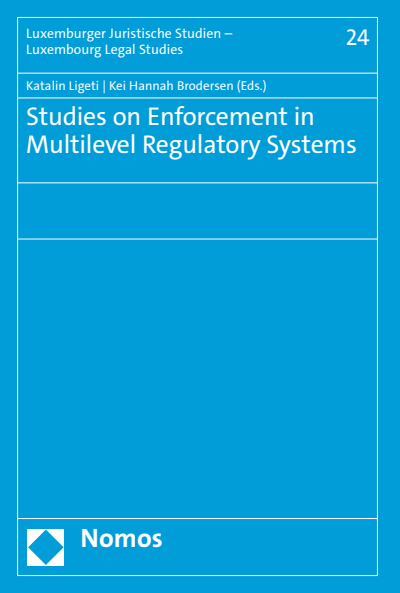
Studies on Enforcement in Multilevel Regulatory Systems
- Editors:
- |
- Series:
- Luxemburger Juristische Studien - Luxembourg Legal Studies, Volume 24
- Publisher:
- 2022
Keywords
Search publication
Bibliographic data
- Copyright Year
- 2022
- ISBN-Print
- 978-3-8487-8665-7
- ISBN-Online
- 978-3-7489-3036-5
- Publisher
- Nomos, Baden-Baden
- Series
- Luxemburger Juristische Studien - Luxembourg Legal Studies
- Volume
- 24
- Language
- English
- Pages
- 309
- Product Type
- Edited Book
Table of contents
ChapterPages
- Titelei/Inhaltsverzeichnis No access Pages 1 - 6
- Authors: | |
- Part I No access
- Part II No access
- Part III No access
- Bibliography No access
- Authors:
- 1. Excluding legal bases No access
- 2. Old habits die hard: the choice of Article 114 TFEU No access
- 3. Business as usual: criticism for the legal bases No access
- B. The complexities of multilevel regulatory systems No access
- C. Enforcement of EU law: challenges and perspectives No access
- D. Concluding remarks No access
- Bibliography No access
- Authors:
- A. Introduction No access
- B. Background No access
- I. Liability of the Single Resolution Board No access
- II. Liability of the national resolution authorities No access
- III. Distribution of liability between the SRB and NRAs No access
- IV. Competing claims between the SRB and NRAs No access
- D. Preliminary solutions No access
- E. Conclusion No access
- Bibliography No access
- Authors:
- A. Introduction No access
- I. Crime control by prevention No access
- 1. Individuals No access
- 2. Commercial enterprise No access
- 1. Hardening infrastructure No access
- 2. Soft enforcement methods No access
- IV. Criminalisation of social policy No access
- I. Evolution of the enforcement system toward shared responsibility No access
- II. Blurring of legal accountability to the individual No access
- D. Conclusion No access
- Bibliography No access
- Authors:
- A. Introduction No access
- B. Framing climate finance in international law No access
- I. Legal challenges related to the nature of the climate-finance obligation No access
- II. The Paris Agreement Enhanced Transparency Framework (ETF) No access
- III. The Paris Agreement implementation and compliance mechanism No access
- IV. The Paris Agreement global stocktake mechanism No access
- V. Alternative means of accountability in climate finance No access
- D. Conclusion No access
- Bibliography No access
- Authors:
- A. Introduction No access
- I. Stability and Growth Pact No access
- II. Macroeconomic Imbalance Procedure No access
- C. European Semester and Europeanised social policy No access
- D. European Semester and social policy outcomes: a tension No access
- I. Issues with effectiveness of the SGP and MIP No access
- II. Low implementation of CSRs No access
- III. Role of social actors No access
- F. European Semester in the context of COVID-19: a new opportunity for a social dimension of the EU? No access
- G. Conclusion No access
- Bibliography No access
- Authors:
- A. Introduction: the growing relevance of time limits in EU procedural law No access
- I. Brussels Ibis: Article 45 (1)(b) refusal ground No access
- II. EEO: default judgments and review procedure No access
- 1. Length of time to react under Brussels Ibis and EEO No access
- 2. Cross-border service and dies a quo of the time to react under Brussels Ibis and EEO No access
- 3. Lack of service under the EEO No access
- I. Feasibility of EU action on the time to react No access
- II. The desirability of EU action on the time to react No access
- III. The proposal in concreto No access
- Bibliography No access
- Authors:
- A. Introduction No access
- B. Democratic Decline No access
- C. Captured and semi-independent Judiciaries No access
- D. Weaknesses of the EU’s transformative Power No access
- E. Enforcement Challenges No access
- F. In lieu of Conclusion No access
- Bibliography No access
- Authors:
- A. Introduction No access
- B. Automating EU law implementation No access
- C. Amplifying intransparencies No access
- D. Maintaining limited jurisdiction No access
- E. Conclusion No access
- Bibliography No access
- Authors:
- A. Introduction No access
- B. Online intermediary liability and the digital enforcement challenge No access
- I. The regulatory framework for online platforms in the EU No access
- II. Defamation and hate speech No access
- III. Intellectual property: trademarks No access
- IV. Product regulation No access
- D. New online platform responsibility in a multilevel regulatory system No access
- E. Conclusion No access
- Bibliography No access
- Authors:
- A. Introduction No access
- B. Enforcement mechanisms of international criminal law No access
- I. Direct enforcement of international criminal law at Nuremberg and Tokyo No access
- II. Multilevel enforcement of international criminal law based on ad hoc and internationalised tribunals’ primacy No access
- III. Multilevel enforcement of international criminal law based on the ICC’s complementarity No access
- I. International economic crimes as a new paradigm of international offences No access
- II. Discussing the Rome Statute’s multilevel enforcement system for international economic crimes No access
- 1. International economic crimes challenging the Rome Statute’s multilevel enforcement system No access
- 2. International economic crimes prosecution benefiting from the Rome Statute’s multilevel enforcement system No access
- D. Conclusion No access
- Bibliography No access
- Authors:
- A. Introduction No access
- B. Reliance on self-placement as a result of the crisis management framework No access
- I. Distribution No access
- II. Product governance No access
- D. Enforcement of the self-placement rules: lost in the maze of multilevel governance? No access
- E. Conclusion No access
- Bibliography No access
- Authors:
- A. Introduction No access
- I. Political origin and existential aim of legal identities No access
- II. Material content of legal identities in a democratic multilevel setting No access
- I. The principle of loyalty as the skeleton of legal pluralism in multilevel settings No access
- II. Legal identities and the enforcement of common rules No access
- I. Distinguishing identity conflicts from authority claims No access
- II. Hybrid adjudicatory organs as the judicial remedy of identity conflicts in multilevel settings No access
- E. Conclusion No access
- Bibliography No access