, to see if you have full access to this publication.
Monograph No access
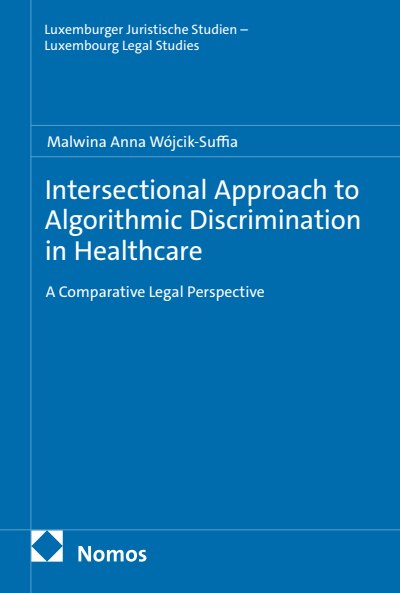
Intersectional Approach to Algorithmic Discrimination in Healthcare
A Comparative Legal Perspective- Authors:
- Series:
- Luxemburger Juristische Studien - Luxembourg Legal Studies, Volume 27
- Publisher:
- 2026
Search publication
Bibliographic data
- Edition
- 1/2026
- Copyright Year
- 2026
- ISBN-Print
- 978-3-7560-4170-1
- ISBN-Online
- 978-3-7489-7121-4
- Publisher
- Nomos, Baden-Baden
- Series
- Luxemburger Juristische Studien - Luxembourg Legal Studies
- Volume
- 27
- Language
- English
- Pages
- 331
- Product Type
- Monograph
Table of contents
ChapterPages
- Acknowledgements No access
- I come to you No access
- 1.1. Intersectional discrimination in clinical algorithms – a new old challenge? No access
- 1.2. Objectives of the book and research questions No access
- 1.3.1. Legal informatics approach No access
- 1.3.2. Comparative legal approach No access
- 1.4. Overview of the book No access
- 2.1. Introduction No access
- 2.2.1.1. The indivisibility of experience No access
- 2.2.1.2. The dynamics of sameness and difference in group disadvantage No access
- 2.2.2. The contextual strand No access
- 2.2.3.1. Domestic and sexual violence against ethnic and racial minority women No access
- 2.2.3.2. Involuntary anticonception and sterilisation of ethnic and racial minority women – the illusion of choice No access
- 2.3.1. Anticategorical approach No access
- 2.3.2. Intracategorical approach No access
- 2.3.3. Intercategorical approach No access
- 2.4.1. Intersectional bias in clinical algorithms No access
- 2.4.2. Synthetic data as a strategy to address the shortage of intersectional data No access
- 2.4.3.1. Fairness metrics manifestly incompatible with intersectionality No access
- 2.4.3.2. Towards intersectionality-sensitive fairness metrics No access
- 2.4.4. Power relations in intersectional fairness No access
- 2.5. Conclusions No access
- 3.1. Introduction No access
- 3.2.1.1. Algorithmic discrimination and the theories of liability – between disparate treatment and disparate impact No access
- 3.2.1.2. Fairness interventions – the legality of algorithmic affirmative action No access
- 3.2.2.1. Algorithmic discrimination and the theories of liability – between direct and indirect discrimination No access
- 3.2.2.2. Fairness interventions – the legality of algorithmic positive action No access
- 3.2.3. Comparative discussion No access
- 3.3.1. Failure to acknowledge patterns of difference and sameness in group disadvantage: The ‘anti-canon’ of intersectionality No access
- 3.3.2.1. US No access
- 3.3.2.2. EU No access
- 3.3.3. Comparative discussion No access
- 3.4.1.1. Applicable law No access
- 3.4.1.2. The uncertain status of gender identity and sexual orientation as prohibited grounds of discrimination No access
- 3.4.1.3. Affordable Care Act’s scope of protection against disparate impact in healthcare No access
- 3.4.1.4. Intersectional discrimination claims under the Affordable Care Act No access
- 3.4.1.5.1. The obligations of healthcare providers to avoid discrimination No access
- 3.4.1.5.2. Algorithmic intersectional discrimination No access
- 3.4.1.5.3. The lack of extended data collection obligations No access
- 3.4.2.1. The applicable law No access
- 3.4.2.2.1. Towards the judicial recognition of new discrimination grounds – the role of Art. 21 of the Charter of Fundamental Rights No access
- 3.4.2.2.2. Towards legislative action to broaden protected grounds and recognise intersectional discrimination – the potential impact of the proposed Horizontal Equality Directive No access
- 3.4.2.3. Remedying fragmented enforcement mechanisms – towards the reform of Equality Bodies No access
- 3.4.3. Comparative discussion No access
- 3.5. Conclusion No access
- 4.1. Introduction No access
- 4.2.1.1. Definition and classification of medical devices No access
- 4.2.1.2. Bias considerations in pre-market conformity assessment No access
- 4.2.1.3. Bias considerations in post-market monitoring No access
- 4.2.2.1. Evidence-based DSI and Predictive DSI No access
- 4.2.2.2. Source attributes No access
- 4.2.2.3. Intervention Risk Management No access
- 4.2.3. The AI Bill of Rights No access
- 4.2.4.1. The regulation of bias in foundation models No access
- 4.3.1.1. The definition and classification of medical devices No access
- 4.3.1.2. Bias considerations in pre-marketing No access
- 4.3.1.3. Bias considerations in post-market monitoring No access
- 4.3.2. The Health Technology Assessment Regulation No access
- 4.3.3.1. Risk management system and algorithmic bias No access
- 4.3.3.2. Data fairness considerations in the AI Act No access
- 4.3.3.3. Fairness-related transparency measures No access
- 4.3.3.4. Fairness-related obligations of deployers No access
- 4.3.3.5. The rights of individuals affected by algorithmic bias No access
- 4.3.3.6. The role of the fundamental rights impact assessment No access
- 4.3.3.7. Addressing algorithmic discrimination on a systemic level No access
- 4.3.3.8. The regulation of bias in foundation models No access
- 4.3.4.1. The impact of the European Health Data Space on the availability of data No access
- 4.3.4.2. The impact of the European Health Data Space on the quality of data No access
- 4.4.1. Between the sectorial and horizontal regulation of bias in clinical AI No access
- 4.4.2. The allocation of responsibility between clinical AI providers and deployers No access
- 4.4.3. Detection and mitigation of bias in foundation models No access
- 4.4.4. Intersectional considerations in the regulation of clinical AI No access
- 4.5. Conclusion No access
- 5.1. Introduction No access
- 5.2.1. Multidimensionality and entanglement of socio-biological categories No access
- 5.2.2. Focus on historically marginalised and oppressed groups No access
- 5.2.3. Power structures on the intersection of technology, medicine and law No access
- 5.3.1. The contribution to intersectionality literature No access
- 5.3.2. Intersectionality wheel for clinical algorithms as a framework to develop a holistic intersectional fairness impact assessment No access
- 5.4. Conclusion No access
- Chapter 6. Conclusions No access Pages 293 - 300
- Bibliography No access Pages 301 - 330