, to see if you have full access to this publication.
Monograph No access
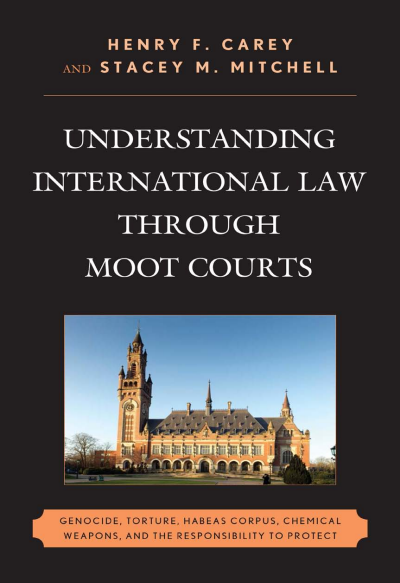
Understanding International Law Through Moot Courts
Genocide, Torture, Habeas Corpus, Chemical Weapons, and the Responsibility to Protect
Authors:
|
Publisher:
2014
Summary
Understanding International Law through Moot Courts: Genocide, Torture, Habeas Corpus, Chemical Weapons, and the Responsibility to Protect consists of five sets of opposing legal briefs and judge’s decisions for five moot court cases held before the International Court of Justice and the International Criminal Court. Each moot court brief included in the book addresses contemporary controversies in international affairs; issues ranging from the application of the newly emerging Responsibility to Protect (R2P) doctrine, to the torture of detainees, to the derogation from international due process protections. These moot court briefs and case judgments help students formulate legal arguments that will be applicable to other similar cases. They also provide students with excellent sources of international and domestic law, as well as greater comprehension of topics ranging from jurisdictional disputes to matters of evidence. Chapter 1 of the book provides an overview of the book as well as instructions regarding the construction of a moot court. Chapter two, by George Andreopoulos discusses the interrelationship between human rights and international criminal law. Chapters 3 through 7 are the cases. The introduction to each chapter (and subsequently each case) lays out the facts of the case in question, discusses (where applicable) issues associated with the material and contextual elements of the crimes(s) in question, provides additional topics for classroom discussion, and also places the issues of contention between the parties within the broader context of foreign affairs and international relations. After each set of briefs and legal judgments is an appendix which includes an example moot court, as well as an appendix that includes a set of alterable facts that students and faculty could adopt to change the general legal argument of the particular case.
Keywords
Search publication
Bibliographic data
Edition
1/2014
Copyright Year
2014
ISBN-Print
978-0-7391-7065-6
ISBN-Online
978-0-7391-7066-3
Publisher
Lexington, Lanham
Language
English
Pages
377
Product Type
Monograph
Table of contents
ChapterPages
Contents No access
1. Crucial Topics for International Law Analysis, Debate, and Moot Courts No access Pages 1 - 20
2. The "Turn to Protection": International Human Rights Law/International Humanitarian Law and the Implications of their Convergence No access Pages 21 - 46
3. Alleged Genocide and Failure to Prevent and Punish Genocide: Nolandia versus Notoria and Idealia No access Pages 47 - 114
4. Responsibility to Protect: Prosecutor versus Marmyan President No access Pages 115 - 184
5. The Necessity Defense to the Criminal Use of Chemical Weapons: Prosecutor versus the Head of State, Post-War Country No access Pages 185 - 242
6. Authorizing the Use of Torture for Interrogation: Prosecutor versus the Ministers of Defense and Justice No access Pages 243 - 308
7. Suspending Habeas Corpus during the War against Terrorism: Middle Eastern Country versus Western Country No access Pages 309 - 364
Index No access Pages 365 - 374
About the Contributors No access Pages 375 - 377
Similar publications
from the topics "Recht allgemein, Übergreifende Werke und Sammlungen"