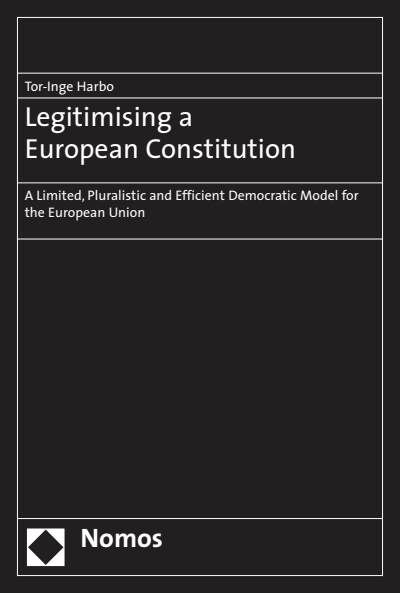
Legitimising a European Constitution
A Limited, Pluralistic and Efficient Democratic Model for the European Union- Authors:
- Publisher:
- 2007
Summary
The discontent with the European Union expressed in the referenda over the Maastricht Treaty in the beginning of the 1990s and more recently enunciated through the French and Dutch rejection of the European Constitutional Treaty has widely been perceived as being a consequence of the Union"s legitimacy deficit. There might be different reasons for this deficit. Whereas some argue that it is rooted in a lack of Humean legitimacy, i.e. a lack of utilitarian problem-solving capacity (output legitimacy), others hold that it is a consequence of the lack of Lockean legitimacy or popular consent or approval of the Union, i.e. a lack of democratic legitimacy (input legitimacy). It is the aim of this book to introduce a democratic model that bridges these two sources of legitimacy and which, bearing in mind the unique institutional, legal and societal qualities of the European Union, could provide a solid basis of legitimacy of the European Union in general and the European Constitutional Treaty in particular.
Dr. Tor-Inge Harbo holds a Norwegian law degree and a MA in European Studies. His PhD thesis was written under the supervision of Professor Dr. iur. Ulrich K. Preuss at the Free University of Berlin, Otto Suhr Institute of Political Studies, Department Legal Bases of Politics. He is currently working as a lecturer and researcher at the Faculty of Law, University of Oslo.
Search publication
Bibliographic data
- Edition
- 1/2007
- Copyright Year
- 2007
- ISBN-Print
- 978-3-8329-2702-8
- ISBN-Online
- 978-3-8452-0277-8
- Publisher
- Nomos, Baden-Baden
- Language
- English
- Pages
- 290
- Product Type
- Monograph
Table of contents
- Titelei/Inhaltsverzeichnis No access Pages 2 - 12Authors:
- List of Abbreviations No access Pages 13 - 14Authors:
- Introduction No access Pages 15 - 20Authors:
- Introduction No access Pages 21 - 25Authors:
- Authors:
- Collectivism (equality) No accessAuthors:
- Individualism (liberty) No accessAuthors:
- Justice (liberty and equality) No accessAuthors:
- Authors:
- Retrenchment No accessAuthors:
- Intervention No accessAuthors:
- Conclusion No access Pages 50 - 52Authors:
- Introduction No access Pages 52 - 53Authors:
- Classical participatory democracy No access Pages 53 - 55Authors:
- Authors:
- Institutional representation (bound or unbound) No accessAuthors:
- Authors:
- Lobbying No accessAuthors:
- Liberal corporatism and consociationalism No accessAuthors:
- Authors:
- Majoritarianism No accessAuthors:
- Associative and deliberative democracy No accessAuthors:
- Modern participatory democracy No accessAuthors:
- Direct democracy No accessAuthors:
- Conclusion No access Pages 75 - 77Authors:
- Introduction No access Pages 77 - 78Authors:
- Authors:
- Homo politicus (citoyens) and homo oeconomicus (bourgeois) No accessAuthors:
- The liberal individualistic approach No accessAuthors:
- The deliberative collective approach No accessAuthors:
- Authors:
- Authors:
- Relative majority rule – minority rule No accessAuthors:
- Intensities No accessAuthors:
- Logrolling No accessAuthors:
- Authors:
- Consociational democracy No accessAuthors:
- Deliberative democracy No accessAuthors:
- Conclusion No access Pages 98 - 100Authors:
- Introduction No access Pages 101 - 104Authors:
- Authors:
- The origin of the federal idea No accessAuthors:
- Federalism and democracy No accessAuthors:
- Authors:
- Federal polity/federal political systems No accessAuthors:
- Confederation (Staatenbund) No accessAuthors:
- Federal state (Bundesstaat) No accessAuthors:
- Federation (Bund) No accessAuthors:
- Authors:
- Federalism in theory No accessAuthors:
- Federalism in practice No accessAuthors:
- Conclusion No access Pages 128 - 130Authors:
- Introduction No access Pages 130 - 131Authors:
- Treaty (subjects, making, revision, termination, arbitration) No access Pages 131 - 134Authors:
- Authors:
- Authors:
- Republican pouvoir constituant No accessAuthors:
- Liberal pouvoir constituant No accessAuthors:
- Authors:
- Republican (political) constitutionalism No accessAuthors:
- Liberal (legal) constitutionalism No accessAuthors:
- Authors:
- Liberal and republican constitutions No accessAuthors:
- A dual concept of constitutionalism No accessAuthors:
- Constitutional review No accessAuthors:
- Constitutional Treaty No access Pages 150 - 152Authors:
- Authors:
- Constitutionalisation of the EC Treaties No accessAuthors:
- A European pouvoir constituant No accessAuthors:
- Judicial review No accessAuthors:
- What kind of Constitutional Treaty? No accessAuthors:
- Conclusion No access Pages 164 - 166Authors:
- Introduction No access Pages 166 - 167Authors:
- Authors:
- Authors:
- French nation No accessAuthors:
- German Volk No accessAuthors:
- The French nation and the German Volk as demos No accessAuthors:
- Authors:
- American constitutional patriotism No accessAuthors:
- Swiss citizenship No accessAuthors:
- Authors:
- A homogeneous concept of a European demos No accessAuthors:
- A plural concept of a European demos No accessAuthors:
- Conclusion No access Pages 190 - 192Authors:
- Introduction No access Pages 193 - 196Authors:
- Authors:
- The sovereignist/intergovernmentalist approach No accessAuthors:
- The Federalist approach No accessAuthors:
- Authors:
- Authors:
- Common Agricultural Policy (CAP) No accessAuthors:
- Cohesion policy No accessAuthors:
- Authors:
- Harmonisation of social policies No accessAuthors:
- Harmonisation of taxes and wages No accessAuthors:
- Authors:
- Externalities No accessAuthors:
- A question of legitimacy No accessAuthors:
- Authors:
- Welfare regimes remain national states No accessAuthors:
- A reform of redistribution policies No accessAuthors:
- Conclusion No access Pages 221 - 222Authors:
- Introduction No access Pages 222 - 223Authors:
- Authors:
- Authors:
- The European Parliament No accessAuthors:
- The (European) Council No accessAuthors:
- The Commission No accessAuthors:
- Balance of powers No accessAuthors:
- Representation/Participation on regional level No accessAuthors:
- Authors:
- Corporatism No accessAuthors:
- Lobbying No accessAuthors:
- Direct democracy No access Pages 243 - 246Authors:
- Conclusion No access Pages 246 - 247Authors:
- Introduction No access Pages 247 - 248Authors:
- Authors:
- From neo-functionalism ... No accessAuthors:
- ... to intergovernmentalism No accessAuthors:
- Authors:
- Liberal intergovernmentalism No accessAuthors:
- Authors:
- Low politics: Comitology No accessAuthors:
- High politics: Convention No accessAuthors:
- Authors:
- Majority rule No accessAuthors:
- Non-majority rule No accessAuthors:
- Efficient decision-making No accessAuthors:
- Conclusion No access Pages 269 - 270Authors:
- Conclusions No access Pages 271 - 275Authors:
- Reference List No access Pages 276 - 290Authors: