, to see if you have full access to this publication.
Monograph No access
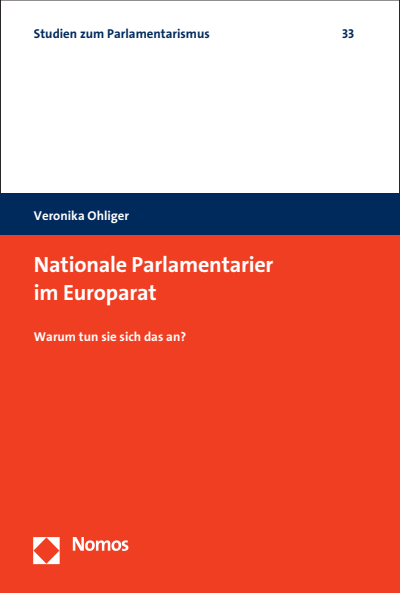
Nationale Parlamentarier im Europarat
Warum tun sie sich das an?- Authors:
- Series:
- Studien zum Parlamentarismus, Volume 33
- Publisher:
- 2019
Search publication
Bibliographic data
- Edition
- 1/2019
- Copyright Year
- 2019
- ISBN-Print
- 978-3-8487-5964-4
- ISBN-Online
- 978-3-7489-0091-7
- Publisher
- Nomos, Baden-Baden
- Series
- Studien zum Parlamentarismus
- Volume
- 33
- Language
- German
- Pages
- 245
- Product Type
- Monograph
Table of contents
ChapterPages
- Titelei/Inhaltsverzeichnis No access Pages 1 - 20
- 1.1 Zentrale Fragestellungen No access
- 1.2 Untersuchungsleitende Hypothesen No access
- 1.3 Fallauswahl und Datengrundlage No access
- 1.4 Aufbau der Untersuchung No access
- 2.1 Transnationale Parlamentarische Versammlungen No access
- Zusammensetzung, Kompetenzen und Arbeitsweise der PVER No access
- Europarat und PVER in der wissenschaftlichen Forschung No access
- 2.3 Zwischenfazit No access
- 3.1 Politische Repräsentation No access
- 3.2 Rollentheorie und Abgeordnetenforschung No access
- 3.3 Repräsentationsrolle und Rollenverhalten in der PVER No access
- 4.1 Institutionelle und strukturelle Einflussfaktoren auf der Makro-Ebene No access
- Two-level Game No access
- Funktionale Institutionswahrnehmung No access
- Repräsentationsfokus No access
- (1) Der Idealist No access
- (2) Der (Policy-)Experte No access
- (3) Der Karrierist No access
- (4) Der Zuschauer No access
- 4.3 Forschungsinteresse und Untersuchungsgsdesign No access
- Auswahl der Befragten, Rekrutierung des Samples und Entwurf des Leitfadens No access
- Rücklaufquote No access
- 5.3 Dokumentenanalyse No access
- 6.1 Selektion und Rechtsstellung der Mitglieder No access
- 6.2 Abgeordnetenprofil und thematische Expertise No access
- Thematische Expertise und Synergieeffekte No access
- Transnationaler Austausch und Netzwerken No access
- Parlamentarische Teilhabe in internationaler Politik No access
- Agenda-Setting durch Beschlüsse No access
- 6.4 Zweifelhafte Motivation: Der Europarat unter Korruptionsverdacht No access
- 6.5 Zwischenfazit No access
- 7.1 Anwesenheitsmuster No access
- 7.2 Redebeiträge No access
- Two-level Game und parlamentarische Mehrebenenverflechtung No access
- 7.4 Zwischenfazit No access
- 8.1 Rolle der Verwaltung No access
- 8.2 Haushalt und Finanzierung No access
- 9.1 Nationaler versus politischer Bezugsrahmen in der Selbstwahrnehmung der Parlamentarier No access
- 9.2 Abstimmungskohäsion Delegation versus Fraktion No access
- 9.3 Zwischenfazit No access
- 10. Fazit und Schlussfolgerungen – Parlamentarische Versammlung oder versammelte Parlamentarier? No access Pages 211 - 223
- 11. Literatur- und Quellenverzeichnis No access Pages 224 - 245
Bibliography (341 entries)
No match found. Try another term.
- Albonetti, Achille (1961): Vorgeschichte der Vereinigten Staaten von Europa, Baden-Baden / Bonn: Verlag August Lutzmeyer. Open Google Scholar DOI: 10.5771/9783748900917
- Alonso, Sonia/ Keane, John /Merkel, Wolfgang (2011): The Future of Representative Democracy. Cambridge: Cambridge University Press. Open Google Scholar DOI: 10.5771/9783748900917
- Alonso, Sonia/ Keane, John/ Merkel, Wolfgang (2011): Rethinking the Future of Representative Democracy, in: Alonso, Sonia/ Keane, John/ Merkel, Wolfgang (Hrsg.), The Future of Representative Democracy. Cambridge: Cambridge University Press, 1-22. Open Google Scholar DOI: 10.5771/9783748900917
- Ambrosio, Thomas (2010): Constructing a Framework of Authoritarian Diffusion, in: International Studies Perspectives 11/4, 375-392. Open Google Scholar DOI: 10.5771/9783748900917
- Andersen, Svein S./ Burns, Tom (1996): The European Union and the Erosion of Parliamentary Democracy: A Study of Post-parliamentary Governance, in: Andersen, Svein S./ Eliassen, Kjell A. (Hrsg.), The European Union: How Democratic Is It? London u. a.: Sage, 227-251. Open Google Scholar DOI: 10.5771/9783748900917
- Andeweg, Rudy B. (1997): Role specialisation or Role Switching? Dutch MPs between Electorate and Executive, in: Müller, Wolfgang C./ Saalfeld, Thomas (Hrsg.), Members of Parliament in Western Europe: Roles and Behaviour, London: Frank Cass, 110-127. Open Google Scholar DOI: 10.5771/9783748900917
- Andeweg, Rudy B. (2003): Beyond Representativeness? Trends in Political Representation, in: European Review 11/2, 147-161. Open Google Scholar DOI: 10.5771/9783748900917
- Andeweg, Rudy B./ Thomassen, Jacques (2011): Pathways to Party Unity: Sanctions, Loyalty, Homogeneity and Division of Labour in the Dutch Parliament, in: Party Politics 17/5, 655-672. Open Google Scholar DOI: 10.5771/9783748900917
- Andeweg, Rudy B. (2012): The consequences of Representatives´ Role Orientation. Attitudes, Behaviour, Perceptions, in: Blomgren, Magnus / Rozenberg, Olivier (Hrsg.), Parliamentary Roles in Modern Legislatures, London/ New York: Routledge, 66-84. Open Google Scholar DOI: 10.5771/9783748900917
- Attina, Fulvio (1990): The voting behaviour of the European Parliament members and the problem of the Europarties, in: European Journal of Political Research 18/5, 557-79. Open Google Scholar DOI: 10.5771/9783748900917
- Auel, Katrin/ Benz, Arthur (2004): National Parliaments in the EU Multilevel Governance – Dilemmas and Strategies of Adaption, in: polis 60, 1-25. Open Google Scholar DOI: 10.5771/9783748900917
- Auel, Katrin/ Benz, Arthur (2006): The Europeanization of Parliamentary Democracy, London: Routledge. Open Google Scholar DOI: 10.5771/9783748900917
- Bailer, Stefanie (2008): Cross Pressure and Cohesion in Transnational Party Group of the European Parliament, in: Giannetti, Daniela, Benoit/ Kenneth (Hrsg.), Intra-Party Politics and Coalition Governments in Parliamentary Democracies, London: Routledge, 189-204. Open Google Scholar DOI: 10.5771/9783748900917
- Bailer, Stefanie (2014): Interviews and Surveys in Legislative Research, in: Martin, Shane/ Saalfeld, Thomas/ Strøm, Kaare (Hrsg.), The Oxford Handbook of Legislative Studies, Oxford: Oxford University Press, 167-193. Open Google Scholar DOI: 10.5771/9783748900917
- Baker, Ross K. (2011): Touching the Bones: Interviewing and Direct Observational Studies of Congress, in: Schickler, Eric/ Lee, Frances E. (Hrsg), The Oxford Handbook of the American Congress. Oxford: Oxford University Press, 95-114. Open Google Scholar DOI: 10.5771/9783748900917
- Bauer, Hans-Joachim (2001): Der Europarat nach der Zeitenwende 1989-1999. Zur Rolle Straßburgs im gesamteuropäischen Integrationsprozeß. Münster u.a.: LIT Verlag. Open Google Scholar DOI: 10.5771/9783748900917
- Baugut, Phillip/ Grundler, Maria-Theresa (2009): Politische (Nicht-)Öffentlichkeit in der Mediendemokratie. Eine Analyse der Beziehungen zwischen Politikern und Journalisten in Berlin, Baden-Baden: Nomos Verlagsgesellschaft. Open Google Scholar DOI: 10.5771/9783748900917
- Beetham, David (2011): Do parliaments have a future?, in: Alonso, Sonia/ Keane, John/ Merkel, Wolfgang (Hrsg.), The Future of Representative Democracy. Cambridge: Cambridge University Press, 124-143. Open Google Scholar DOI: 10.5771/9783748900917
- Beichelt, Timm (2015): Deutschland und Europa. Die Europäisierung des deutschen politischen Systems, 2. Aufl, Wiesbaden: VS Verlag für Sozialwissenschaften. Open Google Scholar DOI: 10.5771/9783748900917
- Benedetto, Giacomo/ Hix, Simon (2007): Explaining the European Parliament’s Gains in the EU Constitution, in: Review of International Organizations 2, 115-29. Open Google Scholar DOI: 10.5771/9783748900917
- Benedetto, Giacomo (2006): Rapporteurs as legislative entrepreneurs: the dynamics of the codecision procedure in Europe's parliament, in: Journal of European Public Policy 12/1, 67-88. Open Google Scholar DOI: 10.5771/9783748900917
- Best, Heinrich / Vogel, Lars (2012): The Emergence and Transformation of Representative Roles, in: Blomgren, Magnus / Rozenberg, Olivier (Hrsg.), Parliamentary Roles in Modern Legislatures. London/ New York: Routledge, 37-65. Open Google Scholar DOI: 10.5771/9783748900917
- Beyme, Klaus von (1998): Niedergang der Parlamente: Internationale Politik und nationale Entscheidungshoheit, in: Internationale Politik 53/4, 21-30. Open Google Scholar DOI: 10.5771/9783748900917
- Beyme, Klaus von (1999): Die parlamentarische Demokratie. Entstehung und Funktionsweise 1789-1999, 2. Aufl., Opaden/ Wiesbaden: Westdeutscher Verlag. Open Google Scholar DOI: 10.5771/9783748900917
- Biddle, Bruce J. (1986): Recent Developments in Role Theory, in: Annual Review of Sociology 12, 67-92. Open Google Scholar DOI: 10.5771/9783748900917
- Björck, Anders (1990): Die Parlamentarische Versammlung als treibende Kraft des Europarats, in: Schmuck, Otto (Hrsg.), Vierzig Jahre Europarat: Renaissance in gesamteuropäischer Perspektive?, Bonn: Europa Union, 23-38. Open Google Scholar DOI: 10.5771/9783748900917
- Blomgren, Magnus (2003): Cross-pressure and political representation in Europe: a comparative study of MEPs and the intra-party arena, Umeå: University, Department of Political Science. Open Google Scholar DOI: 10.5771/9783748900917
- Blomgren, Magnus / Rozenberg, Olivier (Hrsg.) (2012): Parliamentary Roles in Modern Legislatures. London/ New York: Routledge. Open Google Scholar DOI: 10.5771/9783748900917
- Blomgren, Magnus/ Rozenberg Oliver (2012a): Introduction, in: Blomgren, Magnus/ Rozenberg, Oliver (Hrsg.), Roles in Modern Legislatures, London/ New York: Routledge, 1-7. Open Google Scholar DOI: 10.5771/9783748900917
- Blomgren, Magnus/ Rozenberg, Olivier (2012b): Legislative Roles and Legislative Studies: The Neo-institutionalist Turning Point?, in: Blomgren, Magnus/ Rozenberg, Olivier (Hrsg.), Parliamenlary Roles in Modern Legislatures, London: Routlegde, 8-36. Open Google Scholar DOI: 10.5771/9783748900917
- Bond, Martyn (2012): The Council of Europe: Structure, history and issues in European Politics, London u.a.: Routledge Chapman & Hall. Open Google Scholar DOI: 10.5771/9783748900917
- Börzel, Tanja A./ Risse, Thomas (2006): Europeanization: The Domestic Impact of European Union Politics, in: Jørgensen, Knud Erik/ Pollack, Mark A./ Rosamond, Ben (Hrsg.), Handbook of European Union Politics, London: Sage Publications, 483-505. Open Google Scholar DOI: 10.5771/9783748900917
- Bowler, Shaun/ Farrell, David M. (1993): Legislator Shrinking and Voter Monitoring: Impacts of European Parliament Electoral Systems upon Legislator–Voter Relationships, in: Journal of Common Market Studies 31/1, 45-70. Open Google Scholar DOI: 10.5771/9783748900917
- Bowler, Shaun/ Farrell, David M. (1995): The Organizing of the European Parliament: Committees, Specialization and Co-ordination, in: British Journal of Political Science 25/2, 219-243. Open Google Scholar DOI: 10.5771/9783748900917
- Bowler, Shaun and Farrell, David M. (1999): Parties and party discipline within the European Parliament: a norms-based approach, in: Bowler, Shaun/ Farrell, David M./ Katz, Richard S. (Hrsg.), Party Discipline and Parliamentary Government, Columbus, OH: Ohio State University Press, 208-22. Open Google Scholar DOI: 10.5771/9783748900917
- Bowler, Shaun/ Farrell, David M./ Katz, Richard S. (1999): Party Cohesion, Party Discipline and Parliaments, in: Bowler, Shaun/ Farrell, David M./ Katz, Richard S. (Hrsg.), Party Discipline and Parliamentary Government, Columbus: Ohio State University Press, 3-21. Open Google Scholar DOI: 10.5771/9783748900917
- Bowler, Shaun/ McElroy, Gail (2015): Political Group Cohesion And ‘Hurrah’ Voting in The European Parliament, in: Journal of European Public Policy 22/9, 1355-1365. Open Google Scholar DOI: 10.5771/9783748900917
- Bryce, James (1921): Modern Democracies. New York: Macmillan Co. Open Google Scholar DOI: 10.5771/9783748900917
- Burke, Edmund (1777): The political tracts and speeches of Edmund Burke, Dublin: W. Whitestone u.a.. Open Google Scholar DOI: 10.5771/9783748900917
- Burnell, Peter/ Schlumberger, Oliver (2010): Promoting Democracy – Promoting Autocracy? International politics and national political regimes, in: Contemporary Politics 16/1, 1-15. Open Google Scholar DOI: 10.5771/9783748900917
- Burnell, Peter (2012): International politics and national political regimes: promoting democracy – promoting autocracy. London: Routledge. Open Google Scholar DOI: 10.5771/9783748900917
- Brummer, Klaus (2008): Der Europarat. Eine Einführung, Wiesbaden: Springer VS. Open Google Scholar DOI: 10.5771/9783748900917
- Brunn, Gerhard (2005): Die Europäische Einigung von 1945 bis heute, Bonn: Reclam. Open Google Scholar DOI: 10.5771/9783748900917
- Bürgin, Alexander (2007): Die Legitimität der EU. Normative Standards als Verhandlungsressource im Verfassungskonvent, Baden-Baden: Nomos. Open Google Scholar DOI: 10.5771/9783748900917
- Busek, Erhard/ Hummer, Waldemar (Hrsg.) (2004): Etappen am Weg zu einer Europäischen Verfassung. Teil I: Struktur eines zukünftigen Europas. Teil II: Die parlamentarische Komponente im zukünftigen Europa, Wien: Böhlau. Open Google Scholar DOI: 10.5771/9783748900917
- Buzogány, Aron/ Kropp, Sabine (2013): Sisyphos und der Marmorblock: Parlament und Expertise in Zeiten der Euro- Krise, in: Zeitschrift für Politikberatung 6/1, 1-48. Open Google Scholar DOI: 10.5771/9783748900917
- Carey, John M. (2007): Competing Principals, Political Institutions, and Party Unity in Legislative Voting, in: American Journal of Political Science 51/1, 92-107. Open Google Scholar DOI: 10.5771/9783748900917
- Checkel. Jeffrey T. (1999): Norms, Institutions and National Identity in Contemporary Europe, in: International Studies Quarterly 43/1, 83-114. Open Google Scholar DOI: 10.5771/9783748900917
- Cofelice, Andrea (2012): International parliamentary institutions: Some preliminary findigs and setting a research agenda. UNU-CRIS Working Papers. Open Google Scholar DOI: 10.5771/9783748900917
- Committee of Ministers Council of Europe (2009): CM 1, 2009, Budgets of the Council of Europe for the financial year 2009. Open Google Scholar DOI: 10.5771/9783748900917
- Committee of Ministers Council of Europe (2010): CM 1, 2010, Budgets of the Council of Europe for the financial year 2010. Open Google Scholar DOI: 10.5771/9783748900917
- Committee of Ministers Council of Europe (2012): CM 1, 2012, Programme and Budget 2012-2013, online aufgerufen am 25.10.2017 unter: https://www.coe.int/en/web/cm/programme-budget. Open Google Scholar DOI: 10.5771/9783748900917
- Committee of Ministers Council of Europe (2013): CM 1, 2013, Programme and Budget 2012-2013, online aufgerufen am 25.10.2017 unter: https://www.coe.int/en/web/cm/programme-budget. Open Google Scholar DOI: 10.5771/9783748900917
- Committee of Ministers Council of Europe (2014): CM 1, 2014, Programme and Budget 2014-2015, online aufgerufen am 25.10.2017 unter: https://www.coe.int/en/web/cm/programme-budget. Open Google Scholar DOI: 10.5771/9783748900917
- Committee of Ministers Council of Europe (2016): CM 1, 2016, Programme and Budget 2016-2017, online aufgerufen am 25.10.2017 unter: https://www.coe.int/en/web/cm/programme-budget. Open Google Scholar DOI: 10.5771/9783748900917
- Costa, Oliver/ Dri, Clarissa/ Stavridis, Stelios (2013): Parliamentary dimensions of regionalization and globalization the role of inter-parliamentary institutions. Basingstoke: Palgrave Macmillan. Open Google Scholar DOI: 10.5771/9783748900917
- Council of Europe (1949): Die Satzung des Europarates. Open Google Scholar DOI: 10.5771/9783748900917
- Council of Europe (1990): The Parliamentary Assembly. Procedure and Practice, 9. Aufl., Straßburg: Council of Europe. Open Google Scholar DOI: 10.5771/9783748900917
- Council of Europe (2012): Geschäftsordnung der Parlamentarische Versammlung des Europarates. Open Google Scholar DOI: 10.5771/9783748900917
- Council of Europe (2014): Venice Commission. Online abgerufen am 20. März 2018 unter: http://www.venice.coe.int/WebForms/pages/?p=01_Presentation&lang=DE. Open Google Scholar DOI: 10.5771/9783748900917
- Cox, Gary W./ Mccubbins, Mathew D. (1993): Legislative Leviathan. Party Government in the House. Berkeley: University of California Press. Open Google Scholar DOI: 10.5771/9783748900917
- Cox, Gary W. (2006): The Organization of Democratic Legislatures, in: Weingast, Barry R./ Wittman, Donald A. (Hrsg.), The Oxford Handbook of Political Economy, Oxford: Oxford University Press, 141-161. Open Google Scholar DOI: 10.5771/9783748900917
- Crombez, Christophe/ Hix, Simon (2015): Legislative Activity and Gridlock in the European Union, in: British Journal of Political Science 45/3, 477-499. Open Google Scholar DOI: 10.5771/9783748900917
- Cutler, Robert M. (2001): The Emergence of International Parliamentary Institutions: New Networks of Influence in World Society, in: Smith, Gordon/ Wolfish, Daniel (Hrsg.), Who Is Afraid of the State? Canada in a World of Multiple Centres of Power, University of Toronto Press, 201-229. Open Google Scholar DOI: 10.5771/9783748900917
- Cutler, Robert M. (2013): International Parliamentary Institutions as Organizations, in: Journal of International Organizations Studies 4/1, 104-126. Open Google Scholar DOI: 10.5771/9783748900917
- Dahl, Robert A. (1994): A Democratic Dilemma: System Effectiveness versus Citizen Participation, in: Political Science Quarterly 109/1, 23-34. Open Google Scholar DOI: 10.5771/9783748900917
- Deutscher Bundestag (18.12.2015): „Unterrichtung durch die Delegation der Bundesrepublik Deutschland in der Parlamentarischen Versammlung Europarates, Tagung der Parlamentarischen Versammlung des Europarates vom 24. bis 28. Juni 2013 in Straßburg“, Drucksache 18/7130. Open Google Scholar DOI: 10.5771/9783748900917
- Deutscher Bundestag (2016): Parlamentariergruppen. Online abgerufen am 18.05.2018 unter: https://www.bundestag.de/europa_internationales/parlamentariergruppen#url=L2V1cm9wYV9pbnRlcm5hdGlvbmFsZXMvcGFybGFtZW50YXJpZXJncnVwcGVuL3BhcmxhbWVudGFyaWVyZ3J1cHBlbi8xOTYzNjI=&mod=mod442312. Open Google Scholar DOI: 10.5771/9783748900917
- Deutscher Bundestag (15.01.2014): Wahlvorschläge der Fraktionen 18. Wahlperiode, Drucksache 18/290. Open Google Scholar DOI: 10.5771/9783748900917
- De Puig, Lluis Maria (2004): International Parliamentarism: an Introduction to its history, Parliaments, in: Estates and Representation 24/1, 13-62. Open Google Scholar DOI: 10.5771/9783748900917
- De Puig, Lluis Maria (2008): International Parliaments. Straßburg: Council of Europe Publishing. Open Google Scholar DOI: 10.5771/9783748900917
- Deschouwer, Kris/ Depauw, Sam / Audrey, André (2014): Representing the People in Parliaments, in: Deschouwer, Kris / Depauw, Sam (Hrsg.), Representing the People. A survey among members of Statewide and Sub-state Parliaments, Oxford: Oxford University Press, 1-18. Open Google Scholar DOI: 10.5771/9783748900917
- De Winter, Lieven (1997): Intra- and Extra-Parliamentary Role Attitudes and Behaviour of Belgian MPs, in: Journal of Legislative Studies 3/1, 128-54. Open Google Scholar DOI: 10.5771/9783748900917
- DiMaggio, Paul J./ Powell Walter W. (1983): The iron cage revisited: Institutional isomorphism and collective rationality in organizational fields, in: American Sociological Review 48/2, 147-160. Open Google Scholar DOI: 10.5771/9783748900917
- Dinan, Desmond (2013): EU Governance and Institutions: Stresses Above and Below the Waterline, in: Journal of Common Market Studies 51, 89-102. Open Google Scholar DOI: 10.5771/9783748900917
- Döring, Nicola/ Bortz, Jürgen (2016): Forschungsmethoden und Evaluation in den Sozial- und Humanwissenschaften, 5. Aufl., Wiesbaden: VS Verlag. Open Google Scholar DOI: 10.5771/9783748900917
- Dudzińska, Agnieszka/ Poyet, Corentin/ Costa, Olivier/ Weßels, Bernhard (2014): Representational Roles, in: Deschouwer, Kris/ Depauw, Sam (Hrsg.), Representing the People. A survey among members of Statewide and Sub-state Parliaments, Oxford: Oxford University Press, 19-38. Open Google Scholar DOI: 10.5771/9783748900917
- Duncan, Otis Dudley/ Duncan, Beverly (1955): A Methodological Analysis of Segregation Indexes, in: American Sociological Review 20/2, 210-217. Open Google Scholar DOI: 10.5771/9783748900917
- Durm, Martin (12.08.2017): Warum fasst der Europarat Aserbaidschan mit Samthandschuhen an, in: SRF online, online abgerufen am 02.05.2018 unter: https://www.srf.ch/sendungen/international/warum-fasst-der-europarat-aserbaidschan-mit-samthandschuhen-an. Open Google Scholar DOI: 10.5771/9783748900917
- Durm, Martin (30.06.2017): Korruption im Europarat. Die Teppich- und Kaviar-Diplomatie, in: Tagesschau online, online abgerufen am 02.06.2018 unter: www.tagesschau.de/ausland/europarat-111.html. Open Google Scholar DOI: 10.5771/9783748900917
- Eising, Rainer (2003): Europäisierung und Integration. Konzepte in der EU-Forschung, in: Jachtenfuchs, Markus/ Kohler-Koch, Beate (Hrsg.), Europäische Integration, Opladen: Leske + Budrich, 387-416. Open Google Scholar DOI: 10.5771/9783748900917
- Epstein, David/ O´Halloran, Sharyn (1999): Delegating Powers. Atransaction cost politics approach to policy making under separate powers, Cambridge: Cambridge University Press. Open Google Scholar DOI: 10.5771/9783748900917
- Eulau, Heinz/ Wahlke, John C. / Buchanan, William/ Ferguson, Leroy C. (1959): The Role of the Representative: Some Empirical Observations on the Theory of Edmund Burke, in: American Political Science Review 53/3, 742-756. Open Google Scholar DOI: 10.5771/9783748900917
- Eulau, Heinz (1962): The Legislator as Representative: Representational Roles, in: Wahlke, John C./ Eulau, Heinz / Buchanan, Wiliam / Ferguson Leroy C. (Hrsg.), The Legislative System: Explorations in Legislative Behavior. New York: John Wiley, 267-286. Open Google Scholar DOI: 10.5771/9783748900917
- Eulau, Heinz (1978): Changing Views of Representation, in: Eulau, Heinz/ Wahlke, John C. (Hrsg.), The Politics of Representation. Continuities in Theory and Research, Beverly Hills/ London: Sage Publications, 31-54. Open Google Scholar DOI: 10.5771/9783748900917
- Eulau, Heinz (1996): Micro-Macro Dilemmas in Political Science. Personal Pathways Through Complexitiy, Norman/ London: University of Oklahoma Press. Open Google Scholar DOI: 10.5771/9783748900917
- Eulau, Heinz/ Karps, Paul D. (1977): The Puzzle of Representation: Specifying Components of Responsiveness, in: Legislative Studies Quarterly 2/3, 233-254. Open Google Scholar DOI: 10.5771/9783748900917
- Eulau, Heinz/ Wahlke, John C. (Hrsg.) (1978): The Politics of Representation. Continuities in Theory and Research. Beverly Hills/ London: Sage Publications. Open Google Scholar DOI: 10.5771/9783748900917
- Europarat (2012): Der Europarat. 800 Mio. Europäer. Straßburg: Generaldirektion Kommunikation: Council of Europe Publishing. Open Google Scholar DOI: 10.5771/9783748900917
- European Court of Human Rights (2017): The ECHR in Facts & Figures 2016, Straßburg: Public Relations Unit, online abgerufen am 19.03.2018 unter: https://www.echr.coe.int/Documents/Facts_Figures_2016_ENG.pdf. Open Google Scholar DOI: 10.5771/9783748900917
- European Court of Human Rights (2014): Arrest and extended detention of opposition politician following critical blog post was unjustified, 144 application no. 15172/13, online abgerufen am 02.06.2018 unter: https://hudoc.echr.coe.int/eng-press#{"itemid":["003-4767289-5801220"]}. Open Google Scholar DOI: 10.5771/9783748900917
- European Stability Initiative (24.05.2012): Caviar Diplomacy: How Azerbaijan silenced the Council of Europe, online abgerufen am 02.06.2018 unter: https://www.esiweb.org/index.php?lang= en&id=67&newsletter_ID=60. Open Google Scholar DOI: 10.5771/9783748900917
- Faas, Thorsten (2002): Why do MEPs Defect? An Analysis of Party Group Cohesion in the 5th European Parliament, in: European Integration Online Papers 6. Open Google Scholar DOI: 10.5771/9783748900917
- Faas, Thorsten (2003): To defect or not to defect? National, institutional and party group pressure on MEPs adn their conequences for party group cohesion in the European Parliament, in: European Journal of Political Research 42/6, 841-866. Open Google Scholar DOI: 10.5771/9783748900917
- Falk, Richard (2002): The United Nations System: Proposal for Renewal, in: Deepak, Nayyar (Hrsg.), Governing Globalization. Issues and Institutions, Oxford: Oxford University Press, 177-208. Open Google Scholar DOI: 10.5771/9783748900917
- Falk, Richard/ Strauss, Andres (2001): Toward Global Parliament, in: Foreign Affairs 80, 212-220. Open Google Scholar DOI: 10.5771/9783748900917
- Farrell, Henry/ Héritier, Adrienne (2003): Formal and Informal Institutions under Codecision: Continuous Constitution-Building in Europe, in: West European Politics 16/4, 577-600. Open Google Scholar DOI: 10.5771/9783748900917
- Farrell, David M. / Hix, Simon/ Johnston, M./ Scully, Rogers (2006): A Survey of MEPs in the 2004-09 European Parliament, Paper presented to the Annual Conference of the American Political Science Association, Philadelphia, PA. Open Google Scholar DOI: 10.5771/9783748900917
- Farrell, D David M./ Scully, Roger (2007): Representing Europe’s Citizens? Electoral Institutions and the Failure of Parliamentary Representation in the European Union. Oxford: Oxford University Press. Open Google Scholar DOI: 10.5771/9783748900917
- Farrell, David M./ Scully, Roger (2010): The European Parliament: One Parliament, Several Modes of Political Representation on the Ground?, in: Journal of European Public Policy 17/1, 36-54. Open Google Scholar DOI: 10.5771/9783748900917
- Fischer, Per (1962): Europarat und parlamentarische Außenpolitik. München: Oldenburg. Open Google Scholar DOI: 10.5771/9783748900917
- Fischer, Per (1990): Zielsetzungen und Leistungen des Europarates 1949–1989, in: Schmuck, Otto (Hrsg.), Vierzig Jahre Europarat: Renaissance in gesamt-europäischer Perspektive?, Bonn: Europa Union Verlag, 65-80. Open Google Scholar DOI: 10.5771/9783748900917
- Fischer, Leni (2000): Der Jahre an der Spitze der Parlamentarischen Versammlung des Europarates, in: Holtz, Uwe (Hrsg.), 50 Jahre Europarat, Baden-Baden: Nomos, 101-108. Open Google Scholar DOI: 10.5771/9783748900917
- Follesdal, Andreas/ Hix, Simon (2006): Why there is a democratic deficit in the EU: A response to Majone an Moravcsik, in: Journal of Common Market Studies 44/3, 533-62. Open Google Scholar DOI: 10.5771/9783748900917
- Fraenkel Ernst (1964): Die repräsentative und die plebiszitäre Komponente im demokratischen Verfassungsstaat, in: Fraenkel, Ernst (Hrsg.), Deutschland und die westlichen Demokratien, Stuttgart: Kohlhammer. Open Google Scholar DOI: 10.5771/9783748900917
- Fritzsche, Erik (2009): Innerfraktionelle Geschlossenheit im Spiegel der Politikwissenschaft. Stand der Forschung und notwendige Weiterführungen, in: Zeitschrift für Parlamentsfragen 40, 661-682. Open Google Scholar DOI: 10.5771/9783748900917
- Furtak, Florian T. (2015): Internationale Organisationen. Staatliche und nichtstaatliche Organisationen in der Weltpolitik, Wiesbaden: Springer VS. Open Google Scholar DOI: 10.5771/9783748900917
- Galbreath, David J. /Gebhard, Carmen (Hrsg.) (2010): Cooperation or conflict? Problematizing organizational overlap in Europe. Farnham, Surrey u.a.: Ashgate. Open Google Scholar DOI: 10.5771/9783748900917
- Gerhards, Jürgen (1993): Westeuropäische Integration und die Schwierigkeit der Entstehung einer europäischen Öffentlichkeit, in: Zeitschrift für Soziologie 22/2, 96-110. Open Google Scholar DOI: 10.5771/9783748900917
- Glaser, Bamey G./ Strauss, Anselm L. (1998): Grounded Theory. Strategien qualitativer Forschung, Bern: Verlag Hans Huber. Open Google Scholar DOI: 10.5771/9783748900917
- Goetz, Klaus H. (2000): European Integration and National Executives: A Cause in Search or an an Effect?, in: West European Politics 23/4, 211-231. Open Google Scholar DOI: 10.5771/9783748900917
- Goetz, Klaus H./ Hix, Simon (2001): European Integration and National Political Systems, London: Frank Cass. Open Google Scholar DOI: 10.5771/9783748900917
- Goetz, Klaus H. / Meyer-Sahling, Jan-Hinrik (2008): The Europeanisation of national political systems: Parliaments and executives, in: Living Reviews in European Governance 3. Open Google Scholar DOI: 10.5771/9783748900917
- Graziano, Paolo/ Vink, Maarten P. (Hrsg.) (2007): Europeanization: New Research Agendas. Basingstoke: Palgrave Macmillan. Open Google Scholar DOI: 10.5771/9783748900917
- Griffiths, Phillips A./ Wollheim, Richard (1960): How can one person represent another?, in: The Aristotelian Society 34, 182-208. Open Google Scholar DOI: 10.5771/9783748900917
- Grimmer, Klaus (1996): Aufgaben und Zuständigkeiten des Parlaments, in: Raben, Graf von Westphalen (Hrsg.), Parlamentslehre. Das parlamentarische Regierungssystem im technischen Zeitalter, München/ Wien: Oldenburg, 171-207 Open Google Scholar DOI: 10.5771/9783748900917
- Gross, Donald A. (1978): Representative styles and legislative behaviour, in: Western Political Quarterly 31, 359-371. Open Google Scholar DOI: 10.5771/9783748900917
- Große Hüttman, Martin/ Knodt, Michèle (2011): Das Ende der Demokratie in Europa? Intergouvernementalismus, Euro-Krisenpolitik und „Mehrebenenparlamen-tarismus“ in der EU, in: Abels, Gabriele/ Eppler, Annegret (Hrsg.), Auf dem Weg zum Mehrebenenparlamentarismus? Funktionen von Parlamenten im politischen System der EU, Baden- Baden: Nomos, 133-148. Open Google Scholar DOI: 10.5771/9783748900917
- Haas, Ernst B. (1960): Consensus formation in the Council of Europe, Berkeley: University of California Press. Open Google Scholar DOI: 10.5771/9783748900917
- Haas, Ernst B. (1961): International Integration: The European and the Universal Process, in: International Organization 15/3, 366-392. Open Google Scholar DOI: 10.5771/9783748900917
- Habegger, Beat (2005): Parlamentarismus in der internationalen Politik. Europarat, OSZE und Interparlamentarische Union. Baden-Baden: Nomos. Open Google Scholar DOI: 10.5771/9783748900917
- Habegger, Beat (2006): Die Parlamentarisierung der UNO durch die Interparlamentarische Union, in: Zeitschrift für Parlamentsfragen 37/4, 698-712. Open Google Scholar DOI: 10.5771/9783748900917
- Habegger, Beat (2010): Democratic accountability of international organizations: Parliamentary control within the Council of Europe and the OSCE and the prospects for the United Nations, in: Cooperation and Conflict 45/2, 186-204. Open Google Scholar DOI: 10.5771/9783748900917
- Hagger, Mark/ Wing, Martin (1979): The Deconcentration of Legislative Power: The Developement of Committees in the European Parliament, in: European Journal of Political Research 7/2, 117-146. Open Google Scholar DOI: 10.5771/9783748900917
- Hall, Peter A./ Taylor, Rosemary C. R. (1996): Political Science and the Three `New Institutionalism´, in: Political Studies 44, 936-57. Open Google Scholar DOI: 10.5771/9783748900917
- Haller, Bruno (2006): An Assembly for Europe. The Council of Europe´s Parliamentary Assembly 1949-1989, Straßburg: Council of Europe Publishing. Open Google Scholar DOI: 10.5771/9783748900917
- Hanley, David (2008): Beyond the Nation State. Parties in the Era of European Integration. Basingstoke: Parlgrave Macmillan. Open Google Scholar DOI: 10.5771/9783748900917
- Hazan, Reuven Y. (2006): Does Cohesion Equal Discipline? Towards a Conceptual Delineation, in: Hazan, Reuven Y. (Hrsg.), Cohesion and Discipline in Legislatures. New York: Routledge, 1-11. Open Google Scholar DOI: 10.5771/9783748900917
- Héritier, Adrienne (2007): Explaining Institutional Change in Europe. Oxford: Oxford University Press. Open Google Scholar DOI: 10.5771/9783748900917
- Heydt, Volker (1974): Das Parlamentarische Organ des Europarats: Die Beratende Versammlung, in: Institut für Europäische Politik (Hrsg.), Das Europa der siebzehn. Bilanz und Perspektiven von 25 Jahren Europarat, Bonn: Europa Union, 39-70. Open Google Scholar DOI: 10.5771/9783748900917
- Hix, Simon (2002): A supranational party system and the legitimacy of the European Union, in: The International Spectator 37/4, 49-59. Open Google Scholar DOI: 10.5771/9783748900917
- Hix, Simon (2002): Constitutional Agenda Setting through Discretion in Rule Interpretation: Why the European Parliament Won at Amsterdam, in: British Journal of Political Science 32, 259–80. Open Google Scholar DOI: 10.5771/9783748900917
- Hix, Simon (2002): Parliamentary Behavior with Two Principals: Preferences, Parties, and Voting in the European Parliament, American Journal of Political Science 46:3, 688-698. Open Google Scholar DOI: 10.5771/9783748900917
- Hix, Simon (2005): Neither a Preference-Outlier nor a Unitary Actor: Institutional Reform Preferences of the European Parliament, in: Comparative European Politics 3/2, 131-54. Open Google Scholar DOI: 10.5771/9783748900917
- Hix, Simon (2008): What's wrong with the European Union and how to fix it. London: Polity Press. Open Google Scholar DOI: 10.5771/9783748900917
- Hix, Simon / Noury, Abdul G./ Roland, Gérard (2007): Democratic Politics in the European Parliament, Cambridge: Cambridge University Press. Open Google Scholar DOI: 10.5771/9783748900917
- Hix, Simon/ Noury, Abdul G. (2009): After Enlargement: Voting Patterns in the Sixth European Parliament, in: Legislative Studies Quarterly 34, 159-174. Open Google Scholar DOI: 10.5771/9783748900917
- Hix, Simon/ Noury, Abdul G./ Roland, Gérard (2005): Power to the parties: cohesion and competition in the European Parliament, 1979-2001, in: British Journal of Political Science 35/2, 209-34. Open Google Scholar DOI: 10.5771/9783748900917
- Hix, Simon/ Noury, Abdul G./ Roland, Gérard (2006): Dimensions of Politics in the European Parliament, in: American Journal of Political Science 50/2, 494-511. Open Google Scholar DOI: 10.5771/9783748900917
- Hix, Simon/ Noury, Abdul G./ Roland, Gérard (2007): Democratic Politics in the European Parliament. Cambridge: Cambridge University Press. Open Google Scholar DOI: 10.5771/9783748900917
- Hix, Simon/ Noury, Abdul G./ Roland, Gérard (2009): Voting patterns and alliance formation in the European Parliament, in: Philosophical Transactions of The Royal Society 364/1518, 821-31. Open Google Scholar DOI: 10.5771/9783748900917
- Hobolt, Sara B./ Tilley, James (2014): Blaiming Europe? Responsibility Without Accountability in the European Union, Oxford: Oxford University Press. Open Google Scholar DOI: 10.5771/9783748900917
- Holtz, Uwe (2000): 50 Jahre Europarat – eine Einführung, in: Holtz, Uwe (Hrsg.), 50 Jahre Europarat, Baden-Baden: Nomos, 11–36. Open Google Scholar DOI: 10.5771/9783748900917
- Hooghe, Liesbet/ Marks, Gary Marks (2014): Delegation and pooling in international organizations. New York: Springer Science+Business Media. Open Google Scholar DOI: 10.5771/9783748900917
- Höreth, Markus (1999): Das Legitimationstrilemma der EU. Baden-Baden: Nomos. Open Google Scholar DOI: 10.5771/9783748900917
- Hovey, Allan J. (1983): Parlamentarische Zusammenarbeit in der Allianz: Die Zukunft der Nordatlantischen Versammlung. Bericht der Arbeitsgruppe des Atlantic Council of the United States über die Nordatlantische Versammlung. Bonn: Europa Union. Open Google Scholar DOI: 10.5771/9783748900917
- Høyland, Bjørn (2016): Parliaments, in: Cogan Katz, Jacob/ Hurd, Ian/ Johnstone, Ian (Hrsg.), The Oxford Handbook of International Organisations, Oxford: Oxford University Press, 782-801. Open Google Scholar DOI: 10.5771/9783748900917
- Høyland, Bjørn (2016): Allocation of Codecision Reports in the Fifth European Parliament, in: European Union Politics 7/1, 30-50. Open Google Scholar DOI: 10.5771/9783748900917
- Hrbek, Rudolf/ Schweitzer, Carl-Christoph (1989): Die deutschen Europa-Parlamentarier: Ergebnisse einer Befragung der deutschen Mitglieder des Europäischen Parlaments, in: Aus Politik und Zeitgeschichte 3, 3-18. Open Google Scholar DOI: 10.5771/9783748900917
- Hurrelmann, Achim/ DeBardeleben, Joan (2009): Democratic Dilemmas in EU Multilevel Governance: Untangling the Gordian Knot, in: European Political Science Review 1, 229-247. Open Google Scholar DOI: 10.5771/9783748900917
- Ismayr, Wolfgang (2001): Der deutsche Bundestag, 2. Aufl., Opladen: Leske und Budrich. Open Google Scholar DOI: 10.5771/9783748900917
- Jenny, Marcelo / Müller Wolfgang C. (2012): Parliamentary roles of MPs in sharp and soft focus. Interviews and behavioral record compared, in: Blomgren, Magnus / Rozenberg, Olivier (Hrsg.), Parliamentary Roles in Modern Legislatures, London/ New York: Routledge, 145-161. Open Google Scholar DOI: 10.5771/9783748900917
- Jensen, Torben K. (2000): Party Cohesion, in: Esaiasson, Peter/ Heidar, Knut (Hrsg.), Beyond Westminster and Congress: The Nordic Experience, Columbus: Ohio State University Press, 201-236. Open Google Scholar DOI: 10.5771/9783748900917
- Jewell, Malcolm E. (1970): Attitudinal determinants of legislative behavior: the utility of role analysis, in: Kornberg, Allan/ Musolf, Lloyd D. (Hrsg.), Legislatures in Developmental Perspective, Durham: Duke University Press, 460-500. Open Google Scholar DOI: 10.5771/9783748900917
- Johnston, Richard (2008): Survey Methodology, in: Box-Steffensmeier, Janet M./ Brady, Henry E./ Collier, David (Hrsg.), The Oxford Handbook of Political Methodology, Oxford: Oxford University Press, 385-403. Open Google Scholar DOI: 10.5771/9783748900917
- Kam, Christopher (2009): Party Discipline and Parliamentary Government, Cambridge: Cambridge University Press. Open Google Scholar DOI: 10.5771/9783748900917
- Karsten, Detlev (2000): Die Rolle des Europarats bei der Transformation der zentral- und osteuropäischen Länder, in: Holtz, Uwe (Hrsg.), 50 Jahre Europarat, Baden- Baden: Nomos, 237-248. Open Google Scholar DOI: 10.5771/9783748900917
- Katz, Richard S. (1996): Party Organizations and Finance, in: LeDuc, Lawarence/ Niemi, Richard G./ Norris, Pippa (Hrsg.), Comparing Democracies, Thousand Oaks u.a.: Sage Publications, 107-133. Open Google Scholar DOI: 10.5771/9783748900917
- Katz, Richard S. (1997): Representational Roles, in: European Journal of Political Research 32, 211-226. Open Google Scholar DOI: 10.5771/9783748900917
- Katz, Richard S. (1999): Role Orientations in Parliaments, in: Katz, Richard S./ Wessels, Bernhard (Hrsg.), The European Parliament, the National Parliaments, and European Integration, Oxford: Oxford University Press, 61-85. Open Google Scholar DOI: 10.5771/9783748900917
- Katz, Richard/ Wessels, B. (Hrsg.) (1999): The European Parliament, the National Parliaments and European Integration, Oxford: Oxford University Press. Open Google Scholar DOI: 10.5771/9783748900917
- Keohane, Robert O./ Nye, Joseph S. (1997): Interdependence in World Politics, in: Crane, George T./ Amawi, Abla (Hrsg.), The Theoretical evolution of international political economy: a reader, New York: Oxford University Press, 122-132. Open Google Scholar DOI: 10.5771/9783748900917
- Kiljunen, Kimmo (2006): Global Governance and Parliamentary Influence, in: Stapenhurst, Rick/ Johnston, Niall/ Pellizo, Riccardo (Hrsg.), The Role of Parliament in Curbing Corruption, Washington: The World Bank, 245-250. Open Google Scholar DOI: 10.5771/9783748900917
- Kielhorn, Achim (2001): Rollenorientierungen von Abgeordneten in Europa. Eine empirische Analyse von Bestimmungsgründen und Konsequenzen der Repräsentationsrolle von Parlamentariern in elf EU-Ländern, Dissertation, Berlin: Freie Universität Berlin. Open Google Scholar DOI: 10.5771/9783748900917
- Kissling, Claudia (2011): The Legal and Political Status of International Parliamentary institutions, Berlin: Committee for a Democratic U.N.. Open Google Scholar DOI: 10.5771/9783748900917
- Kissling, Claudia (2014): The Legal and Political Status of International Parliamentary institutions, in: Levi, Lucio/ Finizio, Giovanni/ Vallinoto, Nicola (Hrsg.), The Democratization of International Institutions. First international democracy report, New York: Routledge, 25-53. Open Google Scholar DOI: 10.5771/9783748900917
- Klebes, Heinrich (1990): The Development of International Parliamentary Institutions, in: Constitutional and Parliamentary Information 1/159, 77-100. Open Google Scholar DOI: 10.5771/9783748900917
- Klebes, Heinrich (1996): Die Rechtsstruktur des Europarates und insbesondere der Parlamentarischen Versammlung. Vortrag, gehalten am 30.04.1996, Vorträge, Reden und Berichte aus dem Europa-Institut Nr. 240, Saarbrücken 1996. Open Google Scholar DOI: 10.5771/9783748900917
- Klebes, Heinrich (2000): Demokratieförderung durch den Europarat, in: Holtz, Uwe (Hrsg.), 50 Jahre Europarat, Baden-Baden: Nomos, 111-120. Open Google Scholar DOI: 10.5771/9783748900917
- Kleinsorge, Tanja E. J. (2010): Council of Europe. New York: Kluwer Law International. Open Google Scholar DOI: 10.5771/9783748900917
- Klingemann, Hans-Dieter/ Hofferbert, Richard I./ Budge, Ian (1994): Parties, Policies, and Democracy. Boulder u.a.: Westview Press. Open Google Scholar DOI: 10.5771/9783748900917
- Klüver, Heike/ Spoon, Jae-Jae (2015): Bringing salience back in: Explaining voting defection in the European Parliament, in: Party Politics 21/4, 553-564. Open Google Scholar DOI: 10.5771/9783748900917
- König, Thomas (2008): Why do Member States Empower the European Parliament?, in: Journal of European Public Policy 15/2, 167-88. Open Google Scholar DOI: 10.5771/9783748900917
- Kraft-Kasack, Christiane (2008): Transnational Parliamentary Assemblies: A Remedy for the Democratic Deficit of International Governance?, in: West European Politics 31/3, 534-557. Open Google Scholar DOI: 10.5771/9783748900917
- Krehbiel, Keith (2000): Party Discipline and Measures of Partisanship, in: American Journal of Political Science 44, 206-221. Open Google Scholar DOI: 10.5771/9783748900917
- Kremaier, Franz (1985): Das Europäische Parlament der EG und die Parlamentarische Versammlung des Europarats. Eine vergleichende Strukturanalyse zur Begrifflichkeit eines europäischen Parlamentarismus als parlamentarische Komponente im institutionellen Gefüge von europäischen Organisationen in Europe, München: Florentz. Open Google Scholar DOI: 10.5771/9783748900917
- Kreppel, Amie (2002): The European Parliament and Supranational Party System. Cambridge, UK: Cambridge University Press. Open Google Scholar DOI: 10.5771/9783748900917
- Kropp, Sabine/ Ruschke, Matthias (2010): Parlament und Verwaltung: in Rollenpartnerschaft vereint? Ein Plädoyer für die Verknüpfung von Parlaments- und Verwaltungsforschung, in: Zeitschrift für Parlamentsfragen 41/3, 654-676. Open Google Scholar DOI: 10.5771/9783748900917
- Kuper, Ernst (1991): Transnationale Versammlungen und nationales Parlament. Einige Überlegungen zu Funktionen und Leistungen des Parlamentarismus in den internationalen Beziehungen, in: Zeitschrift für Parlamentsfragen 22/4, 620-638. Open Google Scholar DOI: 10.5771/9783748900917
- Kuper, Ernst/ Jun, Uwe (Hrsg.) (1997): Nationales Interesse und integrative Politik in transnationalen parlamentarischen Versammlungen, Opladen: Leske+Buderich. Open Google Scholar DOI: 10.5771/9783748900917
- Ladrech, Robert (2010): Europeanization and National Politics. Basingstoke: Palgrave Macmillan. Open Google Scholar DOI: 10.5771/9783748900917
- Lang, Arabella (2015): UK delegation to the Parliamentary Assembly of the Council of Europe. Briefing Paper Number 7378, House of Commons Library. Online abgerufen am 25.10.2016 unter: http://researchbriefings.files.parliament.uk/ documents/CBP-7378/CBP-7378.pdf. Open Google Scholar DOI: 10.5771/9783748900917
- Leibholz Gerhard (1966): Das Wesen der Repräsentation und der Gestaltwandel der Demokratie im 20. Jahrhundert, 3. Aufl., Berlin: Walter de Gruyter & Co. Open Google Scholar DOI: 10.5771/9783748900917
- Lemke-Müller, Sabine (1999): Abgeordnete im Parlament. Zur Parlamentsstruktur des Deutschen Bundestags in den neunziger Jahren. Rheinbreitbach: NDV Neue Darmstädter Verlagsanstalt. Open Google Scholar DOI: 10.5771/9783748900917
- Lerch, Marika/ Caspar, Michael (1997): Die Parlamentarische Versammlung des Europarates: Transnationale Vermittlungsprozesse im gesamteuropäischen Kontext, in: Kuper, Ernst/ Jun, Uwe (Hrsg.), Nationales Interesse und integrative Politik in transnationalen parlamentarischen Versammlungen, Opladen: Leske + Buderich, 211-263. Open Google Scholar DOI: 10.5771/9783748900917
- Levi, Lucio/ Finizio, Giovanni/ Vallinoto, Nicola (Hrsg.) (2014): The Democratization of International Institutions. First international democracy report, New York: Routledge. Open Google Scholar DOI: 10.5771/9783748900917
- Lilleker, Darren G. (2003): Interviewing the Political Elite: Navigating a Potential Minefield, in: Politics 23, 207-14. Open Google Scholar DOI: 10.5771/9783748900917
- Lindsay, Kenneth (1959): Ein Parlament für Europa. Zehn Jahre Beratende Versammlung des Europarats, Bad Godesberg/ Straßburg: Hans Heger. Open Google Scholar DOI: 10.5771/9783748900917
- Lindsay Kenneth (1958): Towards a European Parliament, Bad Godesberg/ Straßburg: Dr. Verlag Hans Heger. Open Google Scholar DOI: 10.5771/9783748900917
- Lipgens, Walter (1977): Die Anfänge der europäischen Einigungspolitik 1945-1950. Erster Teil: 1945-1947, Stuttgart. Open Google Scholar DOI: 10.5771/9783748900917
- Loewenberg, Gerhard (1971): Modern Parliaments. Change or Decline? Chicago/ New York: Aldine. Open Google Scholar DOI: 10.5771/9783748900917
- Løchen, Einar (1958): A comparative study of certain European Parliamentary Assemblies, in: Landheer, B./ Horsfall, Carter (Hrsg.), European Yearbook Vol. IV, Straßburg: Council of Europe, 150-173. Open Google Scholar DOI: 10.5771/9783748900917
- Longley, Lawrence D./ Hazan, Reuven Y. (2000): The Uneasy Relationship Between Parliamentay Members and Leaders, London: Frank Cass. Open Google Scholar DOI: 10.5771/9783748900917
- Lotter, Christoph (1997): Die Parlamentarische Versammlung der Westeuropäischen Union: demokratische Kontrolle europäischer Sicherheitspolitik, Baden-Baden: Nomos. Open Google Scholar DOI: 10.5771/9783748900917
- Lupia, Arthur (2003): Delegation and ist Perils, in: Strøm, Kaare/ Müller, Wolfgang C./ Bergman, Torbjörn (Hrsg.), Delegation and Accountability in Parliamentary Democracies, Oxford: Oxford University Press, 33-54. Open Google Scholar DOI: 10.5771/9783748900917
- Macmullen, Andrew (2004): Intergovernmental functionalism? The Council of Europe in European Integration, in: Journal of European Integration 26/4, 405-429. Open Google Scholar DOI: 10.5771/9783748900917
- Mair, Peter (2008): The Challenge to Party Government, in: West European Politics 21/1-2, 211-234. Open Google Scholar DOI: 10.5771/9783748900917
- Mair, Peter/ Thomassen, Jacques (2010): Political representation and government in the European Union, in: Journal of European Public Policy 17/1, 20-35. Open Google Scholar DOI: 10.5771/9783748900917
- Mamadouh, Virginie/ Raunio, Tapio (2003): The Committee System: Powers, Appointments and Report Allocation, in: Journal of Common Market Studies 41/2, 333-351. Open Google Scholar DOI: 10.5771/9783748900917
- Mansbridge, Jane (2003): Rethinking Representation, in: American Political Science Review 97/4, 515-528. Open Google Scholar DOI: 10.5771/9783748900917
- Mansbridge, Jane (2011): Clarifying the concept of Representation, in: American Political Science Review 105/3, 621-630. Open Google Scholar DOI: 10.5771/9783748900917
- March, James G./ Olsen, Johan P. (1989): Rediscovering Institutions, New York: Free Press. Open Google Scholar DOI: 10.5771/9783748900917
- Marschall, Stefan (2005): Transnationale Repräsentation in Parlamentarischen Versammlungen, Baden-Baden: Nomos. Open Google Scholar DOI: 10.5771/9783748900917
- Marschall, Stefan (2006): Neoparlamentarische Demokratie jenseits des Nationalstaates? Transnationale Versammlungen in internationalen Organisationen in: Zeitschrift für Parlamentsfragen 37/4, 683-697. Open Google Scholar DOI: 10.5771/9783748900917
- Marsh, Michael/ Norris, Pippa (1997): Political Representation in the European Parliament, in: European Journal of Political Research 32/2, 153-164. Open Google Scholar DOI: 10.5771/9783748900917
- Marsh, Michael/ Weßels Bernhard (1997): Territorial Representation, in: European Journal of Political Research 32, 227-41. Open Google Scholar DOI: 10.5771/9783748900917
- Martin, Shane / Rozenberg, Oliver (2012): The Roles and Function of parliamentary Questions, London: Routledge. Open Google Scholar DOI: 10.5771/9783748900917
- Marti, Simon (19.11.2017): Erdogan isoliert sich immer weiter. Türkei kürzt an den Europarat, in: Blick Online, online abgerufen am 18. März 2018 unter: https://www.blick.ch/news/politik/erdogan-isoliert-sich-immer-weiter-tuerkei-kuerzt-beitraege-an-den-europarat-id7617949.html. Open Google Scholar DOI: 10.5771/9783748900917
- Maurer, Andreas/ Wessels, Wolfgang (Hrsg.) (2001): National Parliaments on their Ways to Europe: Losers or Latecommers? Baden-Baden: Nomos Verlag. Open Google Scholar DOI: 10.5771/9783748900917
- Maurer, Andreas (2009): Mehrebenendemokratie und Mehrebenenparlamentarismus: Das Europäische Parlament und die nationalen Parlamente nach Lissabon, in: Kadelbach, Stefan (Hrsg.), Europäische Integration und parlamentarische Demokratie, Baden-Baden: Nomos, 19-58. Open Google Scholar DOI: 10.5771/9783748900917
- Mayring, Philipp (2003): Qualitative Inhaltsanalyse, Weinheim/ Basel: Beltz. Open Google Scholar DOI: 10.5771/9783748900917
- Mayntz, Renate/ Scharpf, Fritz W. (1995): Der Ansatz des akteurszentrierten Institutionalismus, in Mayntz, Renate/ Scharpf, Fritz W. (Hrsg.), Gesellschaftliche Selbstregelung und politische Steuerung, Frankfurt a.M., New York: Campus, 39-72. Open Google Scholar DOI: 10.5771/9783748900917
- McElroy, Gail (2008): Committees and party cohesion in the European Parliament, in: Östereichische Zeitschrift für Politikwissenschaft 37/3, 357-373. Open Google Scholar DOI: 10.5771/9783748900917
- McElroy, Gail/ Benoit, Kenneth (2012): Party Policy and Group Affiliation in the European Parliament, in: British Journal of Political Science 40/2, 377-98. Open Google Scholar DOI: 10.5771/9783748900917
- McElroy, Gail/ Benoit, Kenneth (2012): Policy Positioning in the European Parliament, in: European Union Politics 13/1, 50-7. Open Google Scholar DOI: 10.5771/9783748900917
- Merkl, Peter H. (1964): European Assembly Parties and National Delegations, in: The Journal of Conflict Resolution 8/1, 50-64. Open Google Scholar DOI: 10.5771/9783748900917
- Melzer, Olaf (2011): Der Europarat und Russland 1992-2006, Frankfurt a.M.: Springer VS. Open Google Scholar DOI: 10.5771/9783748900917
- Mitchell, Paul (2000): Voters and Their Representatives. Electoral Institutions and Delegation in Parliamentary Democracy, in: European Journal of Political Research 37, 335-351. Open Google Scholar DOI: 10.5771/9783748900917
- Mittag, Jürgen (2006): Politische Parteien und europäische Integration Entwicklung und Perspektiven transnationaler Parteienkooperation in Europa, Essen: Klartext Verlag. Open Google Scholar DOI: 10.5771/9783748900917
- Mittag, Jürgen (2008): Kleine Geschichte der Europäischen Union. Von der Europaidee bis zur Gegenwart, Münster: Aschendorff. Open Google Scholar DOI: 10.5771/9783748900917
- Mittag, Jürgen (2011): Zwischen struktureller Vernetzung und funktionalen Grenzen – Reformprozesse und Mehrebenenpotenziale der politischen Parteien auf europäischer Ebene, in: Abels, Gabriele/ Eppler, Annegret (Hrsg.), Auf dem Weg zum Mehrebenenparlamentarismus? Funktionen von Parlamenten im politischen System der EU, Baden-Baden: Nomos, 97-116. Open Google Scholar DOI: 10.5771/9783748900917
- Moury, Catherine (2007): Explaining the European Parliament’s Right to Appoint and Invest the Commission, in: West European Politics 30/2, 367–91. Open Google Scholar DOI: 10.5771/9783748900917
- Müller, Wolfgang C./ Saalfeld, Thomas (Hrsg.) (1997): Members of Parliament in Western Europe: Roles and Behaviour. London/Portland: Frank Cass. Open Google Scholar DOI: 10.5771/9783748900917
- Müller, Wolfgang C./ Strøm, Kaare (1999): Policy, Office, or Votes? How Political Parties in Western Europe Make Hard Decisions. Cambridge: Cambridge University Press. Open Google Scholar DOI: 10.5771/9783748900917
- Müller, Wolfgang C. (2001): Politische Tätigkeit und Amtsverständnis von Parlamentariern: Theorien und Methoden, in: Müller, Wolfgang C./ Jenny, Marcelo (Hrsg.), Die österreichischen Abgeordneten. Individuelle Präferenzen und politisches Verhalten, Wien: WUV, 11-52. Open Google Scholar DOI: 10.5771/9783748900917
- Müller, Wolfgang/ Bergman, Torbjörn/ Strøm Kaare (2003): Parliamentary Democracy: Promise and Problems, in: Strøm, Kaare/ Müller, Wolfgang C./ Bergman, Torbjörn (Hrsg.), Delegation and Accountability in Parliamentary Democracies, Oxford: Oxford University Press, 3-32. Open Google Scholar DOI: 10.5771/9783748900917
- Munzinger, Hannes / Obermayer, Bastian, Ratzesberger, Pia (04.09.2017): Von Kaviar und verkauften Seelen, in: Süddeutsche Zeitung Online, online abgerufen am 02.06.2018 unter: http://www.sueddeutsche.de/politik/lobbyismus-von-kaviar-und-verkauften-seelen-1.3652313. Open Google Scholar DOI: 10.5771/9783748900917
- Munzinger, Hannes / Obermayer, Bastian, Ratzesberger, Pia (19.09.2017): Die Aserbaidschan-Connection einer CDU-Abgeordneten, in: Süddeutsche Zeitung Online, online abgerufen am 02.06.2018 unter: http://www.sueddeutsche.de/politik/bundestag-die-aserbaidschan-connection-1.3671979. Open Google Scholar DOI: 10.5771/9783748900917
- Navarro, Julien (2012): The cognitive rationality role of choices. Evidence from the European Parliament, in: Blomgren, Magnus/ Rozenberg, Olivier (Hrsg.), Parliamentary Roles in Modern Legislatures, London/ New York: Routledge, 184-210. Open Google Scholar DOI: 10.5771/9783748900917
- Niess, Frank (2001): Die Europäische Idee – aus dem Geist des Widerstands. Frankfurt a.M.: Suhrkamp Verlag. Open Google Scholar DOI: 10.5771/9783748900917
- Norton, Philip/ Wood, David M. (1993): Back from Westminster: British Members of Parliament and Their Constituents, Lexington: University Press of Kentucky. Open Google Scholar DOI: 10.5771/9783748900917
- o.A., Zeit Online (09.10.2017): Murat Arslan. Türkischer Verfassungsrichter erhält Menschenrechtspreis, online abgerufen am 04.04.2018 unter: http://www.zeit.de/politik/ausland/2017-10/murat-arslan-vaclav-havel-preis-europarat-menschenrechte-tuerkei-haft. Open Google Scholar DOI: 10.5771/9783748900917
- OSCE Press Release (11.9.2015): Restrictions imposed by Azerbaijan compel cancellation of parliamentary election observation mission, says ODIHR Director Link, online abgerufen am 1.06.2018 unter: https://www.osce.org/odihr/elections/ azerbaijan/181611. Open Google Scholar DOI: 10.5771/9783748900917
- OSCE Office for Democratic Institutions and Human Rights (31.08.2015): Republic of Azerbaijan Parliamentary Elections 1 November 2015. OSCE/ODIHR needs assessment mission report, online abgerufen am 02.06.2018 unter: https://www.osce.org/odihr/elections/azerbaijan/179216?download=true. Open Google Scholar DOI: 10.5771/9783748900917
- Olsen, Johan P. (2002): The Many Faces of Europeanization, in: Journal of Common Market Studies 40/5, 921-952. Open Google Scholar DOI: 10.5771/9783748900917
- Ozbudun, Ergun (1970): Party Cohesion in Western Democracies: A Causal Analysis. Beverly Hills: Sage Publications. Open Google Scholar DOI: 10.5771/9783748900917
- Parliamentary Assembly Council of Europe (2008): 2008 Ordinary Session (Third part).Volume V, Documents 11590-11627. Budgets of the Council of Europe for the financial year 2009, Doc 11599, Straßburg: Council of Europe Publishing Parliamentary Assembly Council of Europe (20.11.2015): Observations of the parliamentary elections in Azerbaijan (1. November 2015), Doc. 13923, online abgerufen am 02.06.2018 unter: http://assembly.coe.int/nw/xml/XRef/Xref-XML2HTML-EN.asp?fileid=22269&lang=en. Open Google Scholar DOI: 10.5771/9783748900917
- Patterson, Samuel C./ Wahlke, John C. (Hrsg.) (1972): Comparative Legislative Behavior: Frontiers of Research, New York u.a.: John Wiley and Sons. Open Google Scholar DOI: 10.5771/9783748900917
- Patzelt, Werner J. (1991): Der Abgeordnete - ein unbekanntes Wesen? Bericht über das Schrifttum zur Abgeordnetenforschung, in: Neue Politische Literatur 36, 76-118. Open Google Scholar DOI: 10.5771/9783748900917
- Patzelt, Werner J. (1993): Abgeordnete und Repräsentation – Amtsverständnis und Wahlkreisarbeit, Passau: Wissenschaftsverlag Rothe. Open Google Scholar DOI: 10.5771/9783748900917
- Patzelt, Werner J. (1996): Deutschlands Abgeordnete. Profil eines Berufsstandes, der weit besser ist als sein Ruf, in: Zeitschrift für Parlamentsfragen 27, 462-502. Open Google Scholar DOI: 10.5771/9783748900917
- Patzelt, Werner J. (1995): Abgeordnete und ihr Beruf. Interviews - Umfragen – Analysen, Berlin: Akademie Verlag. Open Google Scholar DOI: 10.5771/9783748900917
- Patzelt, Werner J. (1998): Wider das Gerede vom ‚Fraktionszwang‘! Funktionslogische Zusammenhänge, populäre Vermutungen und die Sicht der Abgeordneten, in: Zeitschrift für Parlamentsfragen 29, 323-347. Open Google Scholar DOI: 10.5771/9783748900917
- Patzelt, Werner J. (2003): Parlamente und ihre Funktionen. Institutionelle Mechanismen und institutionelles Lernen im Vergleich, Wiesbaden: Westdeutscher Verlag. Open Google Scholar DOI: 10.5771/9783748900917
- Patzelt, Werner J. (2006): Party Cohesion and Party Discipline in German Parliaments, in: Reuven, Y. Hazan (Hrsg.), Cohesion and Discipline in Legislatures, New York: Routledge, 102-115. Open Google Scholar DOI: 10.5771/9783748900917
- Patzelt, Werner J. (2007): The Constituency Roles of MPs at the Federal and Länder Levels in Germany, in: Regional and Federal Studies 17, 47-70. Open Google Scholar DOI: 10.5771/9783748900917
- Penig, Stanley / Pinder, John (Hrsg.), 1969: European Political Parties. London. Open Google Scholar DOI: 10.5771/9783748900917
- Pitkin, Hanna Fenichel (1967): The Concept of Representation, Berkeley/ Los Angeles/ London: University of California Press. Open Google Scholar DOI: 10.5771/9783748900917
- Pitkin, Hanna Fenichel (2004): Representation and Democracy: Uneasy Alliance, in: Scandinavian Political Studies 27/3, 335-342. Open Google Scholar DOI: 10.5771/9783748900917
- Pollak, Johannes (2007): Repräsentation ohne Demokratie. Kollidierende Systeme der Repräsentation in der Europäischen Union, Wien / New York: Springer. Open Google Scholar DOI: 10.5771/9783748900917
- Prewitt, Kenneth/ Eulau, Heinz (1969): Political Matrix and Political Representation: Prolegomenon to a New Departure From an Old Problem, in: American Political Science Review 63/2, 427-441. Open Google Scholar DOI: 10.5771/9783748900917
- Putnam, Robert D. (1988): Diplomacy and Domestic Politics: The Logic of Two-Level Games, in: Internationals Organization 42/3, 427-460. Open Google Scholar DOI: 10.5771/9783748900917
- Rasmussen, Anne (2008): Party soldiers in a non-partisan community? Party linkage in the European Parliament, in: Journal of European Public Policy 15/8, 1164-1183. Open Google Scholar DOI: 10.5771/9783748900917
- Raunio, Tapio (1997): The European Perspective: Transnational Party Groups in the 1989-1994 European Parliament, London: Ashgate. Open Google Scholar DOI: 10.5771/9783748900917
- Raunio, Tapio (1999): Always One Step Behind? National Legislatures and the European Union, in: Government and Opposition 34/2, 180-202. Open Google Scholar DOI: 10.5771/9783748900917
- Raunio, Tapio/ Hix, Simon (2000): Backbenchers Learn to Fight Back: European Integration and Parliamentary Government, in: West European Politics 23/4, 142-168. Open Google Scholar DOI: 10.5771/9783748900917
- Raunio, Tapio/ Hix, Simon (2001): Beckbenchers Learn to Fight Back: European Integration and Parliamentary Government, in: Goetz, Klaus H./ Hix, Simon (Hrsg.), European Integration and National Political Systems. London: Frank Cass, 142-168. Open Google Scholar DOI: 10.5771/9783748900917
- Raunio, Tapio (2014): Legislatures and foreign policy, in: Martin, Shane/ Saalfeld, Thomas/ Strøm, Kaare (Hrsg.), The Oxford Handbook of Legislative Studies, Oxford: Oxford University Press, 543-566. Open Google Scholar DOI: 10.5771/9783748900917
- Rausch, Heinz/ Oberreuter, Heinrich (1971): Parlamentsreform in der Dunkelkammer? Zum Selbstverständnis der Bundestagsabgeordneten, in: Steffani, Winfried (Hrsg.), Parlamentarismus ohne Transparenz, Opladen: Westdeutscher Verlag, 141-164. Open Google Scholar DOI: 10.5771/9783748900917
- Rehfeld, Andrew (2005): The Concept of Constituency: Political Representation, Democratic Legitimacy, and lnstitutional Design, Cambridge: Cambridge University Press. Open Google Scholar DOI: 10.5771/9783748900917
- Rehfeld, Andrew (2009): Representation Rethought: On Trustees, Delegates, and Gyroscopes in the Study of Political Representation and Democracy, in: American Political Science Review 103/2, 214-230. Open Google Scholar DOI: 10.5771/9783748900917
- Rehfeld, Andrew (2011): The concepts of representation, in: American Political Science Review 105/3, 631-641. Open Google Scholar DOI: 10.5771/9783748900917
- Rice, Stuart A. (1928): Quantitative Methods in Politics, New York: Russell & Russell. Open Google Scholar DOI: 10.5771/9783748900917
- Richards, D. (1996): Elite Interviewing: Approaches and Pitfalls, in: Politics 16, 199-204. Open Google Scholar DOI: 10.5771/9783748900917
- Rittberger, Berthold (2001): Which institutions for post-war Europe? Explaining the institutional design or Europe’s first community, in: Journal of European Public Policy 8/5, 673-708. Open Google Scholar DOI: 10.5771/9783748900917
- Rittberger, Berthold (2003): The Creation and Empowerment of the European Parliament, in: Journal of Common Market Studies 41/3, 203-25. Open Google Scholar DOI: 10.5771/9783748900917
- Rittberger, Berthold (2005): Building Europe's Parliament: Democratic Representation Beyond the Nation State. Oxford: Oxford University Press. Open Google Scholar DOI: 10.5771/9783748900917
- Rittberger, Berthold (2012): Institutionalizing Representative Democracy in the European Union: The Case of the European Parliament, in: Journal of Common Market Studies 50/1, 18-37. Open Google Scholar DOI: 10.5771/9783748900917
- Rittberger, Berthold/ Schimmelfennig, Frank (2006): Explaining the Constitutionalization of the European Union, in: Journal of European Public Policy 13/8, 1148-1167. Open Google Scholar DOI: 10.5771/9783748900917
- Robertson, Arthur Henry (1954): The Council of Europe. It´s Structure, Functions and Achievements, London: Stevens & Sons Limited. Open Google Scholar DOI: 10.5771/9783748900917
- Rocabert, Jofre/ Schimmelfennig, Frank/ Winzen, Thomas (2014): The Rise of International Parliamentary Institutions? Conceptualization and First Empirical Illustrations, Paper presented at the ECPR Joint Sessions, Salamanca, 10-15 April 2014. Open Google Scholar DOI: 10.5771/9783748900917
- Roland, Gérard (2009): Legislative Behavior in the European Parliament, in: CESifo Economic Studies 55/1, 15-29. Open Google Scholar DOI: 10.5771/9783748900917
- Royer, Aline (2010): Der Europarat, Straßburg: Council of Europe Publishing. Open Google Scholar DOI: 10.5771/9783748900917
- Rozenberg, Olivier/ Blomgren, Magnus (2012): Bringing parliamentary roles back in, in: Blomgren, Magnus/ Rozenberg, Olivier (Hrsg.), Parliamentary Roles in Modern Legislatures, London/ New York: Routledge, 211-229. Open Google Scholar DOI: 10.5771/9783748900917
- Saalfeld, Thomas (1995a): On Dogs and Whips: Recorded Votes, in: Herbert Döring (Hrsg.), Parliaments and Majority Rule in Western Europe, Frankfurt a. M.: Campus Verlag, 528-565. Open Google Scholar DOI: 10.5771/9783748900917
- Saalfeld, Thomas (1995b): Parteisoldaten und Rebellen. Eine Untersuchung zur Geschlossenheit der Fraktionen im Deutschen Bundestag (1949-1990), Opladen: Leske + Budrich. Open Google Scholar DOI: 10.5771/9783748900917
- Saalfeld, Thomas (2005): Determinanten der Fraktionsdisziplin. Deutschland im internationalen Vergleich, in: Ganghof, Steffen/ Manow, Philip (Hrsg.), Mechanismen der Politik strategische Interaktion im deutschen Regierungssystem, Frankurt a.M.: Campus Verlag. Open Google Scholar DOI: 10.5771/9783748900917
- Saalfeld, Thomas/ Müller, Wolfgang C. (1997): Roles in Legislative Studies: A Theoretical Introduction, in: Müller, Wolfgang C. / Saalfeld, Thomas (Hrsg.), Members of Parliament in Western Europe: Roles and Behaviour, Abingdon/ New York Routledge, 1-16. Open Google Scholar DOI: 10.5771/9783748900917
- Šabič, Zlatko (2008): Building Democratic and Responsible Global Governance: The Role of International Parliamentary Institutions, in: Parliamentary Affairs 61/2, 255-271. Open Google Scholar DOI: 10.5771/9783748900917
- Šabič, Zlatko (2013): International Parliamentary Institutions: A Research Agenda, in: Costa, Oliver/ Dri, Clarissa/ Stavridis, Stelios (Hrsg.), Parliamentary dimensions of regionalization and globalization the role of inter-parliamentary institutions, Basingstoke: Palgrave Macmillan, 20-44. Open Google Scholar DOI: 10.5771/9783748900917
- Salm, Christian (2013): „Come Together“: Transnationale Geschichtsschreibung und politikwissenschaftliche Netzwerkforschung am Beispiel politischer Parteien und europäischer Integration, in: Mitteilungsblatt des Instituts für soziale Bewegungen 46, 131-151. Open Google Scholar DOI: 10.5771/9783748900917
- Salzen, Claudia von, (22.03.2017): Korruptionsvorwürfe im Europarat. Die Spur des Geldes, in: Tagesspiegel online, online abgerufen am 02.06.2018 unter: https://www.tagesspiegel.de/themen/agenda/korruptionsvorwuerfe-im-europarat-die-spur-des-geldes/19544662.html. Open Google Scholar DOI: 10.5771/9783748900917
- Scharpf, Fritz W. (1999): Governing in Europe: Effective and Democratic?, Oxford: Oxford University Press. Open Google Scholar DOI: 10.5771/9783748900917
- Scharpf, Fritz W. (2000): Interaktionsformen. Akteurszentrierter Institutionalismus in der Politikforschung, Wiesbaden: VS Verlag für Sozialwissenschaften. Open Google Scholar DOI: 10.5771/9783748900917
- Sheppard, Robert (2000): Towards a UN World Parliament: UN Reform for the Progressive Evolution of an Elective and Accountable Democratic Parliament Process in the New Millenium, in: Asian-Pacific Law & Policy Journal 1, 1-20. Open Google Scholar DOI: 10.5771/9783748900917
- Schieder, Peter 2000): Die Rolle der Fraktionen im Europarat, in: Holtz, Uwe (Hrsg.): 50 Jahre Europarat, Baden-Baden: Nomos, 101-108. Open Google Scholar DOI: 10.5771/9783748900917
- Schimmelfennig, Frank (2010): The Normative Origins of Democracy in the European Union: Towards a Transformationalist Theory of Democratization, in: European Political Science Review 2/2, 211–33. Open Google Scholar DOI: 10.5771/9783748900917
- Schimmelfennig, Frank (2012): Zwischen Neo- und Postfunktionalismus: Die Integrationstheorien und die Eurokrise, in: Politische Vierteljahresschrift 53/3, 394-413. Open Google Scholar DOI: 10.5771/9783748900917
- Schmitt, Hermann/ Thomassen, Jacques (Hrsg.) (1999): Political Representation and Legitimacy in the European Union. Oxford: Oxford University Press. Open Google Scholar DOI: 10.5771/9783748900917
- Schmitt, Hermann/ Thomassen, Jacques (2000): Dynamic Representation: The Case of European Integration, Mannheim: Mannheimer Zentrum für Europäische Sozialforschung. Open Google Scholar DOI: 10.5771/9783748900917
- Schmitt, Hermann (2005): The European Parliament Elections of June 2004: Still Second-Order?, in: West European Politics 28/3, 650-679. Open Google Scholar DOI: 10.5771/9783748900917
- Schöndube, Claus (1981): Ein Leben für Europa. Richard Graf Coudenhove-Kalergi, in: Jansen, Thomas/ Mahncke, Dieter (Hrsg.), Persönlichkeiten der Europäischen Integration, Vierzehn biographische Essays, Bonn: Europa Union Verlag, 25-70. Open Google Scholar DOI: 10.5771/9783748900917
- Schumann, Klaus (1981): Von der Europäischen Idee zur Europäischen Wirklichkeit: Aristide Briand, in: Jansen, Thomas/ Mahncke, Dieter (Hrsg.), Persönlichkeiten der Europäischen Integration. Vierzehn biographische Essays. Bonn: Europa Union Verlag, 71-95. Open Google Scholar DOI: 10.5771/9783748900917
- Schüttemeyer, Suzanne S. (2007): Entparlamentarisierung – Modewort oder Alarmsignal?: Befunde und Überlegungen zur Entparlamentarisierung, in: Patzelt, Werner J./ Sebaldt, Martin/ Kranenpohl, Uwe (Hrsg.), Res publica semper reformanda. Wissesnchaft und politische Bidlung im Dienste des Gemeinwohls, Wiesbaden: VS Verlag, 240-253. Open Google Scholar DOI: 10.5771/9783748900917
- Schwabe, Frank/ Finck-Krämer, Ute (02.11.2015): Keine freien und fairen Wahlen in Aserbaidschan. Pressemitteilung SPD Bundestagsfraktion, online abgerufen am 02.06.2018 unter: https://www.spdfraktion.de/presse/pressemitteilungen/keine-freien-fairen-wahlen-aserbaidschan. Open Google Scholar DOI: 10.5771/9783748900917
- Schweitzer, Michael (1989): Europarat, WEU, NATO, Europäisches Parlament. In: Schneider, Hans-Peter/ Zeh, Wolfgang (Hrsg.), Parlamentsrecht und Parlamentspraxis in der Bundesrepublik Deutschland, Berlin: Walter de Gruyter, 1657-1693. Open Google Scholar DOI: 10.5771/9783748900917
- Scully, Roger/ Hix, Simon/ Farell, David M. (2012): National or European Parliamentarians? Evidence from a survey of the Members of the European Parliament, in: Journal of Common Market Studies 50, 670-683. Open Google Scholar DOI: 10.5771/9783748900917
- Scully, Roger/ Farrell, David M. (2007): Representing Europe´s citizens?: Electoral institutions and the failure of parliamentary representation, New York u.a.: Oxford University Press. Open Google Scholar DOI: 10.5771/9783748900917
- Searing, Donald D. (1991): Roles, Rules, and rationality in the New Institutionalism, in: American Political Science Review 85, 1239-1260. Open Google Scholar DOI: 10.5771/9783748900917
- Searing, Donald D. (1994): Westminster's World. Understanding Political Roles, Cambridge, Massachusetts/ London: Harvard University Press. Open Google Scholar DOI: 10.5771/9783748900917
- Searing, Donald D. (2012): Foreword, in: Blomgren, Magnus / Rozenberg, Olivier (Hrsg.), Parliamentary Roles in Modern Legislatures, London/ New York: Routledge, xxi-xxvii. Open Google Scholar DOI: 10.5771/9783748900917
- Shapiro, Ian/ Stokes, Susan C./ Wood, Elisabeth Jean/ Kirshner, Alexander S. (Hrsg.) (2009): Political Representation. Cambridge: Cambridge University Press. Open Google Scholar DOI: 10.5771/9783748900917
- Sieberer, Ulrich (2006): Party unity in parliamentary democracies: A comparative analysis. In: Journal of Legislative Studies 12, 150-178. Open Google Scholar DOI: 10.5771/9783748900917
- Sithole, Kundai M. (2014): Council of Europe, in: Levi, Lucio/ Finizio, Giovanni, Vallinoto (Hrsg.), The Democratization of International Institutions. First international democracy report, New York: Routledge, 365-376. Open Google Scholar DOI: 10.5771/9783748900917
- Slaughter, Ann-Marie (2004): A New World Order, Princeton University Press. Open Google Scholar DOI: 10.5771/9783748900917
- Sperling, Dietrich (1961): Der Parlamentarische Charakter europäischer Versammlungen. Studie zur Entwicklung eines europäischen Parlamentarismus, Leiden: Sythoff. Open Google Scholar DOI: 10.5771/9783748900917
- Stecker, Christian (2001): Bedingungsfaktoren der Fraktionsgeschlossenheit. Eine vergleichende Analyse der deutschen Länderparlamente, in: Politische Vierteljahresschrift 52/3, 424-447. Open Google Scholar DOI: 10.5771/9783748900917
- Stecker, Christian (2010) Causes of Roll Call Vote Supply, in: Journal of Legislative Studies 16, 438-459. Open Google Scholar DOI: 10.5771/9783748900917
- Steffani, Winfried (1981): Edmund Burke: Zur Vereinbarkeit von freiem Mandat und Fraktionsdisziplin, in: Zeitschrift für Parlamentsfragen 12, 109-22. Open Google Scholar DOI: 10.5771/9783748900917
- Steffani, Winfried (1979): Parlamentarische und präsidentielle Demokratie, Opladen: Westdeutscher Verlag. Open Google Scholar DOI: 10.5771/9783748900917
- Stegen, Joern (2000): Die Rolle der Parlamentarischen Versammlung als Motor des Europarats, in: Holtz, Uwe (Hrsg.): 50 Jahre Europarat, Baden-Baden: Nomos, 79-90. Open Google Scholar DOI: 10.5771/9783748900917
- Strøm, Kaare (2012): Roles as strategies. Towards a logic of legislative behavior, in: Blomgren, Magnus / Rozenberg, Olivier (Hrsg.), Parliamentary Roles in Modern Legislatures, London/ New York: Routledge, 85-100. Open Google Scholar DOI: 10.5771/9783748900917
- Strøm, Kaare/ Müller, Wolfgang C./ Bergman, Torbjörn (Hrsg.) (2003), Delegation and Accountability in Parliamentary Democracies, Oxford: Oxford University Press. Open Google Scholar DOI: 10.5771/9783748900917
- Strøm, Kaare (1997): Rules, Reasons and Routines: Legislative Roles in Parliamentary Democracies, in: Müller, Wolfgang C. / Saalfeld, Thomas (Hrsg.), Members of Parliament in Western Europe: Roles and Behaviour, Abingdon/New York Routledge, 155-174. Open Google Scholar DOI: 10.5771/9783748900917
- Strøm, Kaare (2000): Delegation and Accountability in Parliamentary Democracies, in: European Journal of Political Research 27, 261-289. Open Google Scholar DOI: 10.5771/9783748900917
- Tansey, Oisín (2016): The problem with autocracy promotion, in: Democratization 23/1, 141-163. Open Google Scholar DOI: 10.5771/9783748900917
- Tallberg, Jonas (2010): Explaning the institutional foundations of the European Union negotiations, in: Journal of European Public Policy 17/5, 633-647. Open Google Scholar DOI: 10.5771/9783748900917
- Tallberg, Jonas, Sommerer, Thomas/ Squatrito, Theresa/ Jönsson, Christian (2013): Opening up: The access of transnational actors to international organizations, Cambridge: Cambridge University Press. Open Google Scholar DOI: 10.5771/9783748900917
- Tallberg, Jonas/ Sommerer, Thomas/ Squatrito, Theresa (2016): Democratic memberships in international organizations: Sources of institutional design, in: The Review of International Organizations 11/1, 59-87. Open Google Scholar DOI: 10.5771/9783748900917
- Thomassen, Jacques/ Schmitt, Hermann (1997): Policy Representation, in: European Journal of Political Research 32/2, 165-184. Open Google Scholar DOI: 10.5771/9783748900917
- Thomassen, Jacques/ Andeweg, Rudy B. (2004): Beyond Collective Representation: Individual Members of Parliament and Interst Representation in the Netherlands, in: Journal of Legislative Studies 10/4, 47-69. Open Google Scholar DOI: 10.5771/9783748900917
- Treib, Oliver/ Scharpf, Fritz W. (2000): Interaktionsformen: Akteurszentrierter Institutionalismus in der Politikforschung, Wiesbaden: Springer. Open Google Scholar DOI: 10.5771/9783748900917
- Van Eekelen, Willem (2004): Decision-making in the Atlantic Alliance and its parliamentary dimension in: Born, Hans/Hänggi, Heiner (Hrsg.), The Double Democratic Deficit: Parliamentary accountability and the use of force under international auspices, Aldershot: Ashgate, 111-129. Open Google Scholar DOI: 10.5771/9783748900917
- Vanderhill, Rachel (2012): Promoting Authoritarianism Abroad, Boulder: Lynne Rienner Publishers. Open Google Scholar DOI: 10.5771/9783748900917
- Veser, Reinhard (17.11.2017): Lackmustest für die Glaubwürdigkeit. Welchen Einfluss hat der Europarat? Frankfurter Allgemeine Zeitung (Politik) am 17.11.2017. Open Google Scholar DOI: 10.5771/9783748900917
- Veser, Reinhard (01.11.2017): Aserbaidschan und Europarat. Im Würgegriff von Despoten, in: Frankfurter Allgemeine Zeitung Online, online abgerufen am 02.06.2018 unter: http://www.faz.net/aktuell/politik/ausland/der-europarat-hueter-der-demokratie-15260366.html. Open Google Scholar DOI: 10.5771/9783748900917
- Vieira, Mónica Brito/ Runciman, David (2008): Representation, Cambridge u.a.: Polity Press. Open Google Scholar DOI: 10.5771/9783748900917
- Wagner, Wolfgang (2013): Who is Coming? Attendance Patterns in the NATO and WEU Parliamentary Assemblies, in: Crum, Ben/ Fossum, John Erik (Hrsg.), Practices of Interparliamentary Coordination in International Politics, University of Essex: ECPR Press, 195-211. Open Google Scholar DOI: 10.5771/9783748900917
- Wahlke, John C./Eulau, Heinz /Buchanan, William/ Ferguson, Leroy C (1962): The Legislative System, New York: Wiley. Open Google Scholar DOI: 10.5771/9783748900917
- Wernet, Juliane (2012): Historische Ausgangslage und Entwicklung der EU, in: Furtak, Florian T./ Groß, Bernd (Hrsg.), Lernziel Europa. Integrationsfelder und -prozesse. Frankfurt a. M., 13-37. Open Google Scholar DOI: 10.5771/9783748900917
- Weßels, Bernhard (1999): Whom to Represent? Role Orientations of Legislators in Europe, in: Schmitt, Hermann/ Thomassen, Jacques (Hrsg.), Political Representation and Legitimacy in the European Union, Oxford: Oxford University Press, 209-234. Open Google Scholar DOI: 10.5771/9783748900917
- Weßels, Berhnard (1999): System Characteristics Matter: Empirical Evidence from Ten Representation Studies, in: Miller, Warren/ Pierce, Roy/ Thomassen, Jacques/ Herrera, Richard/ Holmberg, Sören/ Esaisson, Oeter/ Weßels, Bernhard (Hrsg.), Policy Representation in Western Democracies, Oxford: Oxford University Press, 137-161. Open Google Scholar DOI: 10.5771/9783748900917
- Weßels, Bernhard (2007): Political Representation and Democracy, in: Dalton, Russell J./ Klingemann, Hans-Dieter (Hrsg.), The Oxford Handbook of Political Behavior, New York: Oxford University Press, 833-349. Open Google Scholar DOI: 10.5771/9783748900917
- Westlake, Martin (1994): Britain’s Emerging Euro-elite? The British in the Directly-Elected European Parliament, 1979-1992, Aldershot: Dartmouth. Open Google Scholar DOI: 10.5771/9783748900917
- Whitaker, Richard/ Hix, Simon/ Zapryanova, Galina (2012): National or European Parliamentarians? Evidence from a New Survey of the Members of the European Parliament, in: Journal of Common Market Studies 50/4, 670-683. Open Google Scholar DOI: 10.5771/9783748900917
- Woyke, Wichard (1995): Europäische Organisationen, München/Wien. Open Google Scholar DOI: 10.5771/9783748900917
- Zikmund, Renate (2008): Der Europarat im Spiegel der Massenmedien, in: Brummer, Waldemar (Hrsg.), Österreich und der Europarat 1956-2006. Bilanz seiner 50-jährigen Mitgliedschaft, Wien u.a.: Böhlau, 919-969. Open Google Scholar DOI: 10.5771/9783748900917
- Zittel, Thomas (2012): Legislators and their representational roles. Strategic choices, in: Blomgren, Magnus/ Rozenberg, Olivier (Hrsg.), Parliamentary Roles in Modern Legislatures, London/ New York: Routledge, 101-120. Open Google Scholar DOI: 10.5771/9783748900917
- Zittel, Thomas/ Gschwend, Thomas (2007): Individualisierte Wahlkämpfe im Wahlkreis. Eine Analayse am Beispiel des Bundestagswahlkampfes von 2005, in: Politische Vierteljahresschrift 47/2, 293-321. Open Google Scholar DOI: 10.5771/9783748900917
- Zürn, Michael (1998): Regieren jenseits des Nationalstaates. Globalisierung und Denationalisierung als Chance, Frankfurt a.M.: Suhrkamp. Open Google Scholar DOI: 10.5771/9783748900917
- Zürn, Michael (2000): Democratic Governance beyond the Nation-State: The EU and other International Institutions, European Journal of International Relations 6, 183-221. Open Google Scholar DOI: 10.5771/9783748900917