Monograph Open Access Full access
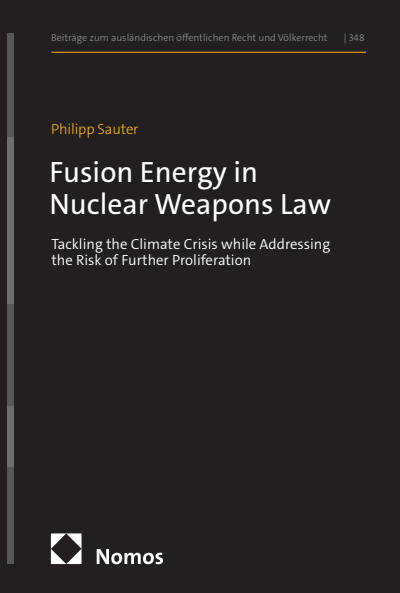
Fusion Energy in Nuclear Weapons Law
Tackling the Climate Crisis while Addressing the Risk of Further Proliferation- Authors:
- Series:
- Beiträge zum ausländischen öffentlichen Recht und Völkerrecht, Volume 348
- Publisher:
- 2026
Summary
This book explores how fusion energy, as a virtually inexhaustible and climate-friendly power source, could play a decisive role in addressing the climate crisis – while also posing security risks. Readers gain insights into the legal framework of international law, in particular the Non-Proliferation Treaty (NPT) and the role of the International Atomic Energy Agency (IAEA). The study highlights existing gaps in the nuclear weapons regime regarding fusion, examines possible approaches to closing them, and develops the idea of a dedicated fusion treaty. The book is aimed at researchers, students, and practitioners in international law and global security policy. This title is also available as Open Access.
Search publication
Bibliographic data
- Edition
- 1/2026
- Copyright Year
- 2026
- ISBN-Print
- 978-3-7560-3561-8
- ISBN-Online
- 978-3-7489-6621-0
- Publisher
- Nomos, Baden-Baden
- Series
- Beiträge zum ausländischen öffentlichen Recht und Völkerrecht
- Volume
- 348
- Language
- English
- Pages
- 330
- Product Type
- Monograph
Table of contents
ChapterPages
- Acknowledgments
- Table of Abbreviations
- 1 Fusion in International Law
- 2 Fusion in International Nuclear Law
- 3.1 The Interest to Study Nuclear Weapons Law
- 3.2 The Interest to Study Nuclear Proliferation
- 3.3 The Interest and Scope of This Study
- 4 Outline of the Book
- 1.1 Atom and its Nucleus
- 1.2 Isotopes
- 1.3 Radioactivity
- 1.4 Neutron Capture
- 2.1 Basics of Nuclear Fusion
- 2.2 Confinement Technologies
- 2.3 Fusionable Materials
- 2.4 Fusion in a Power Plant
- 2.5 The Road to Commercial Fusion Energy
- 3 Nuclear Fission
- 4.1 Tactical and Strategic Nuclear Weapons
- 4.2 Nuclear Weapons Delivery Systems
- 4.3.1 Pure Fission Bombs
- 4.3.2 Thermonuclear Weapons
- 5.1.1 Transmutation of Uranium and Thorium
- 5.1.2 From Fertile to Fissile Material with Fission
- 5.1.3 From Fertile to Fissile Material with Fusion
- 5.1.4 Advantages of Fusion for Plutonium Breeding
- 5.1.5 Limitations of Fusion as a Plutonium Provider
- 5.1.6 Safeguarding ITER
- 5.1.7 Fusion without Transmutation Potential?
- 5.2.1 Tritium Boosting of Fission Weapon
- 5.2.2 Tritium in Multi-Stage Devices
- 5.2.3 Tritium in Military Programmes and Civilian Nuclear Fuel Cycle
- 5.2.4 Tritium and Fusion Energy
- 5.3 Inertial Confinement Fusion
- 5.4 Fusion-Fission-Hybrid Systems
- 5.5 Fundamental Differences Between Fusion and Fission
- 5.6 Summary
- 1.1 Nuclear Weapons as a Tool for Deterrence and Coercion
- 1.2 Conflict between Security and Economy
- 2.1 Non-Proliferation Predating the IAEA
- 2.2.1 The IAEA’s Authority as Nuclear Watchdog
- 2.2.2 The IAEA’s Powers in Nuclear Non-Proliferation
- 2.3.1 The Cornerstone of Nuclear Non-Proliferation
- 2.3.2 Legal Framework of the NPT
- 2.4.1 Structure of Safeguards Agreements
- 2.4.2 Safeguards Predating the NPT
- 2.4.3 Comprehensive Safeguards Agreements and the Additional Protocol
- 2.4.4 Voluntary Offer Agreements
- 2.5.1 The European Route
- 2.5.2 Safeguards in Europe
- 2.6.1 Zangger Committee
- 2.6.2 Nuclear Suppliers Group
- 2.7.1.1 Setting an International Norm
- 2.7.1.2 Stopping Nuclear Weapons Programmes
- 2.7.2.1 Lack of Universality
- 2.7.2.2 Reactivity Instead of Proactivity
- 2.7.2.3.1 Implementation of Article VI
- 2.7.2.3.2 Legality of Nuclear Sharing
- 2.7.2.3.3 Legality of Nuclear Cooperation
- 2.7.2.3.4 Implementation of 1995 Extension Deal
- 2.7.2.3.5 Review of the NPT
- 2.7.3 Summary
- 3.1 Nuclear Disarmament and the United Nations
- 3.2 Disarmament within the NPT
- 3.3 Treaty on the Prohibition of Nuclear Weapons
- 3.4 NWFZ Treaties
- 4.1 Limitations of Safeguards
- 4.2.1.1 United States
- 4.2.1.2 Russia
- 4.2.1.3 United Kingdom
- 4.2.1.4 France
- 4.2.1.5 China
- 4.2.1.6 Summary
- 4.2.2 Nuclear Weapon States Outside the NPT
- 4.2.3 Non-Nuclear NATO States
- 4.2.4 Non-NATO States from the Global North
- 4.2.5 States from the Global South
- 4.2.6 Other States with Particular Interests
- 4.2.7 European Union and Euratom
- 4.2.8 IAEA
- 4.2.9 Summary
- 5 Summary
- 1.1.1 Fusion and Atoms for Peace and Development
- 1.1.2.1 Article III.A.5 of the IAEA Statute
- 1.1.2.2 Article XII of the IAEA Statute
- 1.1.2.3 Article XX of the IAEA Statute
- 1.1.3 Summary
- 1.2.1 Article I NPT
- 1.2.2 Article II NPT
- 1.2.3.1 Objective of Article III.1 NPT
- 1.2.3.2 Source or Special Fissionable Material
- 1.2.3.3 Principal Nuclear Facility
- 1.2.3.4 Summary
- 1.2.4 Export Controls: Article III.2 NPT
- 1.2.5 Summary
- 1.3.1.1 Nuclear Material
- 1.3.1.2 Facility
- 1.3.2 Additional Protocol to the CSA
- 1.3.3.1 Nuclear Material
- 1.3.3.2 Principal Nuclear Facility
- 1.3.4 Voluntary Offer Agreements
- 1.3.5 Summary
- 1.4 Summary
- 2.1 Scope of Export Control Groups
- 2.2 Material Application of the Guidelines
- 2.3 Procedural Application of the Guidelines
- 2.4 Summary
- 3.1 ITER Agreement
- 3.2 Fusion in the Euratom Treaty
- 3.3 Fusion and the TPNW
- 3.4.1 Treaty of Tlatelolco
- 3.4.2 Treaty of Rarotonga
- 3.4.3 Treaty of Bangkok
- 3.4.4 Treaty of Pelindaba
- 3.4.5 Treaty of Semipalatinsk
- 3.4.6 Summary
- 3.5 Summary
- 4.1 A Sprit but not an Obligation to Strengthen the Safeguards Regime
- 4.2 Summary of the Findings
- 1.1 Financial and Commercial Interests
- 1.2.1 NWS recognised the NPT
- 1.2.2 NWS outside the NPT
- 1.2.3 NNWS from the Global North
- 1.2.4 States from the Global South
- 1.2.5 European Union and Euratom
- 1.2.6 IAEA
- 1.2.7 Summary
- 2.1 Doctrinal Background
- 2.2.1 Source and Special Fissionable Material
- 2.2.2 Nuclear Facility
- 2.3 Implications to NWFZ and the TPNW
- 2.4 Euratom Treaty
- 2.5 Stocktaking and Limitations of Evolutionary Interpretation
- 3.1.1 Authority of the Board of Governors
- 3.1.2 Designate Materials
- 3.1.3 Designate Facilities
- 3.1.4 Establishing Committees and Advisory Groups
- 3.1.5 Call for Voluntary State Action
- 3.2.1 Authority of the IAEA Secretariat
- 3.2.2 Advisory Groups
- 3.2.3 Special Inspections
- 3.2.4 Interpreting the Safeguards Instruments
- 3.2.5 Evaluation of the Authorities of IAEA Bodies
- 3.3.1 Modifying Export Control Procedures
- 3.3.2 Safeguarding Inertial Confinement Fusion
- 3.3.3 Evaluation of the NSG’s Authority
- 3.4 NPT Review Conferences
- 3.5 TPNW Meeting of State Parties and Review Conferences
- 3.6 United Nations
- 3.7 Evaluation and Summary
- 4.1 General Considerations on Safeguarding Tritium
- 4.2.1 Amending the NPT and IAEA Statute
- 4.2.2 Second Additional Protocol to the CSA
- 4.3 International Tritium Control System
- 4.4 NWFZ Treaties
- 4.5 Euratom Treaty
- 4.6 Summary
- 5 Conclusion
- 1.1 Fusion is not Fission
- 1.2 The NPT as Pandora’s Box
- 1.3 Vertical Proliferation
- 1.4 Precedents
- 2.1 Politics of a Fusion Treaty
- 2.2.1 International Nuclear Law
- 2.2.2 Technical Assistance
- 2.2.3 Vertical Proliferation and Disarmament
- 2.2.4 Further Regulatory Aspects
- 2.2.5 Summary
- 2.3 Forum for Negotiation
- 2.4 Institutional Framework
- 2.5 Summary
- 3.1 The Question of Nuclear Weapon States
- 3.2 Legal Architecture of Fusion Safeguards
- 3.3.1 Gamma Radiation Detectors
- 3.3.2 Design Review and Monitoring of Energy Output
- 3.3.3 Physical Access to Fusion Facilities and Environmental Sampling
- 3.3.4 Satellite Imagery
- 3.4 Addressing the Risk of Tritium
- 3.5 Addressing the Risk of Knowledge Transfer in ICF
- 3.6 Relevance of Export Control Regimes
- 3.7 Summary
- 4 Conclusion
- Chapter 6: ConclusionPages 289 - 294 Download chapter (PDF)
- 1 Treaties
- 2.1 Permanent Court of International Justice
- 2.2 International Court of Justice
- 2.3 International Tribunal for the Law of the Sea
- 2.4 Arbitral Awards
- 2.5 Court of Justice of the European Union
- 3 Resolutions
- 4.1.1 Information Circular
- 4.1.2 Board of Governors
- 4.1.3 General Conference
- 4.2 United Nations
- 4.3 NPT
- 5 Figures
- 6 Literature