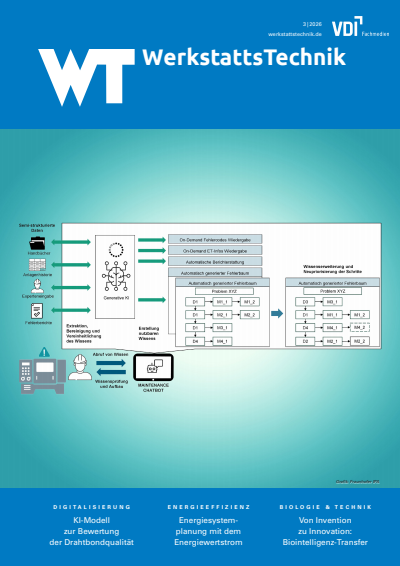
Sustainable industrial manufacturing can be significantly enhanced using data-driven, AI-supported systems. This paper presents a platform based on the three Zero³ dimensions: Zero Human Potential Loss, Zero Resource Loss, and Zero Data Loss. Using...
Large Language Models (LLMs) have quickly become a central component of digital transformation. While their use is widespread in customer service, marketing and sales, the question arises as to what potential LLMs offer in the production...
This article presents a methodology for autonomous cyber defence in Industry 4.0 environments, linking organisational risk management with generative AI. Combining LLMs, RAG, and standardised SOPs creates, a structured decision-making process that...
Implementing AI in manufacturing does not necessarily fail because of model creation but is often due to a lack of reliable operation within production environments. AI Asset Management for Manufacturing (AIM4M) is a process model for the AI...
In production engineering, CNC-controlled manufacturing cells are increasingly extended to include CNC-controlled robots. However, CNC controllers do not provide functions for planning collision-free motion paths. The Robot Operating System (ROS)...
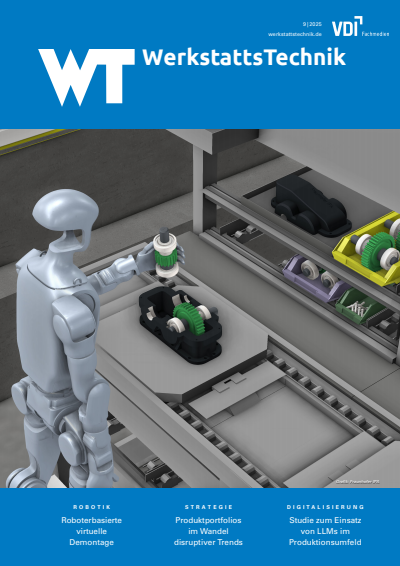
Data from CAE-based vehicle development enables planning, validation, and execution of automated disassembly and sorting according to R-strategies (reuse, recycle, recover, etc.). This paper addresses automated disassembly simulation, based on...
Disruptive trends such as digitalization or the sustainability transition are changing the requirements for product portfolio management. This paper develops a reference model and evaluation method that integrates financial and qualitative factors....
Similar to other sectors, the manufacturing industry in Germany is faced by challenges. They include a shortage of skilled labor, rapid advancements in value creation systems, demographic shifts, and an increased willingness to change jobs. This...
The paper introduces the “One Stop Autonomization” approach, based on embodied, generative AI agents. These humanoid robots act flexibly in real-world environments, enabling scalable, safe, and human-centric automation. Emphasis is placed on...