, to see if you have full access to this publication.
Monograph No access
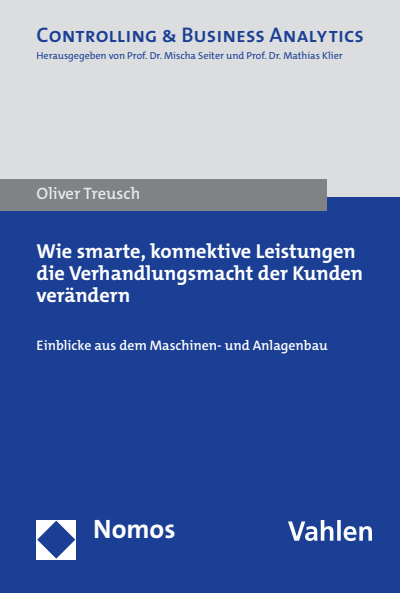
Wie smarte, konnektive Leistungen die Verhandlungsmacht der Kunden verändern
Einblicke aus dem Maschinen- und Anlagenbau- Authors:
- Series:
- Controlling Praxis
- Publisher:
- 2021
Keywords
Search publication
Bibliographic data
- Edition
- 1/2021
- Copyright Year
- 2021
- ISBN-Print
- 978-3-8487-8267-3
- ISBN-Online
- 978-3-7489-2067-0
- Publisher
- Nomos, Baden-Baden
- Series
- Controlling Praxis
- Language
- German
- Pages
- 312
- Product Type
- Monograph
Table of contents
ChapterPages
- Titelei/Inhaltsverzeichnis No access Pages 1 - 24
- 1.1 Problemstellung und Forschungsfrage No access
- 1.2 Zielsetzung und Vorgehensweise No access
- 1.3 Aufbau der Arbeit No access
- 2.1 Vorgehen zur Entwicklung des begrifflichen Bezugsrahmens No access
- 2.2 Definition: Kunde No access
- 2.3 Definition: Verhandlung No access
- 2.4 Definition: Industrielle Verhandlungen No access
- 2.5 Definition: Verhandlungsmacht No access
- 2.6 Definition: Industrie 4.0, Industrial Internet und das Internet of Things No access
- 2.7 Definition: Das smarte, konnektive Produkt No access
- 3.1 Ressourcenorientierte Perspektive No access
- 3.2 Transaktionskostenorientierte Perspektive No access
- 3.3.1 SCP-Paradigma der Industrieökonomie No access
- 3.3.2 Porter’s Five Forces – Branchenstrukturanalyse No access
- 3.3.3 Branchenorientierte Perspektive und generische Strategien No access
- 3.3.4 Kritische Würdigung der branchenorientierten Perspektive No access
- 4.1 Zielsetzung und Aufbau des Kapitels No access
- 4.2 Vorgehen zur Entwicklung des theoriebasierten Erklärungsmodells No access
- 4.3 Entwicklung des übergeordneten theoretischen Bezugsrahmens (Strukturmodell) No access
- 4.4.1 Konstrukt der Kundenkonzentration No access
- 4.4.2 Konstrukt der Produktdifferenzierung No access
- 4.4.3 Konstrukt der Wechselkosten No access
- 4.4.4 Konstrukt der Preisempfindlichkeit der Kunden No access
- 4.4.5 Konstrukt der Gefahr von Rückwärtsintegration No access
- 4.4.6 Konstrukt der Markttransparenz No access
- 4.5 Zusammenfassung des Erklärungsmodells No access
- 5.1 Zielsetzung und Aufbau des Kapitels No access
- 5.2 Vorgehen der empirischen Prüfung No access
- 5.3.1 Auswahl der statistischen Analysemethode No access
- 5.3.2 Aufbau von Strukturgleichungsmodellen No access
- 5.3.3 Partial Least Squares Strukturgleichungsmodellierung No access
- 5.3.4.1 Evaluation der Messmodelle No access
- 5.3.4.2 Evaluation reflektiver Messmodelle No access
- 5.3.4.3 Evaluation formativer Messmodelle No access
- 5.3.4.4 Evaluation des Strukturmodells No access
- 5.3.4.5 Zusammenfassung der Schemata zur Evaluation No access
- 5.3.4.6 Multigruppenanalyse No access
- 5.4.1 Der Operationalisierungsprozess No access
- 5.4.2 Kundenkonzentration No access
- 5.4.3 Produktdifferenzierung No access
- 5.4.4 Wechselkosten No access
- 5.4.5 Preisempfindlichkeit der Kunden No access
- 5.4.6 Gefahr von Rückwärtsintegration No access
- 5.4.7 Markttransparenz No access
- 5.4.8 Konnektivität No access
- 5.4.9 Verhandlungsmacht der Kunden No access
- 5.4.10 Kontrollvariablen No access
- 5.4.11 Zusammenfassung des Modells No access
- 5.5.1 Entwicklung des Fragebogens No access
- 5.5.2 Untersuchungsobjekte und Datenerhebung No access
- 5.5.3 Überprüfung von Fehlerquellen und Verzerrungen No access
- 5.6.1 Vorbereitung der Datenanalyse No access
- 5.6.2 Durchführung der Datenanalyse No access
- 5.6.3.1 Evaluation reflektiv spezifizierter Messmodelle No access
- 5.6.3.2 Evaluation formativ spezifizierter Messmodelle No access
- 5.6.4.1 Evaluation des Strukturmodells Gesamtmodell No access
- 5.6.4.2 Evaluation des Strukturmodells Gruppe Konnektiv No access
- 5.6.4.3 Evaluation des Strukturmodells Gruppe Nicht konnektiv No access
- 5.6.4.4 Evaluation der Strukturmodelle mittels Multigruppenanalyse No access
- 5.6.5 Hypothesenprüfung No access
- 5.6.6 Ergebnisdiskussion No access
- 6.1 Zielsetzung und Vorgehen der Entwicklung der Handlungsempfehlungen No access
- 6.2 Methodische Grundlagen der explorativen Datenanalyse zur Ableitung von Handlungsempfehlungen No access
- 6.3.1 Explorative Analyse der Produktdifferenzierung No access
- 6.3.2 Explorative Analyse der Wechselkosten No access
- 6.4.1 Handlungsempfehlungen zur Kundenkonzentration No access
- 6.4.2 Handlungsempfehlungen zur Produktdifferenzierung No access
- 6.4.3 Handlungsempfehlungen zu Wechselkosten No access
- 6.4.4 Handlungsempfehlungen zur Preisempfindlichkeit No access
- 6.4.5 Handlungsempfehlungen zur Gefahr der Rückwärtsintegration No access
- 6.4.6 Handlungsempfehlungen zur Markttransparenz No access
- 7.1 Ergebniszusammenfassung No access
- 7.2 Limitationen und weiterer Forschungsbedarf No access
- Anhang. Experteninterviews zur Validierung der Ergebnisse undHandlungsempfehlungen No access Pages 265 - 272
- Literaturverzeichnis No access Pages 273 - 312
Bibliography (666 entries)
No match found. Try another term.
- Aaker, D. (1992): The Value of Brand Equity, In: Journal of Business Strategy, Vol. 13, S. 27-32. Open Google Scholar DOI: 10.5771/9783748920670
- Aaker, D. (2003): The power of the brand differentiator, In: Sloan Management Review, Vol. 45, Nr. 1, S. 83-87. Open Google Scholar DOI: 10.5771/9783748920670
- Abosag, I./ Yen, D. A./ Barnes, B. R. (2016): What is dark about the dark-side of business relationships?, In: Industrial Marketing Management, Vol. 55, S. 5-9. Open Google Scholar DOI: 10.5771/9783748920670
- Abramovici, M./ Otthein, H. (2016): Engineering im Umfeld von Industrie 4.0 – Einschätzungen und Handlungsbedarf, acatech Studie, https://www.acatech.de/wp-content/uploads/2018/03/acatech_STUDIE_Engineering40_WEB.pdf, zuletzt aufgerufen am 02.07.2020. Open Google Scholar DOI: 10.5771/9783748920670
- Acatech (Hrsg.; 2011): Cyber-Physical Systems – Innovationsmotor für Mobilität, Gesundheit, Energie und Produktion (acatech POSITION), Springer, Heidelberg. Open Google Scholar DOI: 10.5771/9783748920670
- Acatech (Hrsg.; 2015): Smart Service Welt - Umsetzungsempfehlungen für das Zukunftsprojekt Internetbasierte Dienste für die Wirtschaft, Abschlussbericht, Berlin. https://www.acatech.de/wp-content/uploads/2014/03/Bericht_SmartService_final_barrierefrei_DE.pdf, zu-letzt aufgerufen am 02.07.2020. Open Google Scholar DOI: 10.5771/9783748920670
- Adelman, M. A. (1955): Concept and Statistical Measurement of Vertical Integra-tion, In: Business Concentration and Price Policy (1955), S. 281-330. Open Google Scholar DOI: 10.5771/9783748920670
- Adler, J. (1996): Informationsökonomische Fundierung von Austauschprozes-sen, Springer, Wiesbaden. Open Google Scholar DOI: 10.5771/9783748920670
- Aggarwal, C.-C. (2015): Data Mining, Springer, Heidelberg. Open Google Scholar DOI: 10.5771/9783748920670
- Akkaya, I./ Derler, P./ Emoto, S./ Lee, EA. (2016): Systems Engineering for Indus-trial Cyber-Physical Systems Using Aspects, In: Proceedings of the IEEE, 104(5), https://escholarship.org/uc/item/64k3w3tp, zuletzt aufgerufen am 02.07.2020. Open Google Scholar DOI: 10.5771/9783748920670
- Alba, Joseph W. and J. Wesley Hutchinson. 1987. "Dimensions of Consumer Expertise" Journal of Consumer Research 13 (March): 411-454. Open Google Scholar DOI: 10.5771/9783748920670
- Aldrich, H. E. (1972): Technology and Organization Structure: A Reexamina-tion of the Findings of the Aston Group, In: Administrative Science Quarterly, Vol. 17, S. 26-43. Open Google Scholar DOI: 10.5771/9783748920670
- Alexander, J. F./ Schul, P. L./ McCorkle, D. E. (1994): An Assessment of Se-lected Relationships in a Model of the Industrial Marketing Negotiation Pro-cess, In: Journal of Personal Selling & Sales Management, Vol. 14, Nr. 3, S. 25-41. Open Google Scholar DOI: 10.5771/9783748920670
- Alfaro, L./ Conconi, P./ Fadinger, H./ Newman, A. F. (2016): Do Prices Deter-mine Vertical Integration?, In: Review of Economic Studies (2016) 0, S. 1-34. Open Google Scholar DOI: 10.5771/9783748920670
- Alisch, L.-M. (2005): Über die (Wechsel-)Beziehung zwischen Entdeckungs-, Begründungs- und Verwendungszusammenhang wissenschaftlicher Sätze, In: Heid, H./ Harteis, C. (Hrsg.): Verwertbarkeit – ein Qualitätskriterium (erzie-hungs-)wissenschaftlichen Wissens?, VS Verlag, Wiesbaden, S. 55-78. Open Google Scholar DOI: 10.5771/9783748920670
- Alvarez-Suescun, E. (2007): Testing resource-based propositions about IS sourcing decisions, In: Industrial Management & Data Systems, Vol. 107, Nr. 6, S. 762-779. Open Google Scholar DOI: 10.5771/9783748920670
- Amit, R./ Schoemaker, P. (1993): Strategic Assets and Organizational Rent, In: Strategic Management Journal, Vol. 14, Nr. 1, S. 33-46. Open Google Scholar DOI: 10.5771/9783748920670
- Amoako-Gyampah, K./ Acquaah, M. (2008): Manufacturing strategy, competi-tive strategy and firm performance: An empirical study in a developing econo-my environment, In: International Journal of Production Economics, Vol. 111, S. 575-592. Open Google Scholar DOI: 10.5771/9783748920670
- Andal-Ancion, A./ Cartwright, P. A./ Yip, G (2003): The Digital Transformation of Traditional Businesses, In: MIT Sloan Management Review, Vol 44, Nr. 4, S. 34-41. Open Google Scholar DOI: 10.5771/9783748920670
- Andaleeb, S. S. (1996): An Experimental Investigation of Satisfaction and Commitment in Marketing Channels: The Role of Trust and Dependance, In: Journal of Retailing, Vol. 72, Nr. 1, S. 77-93. Open Google Scholar DOI: 10.5771/9783748920670
- Anderson, J. C./ Gerbing, D. W. (1988): Structural Equation Modeling in Prac-tice: A Review and Recommended Two Step Approach, In: Psychological Bul-letin, Vol. 103, Nr. 3, S. 411-423. Open Google Scholar DOI: 10.5771/9783748920670
- Anderson, E./ Weitz, B. A. (1989): Determinants of Continuity in Conventional Industrial Channel Dyads, In: Marketing Science, Vol. 8, Nr. 4, S. 310-323. Open Google Scholar DOI: 10.5771/9783748920670
- Anderson, E./ Weitz, B. A. (1992): The Use of Pledges to Build and Sustain Commitment in Distribution Channels, In: Journal of Marketing Research, Vol. 29, S. 18-34. Open Google Scholar DOI: 10.5771/9783748920670
- Anderson, E./ Sullivan, M. W. (1993): The Antecedents and Consequences of Customer Satisfaction for Firms, In: Marketing Science, Vol. 12, S. 125-143. Open Google Scholar DOI: 10.5771/9783748920670
- Anderson, E. W. (1994): Cross-Category Variation in Customer Satisfaction and Retention, In: Marketing Letters, Vol. 5, Nr. 1, S. 19-30. Open Google Scholar DOI: 10.5771/9783748920670
- Anderson, E. W. (1996): Customer satisfaction and price tolerance, In: Market-ing Letters, Vol. 7, Nr. 3, 19-30. Open Google Scholar DOI: 10.5771/9783748920670
- Anglin, L. K./ Stuenkel, J. K./ Lepisto, L. R. (1994): The Effect of Stress on Price Sensitivity and Comparison Shopping, In: Advances in Consumer Research, Vol. 21, S. 126-131. Open Google Scholar DOI: 10.5771/9783748920670
- Angrish, A./ Starly, B./ Lee, Y.-S./ Cohen, P. H. (2017): A flexible data schema and system architecture for the virtualization of manufacturing machines (VMM), In: Journal of Manufacturing Systems, Vol. 45, S. 236-247. Open Google Scholar DOI: 10.5771/9783748920670
- Argyres,N. S. (1996): Evidence on the role of firm capabilities in vertical integra-tion Decisions, In: Strategic Management Journal, Vol. 17, Nr. 2, S. 129-159. Open Google Scholar DOI: 10.5771/9783748920670
- Argyres, N. S./ Liebeskind, J. P. (1999): Contractual Commitments, Bargaining Power, and Governance Inseparability: Incorporating History into Transaction Cost Theory, In: The Academy of Management Review, Vol. 24, Nr. 1, S. 49-63. Open Google Scholar DOI: 10.5771/9783748920670
- Armstrong, C./ Shimizu, K. (2007): A review of approaches to empirical research on the resource-based view of the firm, In: Journal of Management, Vol. 33, Nr. 6, S. 959-986. Open Google Scholar DOI: 10.5771/9783748920670
- Arnott, D. C. (2007): Trust – current thinking and future research, In: European Journal of Marketing, Vol. 41 (9/10), S. 981-987. Open Google Scholar DOI: 10.5771/9783748920670
- Ashton, K. (2009): That „Internet of Things“ Thing, In: RFID Journal, Juni 2009. Open Google Scholar DOI: 10.5771/9783748920670
- Atzori, L./ Iera, A./ Morabito, G. (2010): The Internet of Things - A survey, In: Computer Networks, Nr. 54, S. 2787-2805. Open Google Scholar DOI: 10.5771/9783748920670
- Auger, P./ Devinney, T. M./ Louviere, J. J./ Burke, P. F. (2010), The importance of social product attributes in consumer purchasing decisions: A multi-country comparative study, In: International Business Review, Vol. 19, S. 140-159. Open Google Scholar DOI: 10.5771/9783748920670
- Bachmann, R./ Zaheer, A. (2006): Introduction, In: Bachmann, R./ Zaheer, A. [Hrsg.]: Handbook of Trust Research, Edward Elgar, Northampton MA. Open Google Scholar DOI: 10.5771/9783748920670
- Backhaus, K./ Günter, B. (1976): A Phase-differentiated Interaction Approach to Industrial Marketing Decisions, In: Industrial Marketing Management, Vol. 5, Nr. 4, S. 255-270. Open Google Scholar DOI: 10.5771/9783748920670
- Backhaus, K./ Plinke, W. (1978): Der Einfluss von Kosteninformationen auf Preisentscheidungen, Arbeitspapier zum Marketing Ruhr-Universität Bochum, Nr. 3/1978. Open Google Scholar DOI: 10.5771/9783748920670
- Backhaus, K./ Voeth, M. (2007): Industriegütermarketing, 8. Auflage, Vahlen, München. Open Google Scholar DOI: 10.5771/9783748920670
- Backhaus, K./ Voeth, M. (2014): Industriegütermarketing, 10. Auflage, Vahlen, München. Open Google Scholar DOI: 10.5771/9783748920670
- Backhaus, K./ Erichson, B./ Weiber, R. (2015): Fortgeschrittene Multivariate Ana-lysemethoden – Eine anwendungsorientierte Einführung, 3. Auflage, Springer Gabler, Berlin. Open Google Scholar DOI: 10.5771/9783748920670
- Backhaus, K./ Erichson, B./ Plinke, W./ Weiber, R. (2016): Multivariate Analyse-methoden – Eine anwendungsorientierte Einführung, 14. Auflage, Springer Ga-bler, Berlin. Open Google Scholar DOI: 10.5771/9783748920670
- Bagheri, B./ Yang, S./ Kao, H.-A./ Lee, J. (2015): Cyber-physical Systems Archi-tecture for Self-Aware Machines in Industry 4.0 Environment, In: IFAC-Papers Online 48-3 (2015), S. 1622-1627. Open Google Scholar DOI: 10.5771/9783748920670
- Bagozzi, R./ Yi, Y. (1988): On the evaluation of structural equation models, In: Journal of the Academy of Marketing Science, Vol. 16, Nr. 1, S. 74-94. Open Google Scholar DOI: 10.5771/9783748920670
- Baheti, R./ Gill, H. (2011): Cyber-physical systems, In: The Impact of Control Technology 2011, S. 1-6. Open Google Scholar DOI: 10.5771/9783748920670
- Bain, J. S. (1956): Barriers to New Competition: Their character and conse-quences in manufacturing industries, Harvard University Press, Cambridge. Open Google Scholar DOI: 10.5771/9783748920670
- Bain, J. S. (1968): Industrial Organisation, Wiley, New York City. Open Google Scholar DOI: 10.5771/9783748920670
- Baker, W. E./ Sinkula, J. M. (2005): Environmental Marketing Strategy and Firm Performance: Effects on New Product Performance and Market Share, In: Jour-nal of the Academy of Marketing Science, Vol. 33, Nr. 4, S. 461-475. Open Google Scholar DOI: 10.5771/9783748920670
- Balakrishnan, S./ Koza, M. P. (1993): Information asymmetry, adverse selection and joint-ventures: Theory and evidence, In: Journal of Economic Behavior & Organization, Vol. 20, Nr. 1, S. 99-117. Open Google Scholar DOI: 10.5771/9783748920670
- Ball, L./ Romer, D. (2003): Inflation and the Informativeness of Prices, In: Journal of Money, Credit and Banking, Vol. 35, Nr. 2, S. 177-196. Open Google Scholar DOI: 10.5771/9783748920670
- Balmer, J. M. T. (1995): Corporate Branding and Connoisseurship, In: Journal of General Management, Vol. 21, Nr. 1, S. 24-46. Open Google Scholar DOI: 10.5771/9783748920670
- Barclay, D./ Higgins, C./ Thompson, R. (1995): The Partial Least Squares (PLS) Approach to Causal Modeling: Personal Computer adoption and Use as an Il-lustration, In: Technology Studies (1995), Vol. 2, Nr. 2, S. 285-309. Open Google Scholar DOI: 10.5771/9783748920670
- Barney, J. B. (1986): Types of Competition and the Theory of Strategy: Toward an Integrative Framework, In: The Academy of Management Review, Vol. 11, Nr. 4 (Okt., 1986), S. 791-800. Open Google Scholar DOI: 10.5771/9783748920670
- Barney, J. B. (1991): Firm Resources and Sustained Competitive Advantage, In: Journal of Management, Vol 17, Nr. 1, S. 99-120. Open Google Scholar DOI: 10.5771/9783748920670
- Barney, J. B./ Ketchen Jr., D. J./ Wright, M. (2011): The Future of Resource-Based Theory: Revitalization or Decline?, In: Journal of Management, Vol. 37, Nr. 5, S. 1299-1315. Open Google Scholar DOI: 10.5771/9783748920670
- Baron, R. M./ Kenny, D. A. (1986): The moderator-mediator variable distinction in social psychological research: Conceptual, strategic and statistical considera-tions, In: Journal of Personality and Social Psychology, Vol. 51, Nr. 6, S. 1173-1182. Open Google Scholar DOI: 10.5771/9783748920670
- Barroso, C./ Picón, A. (2012): Multi-dimensional analysis of perceived switching costs, In: Industrial Marketing Management, Vol. 41, Nr. 3, S. 531-543. Open Google Scholar DOI: 10.5771/9783748920670
- Basdeo, D. K./ Smith, K. G./ Grimm, C. M./ Rindova, V. P./ Derfus, P. J. (2006): The Impact of Market Actions on Firm Reputation, In: Strategic Management Journal, Vol. 27, Nr. 12, S. 1205-1219. Open Google Scholar DOI: 10.5771/9783748920670
- Batista, L./ Davis-Poynter, S./ Ng, I./ Maull, R. (2017): Servitization through out-come-based contract – A systems perspective from the defence industry, In: In-ternational Journal of Production Economics, Vol. 192, S. 133-143. Open Google Scholar DOI: 10.5771/9783748920670
- Bauer, W./ Schlund, S./ Marrenbach, D./ Ganschar, O. (2014): Industrie 4.0 – Volkswirtschaftliches Potenzial für Deutschland, Studie von BITKOM und Fraunhofer IAO, https://www.bitkom.org/sites/default/files/file/import/Studie-Industrie-40.pdf, zuletzt aufgerufen am 02.07.2020. Open Google Scholar DOI: 10.5771/9783748920670
- Bauernhansl, T./ ten Hompel, M./ Vogel-Heuser, B. (Hrsg.) (2014): Industrie 4.0 in Produktion, Automatisierung und Logistik, Springer Vieweg, Wiesbaden. Open Google Scholar DOI: 10.5771/9783748920670
- Bayón, T. (1997): Neuere Mikroökonomie und Marketing, Springer, Wiesbaden. Open Google Scholar DOI: 10.5771/9783748920670
- Bazerman, M. H./ Neale, M. A. (1985), The Effects of Framing and Negotiator Overconfidence on Bargaining Behaviors and Outcomes, In: Academy of Man-agement Journal, Vol. 28, Nr. 1, S. 34-49. Open Google Scholar DOI: 10.5771/9783748920670
- Bazerman, M. H./ Carroll, J. (1987): Negotiator Cognition, In: Research in Organ-izational Behavior, Vol. 9, S. 247-288. Open Google Scholar DOI: 10.5771/9783748920670
- Bea, F. X./ Haas, J. (2013): Strategisches Management, 6. Auflage, UTB, Stutt-gart. Open Google Scholar DOI: 10.5771/9783748920670
- Beck, V. (2008): Volkswirtschaft verstehen, 5. Auflage, vdf Hochschulverlag, Zü-rich. Open Google Scholar DOI: 10.5771/9783748920670
- Beggs, A./ Klemperer, P. (1992): Multi-Period Competition With Switching Costs, In: Econometrica, Vol. 60, Nr. 3, S. 651-666. Open Google Scholar DOI: 10.5771/9783748920670
- Bell, S. J./ Auh, S./ Smalley, K. (2005): Customer Relationship Dynamics: Ser-vice Quality and Customer Loyalty in the Context of Varying Levels of Customer Expertise and Switching Costs, In: Journal of the Academy of Marketing Sci-ence, Vol. 33, Nr. 2, S. 169-183. Open Google Scholar DOI: 10.5771/9783748920670
- Benedettini, O./ Swink, M./ Neely, A. (2017): Examining the influence of service additions on manufacturing firms' bankruptcy likelihood, In: Industrial Marketing Management, Vol. 60, S. 112-125. Open Google Scholar DOI: 10.5771/9783748920670
- Benedixen, M./ Bukasa, K. A./ Abratt, R. (2004): Brand equity in the business-to-business market, In: Industrial Marketing Management, Vol. 33, S. 371-380. Open Google Scholar DOI: 10.5771/9783748920670
- Bengtsson, N./ Michaloski, J./ Proctor, F./ Shao, G./ Venkatesh, S. (2010): To-wards Data-Driven Sustainable Machining – Combining MTConnect Production Data and Discrete Event Simulation, In: Proceedings of ASME 2010 Internation-al Manufacturing Science and Engineering Conference MSEC 2010 Oktober 12–15, 2010, Erie, Pennsylvania, S. 1-9. Open Google Scholar DOI: 10.5771/9783748920670
- Benkenstein, M./ Henke, N. (1993): Der Grad vertikaler Integration als strategi-sches Entscheidungsproblem – Eine transaktionskostentheoretische Interpreta-tion, In: Die Betriebswirtschaft, Heft 1, 1993, S. 77-91. Open Google Scholar DOI: 10.5771/9783748920670
- Berger, J. O./ Sellke, T. (1987): Testing a point null hypothesis: The irreconcila-bility of p-values and evidence, In: Journal of the American statistical Associa-tion, Vol. 82, Nr. 397, S. 112-122. Open Google Scholar DOI: 10.5771/9783748920670
- Bergweiler, S. (2015): Intelligent Manufacturing based on Self-Monitoring Cyber-Physical Systems, UBICOMM 2015: The Ninth International Conference on Mobile Ubiquitous Computing, Systems, Services and Technologies, S. 108-113. Open Google Scholar DOI: 10.5771/9783748920670
- Bernheim, B. D./ Whinston, M. D. (1986): Menu auctions, resource allocation, and economic influence, In: Quarterly Journal of Economics, Vol. 101, Nr. 1, S. 1-31. Open Google Scholar DOI: 10.5771/9783748920670
- Berry, L. L. (1996): Retailers with a future – Five benefits distinguish companies that compete on value, In: Marketing Management, Vol. 5, S. 39-46. Open Google Scholar DOI: 10.5771/9783748920670
- Besozzi, C./ Zehnpfennig, H. (1976): Methodologische Probleme der Index- Open Google Scholar DOI: 10.5771/9783748920670
- Bildung, In: von Koolwijk, J. /Wieken-Mayser, M. (Hrsg.): Techniken der empiri-schen Sozialforschung 5: Testen und Messen, Oldenbourg, München, S. 9-55. Open Google Scholar DOI: 10.5771/9783748920670
- Bester, H. (1993): Bargaining versus Price Competition in Markets with Quality Uncertainty, In: The American Economic Review, Vol. 83, Nr. 1, S. 278-288. Open Google Scholar DOI: 10.5771/9783748920670
- Bethlehem, J. (2010): Selection Bias in Web Surveys, In: International Statistical Review, Vol. 78, Nr. 2, S. 161-188. Open Google Scholar DOI: 10.5771/9783748920670
- Bettman, J. R. (1973): Perceived Risk and Its Components: A Model and Empiri-cal Test, In: Journal of Marketing Research, Vol. 10, S. 184-190. Open Google Scholar DOI: 10.5771/9783748920670
- Betz, S. (1996): Gestaltung der Leistungstiefe als strategisches Problem, In: Die Betriebswirtschaft (DBW), 56. Jg., Heft 3, 1996, S. 399-412. Open Google Scholar DOI: 10.5771/9783748920670
- Beverungen, D./ Müller, O./ Matzner, M./ Mendling, J./ vom Brocke, J. (2019): Conceptualizing smart service systems, In: Electronic Markets, Vol. 29, S. 7-18. Open Google Scholar DOI: 10.5771/9783748920670
- Bielert, P. (1997), Gewinnorientierte Planung der Produktqualität, Gabler, Wies-baden. Open Google Scholar DOI: 10.5771/9783748920670
- Bingham, F. G./ Raffield, B. T. (1990): Business to Business Marketing Manage-ment, Irwin Professional Publishing, Burr Ridge. Open Google Scholar DOI: 10.5771/9783748920670
- Bingham, F. G./ Gomes, R./ Knowles, P. A. (2005): Business Marketing, McGraw Hill, New York City. Open Google Scholar DOI: 10.5771/9783748920670
- BITKOM (2012): Big Data im Praxiseinsatz – Szenarien, Beispiele, Effekte, https://www.bitkom.org/sites/default/files/file/import/BITKOM-LF-big-data-2012-online1.pdf, zuletzt aufgerufen am 02.07.2020. Open Google Scholar DOI: 10.5771/9783748920670
- BITKOM (2016): Industrie 4.0 - Status und Perspektiven, https://www.bitkom.org/sites/default/files/file/import/160421-LF-Industrie-40-Status-und-Perspektiven.pdf, zuletzt aufgerufen am 02.07.2020. Open Google Scholar DOI: 10.5771/9783748920670
- Blau, P. M. (1964): Exchange and Power in Social Life, Wiley, New York City. Open Google Scholar DOI: 10.5771/9783748920670
- Blau, P./ McHugh-Falbe, C./ McKinley, W./ Phelps, T. (1976): Technology and Organization in Manufacturing, In: Administrative Science Quarterly, Vol. 21, S. 20-40. Open Google Scholar DOI: 10.5771/9783748920670
- Blümle, G. (1975): Theorie der Einkommensverteilung – Eine Einführung, Springer, Berlin. Open Google Scholar DOI: 10.5771/9783748920670
- Blut, M./ Evanschitzky, H./ Vogel, V./ Ahlert, D. (2007): Switching Barriers in the Four-Stage Loyalty Model, In: Advances in Consumer Research – North Ameri-can Conference Proceedings, Vol. 34, S. 726-734. Open Google Scholar DOI: 10.5771/9783748920670
- Blut, M./ Evanschitzky, H./ Backhaus, C./ Rudd, J./ Marck, M. (2016): Securing business-to-business relationships: The impact of switching costs, In: Industrial Marketing Management, Vol. 52, S. 82-90. Open Google Scholar DOI: 10.5771/9783748920670
- Böhler, T. (2015): Echtzeit-Informationen über den Maschinenzustand, https://www.produktion.de/technik/it/echtzeit-informationen-ueber-den-maschinenzustand-124.html, zuletzt aufgerufen am 02.07.2020. Open Google Scholar DOI: 10.5771/9783748920670
- Böhm, E./ Eggert, A./ Thiesbrummel, C. (2017): Service transition: A viable op-tion for manufacturing companies with deteriorating financial performance?, In: Industrial Marketing Management, Vol. 60, S. 101-111. Open Google Scholar DOI: 10.5771/9783748920670
- Bollen, K. A. (1989): Structural Equations with Latent Variables, John Wiley & Sons, S. 179-225. Open Google Scholar DOI: 10.5771/9783748920670
- Bolton, R. N. (1989): The Relationship Between Market Characteristics and Promotional Price Elasticities, In: Marketing Science, Vol. 8, Nr. 2, S. 153-169. Open Google Scholar DOI: 10.5771/9783748920670
- Bolton, R. N. (1993): Pretesting Questionnaires: Content Analyses of Respond-ents' Concurrent Verbal Protocols, In: Marketing Science, Vol. 12, Nr. 3, S. 280-303. Open Google Scholar DOI: 10.5771/9783748920670
- Bolton, R. N./ Lemon, K. N. (1999): A dynamic model of customers' usage of ser-vices: Usage as an antecedent and consequence of satisfaction, In: Journal of Marketing Research, Vol. 36, Nr. 2, S. 171-186. Open Google Scholar DOI: 10.5771/9783748920670
- Bonoma, T. V./ Jonston, W. J. (1978): The Social Psychology of Industrial Buying and Selling, In: Industrial Marketing Management, Vol. 7, Nr. 4, S. 213-224. Open Google Scholar DOI: 10.5771/9783748920670
- Botta, A./ de Donato, W./ Persico, V./ Pescapé, A. (2016): Integration of Cloud computing and Internet of Things: A survey, In: Future Generation Computer Systems, Vol. 56, S. 684-700. Open Google Scholar DOI: 10.5771/9783748920670
- Boueé, C.-E./ Schaible, S. (2015): Die digitale Transformation der Industrie, https://bdi.eu/publikation/news/die-digitale-transformation-der-industrie/, zuletzt aufgerufen am 02.07.2020. Open Google Scholar DOI: 10.5771/9783748920670
- Boulding, W./ Lee, E./ Staelin, R. (1994): Mastering the Mix: Do Advertising, Promotion, and Sales Force Activities Lead to Differentiation, In: Journal of Mar-keting Research, Vol. 31, S. 159-172. Open Google Scholar DOI: 10.5771/9783748920670
- Bowersox, D. J./ Closs, D. J./ Drayer, R. (2005): The Digital Transformation: Technology and Beyond, In: Supply Chain Management Review, Vol. 9, Nr. 1, S. 22-29. Open Google Scholar DOI: 10.5771/9783748920670
- Bowman, C./ Ambrosini, V. (2007): Identifying valuable resources, In: European Management Journal, Vol. 25, Nr. 4, S. 320-329. Open Google Scholar DOI: 10.5771/9783748920670
- Boyd, T. C./ Mason, C. H. (1999): The Link Between Attractiveness of "Ex-trabrand" Attributes and the Adoption of Innovations, In: Journal of the Academy of Marketing Science, Vol. 27, Nr. 3, S. 306-319. Open Google Scholar DOI: 10.5771/9783748920670
- Brax, S. A. /, Visintin, F. (2017): Meta-model of servitization: The integrative pro-filing approach, In: Industrial Marketing Management, Vol. 60 (2017), S. 17-32. Open Google Scholar DOI: 10.5771/9783748920670
- Brockhoff, K. (1993): Produktpolitik, 4. Auflage, UTB, Stuttgart. Open Google Scholar DOI: 10.5771/9783748920670
- Bromiley, P./ Rau, D. (2014): Towards a practice-based view of strategy, In: Stra-tegic Management Journal, http://escholarship.org/uc/item/1z04d5mw, zuletzt aufgerufen am 02.07.2020. Open Google Scholar DOI: 10.5771/9783748920670
- Brown, B. P./ Zablah, A. R./ Bellenger, D. N./ Johnston, W. J. (2011): When do B2B brands influence the decision making of organizational buyers? An exami-nation of the relationship between purchase risk and brand sensitivity, In: Inter-national Journal of Research in Marketing, Vol. 28, S. 194-204. Open Google Scholar DOI: 10.5771/9783748920670
- Brucks, M./ Zeithaml, V. A./ Naylor, G. (2000): Price and Brand Name as Indica-tors of Quality Dimensions for Consumer Durables, In: Journal of the Academy of Marketing Science, Vol. 28, Nr. 3, S. 359-374. Open Google Scholar DOI: 10.5771/9783748920670
- Büchel, B. (2003): Managing Partner Relationships in Joint Ventures, In: MIT Sloan Management Review, Vol. 44, Nr. 4, S. 91-95. Open Google Scholar DOI: 10.5771/9783748920670
- Bundesministerium für Bildung und Forschung BMBF (2012): Bericht der Bun-desregierung - Zukunftsprojekte der Hightech-Strategie (HTS-Aktionsplan), https://www.iwbio.de/fileadmin/Publikationen/IWBio-Publikationen/HTS-Aktionsplan.pdf, zuletzt aufgerufen am 02.07.2020. Open Google Scholar DOI: 10.5771/9783748920670
- Bundesministerium für Wirtschaft und Energie BMWi (2020): Maschinen- und Anlagenbau, https://www.bmwi.de/Redaktion/DE/Artikel/Branchenfokus/Industrie/branchenfokus-maschinen-und-anlagenbau.html, zuletzt aufgerufen am 02.07.2020. Open Google Scholar DOI: 10.5771/9783748920670
- Burnham, T. A./ Frels, J. K./ Mahajan, V. (2003): Consumer switching costs: A typology, antecedents, and consequences, In: Academy of Marketing Science Journal, Vol. 31, Nr. 2, S. 109-126. Open Google Scholar DOI: 10.5771/9783748920670
- Butaney, G./ Wortzel, L. H. (1988): Distributor Power Versus Manufacturer Pow-er: The Customer Role, In: Journal of Marketing, Vol. 52, Nr. 1, S. 52-63. Open Google Scholar DOI: 10.5771/9783748920670
- Buzzell, R. D. (1983): Is vertical integration profitable?, In: Harvard Business Review, Nr. 61, S. 92-102. Open Google Scholar DOI: 10.5771/9783748920670
- Campbell-Hunt, C. (2000): What Have We Learned about Generic Competitive Strategy? A Meta-Analysis, In: Strategic Management Journal, Vol. 21, Nr. 2, S. 127-154. Open Google Scholar DOI: 10.5771/9783748920670
- Caniels, M. C. J./ Gelderman, C. J. (2007): Power and interdependence in buyer supplier relationships: A purchasing portfolio approach, In: Industrial Marketing Management, Vol. 36 (2007), S. 219-229. Open Google Scholar DOI: 10.5771/9783748920670
- Carlson, J. P./ Weathers, D. (2008): Examining differences in consumer reac-tions to partitioned prices with a variable number of price components, In: Journal of Business Research, Vol. 61, S. 724-731. Open Google Scholar DOI: 10.5771/9783748920670
- Carlton, D. W. (1979): Vertical Integration in Competitive Markets under Uncer-tainty, In: The Journal of Industrial Economics, Vol. 27, Nr. 3, S. 189-209. Open Google Scholar DOI: 10.5771/9783748920670
- Carpenter, G. S./ Glazer, R./ Nakatomo, K. (1994): Meaningful brands from meaningless differentiation: The dependence on irrelevant attributes, In: Jour-nal of Marketing Research, Vol. 31, Nr. 3, S. 339-350. Open Google Scholar DOI: 10.5771/9783748920670
- Čater, T./ Čater, B. (2010): Product and relationship quality influence on cus-tomer commitment and loyalty in B2B manufacturing relationships, In: Industri-al Marketing Management, Vol. 39, S. 1321-1333. Open Google Scholar DOI: 10.5771/9783748920670
- Caves, R. E./ Porter, M. E. (1977): From Entry Barriers to Mobility Barriers: Con-jectural Decisions and Contrived Deterrenceto New Competition, In: The Quar-terly Journal of Economics, Vol. 91, Nr. 2, S. 241-262. Open Google Scholar DOI: 10.5771/9783748920670
- Caves, R. E. (1980): Industrial Organisation, Corporate Strategy and Structure, In: Journal of Economic Literature, Vol. 18, Nr. 1, S. 64-92. Open Google Scholar DOI: 10.5771/9783748920670
- Caves, R. E. (1988): Industrial Organization and New Findings on the Turnover and Mobility of Firms, In: Journal of Economic Literature, Vol. 36, Nr. 4, S. 1947-1982. Open Google Scholar DOI: 10.5771/9783748920670
- Chamberlin, E. (1965): The Theory of Monopolistic Competition, Harvard Uni-versity Press, Cambridge, MA. Open Google Scholar DOI: 10.5771/9783748920670
- Chen, H./ Daugherty, P. J./ Landry, T. D. (2009): Supply chain process integra-tion: A theoretical framework, In: Journal of Business Logistics, Vol. 30, Nr. 2, S. 27-46. Open Google Scholar DOI: 10.5771/9783748920670
- Chen, I./ Bao, F./ Guo, J. (2015): Trust-based service management for social Internet of Things, In: IEEE Transactions on Dependable and Secure Compu-ting, Vol. 13, Nr. 6, S. 1545-5971. Open Google Scholar DOI: 10.5771/9783748920670
- Chenhall, R. H./ Langfield-Smith, K. (1998): The relationship between strategic priorities, management techniques and management accounting: an empirical investigation using a systems approach, In: Accounting, Organizations and So-ciety, Vol. 23, Nr. 3, S. 243-264. Open Google Scholar DOI: 10.5771/9783748920670
- Cheng, T./ Teizer, J. (2013): Real-time resource location data collection and vis-ualization technology for construction safety and activity monitoring applications, In: Automation in Construction, Vol. 34, S. 3-15. Open Google Scholar DOI: 10.5771/9783748920670
- Child, J. (1973): Predicting and Understanding Organization Structure, In: Ad-ministrative Science Quarterly, Vol. 18, Nr. 2, S. 168-185. Open Google Scholar DOI: 10.5771/9783748920670
- Childerhouse, P./ Towill, D. R. (2011): Arcs of supply chain integration, In: Inter-national Journal of Production Research, Vol. 49, Nr. 24, S. 7441-7468. Open Google Scholar DOI: 10.5771/9783748920670
- Chin, W. W. (1998): The Partial Least Squares Approach for Structural Equation Modeling, In: Modern Methods for Business Research, Marcoulides, G. A. (Hrsg.), Lawrence Erlbaum Associates, New York, 1998, S. 295-336. Open Google Scholar DOI: 10.5771/9783748920670
- Chin, W. W. (2003): A permutation procedure for multi-group comparison of PLS models, In: Vilares, M./ Tenenhaus, M./ Coelho, P./ Esposito Vinzi, V./ Morineau, A. (Hrsg., 2003), PLS and Related Methods: Proceedings of the International Symposium PLS’03, Decisia, Lissabon, S. 33-43. Open Google Scholar DOI: 10.5771/9783748920670
- Chin, W. (2010): Bootstrap cross-validation indices for PLS path model assess-ment, In: Esposito Vinzi, V./ Chin, W./ Henseler, J./ Wang, H. (Hrsg., 2010), Handbook of Partial Least Squares – Concepts, Methods and Applications, Springer, Berlin, S. 83-97. Open Google Scholar DOI: 10.5771/9783748920670
- Chmielewicz, K. (1979): Forschungskonzeptionen der Wirtschaftswissenschaft, 2. Auflage, Poeschel, Stuttgart. Open Google Scholar DOI: 10.5771/9783748920670
- Churchill, G. A. (1979): A Paradigm for Developing Better Measures of Marketing Constructs, In: Journal of Marketing Research, Vol. 16, S. 64-73. Open Google Scholar DOI: 10.5771/9783748920670
- Civerchia, F./ Bocchino, S./ Salvadori, C./ Rossi, E./ Maggiani, L./ Petracca, M. (2017): Industrial Internet of Things Monitoring Solution for Advanced Predictive Maintenance Applications, In: Journal of Industrial Information Integration, Vol. 7, S. 4-12. Open Google Scholar DOI: 10.5771/9783748920670
- Clopton, S. W. (1984): Seller and Buying Firm Factors Affecting Industrial Buy-ers’ Negotiation Behavior and Outcomes, In: Journal of Marketing Research, Vol. 21, Nr. 1, S. 39-53. Open Google Scholar DOI: 10.5771/9783748920670
- Cisco (2013), An Introduction to the Internet of Things, https://www.cisco.com/c/dam/en_us/solutions/trends/iot/introduction_to_IoT_november.pdf, zuletzt aufgerufen am 02.07.2020. Open Google Scholar DOI: 10.5771/9783748920670
- Coase, R. H. (1937): The Nature of the Firm, In: Economica, New Series, Vol. 4, Nr. 16. (Nov., 1937), S. 386-405. Open Google Scholar DOI: 10.5771/9783748920670
- Cohen, J. (1992): Statistical power analysis, In: Current Directions in Pyscho-logical Science, Vol. 1, Nr. 3, S. 98-101. Open Google Scholar DOI: 10.5771/9783748920670
- Cohen, W. M./ Levinthal, D. A. (1990): A New Perspective on Learning and In-novation, In: Administrative Science Quarterly, Vol. 35, Nr. 1, Special Issue: Technology, Organizations, and Innovation. (März, 1990), S. 128-152. Open Google Scholar DOI: 10.5771/9783748920670
- Comanor, W. S./ Wilson, T. A. (1974): Advertising and Market Power, Harvard University Press, Cambridge (MA). Open Google Scholar DOI: 10.5771/9783748920670
- Connor, T. (2002): The resource-based view of strategy and its value to prac-tising managers, In: Strategic Change, Sep/Oct 2002, Vol. 11, S. 307-316. Open Google Scholar DOI: 10.5771/9783748920670
- Cooper, R. G./ Kaplan, R. S. (1991): Profit Priorities from Activity-Based Costing, In: Harvard Business Review, Mai-Juni 1991, S. 130-135. Open Google Scholar DOI: 10.5771/9783748920670
- Covin, J. G./ Slevin, D. P./ Heeley, M. B. (2000): Pioneers and followers: com-petitive tactics, environment, and firm growth, In: Journal of Business Venturing, Vol. 15, S. 175-210. Open Google Scholar DOI: 10.5771/9783748920670
- Cox, A. (2001): Understanding Buyer and Supplier Power: A Framework for Pro-curement and Supply Competence, In: The Journal of Supply Chain Manage-ment, Spring 2001, S. 8-15. Open Google Scholar DOI: 10.5771/9783748920670
- Cretu, A. E./ Brodie, R. J. (2007): The influence of brand image and company reputation where manufacturers market to small firms: A customer value per-spective, In: Industrial Marketing Management, Vol. 36, S. 230-240. Open Google Scholar DOI: 10.5771/9783748920670
- Crook, T. R./ Combs, J. G. (2007): Sources and consequences of bargaining power in supply chains, In: Journal of Operations Management, Vol. 25, S. 546-555. Open Google Scholar DOI: 10.5771/9783748920670
- Crook, T. R./ Combs, J. G./ Todd, S. Y./ Woehr, D. J./ Ketchen, D. J. (2011): Does Human Capital Matter? A Meta-Analysis of the Relationship Between Human Capital and Firm Performance, In: Journal of Applied Psychology, Vol. 96, Nr. 3, S. 443-456. Open Google Scholar DOI: 10.5771/9783748920670
- Crosby, P. B. (1979): Quality Is Free: The Art of Making Quality Certain, McGraw-Hill, New York City. Open Google Scholar DOI: 10.5771/9783748920670
- Crosby, L. A./ Evans, K. R./ Cowles, D. (1990): Relationship Quality in Services Selling: An Interpersonal Influence Perspective, In: Journal of Marketing, Vol. 54, S. 68-81. Open Google Scholar DOI: 10.5771/9783748920670
- Curtin, J. P./ Gaffney, R. L./ Riggins, F. J. (2013): Identifying Business Value Us-ing the RFID E-Valuation Framework, In: International Journal of RF Technolo-gies: Research and Applications, Nr. 4, Vol. 2, S. 71-91. Open Google Scholar DOI: 10.5771/9783748920670
- Dälken, F. (2014): Are Porter‘s five competitive forces still applicable? A critical examination concerning the relevance for today‘s business, Semantic Scholar, Open Google Scholar DOI: 10.5771/9783748920670
- https://pdfs.semanticscholar.org/063f/be50003c29c81150bae86d4229ce38602a 8f.pdf, zuletzt aufgerufen am 02.07.2020. Open Google Scholar DOI: 10.5771/9783748920670
- Dahl, R. A. (1957): The Concept of Power, In: Behavioral Science, Vol. 2, Aus-gabe 3, S. 201-215. Open Google Scholar DOI: 10.5771/9783748920670
- Davenport, T. H./ Harris, J. G. (2007): Competing on Analytics: The New Sci-ence of Winning, Harvard Business Review Press, Boston. Open Google Scholar DOI: 10.5771/9783748920670
- Davies, A. (2004): Moving base into high-value integrated solutions: a value stream approach, In: Industrial and Corporate Change, Vol. 13, Nr. 5, S. 727-756. Open Google Scholar DOI: 10.5771/9783748920670
- Deming, W. E. (1981): Improvement of quality and productivity through action by management, In: Global Business and Organizational Excellence, Vol. 1, Nr. 1, Winter 1981, S. 12-22. Open Google Scholar DOI: 10.5771/9783748920670
- Derler, P./ Lee, E. A./ Vincentelli, A. S. (2012): Modeling Cyber–Physical Sys-tems, In: Proceedings of the IEEE, Vol. 100, S. 13-28. Open Google Scholar DOI: 10.5771/9783748920670
- De Rond, M./ Thietart, R.-A. (2007): Choice, Chance, and Inevitability in Strate-gy, In: Strategic Management Journal, Vol. 28, S. 535-551. Open Google Scholar DOI: 10.5771/9783748920670
- Deshpandé, R./ Farley, J. U./ Webster Jr., F. E. (1993): Corporate culture, cus-tomer orientation, and innovativeness, In: Journal of Marketing, Vol. 57 (Januar 1993), Nr. 1, S. 23-27. Open Google Scholar DOI: 10.5771/9783748920670
- Dess, G. G./ Davis, P. S. (1984): Porter's (1980) Generic Strategies as Determi-nants of Strategic Group Membership and Organizational Performance, In: The Academy of Management Journal, Vol. 27, Nr. 3, S. 467-488. Open Google Scholar DOI: 10.5771/9783748920670
- Dess, G. G./ Lumpkin, G. T./ Covin, J. G. (1997): Entrepreneurial strategy mak-ing and firm performance: test of contingency and configurational models, In: Strategic Management Journal, Vol. 18, Nr. 9, S. 677-695. Open Google Scholar DOI: 10.5771/9783748920670
- Deutsch, M. (1973): The Resolution of Conflict, Yale University Press, New Haven. Open Google Scholar DOI: 10.5771/9783748920670
- De Wulf, K./ Odekerken-Schröder, G./ Iacobucci, D. (2001): Investments in Consumer Relationships: A Cross-Country and Cross-Industry Exploration, In: Journal of Marketing, Vol. 65, S. 33-50. Open Google Scholar DOI: 10.5771/9783748920670
- Diamantopoulos, A./ Winklhofer, H. (2001): Index Construction with Formative Indicators: An Alternative to Scale Development, In: Journal of Marketing Re-search, Vol. 38, Nr. 2, S. 269-277. Open Google Scholar DOI: 10.5771/9783748920670
- Diamantopoulos, A. (2006): The error term in formative measurement models, Inter-pretation and modeling implications, In: Journal of Modelling in Manage-ment, Vol. 1, Nr. 1, S. 7-17. Open Google Scholar DOI: 10.5771/9783748920670
- Diamantopoulos, A./ Siguaw, J. A. (2006): Formative Versus Reflective Indica-tors in Organizational Measure Development: A Comparison and Empirical Il-lustration, In: British Journal of Management, Vol. 17, S. 263-282. Open Google Scholar DOI: 10.5771/9783748920670
- Diamantopoulos, A. (2011): Incorporating Formative Measures into Covari-ance-Based Structural Equation Models, In: MIS Quarterly, Vol. 35, Nr. 2, S. 335-358. Open Google Scholar DOI: 10.5771/9783748920670
- Diamantopoulos, A./ Temme, D. (2013): MIMIC models, formative indicators and the joys of research, In: AMS Review, Vol. 3, Nr. 3, S. 160-170. Open Google Scholar DOI: 10.5771/9783748920670
- Dichtl, E./ Engelhardt, W. H. (1980): Investitionsgütermarketing, In: WiSt – Wirt-schaftswissenschaftliches Studium, 9. Jahrgang, S. 145-153. Open Google Scholar DOI: 10.5771/9783748920670
- Dick, A. S./ Basu, K. (1994): Customer Loyalty: Toward an Integrated Concep-tual Framework, In: Journal of the Academy of Marketing Science, Vol. 22, Nr. 2, S. 99-113. Open Google Scholar DOI: 10.5771/9783748920670
- Dickson, P. R./ Ginter, J. L. (1987): Market Segmentation, Product Differentia-tion, and Marketing Strategy, In: Journal of Marketing, Vol. 51, Nr. 2, S. 1-10. Open Google Scholar DOI: 10.5771/9783748920670
- Dierickx, I./ Cool, K. (1989): Asset Stock Accumulation and Sustainability of competitive Advantage, In: Management Science, Vol. 35, Nr. 12, S. 1504-1511. Open Google Scholar DOI: 10.5771/9783748920670
- Diller, H./ Goetz, P. (1991): Die Kundenportfolio-Analyse: ein Instrument zur Steuerung von Kundenbeziehungen, Arbeitspapier, Universität Erlangen-Nürnberg, Betriebswirtschaftliches Institut, Lehrstuhl für Marketing. Open Google Scholar DOI: 10.5771/9783748920670
- DIN ISO 9001:2015 (2015), Qualitätsmanagementsysteme : Anforderungen (ISO 9001:2015) Open Google Scholar DOI: 10.5771/9783748920670
- Döring, N./ Bortz, J. (2016): Forschungsmethoden und Evaluation, Für Human- und Sozialwissenschaftler, 5. Auflage, Springer, Berlin, Heidelberg. Open Google Scholar DOI: 10.5771/9783748920670
- Doney, P. M./ Cannon, J. P. (1997): An Examination of the Nature of Trust in Buyer-Seller Relationships, In: Journal of Marketing, Vol. 61, Nr. 2, S. 35-51. Open Google Scholar DOI: 10.5771/9783748920670
- Doney, P. M./ Barry, J. M./ Abratt, R. (2007): Trust determinants and outcomes in global B2B services, In: European Journal of Marketing, Vol. 41(9/10), S. 1096-1116. Open Google Scholar DOI: 10.5771/9783748920670
- Dreyer, S./ Olivotti, D./ Lebek, B./ Breitner, M. H. (2019): Focusing the customer through smart services: a literature review, In: Electronic Markets, Vol. 29, S. 55-78. Open Google Scholar DOI: 10.5771/9783748920670
- Drost, E. A. (2011): Validity and Reliability in Social Science Research, In: Edu-cation Research and Perspectives, Vol. 38, Nr. 1, S. 105-124. Open Google Scholar DOI: 10.5771/9783748920670
- Dulcic, Z. et al. (2012): From five competitive forces to five collaborative forces: revised view on industry structure-firm interrelationship, Procedia - Social and Behavioral Sciences Nr. 58, S. 1077-1084. Open Google Scholar DOI: 10.5771/9783748920670
- Dutton, W. H. (2014): Putting things to work: social and policy challenges for the Internet of things, In: info, Vol. 16, Nr. 3, S. 1-21. Open Google Scholar DOI: 10.5771/9783748920670
- Dwyer, F. R./ Schurr, P. H./ Oh, S. (1987): Developing buyer-seller relationships, In: Journal of Marketing, Vol. 51, S. 11-27. Open Google Scholar DOI: 10.5771/9783748920670
- Dyer, J. H./ Hatch, N. (2006): Relation-specific capabilities and barriers to knowledge transfers: Creating advantage through network relationships, In: Stra-tegic Management Journal, Vol. 27, S. 701-719. Open Google Scholar DOI: 10.5771/9783748920670
- Edmister, R. O. (1972): An Empirical Test of Financial Ratio Analysis for Small Business Failure Prediction, In: The Journal of Financial and Quantitative Anal-ysis, Vol. 7, Nr. 2, Supplement: Outlook for the Securities Industry, S. 1477-1493. Open Google Scholar DOI: 10.5771/9783748920670
- Eggert, A./ Hogreve, J./ Ulaga, W./ Muenkhoff, E. (2011): Industrial services, product innovations, and firm profitability: A multiple-group latent growth curve analysis, In: Industrial Marketing Management, Vol. 40, S. 661-670. Open Google Scholar DOI: 10.5771/9783748920670
- Eliashberg, J./ Robertson, T. S. (1988): New Product Preannouncing Behavior: A Market Signaling Study, In: Journal of Marketing Research, Vol. 25, S. 282-292. Open Google Scholar DOI: 10.5771/9783748920670
- Emerson, R. M. (1962): Power-Dependence Relations, In: American Sociologi-cal Review, Vol. 27, S. 31-40. Open Google Scholar DOI: 10.5771/9783748920670
- Engen, V./ Pickering, J. B./ Walland, P. (2016): Machine agency in human-machine networks - impacts and trust implications, In: Kurosu, M. (Hrsg.), Hu-man-Computer Interaction - Novel User Experiences, Lecture Notes in Comput-er Science, Vol. 9733, Springer, Cham, S. 96-106. Open Google Scholar DOI: 10.5771/9783748920670
- Erdem, T./ Swait, J./ Louviere, J. (2002): The impact of brand credibility on con-sumer price sensitivity, In: International Journal of Research in Marketing, Vol. 19, S. 1-19. Open Google Scholar DOI: 10.5771/9783748920670
- Eskin, G. J./ Baron, P. H. (1977): Effects of price and advertising in test-market experiments, In: Journal of Marketing Research, Vol. 14, S. 499-508. Open Google Scholar DOI: 10.5771/9783748920670
- Etgar, M. (1976): Channel Domination and Countervailing Power in Distributive Channels, In: Journal of Marketing Research, Vol. 13, Nr. 3, S. 254-262. Open Google Scholar DOI: 10.5771/9783748920670
- Falkenreck, C./ Wagner, R. (2017): The Internet of Things – Chance and chal-lenge in industrial business relationships, In: Industrial Marketing Management, Vol. 66 (2017), S. 181-195. Open Google Scholar DOI: 10.5771/9783748920670
- Farrell, F./ Klemperer, P. (2006): Coordination and Lock-In: Competition with Switching Costs and Network Effects, eScholarship University of California, http://escholarship.org/uc/item/9n26k7v1, zuletzt aufgerufen am 02.07.2020. Open Google Scholar DOI: 10.5771/9783748920670
- Farrell, J./ Shapiro, C. (1988): Dynamic Competition With Switching Costs, In: RAND Journal of Economics, Vol. 19, S. 123-137. Open Google Scholar DOI: 10.5771/9783748920670
- Ferguson, J. L./ Ellen, P. S. (2013): Transparency in pricing and its effect on perceived price fairness, In: Journal of Product & Brand Management, Vol. 22, Nr. 5/6, S. 404-412. Open Google Scholar DOI: 10.5771/9783748920670
- Fisher, F. M. (1979): Diagnosing Monopoly, In: Quarterly Review of Economics and Business, Vol 19, Nr. 2, S. 7-33. Open Google Scholar DOI: 10.5771/9783748920670
- Fisher, R./ Ury, W./ Patton, B. (1981): Getting to Yes: Negotiating Agreement Without Giving In, Houghton Mifflin Harcourt, Boston. Open Google Scholar DOI: 10.5771/9783748920670
- Fisher, R./ Ury, W./ Patton, B. (2001): Das Harvard-Konzept, Campus Verlag, Frankfurt am Main. Open Google Scholar DOI: 10.5771/9783748920670
- Flint, D. J./ Blocker, C. P./ Boutin, P. J. (2011): Customer value anticipation, cus-tomer satisfaction and loyalty: an empirical examination, In: Industrial Marketing Management, Vol. 40, Nr. 2, S. 219-230. Open Google Scholar DOI: 10.5771/9783748920670
- Flores, B. E./ Whybark, D. C. (1986): Multiple Criteria ABC Analysis, In: Interna-tional Journal of Operations & Production Management, Vol. 6, Nr. 3, S. 38-46. Open Google Scholar DOI: 10.5771/9783748920670
- Fombrun, C./ Shanley, M. (1990): What's in a Name? Reputation Building and Corporate Strategy, In: The Academy of Management Journal, Vol. 33, Nr. 2 (Juni 1990), S. 233-258. Open Google Scholar DOI: 10.5771/9783748920670
- Fornell, C./ Bookstein, F. L. (1982): A comparative analysis of two structural equation models: LISREL and PLS applied to market data, In: Fornell, C. (Hrsg.): A second generation of multivariate analysis, Vol. 1, S. 289-324. Praeger, New York. Open Google Scholar DOI: 10.5771/9783748920670
- Fornell, C./ Larcker, D. (1981): Evaluating Structural Equation Models with Un-observable Variables and Measurement Error, In: Journal of Marketing Re-search, Vol. 18, Nr. 1, S. 39-50. Open Google Scholar DOI: 10.5771/9783748920670
- Fornell, C./ Wernerfelt, B. (1987): Defensive Marketing Strategy by Customer Complaint Management: A Theoretical Analysis, In: Journal of Marketing Re-search, Vol. 24, Nr. 4., S. 337-346. Open Google Scholar DOI: 10.5771/9783748920670
- Fornell, C. (1992): A National Customer Satisfaction Barometer: The Swedish Experience, In: Journal of Marketing, Vol. 56, S. 6-21. Open Google Scholar DOI: 10.5771/9783748920670
- Foster, G./ Gupta, M./ Sjoblom, L. (1996): Customer profitability analysis: Chal-lenges and new directions, In: Journal of Cost Management (Spring 1996), S. 5-17. Open Google Scholar DOI: 10.5771/9783748920670
- Frank, M./ Koldewey, C./ Rabe, M./ Dumitrescu, R./ Gausemeier, J./ Kühn, A. (2018): Smart Services – Konzept einer neuen Marktleistung, In: ZWF Zeitschrift für wirtschaftlichen Fabrikbetrieb, Jahrgang 113, Nr. 5, S. 306-311. Open Google Scholar DOI: 10.5771/9783748920670
- Fraunhofer IPA (2014): Strukturstudie „Industrie 4.0 für Baden-Württemberg“, https://wm.baden-wuerttemberg.de/fileadmin/redaktion/m-wm/intern/Dateien_Downloads/Innovation/IPA_Strukturstudie_Industrie_4.0_BW.pdf, zuletzt aufgerufen am 02.07.2020. Open Google Scholar DOI: 10.5771/9783748920670
- Frazier, G. L./ Summers, J. O. (1986): Perceptions of Interfirm Power and its Use Whithin a Franchise Channel of Distribution, In: Journal of Marketing Research, Vol. 23, Nr. 2, S. 169-176. Open Google Scholar DOI: 10.5771/9783748920670
- Frazier, G. L./ Gill, J. D./ Kale, S. H. (1989): Dealer Dependence Levels and Re-ciprocal Actions in a Channel of Distribution in a Developing Country, In: Journal of Marketing, Vol. 53, Nr. 1, S. 50-69. Open Google Scholar DOI: 10.5771/9783748920670
- Frazier, G. L./ Rody, R. C. (1991): The Use of Influence Strategies in Interfirm Relationships in Industrial Product Channels, In: Journal of Marketing, Vol. 55, Nr. 1, S. 52-69. Open Google Scholar DOI: 10.5771/9783748920670
- Frecka, T. J./ Lee, C. F. (1983): Generalized Financial Ratio Adjustment Pro-cesses and Their Implications, In: Journal of Accounting Research, Vol. 21, Nr. 1, S. 308-316. Open Google Scholar DOI: 10.5771/9783748920670
- Freitag, M./ Korb, T./ Sommer, P. (2019): Smart Services im Maschinen- und An-lagenbau, Kurzstudie, Fraunhofer-Institut für Arbeitswirtschaft und Organisation IAO, http://publica.fraunhofer.de/dokumente/N-549214.html, zuletzt aufgerufen am 02.07.2020. Open Google Scholar DOI: 10.5771/9783748920670
- French, J. R. P./ Raven, B. (1959): The Bases of Social Power, In: Cartwright, D. (Hrsg.): Studies in Social Power, S. 150-167. Open Google Scholar DOI: 10.5771/9783748920670
- Friedrichs, J. (1990): Methoden empirischer Sozialforschung, 14. Auflage, VS Verlag, Wiesbaden. Open Google Scholar DOI: 10.5771/9783748920670
- Fritsch, L./ Groven, A./ Schulz, T. (2012): On the Internet of Things trust is relati-ve, In: AML Workshops, S. 267-273. Open Google Scholar DOI: 10.5771/9783748920670
- Frohlich, M. T./ Westbrook, R. (2001): Arcs of integration: An international study of supply chain strategies, In: Journal of Operations Management, Vol. 19, Nr. 2, S. 185-200. Open Google Scholar DOI: 10.5771/9783748920670
- Frohwein, T. (2003): Die Porter-Hypothese im Lichte der Neuordnung europäi-scher Chemikalienregulierung, UFZ-Diskussionspapiere 7/2003. Open Google Scholar DOI: 10.5771/9783748920670
- Gambetta, D. (1988): Can We Trust Trust?, In: Gambetta, D. (1988): Trust: Mak-ing and Breaking Cooperative Relations, Oxford University Press, Oxford, S. 213-238. Open Google Scholar DOI: 10.5771/9783748920670
- Ganesan, S. (1994): Determinants of Long-term Orientation in Buyer-Seller rela-tionships, In: Journal of Marketing, Vol. 58, Nr. 2, S. 1-19. Open Google Scholar DOI: 10.5771/9783748920670
- Gao, L./ Bai, X. (2014): An empirical study on continuance intention of mobile social networking services: integrating the IS success model, network externali-ties and flow theory, In: Asia Pacific Journal of Marketing and Logistics, Vol. 26, Nr. 2, S. 168-189. Open Google Scholar DOI: 10.5771/9783748920670
- Garrigós‐Simón, F. J./ Marqués, D. P. (2004): Competitive Strategies and Firm Performance, In: Management Research: Journal of the Iberoamerican Acad-emy of Management, Vol. 2, Nr. 3, S. 251-269. Open Google Scholar DOI: 10.5771/9783748920670
- Garvin, D. A. (1987): Competing on the Eight Dimensions of Quality, In: Harvard Business Review, November 1987, S. 101-109. Open Google Scholar DOI: 10.5771/9783748920670
- Gausemeier, J./ Klocke, F. (2016): Industrie 4.0 – Internationaler Benchmark, Zukunftsoptionen und Handlungsempfehlungen für die Produktionsforschung. Open Google Scholar DOI: 10.5771/9783748920670
- Gebauer, H. (2008): Identifying service strategies in product manufacturing com-panies by exploring environment–strategy configurations, In: Industrial Market-ing Management, Vol. 37, S. 278-291. Open Google Scholar DOI: 10.5771/9783748920670
- Gebauer, H./ Edvardsson, B./ Gustafsson, A./ Witell, L. (2010): Match or mis-match: strategy-structure configurations in the service business of manufacturing companies, In: Journal of Service Research, Vol. 13, Nr. 2, S. 198-215. Open Google Scholar DOI: 10.5771/9783748920670
- Gebauer, H./ Gustafsson, A./ Witell, L. (2011): Competitive advantage through service differentiation by manufacturing companies, In: Journal of Business Re-search, Vol. 64, S. 1270-1280. Open Google Scholar DOI: 10.5771/9783748920670
- Geiger, I. (2007): Industrielle Verhandlungen: Empirische Untersuchung von Verhandlungsmacht und -interaktion in Einzeltransaktion und Geschäftsbe-ziehung (Business-to-Business-Marketing), Deutscher Universitätsverlag, Ber-lin. Open Google Scholar DOI: 10.5771/9783748920670
- Geiger, I. (2017): A model of negotiation issue–based tactics in business-to-business sales negotiations, In: Industrial Marketing Management, Vol. 64, S. 91-106. Open Google Scholar DOI: 10.5771/9783748920670
- Geisberger, E./ Broy, M. (Hrsg.) (2012): agendaCPS: Integrierte Forschungsa-genda Cyber-Physical Systems, Serie acatech Studie, Springer Verlag, Berlin. Open Google Scholar DOI: 10.5771/9783748920670
- Geisser, J. (1974): A predictive approach to the random effect model, In: Bio-metrica, Vol. 61, Nr. 1, S. 101-107. Open Google Scholar DOI: 10.5771/9783748920670
- Gemünden, H.-G. (1981): Innovationsmarketing, Mohr Siebeck, Tübingen. Open Google Scholar DOI: 10.5771/9783748920670
- Georgakopoulos, D./ Jayaraman, P. P. (2016): Internet of things: from internet scale sensing to smart services, In: Computing, Oktober 2016, Vol. 98, Nr. 10, S. 1041-1058. Open Google Scholar DOI: 10.5771/9783748920670
- Gerhardt, T. (1995): Theorie und Realität ökonomischer Organisationen: Der Transaktionskostentheoretische Ansatz zur vertikalen Integration, In: Gabler Edition Wissenschaft, Wiesbaden. Open Google Scholar DOI: 10.5771/9783748920670
- Giebels, E./ De Dreu, C. W./ Van de Vliert, E. (1998): The alternative Negotiator as the Invisible Third at the Table: The Impact of Potency Information, In: Inter-national Journal of Conflict Management, Vol. 9, Nr. 1, S. 5-21. Open Google Scholar DOI: 10.5771/9783748920670
- Giebels, E./ De Dreu, C. W./ Van de Vliert, E. (2000): Interdependence in Nego-tiation: Effects of Exit Options and Scoial Motive on Distributive and Integrative Negotiation, In: European Journal of Social Psychology, Vol. 30, S. 255-272. Open Google Scholar DOI: 10.5771/9783748920670
- Gifford, D. G. (1989): Legal Negotiation. Theory and application, West Publish-ing, St. Paul. Open Google Scholar DOI: 10.5771/9783748920670
- Godfrey, P. C./ Hill, C. W. L (1995): The Problem of Unobservables in Strategic Management Research, In: Strategic Management Journal, Vol. 16, S. 519-533. Open Google Scholar DOI: 10.5771/9783748920670
- Göbel, E. (2002), Neue Institutionenökonomik – Konzeption und betriebswirt-schaftliche Anwendungen, 1. Auflage, UTB, Stuttgart. Open Google Scholar DOI: 10.5771/9783748920670
- Golafshani, N. (2003): Understanding Reliability and Validity in Qualitative Re-search, In: The Qualitative Report, Vol. 8, Nr. 4, S. 597-606. Open Google Scholar DOI: 10.5771/9783748920670
- Göltenboth, M. (1998): Global Sourcing und Kooperationen als Alternative zur vertikalen Integration, In: Schriften zur Unternehmensplanung, Band 49, Peter Lang Verlagsgruppe, Frankfurt am Main. Open Google Scholar DOI: 10.5771/9783748920670
- Götz, K. (2006): Vertrauen als funktionale Systemeigenschaft, In: Götz, K. (2006): Vertrauen in Organisationen, Rainer Hampp, München, S. 59-71. Open Google Scholar DOI: 10.5771/9783748920670
- Gölzer, P./ Cato, P./ Amberg, M. (2015): Data processing requirements of Indus-try 4.0-Use Cases for Big Data Applications, https://aisel.aisnet.org/cgi/viewcontent.cgi?article=1060&context=ecis2015_rip, zuletzt aufgerufen am 02.07.2020. Open Google Scholar DOI: 10.5771/9783748920670
- Goldenberg, J./ Horowitz, R./ Levav, R./ Mazursky, D. (2003): Finding your in-novation sweet spot, In: Harvard Business Review, Vol. 81, Nr. 3, S. 120-129. Open Google Scholar DOI: 10.5771/9783748920670
- Golder, P. N./ Tellis, G. J. (1993): Pioneering advantage: Marketing logic or marketing legend?, In: Journal of Marketing Research, Vol. 30, Nr. 2, S. 158-170. Open Google Scholar DOI: 10.5771/9783748920670
- Goodrich, K. (1994): The Designs of the Decade: Quantifying Design Impact over ten Years, In: Design Management Journal, Vol. 5, S. 47-55. Open Google Scholar DOI: 10.5771/9783748920670
- Grace, J. B./ Bollen, K. A. (2008): Representing General Theoretical Concepts in Structural Equation Models: The Role of Composite Variables, In: Environ-mental and Ecological Statistics, Vol. 15, Nr. 2, S. 191-213. Open Google Scholar DOI: 10.5771/9783748920670
- Graham, J. L. (1986): The Problem-Solving Approach to Negotiations in Indus-trial Marketing, In: Marketing Science, Vol. 4, Nr. 2, S. 130-146. Open Google Scholar DOI: 10.5771/9783748920670
- Granados, N./ Gupta, A./ Kauffman, R. J. (2005): Transparency Strategy in In-ternet-Based Selling, In: Tomak, K. (Hrsg.) (2005): Advances in Economics of Information Systems, Idea Group Publishing, Hershey (PA), S. 80-112. Open Google Scholar DOI: 10.5771/9783748920670
- Grant, R. M. (1991): Porter’s ‚Competitive Advantage of Nations‘:An Assess-ment, In: Strategic Management Journal, Oktober 1991, Nr. 12, Vol. 7, S. 535-548. Open Google Scholar DOI: 10.5771/9783748920670
- Grant, R. M. (1996): Towards a knowledge-based theory of the firm, In: Strategic Management Journal, Vol. 17, Nr. 10, S. 109-122. Open Google Scholar DOI: 10.5771/9783748920670
- Green, R. F./ Lisboa, J./ Yasin, M. M. (1993): Porter's (1980) generic strategies in Portugal, In: European Business Review, Vol. 93, Nr. 2, S. 3-10. Open Google Scholar DOI: 10.5771/9783748920670
- Grewal, R./ Cote, J. A./ Baumgartner, H. (2004): Multicollinearity and measure-ment error in structural equation models: Implications for theory testing, In: Mar-keting Science, Vol. 23, Nr. 4, S. 519-529. Open Google Scholar DOI: 10.5771/9783748920670
- Greyser, S. A. (1999): Advancing and enhancing corporate reputation, In: Corpo-rate Communications: An International Journal, Vol. 4, Nr. 4, S. 177-181. Open Google Scholar DOI: 10.5771/9783748920670
- Grochla, E. (1978): Grundlagen der Materialwirtschaft: Das materialwirtschaftli-che Optimum im Betrieb, 3. Auflage, Gabler, Wiesbaden. Open Google Scholar DOI: 10.5771/9783748920670
- Grundy, T. (2006): Rethinking and reinventing Michael Porter‘s five forces model, In: Strategic Change, Nr. 15, S. 213-229. Open Google Scholar DOI: 10.5771/9783748920670
- Gul, R. (2014): The Relationship between Reputation, Customer Satisfaction, Trust, and Loyalty, In: Journal of Public Administration and Governance 2014, Vol. 4, Nr. 3, S. 368-387. Open Google Scholar DOI: 10.5771/9783748920670
- Guerreiro, R./ Bio, S. R./ Merschmann, E. V. V. (2008): Cost‐to‐serve measure-ment and customer profitability analysis, In: The International Journal of Logis-tics Management, Vol. 19, Nr. 3, S. 389-407. Open Google Scholar DOI: 10.5771/9783748920670
- Gulliver, P. H. (1979): Disputes and Negotiation. A cross cultural perspective, Academic Press, New York City. Open Google Scholar DOI: 10.5771/9783748920670
- Guiltinan, J. P. (1989): A Classification of Switching Costs With Implications for Relationship Marketing, In: Childers, T. L./ Bagozzi, R. P./ Peter, J. P. (1989): AMA Winter Educators' Conference: Marketing Theory and Practice, American Marketing Association, S. 216-220. Open Google Scholar DOI: 10.5771/9783748920670
- Gulbrandsen, B./ Sandvik, K./ Haugland, S. A. (2009): Antecedents of vertical integration: Transaction cost economics and resource-based explanations, In: Journal of Purchasing & Supply Management, Vol. 15, S. 89-102. Open Google Scholar DOI: 10.5771/9783748920670
- Gupta, S./ Zeithaml, V. (2006): Customer Metrics and Their Impact on Financial Performance, In: Marketing Science, Vol. 25, Nr. 6, S. 718-739. Open Google Scholar DOI: 10.5771/9783748920670
- Gurau, C. (2007): Porter’s generic strategies: A re-interpretation from a relation-ship marketing perspective, In: The Marketing Review, Vol. 7, Nr. 4, S. 369-383. Open Google Scholar DOI: 10.5771/9783748920670
- Häder, M. (2015): Empirische Sozialforschung, Eine Einführung, 3. Auflage, Springer, Wiesbaden. Open Google Scholar DOI: 10.5771/9783748920670
- Hair, J. F./ Ringle, C. M./ Sarstedt, M./ (2011): PLS-SEM: Indeed a Silver Bullet, In: Journal of Marketing Theory and Practice, Vol. 19, Nr. 2, S. 139-151. Open Google Scholar DOI: 10.5771/9783748920670
- Hair, J. F./ Sarstedt, M./ Hult, G. T. M./ Pieper, T. M./ Ringle, C. M. (2012a): The Use of Partial Least Squares Structural Equation Modeling in Strategic Man-agement Research: A Review of Past Practices and Recommendations for Fu-ture Applications, In: Long Range Planning, Vol. 45 (2012), S. 320-340. Open Google Scholar DOI: 10.5771/9783748920670
- Hair, J./ Sarstedt, M./ Ringle, C./ Mena, J. (2012b): An assessment of the use of partial least squares structural equation modeling in marketing research, In: Journal of the Academy of Marketing Science, Vol. 40, Nr. 3, S. 414-433. Open Google Scholar DOI: 10.5771/9783748920670
- Hair, J. F./ Hult, G. T. M./ Ringle, C. M./ Sarstedt, M./ Richter, N. F./ Hauff, S. Open Google Scholar DOI: 10.5771/9783748920670
- (2017): Partial Least Squares Strukturgleichungsmodellierung (PLS-SEM): Eine anwendungsorientierte Einführung, Vahlen, München. Open Google Scholar DOI: 10.5771/9783748920670
- Hallén, L./ Johanson, J./ Seyed-Mohemed, N. (1991): Interfirm Adaption in Busi-ness Relationships, In: Journal of Marketing, Vol. 55, Nr. 2, S. 29-37. Open Google Scholar DOI: 10.5771/9783748920670
- Han, S./ Gupta, S./ Lehmann, D. R. (2001): Consumer price sensitivity and price thresholds, In: Journal of Retailing, Vol. 77, S. 435-456. Open Google Scholar DOI: 10.5771/9783748920670
- Hancock, J. I./ Allen, D. G./ Bosco, F. A./ McDaniel, K. R./ Pierce, C. A. (2013): Meta-Analytic Review of Employee Turnover as a Predictor of Firm Perfor-mance, In: Journal of Management, Vol. 39, Nr. 3, S. 573-603. Open Google Scholar DOI: 10.5771/9783748920670
- Harrigan, K. R. (1981): Barriers to Entry and Competitive Strategies, In: Strategic Management Journal, Vol. 2, Nr. 4, S. 395-412. Open Google Scholar DOI: 10.5771/9783748920670
- Harrigan, K. R. (1984): Formulating Vertical Integration Strategies, In: The Acad-emy of Management Review, Vol. 9, Nr. 4, S. 638-652. Open Google Scholar DOI: 10.5771/9783748920670
- Harrigan, K. R. (1985a): Vertical integration and corporate strategy, In: Academy of Management Journal, Vol. 28, Nr. 2, S. 397-425. Open Google Scholar DOI: 10.5771/9783748920670
- Harrigan, K. R. (1985b): Exit barriers and vertical integration, In: Academy of Management Journal, Vol. 28. Nr. 3, S. 686-697. Open Google Scholar DOI: 10.5771/9783748920670
- Hart, S. L./ Dowell, G. (2011): A Natural-Resource-Based View of the Firm: Fif-teen Years After, In: Journal of Management, Vol. 37, Nr. 5, S. 1464-1479. Open Google Scholar DOI: 10.5771/9783748920670
- Heide, J./ Weiss, Allen M. (1995): Vendor Consideration and Switching Behavior for Buyers in High-Technology Markets, In: Journal of Marketing, Vol. 59, Nr. 3, S. 30-43. Open Google Scholar DOI: 10.5771/9783748920670
- Heidenreich, M. (1995): Informatisierung und Kultur: die Einführung und Nut-zung von Informationssystemen in italienische, französischen und westdeut-schen Unternehmen, Westdeutscher Verlag, Opladen. Open Google Scholar DOI: 10.5771/9783748920670
- Helm, S. (2007): Unternehmensreputation und Stakeholder-Loyalität, Springer, Wiesbaden. Open Google Scholar DOI: 10.5771/9783748920670
- Henseler, J. (2006): Das Wechselverhalten von Konsumenten im Strommarkt: Eine empirische Untersuchung direkter und moderierender Effekte, Deutscher Universitätsverlag, Wiesbaden. Open Google Scholar DOI: 10.5771/9783748920670
- Henseler, J./ Chin, W. (2010): A Comparison of Approaches for the Analysis of Interaction Effects Between Latent Variables Using Partial Least Squares Path Modeling, In: Structural Equation Modeling: A Multidisciplinary Journal, Vol. 17, Nr. 1, S. 82-109. Open Google Scholar DOI: 10.5771/9783748920670
- Henseler, J./ Dijkstra, T. K./ Sarstedt, M./ Ringle, C. M./ Diamantopoulos, A./ Straub, D. W./ Ketchen, D. J./ Hair, J. F./ Hult, G. T. M./ Calantone, R. J. (2014): Common beliefs and reality about partial least squares: comments on Rönkkö & Evermann (2013), In: Organizational Research Methods, Vol. 17, Nr. 2, S. 182-209. Open Google Scholar DOI: 10.5771/9783748920670
- Henseler, J./ Hubona, G./ Ray, P. A. (2016): Using PLS path modeling in new technology research: updated guidelines, In: Industrial Management & Data Systems, Vol. 116, Nr. 1, S. 2-20. Open Google Scholar DOI: 10.5771/9783748920670
- Henseler, J./ Ringle, C./ Sarstedt, M. (2012): Using partial least squares path modeling in advertising research: basic concepts and recent issues, In: Okazaki (Hrsg., 2012), S. 252-276. Open Google Scholar DOI: 10.5771/9783748920670
- Henseler, J./ Ringle, C./ Sarstedt, M. (2015): A new criterion for assessing dis-criminant validity in variance-based structural equation modeling, In: Journal of the Academy of Marketing Science, Vol. 43, S. 115-135. Open Google Scholar DOI: 10.5771/9783748920670
- Henseler, J./ Ringle, C./ Sarstedt, M. (2016): Testing measurement invariance of composites using partial least squares, In: International Marketing Review, Vol. 33, Nr. 3, S. 405-431. Open Google Scholar DOI: 10.5771/9783748920670
- Henseler, J./ Ringle, C./ Sinkovics, R. (2009): The use of Partial Least Squares Pathmodeling in International Marketing, In: Advances in International Market-ing, Vol. 20, Nr. 1, S. 277-319. Open Google Scholar DOI: 10.5771/9783748920670
- Herbig, P./ Milewicz, J./ Golden, J. (1994): A model of reputation building and destruction, In: Journal of Business Research, Vol. 31, Nr. 1, S. 23-31. Open Google Scholar DOI: 10.5771/9783748920670
- Herterich, M. M./ Uebernickel, F./ Brenner, W. (2015): The Impact of Cyber-Physical Systems on Industrial Services in Manufacturing, In: Procedia CIRP 30 (2015), S. 323-328. Open Google Scholar DOI: 10.5771/9783748920670
- Hirshleifer, J. (1971): The Private and Social Value of Information and the Re-ward to Inventive Activity, In: The American Economic Review, Vol. 61, Nr. 4, S. 561-574. Open Google Scholar DOI: 10.5771/9783748920670
- Hirshleifer, D./ David, Teoh, S. H. (2003): Limited attention, information disclo-sure, and financial reporting, In: Journal of Accounting and Economics, Vol. 36, S. 337-386. Open Google Scholar DOI: 10.5771/9783748920670
- Hitt, M. A./ Ireland, R. D./ Hoskisson, R. E. (2007): Strategic Management: Com-petitiveness and Globalization, Thomson South-Western, Mason. Open Google Scholar DOI: 10.5771/9783748920670
- Hoejmose, S. U./ Roehrich, J. K./ Grosvold, J. (2014): Is doing more doing bet-ter? The relationship between responsible supply chain management and cor-porate reputation, In: Industrial Marketing Management, Vol. 43, Nr. 1, S. 77-90. Open Google Scholar DOI: 10.5771/9783748920670
- Hofmann, H.-J. (1982): Die Evolution von Marktstrukturen: Eine theoretische und empirische Untersuchung zur Entwicklung der horizontalen Unternehmenskon-zentration, Haupt, Bern u.a. Open Google Scholar DOI: 10.5771/9783748920670
- Hofmann, E. (2004): Betriebswirtschaftslehre als anwendungsorientierte Wis-senschaftsdisziplin - Zur Diskrepanz von Wissenschaft und Praxis bei der Erar-beitung von Gestaltungsempfehlungen, In: Pfohl, H.-Chr. (Hrsg.): Netzkompe-tenz in Supply Chains - Grundlagen und Umsetzung. Wiesbaden 2004, S. 285-297. Open Google Scholar DOI: 10.5771/9783748920670
- Holcomb, T./ Hitt, M. (2007): Toward a model of strategic outsourcing, In: Journal of Operations Management, Vol. 25, Nr. 2, S. 464-481. Open Google Scholar DOI: 10.5771/9783748920670
- Homburg, C./ Giering, A./ Menon, A. (2003): Relationship Characteristics as Moderators of the Satisfaction-Loyalty Link: Findings in a Business-to-Business Context, In: Journal of Business-to-Business Marketing, Vol. 10, Nr. 3, S. 35-62. Open Google Scholar DOI: 10.5771/9783748920670
- Homburg, C. (2009): Wege aus der Commodity Falle – Der Product Differentia-tion Excellence-Ansatz, Institut für Marktorientierte Unternehmensführung, Mannheim. Open Google Scholar DOI: 10.5771/9783748920670
- Homburg, C./ Staritz, M./ Bingemer, S. (2014): Commodity-Differenzierung – Ein branchenübergreifender Ansatz, In: Commodity Marketing: Grundlagen – Be-sonderheiten – Erfahrungen, 3. Auflage, Springer-Gabler, Wiesbaden, S. 27-50. Open Google Scholar DOI: 10.5771/9783748920670
- Homburg, C. (2017): Marketingmanagement, Strategie - Instrumente - Umset-zung - Unternehmensführung, 6. Auflage, Springer-Gabler, Wiesbaden. Open Google Scholar DOI: 10.5771/9783748920670
- Horrigan, J. O. (1968): Short History of Financial Ratio Analysis, In: The Ac-counting Review, Vol. 43, Nr. 2, S. 284-294. Open Google Scholar DOI: 10.5771/9783748920670
- Hübner, T. (1988): Vertikale Integration in der Automobilindustrie - Anreizsystem und wettbewerbspolitische Beurteilung, Dissertation, Berlin. Open Google Scholar DOI: 10.5771/9783748920670
- Hult, G. T./ Ketchen, D. J./ Slater, S. F. (2004): Information processing, knowledge development, and strategic supply chain performance, In: Academy of Management Journal, Vol. 47, Nr. 2, S. 241-253. Open Google Scholar DOI: 10.5771/9783748920670
- Hult, G.T./ Ketchen, D. J./ Griffith, D. A./ Finnegan, C. A./ Gonzalez-Padron, T./ Harmancioglu, N./ Huang, Y./ Talay, M. B./ Cavusgil, S. T. (2008): Data equiva-lence in cross-cultural international business research: assessment and guide-lines, In: Journal of International Business Studies, Vol. 39, Nr. 6, S. 1027-1044. Open Google Scholar DOI: 10.5771/9783748920670
- Hussy, W./ Schreier, M./ Echterhoff, G. (2013): Forschungsmethoden in Psycho-logie und Sozialwissenschaften für Bachelor, 2. Auflage, Springer, Berlin, Hei-delberg. Open Google Scholar DOI: 10.5771/9783748920670
- Hutzschenreuter, T. (2009): Allgemeine Betriebswirtschaftslehre: Grundlagen mit zahlreichen Praxisbeispielen, 3. Auflage, Springer, Wiesbaden. Open Google Scholar DOI: 10.5771/9783748920670
- Iansiti, M./ Lakhani, K. R. (2014): Digital ubiquity: how connections, sensors and data are revolutionizing business (digest summary), In: Harvard Business Re-view, Vol. 92, Nr. 11, S. 91-99. Open Google Scholar DOI: 10.5771/9783748920670
- Inderst, R./ Wey, C. (2007): Buyer Power and Supplier Incentives, In: European Economic Review, Vol. 51, Iss. 3, S. 647-667. Open Google Scholar DOI: 10.5771/9783748920670
- Industrial Internet Consortium (IIC) (2017): http://www.iiconsortium.org/about-us.htm, zuletzt aufgerufen am 02.07.2020. Open Google Scholar DOI: 10.5771/9783748920670
- Inkpen, A. C./ Beamish, P. W. (1997): Knowledge, Bargaining Power, and the Instability of International Joint Ventures, In: Academy of Management Review, Vol. 22, Nr. 1, S. 177-202. Open Google Scholar DOI: 10.5771/9783748920670
- International Standard (2005): DIN EN ISO 9000: Qualitätsmanagementsysteme – Grundlagen und Begriffe (ISO 9000:2005), Berlin. Open Google Scholar DOI: 10.5771/9783748920670
- Ireland, R. D./ Webb, J. W. (2007): A multi-theoretic perspective on trust and power in strategic supply chains, In: Journal of Operations Management, Vol. 25, Nr. 2, S. 482-497. Open Google Scholar DOI: 10.5771/9783748920670
- Jaakkola, E./ Alexander, M. (2014): The role of customer engagement behaviour in value co-creation: a service system perspective, In: Journal of Service Re-search, Vol. 17, Nr. 3, S. 247-261. Open Google Scholar DOI: 10.5771/9783748920670
- Jap, S. D./ Ganesan, S. (2000): Control Mechanisms and Relationship Life Cy-cle: Implications for Safeguarding Specific Investments and Developing Com-mitment, In: Journal of Marketing Research, Vol. 37, S. 227-245. Open Google Scholar DOI: 10.5771/9783748920670
- Jaworski, B. J./ Kohli, A. (1993): Market Orientation: Antecedents and Conse-quences, In: Journal of Marketing, Vol. 57, S. 53-70. Open Google Scholar DOI: 10.5771/9783748920670
- Jensen, M. C./ Meckling, W. H. (1976): Theory of the firm: managerial behavior, Agency costs and ownership structure, In: Journal of Financial Economics, Vol. 3, S. 305-360. Open Google Scholar DOI: 10.5771/9783748920670
- Johnson, J. L. (1999): Strategic Integration in Industrial Distribution Channels: Managing the Interfirm Relationship as a Strategic Asset, In: Journal of the Academy of Marketing Science, Vol. 27, Nr. 1, S. 4-18. Open Google Scholar DOI: 10.5771/9783748920670
- Johnson, R. D./ Levin, I. P. (1985): More than meets the eye: The effect of miss-ing information on purchase evaluations, In: Journal of Consumer Research, Vol. 12, Nr. 3, S. 169-177. Open Google Scholar DOI: 10.5771/9783748920670
- Jones, M. A./ Mothersbaugh, D. L./ Beatty, S. E. (2000): Switching Barriers and Repurchase Intentions in Services, In: Journal of Retailing, Vol. 76, Nr. 2, S. 109-126. Open Google Scholar DOI: 10.5771/9783748920670
- Jones, M. A./ Mothersbaugh, D. L./ Beatty, S. E. (2002): Why Customers Stay: Measuring the Underlying Dimensions of Services Switching Costs and Manag-ing their Differential Strategic Outcomes, In: Journal of Business Research, Vol. 55, Nr. 6, S. 441-450. Open Google Scholar DOI: 10.5771/9783748920670
- Jung, S. (1999): Das Management von Geschäftsbeziehungen, Deutscher Uni-versitätsverlag, Mannheim. Open Google Scholar DOI: 10.5771/9783748920670
- Juran, J. M. (1998): Juran's Quality Handbook: The Complete Guide to Perfor-mance Excellence, 5. Auflage, McGraw Hill, New York City. Open Google Scholar DOI: 10.5771/9783748920670
- Kaas, K. (1992): Marketing und neue Institutionenlehre, Arbeitspapier Nr. 1, For-schungsprojekt: Marketing und ökonomische Theorie, Frankfurt a.M. Open Google Scholar DOI: 10.5771/9783748920670
- Kagermann, H./ Wahlster, W./ Helbig, J. (Hrsg., 2013): Umsetzungsempfehlun-gen für das Zukunftsprojekt Industrie 4.0: Abschlussbericht des Arbeitskreises Industrie 4.0. Berlin, Promotorengruppe Kommunikation der Forschungsunion Wirtschaft – Wissenschaft, https://www.bmbf.de/files/Umsetzungsempfehlungen_Industrie4_0.pdf, zuletzt aufgerufen am 02.07.2020. Open Google Scholar DOI: 10.5771/9783748920670
- Kaiser, S./ Ringlstetter, M. (2006): Vertrauen: Erfolgsfaktor für wissensintensive Dienstleistungsunternehmen, In: Götz, K. (2006): Vertrauen in Organisationen, Rainer Hampp, München, S. 99-112. Open Google Scholar DOI: 10.5771/9783748920670
- Kakwani, N. C. (1977): Applications of Lorenz Curves in Economic Analysis, In: Econometrica, Vol. 45, Nr. 3 (April 1977), S. 719-728. Open Google Scholar DOI: 10.5771/9783748920670
- Kamp, B./ Parry, G. (2017): Servitization and advanced business services as levers for competitiveness, In: Industrial Marketing Management, Vol. 60, S. 11-16. Open Google Scholar DOI: 10.5771/9783748920670
- Kanetkar, V./ Weinberg, C. B./ Weiss, D. L. (1992): Price Sensitivity and Televi-sion Advertising Exposures: Some Empirical Findings, In: Marketing Science, Vol. 11, Nr. 4, S. 359-371. Open Google Scholar DOI: 10.5771/9783748920670
- Karakaya, F./ Stahl, M. J. (1989): Barriers to Entry and Market Decisions in Con-sumer and Industrial Goods Markets, In: Journal of Marketing, Vol. 53, S. 80-91. Open Google Scholar DOI: 10.5771/9783748920670
- Karakaya, F. (2002): Barriers to entry in industrial markets, In: Journal of Busi-ness & Industrial Marketing, Vol. 17, Nr. 5, S. 379-388. Open Google Scholar DOI: 10.5771/9783748920670
- Karnanai, A. (1984): The value of market share and the product life cycle – A game theoretic model, In: Management Science, Vol. 30, Nr. 6, S. 696-713. Open Google Scholar DOI: 10.5771/9783748920670
- Kastalli, I. V./ Van Looy, B. (2013): Servitization: Disentangling the impact of ser-vice business model innovation on manufacturing firm performance, In: Journal of Operations Management, Vol. 31, S. 169-180. Open Google Scholar DOI: 10.5771/9783748920670
- Kaul, A./ Wittnik, D. R. (1995): Empirical Generalizations about the Impact of Ad-vertising on Price Sensitivity and Price, In: Marketing Science, Vol. 14, Nr. 3, Part 2 of 2: Special Issue on Empirical Generalizations in Marketing (1995), S. 151-160. Open Google Scholar DOI: 10.5771/9783748920670
- Keil, M./ Saarinen, T./ Tan, B. C. Y./ Tuunainen, V./ Wassenaar, A./ Wei, K.-K. (2000): A cross-cultural study on escalation of commitment behavior in soft-ware projects, In: Management Information Systems Quarterly, Vol. 24, Nr. 2, S. 299-325. Open Google Scholar DOI: 10.5771/9783748920670
- Keith, J. E./ Jackson, D. W./ Crosby, L. A. (1990): Effects of Alternative Types of Influence Strategies under Different Channel Dependence Structures, In: Journal of Marketing, Vol. 54, Nr. 3, S. 30-41. Open Google Scholar DOI: 10.5771/9783748920670
- Kelava, A./ Moosbrugger, H. (2012): Testtheorie und Fragebogenkonstruktion, 2. Auflage, Springer, Berlin. Open Google Scholar DOI: 10.5771/9783748920670
- Kelley, H. H./ Thibaut, J. W. (1978): Interpersonal Relationships – A Theory of Interdependence, Wiley, New York City. Open Google Scholar DOI: 10.5771/9783748920670
- Kelly, T./ Gosman, M. L. (2000): Increased Buyer Concentration and Its Effects on Profitability in the Manufacturing Sector, In: Review of Industrial Organiza-tion, Vol. 17, Nr. 1, S. 41-59. Open Google Scholar DOI: 10.5771/9783748920670
- Kerin, R. A. P./ Varadarajan, R./ Peterson, R. A. (1992): First-Mover Advantage: A Synthesis, Conceptual Framework, and Research Propositions, In: Journal of Marketing, Vol. 56, S. 33-52. Open Google Scholar DOI: 10.5771/9783748920670
- Kern, E. (1990): Der Interaktionsansatz im Investitionsgütermarketing: Eine konfirmatorische Analyse, Duncker & Humblot, Berlin. Open Google Scholar DOI: 10.5771/9783748920670
- Kim, K.-D./ Kumar, P. R. (2012): Cyber–Physical Systems: A Perspective at the Centennial, In: Proceedings of the IEEE, Vol. 100, S. 1287-1308. Open Google Scholar DOI: 10.5771/9783748920670
- Kim, L./ Lim, Y. (1988): Environment, Generic Strategies, and Performance in a Rapidly Developing Country: A Taxonomic Approach, In: The Academy of Management Journal, Vol. 31, Nr. 4, S. 802-827. Open Google Scholar DOI: 10.5771/9783748920670
- Kindström, D./ Kowalkowski, C. (2014): Service innovation in product-centric firms: Amultidimensional business model perspective, In: Journal of Business & Industrial Marketing, Vol. 29, Nr. 2, S. 96-111. Open Google Scholar DOI: 10.5771/9783748920670
- Kirmani, A./ Rao, R. (2000): No Pain, No Gain: A Critical Review of the Litera-ture on Signaling Unobservable Product Quality, In: Journal of Marketing: April 2000, Vol. 64, Nr. 2, S. 66-79. Open Google Scholar DOI: 10.5771/9783748920670
- Kirsch, W./ Seidl, D./ van Aaken, D. (2007): Betriebswirtschaftliche Forschung, Wissenschaftstheoretische Grundlagen und Anwendungsorientierung, Stutt-gart, 2007. Open Google Scholar DOI: 10.5771/9783748920670
- Klein, B./ Crawford, R. G./ Alchian, A. A. (1978): Vertical Integration, Appropria-ble Rents, and the Competitive Contracting Process, In: Journal of Law and Economics, Band 21(2), S. 297-326. Open Google Scholar DOI: 10.5771/9783748920670
- Kleinstüber, H. J. (2013): Digitalisierung, In: Bentele et al. (Hrsg.) (2013): Lexi-kon Kommunikations- und Medienwissenschaft. 2. Auflage, Springer Verlag, Wiesbaden. Open Google Scholar DOI: 10.5771/9783748920670
- Klemperer, P. (1995): Competition when Customers have Switching Costs: An Overview with Applications to Industrial Organization, Macroeconomics, and International Trade, In: Review of Economic Studies, Heft Nr. 4, 62. Jg., 1995, S. 515-539. Open Google Scholar DOI: 10.5771/9783748920670
- Koch, F.-K. (1987): Verhandlungen bei der Vermarktung von Investitionsgü-tern, Darmstadt. Open Google Scholar DOI: 10.5771/9783748920670
- Koch, V./ Kluge, S./ Geissbauer, R./ Schrauf, S. (2014): Industrie 4.0 - Chancen und Herausforderungen der vierten industriellen Revolution, https://www.pwc.ch/de/publications/2016/pwc_studie_industrie_d.pdf, zuletzt aufgerufen am 02.07.2020. Open Google Scholar DOI: 10.5771/9783748920670
- Koch, W. (2011): Zur Wertschöpfungstiefe von Unternehmen – Die strategi-sche Logik der Integration, 9. Auflage, GWV, Wiesbaden. Open Google Scholar DOI: 10.5771/9783748920670
- Konstantinou, N./ Spanos, D.-E. (2015): Materializing the Web of Linked Data, Springer Verlag, Berlin. Open Google Scholar DOI: 10.5771/9783748920670
- Kraaijenbrink, J./ Spender, J. C./ Groen, A. (2010): The resource-based view: A review and assessment of its critiques, MPRA Paper Nr. 21442, https://mpra.ub.uni-muenchen.de/21442/2/MPRA_paper_21442.pdf, zuletzt aufgerufen am 02.07.2020. Open Google Scholar DOI: 10.5771/9783748920670
- Kramer R. M./ Tyler, T. R. (1995): Trust in Organizations. Frontiers of Theory and Research, Sage, Thousand Oaks CA. Open Google Scholar DOI: 10.5771/9783748920670
- Kreuzer-Burger, E. (2002): Kundenorientiertes Wissensmanagement für In-dustriegüterunternehmen. Ein ganzheitlicher Ansatz zur Generierung dauer-hafter Wettbewerbsvorteile, 1. Auflage, DUV, Wiesbaden. Open Google Scholar DOI: 10.5771/9783748920670
- Krishna, A./ Currim, I. S./ Shoemaker, R. W. (1991): Consumer perceptions of promotional activity, In: Journal of Marketing, Vol. 55, Nr. 2, S. 4-16. Open Google Scholar DOI: 10.5771/9783748920670
- Kromrey, H. (2009): Empirische Sozialforschung, Lucius + Lucius, Stuttgart. Open Google Scholar DOI: 10.5771/9783748920670
- Kulp, S. C./ Lee, H. L./ Ofek, E. (2004): Manufacturer Benefits from Information Integration with Retail Customers, In: Management Science, Vol. 50, Nr. 4, S. 431-444. Open Google Scholar DOI: 10.5771/9783748920670
- Kumar, N./ Stern, L. W./ Achrol, R. S. (1992): Assessing reseller performance from the perspective of the supplier, In: Journal of Marketing Research, Vol. 29, Nr. 2, S. 238-253. Open Google Scholar DOI: 10.5771/9783748920670
- Kumar, N./ Scheer, L. K./ Steenkamp, J.-B. E. M. (1998): Interdependence, Puni-tive Capability, and the Reciprocation of Punitive Actions in Channel Relation-ships, In: Journal of Marketing Research, Vol. 35, Nr. 2, S. 225-235. Open Google Scholar DOI: 10.5771/9783748920670
- Kunschert, M. (2009): Der Kundenwert im Industriegütermarketing. 1. Auflage, Kölner Wissenschaftsverlag, Köln. Open Google Scholar DOI: 10.5771/9783748920670
- Kuß, A./ Wildner, R./ Kreis, H. (2014): Marktforschung – Grundlagen der Daten-erhebung und Datenanalyse, 5. Auflage, Springer Gabler, Wiesbaden. Open Google Scholar DOI: 10.5771/9783748920670
- Kutschker, M. (1972): Verhandlungen als Elemente eines verhaltenswissen-schaftlichen Bezugsrahmens des Investitionsgütermarketing, Mannheim. Open Google Scholar DOI: 10.5771/9783748920670
- Kutschker, M./Kirsch, W. (1978):Verhandlungen in Multiorganisationalen Ent-scheidungsprozessen, München. Open Google Scholar DOI: 10.5771/9783748920670
- Laakmann, K. (1995): Value-Added Services als Profilierungsinstrument im Wettbewerb – Analyse, Generierung und Bewertung, In: Schriften zu Marketing und Management, Band 27, Europäischer Verlag der Wissenschaften, Frankfurt am Main. Open Google Scholar DOI: 10.5771/9783748920670
- Lam, S. Y./ Shankar, V./ Erramilli, M. K./ Murthy, B. (2004): Customer value, satis-faction, loyalty, and switching costs: an illustration from a business-to-business service context, In: Journal of the Academy of Marketing Science, Vol. 32 Nr. 3, S. 293-311. Open Google Scholar DOI: 10.5771/9783748920670
- Landoni P./ Dell’Era, C./ Ferraloro, G./ Karlsson, H./ Peradotto, M./ Verganti, R. (2016): Design contribution to the competitive performances of SMEs: The role of design innovation capabilities, In: Creativity and Innovation Management, Vol. 25, Nr. 4, S. 484-499. Open Google Scholar DOI: 10.5771/9783748920670
- Latcheva, R./ Davidov, E. (2014): Skalen und Indizes, In: Baur, N./ Blasius, J. (Hrsg.): Handbuch Methoden der empirischen Sozialforschung, Springer, Wies-baden, S. 745-756. Open Google Scholar DOI: 10.5771/9783748920670
- Lawler, E. J. (1992): Power Processes in Bargaining, In: Sociological Quarterly, Vol. 33, Nr. 1, S. 17-34. Open Google Scholar DOI: 10.5771/9783748920670
- Lax, D. A./ Sebenius, J. K. (1986): The Manager as Negotiator, Simon and Schuster, New York City. Open Google Scholar DOI: 10.5771/9783748920670
- Lee, E. A. (2008): Cyber Physical Systems: Design Challenges, Technical Re-port Nr. UCB/EECS-2008-8, https://www2.eecs.berkeley.edu/Pubs/TechRpts/2008/EECS-2008-8.pdf, zuletzt aufgerufen am 02.07.2020. Open Google Scholar DOI: 10.5771/9783748920670
- Lee, J./ Lapira, E./ Bagheri, B./ Kao, H-A. (2013): Recent advances and trends in predictive manufacturing systems in big data environment, In: Manufacturing Letters 1 (2013), S. 38-41. Open Google Scholar DOI: 10.5771/9783748920670
- Lee, J./ Bagheri, B./ Kao, H.-A. (2015): A Cyber-Physical Systems architecture for Industry 4.0-based manufacturing systems, In: Manufacturing Letters, Nr. 3 2015, S. 18-23. Open Google Scholar DOI: 10.5771/9783748920670
- Lee, N./ Cadogan, J./ Chamberlain, L. (2013): The MIMIC model and formative variables, Problems and solutions, In: AMS Review, Vol. 3, Nr. 1, S. 317. Open Google Scholar DOI: 10.5771/9783748920670
- Lee, S.-G./ Koo, C./ Nam, K. (2010): Cumulative strategic capability and perfor-mance of early movers and followers in the cyber market, In: International Jour-nal of Information Management , Vol. 30 (2010), S. 239-255. Open Google Scholar DOI: 10.5771/9783748920670
- Leek, S./ Christodoulides, G. (2011): Brands: Just for consumers? Introduction to the special issue on B2B branding, In: Industrial Marketing Management, Vol. 40, S. 1060-1062. Open Google Scholar DOI: 10.5771/9783748920670
- Lefkoff-Hagius, R./ Mason, C. H. (1990): The Role of Tangible and Intangible Attributes in Similarity and Preference Judgments, In: NA - Advances in Con-sumer Research, Vol. 17, S. 135-143, http://www.acrwebsite.org/search/view-conference-proceedings.aspx?Id=7008, zuletzt aufgerufen am 02.07.2020. Open Google Scholar DOI: 10.5771/9783748920670
- Leminen, S./ Rajahonka, M./ Wendelin, R./ Westerlund, M. (2020): Industrial in-ternet of things business models in the machine-to-machine context, In: Industri-al Marketing Management, Vol. 84 (2020), S. 298-311. Open Google Scholar DOI: 10.5771/9783748920670
- Leuschner, R./ Rogers, D. S./ Charvet, F. F. (2013): A Meta-Analysis of Supply Chain Integration and Firm Performance, In: Journal of Supply Chain Manage-ment, Vol. 49, Nr. 2, S. 34-57. Open Google Scholar DOI: 10.5771/9783748920670
- Levitt, T. (1980): Marketing Success Through Differentiation – of Anything, In: Harvard Business Review (Januar-Februar 1980), S. 83-93. Open Google Scholar DOI: 10.5771/9783748920670
- Levitt, T. (1981): Marketing Intangible Products and Product Intangibles, In: Har-vard Business Review, Vol. 59, Nr. 3, S. 94-102. Open Google Scholar DOI: 10.5771/9783748920670
- Lewicki, R. J./ Saunders, D. M./ Minton, J. W. (2001): Essentials of Negotiation, 2. Auflage, McGraw-Hill Higher Education, New York City. Open Google Scholar DOI: 10.5771/9783748920670
- Lichtenau, T. (2005): E-Business und Geschäftsbeziehungen, Deutscher Uni-versitätsverlag, Wiesbaden. Open Google Scholar DOI: 10.5771/9783748920670
- Lichtenstein, D. R./ Ridgway, N. M./ Netemeyer, R. G. (1993): Price Perceptions and Consumer Shopping Behavior: A Field Study, In: Journal of Marketing Re-search, Vol. 30, Nr. 2, S. 234-245. Open Google Scholar DOI: 10.5771/9783748920670
- Lieberman, M. B. (1991): Determinants of Vertical Integration: An Empirical test, In: Journal of Industrial Economics, Vol. 39, Nr. 5, S. 451-466. Open Google Scholar DOI: 10.5771/9783748920670
- Lieberman, M. B./ Montgomery, D. B. (1998): First-Movers (Dis)Advantages: Ret-rospective and Link with the Resource-based View, In: Strategic Management Journal, Vol. 19, S. 1111-1125. Open Google Scholar DOI: 10.5771/9783748920670
- Lockett, A./ Wild, A. (2014): Bringing history (back) into the resource-based Open Google Scholar DOI: 10.5771/9783748920670
- View, In: Business History, Vol. 56, Nr. 3, S. 372-390. Open Google Scholar DOI: 10.5771/9783748920670
- Løwendahl, B./ Øivind, R (1998): Challenges to existing Strategy Theory in a postindustrial Society, In: Strategic Management Journal, Vol. 19, S. 755-773. Open Google Scholar DOI: 10.5771/9783748920670
- Lu, Y. (2017): Industry 4.0: A survey on technologies, applications and open re-search issues, In: Journal of Industrial Information Integration, Vol. 6, S. 1-10. Open Google Scholar DOI: 10.5771/9783748920670
- Lünnemann, P./ Wang, W. M./ Lindow, K. (2019): Smart Industrial Products – Smarte Produkte und ihr Einfluss auf Geschäftsmodelle, Zusammenarbeit, Port-folios und Infrastrukturen, Studie des Fraunhofer IPK. Open Google Scholar DOI: 10.5771/9783748920670
- Lusch, R. F./ Brown, J. R. (1996): Interdependency, Contracting and Relational Behavior in Marketing Channels, In: Journal of Marketing, Vol. 60, Nr. 4, S. 19-38. Open Google Scholar DOI: 10.5771/9783748920670
- Lussier, D. A./ Olshavsky, R. W. (1979): Task Complexity and Contingent Pro-cessing in Brand Choice, In: Journal of Consumer Research, Vol. 6, Nr. 2, Spe-cial Issue on Consumer Decision Making (September 1979), S. 154-165. Open Google Scholar DOI: 10.5771/9783748920670
- Lustgarten, S. H. (1975): The Impact of Buyer Concentration in Manufacturing Industries, In: The Review of Economics and Statistics, Vol. 57, Nr. 2, S. 125-132. Open Google Scholar DOI: 10.5771/9783748920670
- MacKenzie, S. B. (2003): The Dangers of Poor Construct Conceptualization, In: Journal of the Academy of Marketing Science, Vol. 31, Nr. 3, S. 323-326. Open Google Scholar DOI: 10.5771/9783748920670
- MacKenzie, S./ Podsakoff, P./ Podsakoff, N. (2011): Construct Measurement and Validation Procedures in MIS and Behavioral Research: Integrating New and Existing Techniques, In: MIS Quarterly, Vol. 35, Nr. 2, S. 293-334. Open Google Scholar DOI: 10.5771/9783748920670
- MacMillan, I. C./ Hambrick, D. C./ Pennings, J. M. (1986): Uncertainty Reduction and the Threat of Supplier Retaliation: Two Views of the Backward Integration Decision, In: Organization Studies, Vol. 7, Nr. 3, S. 263-278. Open Google Scholar DOI: 10.5771/9783748920670
- MacMillan, I. C./ McGrath, R. G. (1997): Discovering new points of differentiation, In: Harvard Business Review, Juli-August 1997, Reprint 97408. Open Google Scholar DOI: 10.5771/9783748920670
- Madhavan, A. (1996): Security Prices and Market Transparency, In: Journal of Financial Intermediation, Vol 5, S. 255-283. Open Google Scholar DOI: 10.5771/9783748920670
- Mahoney, J. T. (1995): The Management of Resources and the Resource of Management, In: Journal of Business Review, Vol. 33, S. 91-101. Open Google Scholar DOI: 10.5771/9783748920670
- Maier, M. W. (1998): Architecting principles for systems-of-systems, In: Systems Engineering, Vol. 1, Nr. 4, S. 267-284. Open Google Scholar DOI: 10.5771/9783748920670
- Makadok, R. (2001): Toward a synthesis of the resource-based and dynamic-capability views of rent creation, In: Strategic Management Journal, Vol. 22 (2001), S. 387-401. Open Google Scholar DOI: 10.5771/9783748920670
- Makadok, R./ Ross, D. G. (2013): Taking industry structuring seriously – a strate-gic perspective on product differentiation, In: Strategic Management Journal, Vol. 34, S. 509-532. Open Google Scholar DOI: 10.5771/9783748920670
- Malerba, F. (2002): Sectoral systems of innovation and production, In: Research Policy, Vol. 31 (2002), S. 247-264. Open Google Scholar DOI: 10.5771/9783748920670
- Malhotra, N. K. (1982): Information Load and Consumer Decision Making, In: Journal of Consumer Research, Vol. 8, S. 419-430. Open Google Scholar DOI: 10.5771/9783748920670
- Mang, F. (2012): Versioning durch Flexible Produkte, https://opus4.kobv.de/opus4-uni-passau/files/189/Mang_Stefan.pdf, zuletzt auf-gerufen am 02.07.2020. Open Google Scholar DOI: 10.5771/9783748920670
- Mannix, E. A./ Neale, M. A. (1993): Power Imbalance and the Pattern of Ex-change in Dyadic Negotiation, In: Group Decision and Negotiation, Vol. 2, S. 119-133. Open Google Scholar DOI: 10.5771/9783748920670
- Mano, H./ Elliott, M. T. (1997): Smart Shopping: the Origins and Consequences of Price Savings, In: NA Advances in Consumer Research, Vol. 24, S. 504-510. Open Google Scholar DOI: 10.5771/9783748920670
- Manoj, E. S. S. (2011): Role of switching costs in the service quality, perceived value, customer satisfaction and customer retention linkage, In: Asia Pacific Journal of Marketing and Logistics, Vol. 23, Nr. 3, S. 327-345. Open Google Scholar DOI: 10.5771/9783748920670
- Manzei, C./ Schleupner, L./ Heinze, R. (2017): Industrie 4.0 im internationalen Kontext: Kernkonzepte, Ergebnisse, Trends, 2. Auflage, VDE, Berlin. Open Google Scholar DOI: 10.5771/9783748920670
- Markl, V. (2012): Forschung, Innovation und Ausbildung in Big Data Analytics – Chancen und Herausforderungen, in: Eberspächer, J./ Wohlmuth, O. [Hrsg.] (2012): Big Data wird neues Wissen, Münchner Kreis e.V. – Übernationale Ver-einigung für Kommunikationsforschung, München, S. 21-35. Open Google Scholar DOI: 10.5771/9783748920670
- Markl, V./ Hoeren, T./ Krcmar, H. (2013): Innovationspotenzialanalyse für die neuen Technologien für das Verwalten und Analysieren von großen Datenmen-gen (Big Data Management), http://www.dima.tu-berlin.de/fileadmin/fg131/Publikation/BDM_Studie/StudieBiDaMa-online-v2.pdf, zuletzt aufgerufen am 02.07.2020. Open Google Scholar DOI: 10.5771/9783748920670
- Mason, E. S. (1939): Price and Production Policies of Large-Scale Enterprises, In: American Economic Review, Vol. 29, S. 61-74. Open Google Scholar DOI: 10.5771/9783748920670
- Mason, E. S. (1949): The current state of the monopoly problem in the US, In: Harvard Law Review, Vol. 62, S. 1265-1285. Open Google Scholar DOI: 10.5771/9783748920670
- Massa, L./ Tucci, C. L./ Afuah, A. (2017): A Critical Assessment Of Business Model Research, In: Academy of Management Annals 2017, Vol. 11, Nr. 1, S. 73-104. Open Google Scholar DOI: 10.5771/9783748920670
- Mathieu, A. (2004): Strategie in High-velocity-märkten: Konzeptionalisierung, Operationalisierung und Erfolgswirkung, Deutscher Universitäts-Verlag, Wies-baden. Open Google Scholar DOI: 10.5771/9783748920670
- Mathieu, V. (2001): Service strategies within the manufacturing sector: benefits, costs and partnership, In: International Journal of Service Industry Management, Vol. 12, Nr. 5, S. 451-475. Open Google Scholar DOI: 10.5771/9783748920670
- Matt, C./ Hess, T./ Benlian, A. (2015): Digital Transformation Strategies, In: Busi-ness & Information Systems Engineering, Vol. 57, Nr. 5, S. 339-343. Open Google Scholar DOI: 10.5771/9783748920670
- Matzler, K./ Strobl, A./ Thurner, N./ Füller, J. (2014): Switching experience, cus-tomer satisfaction, and switching costs in the ICT industry, In: Journal of Service Management, Vol. 26, Nr. 1, S. 117-136. Open Google Scholar DOI: 10.5771/9783748920670
- Maxwell, S. (1995): What makes a price increase seem fair, In: Pricing Strategy Practice, Vol. 3, Nr. 4, S. 21-27. Open Google Scholar DOI: 10.5771/9783748920670
- Mayer, R. C./ Davis. J. H./ Schoorman, F. D. (1995): An Integrative Model of Or-ganizational Trust, In: Academy of Management Review, Vol. 20, Nr. 3, S. 709-734. Open Google Scholar DOI: 10.5771/9783748920670
- Mazzone, D. M. (2014): Digital or Death: Digital Transformation - The Only Choice for Business to Survive, Smash, and Conquer, Smashbox Consulting Inc., Mississauga. Open Google Scholar DOI: 10.5771/9783748920670
- McAfee, R. P./ Mialon, H. M./ Williams, M. A. (2004): What Is a Barrier to Entry?, In: The American Economic Review, Vol. 94, Nr. 2, S. 461-465. Open Google Scholar DOI: 10.5771/9783748920670
- McCracken, G. (1986): Culture and Consumption: A Theoretical Account of the Structure and Movement of the Cultural Meaning of Consumer Goods, In: Jour-nal of Consumer Research, Vol. 13, S. 71-84. Open Google Scholar DOI: 10.5771/9783748920670
- McDonald, R. P. (1996): Path analysis with composite variables, In: Multivariate Behavioral Research, Vol. 31, Nr. 2, S. 239-270. Open Google Scholar DOI: 10.5771/9783748920670
- McEvily, B./ Zaheer, A. (1999): Bringing ties. A source of firm heterogeneity in competitive capabilities, In: Strategic Management Journal, Vol. 20, S. 1133-1156. Open Google Scholar DOI: 10.5771/9783748920670
- McEvily, B./ Perrone, V./ Zaheer, A. (2003): Trust as an organizing principle, In: Organization Science, Vol. 14, S. 91-103. Open Google Scholar DOI: 10.5771/9783748920670
- McEvily, B./ Zaheer, A. (2006): Does trust still matter? Research on the role of trust in inter-organizational exchange, In: Bachmann, R./ Zaheer, A. [Hrsg.]: Handbook of Trust Research, Edward Elgar, Northampton MA, S. 280-302. Open Google Scholar DOI: 10.5771/9783748920670
- McGinn, K. L. (2006): Relationships and Negotiations in Context, In: L. Thomp-son (Ed.) Frontiers of Social Psychology: Negotiation Theory and Research, New York City: Psychological Press, S. 129-144. Open Google Scholar DOI: 10.5771/9783748920670
- McKnight, D. H./ Carter, M./ Thatcher, J. B./ Clay, P. F. (2011): Trust in a specific technology: an investigation of its components and measures, In: ACM Transac-tions on Management Information Systems, Vol. 2, Nr. 2, S. 1-25. Open Google Scholar DOI: 10.5771/9783748920670
- McQuail, D. (2010): McQuail’s Mass Communication Theory, 6. Auflage, Sage Publications, London. Open Google Scholar DOI: 10.5771/9783748920670
- McQuiston, D. H. (2004): Successful branding of a commodity product: The case of RAEX LASER steel, In: Industrial Marketing Management, Vol. 33, S. 345-354. Open Google Scholar DOI: 10.5771/9783748920670
- Melville, N./ Kraemer, K./ Gurbaxani, V. (2004): Review: Information Technology and Organizational Performance: An Integrative Model of IT Business Value, In: MIS Quarterly, Vol. 28, Nr. 2 (Jun., 2004), S. 283-322. Open Google Scholar DOI: 10.5771/9783748920670
- Meyer, H. (2010): Software Architecture of Manufacturing Execution Systems, In: Systemics, Cybernetics and Informatics, Vol. 8, Nr. 2, S. 62-66. Open Google Scholar DOI: 10.5771/9783748920670
- Michell, P./ King, J./ Reast, J. (2001): Brand Values Related to Industrial Prod-ucts, In: Industrial Marketing Management, Vol. 30, S. 415-425. Open Google Scholar DOI: 10.5771/9783748920670
- Mick, D. G./ Fournier, S. (1998): Paradoxes of Technology: Consumer Cogni-zance, Emotions, and Coping Strategies, In: Journal of Consumer Research, Vol. 25, Nr. 2, S. 123-144. Open Google Scholar DOI: 10.5771/9783748920670
- Miller, D. (1987): Strategy making and structure: analysis and implications for performance, In: The Academy of Management Journal, Vol. 30, Nr. 1, S. 7-32. Open Google Scholar DOI: 10.5771/9783748920670
- Miller, D. (2003): An asymmetry-based view of advantage: Towards an attainable Sustainability, In: Strategic Management Journal, Vol. 24, S. 961-976. Open Google Scholar DOI: 10.5771/9783748920670
- Misztal, B. A. (1996): Trust in Modern Societies. The Search for the Bases of So-cial Order, Polity, Oxford. Open Google Scholar DOI: 10.5771/9783748920670
- Mitra, A./ Lynch, J. (1995): Toward a reconciliation of market power and infor-mation theories of advertising effects on price elasticity, In: Journal of Customer Research, Vol. 21, Nr. 4, S. 644-659. Open Google Scholar DOI: 10.5771/9783748920670
- Mitra, D./ Golder, P. N. (2006): How Does Objective Quality Affect Perceived Quality? Short-Term Effects, Long-Term Effects, and Asymmetries, In: Marketing Science, Vol. 25, Nr. 3, S. 230-247. Open Google Scholar DOI: 10.5771/9783748920670
- Mittal, D./ Agrawal, S. R. (2016): Price transparency reflects assurance and reli-ability, In: Journal of Retailing and Consumer Services, Vol. 31, S. 43-51. Open Google Scholar DOI: 10.5771/9783748920670
- Mittal, S./ Khan, M. A./ Romero, D./ Wuest, T. (2019): Smart manufacturing: Characteristics, technologies and enabling factors, In: Journal of Engineering Manufacture, Vol. 233, Nr. 5, S. 1342-1361. Open Google Scholar DOI: 10.5771/9783748920670
- Möllgaard, H. P./ Overgaard, P. B. (2001): Market Transparency and Competition Policy, In: Rivista di Politica Economica, Vol. 91, Nr. 4, S. 11-64. Open Google Scholar DOI: 10.5771/9783748920670
- Mohr, J. J./ Fisher, R. J./ Nevin, R. J. (1996): Collaborative Communication in Interfirm Relationships: Moderating Effects of Integration and Control, In: Journal of Marketing, Vol. 60, S. 103-115. Open Google Scholar DOI: 10.5771/9783748920670
- Moorman, C./ Zaltman, G./ Deshpandé, R. (1992): Relationships between pro-viders and users of marketing research: The dynamics of trust within and be-tween organizations, In: Journal of Marketing Research, Vol. 29, S. 314-329. Open Google Scholar DOI: 10.5771/9783748920670
- Morgan, R. M./ Hunt, S. D. (1994): The Commitment-Trust Theory of Relation-ship Marketing, In: Journal of Marketing, Vol. 58, Nr. 4, S. 359-371. Open Google Scholar DOI: 10.5771/9783748920670
- Morgan, N. A./ Kaleka, A./ Katsikeas, C. S. (2004): Antecedents of Export Ven-ture Performance: A Theoretical Model and Empirical Assessment, In: Journal of Marketing, Vol. 68 (January 2004), S. 90-108. Open Google Scholar DOI: 10.5771/9783748920670
- Mudambi, R./ Venzin, M. (2010): The strategic nexus of offshoring and outsourc-ing decisions, In: Journal of Management Studies, Vol. 47, Nr. 8, S. 1510-1532. Open Google Scholar DOI: 10.5771/9783748920670
- Mudambi, S. (2002): Branding importance in business-to-business markets – Three buyer clusters, In: Industrial Marketing Management, Vol. 31, S. 525-533. Open Google Scholar DOI: 10.5771/9783748920670
- Mukherjee, A./ Hoyer, W. D. (2001): The Effect of Novel Attributes on Product Evaluation, In: Journal of Consumer Research , Vol. 28, Nr. 3, S. 462-472. Open Google Scholar DOI: 10.5771/9783748920670
- Müller-Stewens, G./ C. Lechner (2005): Strategisches Management: Wie strate-gische Initiativen zum Wandel führen, Schäffer-Poeschel, Stuttgart. Open Google Scholar DOI: 10.5771/9783748920670
- Müsseler, J./ Rieger, M. (Hrsg.) (2017): Allgemeine Psychologie, 3. Auflage, Springer, Berlin. Open Google Scholar DOI: 10.5771/9783748920670
- Nandakumar, M. K./ Ghobadian, A./ O’Regan, N. (2011): Generic strategies and performance – evidence from manufacturing firms, In: International Journal of Productivity and Performance Management, Vol. 60, Nr. 3, S. 222-251. Open Google Scholar DOI: 10.5771/9783748920670
- Narver, J. C./ Slater, S. F. (1990): The effect of a market orientation on business profitability, In: Journal of Marketing, Oktober 1990, S. 20-35. Open Google Scholar DOI: 10.5771/9783748920670
- Nason, R. S./ Wiklund, J. (2018): An Assessment of Resource-Based Theorizing on Firm Growth and Suggestions for the Future, In: Journal of Management, Vol. 44, Nr. 1, S. 32-60. Open Google Scholar DOI: 10.5771/9783748920670
- Neely, A. (2008): Exploring the financial consequences of the servitization of manufacturing, In: Operations Management Research, Vol. 1, S. 103-118. Open Google Scholar DOI: 10.5771/9783748920670
- Nelson, P. (1970): Information and Consumer Behavior, In: Journal of Political Economy, Vol. 78, S. 311-329. Open Google Scholar DOI: 10.5771/9783748920670
- Nelson, R. R./ Winter, S. G. (1982): An Evolutionary Theory of Economic Change, The Belknap Press of Harvard University Press, Cambridge. Open Google Scholar DOI: 10.5771/9783748920670
- Neuberger, O. (2006): Vertrauen vertrauen? Misstrauen als Sozialkapital, In: Götz, K. (2006): Vertrauen in Organisationen, Rainer Hampp, München, S. 11. Open Google Scholar DOI: 10.5771/9783748920670
- 55. Open Google Scholar DOI: 10.5771/9783748920670
- Neuhofer, B./ Buhalis, D./ Ladkin, A. (2015): Smart technologies for personalized experiences: a case study in the hospitality domain, In: Electronic Markets, Vol. 25, Nr. 3, S. 243-254. Open Google Scholar DOI: 10.5771/9783748920670
- Newbert, S. (2007): Empirical research on the resource-based view of the firm: an assessment and suggestions for future research, In: Strategic Management Journal, Vol. 28, Nr. 2, S. 121-146. Open Google Scholar DOI: 10.5771/9783748920670
- Nielson, C. C. (1996): An empirical examination of switching cost investments in business-to-business marketing relationships, In: The Journal of Business and Industrial Marketing, Heft Nr. 6, 11. Jg., 1996, S. 38-60. Open Google Scholar DOI: 10.5771/9783748920670
- Nopp, A./ Hallstein, R. K./ Schwellinger, M. (2015): Vernetzte Produktion - Die Möbelfertigung auf dem Weg zu Industrie 4.0, https://www.homag.com/fileadmin/systems/brochures/vernetzte-produkton-industrie40-de.pdf, zuletzt aufgerufen am 02.07.2020. Open Google Scholar DOI: 10.5771/9783748920670
- Noteboom, B. (2002): Trust: Forms, foundations, functions, failures and figures, Edward Elgar, Cheltenham. Open Google Scholar DOI: 10.5771/9783748920670
- Nussbaum, B. (1988): Smart Design, In: Business Week, 3046, 4.11.1988, S. 102-117. Open Google Scholar DOI: 10.5771/9783748920670
- Nyberg, A. J./ Moliterno, T. P./ Hale, D./ Lepak, D. P. (2013): Resource-Based Perspectives on Unit-Level Human Capital: A Review and Integration, In: Jour-nal of Management, Vol. 40, Nr. 1, S. 316-346. Open Google Scholar DOI: 10.5771/9783748920670
- Oliver, R. L./ DeSarbo, W. S. (1988): Response determinants in satisfaction judgments, In: Journal of Consumer Research, Vol. 14, S. 495-508. Open Google Scholar DOI: 10.5771/9783748920670
- Oliver, R. L./ Balakrishnan, P. V. S./Barry, B. (1994): Outcome Satisfaction in Ne-gotiation: A Test of Expectancy Disconfirmation, In: Organizational Behavior and Human Decision Processes, Vol. 60, Nr. 2, S. 252-275. Open Google Scholar DOI: 10.5771/9783748920670
- Olorunniwo, F. O./ Li, X. (2010): Information sharing and collaboration practices in reverse logistics, In: Supply Chain Management: An International Journal, Vol. 15, Nr. 6, S. 454-462. Open Google Scholar DOI: 10.5771/9783748920670
- Ortega, M. J. R. (2010): Competitive strategies and firm performance: Technolog-ical capabilities' moderating roles, In: Journal of Business Research, Vol. 63, S. 1273-1281. Open Google Scholar DOI: 10.5771/9783748920670
- Ozment, J./ Morash, E. A. (1994): The augmented service offering for perceived and actual service quality, In: Journal of the Academy of Marketing Science, Vol. 22, Nr. 4, S. 352-363. Open Google Scholar DOI: 10.5771/9783748920670
- Paiola, M./ Gebauer, H. (2020): Internet of things technologies, digital servitiza-tion and business model innovation in BtoB manufacturing firms, In: Industrial Marketing Management, https://doi.org/10.1016/j.indmarman.2020.03.009. Open Google Scholar DOI: 10.5771/9783748920670
- Palmatier, R. W./ Dant, R. P./ Grewal, D./ Evans, K. R. (2006a): Factors Influenc-ing the Effectiveness of Relationship Marketing: A Meta-Analysis, In: Journal of Marketing, Vol. 70, S. 136-153. Open Google Scholar DOI: 10.5771/9783748920670
- Palmatier, R. W./ Gopalakrishna, S./ Houston, M. B. (2006b): Returns on Busi-ness-to-Business Relationship Marketing Investments: Strategies for Leveraging Profits, In: Marketing Science, Vol. 25, Nr. 5, S. 477-493. Open Google Scholar DOI: 10.5771/9783748920670
- Partanen, J./ Kohtamäki, M./ Parida, V./ Wincent, J. (2017): Developing and vali-dating a multi-dimensional scale for operationalizing industrial service offering, In: Journal of Business & Industrial Marketing, Vol. 32, Nr. 2, S. 295-309. Open Google Scholar DOI: 10.5771/9783748920670
- Partovi, F. Y./ Burton, J. (1993): Using the Analytic Hierarchy Process for ABC Analysis, In: International Journal of Operations & Production Management, Vol. 13, Nr. 9, S. 29-44. Open Google Scholar DOI: 10.5771/9783748920670
- Patterson, P. G./ Smith, T. (2003): A cross-cultural study of Switching Barriers and Propensity to Stay with Service Providers, In: Journal of Retailing, Vol. 79, Nr. 2, S. 107-120. Open Google Scholar DOI: 10.5771/9783748920670
- Pavlou, P. A./ Liang, H./ Xue, Y. (2007): Understanding and Mitigating Uncertain-ty in Online Exchange Relationships: A Principal-Agent Perspective, In: MIS Quarterly, Vol. 31, Nr. 1, S. 105-136. Open Google Scholar DOI: 10.5771/9783748920670
- Penna, R./ Amaral, M./ Espindola, D./ Botelho, S./ Duarte, N./ Pereira, C. E./ Zuccolotto, M./ Frazzon, E. M. (2014): Visualization tool for cyber-physical maintenance systems, In: 2014 12th IEEE International Conference on Industrial Informatics (INDIN), S. 572-577. Open Google Scholar DOI: 10.5771/9783748920670
- Penrose, E. (1959): The Theory of the Growth of the Firm, Basil Blackwell, Ox-ford. Open Google Scholar DOI: 10.5771/9783748920670
- Perdue, B. C. (1988): The Selling Firm’s Negotiation Team in Rebuys of Com-ponent Parts, In: Journal of Personal Selling & Sales Management, Vol. 8, Nr. 3, S. 1-10. Open Google Scholar DOI: 10.5771/9783748920670
- Perdue, B. C./ Summers, J. O. (1991): Purchasing Agents’ Use of Negotiation Strategies, In: Journal of Marketing Research, Vol. 28, Nr. 2, S. 175-189. Open Google Scholar DOI: 10.5771/9783748920670
- Perry, S. R. (2014): Digitization and digital preservation: A review of the litera-ture, In: SLIS Student Research Journal, Vol. 4, Nr. 1, S. 1-12. Open Google Scholar DOI: 10.5771/9783748920670
- Persson, N. (2010): An exploratory investigation of the elements of B2B brand image and its relationship to price premium, In: Industrial Marketing Manage-ment, Vol. 39, S. 1269-1277. Open Google Scholar DOI: 10.5771/9783748920670
- Peteraf, M. A. (1993): The cornerstones of competitive advantage: a resource-based view, In: Strategic Management Journal, Vol. 14, Nr. 3, S. 179-191. Open Google Scholar DOI: 10.5771/9783748920670
- Petersen, J. (2004): Local Content-Auflagen: Betriebswirtschaftliche Relevanz und Handhabung am Beispiel des internationalen Großanlagenbaus, Deutscher Universitäts-Verlag, Wiesbaden. Open Google Scholar DOI: 10.5771/9783748920670
- Petrasch, R. (2001): Einführung in das Software-Qualitätsmanagement, Logos, Berlin. Open Google Scholar DOI: 10.5771/9783748920670
- Pfähler, W./ Wiese, H. (2006): Unternehmensstrategien im Wettbewerb: Eine spieltheoretische Analyse, 2. Auflage, Springer, Berlin. Open Google Scholar DOI: 10.5771/9783748920670
- Picot, A. (1991): Ein neuer Ansatz zur Gestaltung der Leistungstiefe, In: Schma-lenbachs Zeitschrift für betriebswirtschaftliche Forschung (zfbf), 43. Jahrgang, Heft 4, 1991, S. 336-357. Open Google Scholar DOI: 10.5771/9783748920670
- Picot, A./ Franck, E. (1993): Vertikale Integration, In: Hauschildt, J./ Grün, O. (Hrsg.): Ergebnisse empirischer betriebswirtschaftlicher Forschung, Zu einer Realtheorie der Unternehmung, Festschrift für Eberhard Witte, Stuttgart, S. 179-219. Open Google Scholar DOI: 10.5771/9783748920670
- Picot, A./ Dietl, H./ Franck, E. (2002): Organisation: Eine ökonomische Perspek-tive, 3. Auflage, Schäffer-Poeschel, Stuttgart. Open Google Scholar DOI: 10.5771/9783748920670
- Ping, R. A. (1993): The Effects of Satisfaction and Structural Constraints on Retailer Exiting, Voice, Loyalty, Opportunism, and Neglect, In: Journal of Re-tailing, Vol. 69, Nr. 3, S. 320-352. Open Google Scholar DOI: 10.5771/9783748920670
- Pinkley, R./ Neale, M. A./ Bennett, R. J. (1994): The Impact of Alternatives to Settlement in Dyadic Negotiation: In: Organizational Behavior and Human De-cision Processes, Vol. 57, Nr. 1, S. 97-116. Open Google Scholar DOI: 10.5771/9783748920670
- Pitelis, C. N. (2009): The Co-Evolution of Organizational Value Capture, Value Creation and Sustainable Advantage, In: Organization Studies, Vol. 30, Nr. 10, S. 1115-1139. Open Google Scholar DOI: 10.5771/9783748920670
- Plattform Industrie 4.0 (2015): Memorandum der Plattform Industrie 4.0, Oktober 2015 Open Google Scholar DOI: 10.5771/9783748920670
- Popkowski-Leszczyc, P. T. L./ Rao, R. C. (1989): An Empirical Analysis of Na-tional and Local Advertising Effects on Price Elasticity, In: Marketing Letters, Vol. 1, Nr. 2, S. 149-160. Open Google Scholar DOI: 10.5771/9783748920670
- Porter, M. E. (1979): How competitive forces shape strategy, Harvard Business Review 57, Nr. 2 (März-April 1979), S. 137-145. Open Google Scholar DOI: 10.5771/9783748920670
- Porter, M. E. (1980): Competitive Strategy - Techniques for Analyzing Industries and Competitors, Free Press, New York City. Open Google Scholar DOI: 10.5771/9783748920670
- Porter, M. E. (1981): The contributions of industrial organization to strategic Open Google Scholar DOI: 10.5771/9783748920670
- Management, In: Academy of Management Review Nr. 6, S. 609-620. Open Google Scholar DOI: 10.5771/9783748920670
- Porter, M. E. (1985): Competitive advantage: creating and sustaining superior Performance, MacMillan, New York. Open Google Scholar DOI: 10.5771/9783748920670
- Porter, M. E. (1990): The competitive advantage of nations, In: Harvard Business Review, (März-April 1990), S. 73-91. Open Google Scholar DOI: 10.5771/9783748920670
- Porter, M. E. (2001): Strategy and the Internet, Harvard Business Review On-Point, http://eatonprogram.org/wp-content/uploads/2013/01/Strategy-and-the-Internet.pdf. Open Google Scholar DOI: 10.5771/9783748920670
- Porter, M. E. (2008): The five competitive forces that shape strategy, Harvard Business Review 86 (Januar 2008), S. 79-93. Open Google Scholar DOI: 10.5771/9783748920670
- Porter, M. E. (2013): Wettbewerbsstrategie: Methoden zur Analyse von Bran-chen und Konkurrenten, 12. Auflage, Campus Verlag, Frankfurt am Main. Open Google Scholar DOI: 10.5771/9783748920670
- Porter, M. E./ Heppelmann, J. E. (2014): How Smart, Connected Products are Transforming Competition, Harvard Business Review 92, Nr. 11 (November 2014), S. 64-88. Open Google Scholar DOI: 10.5771/9783748920670
- Porter, M. E./ Heppelmann, J. E. (2015): How Smart, Connected Products are Transforming Companies, Harvard Business Review 93, Nr. 10 (Oktober 2015), S. 97-114. Open Google Scholar DOI: 10.5771/9783748920670
- Priem, R. L./ Butler, J. E. (2001): Is the Resource-Based "View" a Useful Per-spective for Strategic Management Research?, In: The Academy of Manage-ment Review, Vol. 26, Nr. 1, S. 22-40. Open Google Scholar DOI: 10.5771/9783748920670
- Pruitt, D. G. (1981): Negotiation Behavior, Academic Press, New York City. Open Google Scholar DOI: 10.5771/9783748920670
- Pruitt, D. G./ Carnevale, P. J. D. (1993): Negotiation in Social Conflict, Open University Press, Buckingham. Open Google Scholar DOI: 10.5771/9783748920670
- Pullins, E. B./ Haugtvedt, C. P./ Dickson, P. R./ Fine, L. M./ Lewicki, R. J. (2000): Individual Differences in Intrinsic Motivation and the Use of Cooperative Negota-tion Tactics, In: Journal of Business & Industrial Marketing, Vol. 15, Nr. 7, S. 466-478. Open Google Scholar DOI: 10.5771/9783748920670
- Raab, G./ Unger, A./ Unger, F. (2009): Methoden der Marketing-Forschung – Grundlagen und Praxisbeispiele, Springer Gabler, Wiesbaden. Open Google Scholar DOI: 10.5771/9783748920670
- Raddats, C. (2011): Aligning industrial services with strategies and sources of market differentiation, In: Journal of Business & Industrial Marketing Vol. 26, Nr. 5, S. 332-343. Open Google Scholar DOI: 10.5771/9783748920670
- Raiffa, H. (1982): The Art and Science of Negotiation, Harvard University Press, Cambridge. Open Google Scholar DOI: 10.5771/9783748920670
- Raiffa, H./ Richardson, J./ Metcalfe, D. (2002): Negotiation Analysis - The Sci-ence and Art of Collaborative Decision Making, Harvard University Press, Cam-bridge/Massachusetts. Open Google Scholar DOI: 10.5771/9783748920670
- Rauch, F. (2013): Advertising expenditure and consumer prices, In: International Journal of Industrial Organization, Vol. 31, S. 331-341. Open Google Scholar DOI: 10.5771/9783748920670
- Ravasi, D./ Stigliani, I. (2012): Product Design: A Review and Research Agenda for Management Studies, In: International Journal of Management Reviews, Vol. 14, Nr. 4, S. 464-488. Open Google Scholar DOI: 10.5771/9783748920670
- Ravenscraft, David J. (1983): Structure-profit relationships at the line of business and industry level, In: Review of Economics and Statistics, Vol. 65, Nr. 1, S. 22-31. Open Google Scholar DOI: 10.5771/9783748920670
- Reichenbach, R. (1994): Moral, Diskurs und Einigung: Zur Bedeutung von Dis-kurs und Konsens für das Ethos des Lehrberufs, Lang, Bern. Open Google Scholar DOI: 10.5771/9783748920670
- Reichertz, J. (2014): Empirische Sozialforschung und soziologische Theorien, In: Baur, Blasius (Hrsg., 2014), S. 65-80. Open Google Scholar DOI: 10.5771/9783748920670
- Rembeck, M. (1973): Unternehmung und Make or Buy, In: Männel, W. (Hrsg.): Entscheidungen zwischen Eigenfertigung und Fremdbezug in der Praxis, Her-ne, Berlin, S. 23-38. Open Google Scholar DOI: 10.5771/9783748920670
- Reynolds, K. E./ Beatty, S. E. (1999): Customer Benefits and Company Conse-quences of Customer-Salesperson Relationships in Retailing, In: Journal of Re-tailing, Vol. 75, Nr. 1, S. 11-32. Open Google Scholar DOI: 10.5771/9783748920670
- Richards, K. A./ Jones, E. (2008): Customer relationship management: Finding value drivers, In: Industrial Marketing Management, Vol. 37, S. 120-130. Open Google Scholar DOI: 10.5771/9783748920670
- Richter, R./ Furubotn, E. G. (2003): Neue Institutionenökonomik – Eine Einfüh-rung und kritische Würdigung, 3. Auflage, Mohr Siebeck, Tübingen. Open Google Scholar DOI: 10.5771/9783748920670
- Rigdon, E. E. (2012): Rethinking partial least squares path modeling: in praise of simple methods, In: Long Range Planning, Vol. 45, S. 341-358. Open Google Scholar DOI: 10.5771/9783748920670
- Riggins, F. J./ Wamba S. F. (2015): Research Directions on the Adoption, Usage and Impact of the Internet of Things through the Use of Big Data Analytics, In: 48th Hawaii International Conference on System Sciences (HICSS), S. 1531-1540. Open Google Scholar DOI: 10.5771/9783748920670
- Rindfleisch, A./ heide, J. B. (1997): Transaction Cost Analysis: Past, Present, and Future Applications, In: Journal of Marketing, Vol. 61, Nr. 4, S. 30-54. Open Google Scholar DOI: 10.5771/9783748920670
- Ringle, C. M./ Wende, S./ Becker, J.-M. (2015): SmartPLS 3, Boenningstedt: SmartPLS GmbH, http://www.smartpls.com. Open Google Scholar DOI: 10.5771/9783748920670
- Roberts, J. H./ Lattin, J. M. (1991): Development and Testing of a Model of Con-sideration Set Composition, In: Journal of Marketing Research; Vol. 28, Nr. 4, S. 429-440. Open Google Scholar DOI: 10.5771/9783748920670
- Robinson, P. J./ Faris, C. W./ Wind, Y. (1967): Industrial Buying and Creative Marketing, Allyn & Bacon, Boston. Open Google Scholar DOI: 10.5771/9783748920670
- Robinson, R. B./ Pearce, J. A. (1988): Planned patterns of strategic behaviour and their relationship to business-unit performance, In: Strategic Management Journal, Vol. 9, S. 43-60. Open Google Scholar DOI: 10.5771/9783748920670
- Robinson, W. T./ Fornell, C. (1985): The sources of market pioneer advantages in consumer goods industries, In: Journal of Marketing Research, Vol. 222, S. 305-317. Open Google Scholar DOI: 10.5771/9783748920670
- Rohwer, G./ Pötter, U. (2002): Methoden der sozialwissenschaftlichen Daten-konstruktion, Juventa, Weinheim/München. Open Google Scholar DOI: 10.5771/9783748920670
- Rönkkö, M./ Evermann, J. (2013): A critical examination of common beliefs about partial least squares path modeling, In: Organizational Research Methods, Vol. 16, Nr. 3, S. 425-448. Open Google Scholar DOI: 10.5771/9783748920670
- Roxin, J. (1992): Internationale Wettbewerbsanalyse und Wettbewerbsstrategie, Gabler Verlag, Wiesbaden. Open Google Scholar DOI: 10.5771/9783748920670
- Roy, R. (1994): Can the benefits of good design be quantified?, In: Design Man-agement Journal, Vol. 5, S. 9-17. Open Google Scholar DOI: 10.5771/9783748920670
- Rubin, J. Z./ Brown, B. R. (1975): The Social Psychology of Bargaining and Ne-gotiation, Academic Press, New York City. Open Google Scholar DOI: 10.5771/9783748920670
- Rumelt, R. P. (1991): How Much Does Industry Matter?, In: Strategic Manage-ment Journal, Vol. 12, Nr. 3, S. 167-185. Open Google Scholar DOI: 10.5771/9783748920670
- Rymaszewska, A./ Helo, P./ Gunasekaran, A. (2017): IoT powered servitization of manufacturing – An exploratory case study, In: International Journal of Pro-duction Economics, Vol. 192, S. 92-105. Open Google Scholar DOI: 10.5771/9783748920670
- Samuelson, W./ Zeckhauser, R. (1988): Status Quo Bias in Decision Making?, In: Journal of Risk and Uncertainty, Vol. 1, S. 7-59. Open Google Scholar DOI: 10.5771/9783748920670
- Sanders, R. (1987): The Pareto Principle: Its Use and Abuse, In: Journal of Ser-vices Marketing, Vol. 1, Nr. 2, S.37-40. Open Google Scholar DOI: 10.5771/9783748920670
- Saner, R. (2008): Verhandlungstechnik : Strategie, Taktik, Motivation, Verhalten, Delegationsführung, 2. Auflage, Haupt Verlag, Bern. Open Google Scholar DOI: 10.5771/9783748920670
- Sarkar, M. B./ Echambadi, R./ Harrison, J. S. (2001): Alliance Entrepreneurship and Firm Market Performance, In: Strategic Management Journal, Vol. 22, Nr. 6/7, Special Issue: Strategic Entrepreneurship: Entrepreneurial Strategies for Wealth Creation (Jun. - Jul., 2001), S. 701-711. Open Google Scholar DOI: 10.5771/9783748920670
- Sarstedt, M./ Henseler, J./ Ringle, C. M. (2011): Multigroup Analysis in Partial Least Squares (Pls) Path Modeling: Alternative Methods and Empirical Results, In: Measurement and Research Methods in International Marketing Advances in International Marketing, Vol. 22, S. 195-218. Open Google Scholar DOI: 10.5771/9783748920670
- Sarstedt, M./ Diamantopoulos, A./ Salzberger, A./ Baumgartner, P. (2016a): Se-lecting single items to measure doubly concrete constructs: A cautionary tale, In: Journal of Business Research, Vol. 69, S. 3159-3167. Open Google Scholar DOI: 10.5771/9783748920670
- Sarstedt, M./ Hair, J. F./ Ringle, C. M./ Thiele, K. O./ Gudergan, S. P. (2016b): Es-timation issues with PLS and CBSEM: Where the bias lies!, In: Journal of Busi-ness Research, Vol. 69 (2016), S. 3998-4010. Open Google Scholar DOI: 10.5771/9783748920670
- Sarstedt, M./ Wilczynski, P./ Melewar, T. C. (2013): Measuring reputation in glob-al markets – A comparison of reputation measures’ convergent and criterion va-lidities, In: Journal of World Business, Vol. 48, S. 329-339. Open Google Scholar DOI: 10.5771/9783748920670
- Scherer, F. M. (1980): Industrial market structure and economic performance, Open Google Scholar DOI: 10.5771/9783748920670
- 2. Auflage, Houghton Mifflin, Boston. Open Google Scholar DOI: 10.5771/9783748920670
- Schertler, W. (2006): Strategisches Affinity-Group-Management: Wettbewerbs-vorteile durch ein neues Zielgruppenverständnis, Gabler Verlag, Wiesbaden. Open Google Scholar DOI: 10.5771/9783748920670
- Schlägel, C./ Sarstedt, M. (2016): Assessing the measurement invariance of the four-dimensional cultural intelligence scale across countries: A composite model approach, In: European Management Journal, Vol. 34, S. 633-649. Open Google Scholar DOI: 10.5771/9783748920670
- Schmalensee, R. (1982): Product Differentiation Advantages of Pioneering Brands, The American Economic Review, Vol. 72, Nr. 3 (Jun., 1982), S. 349-365. Open Google Scholar DOI: 10.5771/9783748920670
- Schnell, R./ Hill, P./ Esser, E. (2013): Methoden der empirischen Sozialfor-schung, 10. Auflage, München, 2013. Open Google Scholar DOI: 10.5771/9783748920670
- Schoch, R. (1969): Der Verkaufsvorgang als sozialer Interaktionsprozess, Win-terthur 1969. Open Google Scholar DOI: 10.5771/9783748920670
- Scholz-Reiter, B./ Sowade, S. (2011): Wandlungsfähigkeit durch selbststeuern-de Produktionssysteme - Ein Beispiel aus der Bekleidungsindustrie, In: Industrie Management, Vol. 27, Nr. 3, S. 9-12. Open Google Scholar DOI: 10.5771/9783748920670
- Schreyögg, G. (1984): Unternehmensstrategie, De Gruyter, Berlin. Open Google Scholar DOI: 10.5771/9783748920670
- Schulte, K.-W. (2008): Immobilienökonomie – Band 1: betriebswirtschaftliche Grundlagen, Oldenbourg, München. Open Google Scholar DOI: 10.5771/9783748920670
- Schultz, C. (2002): Market transparency and product differentiation, In: Econom-ics Letters, Vol. 83, S. 173-178. Open Google Scholar DOI: 10.5771/9783748920670
- Schumann, J./ Meyer, U./ Ströbele, W. (2011): Grundzüge der mikroökonomi-schen Theorie, 9. Auflage, Springer, Heidelberg. Open Google Scholar DOI: 10.5771/9783748920670
- Schweitzer, M. (Hrsg.) (1978): Auffassungen und Wissenschaftsziele der Be-triebswirtschaftslehre, Wege der Forschung Band 502, Wissenschaftliche Buch-gesellschaft Darmstadt. Open Google Scholar DOI: 10.5771/9783748920670
- Sebastianelli, R./ Tamimi, N. (2002): How product quality dimensions relate to defining quality, In: International Journal of Quality & Reliability Management, Vol. 19, Nr. 4, S. 442-453. Open Google Scholar DOI: 10.5771/9783748920670
- Seiter, M. (2016): Industrielle Dienstleistungen – Wie produzierende Unterneh-men ihr Dienstleistungsgeschäft aufbauen und steuern, 2. Auflage, Springer Gabler, Wiesbaden. Open Google Scholar DOI: 10.5771/9783748920670
- Seiter, M./ Bayrle, C./ Berlin, S./ David, U./ Rusch, M./ Treusch, O. (2016): Roadmap Industrie 4.0 – Ihr Weg zur erfolgreichen Umsetzung von Industrie 4.0, tredition, Stuttgart. Open Google Scholar DOI: 10.5771/9783748920670
- Seiter, M. (2019): Business Analytics - Wie Sie Daten für die Steuerung von Un-ternehmen nutzen, 2. Auflage, Vahlen, München. Open Google Scholar DOI: 10.5771/9783748920670
- Selznick, P. (1957): Leadership in Administration, Harper & Row, New York City. Open Google Scholar DOI: 10.5771/9783748920670
- Sen, A. (1970): The Impossibility of a Paretian Liberal, In: Journal of Political Economy, Vol. 78, Nr. 1 (Jan. - Feb., 1970), S. 152-157. Open Google Scholar DOI: 10.5771/9783748920670
- Shapiro, C. (1982): Consumer Information, Product Quality, and Seller Reputa-tion, In: The Bell Journal of Economics, Vol. 13, Nr. 1 (Spring, 1982), S. 20-35. Open Google Scholar DOI: 10.5771/9783748920670
- Shapiro, C. (1983): Premiums for High Quality Products as Returns to Reputa-tions, In: The Quarterly Journal of Economics, Vol. 98, Nr. 4 (Nov., 1983), Open Google Scholar DOI: 10.5771/9783748920670
- S. 659-680. Open Google Scholar DOI: 10.5771/9783748920670
- Shi, J./ Wan, J./ Yan, H./ Suo, H. (2011): A Survey of Cyber-Physical Systems, In: Proceedings of the 2011 International Conference on Wireless Communications and Signal Processing (WCSP), Nanjing, China, November 9-11, https://www.researchgate.net/publication/228934884_A_Survey_of_Cyber_Physical_Systems, zuletzt aufgerufen am 02.07.2020. Open Google Scholar DOI: 10.5771/9783748920670
- Shi, Q./ Abdel-Aty, M. (2015): Big Data applications in real-time traffic operation and safety monitoring and improvement on urban expressways, In: Transporta-tion Research, Part C 58, S. 380-394. Open Google Scholar DOI: 10.5771/9783748920670
- Shiv, B./ Edell, J. A./ Payne, J. W. (1997): Factors affecting the Impact of Nega-tively and Positively Framed Ad Messages, In: Journal of Consumer Research, Vol. 24, S. 285-294. Open Google Scholar DOI: 10.5771/9783748920670
- Shugan, S. M. (1980): The Costs of Thinking, In: Journal of Consumer Re-search, Vol. 7, S. 99-111. Open Google Scholar DOI: 10.5771/9783748920670
- Siegel, J./ Dubrovsky, V./ Kiesler, S./ McGuire, T. W. (1986): Group Processes in Computer-Mediated Communication, In: Organizational Behavior and Hu-man Decision Processes, Vol. 37, S. 157-187. Open Google Scholar DOI: 10.5771/9783748920670
- Siguaw, J. A./ Simpson, P. M./ Baker, T. L. (1998): Effects of Supplier Market Orientation on Distributor Market Orientation and the Channel Relationship: The Distributor Perspective, In: Journal of Marketing, Vol. 62, S. 99-111. Open Google Scholar DOI: 10.5771/9783748920670
- Simon, H. (1993): Industrielle Dienstleistungen und Wettbewerbsstrategie, In: Industrielle Dienstleistungen, Hrsg.: Simon, H., Stuttgart (1993), S. 3-22. Open Google Scholar DOI: 10.5771/9783748920670
- Simons, H. (1959): Theories of decision making in economics and behavioural science, In: American Economic Review, Vol. 49, Nr. 3, S. 253-283. Open Google Scholar DOI: 10.5771/9783748920670
- Skiera, B. (1999): Mengenbezogene Preisdifferenzierung bei Dienstleistun-gen, Deutscher Universitäts-Verlag, Wiesbaden. Open Google Scholar DOI: 10.5771/9783748920670
- Soh, C./ Markus, M. L./ Goh, K. H. (2006): Electronic Marketplaces and Price Transparency. Strategy, Information technology and Success, In: MIS Quarterly Vol. 30, Nr. 3, S. 705-723. Open Google Scholar DOI: 10.5771/9783748920670
- Sohn, J./ Kim, T. J./ Hewings, G. J. D. (2002): Information Technology Impacts on Urban Spatial Structure in the Chicago Region, In: Geographical Analysis, Vol. 34, Nr. 4, S. 313-329. Open Google Scholar DOI: 10.5771/9783748920670
- Sondak, H./ Bazermann, M. H. (1991): Power Balance and Rationality of Out-comes in matching Markets, In: Organizational Behavior and Human Decision Processes, Vol. 50, Nr. 1, S. 1-23. Open Google Scholar DOI: 10.5771/9783748920670
- Song, X. M./ Parry, M. E. (1997): A cross-national comparative study of new product development processes: Japan and the United States, In: Journal of Marketing, Vol. 61, Nr. 2, S. 1-18. Open Google Scholar DOI: 10.5771/9783748920670
- Spath, D. (Hrsg.)/ Ganschar, O./ Gerlach, S./ Hämmerle, M./ Krause, T./ Schund, S. (2013): Produktionsarbeit der Zukunft - Industrie 4.0, Fraunhofer Verlag, Stutt-gart. Open Google Scholar DOI: 10.5771/9783748920670
- Spekman, R. E. (1988): Strategic Supplier Selection: Understanding Long-Term Relationships, In: Business Horizons, Vol. 31, S. 75-81. Open Google Scholar DOI: 10.5771/9783748920670
- Spiteri, J. M./ Dion, P. A. (2004): Customer value, overall satisfaction, end-user loyalty, and market performance in detail intensive industries, In: Industrial Mar-keting Management, Vol. 33, Nr. 8, S. 675-687. Open Google Scholar DOI: 10.5771/9783748920670
- Steenkamp, J.‐B. E. M./ Baumgartner, H. (1998): Assessing Measurement Invar-iance in Cross‐National Consumer Research, In: Journal of Consumer Re-search, Vol. 25, Nr. 1, S. 78-107. Open Google Scholar DOI: 10.5771/9783748920670
- Stigler, G. (1966): The Theory of Price, Macmillan, New York City. Open Google Scholar DOI: 10.5771/9783748920670
- Stone, M. (1974): Cross-validatory choice and assessment of statistical predic-tions, In: Journal of the Royal Statistical Society, Vol. 36, Nr. 2, S. 111-147. Open Google Scholar DOI: 10.5771/9783748920670
- Stotz, D. (2011): Computergestützte Audio- und Videotechnik, 2. Auflage, Springer Verlag, Berlin. Open Google Scholar DOI: 10.5771/9783748920670
- Suppatvech, C./ Godsell, J./ Day, S. (2019): The roles of internet of things tech-nology in enabling servitized business models: A systematic literature review, In: Industrial Marketing Management, Vol. 82, S. 70-86. Open Google Scholar DOI: 10.5771/9783748920670
- Swan, J. E./ Trawik, I. F./ Silva, D. W. (1985): How Industrial Salespeople Gain Customer Trust, In: Industrial Marketing Management, Vol. 14, Nr. 3, S. 203-221. Open Google Scholar DOI: 10.5771/9783748920670
- Teece, D. J. (1980): Economies of scope and the scope of the enterprise, In: Journal of Economic Behavior & Organization, Vol. 1, Nr. 3 (September 1980), S. 223-247. Open Google Scholar DOI: 10.5771/9783748920670
- Teece, D. J./ Pisano, G./ Shuen, A. (1997): Dynamic Capabilities and Strategic Management, In: Strategic Management Journal, Vol. 18, Nr. 7, S. 509-533. Open Google Scholar DOI: 10.5771/9783748920670
- Teece, D. J. (2008): Economic Analysis and Strategic Management, In: Augier, M. [Hrsg.], Fundamentals of business strategy, Vol. 1, SAGE, Los Angeles, S. 3-22. Open Google Scholar DOI: 10.5771/9783748920670
- Teece, D. J. (2014): A dynamic capabilities-based entrepreneurial theory of the multinational enterprise, In: Journal of International Business Studies (2014), Vol. 45, S. 8-37. Open Google Scholar DOI: 10.5771/9783748920670
- Tellis, G. J./ Gaeth, G. (1990): Best value, price-seeking and price aversion: The impact of information and learning on consumer choices, In: Journal of Market-ing, Vol. 54, S. 34-45. Open Google Scholar DOI: 10.5771/9783748920670
- Temme, D./ Paulssen, M./ Hildebrandt, L. (2009): Common Method Variance, In: Die Betriebswirtschaft, Vol. 69, Nr. 2, S. 123-146. Open Google Scholar DOI: 10.5771/9783748920670
- Tenenhaus, M./ Esposito Vinzi, V./ Chatelin, Y.-M./ Lauro, C. (2005): PLS path modeling, In: Computational Statistics & Data Analysis, Vol. 48, Nr. 1, S. 159-205. Open Google Scholar DOI: 10.5771/9783748920670
- Thibaut, J./ Kelley, H. H. (1959): The Social Psychology of Groups, Wiley, New York City. Open Google Scholar DOI: 10.5771/9783748920670
- Thompson, L. (1990): Negotiation Behavior and Outcomes: Empirical Evidence and Theoretical Issues, In: Psychological Bulletin, Vol. 108, Nr. 3, S. 515-532. Open Google Scholar DOI: 10.5771/9783748920670
- Thompson, L. (2005): The Mind and Heart of the Negotiator, 3. Auflage, Upper Saddle River, New Jersey. Open Google Scholar DOI: 10.5771/9783748920670
- Thorelli, H. B. (1986): Networks: Between Markets and Hierarchies, In: Strategic Management Journal, Vol. 7, Nr. 3, S. 7-51. Open Google Scholar DOI: 10.5771/9783748920670
- Thornhill, S./ White, R. E. (2007): Strategic Purity: A Multi-Industry Evaluation of Pure vs. Hybrid Business Strategies, In: Strategic Management Journal, Vol. 28, Nr. 5 (Mai 2007), S. 553-561. Open Google Scholar DOI: 10.5771/9783748920670
- Töllner, A./ Blut, M./ Holzmüller, H. H. (2011): Customer solutions in the capital goods industry: Examining the impact of the buying center, In: Industrial Market-ing Management, Vol. 40, S. 712-722. Open Google Scholar DOI: 10.5771/9783748920670
- Töytäri, P./ Turunen, T./ Klein, M./ Eloranta, V./ Biehl, S./ Rajala, R. (2018): Align-ing the Mindset and Capabilities within a Business Network for Successful Adoption of Smart Services, In: Journal of Product Innovation Managemen, Vol. 35, Nr. 5, S. 763-779. Open Google Scholar DOI: 10.5771/9783748920670
- Ulaga, W./ Reinartz, W. J. (2011): Hybrid Offerings: How Manufacturing Firms Combine Goods and Services Successfully, In: Journal of Marketing, Vol. 75 (November 2011), S. 5-23. Open Google Scholar DOI: 10.5771/9783748920670
- Ullman, J. (2006): Structural equation modeling: reviewing the basics and mov-ing forward, In: Journal of personality assessment, Vol. 87, Nr. 1, S. 35-50. Open Google Scholar DOI: 10.5771/9783748920670
- Unterschütz, A. (2004): Einfluss unternehmensübergreifender Informationssys-teme auf industrielle Geschäftsbeziehungen, DUV, Wiesbaden. Open Google Scholar DOI: 10.5771/9783748920670
- Utikal, H. (2001): Die Organisation industrieller Geschäftsbeziehungen, Deut-scher Universitätsverlag, Wiesbaden. Open Google Scholar DOI: 10.5771/9783748920670
- Vandenberg, R. J./ Lance, C. E. (2000): A Review and Synthesis of the Meas-urement Invariance Literature: Suggestions, Practices, and Recommendations for Organizational Research, In: Organizational Research Methods, Vol. 3, Nr. 1, S. 4-70. Open Google Scholar DOI: 10.5771/9783748920670
- Vandenbosch, M./ Dawar, N. (2002): Beyond Better Products: Capturing Value in Customer Interactions, In: MIT Sloan Management Review, Summer, S. 35-42. Open Google Scholar DOI: 10.5771/9783748920670
- van der Aalst, W. M. P./ Bichler, M./ Heinzl, A. (2018): Robotic Process Automa-tion, In: Business & Information Systems Engineering Vol. 60, S. 269-272. Open Google Scholar DOI: 10.5771/9783748920670
- Vandermerwe, S./ Rada, J. (1988): Servitization of Business: Adding Value by Adding Services, In: European Management Journal, Vol. 6, Nr. 4, S. 314-324. Open Google Scholar DOI: 10.5771/9783748920670
- van Donk, D./ van der Vaart, T. (2008): A critical review on survey-based re-search in supply chain integration, In: International Journal of Production Eco-nomics, Vol. 111, Nr. 1, S. 42-55. Open Google Scholar DOI: 10.5771/9783748920670
- Vanhonacker, W. R. (1989): Modeling the Effect of Advertising on Price Re-sponse: An Econometric Framework and Some Preliminary Findings, In: Journal of Business Research, Vol. 19, S. 127-149. Open Google Scholar DOI: 10.5771/9783748920670
- Varian, H. R. (1980): A Model of Sales, In: The American Economic Review, Vol. 70, Nr. 4 (Sep., 1980), S. 651-659. Open Google Scholar DOI: 10.5771/9783748920670
- VDI/VDE-Gesellschaft (2013): Cyber-Physical Systems: Chancen und Nutzen aus Sicht der Automation, April 2013, https://www.vdi.de/uploads/media/Stellungnahme_Cyber-Physical_Systems.pdf, zuletzt aufgerufen am 02.07.2020. Open Google Scholar DOI: 10.5771/9783748920670
- VDMA (2016): Industrie 4.0 konkret – Lösungen für die industrielle Praxis, https://industrie40.vdma.org/documents/4214230/5356229/Industrie%204.0%20konkret%202016/9912b1a7-be6b-4f32-a132-79aef5b8a11c, zuletzt aufgerufen am 02.07.2020. Open Google Scholar DOI: 10.5771/9783748920670
- VDMA (2019): Maschinenbau in Zahl und Bild 2019, https://www.vdma.org/documents/14969753/26250981/Maschinenbau+in+Zahl+und+Bild+2019.pdf/fe7cbf9d-3873-d927-4d98-c979dac2b5f0, zuletzt aufgerufen am 22.04.2020. Open Google Scholar DOI: 10.5771/9783748920670
- VDMA (2020a): Über den VDMA, http://www.vdma.org/ueber-den-vdma, zuletzt aufgerufen am 02.07.2020. Open Google Scholar DOI: 10.5771/9783748920670
- VDMA (2020b): Finden Sie Hersteller aus dem Maschinen- und Anlagenbau, https://vdma-products.com, zuletzt aufgerufen am 02.07.2020. Open Google Scholar DOI: 10.5771/9783748920670
- Voeth, M./ Rabe, C. (2004): Preisverhandlungen, In: Backhaus, K./ Voeth, M. (Hrsg.): Handbuch Industriegütermarketing, Gabler Verlag, Wiesbaden, S. 1015-1038. Open Google Scholar DOI: 10.5771/9783748920670
- vom Brocke, J./ Alexander, S./ Niehaves, B./ Riemer, K./ Plattfaut, R./ Cleven, A. (2009): Reconstructing the giant: On the importance of rigour in documenting the literature search process, In: European Conference on Information Systems Working Paper, S. 2206-2217. Open Google Scholar DOI: 10.5771/9783748920670
- Wakefield, K. L./ Inman, J. J. (2003): Situational price sensitivity: the role of consumption occasion, social context and income, In: Journal of Retailing, Vol. 79, S. 199-212. Open Google Scholar DOI: 10.5771/9783748920670
- Waldenberger, F. (1991): Vertikale Integration von Unternehmen, eine theore-tische und empirische Analyse, In: Donges, J. B./ Watrin, C. (Hrsg.), Untersu-chungen zur Wirtschaftspolitik, Nr. 86, Köln. Open Google Scholar DOI: 10.5771/9783748920670
- Wang, C. (2010): Service Quality, Perceived Value, Corporate Image, and Cus-tomer Loyalty in the Context of Varying Levels of Switching Costs, In: Psychol-ogy and Marketing, Vol. 27, Nr. 3, S. 252-262. Open Google Scholar DOI: 10.5771/9783748920670
- Wang, J./ Zhang, C. (2017): The impact of value congruence on marketing channel relationship, In: Industrial Marketing Management, Vol. 62, S. 118-127. Open Google Scholar DOI: 10.5771/9783748920670
- Wang, S./ Li, D./ Zhang, C. (2016): Implementing Smart Factory of Industrie 4.0: An Outlook, International Journal of Distributed Sensor Networks, Band 2016, S. 1-10. Open Google Scholar DOI: 10.5771/9783748920670
- Waterman, R. W./ Meier, K. J. (1998): Principal-Agent Models: An Expansion?, In: Journal of Public Administration Research and Theory, Vol. 8, Nr. 2, S. 173-202. Open Google Scholar DOI: 10.5771/9783748920670
- Weiss, A. M./ Heide, J. B. (1993): The Nature of Organizational Search in High Technology Markets, In: Journal of Marketing Research, Vol. 30, S. 220-233. Open Google Scholar DOI: 10.5771/9783748920670
- Wells, W. D./ Tigert, D. (1971): Activities, Interests and Opinions, In: Journal of Advertising Research, Vol. 11, S. 27-41. Open Google Scholar DOI: 10.5771/9783748920670
- Werner, A./ Zimmermann, N./ Lentes, J. (2019): Approach for a Holistic Predic-tive Maintenance Strategy by Incorporating a Digital Twin, In: Procedia Manu-facturing, Vol. 39, S. 1743-1751. Open Google Scholar DOI: 10.5771/9783748920670
- Wernerfelt, B. (1984): A Resource-based view of the Firm, In: Strategic Man-agement Journal Vol. 5, Nr. 2, S. 171-180. Open Google Scholar DOI: 10.5771/9783748920670
- Wernerfelt, B. (1985): Brand Loyalty and User Skills, In: Journal of Economic Behavior and Organizations, Vol. 6, S. 381-385. Open Google Scholar DOI: 10.5771/9783748920670
- Werts, C. E./ Linn, R. L./ Jöreskog, K. G.(1974): Intraclass reliability estimates: Testing structural assumptions, In: Educational and Psychological Measure-ment, Vol. 34, Nr. 1, S. 25-33. Open Google Scholar DOI: 10.5771/9783748920670
- Williams, P./ Khan, M. S./ Ashill, N. J./ Naumann, E. (2011): Customer attitudes of stayers and defectors in B2B services: are they really different?, In: Industrial Marketing Management, Vol. 40, Nr. 5, S. 805-815. Open Google Scholar DOI: 10.5771/9783748920670
- Williams, K./ Chatterjee, S./ Rossi, M. (2008): Design of Emerging Digital Ser-vices: A taxonomy, In: European Journal of Information Systems, Vol. 17, Nr. 5, S: 505-517. Open Google Scholar DOI: 10.5771/9783748920670
- Williamson, O. E. (1975): Markets and Hierarchies - Analysis and Antitrust Impli-cations, The Free Press, New York City. Open Google Scholar DOI: 10.5771/9783748920670
- Williamson, O. E. (1986): Economic Organisation: firms, markets and policy con-trol, Harvester/Wheatsheaf, Brighton. Open Google Scholar DOI: 10.5771/9783748920670
- Williamson, O. E. (1991a): Strategizing, Economizing, and Economic Organiza-tion, In: Strategic Management Journal Vol. 12 (Special Issue Winter), S. 75-94. Open Google Scholar DOI: 10.5771/9783748920670
- Williamson, O. E. (1991b): Comparative Economic Organization: The Analysis of Discrete Structural Alternatives, In: Administrative Science Quarterly, Vol. 36, Nr. 2. (Jun., 1991), S. 269-296. Open Google Scholar DOI: 10.5771/9783748920670
- Williamson, O. E. (1998): Transaction cost economics – How it works, where it is headed, In: De Economist, Vol. 146, Nr. 1, S. 23-58. Open Google Scholar DOI: 10.5771/9783748920670
- Williamson, O./ Ghani, T. (2012): Transaction cost economics and its uses in marketing, In: Journal of the Acadademy of Marketing Science (2012), Vol. 40, S. 74-85. Open Google Scholar DOI: 10.5771/9783748920670
- Wilson, D. T. (1995): An Integrated Model of Buyer-Seller Relationships, In: Journal of the Academy of Marketing Science, Vol. 23, Nr. 4, S. 335-345. Open Google Scholar DOI: 10.5771/9783748920670
- Wingert, G. M. (1997): Wettbewerbsvorteile durch Lieferantenintegration, 1. Auf-lage, Springer Gabler, Wiesbaden. Open Google Scholar DOI: 10.5771/9783748920670
- Wittenberg, R./ Knecht, A. (2008): Einführung in die empirische Sozialforschung I: Skript. (6. Auflage), Arbeits- und Diskussionspapiere / Universität Erlangen-Nürnberg, Lehrstuhl für Soziologie und empirische Sozialforschung, https://nbn-resolving.org/urn:nbn:de:0168-ssoar-360301, zuletzt aufgerufen am 03.08.2020. Open Google Scholar DOI: 10.5771/9783748920670
- Wolff, B. (1995): Organisation durch Verträge – Koordination und Motivation in Unternehmen, Springer, Wiesbaden. Open Google Scholar DOI: 10.5771/9783748920670
- Wu, F.-J./ Kao, Y.-F./ Tseng, Y.-C. (2011): From wireless sensor networks towards cyber physical systems, In: Pervasive and Mobile Computing 7 (2011), S. 397-413. Open Google Scholar DOI: 10.5771/9783748920670
- Wu, K-J./ Tseng, M.-L./ Chiu, A. S. F. (2012): Using the analytical network pro-cess in Porter’s five forces analysis – Case study in Philippines, In: Procedia – Social and Behavioral Sciences, Nr. 57, S. 1-9. Open Google Scholar DOI: 10.5771/9783748920670
- Yang, Z./ Peterson, R. T. (2004): Customer Perceived Value, Satisfaction, and Loyalty: The Role of Switching Costs. In: Psychology and Marketing, Vol. 21, Nr. 10, S. 799-822. Open Google Scholar DOI: 10.5771/9783748920670
- Zaheer, A./ McEvily, B./ Perrone, V. (1998): Does Trust Matter? Exploring the Ef-fects of Interorganizational and Interpersonal Trust on Performance, In: Organi-zation Science, Vol. 9, Nr. 2, S. 141-159. Open Google Scholar DOI: 10.5771/9783748920670
- Zawadzki, P./ Żywicki, K. (2016): Smart product design and production control for effective mass customization In the iIdustry 4.0 concept, In: Management and Production Engineering Review, Vol. 7, Nr. 3, S. 105-112. Open Google Scholar DOI: 10.5771/9783748920670
- Zeithaml, V. A./ Berry, L. L./ Parasuraman (1996): The Behavioral Consequenc-es of Service Quality, In: Journal of Marketing, Vol. 60, S. 31-46. Open Google Scholar DOI: 10.5771/9783748920670
- Zeng, F./ Yang, Z./ Li, Y./ Fam, K.-S. (2011): Small business industrial buyers' price sensitivity: Do service quality dimensions matter in business markets?, In: Industrial Marketing Management, Vol. 40, S. 395-404. Open Google Scholar DOI: 10.5771/9783748920670
- Zhang, W./ Banerji, S. (2017): Challenges of servitization: A systematic literature review, Industrial Marketing Management, Vol. 65, S. 217-227. Open Google Scholar DOI: 10.5771/9783748920670
- Zhao, M./ Hoeffler, S./ Zauberman, G. (2011): Mental Simulation and Product evaluation: the affective and Cognitive Dimensions of Process versus outcome Simulation, In: Journal of Marketing Research, Vol. . 48, S. 827-839. Open Google Scholar DOI: 10.5771/9783748920670
- Zimmermann, F./ Foerstl, K. (2014): A Meta-Analysis Of The “Purchasing And Supply Management Practice–Performance Link”, In: Journal of Supply Chain Management, Vol. 50, Nr. 3, S. 37-54. Open Google Scholar DOI: 10.5771/9783748920670
- Zwick, R./ Weg, E. (2000): An Experimental Study of Buyer-Seller Negotiations: Self-interest Versus Other-regarding Behavior, In: Advances in Consumer Re-search, Vol. 27, Nr. 1, S. 190-195. Open Google Scholar DOI: 10.5771/9783748920670