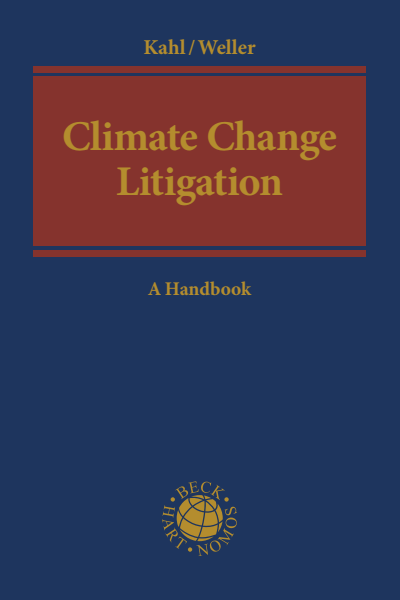
Climate Change Litigation
A Handbook- Editors:
- |
- Series:
- Beck International
- Publisher:
- 2021
Summary
Kahl/Weller
Climate Change Litigation This handbook investigates and discusses the respective issues arising in the current discourse on climate protection from different legal perspectives (including international law, European law and national public and civil law). In particular, it addresses the issue of “climate protection by courts”. It gives an overview about important jurisdictions in the field of Climate Change Litigation, including inter alia the US, Canada, Australia, UK, France, The Netherlands, Italy, Brazil and Germany. The book aims to pave the way for research in the field of climate change litigation, which up to this point has surprisingly remained untrodden ground in Germany or Europe. Furthermore, it is guaranteed to provide an overview of the latest news in cases and progress in the field of climate change litigation.
Search publication
Bibliographic data
- Edition
- 1/2021
- Copyright Year
- 2021
- ISBN-Print
- 978-3-406-74389-4
- ISBN-Online
- 978-3-406-77923-7
- Publisher
- C.H.BECK Recht - Wirtschaft - Steuern, München
- Series
- Beck International
- Language
- English
- Pages
- 566
- Product Type
- Edited Book
Table of contents
- Titelei/Inhaltsverzeichnis No access Pages I - XXXII
- I. Introduction: climate change – a global threat No access Pages 2 - 3
- II. Challenges (and possibilities) for global governance and international law No access Pages 3 - 7
- 1. Addressing the causes of climate change No access Pages 7 - 12
- 2. Addressing the consequences of climate change No access Pages 12 - 13
- 3. Response measures to climate change No access Pages 13 - 14
- IV. Major legal issues No access Pages 14 - 17
- V. Potential role for litigation in national courts No access Pages 17 - 21
- I. Introduction: global warming’s spatiotemporal strangeness – “tricky” to imagine No access Pages 23 - 23
- 1. The case Lliuya v. RWE No access
- 2. Three exemplary issues: statute of limitations, rivalling Rechtsregime, adequate causation No access
- 3. Trying to imagine “strange” ‘spaces’, ‘times’ and ‘agents’ No access
- 1. Integrative frameworks for “evaluating environmental decisions” No access
- 2. First encounters, some basic definitions, some common(?) ground No access
- 3. Some traps: ‘lucid dreams’ of harmony, ‘greenwashing’ and anthropocentrist blind spots No access
- 4. ‘Ecological justice’ – ‘space’, ‘time’ and ‘agency’ in the Anthropocene No access
- 1. Times of global warming No access
- 2. Spaces of global warming No access
- V. Coda: “more time tunnels of different sizes” No access Pages 43 - 45
- I. Introduction No access Pages 46 - 46
- 1. Historical development No access
- 2. State of recognition No access
- 1. Principle or rule? No access
- 2. Legal effects No access
- 1. Diversity of functions No access
- 2. Internalisation vs. instrumental orientation No access
- 3. Redistribution of costs vs. material responsibility No access
- 1. Generalities No access
- 2. Protected assets No access
- 3. Identification of the polluter (originator) No access
- 4. Causation and accountability No access
- 5. Delimitation from the common burden principle No access
- 1. Generalities No access
- 2. Liability in particular No access
- VII. Conclusion No access Pages 60 - 62
- I. Introduction: the judicialization of climate change governance No access Pages 64 - 66
- 1. Venues No access
- 2. Protagonists No access
- 3. Goals No access
- 1. Procedural rules and the competences of courts No access
- 2. Substantive law and the legal order in general No access
- 3. Political and social environment No access
- 1. Climate change litigation between law and politics No access
- 2. The suitability of judicial engagement with climate change No access
- 3. The effectiveness of climate change litigation No access
- V. Conclusion: potential and limitations of judicial climate protection No access Pages 80 - 81
- I. Introduction No access Pages 82 - 83
- 1. Protection of the environment No access
- 2. Protection of human rights No access
- 1. The protection against dangerous activities No access
- 2. The protection against natural disasters No access
- 3. Open questions No access
- 1. Individual rights No access
- 2. Access to courts No access
- 3. Causation No access
- 4. Scope of obligations No access
- 5. Separation of powers No access
- V. Conclusion No access Pages 95 - 97
- I. Introduction No access Pages 98 - 99
- 1. Disputes resulting from material damages No access
- 2. Disputes over natural resources No access
- 3. Disputes resulting from international climate treaties No access
- 4. Disputes resulting from transformation of the economy No access
- 5. Climate finance disputes No access
- 6. Corporate disputes No access
- 1. Arbitration law No access
- 2. Enforceability No access
- 3. Arbitration agreement No access
- 4. Confidentiality No access
- 5. Flexibility of proceedings No access
- 6. Selection of arbitrators No access
- 7. Involvement of third parties No access
- 8. Involvement of states No access
- 9. Applicable law No access
- 10. Claims based on tort No access
- 1. Political and public law claims No access
- 2. Claims for damages and for specific performance against companies No access
- 3. Disputes over natural resources No access
- 4. Disputes arising from international climate protection treaties No access
- 5. Disputes resulting from the implementation of international climate treaties No access
- 6. Disputes due to transformation towards Green economy No access
- 7. Disputes arising from climate finance No access
- 8. Corporate disputes No access
- 1. Permanent Court of Arbitration, The Hague No access
- 2. International Court of Arbitration of the ICC, Paris No access
- VI. Summary No access Pages 118 - 119
- 1. Road map No access
- 2. Cross-border elements giving rise to questions of private international law No access
- 3. No universal rules with respect to jurisdiction and Choice of Law No access
- 1. State immunity No access
- 2. “Political question doctrine” as a limitation to cross-border proceedings No access
- 1. Introduction No access
- 2. Brussels Ibis Regulation and Lugano Convention No access
- 3. EU Member States’ autonomous rules on jurisdiction No access
- 4. United States: Personal jurisdiction of state and federal courts No access
- 1. Introduction No access
- 2. EU: Liability in tort (delict) according to the Rome II Regulation No access
- 3. Autonomous PIL: Property law No access
- 4. US conflict of laws No access
- I. Introduction No access Pages 150 - 151
- II. Notion – environmental liability – what does it mean and what is the purpose in the context of a liability regime? No access Pages 151 - 152
- 1. Introduction – first jurisprudence No access
- 2. Development of the treaty law on civil liability No access
- 3. International treaties on the protection of the environment of international common spaces: A paradigmatic shift? No access
- 4. Customary international law: Does there exist an international regime on environmental liability? No access
- 1. Introduction No access
- 2. Liability for lawful or only illegal activities No access
- 3. Intensity of harm No access
- 4. Liability for not establishing precautionary measures or an adequate response system No access
- 5. The matter of causality No access
- 6. Fault based or strict liability No access
- 7. Calculating the amount of compensation to be paid and limits No access
- 8. The potential claimant No access
- I. Introduction No access Pages 168 - 169
- II. International policy & treaty commitments to climate justice & investment in carbon neutral/negative sustainable development No access Pages 169 - 173
- III. Climate change litigation guiding investment risk assessment & decision-making No access Pages 173 - 182
- 1. Treaty & policy developments No access
- 2. Investment treaty disputes No access
- V. Conclusions No access Pages 196 - 197
- I. Introduction No access Pages 199 - 200
- 1. The Paris Agreement – binding or not binding? No access
- 2. Obligations in the main action areas No access
- 3. Compliance and enforcement No access
- 1. Interplay between the international and national level No access
- 2. The Paris Agreement in domestic litigation No access
- 3. Rights-based litigation No access
- 4. Adjudication in planning decisions No access
- 5. Some general remarks: the importance of considering the national context No access
- IV. Conclusion and outlook No access Pages 215 - 217
- I. Introduction No access Pages 218 - 219
- II. Greenhouse gas reduction obligations of EU Member States under EU law No access Pages 219 - 221
- III. EU Member State liability within the non-ETS sector: the obligation to purchase surplus allocations from other Member States as financial sanction No access Pages 221 - 223
- IV. Financial sanctions within the infringement procedure as liability mechanism No access Pages 223 - 224
- 1. The origins, function and reasoning and doctrinal embedding of non-contractual Member State liability as developed by the Court No access
- 2. The Francovich criteria for state liability and climate law cases No access
- 3. Does the nature of the breach of Union law require a different yardstick in climate law cases? No access
- VI. Conclusion No access Pages 236 - 237
- I. Introduction No access Pages 237 - 238
- 1. Standing No access
- 2. Personal jurisdiction No access
- 3. Subject matter jurisdiction No access
- 1. Litigation under the Clean Air Act No access
- 2. Litigation over disclosure of climate impacts No access
- 3. Adaptation issues No access
- 4. Non-statutory claims No access
- 1. Nuisance law and climate change No access
- 2. Causation issues No access
- 3. Litigation prospects No access
- V. Conclusion No access Pages 252 - 253
- I. Introduction No access Pages 254 - 255
- II. Climate law and governance in Canada No access Pages 255 - 258
- 1. Syncrude Canada Ltd. v. The Attorney General of Canada No access
- 2. The GHG pollution pricing reference cases No access
- 1. Cases involving a failure of public bodies to adequately consider GHG emissions No access
- 2. Litigation relating to the Kyoto Protocol No access
- 3. Rights-based climate lawsuits No access
- V. Conclusion No access Pages 269 - 271
- I. Introduction No access Pages 272 - 274
- II. Climate change law and litigation in Brazil No access Pages 274 - 279
- III. Legal remedies which may be used in climate litigation in Brazil No access Pages 279 - 281
- 1. Precedent of the Supreme Federal Court No access
- 2. Precedents by the Brazilian Superior Court of Justice No access
- V. Conclusion No access Pages 286 - 288
- I. Introduction No access Pages 289 - 290
- 1. Early cases No access
- 2. The Queensland coal mine cases No access
- 3. Adani before the Federal Court No access
- 4. New development – Rocky Hill decision No access
- 5. Future directions and negative regulatory responses No access
- 1. Corporate law No access
- 2. Human rights law No access
- 3. Operators of emissions-intensive industries No access
- IV. Conclusion No access Pages 303 - 304
- 1. Background to climate change litigation in the UK No access
- 2. Early history of climate litigation in the UK: 1990s to the mid-2000s No access
- 1. Plan B takes on the UK climate mitigation target No access
- 2. Human rights and climate change in the courts No access
- 3. The path to net zero: winning the political battle, losing the legal battle No access
- 1. Litigation on wind and solar projects No access
- 2. Anti-fracking cases No access
- 3. Litigation against airport expansion No access
- IV. Criminal prosecution of climate activism: an emerging area of climate litigation No access Pages 319 - 322
- V. Conclusions and the future climate litigation in the UK No access Pages 322 - 324
- I. Introduction No access Pages 324 - 325
- 1. Mitigation measures No access
- 2. Adaptation measures No access
- III. “Giudizio universale” (the last judgment): a high-profile case to be litigated by the first months of 2020 No access Pages 329 - 333
- IV. Local court cases that are relevant to climate change litigation in Italy No access Pages 333 - 335
- V. Conclusion No access Pages 335 - 336
- I. Introduction No access Pages 337 - 338
- 1. Available remedies No access
- 2. Injury No access
- 3. Illegal act or conduct No access
- 4. The causal link between the damage and the misconduct No access
- 1. Making French companies eco-friendly through business law No access
- 2. Conditions and limits to the engagement of climate change civil liability: analysis of the difficulties and solutions to overcome them No access
- I. Introduction No access Pages 363 - 365
- 1. The District Court judgment No access
- 2. The Court of Appeal ruling No access
- 3. The Supreme Court decision No access
- 4. Analysis and critique No access
- 1. Friends of the Earth versus Shell No access
- 2. The Climate Act No access
- 3. The Climate Agreement No access
- IV. Conclusions No access Pages 377 - 378
- I. Introduction No access Pages 380 - 382
- 1. The climate system No access
- 2. Greenhouse effect and greenhouse gases No access
- 3. Detection and attribution of climate change No access
- III. Climate change litigation and private international law No access Pages 386 - 387
- 1. General forum, Art. 4 of Regulation No. 1215/2012 No access
- 2. Special forum of the tort, Art. 7 No. 2 of Regulation No. 1215/2012 No access
- 3. Special forum of the joinder of parties, Art. 8 No. 1 of Regulation No. 1215/2012 No access
- 1. Scope of the tort statute No access
- 2. Choice of law, Art. 14 Rome II No access
- 3. Environmental tort statute, Art. 7 Rome II No access
- 4. Interim result No access
- 1. Compensation for already occurred damages No access
- 2. Protection from future impairments No access
- 3. Proof of causality as central hurdle of private climate actions No access
- VII. Summary No access Pages 403 - 405
- 1. Overview No access
- 2. The law of delict No access
- 3. Nuisance law No access
- 4. Strict liability No access
- II. A prominent case in German courts: Saúl Ananías Luciano Lliuya vs. RWE AG No access Pages 410 - 412
- 1. Negligence liability, Section 823 (1) BGB No access
- 2. Breach of statutory duty, Section 823 (2) BGB No access
- 3. Actio doli, Section 826 BGB No access
- IV. Strict liability No access Pages 423 - 423
- 1. Actio negatoria, Section 1004 BGB No access
- 2. Section 906 (2) cl. 2 BGB and Section 14 cl. 2 BImSchG No access
- VI. Conclusion No access Pages 427 - 429
- I. Introduction No access Pages 430 - 431
- II. Basic principles of the UmweltHG No access Pages 431 - 433
- III. Nature of liability No access Pages 433 - 434
- 1. Basic principles No access
- 2. Annex 1 catalogue No access
- 1. Basic principles No access
- 2. Climate change damages subject to the UmweltHG? No access
- 1. Basic principles No access
- 2. Environmental impact in the form of climate change No access
- 1. Basic principles No access
- 2. Presumption of causation No access
- 3. Causation in cases of climate change damages No access
- VIII. Temporal scope of application No access Pages 445 - 446
- IX. Conclusion No access Pages 446 - 447
- 1. Climate protection in current accounting and stock corporation law No access
- 2. The company’s external and internal relationships No access
- 3. Delimiting the object of study No access
- 1. The internalization of negative externalities as a guidance objective No access
- 2. Efficiency of lawfulness and compliance duties for legal enforcement No access
- 1. Corporate management and the objectives of stock corporation law No access
- 2. Duty of lawfulness and compliance responsibility (under stock corporation law), §§ 91 (2), 93, 116 p. 1 AktG No access
- 3. CSR reporting duties No access
- 4. CSR and corporate interest No access
- IV. Conclusion and prospects No access Pages 464 - 466
- I. Introduction No access Pages 469 - 470
- II. Climate change arrived in the investment community No access Pages 470 - 471
- 1. Insufficient political measures No access
- 2. Changing regulatory frameworks No access
- 3. Need for more sustainable investments No access
- 4. Business dimension of the investor’s-led action for climate No access
- 1. Invest responsibly No access
- 2. Divest from non-sustainable businesses No access
- 3. Stay invested and take action No access
- 1. Investor’s dialogue with management No access
- 2. Corporate decisions and the public arena No access
- 3. Adopting climate change shareholder resolutions No access
- 4. Insisting on disclosure and climate change reporting No access
- 5. Acting as thought leaders No access
- 6. Taking a seat and action No access
- 7. Litigating as last resort No access
- VI. Conclusion No access Pages 486 - 487
- I. Introduction No access Pages 488 - 489
- 1. Damage to species and natural habitats No access
- 2. Water damage No access
- 3. Land damage No access
- 4. Restriction of the concept of environmental damage No access
- 5. Climate damages as environmental damages within the meaning of the EDA No access
- 1. Category of persons concerned No access
- 2. Direct causation No access
- 3. Responsible party for climate damages within the scope of the EDA No access
- 1. Obligations of the responsible party No access
- 2. Powers of the authorities No access
- 3. Selection of disturbers No access
- 4. Bearing of costs No access
- V. Conclusion No access Pages 505 - 507
- 1. NGO’s as representatives of the environment No access
- 2. NGO’s and climate litigation in practice No access
- 3. Climate litigation in Germany by defendants No access
- II. NGO independent access to court as exception to the rule – the German standing rules in a nutshell No access Pages 513 - 516
- 1. Standing in project related actions No access
- 2. Compliance with climate protection targets or other rules of climate law No access
- 3. Climate litigation against the state: Climate legislation No access
- 1. Intervention No access
- 2. Amicus Curiae – “friend of the court” No access
- 1. Obligations under the EU Governance Regulation No access
- 2. The EU Climate Change Regulation No access
- 3. National climate protection law No access
- 4. Actions for adjustment and compensation No access
- VI. Conclusion No access Pages 530 - 535
- I. Introduction No access Pages 535 - 537
- 1. Sustainability and environmental justice No access Pages 537 - 538
- 2. Polluter-pays principle No access Pages 538 - 538
- 3. The role of the legislature and the judiciary No access Pages 538 - 539
- 4. Duties of protection No access Pages 539 - 540
- 1. Procedures before civil courts No access
- 2. Applicable law No access Pages 541 - 541
- 3. Arbitration proceedings No access Pages 541 - 541
- IV. State liability under international and European law No access Pages 541 - 543
- 1. USA No access Pages 543 - 544
- 2. Canada No access Pages 544 - 544
- 3. Brazil No access Pages 544 - 544
- 4. Australia No access Pages 544 - 545
- 5. United Kingdom No access Pages 545 - 546
- 6. Italy No access Pages 546 - 546
- 7. France No access Pages 546 - 548
- 8. Netherlands No access Pages 548 - 549
- 1. Environmental Damage Act No access Pages 549 - 550
- 2. Role of the NGOs No access Pages 550 - 550
- 3. Corporate climate responsibility No access Pages 550 - 551
- 4. Delictual climate change liability No access Pages 551 - 551
- 1. Primacy of the legislature, supplemental function of the courts No access Pages 551 - 552
- 2. Basic right or state objective: climate protection in the national constitutions? No access Pages 552 - 553
- 3. Emission reduction objectives in the constitution? No access Pages 553 - 554
- 4. Private enforcement No access Pages 554 - 558
- 5. Conclusion No access Pages 558 - 561
- Index No access Pages 561 - 566