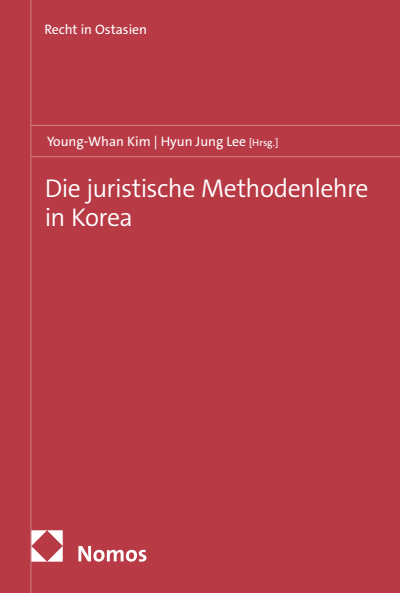
Die juristische Methodenlehre in Korea
- Editors:
- |
- Series:
- Recht in Ostasien, Volume 22
- Publisher:
- 2025
Summary
The Korean legal system contains an infinite, amorphous dimension that resists clear identification—yet it remains an inherent part of any legal order. Legal practitioners should not suppress this aspect but rather recognize it as integral to their own legal understanding and practice. Law is not merely about extracting objective meanings from statutes; it is about consciously shaping the law itself. A balanced legal approach considers both written and unwritten law. It opens a democratic discourse on which legal norm should be considered fundamental in each case—especially where suppression or marginalization is at stake. This pro-cess remains open, normative, and creative—yet inescapable for any living legal system.With contributions byProf. Dr. Su Gil Ahn | Prof. Dr. Joon Kyu Choi | Prof. Dr. Doo Hyun Kong | Prof. Dr. Wu Ye Kang | Dr. Bum Jin Kim | Prof. Dr. Young Whan Kim | Prof. Dr. Hyun Jung Lee | Dr. Hyun Kyung Lee | Prof. Dr. Kye Il Lee | Prof. Dr. Seong Bum Lee
Keywords
Search publication
Bibliographic data
- Edition
- 1/2025
- Copyright Year
- 2025
- ISBN-Print
- 978-3-7560-3168-9
- ISBN-Online
- 978-3-7489-6053-9
- Publisher
- Nomos, Baden-Baden
- Series
- Recht in Ostasien
- Volume
- 22
- Language
- German
- Pages
- 240
- Product Type
- Edited Book
Table of contents
- Vorwort No access
- Authors:
- Abstract No access
- Keywords No access
- I. Questions No access
- II. What “Normative” Means No access
- I. Basic Type: “Evaluation” of Facts No access
- 1. Judgment of Sub-Requirements Derived Through Legal Interpretation No access
- 2. Evaluation of Various Ancillary Requirements Accompanying the Determination of Legal Requirements No access
- 3. Judgment of Additional Issues That Arise When Multiple Laws Are Applied No access
- 4. Cases in Which Supreme Court Adopts “Comprehensive Consideration Theory” No access
- 1. Contract Disputes and Normative Judgments No access
- 2. Role of Normative Judgment in Fact-Finding No access
- 3. Judgment of Balancing, Sentencing Judgment No access
- IV. Final Conclusion of Trial and Multi-Layered Normative Judgment No access
- V. Conclusion Drawn from This Section No access
- I. Past: Legal Interpretation Methodology, “Normative Judgment” on How to Understand the Law No access
- II. Present: Changes in Normative Situations and Various Normative Judgments No access
- III. Future: Policy Argument or Outcome Consideration Argument No access
- IV. Conclusion No access
- D. Summary of Discussion No access
- Authors:
- Abstract No access
- Keywords No access
- A. Introduction No access
- B. Legal Methodology in the Supreme Court of Korea No access
- C. Radbruch's Purposiveness and Justice Kim Jae-Hyung No access
- D. Jhering's Purpose and Justice Ahn Chul Sang No access
- E. Hard Cases and Deeper Justification by Judicial Philosophy No access
- F. Reflection on the Two Approaches No access
- G. Conclusions No access
- Bibliography No access
- Authors:
- Abstract No access
- A. Introduction No access
- B. The Proportionality and Law of Balancing No access
- I. The Case of Lüth (1958) No access
- II. The Case of Novel “Esra” (2007) No access
- III. The Case of Künast (2021) No access
- IV. Concluding Remarks No access
- I. The decision on criminalizing “false communications” (2010, 2008 Hun-Ba 157) No access
- II. The decision on criminalizing “public defamation” (2021, 2016 Hun-Ba 84) No access
- III. Concluding Remarks No access
- E. Conclusion No access
- Bibliography No access
- Authors:
- A. Convention closer than law? No access
- Ⅰ. ‘Legal convention formula’ No access
- Ⅱ. Multidimensional legal reasoning and sources of law No access
- Ⅰ. Normative power and types of sources in legal reasoning No access
- Ⅱ. “The principle of deference to conventions” and “the presumptive validity thesis” No access
- Ⅲ. The problem of 'bad conventions' in legal reasoning: meaning, validity and duty to comply No access
- Ⅰ. Conventions and judicial reasoning: ‘The validity of a note without a place of issue’ Case No access
- Ⅱ. Convention and legislative reasoning: the 'codification of conventions' No access
- E. Towards 'reflective conventionalism': ‘Law as a Reflective Convention’ + ‘Reflective Reasoning’ No access
- Bibliography No access
- Authors:
- A. Intro No access
- 1. Who is misero? No access
- 2. When is a situation ambiguous? No access
- 1. Judges’ comparative advantage & Functional separation of powers No access
- 2. Commensurability & Agreement within disagreement No access
- 1. A Perspective in Favor of a Victim of Forced Child Marriage No access
- 2. A Perspective in Favor of a Minor Inheritor No access
- Ⅱ. Interpretation of Administrative law: judicial activism for misero No access
- a. Current Legal Situation in Korea No access
- aa. Three Possible Positions No access
- bb. Constitutional Justification for Same-Sex Marriage No access
- cc. Counterarguments and Their Rebuttals No access
- dd. The Role of the Judiciary in Protecting Minority Rights No access
- a. Backgrounds No access
- (1) The Right to Abortion as an Extension of the Right to Self-Determination No access
- (2) The State’s Duty to Protect Fetal Life No access
- (3) Balancing Pro-Choice and Pro-Life Interests No access
- (4) Scope of Unconstitutionality No access
- bb. Reasoning Behind the Simple Unconstitutionality Opinion No access
- aa. Incommensurability of Abortion Issue, and the Scope of Constitutional Right to Self-Determination No access
- bb. Constitutional Interpretation in Favor of Those who Cannot Speak for Themselves No access
- d. The Unconstitutionality of Current Legal Situation No access
- e. The Strategic Aspect of the Constitutional Court’s Decision No access
- D. Conclusion No access
- Authors:
- I. Einleitung No access
- 1. Methodische Diskussionslage No access
- 2. Das strukturelle Potenzial der argumentativen Gegensätze No access
- a) Methodische Fortschritte in der Wortlautauslegung No access
- b) Strukturelles Potenzial argumentativer Gegensätze in der Wortlautauslegung No access
- a) Methodologischer Fortschritt der historischen Auslegung No access
- b) Strukturelles Potenzial argumentativer Gegensätze in der historischen Auslegung No access
- a) Erscheinungsformen der systematischen Auslegung No access
- b) Strukturelles Potenzial argumentativer Gegensätze in der systematischen Auslegung No access
- a) Erscheinungsformen der teleologischen Auslegung No access
- b) Strukturelles Potenzial argumentativer Gegensätze bei der teleologischen Auslegung No access
- 1. Methodischer Fortschritt der verfassungskonformen Auslegung No access
- 2. Das strukturelle Potenzial der argumentativen Gegensätze bei der verfassungskonformen Auslegung No access
- 1. Folgenorientierte Auslegung – ihr methodischer Fortschritt und das strukturelle Potenzial der argumentativen Gegensätze No access
- a) Methodologischer Fortschritt bei der Argumentation über die Bedingungen von Präjudizienänderungen und das strukturelle Potenzial der argumentativen Gegensätze No access
- b) Die methodischen Fortschritte und das strukturelle Potenzial der argumentativen Gegensätze bei der Bestimmung des zeitlichen Geltungsbereichs von Präjudizienänderungen No access
- 1. Lückenfüllende Rechtsfortbildung No access
- 2. Richterliche Gesetzeskorrektur No access
- 1. Gelegentlich auftretende Inkonsistenzen in der angewandten Auslegungslehre je nach Fall No access
- 2. Eine Entwicklungslinie von einer „ganzheitlichen und holistischen Auslegungslehre„ hin zu einer „schwachen Form der Vorrangsrelationen unter den Kriterien„ No access
- 1. Die kristalline Struktur argumentativer Gegensätze No access
- 2. Der unvermeidliche Spielraum der Urteilskraft und die begrenzte Rationalität der normativen Methodik No access
- 3. Die Kluft zwischen Rechtsherstellung und Rechtsdarstellung sowie die Notwendigkeit des Methodenpluralismus No access
- Authors:
- A. Einleitung No access
- B. Die bestehende Auslegungsmethode für rechtsethische Argumente No access
- C. Kritik No access
- D. Rechtsethische Auslegung No access
- E. Methodologische Anwendung No access
- Authors:
- I. No access
- 1. Deduktion No access
- 2. Induktion No access
- 3. Abduktion No access
- 4. Analogie No access
- 1. No access
- 2. No access
- 3. No access
- 4. No access
- IV. No access
- Authors:
- A. Introduction No access
- Ⅰ. Limits of Statutory Interpretation No access
- Ⅱ. Gaps of Law No access
- Ⅲ. General Standard of Law No access
- Ⅳ. Legal Justification No access
- Ⅴ. Sentencing Law No access
- Ⅰ. Substance over Form No access
- Ⅱ. Subjectivity over Objectivity No access
- Ⅲ. A Free Person Perspective No access
- D. Conclusion No access
- Bibliography No access
- Authors:
- I. Begriff und Funktion der juristischen Methodenlehre No access
- II. Das Hauptschema der juristischen Methodenlehre No access
- 1. Das Auslegungsziel, Gesetzgeber oder Gesetz? No access
- 2. Kriterien der Auslegung; sog. Auslegungscanones No access
- 3. Rangordnung der Auslegungselemente No access
- 1. Rechtsfortbildung als Fortsetzung der Rechtsfindung No access
- 2. Begriff und Art der Gesetzeslücke No access
- 3. Analogie als die Ausfüllung der offenen Lücke No access
- 4. teleologische Reduktion zur Ausfüllung der verdecken Lücke No access
- 5. Rechtsfortbildung mit Rücksichten auf allgemeine Grundsätze des Rechts oder die Bedürfnisse im Rechtsverkehr No access
- Autorenverzeichnis No access Pages 239 - 240