, to see if you have full access to this publication.
Monograph No access
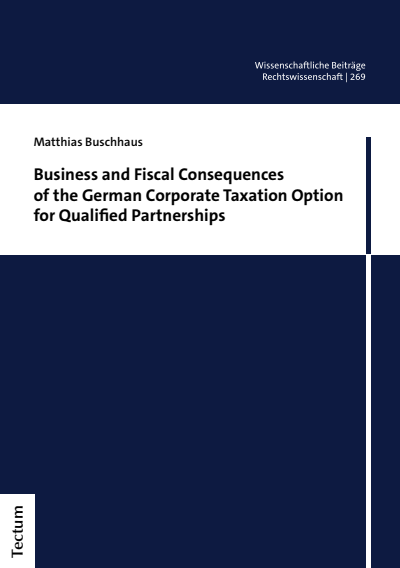
Business and Fiscal Consequences of the German Corporate Taxation Option for Qualified Partnerships
- Authors:
- Series:
- Wissenschaftliche Beiträge aus dem Tectum Verlag: Rechtswissenschaft, Volume 269
- Publisher:
- 2026
Summary
This work examines Section 1a of the German Corporation Tax Act (KStG), which enables partnerships in Germany to be taxed in the same way as corporations. The aim of the analysis is to discuss the systematic and legal requirements of this regulation, whilst highlighting its practical significance for economic and tax financial planning. The analysis focuses on the extent to which Section 1a KStG reduces the tax burden on partnerships, which factors have the greatest impact on the tax burden, and what financial risks are associated with it.
Search publication
Bibliographic data
- Edition
- 1/2026
- Copyright Year
- 2026
- ISBN-Print
- 978-3-68900-580-1
- ISBN-Online
- 978-3-68900-581-8
- Publisher
- Tectum, Baden-Baden
- Series
- Wissenschaftliche Beiträge aus dem Tectum Verlag: Rechtswissenschaft
- Volume
- 269
- Language
- English
- Pages
- 235
- Product Type
- Monograph
Table of contents
ChapterPages
- Foreword No access
- Acknowledgements No access
- Abstract No access
- Keywords No access
- Categorization of the dissertation topic No access
- Aim of the dissertation No access
- Hypotheses on the research question I No access
- Hypotheses on the research question II No access
- Hypotheses on the research question III No access
- Current state of Research No access
- 1.1.1. Literature No access
- 1.1.2. Official Data No access
- 1.1.3.1. Data from the study of the cooperation between the Foundation for Family Businesses and the Ifo Institute No access
- 1.1.3.2. Addition of own variables No access
- 1.2.1. Methods for analyzing literature No access
- 1.2.2. Research Methods for quantitative analysis in Section 5 No access
- 2.1. Implementation of the new regulation in the law No access
- 2.2. Special features of the tax burden of transparency principle No access
- 2.3.1. Eligibility for application No access
- 2.3.2. The Application No access
- 2.3.3. Legal consequences for the partnership due to the option in Section 1a KStG No access
- 2.3.4. Legal consequences for the opting company after exercise of the option No access
- 2.3.5. Legal consequences for the shareholder No access
- 2.3.6. Requirements and consequences of return option of the old taxation regime No access
- 2.3.7. Conclusion No access
- 2.4.1. Inheritance and gift tax No access
- 2.4.2. Real Estate Transfer Tax No access
- 2.5.1. Economic analysis No access
- 2.5.2. Conclusion No access
- 2.6. Discussion of German tax policy regarding the option for corporate taxation No access
- 3.1. Flat tax in tax theory No access
- 3.2. Neo-liberal approach No access
- 3.3. Comparison to mentioned tax approaches No access
- 3.4. Conclusion No access
- 4.1. Concepts of Tax Regimes in the European Union No access
- 4.2. Comparative table of EU states No access
- 4.3.1.1. French Corporate Law No access
- 4.3.1.2. French method of taxing partnerships No access
- 4.3.1.3. Conclusion No access
- 4.3.2.1. Austrian Corporate Law No access
- 4.3.2.2. Austrian method of taxing partnerships No access
- 4.3.2.3. Conclusion No access
- 4.3.3.1. US Corporate Law No access
- 4.3.3.2. US method of taxing partnerships No access
- 4.3.3.3. Conclusion No access
- 5.1. Foundation for Family Businesses No access
- 5.2.1. Correlations No access
- 5.2.2. Regressions No access
- 5.3.1. Correlations No access
- 5.3.2. Regressions No access
- 5.3.3. Load comparison No access
- 5.3.4. Results No access
- 6.1. Advantages and disadvantages of the previous taxation regimes No access
- 6.2.1. Retroactive taxation No access
- 6.2.2. Fiscal year No access
- 6.2.3. Liability No access
- 6.2.4. Contribution of special business assets No access
- 6.2.5. Higher consulting costs for the respective partnership No access
- 6.2.6. Conclusion No access
- 6.3.1. Consequences for the German state budget No access
- 6.3.2. Consequences for the state authorities No access
- 6.3.3. Conclusion No access
- Conclusion No access Pages 203 - 208
- References No access Pages 209 - 216