, to see if you have full access to this publication.
Monograph No access
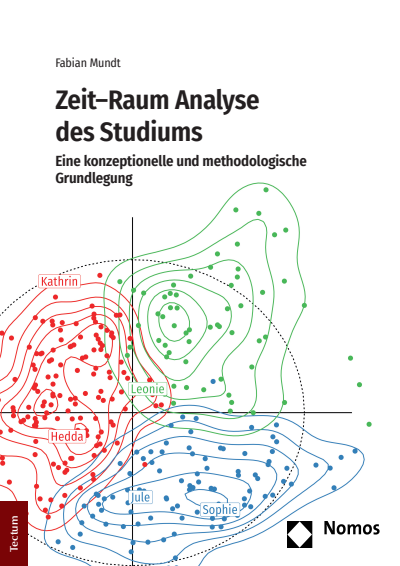
Zeit-Raum Analyse des Studiums
Eine konzeptionelle und methodologische Grundlegung- Authors:
- Publisher:
- 2022
Keywords
Search publication
Bibliographic data
- Copyright Year
- 2022
- ISBN-Print
- 978-3-8288-4792-7
- ISBN-Online
- 978-3-8288-7904-1
- Publisher
- Nomos, Baden-Baden
- Language
- German
- Pages
- 216
- Product Type
- Monograph
Table of contents
ChapterPages
- Titelei/Inhaltsverzeichnis No access Pages I - XIV
- A Zielsetzungen No access
- B Aufbau No access
- 1.1.1 Heterogene Konzepte No access
- 1.1.2 Kombinationsvorschläge No access
- 1.2.1 Die Herstellung von Zeit–Räumen durch die soziale Praxis No access
- 1.2.2 Die dynamische Stabilisierung von Zeit–Raum-Konstellationen No access
- 1.3.1 Metrisch: Objektivierte Distanzen No access
- 1.3.2 Mental: Habitualisierte Schemata No access
- 2.1.1 Klassifizieren: Verbreitete Zeitmuster identifizieren No access
- 2.1.2 Visualisieren: Zeitmuster grafisch abbilden No access
- 2.2.1 Zeitgeografische Referenzen No access
- 2.2.2 Flache Visualisierungen No access
- 2.3.1 Von Datentabellen zur Kartierung von Punktwolken No access
- 2.3.2 Punktwolken kumulativ erweitern No access
- 3.1.1 Geometrischer Orientierungsrahmen und fokussierte Einzelfälle No access
- 3.1.2 Verläufe untersuchen No access
- 3.2.1 Fragebögen No access
- 3.2.2 Logbücher No access
- 3.2.3 Fokussierte Interviews No access
- 3.3.1 Geometrisch-quantitativ No access
- 3.3.2 Kartografisch-qualitativ No access
- 4.1 Fokus und Fragestellung No access
- 4.2 Organisation der Erhebungen No access
- 5.1.1 Zeitmuster No access
- 5.1.2 Lebensgestaltung No access
- 5.1.3 Studiengestaltung No access
- 5.2.1 Individuelle Positionen No access
- 5.2.2 Inhaltliche Dimensionen deuten No access
- 5.2.3 Eine erste Karte der Studierenden No access
- 5.3.1 Soziale Herkunft No access
- 5.3.2 Schulische Genese No access
- 5.3.3 Studienwahl No access
- 6.1.1 Drei Konstellationen No access
- 6.1.2 Spezifische Studierende in den Blick nehmen No access
- 6.2.1 Zwei Positionen im Fokus: Hedda und Kathrin No access
- 6.2.2 Orte Chronologien: Zwischen Studium und Familie No access
- 6.2.3 Zusammenführende Interpretation No access
- 6.3.1 Zwei Positionen im Fokus: Sophie und Jule No access
- 6.3.2 Orte Chronologien: Studieren an Ort und Stelle No access
- 6.3.3 Zusammenführende Interpretation No access
- 6.4.1 Eine Position im Fokus: Leonie No access
- 6.4.2 Orte Chronologie: Studieren und arbeiten No access
- 6.4.3 Zusammenführende Interpretation No access
- 7.1.1 Trajektorien nachzeichnen No access
- 7.1.2 Die Gesamtheit der Studierenden im Wandel No access
- 7.2.1 Hedda und Kathrin: Annäherung und Entfernung No access
- 7.2.2 Orte-chronologische Verschiebungen No access
- 7.2.3 Perspektivische Interpretation No access
- 7.3.1 Sophie und Jule: Stabilisierungen No access
- 7.3.2 Orte-chronologische Kontinuitäten No access
- 7.3.3 Perspektivische Interpretation No access
- 7.4.1 Leonie: Anpassung No access
- 7.4.2 Orte-chronologische Verlagerungen No access
- 7.4.3 Perspektivische Interpretation No access
- 8.1 Gegenüberstellung der drei studentischen Zeit–Raum-Konstellationen No access
- 8.2 Perspektiven und Potenziale zukünftiger Zeit–Raum Analysen No access
- Danksagung No access Pages 201 - 202
- Literatur No access Pages 203 - 212
- Register No access Pages 213 - 216
Bibliography (213 entries)
No match found. Try another term.
- Abbott, A. (2004). Methods of Discovery: Heuristics for the Social Sciences. W. W. Norton & Company. Open Google Scholar DOI: 10.5771/9783828879041
- Adam, B. (2005a). Das Diktat der Uhr: Zeitformen, Zeitkonflikte, Zeitperspektiven (U. Beck, Hrsg.). Suhrkamp. (Original erschienen 1995) Open Google Scholar DOI: 10.5771/9783828879041
- Adam, B. (2005b). Timescapes of Modernity: The Environment and Invisible Hazards. Routledge. Open Google Scholar DOI: 10.5771/9783828879041
- Althausen, F. (2019). Typeface: »Vollkorn«. Verfügbar 28. Juli 2020 unter https://www.vollkorntypeface.com Open Google Scholar DOI: 10.5771/9783828879041
- Asdonk, J., Kuhnen, S. U., & Bornkessel, P. (Hrsg.). (2013). Von der Schule zur Hochschule: Analysen, Konzeptionen und Gestaltungsperspektiven des Übergangs. Waxmann. Open Google Scholar DOI: 10.5771/9783828879041
- Audigier, V., Husson, F., & Josse, J. (2015). MIMCA: Multiple imputation for categorical variables with multiple correspondence analysis. Open Google Scholar DOI: 10.5771/9783828879041
- Augé, M. (2014). Nicht-Orte (4. Aufl.). C. H. Beck. Open Google Scholar DOI: 10.5771/9783828879041
- Bach, B., Dragicevic, P., Archambault, D., Hurter, C., & Carpendale, S. (2014). A Review of Temporal Data Visualizations Based on Space-Time Cube Operations. Eurographics Conference on Visualization. Open Google Scholar DOI: 10.5771/9783828879041
- Bachelard, G. (1987). Die Bildung des wissenschaftlichen Geistes: Beitrag zu einer Psychoanalyse der objektiven Erkenntnis. Suhrkamp. (Original erschienen 1938) Open Google Scholar DOI: 10.5771/9783828879041
- Bachelard, G. (1988). Der neue wissenschaftliche Geist. Suhrkamp. (Original erschienen 1934) Open Google Scholar DOI: 10.5771/9783828879041
- Bachelard, G. (1993). Epistemologie. Fischer. Open Google Scholar DOI: 10.5771/9783828879041
- Banagl, M. (2012). Mathematik/Topologie. In S. Günzel (Hrsg.), Raumwissenschaften (S. 242–258). Suhrkamp. (Original erschienen 2009) Open Google Scholar DOI: 10.5771/9783828879041
- Barlösius, E. (2006). Pierre Bourdieu. Campus. Open Google Scholar DOI: 10.5771/9783828879041
- Baur, N. (2005). Verlaufsmusteranalyse [Diss.]. Wiesbaden, VS. Open Google Scholar DOI: 10.5771/9783828879041
- Baur, N., & Christmann, G. (2021). Fallauswahl und Generalisierung. In A. J. Heinrich, S. Marguin, A. Million & J. Stollmann (Hrsg.), Handbuch qualitative und visuelle Methoden der Raumforschung S. 121–135). transcript. Open Google Scholar DOI: 10.5771/9783828879041
- Baur, N., Hering, L., Raschke, A. L., & Thierbach, C. (2014). Theory and Methods in Spatial Analysis: Towards Integrating Qualitative, Quantitative and Cartographic Approaches in the Social Sciences and Humanities. Historische Sozialforschung, 39(2), 7–50. Open Google Scholar DOI: 10.5771/9783828879041
- bBox Type GmbH. (2020). Fira Schriftenfamilie. Verfügbar 28. Juli 2020 unter https://bboxtype.com/fira/ Open Google Scholar DOI: 10.5771/9783828879041
- Becker, M., & Hehl, K. (2012). Geodäsie. WBG. Open Google Scholar DOI: 10.5771/9783828879041
- Benzécri, J.-P. (1992). Correspondence Analysis Handbook. Marcel Dekker. Open Google Scholar DOI: 10.5771/9783828879041
- Benzécri, J.-P. (2012). Choriogenesis: The Dynamical Genesis of Space and Its Dimensions, Controlled by Correspondence Analysis. In M. G. Summa, L. Bottou, B. Goldfarb, F. Murtagh, C. Pardoux & M. Touati (Hrsg.), Statistical Learning and Data Science (S. 63–76). CRC. Open Google Scholar DOI: 10.5771/9783828879041
- Berg, B. (2020). SDAPS: Scripts for data acquisition with paper-based surveys. Verfügbar 28. Juli 2020 unter https://sdaps.org Open Google Scholar DOI: 10.5771/9783828879041
- Blasius, J. (2001). Korrespondenzanalyse. Oldenbourg. Open Google Scholar DOI: 10.5771/9783828879041
- Blasius, J., & Greenacre, M. (Hrsg.). (2014). Visualization and Verbalization of Data. CRC. Open Google Scholar DOI: 10.5771/9783828879041
- Blasius, J., Lebaron, F., Roux, B. L., & Schmitz, A. (Hrsg.). (2019). Empirical Investigations of Social Space. Springer. Open Google Scholar DOI: 10.5771/9783828879041
- Blumenberg, H. (2013). Lebenszeit und Weltzeit (4. Aufl.). Suhrkamp. (Original erschienen 2001) Open Google Scholar DOI: 10.5771/9783828879041
- Böhm-Kasper, O., Schuchart, C., & Weishaupt, H. (2009). Quantitative Methoden in der Erziehungswissenschaft. WBG. Open Google Scholar DOI: 10.5771/9783828879041
- Bohnsack, R. (2001). Dokumentarische Methode: Theorie und Praxis wissenssoziologischer Interpretation. In T. Hug (Hrsg.), Wie kommt Wissenschaft zu Wissen? (S. 326–345). Schneider Hohengehren. Open Google Scholar DOI: 10.5771/9783828879041
- Bohnsack, R. (2014). Rekonstruktive Sozialforschung: Einführung in qualitative Methoden (9. Aufl.). UTB. Open Google Scholar DOI: 10.5771/9783828879041
- Bohnsack, R., Nentwig-Gesemann, I., & Nohl, A.-M. (Hrsg.). (2008). Die dokumentarische Methode und ihre Forschungspraxis: Grundlagen qualitativer Sozialforschung (3. Aufl.). Springer VS. Open Google Scholar DOI: 10.5771/9783828879041
- Bourdieu, P. (1976). Entwurf einer Theorie der Praxis. Suhrkamp. (Original erschienen 1972) Open Google Scholar DOI: 10.5771/9783828879041
- Bourdieu, P. (1982). Die feinen Unterschiede: Kritik der gesellschaftlichen Urteilskraft. Suhrkamp. (Original erschienen 1979) Open Google Scholar DOI: 10.5771/9783828879041
- Bourdieu, P. (1987). Sozialer Sinn: Kritik der theoretischen Vernunft. Suhrkamp. (Original erschienen 1980) Open Google Scholar DOI: 10.5771/9783828879041
- Bourdieu, P. (1988). Homo academicus. Suhrkamp. (Original erschienen 1984) Open Google Scholar DOI: 10.5771/9783828879041
- Bourdieu, P. (1991). Physischer, sozialer und physisch angeeigneter Raum. In M. Wentz (Hrsg.), Stadt-Räume. Campus. Open Google Scholar DOI: 10.5771/9783828879041
- Bourdieu, P. (2001). Meditationen: Zur Kritik der scholastischen Vernunft. Suhrkamp. (Original erschienen 1997) Open Google Scholar DOI: 10.5771/9783828879041
- Bourdieu, P. (2004). Der Staatsadel. UVK. (Original erschienen 1989) Open Google Scholar DOI: 10.5771/9783828879041
- Brake, A. (2011). Kombinieren, mixen, verbinden? In J. Ecarius & I. Miethe (Hrsg.), Methodentriangulation in der qualitativen Bildungsforschung (S. 41–63). Barbara Budrich. Open Google Scholar DOI: 10.5771/9783828879041
- Bringhurst, R. (2004). The Elements of Typographic Style (3. Aufl.). Hartley & Marks. Open Google Scholar DOI: 10.5771/9783828879041
- Carlier, A., & Kroonenberg, P. M. (1998). The Case of the French Cantons: An Application of Three-Way Correspondence Analysis. In J. Blasius & M. Greenacre (Hrsg.), Visualization of Categorical Data (S. 253–275). Academic Press. Open Google Scholar DOI: 10.5771/9783828879041
- Cassor, F., & Le Roux, B. (2019). Assigning Changes Over Time Using Geometric Data Analysis Methods: Application to the French »Barometer of Political Trust«. In J. Blasius, F. Lebaron, B. L. Roux & A. Schmitz (Hrsg.), Empirical Investigations of Social Space (S. 325–344). Springer. Open Google Scholar DOI: 10.5771/9783828879041
- Castells, M. (2000). The Rise of the Network Society: Economy, Society and Culture (2. Aufl., Bde. 2, Bd. 1). Blackwell. (Original erschienen 1996) Open Google Scholar DOI: 10.5771/9783828879041
- Cramer, C. (2012). Entwicklung von Professionalität in der Lehrerbildung: Empirische Befunde zu Eingangsbedingungen, Prozessmerkmale und Ausbildungserfahrungen Lehramtsstudierender. Klinkhardt. Open Google Scholar DOI: 10.5771/9783828879041
- Crang, M. (2015). Zeit : Raum. In J. Döring & T. Thielmann (Hrsg.), Spatial Turn: Das Raumparadigma in den Kultur- und Sozialwissenschaften (S. 409–438). transcript. Open Google Scholar DOI: 10.5771/9783828879041
- Creswell, J. W., & Clark, V. L. P. (2018). Designing and Conducting Mixed Methods Research (3. Aufl.). SAGE. Open Google Scholar DOI: 10.5771/9783828879041
- de Certeau, M. (1988). Kunst des Handelns. Merve. (Original erschienen 1980) Open Google Scholar DOI: 10.5771/9783828879041
- de Leeuw, J. (1998). Here’s Looking at Multivariables. In J. Blasius & M. Greenacre (Hrsg.), Visualization of Categorical Data (S. 1–11). Academic Press. Open Google Scholar DOI: 10.5771/9783828879041
- Deleuze, G., & Guattari, F. (1977). Rhizom. Merve Verlag. (Original erschienen 1976) Open Google Scholar DOI: 10.5771/9783828879041
- Diaz-Bone, R. (2007). Die französische Epistemologie und ihre Revisionen: Zur Rekonstruktion des methodologischen Standortes der Foucaultschen Diskursanalyse. Forum Qualitative Sozialforschung, 8(2). Open Google Scholar DOI: 10.5771/9783828879041
- Diaz-Bone, R. (2019). Statistik für Soziologen (5. Aufl.). UTB. Open Google Scholar DOI: 10.5771/9783828879041
- Dollase, R. (1995). Temporale Muster in der Freizeitforschung: Eine neue methodische Perspektive für empirische Untersuchungen. Spektrum Freizeit, 2(3), 107–119. Open Google Scholar DOI: 10.5771/9783828879041
- Dollase, R. (2000). Was sind Temporale Muster? Zur Phänomenologie, Forschungsgeschichte und Relevanz eines vertrauten Alltagsphänornens. In R. Dollase, K. Hammerich & W. Tokarski (Hrsg.), Temporale Muster: Die ideale Reihenfolge der Tätigkeiten (S. 13–33). Springer. Open Google Scholar DOI: 10.5771/9783828879041
- Dollase, R., Hammerich, K., & Tokarski, W. (Hrsg.). (2000). Temporale Muster: Die ideale Reihenfolge der Tätigkeiten. Springer. Open Google Scholar DOI: 10.5771/9783828879041
- Egger, R., Mikula, R., Haring, S., Felbinger, A., & Pilch-Ortega, A. (Hrsg.). (2008). Orte des Lernens: Lernwelten und ihre biographische Aneignung. Springer. Open Google Scholar DOI: 10.5771/9783828879041
- Elias, N. (1984). Über die Zeit. Suhrkamp. Open Google Scholar DOI: 10.5771/9783828879041
- El-Mafaalani, A. (2020). Mythos Bildung: Die ungerechte Gesellschaft, ihr Bildungssystem und seine Zukunft. Kiepenheuer & Witsch. Open Google Scholar DOI: 10.5771/9783828879041
- Engels, J. M., & Diehr, P. (2003). Imputation of Missing Longitudinal Data: A Comparison of Methods. Journal of Clinical Epidemiology, 56(10), 968–976. Open Google Scholar DOI: 10.5771/9783828879041
- Flick, U. (2011). Qualitative Sozialforschung: Eine Einführung (4. Auflage). Rowohlt. Open Google Scholar DOI: 10.5771/9783828879041
- Franck, G. (2002). Soziale Raumzeit. In D. Henckel & M. Eberling (Hrsg.), Raumzeitpolitik (S. 61–80). Open Google Scholar DOI: 10.5771/9783828879041
- Frehse, F. (2020). On the Temporalities and Spatialities of the Production of Space. SFB 1265 Working Paper, (4). Open Google Scholar DOI: 10.5771/9783828879041
- Friebertshäuser, B. (2008). Statuspassage von der Schule ins Studium. In W. Helsper & J. Böhme (Hrsg.), Handbuch der Schulforschung (S. 611–630). VS. Open Google Scholar DOI: 10.5771/9783828879041
- Fuchs-Heinritz, W., & König, A. (2014). Pierre Bourdieu: Eine Einführung (3. Aufl.). UTB. Open Google Scholar DOI: 10.5771/9783828879041
- Genolini, C., Alacoque, X., Sentenac, M., & Arnaud, C. (2015). kml and kml3d: R Packages to Cluster Longitudinal Data. Journal of Statistical Software, 65(4). Open Google Scholar DOI: 10.5771/9783828879041
- Genolini, C., Ecochard, R., Benghezal, M., Driss, T., Andrieu, S., & Subtil, F. (2016). kmlShape: An Efficient Method to Cluster Longitudinal Data (Time-Series) According to Their Shapes. PLOS ONE, 11(6), 1–25. Open Google Scholar DOI: 10.5771/9783828879041
- Genolini, C., Pingault, J.-B., Driss, T., Côté, S., Tremblay, R., Vitaro, F., Arnaud, C., & Falissard, B. (2013). KmL3D: A non-parametric algorithm for clustering joint trajectories. Computer Methods and Programs in Biomedicine, 109(1), 104–111. Open Google Scholar DOI: 10.5771/9783828879041
- Giddens, A. (1997). Die Konstitution der Gesellschaft: Grundzüge einer Theorie der Strukturierung (3. Auflage). Suhrkamp. (Original erschienen 1984) Open Google Scholar DOI: 10.5771/9783828879041
- Gloy, K. (2006). Zeit: Eine Morphologie. Karl Alber. Open Google Scholar DOI: 10.5771/9783828879041
- Google. (2021). Google Maps Platform. Verfügbar 22. November 2021 unter https://developers.google.com/maps/ Open Google Scholar DOI: 10.5771/9783828879041
- Gothe, K., & Pfadenhauer, M. (2010). My Campus – Räume für die »Wissensgesellschaft?« Raumnutzungsmuster von Studierenden. VS. Open Google Scholar DOI: 10.5771/9783828879041
- Greenacre, M. (2007). Constructing Maps of Data Using Correspondence Analysis. BBVA Foundation Newsletter, 6, 16–17. Open Google Scholar DOI: 10.5771/9783828879041
- Greenacre, M. (2010). Biplots in Practice. BBVA. Open Google Scholar DOI: 10.5771/9783828879041
- Greenacre, M. (2016). Correspondence Analysis in Practice (3. Aufl.). CRC. Open Google Scholar DOI: 10.5771/9783828879041
- Gren, M. (2001). Time-geography matters. In J. May & N. Thrift (Hrsg.), TimeSpace (S. 208–225). Routledge. Open Google Scholar DOI: 10.5771/9783828879041
- Grenfell, M., & Lebaron, F. (Hrsg.). (2014). Bourdieu and Data Analysis: Methodological Principles and Practice. Peter Lang. Open Google Scholar DOI: 10.5771/9783828879041
- Grolemund, G., &Wickham, H. (2011). Dates andTimes Made Easywith lubridate. Journal of Statistical Software, 40(3), 1–25. Open Google Scholar DOI: 10.5771/9783828879041
- Groppe, C. (2016). Die deutsche Universität als pädagogische Institution: Analysen zu ihrer historischen, aktuellen und zukünftigen Entwicklung. In S. Blömeke, M. Caruso, S. Reh, U. Salaschek & J. Stiller (Hrsg.), Traditionen und Zukünfte: Beiträge zum 24. Kongress der Deutschen Gesellschaft für Erziehungswissenschaft (S. 57–76). Barbara Budrich. Open Google Scholar DOI: 10.5771/9783828879041
- Grützmacher, J., & Willige, J. (2016). Die Studieneingangsphase aus Studierendensicht: Ergebnisse aus dem Studienqualitätsmonitor 2015. DZHW. Open Google Scholar DOI: 10.5771/9783828879041
- Günther, D., Kirschbaum, M., Kruse, R., Ladwig, T., Prill, A., Stang, R., & Wertz, I. (2019). Zukunftsfähige Lernraumgestaltung im digitalen Zeitalter: Thesen und Empfehlungen der Ad-hoc Arbeitsgruppe Lernarchitekturen des Hochschulforum Digitalisierung. Hochschulforum Digitalisierung. Open Google Scholar DOI: 10.5771/9783828879041
- Günzel, S. (2007). Raum – Topographie – Topologie. In S. Günzel (Hrsg.), Topologie. Zur Raumbeschreibung in den Kultur- und Medienwissenschaften (S. 13–29). transcript. Open Google Scholar DOI: 10.5771/9783828879041
- Günzel, S. (2009). Spatial Turn –Topographical Turn –Topological Turn. In J. Döring & T. Thielmann (Hrsg.), Spatial Turn (2. Aufl., S. 219–237). transcript. Open Google Scholar DOI: 10.5771/9783828879041
- Günzel, S. (2018). Raum: Eine kulturwissenschaftliche Einführung (2. Aufl.). transcript. Open Google Scholar DOI: 10.5771/9783828879041
- Hägerstrand, T. (1970). What about people in Regional Science? Papers of the Regional Science Association, 24, 7–21. Open Google Scholar DOI: 10.5771/9783828879041
- Hägerstrand, T. (1975). Survival and Arena: On the Life-History of Individuals in Relation to their Geographical Environment. The Monadnock, 49, 9–29. Open Google Scholar DOI: 10.5771/9783828879041
- Harvey, D. (2005). Spacetime and the World. In Cosmopolitanism and the Geographies of Freedom (S. 113–165). Columbia University Press. Open Google Scholar DOI: 10.5771/9783828879041
- Healy, K. (2019). Data Visualization: A Practical Introduction. Princeton University Press. Open Google Scholar DOI: 10.5771/9783828879041
- Heidegger, M. (2006). Sein und Zeit. Max Niemeyer. (Original erschienen 1926) Open Google Scholar DOI: 10.5771/9783828879041
- Heinrich, A. J. (2021). Integration visueller und verbaler Daten. In A. J. Heinrich, S. Marguin, A. Million & J. Stollmann (Hrsg.), Handbuch qualitative und visuelle Methoden der Raumforschung (S. 137–150). transcript. Open Google Scholar DOI: 10.5771/9783828879041
- Heinrich, A. J., Marguin, S., Million, A., & Stollmann, J. (Hrsg.). (2021). Handbuch qualitative und visuelle Methoden der Raumforschung. transcript. Open Google Scholar DOI: 10.5771/9783828879041
- Hess, R. (2009). Die Praxis des Tagebuchs: Beobachtung – Dokumentation – Reflexion (G. Weigand, Hrsg. & Übers.). Waxmann. Open Google Scholar DOI: 10.5771/9783828879041
- Hjellbrekke, J. (2019). Multiple Correspondence Analysis for the Social Sciences. Routledge. Open Google Scholar DOI: 10.5771/9783828879041
- Hjellbrekke, J., Le Roux, B., Korsnes, O., Lebaron, F., Rosenlund, L., & Rouanet, H. (2007). The Norwegian Field of Power. European Societies, 9(2), 245–273. Open Google Scholar DOI: 10.5771/9783828879041
- Hörning, K. H., Ahrens, D., & Gerhard, A. (1997). Zeitpraktiken: Experimentierfelder der Spätmoderne. Suhrkamp. Open Google Scholar DOI: 10.5771/9783828879041
- Hoyer, T. (2011). Wozu ist die Bildung da? In S. Scheef & G. Schlemminger (Hrsg.), Plädoyer für eine anspruchsvolle LehrerInnenbildung: Versuch einer etwas anderen Festschrift für Liesel Hermes (S. 145–154). Open Google Scholar DOI: 10.5771/9783828879041
- Huber, L. (1991). Fachkulturen. Neue Sammlung, 31(1), 3–24. Open Google Scholar DOI: 10.5771/9783828879041
- Hünersdorf, B., Müller, B., & Maeder, C. (2008). Ethnographie der Pädagogik: Eine Einführung. In B. Hünersdorf, C. Maeder & B. Müller (Hrsg.), Ethnographie und Erziehungswissenschaft (S. 11–27). Juventa. Open Google Scholar DOI: 10.5771/9783828879041
- Husson, F., Lê, S., & Pagès, J. (2017). Exploratory Multivariate Analysis by Example Using R (2. Aufl.). CRC Press. Open Google Scholar DOI: 10.5771/9783828879041
- Hüther, O., & Krücken, G. (2016). Hochschulen: Fragestellungen, Ergebnisse und Perspektiven der sozialwissenschaftlichen Hochschulforschung. Springer VS. Open Google Scholar DOI: 10.5771/9783828879041
- Instagram. (2021). Instagram-Platform (Facebook, Hrsg.). Verfügbar 22. November 2021 unter https://developers.facebook.com/docs/instagram Open Google Scholar DOI: 10.5771/9783828879041
- Janelle, D. G. (2001). Time-Space in Geography. In International Encyclopedia of the Social Behavioral Sciences. Elsevier. Open Google Scholar DOI: 10.5771/9783828879041
- Jetzkowitz, J., Lüdtke, H., & Schneider, J. (2004). O Tempora, o Mores: Wie Studierende mit der Zeit umgehen. VS. Open Google Scholar DOI: 10.5771/9783828879041
- Jordheim, H., & Ytreberg, E. (2021). After supersynchronisation: How media synchronise the social. Time & Society, 30(3). https://doi.org/10.1177/0961463X211012507 Open Google Scholar DOI: 10.5771/9783828879041
- Josse, J., & Husson, F. (2016). missMDA. Journal of Statistical Software, 70(1). Open Google Scholar DOI: 10.5771/9783828879041
- Kahle, D. (2013). Maps in R. Kahle, D., & Wickham, H. (2013). ggmap: Spatial Visualization with ggplot2. The R Journal, 5(1), 144–161. Open Google Scholar DOI: 10.5771/9783828879041
- Kassambara, A., & Mundt, F. (2017). factoextra: Extract and Visualize the Results of Multivariate Data Analyses (1.0.4). R package. CRAN. Open Google Scholar DOI: 10.5771/9783828879041
- Kelle, U. (2008). Die Integration qualitativer und quantitativer Methoden in der empirischen Sozialforschung: Theoretische Grundlagen und methodologische Konzepte (2. Aufl.). VS Verlag. Open Google Scholar DOI: 10.5771/9783828879041
- Kleining, G. (2001). Offenheit als Kennzeichen entdeckender Forschung. Kontrapunkt Jahrbuch für kritische Sozialwissenschaft und Philosophie, 1, 27–36. Open Google Scholar DOI: 10.5771/9783828879041
- Krawietz, J., Raithelhuber, E., & Roman, N. (2013). Übergänge in der Hochschule. In W. Schröer, B. Stauber, A. Walther, L. Böhnisch & K. Lenz (Hrsg.), Handbuch Übergänge (S. 651–687). Beltz Juventa. Open Google Scholar DOI: 10.5771/9783828879041
- Kuchling, H. (2007). Taschenbuch der Physik (19. Aufl.). Hanser. Open Google Scholar DOI: 10.5771/9783828879041
- Kuckartz, U. (2014). Mixed Methods: Methdologie, Forschungsdesigns und Analyseverfahren. Springer VS. Open Google Scholar DOI: 10.5771/9783828879041
- Lamigueiro, O. P. (2014). Displaying Time Series, Spatial, and Space-Time Data with R. CRC. Open Google Scholar DOI: 10.5771/9783828879041
- Laux, H., Henkel, A., & Anicker, F. (Hrsg.). (2017). Raum und Zeit: Soziologische Beobachtungen zur gesellschaftlichen Raumzeit. Beltz/Juventa. Open Google Scholar DOI: 10.5771/9783828879041
- Lê, S., Josse, J., & Husson, F. (2008). FactoMineR: An R package for multivariate data analysis. Journal of Statistical Software, 25(1). Open Google Scholar DOI: 10.5771/9783828879041
- Le Roux, B. (2014a). Structured Data Analysis. In J. Blasius & M. Greenacre (Hrsg.), Visualization and Verbalization of Data (S. 185–204). CRC. Open Google Scholar DOI: 10.5771/9783828879041
- Le Roux, B. (2014b). Analyse géométrique des données multidimensionnelles. Dunod. Open Google Scholar DOI: 10.5771/9783828879041
- Le Roux, B., & Rouanet, H. (2004). Geometric Data Analysis: From Correspondence Analysis to Structured Data Analysis. Springer. Open Google Scholar DOI: 10.5771/9783828879041
- Le Roux, B., & Rouanet, H. (2010). Multiple Correspondence Analysis. SAGE. Open Google Scholar DOI: 10.5771/9783828879041
- Lebaron, F. (2012a). Geometric Data Analysis in a Social Science Research Program: The Case of Bourdieu’s Sociology. In M. G. Summa, L. Bottou, B. Goldfarb, F. Murtagh, C. Pardoux & M. Touati (Hrsg.), Statistical Learning and Data Science (S. 77–90). CRC. Open Google Scholar DOI: 10.5771/9783828879041
- Lebaron, F. (2012b). Grundzüge einer geometrischen Formalisierung des Feldkonzepts. In S. Bernhard & C. Schmidt-Wellenburg (Hrsg.), Feldanalyse als Forschungsprogramm 1 (S. 123–150). Springer VS. Open Google Scholar DOI: 10.5771/9783828879041
- Lebaron, F., & Bonnet, P. (2014). Classification, Social Classes and Cultural Practices: A GDA Approach Through Bourdieu’s Sociology of Culture. In M. Grenfell & F. Lebaron (Hrsg.), Bourdieu and Data Analysis: Methodological Principles and Practice (S. 127–164). Peter Lang. Open Google Scholar DOI: 10.5771/9783828879041
- Lebart, L. (2006). Validation Techniques in Multiple Correspondence Analysis. In M. Greenacre & J. Blasius (Hrsg.), Multiple Correspondence Analysis and Related Methods (S. 179–196). CRC. Open Google Scholar DOI: 10.5771/9783828879041
- Lefebvre, H. (1992). The Production of Space. Wiley-Blackwell. (Original erschienen 1974) Open Google Scholar DOI: 10.5771/9783828879041
- Lenntrop, B. (1976). Paths in Space-Time Environments: A Time-Geographic Study of Movement Possibilities of Individuals. The Royal University of Lund. Open Google Scholar DOI: 10.5771/9783828879041
- Levine, R. (2016). Eine Landkarte der Zeit (20. Aufl.). Piper. (Original erschienen 1999) Open Google Scholar DOI: 10.5771/9783828879041
- Lippuner, R., & Lossau, J. (2010). Kritik der Raumkehren. In S. Günzel (Hrsg.), Raum. Ein interdisziplinäres Handbuch (S. 110–119). J. B. Metzler. Open Google Scholar DOI: 10.5771/9783828879041
- Lovelace, R., Nowosad, J., & Muenchow, J. (2019). Geocomputation with R. CRC. Open Google Scholar DOI: 10.5771/9783828879041
- Löw, M. (2001). Raumsoziologie. Suhrkamp. Open Google Scholar DOI: 10.5771/9783828879041
- Löw, M. (2015). Space Oddity: Raumtheorie nach dem Spatial Turn. sozialraum.de, (7). Open Google Scholar DOI: 10.5771/9783828879041
- Löw, M. (2018). Vom Raum aus die Stadt denken: Grundlagen einer raumtheoretischen Stadtsoziologie. transcript. Open Google Scholar DOI: 10.5771/9783828879041
- Löw, M., & Sturm, G. (2005). Raumsoziologie. In F. Kessl, C. Reutlinger, S. Maurer & O. Frey (Hrsg.), Handbuch Sozialraum (S. 31–48). VS. Open Google Scholar DOI: 10.5771/9783828879041
- Manovich, L. (2016). Instagram and Contemporary Image. Verfügbar 7. Januar 2022 unter http://manovich . net / content / 04 - projects / 160 - instagram - and - contemporary - image / instagram_book_manovich_2017.pdf Open Google Scholar DOI: 10.5771/9783828879041
- Manovich, L. (2020). Cultural Analytics. MIT Press. Open Google Scholar DOI: 10.5771/9783828879041
- Manovich, L., Hochman, N., & Chow, J. (2013). Phototrails. Verfügbar 22. November 2021 unter http://phototrails.info Open Google Scholar DOI: 10.5771/9783828879041
- Massey, D. (2005). For Space. SAGE. Open Google Scholar DOI: 10.5771/9783828879041
- May, J., & Thrift, N. (Hrsg.). (2001). TimeSpace: Geographies of Temporality. Routledge. Open Google Scholar DOI: 10.5771/9783828879041
- McTaggart, J. E. (1968). The Nature of Existence (2. Aufl.). The University Press. (Original erschienen 1921) Open Google Scholar DOI: 10.5771/9783828879041
- Michalek, R. (2008). Analyseschritte der Dokumentarischen Methode (QUASUS, Hrsg.). Verfügbar 22. November 2021 unter https://quasus.ph-freiburg.de/analyseschritte-der-dokumentarischenmethode/ Open Google Scholar DOI: 10.5771/9783828879041
- Middendorff, E., Apolinarski, B., Becker, K., Bornkessel, P., Brandt, T., Heißenberg, S., & Poskowsky, J. (2017). Die wirtschaftliche und soziale Lage der Studierenden in Deutschland 2016: 21. Sozialerhebung des Deutschen Studentenwerks durchgeführt vom Deutschen Zentrum für Hochschul- und Wissenschaftsforschung. BMBF. Open Google Scholar DOI: 10.5771/9783828879041
- Middendorff, E., Apolinarski, B., Poskowsky, J., Kandulla, M., & Netz, N. (2013). Die wirtschaftliche und soziale Lage der Studierenden in Deutschland 2012: 20. Sozialerhebung des Deutschen Studentenwerks. BMBF. Open Google Scholar DOI: 10.5771/9783828879041
- Multrus, F. (2005). Identifizierung von Fachkulturen über Studierende deutscher Hochschulen: Ergebnisse auf der Basis des Studierendensurveys vom WS 2000/01. Hefte zur Bildungs- und Hochschulforschung, 45. Open Google Scholar DOI: 10.5771/9783828879041
- Multrus, F., Majer, S., Bargel, T., & Schmidt, M. (2017). Studiensituation und studentische Orientierungen: 13. Studierendensurvey an Universitäten und Fachhochschulen. BMBF. Open Google Scholar DOI: 10.5771/9783828879041
- Mundt, F. (2011). Old Habits Die Hard: Charakterbildung und Habitus oder die Möglichkeiten reflexiver Erziehung. Logos. Open Google Scholar DOI: 10.5771/9783828879041
- Mundt, F. (2016). SpatemR. Verfügbar 7. Januar 2022 unter https://github.com/inventionate/SpatemR Open Google Scholar DOI: 10.5771/9783828879041
- Mundt, F. (2018). Locate. Verfügbar 7. Januar 2022 unter https://github.com/inventionate/Locate Open Google Scholar DOI: 10.5771/9783828879041
- Mundt, F. (2020). TimeSpaceAnalysis [GitLab Repository]. Verfügbar 7. Januar 2022 unter https://gitlab.com/Inventionate/TimeSpaceAnalysis Open Google Scholar DOI: 10.5771/9783828879041
- Mundt, F. (2022). Materialien Dissertation [Open Science Framework Projekt]. Verfügbar 7. Januar 2022 unter osf.io/37znf Open Google Scholar DOI: 10.5771/9783828879041
- Mundt, F., Hartmann, M., Kawasaki, T., Bayer, A., & Borys, T. (2016). Geometrische Modellierung kultureller Differenzen. In ICMI (Hrsg.), ICME-13. Open Google Scholar DOI: 10.5771/9783828879041
- Mundt, F., & Horvath, K. (2019). Exploring the Complex Social Spaces of Higher Education: On the Uses and Challenges of Geometric Data Analysis and Topological Approaches. In J. Open Google Scholar DOI: 10.5771/9783828879041
- Huisman & M. Tight (Hrsg.), Theory and Method in Higher Education Research (S. 103–123, Bd. 4). Emerland. Open Google Scholar DOI: 10.5771/9783828879041
- Mundt, F., & Kutzner, D. (2017). Die Konstruktion des Raums der Interessenslagen potenzieller Studierender in der Frühpädagogik. die hochschullehre, (3). Open Google Scholar DOI: 10.5771/9783828879041
- Murtagh, F. (2014). History of Cluster Analysis. In J. Blasius & M. Greenacre (Hrsg.), Visualization and Verbalization of Data (S. 117–133). CRC. Open Google Scholar DOI: 10.5771/9783828879041
- Nassehi, A. (2012). Mentalizing theories oder theories of mentalizing? In H. Förstl (Hrsg.), Theory of Mind: Neurobiologie und Psychologie sozialen Verhaltens (S. 39–52). Springer. Open Google Scholar DOI: 10.5771/9783828879041
- Nohl, A.-M. (2012). Interview und dokumentarische Methode: Anleitungen für die Forschungspraxis. Springer VS. Open Google Scholar DOI: 10.5771/9783828879041
- Nowotny, H. (1989). Eigenzeit. Suhrkamp. Open Google Scholar DOI: 10.5771/9783828879041
- Nuissl, E., & Nuissl, H. (Hrsg.). (2015). Bildung im Raum: Grundlagen der Berufs- und Erwachsenenbildung. Schneider. Open Google Scholar DOI: 10.5771/9783828879041
- OpenStreetMap. (2021). OSM API v0.6.Verfügbar 22. November 2021 unter https://wiki.openstreetmap.org/wiki/API Open Google Scholar DOI: 10.5771/9783828879041
- Pädagogische Hochschule Karlsruhe (Hrsg.). (2019). Hochschulstatistik: Studiengänge und Fächerwahl 2015 bis 2017. Open Google Scholar DOI: 10.5771/9783828879041
- Pagès, J. (2015). Multiple Factor Analysis by Example Using R. CRC. Open Google Scholar DOI: 10.5771/9783828879041
- Pedersen, T. L. (2020). ggforce: Accelerating ggplot2. R package. CRAN. Open Google Scholar DOI: 10.5771/9783828879041
- Peirce, C. S. (1998). Naturordnungen und Zeichenprozeß (2. Aufl.). Suhrkamp. (Original erschienen 1988) Open Google Scholar DOI: 10.5771/9783828879041
- Pfaff-Czarnecka, J. (Hrsg.). (2017). Das soziale Leben der Universität: Studentischer Alltag zwischen Selbstfindung und Fremdbestimmung. transcript. Open Google Scholar DOI: 10.5771/9783828879041
- Pickles, J. (2004). A History of Spaces: Cartographic reason, mapping and the geo-coded world. Routledge. Open Google Scholar DOI: 10.5771/9783828879041
- Pöge, A. (2011). Persönliche Codes bei Längsschnittuntersuchungen. Methoden — Daten — Analysen, 5(1), 109–134. Open Google Scholar DOI: 10.5771/9783828879041
- R-Core-Team. (2020). R: A Language and Environment for Statistical Computing. Vienna, R Foundation for Statistical Computing. Open Google Scholar DOI: 10.5771/9783828879041
- Raab-Steiner, E., & Benesch, M. (2012). Der Fragebogen: Von der Forschungsidee zur SPSS-Auswertung (3. Aufl.). UTB. Open Google Scholar DOI: 10.5771/9783828879041
- Rämö, H. (1999). An Aristetolian Human Time-Space Manifold. Time & Society, 8(2), 309–328. Open Google Scholar DOI: 10.5771/9783828879041
- Reckwitz, A. (2017). Die Gesellschaft der Singularitäten: Zum Strukturwandel der Moderne. Suhrkamp. Open Google Scholar DOI: 10.5771/9783828879041
- Rheinberger, H.-J. (2005). Gaston Bachelard and the Notion of »Phenomenotechnique«. Perspectives on Science, 13(3). Open Google Scholar DOI: 10.5771/9783828879041
- Ridder, A., & Dollase, R. (2000). Strategien der Auswertung ternporaler Muster. In R. Dollase, K. Hammerich & W. Tokarski (Hrsg.), Temporale Muster: Die ideale Reihenfolge der Tätigkeiten (S. 343–354). Springer. Open Google Scholar DOI: 10.5771/9783828879041
- Robette, N. (2021). Geometric Data Analysis with GDAtools. https : / / nicolas - robette . github . io / GDAtools/articles/english/Tutorial_GDA.html Open Google Scholar DOI: 10.5771/9783828879041
- Rosa, H. (2005). Beschleunigung: Die Veränderung der Zeitstrukturen in der Moderne. Suhrkamp. Open Google Scholar DOI: 10.5771/9783828879041
- Rothland, M. (2014). Wer entscheidet sich für den Lehrerberuf? In E. Terhart, H. Bennewitz & M. Open Google Scholar DOI: 10.5771/9783828879041
- Rothland (Hrsg.), Handbuch der Forschung zum Lehrerberuf (2. Aufl., S. 319–348). Waxmann. Open Google Scholar DOI: 10.5771/9783828879041
- Rouanet, H. (2006). The Geometric Analysis of Structured Individuals × Variables Tables. In M. Greenacre & J. Blasius (Hrsg.), Multiple Correspondence Analysis and Related Methods (S. 137–159). CRC. Open Google Scholar DOI: 10.5771/9783828879041
- Rovelli, C. (2018). Die Ordnung der Zeit. Rowolth. Open Google Scholar DOI: 10.5771/9783828879041
- Ruhl, B. (2000). Auswertungsverfahren und Darstellungsmöglichkeiten temporaler Muster. In R. Dollase, K. Hammerich & W. Tokarski (Hrsg.), Temporale Muster: Die ideale Reihenfolge der Tätigkeiten (S. 355–360). Springer. Open Google Scholar DOI: 10.5771/9783828879041
- Sander, T. (Hrsg.). (2014). Habitussensibilität: Eine neue Anforderung an professionelles Handeln. Springer VS. Open Google Scholar DOI: 10.5771/9783828879041
- Schatzki, T. R. (2010). The Timespace of Human Activity: On Performance, Society, and History as Indeterminate Teleological Events. Lexington Books. Open Google Scholar DOI: 10.5771/9783828879041
- Schatzki, T. R., Knorr-Cetina, K., & von Savigny, E. (Hrsg.). (2001). The Practice Turn in Contemporary Theory. Routledge. Open Google Scholar DOI: 10.5771/9783828879041
- Scheller, P., Isleib, S., & Sommer, D. (2013). Studienanfängerinnen und Studienanfänger im Wintersemester 2011/12. HIS: Forum Hochschule. Open Google Scholar DOI: 10.5771/9783828879041
- Schlitte, A., Hünefeldt, T., Romic, D., & van Loon, J. (Hrsg.). (2014). Philosophie des Orts. transcript. Open Google Scholar DOI: 10.5771/9783828879041
- Schlögel, K. (2006). Im Raume lesen wir die Zeit: Über Zivilisationsgeschichte und Geopolitik (5. Aufl.). Fischer. Open Google Scholar DOI: 10.5771/9783828879041
- Schmidt-Hertha, B., & Tippelt, R. (2011). Erziehungswissenschaftliche Zugänge zur Hochschulforschung. die hochschule, (2), 25–40. Open Google Scholar DOI: 10.5771/9783828879041
- Schmidt-Lauff, S. (2012). Zeit und Bildung: Annäherungen an eine zeittheoretische Grundlegung [Diss.]. Münster, Waxmann. Open Google Scholar DOI: 10.5771/9783828879041
- Schmitz, A., & Warczok, T. (2020). Geometric Data Analysis: Advanced Issues and Current Developments (P. Atkinson, S. Delamont, A. Cernat, J. W. Sakshaug & R. A. Williams, Hrsg.). The Open Google Scholar DOI: 10.5771/9783828879041
- SAGE Encyclopedia of Research Methods. https://doi.org/10.4135/9781526421036929715 Open Google Scholar DOI: 10.5771/9783828879041
- Schroer, M. (2012). Räume, Orte, Grenzen: Auf dem Weg zu einer Soziologie des Raums (4. Aufl.). Suhrkamp. Open Google Scholar DOI: 10.5771/9783828879041
- Schroer, M. (2019). Räume der Gesellschaft: Soziologische Studien. Springer VS. Open Google Scholar DOI: 10.5771/9783828879041
- Schulmeister, R., & Metzger, C. (Hrsg.). (2011). Die Workload im Bachelor: Zeitbudget und Studierverhalten. Waxmann. Open Google Scholar DOI: 10.5771/9783828879041
- Shields, R. (2013). Spatial Questions: Cultural Topologies and Social Spatialisations. SAGE. Open Google Scholar DOI: 10.5771/9783828879041
- Sörlin, S. (2020). Hägerstrand as historian: innovation, diffusion and the processual landscape. Landscape Research, 45(6), 712–723. https://doi.org/10.1080/01426397.2020.1790506 Open Google Scholar DOI: 10.5771/9783828879041
- Stamen Design. (2021). Stamen Data Sisualization Services. Verfügbar 22. November 2021 unter https://stamen.com Open Google Scholar DOI: 10.5771/9783828879041
- Statistisches Bundesamt (Hrsg.). (2001). Zeitbudget in Deutschland – Erfahrungsberichte der Wissenschaft (Bd. 17). Metzler Poeschel. Open Google Scholar DOI: 10.5771/9783828879041
- Statistisches Bundesamt (Hrsg.). (2017). Wie die Zeit vergeht: Analysen zur Zeitverwendung in Deutschland [Beiträge zur Ergebniskonferenz der Zeitverwendungserhebung 212/2013 am 5./6. Oktober 2016 in Wiesbaden]. Statistisches Bundesamt. Open Google Scholar DOI: 10.5771/9783828879041
- Sui, D. (2012). Looking through Hägerstrand’s dual vistas: towards a unifying framework for time geography [Special Issue on Time Geography]. Journal of Transport Geography, 23, 5–16. https://doi.org/10.1016/j.jtrangeo.2012.03.020 Open Google Scholar DOI: 10.5771/9783828879041
- Tabačková, Z. (2021). Ortsbegehung. In A. J. Heinrich, S. Marguin, A. Million & J. Stollmann (Hrsg.), Handbuch qualitative und visuelle Methoden der Raumforschung (S. 275–290). transcript. Open Google Scholar DOI: 10.5771/9783828879041
- Tashakkori, A., & Teddlie, C. (Hrsg.). (2010). SAGE Handbook of Mixed Methods in Social & Behavioral Research. SAGE. Open Google Scholar DOI: 10.5771/9783828879041
- Thrift, N. (2009). Space: The Fundamental Stuff of Human Geography. In N. Clifford, S. Holloway, S. P. Rice & G. Valentine (Hrsg.), Key Concepts in Geography (S. 95–107). SAGE. Open Google Scholar DOI: 10.5771/9783828879041
- Tuan, Y.-F. (2014). Space and Place: The Perspective of Experience (8. Aufl.). University of Minnesota Press. (Original erschienen 1977) Open Google Scholar DOI: 10.5771/9783828879041
- Tufte, E. R. (1990). Envisioning Information. Graphics Press. Open Google Scholar DOI: 10.5771/9783828879041
- Tufte, E. R. (1997). Visual Explanations: Images and Quantities, Evidence and Narrative. Graphics Press. Open Google Scholar DOI: 10.5771/9783828879041
- Tufte, E. R. (2010). Beautiful Evidence. Graphics Press. Open Google Scholar DOI: 10.5771/9783828879041
- van Tienoven, T. P., & Minnen, J. (2017). Exploring the stable practices of everyday life: A multi-day time-diary approach. Sociological Review, 65. https://doi.org/10.1177/0038026116674886 Open Google Scholar DOI: 10.5771/9783828879041
- Virilio, P. (2008). Rasender Stillstand (4. Aufl.). Fischer. (Original erschienen 1990) Open Google Scholar DOI: 10.5771/9783828879041
- Vogel, B., Willige, J., Grützmacher, J., & Sudheimer, S. (2019). Orte des Selbststudiums 2018: Eine empirische Studie zur zeitlichen und räumlichen Organisation des Lernens von Studierenden (Forum Hochschule). HIS-HE. Open Google Scholar DOI: 10.5771/9783828879041
- Volpato, R. (2014). Prologue: Let the Data Speak! In J. Blasius & M. Greenacre (Hrsg.), Visualization and Verbalization of Data. CRC. Open Google Scholar DOI: 10.5771/9783828879041
- Wacquant, L. J. D. (1996). Auf dem Wege zu einer Sozialpraxeologie: Struktur und Logik der Soziologie Pierre Bourdieus. In Reflexive Anthropologie (S. 17–93). Suhrkamp. Open Google Scholar DOI: 10.5771/9783828879041
- Waldenfels, B. (2009). Ortsverschiebungen, Zeitverschiebungen: Modi leibhaftiger Erfahrung. Suhrkamp. Open Google Scholar DOI: 10.5771/9783828879041
- Weidenhaus, G. (2015). Soziale Raumzeit. Suhrkamp. Open Google Scholar DOI: 10.5771/9783828879041
- Wickham, H. (2010). ggplot2: Elegant Graphics for Data Analysis: Use R! (3. Auflage). Springer. Open Google Scholar DOI: 10.5771/9783828879041
- Wickham, H. (2019). Welcome to the tidyverse. Journal of Open Source Software, 4(43). https://doi.org/10.21105/joss.01686 Open Google Scholar DOI: 10.5771/9783828879041
- Wilke, C. O. (2019). Fundamentals of Data Visualization. O’Reilly. Open Google Scholar DOI: 10.5771/9783828879041
- Witte, D., Schmitz, A., & Schmidt-Wellenburg, C. (2018). Geordnete Verhältnisse? Vielfalt und Einheit relationalen Denkens in der Soziologie. Berliner Journal für Soziologie, 2017(27), 347–376. Open Google Scholar DOI: 10.5771/9783828879041
- Xie, Y., Allaire, J., & Grolemund, G. (2018). R Markdown: The Definitive Guide. CRC. Open Google Scholar DOI: 10.5771/9783828879041
- Yin, M. R. K. (2006). Mixed Methods Research: Are the Methods Genuinely Integrated or Merely Parallel? Research in the Schools, 13(1), 41–47. Open Google Scholar DOI: 10.5771/9783828879041