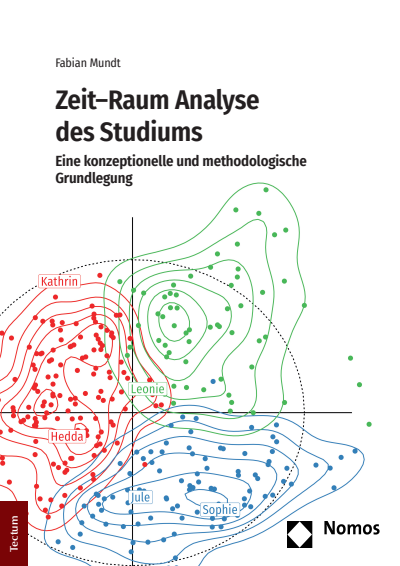
Zeit-Raum Analyse des Studiums
Eine konzeptionelle und methodologische Grundlegung- Autor:innen:
- Verlag:
- 2022
Zusammenfassung
Wie lassen sich soziale Zeit–Räume denken und erkunden? Ausgehend von dieser Fragestellung werden in einem ersten Schritt in Anlehnung an die Idee der Phänomenotechnik die konzeptionellen Grundlagen des sozialen Zusammenhangs von Zeit und Raum theoretisch formuliert und methodologisch reflektiert. Es folgt in einem zweiten Schritt die forschungspraktische Anwendung der konzeptionellen Grundlegung anhand einer exemplarischen Analyse studentischer Zeit–Raum-Konstellationen. Hierzu wird auf eine innovative Kombination quantitativ-geometrischer und qualitativ-kartografischer Ansätze zurückgegriffen, die nicht nur dominante zeitlich-räumlichen Muster und deren Hintergründe sichtbar macht, sondern zugleich neue Perspektiven für die Hochschulforschung eröffnet.
Schlagworte
Publikation durchsuchen
Bibliographische Angaben
- Copyrightjahr
- 2022
- ISBN-Print
- 978-3-8288-4792-7
- ISBN-Online
- 978-3-8288-7904-1
- Verlag
- Nomos, Baden-Baden
- Sprache
- Deutsch
- Seiten
- 216
- Produkttyp
- Monographie
Inhaltsverzeichnis
- Titelei/Inhaltsverzeichnis Kein Zugriff Seiten I - XIV
- A Zielsetzungen Kein Zugriff
- B Aufbau Kein Zugriff
- 1.1.1 Heterogene Konzepte Kein Zugriff
- 1.1.2 Kombinationsvorschläge Kein Zugriff
- 1.2.1 Die Herstellung von Zeit–Räumen durch die soziale Praxis Kein Zugriff
- 1.2.2 Die dynamische Stabilisierung von Zeit–Raum-Konstellationen Kein Zugriff
- 1.3.1 Metrisch: Objektivierte Distanzen Kein Zugriff
- 1.3.2 Mental: Habitualisierte Schemata Kein Zugriff
- 2.1.1 Klassifizieren: Verbreitete Zeitmuster identifizieren Kein Zugriff
- 2.1.2 Visualisieren: Zeitmuster grafisch abbilden Kein Zugriff
- 2.2.1 Zeitgeografische Referenzen Kein Zugriff
- 2.2.2 Flache Visualisierungen Kein Zugriff
- 2.3.1 Von Datentabellen zur Kartierung von Punktwolken Kein Zugriff
- 2.3.2 Punktwolken kumulativ erweitern Kein Zugriff
- 3.1.1 Geometrischer Orientierungsrahmen und fokussierte Einzelfälle Kein Zugriff
- 3.1.2 Verläufe untersuchen Kein Zugriff
- 3.2.1 Fragebögen Kein Zugriff
- 3.2.2 Logbücher Kein Zugriff
- 3.2.3 Fokussierte Interviews Kein Zugriff
- 3.3.1 Geometrisch-quantitativ Kein Zugriff
- 3.3.2 Kartografisch-qualitativ Kein Zugriff
- 4.1 Fokus und Fragestellung Kein Zugriff
- 4.2 Organisation der Erhebungen Kein Zugriff
- 5.1.1 Zeitmuster Kein Zugriff
- 5.1.2 Lebensgestaltung Kein Zugriff
- 5.1.3 Studiengestaltung Kein Zugriff
- 5.2.1 Individuelle Positionen Kein Zugriff
- 5.2.2 Inhaltliche Dimensionen deuten Kein Zugriff
- 5.2.3 Eine erste Karte der Studierenden Kein Zugriff
- 5.3.1 Soziale Herkunft Kein Zugriff
- 5.3.2 Schulische Genese Kein Zugriff
- 5.3.3 Studienwahl Kein Zugriff
- 6.1.1 Drei Konstellationen Kein Zugriff
- 6.1.2 Spezifische Studierende in den Blick nehmen Kein Zugriff
- 6.2.1 Zwei Positionen im Fokus: Hedda und Kathrin Kein Zugriff
- 6.2.2 Orte Chronologien: Zwischen Studium und Familie Kein Zugriff
- 6.2.3 Zusammenführende Interpretation Kein Zugriff
- 6.3.1 Zwei Positionen im Fokus: Sophie und Jule Kein Zugriff
- 6.3.2 Orte Chronologien: Studieren an Ort und Stelle Kein Zugriff
- 6.3.3 Zusammenführende Interpretation Kein Zugriff
- 6.4.1 Eine Position im Fokus: Leonie Kein Zugriff
- 6.4.2 Orte Chronologie: Studieren und arbeiten Kein Zugriff
- 6.4.3 Zusammenführende Interpretation Kein Zugriff
- 7.1.1 Trajektorien nachzeichnen Kein Zugriff
- 7.1.2 Die Gesamtheit der Studierenden im Wandel Kein Zugriff
- 7.2.1 Hedda und Kathrin: Annäherung und Entfernung Kein Zugriff
- 7.2.2 Orte-chronologische Verschiebungen Kein Zugriff
- 7.2.3 Perspektivische Interpretation Kein Zugriff
- 7.3.1 Sophie und Jule: Stabilisierungen Kein Zugriff
- 7.3.2 Orte-chronologische Kontinuitäten Kein Zugriff
- 7.3.3 Perspektivische Interpretation Kein Zugriff
- 7.4.1 Leonie: Anpassung Kein Zugriff
- 7.4.2 Orte-chronologische Verlagerungen Kein Zugriff
- 7.4.3 Perspektivische Interpretation Kein Zugriff
- 8.1 Gegenüberstellung der drei studentischen Zeit–Raum-Konstellationen Kein Zugriff
- 8.2 Perspektiven und Potenziale zukünftiger Zeit–Raum Analysen Kein Zugriff
- Danksagung Kein Zugriff Seiten 201 - 202
- Literatur Kein Zugriff Seiten 203 - 212
- Register Kein Zugriff Seiten 213 - 216
Literaturverzeichnis (213 Einträge)
Es wurden keine Treffer gefunden. Versuchen Sie einen anderen Begriff.
- Abbott, A. (2004). Methods of Discovery: Heuristics for the Social Sciences. W. W. Norton & Company. Google Scholar öffnen DOI: 10.5771/9783828879041
- Adam, B. (2005a). Das Diktat der Uhr: Zeitformen, Zeitkonflikte, Zeitperspektiven (U. Beck, Hrsg.). Suhrkamp. (Original erschienen 1995) Google Scholar öffnen DOI: 10.5771/9783828879041
- Adam, B. (2005b). Timescapes of Modernity: The Environment and Invisible Hazards. Routledge. Google Scholar öffnen DOI: 10.5771/9783828879041
- Althausen, F. (2019). Typeface: »Vollkorn«. Verfügbar 28. Juli 2020 unter https://www.vollkorntypeface.com Google Scholar öffnen DOI: 10.5771/9783828879041
- Asdonk, J., Kuhnen, S. U., & Bornkessel, P. (Hrsg.). (2013). Von der Schule zur Hochschule: Analysen, Konzeptionen und Gestaltungsperspektiven des Übergangs. Waxmann. Google Scholar öffnen DOI: 10.5771/9783828879041
- Audigier, V., Husson, F., & Josse, J. (2015). MIMCA: Multiple imputation for categorical variables with multiple correspondence analysis. Google Scholar öffnen DOI: 10.5771/9783828879041
- Augé, M. (2014). Nicht-Orte (4. Aufl.). C. H. Beck. Google Scholar öffnen DOI: 10.5771/9783828879041
- Bach, B., Dragicevic, P., Archambault, D., Hurter, C., & Carpendale, S. (2014). A Review of Temporal Data Visualizations Based on Space-Time Cube Operations. Eurographics Conference on Visualization. Google Scholar öffnen DOI: 10.5771/9783828879041
- Bachelard, G. (1987). Die Bildung des wissenschaftlichen Geistes: Beitrag zu einer Psychoanalyse der objektiven Erkenntnis. Suhrkamp. (Original erschienen 1938) Google Scholar öffnen DOI: 10.5771/9783828879041
- Bachelard, G. (1988). Der neue wissenschaftliche Geist. Suhrkamp. (Original erschienen 1934) Google Scholar öffnen DOI: 10.5771/9783828879041
- Bachelard, G. (1993). Epistemologie. Fischer. Google Scholar öffnen DOI: 10.5771/9783828879041
- Banagl, M. (2012). Mathematik/Topologie. In S. Günzel (Hrsg.), Raumwissenschaften (S. 242–258). Suhrkamp. (Original erschienen 2009) Google Scholar öffnen DOI: 10.5771/9783828879041
- Barlösius, E. (2006). Pierre Bourdieu. Campus. Google Scholar öffnen DOI: 10.5771/9783828879041
- Baur, N. (2005). Verlaufsmusteranalyse [Diss.]. Wiesbaden, VS. Google Scholar öffnen DOI: 10.5771/9783828879041
- Baur, N., & Christmann, G. (2021). Fallauswahl und Generalisierung. In A. J. Heinrich, S. Marguin, A. Million & J. Stollmann (Hrsg.), Handbuch qualitative und visuelle Methoden der Raumforschung S. 121–135). transcript. Google Scholar öffnen DOI: 10.5771/9783828879041
- Baur, N., Hering, L., Raschke, A. L., & Thierbach, C. (2014). Theory and Methods in Spatial Analysis: Towards Integrating Qualitative, Quantitative and Cartographic Approaches in the Social Sciences and Humanities. Historische Sozialforschung, 39(2), 7–50. Google Scholar öffnen DOI: 10.5771/9783828879041
- bBox Type GmbH. (2020). Fira Schriftenfamilie. Verfügbar 28. Juli 2020 unter https://bboxtype.com/fira/ Google Scholar öffnen DOI: 10.5771/9783828879041
- Becker, M., & Hehl, K. (2012). Geodäsie. WBG. Google Scholar öffnen DOI: 10.5771/9783828879041
- Benzécri, J.-P. (1992). Correspondence Analysis Handbook. Marcel Dekker. Google Scholar öffnen DOI: 10.5771/9783828879041
- Benzécri, J.-P. (2012). Choriogenesis: The Dynamical Genesis of Space and Its Dimensions, Controlled by Correspondence Analysis. In M. G. Summa, L. Bottou, B. Goldfarb, F. Murtagh, C. Pardoux & M. Touati (Hrsg.), Statistical Learning and Data Science (S. 63–76). CRC. Google Scholar öffnen DOI: 10.5771/9783828879041
- Berg, B. (2020). SDAPS: Scripts for data acquisition with paper-based surveys. Verfügbar 28. Juli 2020 unter https://sdaps.org Google Scholar öffnen DOI: 10.5771/9783828879041
- Blasius, J. (2001). Korrespondenzanalyse. Oldenbourg. Google Scholar öffnen DOI: 10.5771/9783828879041
- Blasius, J., & Greenacre, M. (Hrsg.). (2014). Visualization and Verbalization of Data. CRC. Google Scholar öffnen DOI: 10.5771/9783828879041
- Blasius, J., Lebaron, F., Roux, B. L., & Schmitz, A. (Hrsg.). (2019). Empirical Investigations of Social Space. Springer. Google Scholar öffnen DOI: 10.5771/9783828879041
- Blumenberg, H. (2013). Lebenszeit und Weltzeit (4. Aufl.). Suhrkamp. (Original erschienen 2001) Google Scholar öffnen DOI: 10.5771/9783828879041
- Böhm-Kasper, O., Schuchart, C., & Weishaupt, H. (2009). Quantitative Methoden in der Erziehungswissenschaft. WBG. Google Scholar öffnen DOI: 10.5771/9783828879041
- Bohnsack, R. (2001). Dokumentarische Methode: Theorie und Praxis wissenssoziologischer Interpretation. In T. Hug (Hrsg.), Wie kommt Wissenschaft zu Wissen? (S. 326–345). Schneider Hohengehren. Google Scholar öffnen DOI: 10.5771/9783828879041
- Bohnsack, R. (2014). Rekonstruktive Sozialforschung: Einführung in qualitative Methoden (9. Aufl.). UTB. Google Scholar öffnen DOI: 10.5771/9783828879041
- Bohnsack, R., Nentwig-Gesemann, I., & Nohl, A.-M. (Hrsg.). (2008). Die dokumentarische Methode und ihre Forschungspraxis: Grundlagen qualitativer Sozialforschung (3. Aufl.). Springer VS. Google Scholar öffnen DOI: 10.5771/9783828879041
- Bourdieu, P. (1976). Entwurf einer Theorie der Praxis. Suhrkamp. (Original erschienen 1972) Google Scholar öffnen DOI: 10.5771/9783828879041
- Bourdieu, P. (1982). Die feinen Unterschiede: Kritik der gesellschaftlichen Urteilskraft. Suhrkamp. (Original erschienen 1979) Google Scholar öffnen DOI: 10.5771/9783828879041
- Bourdieu, P. (1987). Sozialer Sinn: Kritik der theoretischen Vernunft. Suhrkamp. (Original erschienen 1980) Google Scholar öffnen DOI: 10.5771/9783828879041
- Bourdieu, P. (1988). Homo academicus. Suhrkamp. (Original erschienen 1984) Google Scholar öffnen DOI: 10.5771/9783828879041
- Bourdieu, P. (1991). Physischer, sozialer und physisch angeeigneter Raum. In M. Wentz (Hrsg.), Stadt-Räume. Campus. Google Scholar öffnen DOI: 10.5771/9783828879041
- Bourdieu, P. (2001). Meditationen: Zur Kritik der scholastischen Vernunft. Suhrkamp. (Original erschienen 1997) Google Scholar öffnen DOI: 10.5771/9783828879041
- Bourdieu, P. (2004). Der Staatsadel. UVK. (Original erschienen 1989) Google Scholar öffnen DOI: 10.5771/9783828879041
- Brake, A. (2011). Kombinieren, mixen, verbinden? In J. Ecarius & I. Miethe (Hrsg.), Methodentriangulation in der qualitativen Bildungsforschung (S. 41–63). Barbara Budrich. Google Scholar öffnen DOI: 10.5771/9783828879041
- Bringhurst, R. (2004). The Elements of Typographic Style (3. Aufl.). Hartley & Marks. Google Scholar öffnen DOI: 10.5771/9783828879041
- Carlier, A., & Kroonenberg, P. M. (1998). The Case of the French Cantons: An Application of Three-Way Correspondence Analysis. In J. Blasius & M. Greenacre (Hrsg.), Visualization of Categorical Data (S. 253–275). Academic Press. Google Scholar öffnen DOI: 10.5771/9783828879041
- Cassor, F., & Le Roux, B. (2019). Assigning Changes Over Time Using Geometric Data Analysis Methods: Application to the French »Barometer of Political Trust«. In J. Blasius, F. Lebaron, B. L. Roux & A. Schmitz (Hrsg.), Empirical Investigations of Social Space (S. 325–344). Springer. Google Scholar öffnen DOI: 10.5771/9783828879041
- Castells, M. (2000). The Rise of the Network Society: Economy, Society and Culture (2. Aufl., Bde. 2, Bd. 1). Blackwell. (Original erschienen 1996) Google Scholar öffnen DOI: 10.5771/9783828879041
- Cramer, C. (2012). Entwicklung von Professionalität in der Lehrerbildung: Empirische Befunde zu Eingangsbedingungen, Prozessmerkmale und Ausbildungserfahrungen Lehramtsstudierender. Klinkhardt. Google Scholar öffnen DOI: 10.5771/9783828879041
- Crang, M. (2015). Zeit : Raum. In J. Döring & T. Thielmann (Hrsg.), Spatial Turn: Das Raumparadigma in den Kultur- und Sozialwissenschaften (S. 409–438). transcript. Google Scholar öffnen DOI: 10.5771/9783828879041
- Creswell, J. W., & Clark, V. L. P. (2018). Designing and Conducting Mixed Methods Research (3. Aufl.). SAGE. Google Scholar öffnen DOI: 10.5771/9783828879041
- de Certeau, M. (1988). Kunst des Handelns. Merve. (Original erschienen 1980) Google Scholar öffnen DOI: 10.5771/9783828879041
- de Leeuw, J. (1998). Here’s Looking at Multivariables. In J. Blasius & M. Greenacre (Hrsg.), Visualization of Categorical Data (S. 1–11). Academic Press. Google Scholar öffnen DOI: 10.5771/9783828879041
- Deleuze, G., & Guattari, F. (1977). Rhizom. Merve Verlag. (Original erschienen 1976) Google Scholar öffnen DOI: 10.5771/9783828879041
- Diaz-Bone, R. (2007). Die französische Epistemologie und ihre Revisionen: Zur Rekonstruktion des methodologischen Standortes der Foucaultschen Diskursanalyse. Forum Qualitative Sozialforschung, 8(2). Google Scholar öffnen DOI: 10.5771/9783828879041
- Diaz-Bone, R. (2019). Statistik für Soziologen (5. Aufl.). UTB. Google Scholar öffnen DOI: 10.5771/9783828879041
- Dollase, R. (1995). Temporale Muster in der Freizeitforschung: Eine neue methodische Perspektive für empirische Untersuchungen. Spektrum Freizeit, 2(3), 107–119. Google Scholar öffnen DOI: 10.5771/9783828879041
- Dollase, R. (2000). Was sind Temporale Muster? Zur Phänomenologie, Forschungsgeschichte und Relevanz eines vertrauten Alltagsphänornens. In R. Dollase, K. Hammerich & W. Tokarski (Hrsg.), Temporale Muster: Die ideale Reihenfolge der Tätigkeiten (S. 13–33). Springer. Google Scholar öffnen DOI: 10.5771/9783828879041
- Dollase, R., Hammerich, K., & Tokarski, W. (Hrsg.). (2000). Temporale Muster: Die ideale Reihenfolge der Tätigkeiten. Springer. Google Scholar öffnen DOI: 10.5771/9783828879041
- Egger, R., Mikula, R., Haring, S., Felbinger, A., & Pilch-Ortega, A. (Hrsg.). (2008). Orte des Lernens: Lernwelten und ihre biographische Aneignung. Springer. Google Scholar öffnen DOI: 10.5771/9783828879041
- Elias, N. (1984). Über die Zeit. Suhrkamp. Google Scholar öffnen DOI: 10.5771/9783828879041
- El-Mafaalani, A. (2020). Mythos Bildung: Die ungerechte Gesellschaft, ihr Bildungssystem und seine Zukunft. Kiepenheuer & Witsch. Google Scholar öffnen DOI: 10.5771/9783828879041
- Engels, J. M., & Diehr, P. (2003). Imputation of Missing Longitudinal Data: A Comparison of Methods. Journal of Clinical Epidemiology, 56(10), 968–976. Google Scholar öffnen DOI: 10.5771/9783828879041
- Flick, U. (2011). Qualitative Sozialforschung: Eine Einführung (4. Auflage). Rowohlt. Google Scholar öffnen DOI: 10.5771/9783828879041
- Franck, G. (2002). Soziale Raumzeit. In D. Henckel & M. Eberling (Hrsg.), Raumzeitpolitik (S. 61–80). Google Scholar öffnen DOI: 10.5771/9783828879041
- Frehse, F. (2020). On the Temporalities and Spatialities of the Production of Space. SFB 1265 Working Paper, (4). Google Scholar öffnen DOI: 10.5771/9783828879041
- Friebertshäuser, B. (2008). Statuspassage von der Schule ins Studium. In W. Helsper & J. Böhme (Hrsg.), Handbuch der Schulforschung (S. 611–630). VS. Google Scholar öffnen DOI: 10.5771/9783828879041
- Fuchs-Heinritz, W., & König, A. (2014). Pierre Bourdieu: Eine Einführung (3. Aufl.). UTB. Google Scholar öffnen DOI: 10.5771/9783828879041
- Genolini, C., Alacoque, X., Sentenac, M., & Arnaud, C. (2015). kml and kml3d: R Packages to Cluster Longitudinal Data. Journal of Statistical Software, 65(4). Google Scholar öffnen DOI: 10.5771/9783828879041
- Genolini, C., Ecochard, R., Benghezal, M., Driss, T., Andrieu, S., & Subtil, F. (2016). kmlShape: An Efficient Method to Cluster Longitudinal Data (Time-Series) According to Their Shapes. PLOS ONE, 11(6), 1–25. Google Scholar öffnen DOI: 10.5771/9783828879041
- Genolini, C., Pingault, J.-B., Driss, T., Côté, S., Tremblay, R., Vitaro, F., Arnaud, C., & Falissard, B. (2013). KmL3D: A non-parametric algorithm for clustering joint trajectories. Computer Methods and Programs in Biomedicine, 109(1), 104–111. Google Scholar öffnen DOI: 10.5771/9783828879041
- Giddens, A. (1997). Die Konstitution der Gesellschaft: Grundzüge einer Theorie der Strukturierung (3. Auflage). Suhrkamp. (Original erschienen 1984) Google Scholar öffnen DOI: 10.5771/9783828879041
- Gloy, K. (2006). Zeit: Eine Morphologie. Karl Alber. Google Scholar öffnen DOI: 10.5771/9783828879041
- Google. (2021). Google Maps Platform. Verfügbar 22. November 2021 unter https://developers.google.com/maps/ Google Scholar öffnen DOI: 10.5771/9783828879041
- Gothe, K., & Pfadenhauer, M. (2010). My Campus – Räume für die »Wissensgesellschaft?« Raumnutzungsmuster von Studierenden. VS. Google Scholar öffnen DOI: 10.5771/9783828879041
- Greenacre, M. (2007). Constructing Maps of Data Using Correspondence Analysis. BBVA Foundation Newsletter, 6, 16–17. Google Scholar öffnen DOI: 10.5771/9783828879041
- Greenacre, M. (2010). Biplots in Practice. BBVA. Google Scholar öffnen DOI: 10.5771/9783828879041
- Greenacre, M. (2016). Correspondence Analysis in Practice (3. Aufl.). CRC. Google Scholar öffnen DOI: 10.5771/9783828879041
- Gren, M. (2001). Time-geography matters. In J. May & N. Thrift (Hrsg.), TimeSpace (S. 208–225). Routledge. Google Scholar öffnen DOI: 10.5771/9783828879041
- Grenfell, M., & Lebaron, F. (Hrsg.). (2014). Bourdieu and Data Analysis: Methodological Principles and Practice. Peter Lang. Google Scholar öffnen DOI: 10.5771/9783828879041
- Grolemund, G., &Wickham, H. (2011). Dates andTimes Made Easywith lubridate. Journal of Statistical Software, 40(3), 1–25. Google Scholar öffnen DOI: 10.5771/9783828879041
- Groppe, C. (2016). Die deutsche Universität als pädagogische Institution: Analysen zu ihrer historischen, aktuellen und zukünftigen Entwicklung. In S. Blömeke, M. Caruso, S. Reh, U. Salaschek & J. Stiller (Hrsg.), Traditionen und Zukünfte: Beiträge zum 24. Kongress der Deutschen Gesellschaft für Erziehungswissenschaft (S. 57–76). Barbara Budrich. Google Scholar öffnen DOI: 10.5771/9783828879041
- Grützmacher, J., & Willige, J. (2016). Die Studieneingangsphase aus Studierendensicht: Ergebnisse aus dem Studienqualitätsmonitor 2015. DZHW. Google Scholar öffnen DOI: 10.5771/9783828879041
- Günther, D., Kirschbaum, M., Kruse, R., Ladwig, T., Prill, A., Stang, R., & Wertz, I. (2019). Zukunftsfähige Lernraumgestaltung im digitalen Zeitalter: Thesen und Empfehlungen der Ad-hoc Arbeitsgruppe Lernarchitekturen des Hochschulforum Digitalisierung. Hochschulforum Digitalisierung. Google Scholar öffnen DOI: 10.5771/9783828879041
- Günzel, S. (2007). Raum – Topographie – Topologie. In S. Günzel (Hrsg.), Topologie. Zur Raumbeschreibung in den Kultur- und Medienwissenschaften (S. 13–29). transcript. Google Scholar öffnen DOI: 10.5771/9783828879041
- Günzel, S. (2009). Spatial Turn –Topographical Turn –Topological Turn. In J. Döring & T. Thielmann (Hrsg.), Spatial Turn (2. Aufl., S. 219–237). transcript. Google Scholar öffnen DOI: 10.5771/9783828879041
- Günzel, S. (2018). Raum: Eine kulturwissenschaftliche Einführung (2. Aufl.). transcript. Google Scholar öffnen DOI: 10.5771/9783828879041
- Hägerstrand, T. (1970). What about people in Regional Science? Papers of the Regional Science Association, 24, 7–21. Google Scholar öffnen DOI: 10.5771/9783828879041
- Hägerstrand, T. (1975). Survival and Arena: On the Life-History of Individuals in Relation to their Geographical Environment. The Monadnock, 49, 9–29. Google Scholar öffnen DOI: 10.5771/9783828879041
- Harvey, D. (2005). Spacetime and the World. In Cosmopolitanism and the Geographies of Freedom (S. 113–165). Columbia University Press. Google Scholar öffnen DOI: 10.5771/9783828879041
- Healy, K. (2019). Data Visualization: A Practical Introduction. Princeton University Press. Google Scholar öffnen DOI: 10.5771/9783828879041
- Heidegger, M. (2006). Sein und Zeit. Max Niemeyer. (Original erschienen 1926) Google Scholar öffnen DOI: 10.5771/9783828879041
- Heinrich, A. J. (2021). Integration visueller und verbaler Daten. In A. J. Heinrich, S. Marguin, A. Million & J. Stollmann (Hrsg.), Handbuch qualitative und visuelle Methoden der Raumforschung (S. 137–150). transcript. Google Scholar öffnen DOI: 10.5771/9783828879041
- Heinrich, A. J., Marguin, S., Million, A., & Stollmann, J. (Hrsg.). (2021). Handbuch qualitative und visuelle Methoden der Raumforschung. transcript. Google Scholar öffnen DOI: 10.5771/9783828879041
- Hess, R. (2009). Die Praxis des Tagebuchs: Beobachtung – Dokumentation – Reflexion (G. Weigand, Hrsg. & Übers.). Waxmann. Google Scholar öffnen DOI: 10.5771/9783828879041
- Hjellbrekke, J. (2019). Multiple Correspondence Analysis for the Social Sciences. Routledge. Google Scholar öffnen DOI: 10.5771/9783828879041
- Hjellbrekke, J., Le Roux, B., Korsnes, O., Lebaron, F., Rosenlund, L., & Rouanet, H. (2007). The Norwegian Field of Power. European Societies, 9(2), 245–273. Google Scholar öffnen DOI: 10.5771/9783828879041
- Hörning, K. H., Ahrens, D., & Gerhard, A. (1997). Zeitpraktiken: Experimentierfelder der Spätmoderne. Suhrkamp. Google Scholar öffnen DOI: 10.5771/9783828879041
- Hoyer, T. (2011). Wozu ist die Bildung da? In S. Scheef & G. Schlemminger (Hrsg.), Plädoyer für eine anspruchsvolle LehrerInnenbildung: Versuch einer etwas anderen Festschrift für Liesel Hermes (S. 145–154). Google Scholar öffnen DOI: 10.5771/9783828879041
- Huber, L. (1991). Fachkulturen. Neue Sammlung, 31(1), 3–24. Google Scholar öffnen DOI: 10.5771/9783828879041
- Hünersdorf, B., Müller, B., & Maeder, C. (2008). Ethnographie der Pädagogik: Eine Einführung. In B. Hünersdorf, C. Maeder & B. Müller (Hrsg.), Ethnographie und Erziehungswissenschaft (S. 11–27). Juventa. Google Scholar öffnen DOI: 10.5771/9783828879041
- Husson, F., Lê, S., & Pagès, J. (2017). Exploratory Multivariate Analysis by Example Using R (2. Aufl.). CRC Press. Google Scholar öffnen DOI: 10.5771/9783828879041
- Hüther, O., & Krücken, G. (2016). Hochschulen: Fragestellungen, Ergebnisse und Perspektiven der sozialwissenschaftlichen Hochschulforschung. Springer VS. Google Scholar öffnen DOI: 10.5771/9783828879041
- Instagram. (2021). Instagram-Platform (Facebook, Hrsg.). Verfügbar 22. November 2021 unter https://developers.facebook.com/docs/instagram Google Scholar öffnen DOI: 10.5771/9783828879041
- Janelle, D. G. (2001). Time-Space in Geography. In International Encyclopedia of the Social Behavioral Sciences. Elsevier. Google Scholar öffnen DOI: 10.5771/9783828879041
- Jetzkowitz, J., Lüdtke, H., & Schneider, J. (2004). O Tempora, o Mores: Wie Studierende mit der Zeit umgehen. VS. Google Scholar öffnen DOI: 10.5771/9783828879041
- Jordheim, H., & Ytreberg, E. (2021). After supersynchronisation: How media synchronise the social. Time & Society, 30(3). https://doi.org/10.1177/0961463X211012507 Google Scholar öffnen DOI: 10.5771/9783828879041
- Josse, J., & Husson, F. (2016). missMDA. Journal of Statistical Software, 70(1). Google Scholar öffnen DOI: 10.5771/9783828879041
- Kahle, D. (2013). Maps in R. Kahle, D., & Wickham, H. (2013). ggmap: Spatial Visualization with ggplot2. The R Journal, 5(1), 144–161. Google Scholar öffnen DOI: 10.5771/9783828879041
- Kassambara, A., & Mundt, F. (2017). factoextra: Extract and Visualize the Results of Multivariate Data Analyses (1.0.4). R package. CRAN. Google Scholar öffnen DOI: 10.5771/9783828879041
- Kelle, U. (2008). Die Integration qualitativer und quantitativer Methoden in der empirischen Sozialforschung: Theoretische Grundlagen und methodologische Konzepte (2. Aufl.). VS Verlag. Google Scholar öffnen DOI: 10.5771/9783828879041
- Kleining, G. (2001). Offenheit als Kennzeichen entdeckender Forschung. Kontrapunkt Jahrbuch für kritische Sozialwissenschaft und Philosophie, 1, 27–36. Google Scholar öffnen DOI: 10.5771/9783828879041
- Krawietz, J., Raithelhuber, E., & Roman, N. (2013). Übergänge in der Hochschule. In W. Schröer, B. Stauber, A. Walther, L. Böhnisch & K. Lenz (Hrsg.), Handbuch Übergänge (S. 651–687). Beltz Juventa. Google Scholar öffnen DOI: 10.5771/9783828879041
- Kuchling, H. (2007). Taschenbuch der Physik (19. Aufl.). Hanser. Google Scholar öffnen DOI: 10.5771/9783828879041
- Kuckartz, U. (2014). Mixed Methods: Methdologie, Forschungsdesigns und Analyseverfahren. Springer VS. Google Scholar öffnen DOI: 10.5771/9783828879041
- Lamigueiro, O. P. (2014). Displaying Time Series, Spatial, and Space-Time Data with R. CRC. Google Scholar öffnen DOI: 10.5771/9783828879041
- Laux, H., Henkel, A., & Anicker, F. (Hrsg.). (2017). Raum und Zeit: Soziologische Beobachtungen zur gesellschaftlichen Raumzeit. Beltz/Juventa. Google Scholar öffnen DOI: 10.5771/9783828879041
- Lê, S., Josse, J., & Husson, F. (2008). FactoMineR: An R package for multivariate data analysis. Journal of Statistical Software, 25(1). Google Scholar öffnen DOI: 10.5771/9783828879041
- Le Roux, B. (2014a). Structured Data Analysis. In J. Blasius & M. Greenacre (Hrsg.), Visualization and Verbalization of Data (S. 185–204). CRC. Google Scholar öffnen DOI: 10.5771/9783828879041
- Le Roux, B. (2014b). Analyse géométrique des données multidimensionnelles. Dunod. Google Scholar öffnen DOI: 10.5771/9783828879041
- Le Roux, B., & Rouanet, H. (2004). Geometric Data Analysis: From Correspondence Analysis to Structured Data Analysis. Springer. Google Scholar öffnen DOI: 10.5771/9783828879041
- Le Roux, B., & Rouanet, H. (2010). Multiple Correspondence Analysis. SAGE. Google Scholar öffnen DOI: 10.5771/9783828879041
- Lebaron, F. (2012a). Geometric Data Analysis in a Social Science Research Program: The Case of Bourdieu’s Sociology. In M. G. Summa, L. Bottou, B. Goldfarb, F. Murtagh, C. Pardoux & M. Touati (Hrsg.), Statistical Learning and Data Science (S. 77–90). CRC. Google Scholar öffnen DOI: 10.5771/9783828879041
- Lebaron, F. (2012b). Grundzüge einer geometrischen Formalisierung des Feldkonzepts. In S. Bernhard & C. Schmidt-Wellenburg (Hrsg.), Feldanalyse als Forschungsprogramm 1 (S. 123–150). Springer VS. Google Scholar öffnen DOI: 10.5771/9783828879041
- Lebaron, F., & Bonnet, P. (2014). Classification, Social Classes and Cultural Practices: A GDA Approach Through Bourdieu’s Sociology of Culture. In M. Grenfell & F. Lebaron (Hrsg.), Bourdieu and Data Analysis: Methodological Principles and Practice (S. 127–164). Peter Lang. Google Scholar öffnen DOI: 10.5771/9783828879041
- Lebart, L. (2006). Validation Techniques in Multiple Correspondence Analysis. In M. Greenacre & J. Blasius (Hrsg.), Multiple Correspondence Analysis and Related Methods (S. 179–196). CRC. Google Scholar öffnen DOI: 10.5771/9783828879041
- Lefebvre, H. (1992). The Production of Space. Wiley-Blackwell. (Original erschienen 1974) Google Scholar öffnen DOI: 10.5771/9783828879041
- Lenntrop, B. (1976). Paths in Space-Time Environments: A Time-Geographic Study of Movement Possibilities of Individuals. The Royal University of Lund. Google Scholar öffnen DOI: 10.5771/9783828879041
- Levine, R. (2016). Eine Landkarte der Zeit (20. Aufl.). Piper. (Original erschienen 1999) Google Scholar öffnen DOI: 10.5771/9783828879041
- Lippuner, R., & Lossau, J. (2010). Kritik der Raumkehren. In S. Günzel (Hrsg.), Raum. Ein interdisziplinäres Handbuch (S. 110–119). J. B. Metzler. Google Scholar öffnen DOI: 10.5771/9783828879041
- Lovelace, R., Nowosad, J., & Muenchow, J. (2019). Geocomputation with R. CRC. Google Scholar öffnen DOI: 10.5771/9783828879041
- Löw, M. (2001). Raumsoziologie. Suhrkamp. Google Scholar öffnen DOI: 10.5771/9783828879041
- Löw, M. (2015). Space Oddity: Raumtheorie nach dem Spatial Turn. sozialraum.de, (7). Google Scholar öffnen DOI: 10.5771/9783828879041
- Löw, M. (2018). Vom Raum aus die Stadt denken: Grundlagen einer raumtheoretischen Stadtsoziologie. transcript. Google Scholar öffnen DOI: 10.5771/9783828879041
- Löw, M., & Sturm, G. (2005). Raumsoziologie. In F. Kessl, C. Reutlinger, S. Maurer & O. Frey (Hrsg.), Handbuch Sozialraum (S. 31–48). VS. Google Scholar öffnen DOI: 10.5771/9783828879041
- Manovich, L. (2016). Instagram and Contemporary Image. Verfügbar 7. Januar 2022 unter http://manovich . net / content / 04 - projects / 160 - instagram - and - contemporary - image / instagram_book_manovich_2017.pdf Google Scholar öffnen DOI: 10.5771/9783828879041
- Manovich, L. (2020). Cultural Analytics. MIT Press. Google Scholar öffnen DOI: 10.5771/9783828879041
- Manovich, L., Hochman, N., & Chow, J. (2013). Phototrails. Verfügbar 22. November 2021 unter http://phototrails.info Google Scholar öffnen DOI: 10.5771/9783828879041
- Massey, D. (2005). For Space. SAGE. Google Scholar öffnen DOI: 10.5771/9783828879041
- May, J., & Thrift, N. (Hrsg.). (2001). TimeSpace: Geographies of Temporality. Routledge. Google Scholar öffnen DOI: 10.5771/9783828879041
- McTaggart, J. E. (1968). The Nature of Existence (2. Aufl.). The University Press. (Original erschienen 1921) Google Scholar öffnen DOI: 10.5771/9783828879041
- Michalek, R. (2008). Analyseschritte der Dokumentarischen Methode (QUASUS, Hrsg.). Verfügbar 22. November 2021 unter https://quasus.ph-freiburg.de/analyseschritte-der-dokumentarischenmethode/ Google Scholar öffnen DOI: 10.5771/9783828879041
- Middendorff, E., Apolinarski, B., Becker, K., Bornkessel, P., Brandt, T., Heißenberg, S., & Poskowsky, J. (2017). Die wirtschaftliche und soziale Lage der Studierenden in Deutschland 2016: 21. Sozialerhebung des Deutschen Studentenwerks durchgeführt vom Deutschen Zentrum für Hochschul- und Wissenschaftsforschung. BMBF. Google Scholar öffnen DOI: 10.5771/9783828879041
- Middendorff, E., Apolinarski, B., Poskowsky, J., Kandulla, M., & Netz, N. (2013). Die wirtschaftliche und soziale Lage der Studierenden in Deutschland 2012: 20. Sozialerhebung des Deutschen Studentenwerks. BMBF. Google Scholar öffnen DOI: 10.5771/9783828879041
- Multrus, F. (2005). Identifizierung von Fachkulturen über Studierende deutscher Hochschulen: Ergebnisse auf der Basis des Studierendensurveys vom WS 2000/01. Hefte zur Bildungs- und Hochschulforschung, 45. Google Scholar öffnen DOI: 10.5771/9783828879041
- Multrus, F., Majer, S., Bargel, T., & Schmidt, M. (2017). Studiensituation und studentische Orientierungen: 13. Studierendensurvey an Universitäten und Fachhochschulen. BMBF. Google Scholar öffnen DOI: 10.5771/9783828879041
- Mundt, F. (2011). Old Habits Die Hard: Charakterbildung und Habitus oder die Möglichkeiten reflexiver Erziehung. Logos. Google Scholar öffnen DOI: 10.5771/9783828879041
- Mundt, F. (2016). SpatemR. Verfügbar 7. Januar 2022 unter https://github.com/inventionate/SpatemR Google Scholar öffnen DOI: 10.5771/9783828879041
- Mundt, F. (2018). Locate. Verfügbar 7. Januar 2022 unter https://github.com/inventionate/Locate Google Scholar öffnen DOI: 10.5771/9783828879041
- Mundt, F. (2020). TimeSpaceAnalysis [GitLab Repository]. Verfügbar 7. Januar 2022 unter https://gitlab.com/Inventionate/TimeSpaceAnalysis Google Scholar öffnen DOI: 10.5771/9783828879041
- Mundt, F. (2022). Materialien Dissertation [Open Science Framework Projekt]. Verfügbar 7. Januar 2022 unter osf.io/37znf Google Scholar öffnen DOI: 10.5771/9783828879041
- Mundt, F., Hartmann, M., Kawasaki, T., Bayer, A., & Borys, T. (2016). Geometrische Modellierung kultureller Differenzen. In ICMI (Hrsg.), ICME-13. Google Scholar öffnen DOI: 10.5771/9783828879041
- Mundt, F., & Horvath, K. (2019). Exploring the Complex Social Spaces of Higher Education: On the Uses and Challenges of Geometric Data Analysis and Topological Approaches. In J. Google Scholar öffnen DOI: 10.5771/9783828879041
- Huisman & M. Tight (Hrsg.), Theory and Method in Higher Education Research (S. 103–123, Bd. 4). Emerland. Google Scholar öffnen DOI: 10.5771/9783828879041
- Mundt, F., & Kutzner, D. (2017). Die Konstruktion des Raums der Interessenslagen potenzieller Studierender in der Frühpädagogik. die hochschullehre, (3). Google Scholar öffnen DOI: 10.5771/9783828879041
- Murtagh, F. (2014). History of Cluster Analysis. In J. Blasius & M. Greenacre (Hrsg.), Visualization and Verbalization of Data (S. 117–133). CRC. Google Scholar öffnen DOI: 10.5771/9783828879041
- Nassehi, A. (2012). Mentalizing theories oder theories of mentalizing? In H. Förstl (Hrsg.), Theory of Mind: Neurobiologie und Psychologie sozialen Verhaltens (S. 39–52). Springer. Google Scholar öffnen DOI: 10.5771/9783828879041
- Nohl, A.-M. (2012). Interview und dokumentarische Methode: Anleitungen für die Forschungspraxis. Springer VS. Google Scholar öffnen DOI: 10.5771/9783828879041
- Nowotny, H. (1989). Eigenzeit. Suhrkamp. Google Scholar öffnen DOI: 10.5771/9783828879041
- Nuissl, E., & Nuissl, H. (Hrsg.). (2015). Bildung im Raum: Grundlagen der Berufs- und Erwachsenenbildung. Schneider. Google Scholar öffnen DOI: 10.5771/9783828879041
- OpenStreetMap. (2021). OSM API v0.6.Verfügbar 22. November 2021 unter https://wiki.openstreetmap.org/wiki/API Google Scholar öffnen DOI: 10.5771/9783828879041
- Pädagogische Hochschule Karlsruhe (Hrsg.). (2019). Hochschulstatistik: Studiengänge und Fächerwahl 2015 bis 2017. Google Scholar öffnen DOI: 10.5771/9783828879041
- Pagès, J. (2015). Multiple Factor Analysis by Example Using R. CRC. Google Scholar öffnen DOI: 10.5771/9783828879041
- Pedersen, T. L. (2020). ggforce: Accelerating ggplot2. R package. CRAN. Google Scholar öffnen DOI: 10.5771/9783828879041
- Peirce, C. S. (1998). Naturordnungen und Zeichenprozeß (2. Aufl.). Suhrkamp. (Original erschienen 1988) Google Scholar öffnen DOI: 10.5771/9783828879041
- Pfaff-Czarnecka, J. (Hrsg.). (2017). Das soziale Leben der Universität: Studentischer Alltag zwischen Selbstfindung und Fremdbestimmung. transcript. Google Scholar öffnen DOI: 10.5771/9783828879041
- Pickles, J. (2004). A History of Spaces: Cartographic reason, mapping and the geo-coded world. Routledge. Google Scholar öffnen DOI: 10.5771/9783828879041
- Pöge, A. (2011). Persönliche Codes bei Längsschnittuntersuchungen. Methoden — Daten — Analysen, 5(1), 109–134. Google Scholar öffnen DOI: 10.5771/9783828879041
- R-Core-Team. (2020). R: A Language and Environment for Statistical Computing. Vienna, R Foundation for Statistical Computing. Google Scholar öffnen DOI: 10.5771/9783828879041
- Raab-Steiner, E., & Benesch, M. (2012). Der Fragebogen: Von der Forschungsidee zur SPSS-Auswertung (3. Aufl.). UTB. Google Scholar öffnen DOI: 10.5771/9783828879041
- Rämö, H. (1999). An Aristetolian Human Time-Space Manifold. Time & Society, 8(2), 309–328. Google Scholar öffnen DOI: 10.5771/9783828879041
- Reckwitz, A. (2017). Die Gesellschaft der Singularitäten: Zum Strukturwandel der Moderne. Suhrkamp. Google Scholar öffnen DOI: 10.5771/9783828879041
- Rheinberger, H.-J. (2005). Gaston Bachelard and the Notion of »Phenomenotechnique«. Perspectives on Science, 13(3). Google Scholar öffnen DOI: 10.5771/9783828879041
- Ridder, A., & Dollase, R. (2000). Strategien der Auswertung ternporaler Muster. In R. Dollase, K. Hammerich & W. Tokarski (Hrsg.), Temporale Muster: Die ideale Reihenfolge der Tätigkeiten (S. 343–354). Springer. Google Scholar öffnen DOI: 10.5771/9783828879041
- Robette, N. (2021). Geometric Data Analysis with GDAtools. https : / / nicolas - robette . github . io / GDAtools/articles/english/Tutorial_GDA.html Google Scholar öffnen DOI: 10.5771/9783828879041
- Rosa, H. (2005). Beschleunigung: Die Veränderung der Zeitstrukturen in der Moderne. Suhrkamp. Google Scholar öffnen DOI: 10.5771/9783828879041
- Rothland, M. (2014). Wer entscheidet sich für den Lehrerberuf? In E. Terhart, H. Bennewitz & M. Google Scholar öffnen DOI: 10.5771/9783828879041
- Rothland (Hrsg.), Handbuch der Forschung zum Lehrerberuf (2. Aufl., S. 319–348). Waxmann. Google Scholar öffnen DOI: 10.5771/9783828879041
- Rouanet, H. (2006). The Geometric Analysis of Structured Individuals × Variables Tables. In M. Greenacre & J. Blasius (Hrsg.), Multiple Correspondence Analysis and Related Methods (S. 137–159). CRC. Google Scholar öffnen DOI: 10.5771/9783828879041
- Rovelli, C. (2018). Die Ordnung der Zeit. Rowolth. Google Scholar öffnen DOI: 10.5771/9783828879041
- Ruhl, B. (2000). Auswertungsverfahren und Darstellungsmöglichkeiten temporaler Muster. In R. Dollase, K. Hammerich & W. Tokarski (Hrsg.), Temporale Muster: Die ideale Reihenfolge der Tätigkeiten (S. 355–360). Springer. Google Scholar öffnen DOI: 10.5771/9783828879041
- Sander, T. (Hrsg.). (2014). Habitussensibilität: Eine neue Anforderung an professionelles Handeln. Springer VS. Google Scholar öffnen DOI: 10.5771/9783828879041
- Schatzki, T. R. (2010). The Timespace of Human Activity: On Performance, Society, and History as Indeterminate Teleological Events. Lexington Books. Google Scholar öffnen DOI: 10.5771/9783828879041
- Schatzki, T. R., Knorr-Cetina, K., & von Savigny, E. (Hrsg.). (2001). The Practice Turn in Contemporary Theory. Routledge. Google Scholar öffnen DOI: 10.5771/9783828879041
- Scheller, P., Isleib, S., & Sommer, D. (2013). Studienanfängerinnen und Studienanfänger im Wintersemester 2011/12. HIS: Forum Hochschule. Google Scholar öffnen DOI: 10.5771/9783828879041
- Schlitte, A., Hünefeldt, T., Romic, D., & van Loon, J. (Hrsg.). (2014). Philosophie des Orts. transcript. Google Scholar öffnen DOI: 10.5771/9783828879041
- Schlögel, K. (2006). Im Raume lesen wir die Zeit: Über Zivilisationsgeschichte und Geopolitik (5. Aufl.). Fischer. Google Scholar öffnen DOI: 10.5771/9783828879041
- Schmidt-Hertha, B., & Tippelt, R. (2011). Erziehungswissenschaftliche Zugänge zur Hochschulforschung. die hochschule, (2), 25–40. Google Scholar öffnen DOI: 10.5771/9783828879041
- Schmidt-Lauff, S. (2012). Zeit und Bildung: Annäherungen an eine zeittheoretische Grundlegung [Diss.]. Münster, Waxmann. Google Scholar öffnen DOI: 10.5771/9783828879041
- Schmitz, A., & Warczok, T. (2020). Geometric Data Analysis: Advanced Issues and Current Developments (P. Atkinson, S. Delamont, A. Cernat, J. W. Sakshaug & R. A. Williams, Hrsg.). The Google Scholar öffnen DOI: 10.5771/9783828879041
- SAGE Encyclopedia of Research Methods. https://doi.org/10.4135/9781526421036929715 Google Scholar öffnen DOI: 10.5771/9783828879041
- Schroer, M. (2012). Räume, Orte, Grenzen: Auf dem Weg zu einer Soziologie des Raums (4. Aufl.). Suhrkamp. Google Scholar öffnen DOI: 10.5771/9783828879041
- Schroer, M. (2019). Räume der Gesellschaft: Soziologische Studien. Springer VS. Google Scholar öffnen DOI: 10.5771/9783828879041
- Schulmeister, R., & Metzger, C. (Hrsg.). (2011). Die Workload im Bachelor: Zeitbudget und Studierverhalten. Waxmann. Google Scholar öffnen DOI: 10.5771/9783828879041
- Shields, R. (2013). Spatial Questions: Cultural Topologies and Social Spatialisations. SAGE. Google Scholar öffnen DOI: 10.5771/9783828879041
- Sörlin, S. (2020). Hägerstrand as historian: innovation, diffusion and the processual landscape. Landscape Research, 45(6), 712–723. https://doi.org/10.1080/01426397.2020.1790506 Google Scholar öffnen DOI: 10.5771/9783828879041
- Stamen Design. (2021). Stamen Data Sisualization Services. Verfügbar 22. November 2021 unter https://stamen.com Google Scholar öffnen DOI: 10.5771/9783828879041
- Statistisches Bundesamt (Hrsg.). (2001). Zeitbudget in Deutschland – Erfahrungsberichte der Wissenschaft (Bd. 17). Metzler Poeschel. Google Scholar öffnen DOI: 10.5771/9783828879041
- Statistisches Bundesamt (Hrsg.). (2017). Wie die Zeit vergeht: Analysen zur Zeitverwendung in Deutschland [Beiträge zur Ergebniskonferenz der Zeitverwendungserhebung 212/2013 am 5./6. Oktober 2016 in Wiesbaden]. Statistisches Bundesamt. Google Scholar öffnen DOI: 10.5771/9783828879041
- Sui, D. (2012). Looking through Hägerstrand’s dual vistas: towards a unifying framework for time geography [Special Issue on Time Geography]. Journal of Transport Geography, 23, 5–16. https://doi.org/10.1016/j.jtrangeo.2012.03.020 Google Scholar öffnen DOI: 10.5771/9783828879041
- Tabačková, Z. (2021). Ortsbegehung. In A. J. Heinrich, S. Marguin, A. Million & J. Stollmann (Hrsg.), Handbuch qualitative und visuelle Methoden der Raumforschung (S. 275–290). transcript. Google Scholar öffnen DOI: 10.5771/9783828879041
- Tashakkori, A., & Teddlie, C. (Hrsg.). (2010). SAGE Handbook of Mixed Methods in Social & Behavioral Research. SAGE. Google Scholar öffnen DOI: 10.5771/9783828879041
- Thrift, N. (2009). Space: The Fundamental Stuff of Human Geography. In N. Clifford, S. Holloway, S. P. Rice & G. Valentine (Hrsg.), Key Concepts in Geography (S. 95–107). SAGE. Google Scholar öffnen DOI: 10.5771/9783828879041
- Tuan, Y.-F. (2014). Space and Place: The Perspective of Experience (8. Aufl.). University of Minnesota Press. (Original erschienen 1977) Google Scholar öffnen DOI: 10.5771/9783828879041
- Tufte, E. R. (1990). Envisioning Information. Graphics Press. Google Scholar öffnen DOI: 10.5771/9783828879041
- Tufte, E. R. (1997). Visual Explanations: Images and Quantities, Evidence and Narrative. Graphics Press. Google Scholar öffnen DOI: 10.5771/9783828879041
- Tufte, E. R. (2010). Beautiful Evidence. Graphics Press. Google Scholar öffnen DOI: 10.5771/9783828879041
- van Tienoven, T. P., & Minnen, J. (2017). Exploring the stable practices of everyday life: A multi-day time-diary approach. Sociological Review, 65. https://doi.org/10.1177/0038026116674886 Google Scholar öffnen DOI: 10.5771/9783828879041
- Virilio, P. (2008). Rasender Stillstand (4. Aufl.). Fischer. (Original erschienen 1990) Google Scholar öffnen DOI: 10.5771/9783828879041
- Vogel, B., Willige, J., Grützmacher, J., & Sudheimer, S. (2019). Orte des Selbststudiums 2018: Eine empirische Studie zur zeitlichen und räumlichen Organisation des Lernens von Studierenden (Forum Hochschule). HIS-HE. Google Scholar öffnen DOI: 10.5771/9783828879041
- Volpato, R. (2014). Prologue: Let the Data Speak! In J. Blasius & M. Greenacre (Hrsg.), Visualization and Verbalization of Data. CRC. Google Scholar öffnen DOI: 10.5771/9783828879041
- Wacquant, L. J. D. (1996). Auf dem Wege zu einer Sozialpraxeologie: Struktur und Logik der Soziologie Pierre Bourdieus. In Reflexive Anthropologie (S. 17–93). Suhrkamp. Google Scholar öffnen DOI: 10.5771/9783828879041
- Waldenfels, B. (2009). Ortsverschiebungen, Zeitverschiebungen: Modi leibhaftiger Erfahrung. Suhrkamp. Google Scholar öffnen DOI: 10.5771/9783828879041
- Weidenhaus, G. (2015). Soziale Raumzeit. Suhrkamp. Google Scholar öffnen DOI: 10.5771/9783828879041
- Wickham, H. (2010). ggplot2: Elegant Graphics for Data Analysis: Use R! (3. Auflage). Springer. Google Scholar öffnen DOI: 10.5771/9783828879041
- Wickham, H. (2019). Welcome to the tidyverse. Journal of Open Source Software, 4(43). https://doi.org/10.21105/joss.01686 Google Scholar öffnen DOI: 10.5771/9783828879041
- Wilke, C. O. (2019). Fundamentals of Data Visualization. O’Reilly. Google Scholar öffnen DOI: 10.5771/9783828879041
- Witte, D., Schmitz, A., & Schmidt-Wellenburg, C. (2018). Geordnete Verhältnisse? Vielfalt und Einheit relationalen Denkens in der Soziologie. Berliner Journal für Soziologie, 2017(27), 347–376. Google Scholar öffnen DOI: 10.5771/9783828879041
- Xie, Y., Allaire, J., & Grolemund, G. (2018). R Markdown: The Definitive Guide. CRC. Google Scholar öffnen DOI: 10.5771/9783828879041
- Yin, M. R. K. (2006). Mixed Methods Research: Are the Methods Genuinely Integrated or Merely Parallel? Research in the Schools, 13(1), 41–47. Google Scholar öffnen DOI: 10.5771/9783828879041