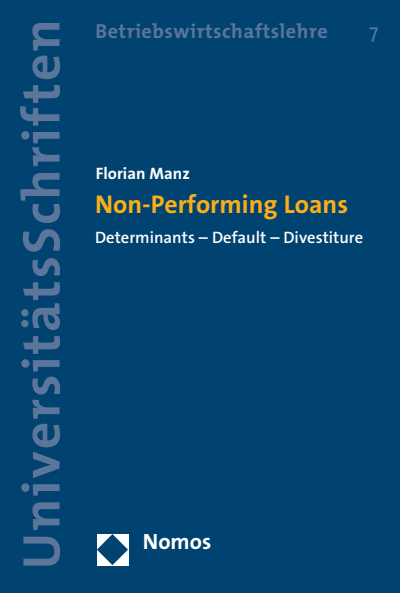
Non-Performing Loans
Determinants - Default - Divestiture- Authors:
- Series:
- Nomos Universitätsschriften - Betriebswirtschaftslehre, Volume 7
- Publisher:
- 2019
Summary
Diese Arbeit nimmt die aktuellen Leitlinien der Europäischen Aufsichtsbehörden zum Umgang mit notleidenden Krediten (NPL) zum Anlass, die Wirksamkeit der bereits genutzten und darin vorgeschlagenen Mechanismen anhand von vier wissenschaftlichen Studien zu beleuchten. Im Rahmen eines systematischen Literaturüberblicks werden zunächst die Determinanten der mit dem Terminus NPL beschriebenen Situation auf makroökonomischer, Bank- und Kreditebene untersucht. Im Anschluss betrachten drei empirische Analysen die Marktreaktionen auf Abwicklungsankündigungen notleidender Assets im Europäischen Aktien- und Fremdkapitalmarkt. Die Ergebnisse präsentieren der Bankenindustrie sowie dem Leitliniengeber und seinen Mitgliedstaaten einen nuancierten Impuls, wie in Zeiten sich stetig ändernder ökonomischer Rahmenbedingungen mit einem hohen Bestand an notleidenden Vermögenswerten umgegangen werden kann.
Search publication
Bibliographic data
- Edition
- 1/2019
- Copyright Year
- 2019
- ISBN-Print
- 978-3-8487-6506-5
- ISBN-Online
- 978-3-7489-0592-9
- Publisher
- Nomos, Baden-Baden
- Series
- Nomos Universitätsschriften - Betriebswirtschaftslehre
- Volume
- 7
- Language
- English
- Pages
- 150
- Product Type
- Monograph
Table of contents
- Titelei/Inhaltsverzeichnis No access Pages 1 - 18
- 1.1 Problem definition and research objectives No access
- 1.2 Dissertation studies No access
- 2.1 Introduction No access
- 2.2.1 Object under investigation No access
- 2.2.2 Information retrieval No access
- 2.2.3 Descriptive analysis No access
- 2.3.1.1 Economic environment No access
- 2.3.1.2 Monetary aspects No access
- 2.3.1.3 Sovereign debt No access
- 2.3.1.4 Price levels No access
- 2.3.1.5 Terms of trade No access
- 2.3.2.1 Cost efficiency No access
- 2.3.2.2 Bank capitalization No access
- 2.3.2.3 Lending policy No access
- 2.3.2.4 Economics of information No access
- 2.3.2.5 Corporate governance No access
- 2.3.3.1 Terms of credit No access
- 2.3.3.2 Disaggregated loan aspects No access
- 2.3.3.3 Interaction with the real economy No access
- 2.4.1.1 Macroeconomic considerations No access
- 2.4.1.2 Bank-specific considerations No access
- 2.4.1.3 Loan-specific considerations No access
- 2.4.2.1 Research activity 1: direct research towards loan-specific events No access
- 2.4.2.2 Research activity 2: direct research towards interdisciplinary and disaggregate analysis of collateral, assets and borrowers No access
- 2.4.2.3 Research activity 3: why do some countries perform better than others? Application of existing theories to different regions, political systems and country clusters No access
- 2.4.2.4 Research activity 4: direct research towards pro-cyclical application of available knowledge for prudent stress testing No access
- 2.4.2.5 Research activity 5: direct research towards a methodological discussion of possible issues of endogeneity in panel data sets No access
- 3.1 Introduction No access
- 3.2 Related literature and hypothesis development No access
- 3.3.1 Data No access
- 3.3.2 Methodology No access
- 3.4.1 Abnormal returns following NPL divestiture announcements No access
- 3.4.2 Real estate driven abnormal returns No access
- 3.4.3 Cross-sectional analysis of abnormal returns No access
- 3.4.4 Cross-sectional buy-side analysis No access
- 3.5 Conclusion No access
- 4.1. Introduction No access
- 4.2. Literature review and hypotheses development No access
- 4.3.1 Sample construction and event study methodology No access
- 4.3.2 Descriptive statistics No access
- 4.4.1 Abnormal returns following NPL divestiture No access
- 4.4.2 The impact of the introduction of CDS trading on NPL sales No access
- 4.4.3 NPL sales at TBTF-banks No access
- 4.5 Conclusion No access
- 5.1. Introduction No access
- 5.2. Sample construction and methodology No access
- 5.3. Results No access
- 5.4. Robustness tests No access
- 5.5. Conclusion and economic implications No access
- 6 Concluding remarks No access Pages 124 - 128
- Appendix No access Pages 129 - 138
- References No access Pages 139 - 150
Bibliography (180 entries)
No match found. Try another term.
- Acharya, V., & Johnson, T. (2007). Insider trading in credit derivatives. Journal of Financial Economics, 84(1), 110-141. doi:10.1016/j.jfineco.2006.05.003 Open Google Scholar DOI: 10.5771/9783748905929
- Adelino, M., Schoar, A., & Severino, F. (2016). Loan originations and defaults in the mortgage crisis: The role of the middle class. Review of Financial Studies, 29(7), 1635-1670. doi:10.1093/rfs/hhw018 Open Google Scholar DOI: 10.5771/9783748905929
- Agarwal, S., Deng, Y. H., Luo, C. X., & Qian, W. L. (2016). The hidden peril: The role of the condo loan market in the recent financial crisis. Review of Finance, 20(2), 467-500. doi:10.1093/rof/rfv015 Open Google Scholar DOI: 10.5771/9783748905929
- Aigner, D., Lovell, C. K., & Schmidt, P. (1977). Formulation and estimation of stochastic frontier production function models. Journal of Econometrics, 6(1), 21-37. doi: 10.1016/ 0304-4076(77)90052-5 Open Google Scholar DOI: 10.5771/9783748905929
- Al-Khazali, O. M., & Mirzaei, A. (2017). The impact of oil price movements on bank non-performing loans: Global evidence from oil-exporting countries. Emerging Markets Review, 31, 193-208. doi:10.1016/j.ememar.2017.05.006 Open Google Scholar DOI: 10.5771/9783748905929
- Arellano, M., & Bond, S. (1991). Some tests of specification for panel data – Monte-Carlo evidence and an application to employment equations. Review of Economic Studies, 58(2), 277-297. doi:10.2307/2297968 Open Google Scholar DOI: 10.5771/9783748905929
- Arellano, M., & Bover, O. (1995). Another look at the instrumental variable estimation of error-components models. Journal of Econometrics, 68(1), 29-51. doi:10.1016/0304-4076(94)01642-D Open Google Scholar DOI: 10.5771/9783748905929
- Babihuga, R. (2007). Macroeconomic and financial soundness indicators: An empirical investigation. IMF Working Paper – WP/07/115. International Monetary Fund. Open Google Scholar DOI: 10.5771/9783748905929
- Baker, J. D. (2016). The purpose, process, and methods of writing a literature review. AORN Journal, 103(3), 265-269. doi:10.1016/j.aorn.2016.01.016 Open Google Scholar DOI: 10.5771/9783748905929
- Balgova, M., Nies, M., & Plekhanov, A. (2016). The economic impact of reducing non-performing loans. European Bank for Reconstruction and Development: Working Paper No. 193. Retrieved from http://www.ebrd.com/publications/working-papers/economic-impact.html. Open Google Scholar DOI: 10.5771/9783748905929
- Ball, R., & Brown, P. (1968). An empirical evaluation of accounting income numbers. Journal of Accounting Research, 6(2), 159-178. doi:10.2307/2490232 Open Google Scholar DOI: 10.5771/9783748905929
- Banerji, S. (2008). Asset sales and debt-equity swap under asymmetric information. Economics Letters, 99(1), 189-191. doi:10.1016/j.econlet.2007.06.025 Open Google Scholar DOI: 10.5771/9783748905929
- Bannier, C. E., & Hirsch, C. W. (2010). The economic function of credit rating agencies – What does the watchlist tell us? Journal of Banking & Finance, 34(12), 3037-3049. doi: 10.1016/j.jbankfin.2010.07.002 Open Google Scholar DOI: 10.5771/9783748905929
- Barber, B. M., & Lyon, J. D. (1996). Detecting abnormal operating performance: The empirical power and specification of test statistics. Journal of Financial Economics, 41(3), 359-399. doi:10.1016/0304-405x(96)84701-5 Open Google Scholar DOI: 10.5771/9783748905929
- Barker, C. A. (1956). Effective Stock Splits. Harvard Business Review, 34(1), 101-106. Open Google Scholar DOI: 10.5771/9783748905929
- Barseghyan, L. (2010). Non-performing loans, prospective bailouts, and Japan's slowdown. Journal of Monetary Economics, 57(7), 873-890. doi:10.1016/j.jmoneco.2010.08.002 Open Google Scholar DOI: 10.5771/9783748905929
- Barth, J. R., Caprio Jr, G., & Levine, R. (2004). Bank regulation and supervision: what works best? Journal of Financial Intermediation, 13(2), 205-248. doi:10.1016/j.jfi.2003.06.002 Open Google Scholar DOI: 10.5771/9783748905929
- Bartram, S. M., Conrad, J. S., Lee, J., & Subrahmanyam, M. G. (2019). Credit default swaps around the world: Investment and financing effects. Working Paper. Available at SSRN 3157187. Open Google Scholar DOI: 10.5771/9783748905929
- Beck, R., Jakubik, P., & Piloiu, A. (2015). Key determinants of non-performing loans: New evidence from a global sample. Open Economies Review, 26(3), 525-550. doi:10.1007/s11079-015-9358-8 Open Google Scholar DOI: 10.5771/9783748905929
- Berger, A. N., & DeYoung, R. (1997). Problem loans and cost efficiency in commercial banks. Journal of Banking & Finance, 21(6), 849-870. doi:10.1016/S0378-4266(97)00003-4 Open Google Scholar DOI: 10.5771/9783748905929
- Berger, A. N., & Humphrey, D. B. (1997). Efficiency of financial institutions: International survey and directions for future research. European Journal of Operational Research, 98(2), 175-212. doi:10.1016/S0377-2217(96)00342-6 Open Google Scholar DOI: 10.5771/9783748905929
- Bernanke, B. S. (1981). Bankruptcy, liquidity, and recession. American Economic Review, 71(2), 155-159. Open Google Scholar DOI: 10.5771/9783748905929
- Bernanke, B., & Gertler, M. (1989). Agency costs, net worth, and business fluctuations. American Economic Review, 79(1), 14-31. Open Google Scholar DOI: 10.5771/9783748905929
- Bernanke, B., Gertler, M., & Gilchrist, S. (1999). The financial accelerator in a quantitative business cycle framework. Handbook of Macroeconomics, 1, 1341-1393. Open Google Scholar DOI: 10.5771/9783748905929
- Binder, J. (1998). The event study methodology since 1969. Review of Quantitative Finance and Accounting, 11(2), 111-137. doi:10.1023/A:1008295500105 Open Google Scholar DOI: 10.5771/9783748905929
- Blaschke, M. W. (2001). Stress testing of financial systems: an overview of issues, methodologies, and FSAP experiences. IMF Working Paper – WP/01/88. International Monetary Fund. Open Google Scholar DOI: 10.5771/9783748905929
- Blundell, R., & Bonds, S. (1998). Initial conditions and moment restrictions in dynamic panel data models. Journal of Econometrics, 87(1), 115-143. doi:10.1016/S0304-4076(98)00009-8 Open Google Scholar DOI: 10.5771/9783748905929
- Blundell, R., Bond, S., & Windmeijer, F. (2001). Estimation in dynamic panel data models: improving on the performance of the standard GMM estimator. Nonstationary panels, panel cointegration, and dynamic panels (pp. 53-91): Emerald Group Publishing Limited. Open Google Scholar DOI: 10.5771/9783748905929
- Boehmer, E., Musumeci, J., & Poulsen, A. B. (1991). Event-study methodology under conditions of event-induced variance. Journal of Financial Economics, 30(2), 253-272. doi:10.1016/0304-405x(91)90032-F Open Google Scholar DOI: 10.5771/9783748905929
- Bolton, P., & Oehmke, M. (2011). Credit default swaps and the empty creditor problem. Review of Financial Studies, 24(8), 2617-2655. doi:10.1093/rfs/hhr002 Open Google Scholar DOI: 10.5771/9783748905929
- Bongini, P., Nieri, L., & Pelagatti, M. (2015). The importance of being systemically important financial institutions. Journal of Banking & Finance, 50, 562-574. doi: 10.1016/ j.jbankfin.2014.07.006 Open Google Scholar DOI: 10.5771/9783748905929
- Bonin, J. P., Hasan, I., & Wachtel, P. (2005). Bank performance, efficiency and ownership in transition countries. Journal of Banking & Finance, 29(1), 31-53. doi:10.1016/ j.jbankfin.2004.06.015 Open Google Scholar DOI: 10.5771/9783748905929
- Borio, C., Drehmann, M., & Tsatsaronis, K. (2014). Stress-testing macro stress testing: does it live up to expectations? Journal of Financial Stability, 12, 3-15. doi: 10.1016/ j.jfs.2013.06.001 Open Google Scholar DOI: 10.5771/9783748905929
- Boudriga, A., Boulila, N., & Jellouli, S. (2009). Banking supervision and nonperforming loans: a cross‐country analysis. Journal of Financial Economic Policy, 1(4), 286-318. doi:10.1108/17576380911050043 Open Google Scholar DOI: 10.5771/9783748905929
- Breuer, W., & Nadler, C. (2012). Real estate and real estate finance as a research field—an international overview. Zeitschrift für Betriebswirtschaft, 82(S1), 5-52. doi:10.1007/s11573-011-0524-1 Open Google Scholar DOI: 10.5771/9783748905929
- Brown, D. T., James, C. M., & Mooradian, R. M. (1994). Asset sales by financially distressed firms. Journal of Corporate Finance, 1(2), 233-257. doi:10.1016/0929-1199(94)90004-3 Open Google Scholar DOI: 10.5771/9783748905929
- Brown, S. J., & Warner, J. B. (1980). Measuring security price performance. Journal of Financial Economics, 8(3), 205-258. doi:10.1016/0304-405x(80)90002-1 Open Google Scholar DOI: 10.5771/9783748905929
- Carey, M. (1998). Credit risk in private debt portfolios. Journal of Finance, 53(4), 1363-1387. doi:10.1111/0022-1082.00056 Open Google Scholar DOI: 10.5771/9783748905929
- Cashin, P., Cespedes, L. F., & Sahay, R. (2004). Commodity currencies and the real exchange rate. Journal of Development Economics, 75(1), 239-268. doi:10.1016/ j.jdeveco.2003.08.005 Open Google Scholar DOI: 10.5771/9783748905929
- Chava, S., Ganduri, R., & Ornthanalai, C. (2019). Do credit default swaps mitigate the impact of credit rating downgrades? Review of Finance, 23(3), 471-511. doi:10.1093/rof/rfy033 Open Google Scholar DOI: 10.5771/9783748905929
- Chen, J., Leung, W. S., Song, W., & Avino, D. (2019). Does CDS trading affect risk-taking incentives in managerial compensation? Journal of Banking & Finance. doi:10.1016/j.jbankfin.2019.01.004 Open Google Scholar DOI: 10.5771/9783748905929
- Chernov, M., Gorbenko, A. S., & Makarov, I. (2013). CDS auctions. The Review of Financial Studies, 26(3), 768-805. doi:10.1093/rfs/hhs124 Open Google Scholar DOI: 10.5771/9783748905929
- Cici, G., Corgel, J., & Gibson, S. (2011). Can fund managers select outperforming REITs? Examining fund holdings and trades. Real Estate Economics, 39(3), 455-486. doi:10.1111/j.1540-6229.2010.00304.x Open Google Scholar DOI: 10.5771/9783748905929
- Clubb, C., & Stouraitis, A. (2002). The significance of sell-off profitability in explaining the market reaction to divestiture announcements. Journal of Banking & Finance, 26(4), 671-688. doi:10.1016/S0378-4266(01)00169-8 Open Google Scholar DOI: 10.5771/9783748905929
- Comment, R., & Jarrell, G. A. (1995). Corporate focus and stock returns. Journal of Financial Economics, 37(1), 67-87. doi:10.1016/0304-405X(94)00777-X Open Google Scholar DOI: 10.5771/9783748905929
- Corrado, C. J. (2011). Event studies: A methodology review. Accounting and Finance, 51(1), 207-234. doi:10.1111/j.1467-629X.2010.00375.x Open Google Scholar DOI: 10.5771/9783748905929
- Corrado, C. J., & Zivney, T. L. (1992). The specification and power of the sign test in event study hypothesis tests using daily stock returns. Journal of Financial and Quantitative Analysis, 27(3), 465-478. doi:10.2307/2331331 Open Google Scholar DOI: 10.5771/9783748905929
- Cowan, A. R. (1992). Nonparametric event study tests. Review of Quantitative Finance and Accounting, 2(4), 343-358. doi:10.1007/BF00939016 Open Google Scholar DOI: 10.5771/9783748905929
- Dahiya, S., Puri, M., & Saunders, A. (2003). Bank borrowers and loan sales: New evidence on the uniqueness of bank loans. Journal of Business, 76(4), 563-582. doi:10.1086/377031 Open Google Scholar DOI: 10.5771/9783748905929
- Danis, A., & Gamba, A. (2018). The real effects of credit default swaps. Journal of Financial Economics, 127(1), 51-76. doi:10.1016/j.jfineco.2017.10.005 Open Google Scholar DOI: 10.5771/9783748905929
- De Bock, R., & Demyanets, M. A. (2012). Bank asset quality in emerging markets: Determinants and spillovers. IMF Working Paper WP/12/71, International Monetary Fund. Open Google Scholar DOI: 10.5771/9783748905929
- Demirgüç-Kunt, A., & Levine, R. (2004). Financial structure and economic growth: A cross-country comparison of banks, markets, and development: MIT press. Open Google Scholar DOI: 10.5771/9783748905929
- Dick, M. (2010). Der Verkauf von Non Performing Loans: eine Analyse von NPL-Transaktionen aus Bankensicht (1. Aufl. ed.). Wiesbaden: Gabler. Open Google Scholar DOI: 10.5771/9783748905929
- Dimitrios, A., Helen, L., & Mike, T. (2016). Determinants of non-performing loans: Evidence from Euro-area countries. Finance Research Letters, 18, 116-119. doi:10.1016/j.frl.2016.04.008 Open Google Scholar DOI: 10.5771/9783748905929
- Dolley, J. C. (1933). Characteristics and Procedure of Common-Stock Split-Ups. Harvard Business Review, 11(3), 316-326. Open Google Scholar DOI: 10.5771/9783748905929
- Economic and Financial Affairs Council – ECOFIN. (2017). Council conclusions on Action plan to tackle non-performing loans in Europe. Press release. Retrieved from http://www.consilium.europa.eu/en/press/press-releases/2017/07/11/conclusions-non-performing-loans/pdf Open Google Scholar DOI: 10.5771/9783748905929
- Economic and Financial Affairs Council – ECOFIN. (2018). Banking Union: Council endorses package of measures to reduce risk [Press release]. Retrieved from https://www.consilium.europa.eu/en/press/press-releases/2018/12/04/banking-union-council-endorses -package-of-measures-to-reduce-risk/pdf Open Google Scholar DOI: 10.5771/9783748905929
- Espinoza, R., & Prasad, A. (2010). Nonperforming loans in the GCC banking system and their macroeconomic effects. IMF Working Paper WP/10/224, International Monetary Fund. Open Google Scholar DOI: 10.5771/9783748905929
- European Banking Authority – EBA. (2013). EBA FINAL draft Implementing technical standards. On supervisory reporting on forbearance and non-performing exposures under article 99(4) of regulation (EU) No 575/2013. Retrieved from https://www.eba.europa.eu/ documents/10180/449824/EBA-ITS-201303+Final+draft+ITS+on+Forbearance+and+ Non-performing+exposures.pdf Open Google Scholar DOI: 10.5771/9783748905929
- European Banking Authority – EBA. (2018). Consultation document: Draft guidelines on management of non-performing and forborne exposures. Retrieved from https://www.eba.europa.eu/documents/10180/2150622/Consultation+Paper+on+Guidelines+on+management+of+non-performing+and+forborne+exposures+%28EBA-CP-2018-01%29.pdf Open Google Scholar DOI: 10.5771/9783748905929
- European Central Bank – ECB. (2017a). Introductory statement to the press conference on the ECB annual report on supervisory activities 2016 (with Q&A). [Press release]. Frankfurt: European Central Bank (Eurosystem) Retrieved from https://www.bankingsupervision. europa.eu/press/speeches/date/2017/html/se170327.en.html. Open Google Scholar DOI: 10.5771/9783748905929
- European Central Bank – ECB. (2017b). Annual Report 2016. Frankfurt: European Central Bank (Eurosystem) Retrieved from https://www.ecb.europa.eu/pub/pdf/annrep/ar2016 en.pdf?f7090bb266c06d6c8857f41220370bfb. Open Google Scholar DOI: 10.5771/9783748905929
- European Central Bank – ECB. (2017c). Guidance to banks on non-performing loans. Retrieved from https://www.bankingsupervision. europa.eu/ecb/pub/pdf/guidance_on_ npl.en.pdf Open Google Scholar DOI: 10.5771/9783748905929
- European Central Bank – ECB. (2018a). Second ordinary hearing in 2018 at the European parliament’s economic and monetary affairs committee [Press release]. Retrieved from https://www.bankingsupervision.europa.eu/press/speeches/date/2018/html/ssm.sp181120.en.html Open Google Scholar DOI: 10.5771/9783748905929
- European Central Bank – ECB. (2018b). Addendum to the ECB guidance to banks on non- performing loans: supervisory expectations for prudential provisioning of non-performing exposures. Retrieved from https://www.bankingsupervision.europa.eu/ecb/ pub/pdf/ssm.npl_addendum_201803.en.pdf Open Google Scholar DOI: 10.5771/9783748905929
- European Commission. (2017, 11 October 2017). Communication from the Commission: Completing the banking union. Retrieved from https://ec.europa.eu/info/ publications/171011-communication-banking-union_en Open Google Scholar DOI: 10.5771/9783748905929
- European Commission. (2018). Second progress report on the reduction of non-performing loans (NPLs). Retrieved from https://ec.europa.eu/info/publications/180314-non-performing-loans-progress-report_en Open Google Scholar DOI: 10.5771/9783748905929
- Faa, L. C. (Producer). (2019). The effects of non-performing loans disposals on banks' stock prices: evidence from Italy. POLITESI digital archive of PhD and post graduate theses. Retrieved from https://www.politesi.polimi.it/handle/10589/145839?mode=full& submit_simple=Show+full+thesis+record Open Google Scholar DOI: 10.5771/9783748905929
- Fama, E. F. (1970). Efficient capital markets: A review of theory and empirical work. Journal of Finance, 25(2), 383-417. Open Google Scholar DOI: 10.5771/9783748905929
- Fama, E. F., & French, K. R. (1993). Common risk-factors in the returns on stocks and bonds. Journal of Financial Economics, 33(1), 3-56. Open Google Scholar DOI: 10.5771/9783748905929
- Fama, E. F., Fisher, L., Jensen, M. C., & Roll, R. (1969). The adjustment of stock prices to new information. International Economic Review, 10(1), 1. doi:10.2307/2525569 Open Google Scholar DOI: 10.5771/9783748905929
- Federal Reserve Economic Data. (2018). Bank non-performing loans to gross loans for United States, Europe, China, percent, annual, not seasonally adjusted. Retrieved from: https://fred.stlouisfed.org Open Google Scholar DOI: 10.5771/9783748905929
- Festić, M., Kavkler, A., & Repina, S. (2011). The macroeconomic sources of systemic risk in the banking sectors of five new EU member states. Journal of Banking & Finance, 35(2), 310-322. Open Google Scholar DOI: 10.5771/9783748905929
- Finnerty, J. D., Miller, C. D., & Chen, R.-R. (2013). The impact of credit rating announcements on credit default swap spreads. Journal of Banking & Finance, 37(6), 2011–2030. doi: 10.1016/j.jbankfin.2013.01.028 Open Google Scholar DOI: 10.5771/9783748905929
- Froitzheim, R., Lotz, U., & Breitenreicher, J. (2006). Non-Performing Loans (NPL) in Deutschland: Praxisrelevante Aspekte, Instrumente zur Abgabe von notleidenden Krediten und Bedeutung für die Banksteuerung. Köln: Bank-Verlag. Open Google Scholar DOI: 10.5771/9783748905929
- Gallo, J. G., Lockwood, L. J., & Rutherford, R. C. (2000). Asset allocation and the performance of real estate mutual funds. Real Estate Economics, 28(1), 165-184. doi:10.1111/1540-6229.00797 Open Google Scholar DOI: 10.5771/9783748905929
- Gande, A., & Saunders, A. (2012). Are banks still special when there is a secondary market for loans? Journal of Finance, 67(5), 1649-1684. Open Google Scholar DOI: 10.5771/9783748905929
- Gavalas, D. (2015). How do banks perform under Basel III? Tracing lending rates and loan quantity. Journal of Economics and Business, 81, 21-37. Open Google Scholar DOI: 10.5771/9783748905929
- Geiger, F., Rottke, N. B., & Schiereck, D. (2007). Marktreaktionen auf Portfolioverkäufe–Transaktionen Not leidender Immobiliendarlehen in Deutschland. Zeitschrift für immobilienwirtschaftliche Forschung und Praxis, H, 3, 15-16. Open Google Scholar DOI: 10.5771/9783748905929
- Gentgen, J. (2007). Strategien deutscher Banken: der Umgang mit immobiliengesicherten Problemkrediten. Wiesbaden: Springer-Gabler-Verlag. Open Google Scholar DOI: 10.5771/9783748905929
- Ghosh, A. (2015). Banking-industry specific and regional economic determinants of non-performing loans: Evidence from US states. Journal of Financial Stability, 20, 93-104. doi:10.1016/j.jfs.2015.08.004 Open Google Scholar DOI: 10.5771/9783748905929
- Ghosh, A. (2017). Sector-specific analysis of non-performing loans in the US banking system and their macroeconomic impact. Journal of Economics and Business, 93, 29-45. doi:10.1016/j.jeconbus.2017.06.002 Open Google Scholar DOI: 10.5771/9783748905929
- Ghosh, S. (2005). Does leverage influence banks' non-performing loans? Evidence from India. Applied Economics Letters, 12(15), 913-918. doi:10.1080/13504850500378064 Open Google Scholar DOI: 10.5771/9783748905929
- Goczek, L., & Malyarenko, N. (2015). Loan loss provisions during the financial crisis in Ukraine. Post-Communist Economies, 27(4), 472-496. doi:10.1080/14631377.20 15.1084717 Open Google Scholar DOI: 10.5771/9783748905929
- Granja, J., Matvos, G., & Seru, A. (2017). Selling failed banks. The Journal of Finance, 72(4), 1723-1784. Open Google Scholar DOI: 10.5771/9783748905929
- Gropp, R., Gruendl, C., & Guettler, A. (2013). The impact of public guarantees on bank risk-taking: Evidence from a natural experiment. Review of Finance, 18(2), 457-488. Open Google Scholar DOI: 10.5771/9783748905929
- Haensel, D., & Krahnen, J. (2007). Does credit securitization reduce bank risk? Evidence from the European CDO market. Unpublished Working Paper. January 29, 2007. doi:10.2139/s srn.967430 Open Google Scholar DOI: 10.5771/9783748905929
- Hirtle, B. (2009). Credit derivatives and bank credit supply. Journal of Financial Intermediation, 18(2), 125-150. Open Google Scholar DOI: 10.5771/9783748905929
- Hu, H. T., & Black, B. (2008). Debt, equity and hybrid decoupling: Governance and systemic risk implications. European Financial Management, 14(4), 663-709. Open Google Scholar DOI: 10.5771/9783748905929
- Hu, J. L., Li, Y., & Chiu, Y. H. (2004). Ownership and nonperforming loans: Evidence from Taiwan's banks. Developing Economies, 42(3), 405-420. doi:10.1111/j.17461049. 2004.tb00945.x Open Google Scholar DOI: 10.5771/9783748905929
- Huang, W. H., Schwienbacher, A., & Zhao, S. (2012). When bank loans are bad news: Evidence from market reactions to loan announcements under the risk of expropriation. Journal of International Financial Markets Institutions & Money, 22(2), 233-252. doi:10.1016/j.intfin.2011.09.004 Open Google Scholar DOI: 10.5771/9783748905929
- Hull, J., Predescu, M., & White, A. (2004). The relationship between credit default swap spreads, bond yields, and credit rating announcements. Journal of Banking & Finance, 28(11), 2789-2811. doi:10.1016/j.jbankfin.2004.06.010 Open Google Scholar DOI: 10.5771/9783748905929
- Irani, R. M., & Meisenzahl, R. R. (2017). Loan sales and bank liquidity management: Evidence from a US credit register. Review of Financial Studies, 30(10), 3455-3501. doi:10.1093/rfs/hhx024 Open Google Scholar DOI: 10.5771/9783748905929
- Ismailescu, I., & Kazemi, H. (2010). The reaction of emerging market credit default swap spreads to sovereign credit rating changes. Journal of Banking & Finance, 34(12), 2861-2873. doi:10.1016/j.jbankfin.2010.05.014 Open Google Scholar DOI: 10.5771/9783748905929
- James, C. (1987). Some evidence on the uniqueness of bank loans. Journal of Financial Economics, 19(2), 217-235. doi:10.1016/0304-405x(87)90003-1 Open Google Scholar DOI: 10.5771/9783748905929
- Jensen, M. C. (2002). Value maximization, stakeholder theory, and the corporate objective function. Business Ethics Quarterly, 12(2), 235-256. doi: 10.1111/j.1745-6622.2001. tb00434.x Open Google Scholar DOI: 10.5771/9783748905929
- Jiménez, G., & Saurina, J. (2006). Credit cycles, credit risk, and prudential regulation. International Journal of Central Banking, 2(2), 65-98. Open Google Scholar DOI: 10.5771/9783748905929
- Jin, J. Y., Kanagaretnam, K., & Lobo, G. J. (2011). Ability of accounting and audit quality variables to predict bank failure during the financial crisis. Journal of Banking & Finance, 35(11), 2811-2819. doi:10.1016/j.jbankfin.2011.03.005 Open Google Scholar DOI: 10.5771/9783748905929
- John, K., & Ofek, E. (1995). Asset sales and increase in focus. Journal of Financial Economics, 37(1), 105-126. Open Google Scholar DOI: 10.5771/9783748905929
- Jorion, P., Liu, Z., & Shi, C. (2005). Informational effects of regulation FD: Evidence from rating agencies. Journal of Financial Economics, 76(2), 309-330. Open Google Scholar DOI: 10.5771/9783748905929
- Kaminsky, G. L., & Reinhart, C. M. (1999). The twin crises: The causes of banking and balance-of-payments problems. American Economic Review, 89(3), 473-500. doi:10.12 57/aer.89.3.473 Open Google Scholar DOI: 10.5771/9783748905929
- Keeton, W. R., & Morris, C. S. (1987). Why do banks' loan losses differ? Economic Review-Federal Reserve Bank of Kansas City, 72(5), 3. Open Google Scholar DOI: 10.5771/9783748905929
- Kiesel, F., Kolaric, S., & Schiereck, D. (2016). Market integration and efficiency of CDS and equity markets. Quarterly Review of Economics and Finance, 61, 209-229. doi: 10.1016/j.qref.2016.02.010 Open Google Scholar DOI: 10.5771/9783748905929
- Kiyotaki, N., & Moore, J. (1997). Credit cycles. Journal of Political Economy, 105(2), 211-248. doi:10.1086/262072 Open Google Scholar DOI: 10.5771/9783748905929
- Klein, N. (2013). Non-performing loans in CESEE; Determinants and impact on macroeconomic performance. IMF Working Paper WP/13/72, International Monetary Fund, Washington D.C. Open Google Scholar DOI: 10.5771/9783748905929
- Kolaric, S., Kiesel, F., & Ongena, S. (2019). Market discipline through credit ratings and too-big-to-fail in banking. Swiss Finance Institute Research Paper (17-09). Open Google Scholar DOI: 10.5771/9783748905929
- Konstantakis, K. N., Michaelides, P. G., & Vouldis, A. T. (2016). Non-performing loans (NPLs) in a crisis economy: Long-run equilibrium analysis with a real time VEC model for Greece (2001-2015). Physica A – Statistical Mechanics and Its Applications, 451, 149-161. doi:10.1016/j.physa.2015.12.163 Open Google Scholar DOI: 10.5771/9783748905929
- Kothari, S., & Warner, J. B. (2007). Econometrics of event studies. Handbook of Empirical Corporate Finance, 1, 3-36. Open Google Scholar DOI: 10.5771/9783748905929
- Krause, T., Sondershaus, T., & Tonzer, L. (2017). Complexity and bank risk during the financial crisis. Economics Letters, 150, 118-121. doi:10.1016/j.econlet.2016.11.026 Open Google Scholar DOI: 10.5771/9783748905929
- Kwan, S., & Eisenbeis, R. A. (1997). Bank risk, capitalization, and operating efficiency. Journal of Financial Services Research, 12(2-3), 117-131. doi:10.1023/A:1007970618 648 Open Google Scholar DOI: 10.5771/9783748905929
- Labbé, A. (2016). The NPL clean-up. International Financial Law Review, 21-21. Open Google Scholar DOI: 10.5771/9783748905929
- Lane, W. R., Looney, S. W., & Wansley, J. W. (1986). An application of the cox proportional hazards model to bank failure. Journal of Banking & Finance, 10(4), 511-531. doi:10.1016/S0378-4266(86)80003-6 Open Google Scholar DOI: 10.5771/9783748905929
- Lasfer, M. A., Sudarsanam, P. S., & Taffler, R. J. (1996). Financial distress, asset sales, and lender monitoring. Financial Management, 57-66. Open Google Scholar DOI: 10.5771/9783748905929
- Lee, J., Naranjo, A., & Velioglu, G. (2018). When do CDS spreads lead? Rating events, private entities, and firm-specific information flows. Journal of Financial Economics, 130(3), 556-578. Open Google Scholar DOI: 10.5771/9783748905929
- Lintner, J. (1969). The valuation of risk assets and the selection of risky investments in stock portfolios and capital budgets: A reply. The Review of Economics and Statistics, 222-224. Open Google Scholar DOI: 10.5771/9783748905929
- Lockwood, L. J., Rutherford, R. C., & Herrera, M. J. (1996). Wealth effects of asset securitization. Journal of Banking & Finance, 20(1), 151-164. doi:10.1016/0378-4266(94)00101-4 Open Google Scholar DOI: 10.5771/9783748905929
- Longstaff, F. A., Mithal, S., & Neis, E. (2005). Corporate yield spreads: Default risk or liquidity? New evidence from the credit default swap market. Journal of Finance, 60(5), 2213-2253. doi:10.1111/j.1540-6261.2005.00797.x Open Google Scholar DOI: 10.5771/9783748905929
- Looney, A., & Yannelis, C. (2015). A crisis in student loans? How changes in the characteristics of borrowers and in the institutions they attended contributed to rising loan defaults. Brookings Papers on Economic Activity, 1-68. Open Google Scholar DOI: 10.5771/9783748905929
- Louzis, D. P., Vouldis, A. T., & Metaxas, V. L. (2012). Macroeconomic and bank-specific determinants of non-performing loans in Greece: A comparative study of mortgage, business and consumer loan portfolios. Journal of Banking & Finance, 36(4), 1012-1027. doi:10.1016/j.jbankfin.2011.10.012 Open Google Scholar DOI: 10.5771/9783748905929
- Lu, D., Thangavelu, S. M., & Hu, Q. (2005). Biased lending and non-performing loans in China's banking sector. Journal of Development Studies, 41(6), 1071-1091. doi:10.1080/00220380500155361 Open Google Scholar DOI: 10.5771/9783748905929
- MacKinlay, A. C. (1997). Event studies in economics and finance. Journal of Economic Literature, 35(1), 13-39. Open Google Scholar DOI: 10.5771/9783748905929
- Makri, V., Tsagkanos, A., & Belles, A. (2014). Determinants of non-performing loans: The case of Eurozone. Panoeconomicus, 61(2), 193-206. doi:10.2298/Pan1402193m Open Google Scholar DOI: 10.5771/9783748905929
- Manz, F. (2019). Determinants of non-performing loans: What do we know? A systematic review and avenues for future research. Management Review Quarterly, 1-39. doi:10.1007/s11301-019-00156-7 Open Google Scholar DOI: 10.5771/9783748905929
- Manz, F., Kiesel, F., & Schiereck, D. (2019). Do NPL portfolio sales help reduce banks’ financing costs? Economics Letters, 182, 93-97. doi:10.1016/j.econlet.2019.06.009 Open Google Scholar DOI: 10.5771/9783748905929
- Maskara, P. K., & Mullineaux, D. J. (2011). Information asymmetry and self-selection bias in bank loan announcement studies. Journal of Financial Economics, 101(3), 684-694. doi:10.1016/j.jfineco.2011.03.019 Open Google Scholar DOI: 10.5771/9783748905929
- Mendoza, E. G. (1995). The terms of trade, the real exchange-rate, and economic-fluctuations. International Economic Review, 36(1), 101-137. doi:10.2307/2527429 Open Google Scholar DOI: 10.5771/9783748905929
- Mora-Sanguinetti, J. S., Martinez-Matute, M., & Garcia-Posada, M. (2017). Credit, crisis and contract enforcement: evidence from the Spanish loan market. European Journal of Law and Economics, 44(2), 361-383. doi:10.1007/s10657-017-9557-4 Open Google Scholar DOI: 10.5771/9783748905929
- Mori, M., & Ziobrowski, A. J. (2011). Performance of pairs trading strategy in the US REIT market. Real Estate Economics, 39(3), 409-428. Open Google Scholar DOI: 10.5771/9783748905929
- Myers, J. H., & Bakay, A. J. (1948). Influence of stock split-ups on market price. Harvard Business Review, 26(2), 251-255. Open Google Scholar DOI: 10.5771/9783748905929
- Niering, C. (2008). Non Performing Loans – Herausforderung für den Insolvenzverwalter: Neue Zeitschrift für das Recht der Insolvenz und Sanierung. NZI, Vol. 3, 146–149. Open Google Scholar DOI: 10.5771/9783748905929
- Nikolopoulos, K. I., & Tsalas, A. I. (2017). Non-performing loans: A review of the literature and the international experience. In P. Monokroussos & C. Gortsos (Eds.), Non-Performing Loans and Resolving Private Sector Insolvency: Experiences from the EU Periphery and the Case of Greece (pp. 47-68). Cham: Springer International Publishing. Open Google Scholar DOI: 10.5771/9783748905929
- Nkusu, M. (2011). Nonperforming loans and macrofinancial vulnerabilities in advanced economies. IMF Working Paper WP/11/161. International Monetary Fund. Open Google Scholar DOI: 10.5771/9783748905929
- Norden, L., & Weber, M. (2004). Informational efficiency of credit default swap and stock markets: The impact of credit rating announcements. Journal of Banking & Finance, 28(11), 2813-2843. doi:10.1016/j.jbankfin.2004.06.011 Open Google Scholar DOI: 10.5771/9783748905929
- O'hara, M., & Shaw, W. (1990). Deposit insurance and wealth effects: the value of being “too big to fail”. The Journal of Finance, 45(5), 1587-1600. Open Google Scholar DOI: 10.5771/9783748905929
- Ortiz-Molina, H., & Penas, M. F. (2008). Lending to small businesses: the role of loan maturity in addressing information problems. Small Business Economics, 30(4), 361-383. doi:10.1007/s11187-007-9053-2 Open Google Scholar DOI: 10.5771/9783748905929
- Osei-Assibey, E., & Asenso, J. K. (2015). Regulatory capital and its effect on credit growth, non-performing loans and bank efficiency. Journal of Financial Economic Policy, 7(4), 401-420. doi:10.1108/jfep-03-2015-0018 Open Google Scholar DOI: 10.5771/9783748905929
- Pennacchi, G. G. (1988). Loan sales and the cost of bank capital. The Journal of Finance, 43(2), 375-396. doi:10.2307/2328466 Open Google Scholar DOI: 10.5771/9783748905929
- Peric, B. S., & Konjusak, N. (2017). How did rapid credit growth cause non-performing loans in the CEE Countries? South East European Journal of Economics and Business, 12(2), 73-84. doi:10.1515/jeb-2017-0019 Open Google Scholar DOI: 10.5771/9783748905929
- Petersen, M. A., & Rajan, R. G. (1994). The benefits of lending relationships – Evidence from small business data. Journal of Finance, 49(1), 3-37. doi:10.2307/2329133 Open Google Scholar DOI: 10.5771/9783748905929
- Podpiera, J., & Weill, L. (2008). Bad luck or bad management? Emerging banking market experience. Journal of Financial Stability, 4(2), 135-148. doi:10.1016/j.jfs.2008.01.005 Open Google Scholar DOI: 10.5771/9783748905929
- Quagliariello, M. (2007). Banks’ riskiness over the business cycle: a panel analysis on Italian intermediaries. Applied Financial Economics, 17(2), 119-138. Open Google Scholar DOI: 10.5771/9783748905929
- Radivojevic, N., & Jovovic, J. (2017). Examining of determinants of non-performing loans. Prague Economic Papers, 26(3), 300-316. doi:10.18267/j.pep.615 Open Google Scholar DOI: 10.5771/9783748905929
- Reinhart, C. M., & Rogoff, K. S. (2011). From financial crash to debt crisis. American Economic Review, 101(5), 1676-1706. doi:10.1257/aer.101.5.1676 Open Google Scholar DOI: 10.5771/9783748905929
- Rime, B. (2001). Capital requirements and bank behaviour: Empirical evidence for Switzerland. Journal of Banking & Finance, 25(4), 789-805. doi:10.1016/S0378-4266(00)00105-9 Open Google Scholar DOI: 10.5771/9783748905929
- Rinaldi, L., & Sanchis-Arellano, A. (2006). Household debt sustainability: What explains household non-performing loans? An empirical analysis. ECB Working Paper Series No. 570, European Central Bank. Open Google Scholar DOI: 10.5771/9783748905929
- Rossi, S. P. S., Schwaiger, M. S., & Winkler, G. (2009). How loan portfolio diversification affects risk, efficiency and capitalization: A managerial behaviour model for Austrian banks. Journal of Banking & Finance, 33(12), 2218-2226. doi:10.1016/j.jbankfin. 2009.05.022 Open Google Scholar DOI: 10.5771/9783748905929
- Rottke N., & Gentgen J. (2008) Workout management of non‐performing loans. Journal of Property Investment & Finance, 26(1), 59-79. doi:10.1108/14635780810845163 Open Google Scholar DOI: 10.5771/9783748905929
- Rowe, F. (2014). What literature review is not: Diversity, boundaries and recommendations. European Journal of Information Systems, 23(3), 241-255. doi:10.1057/ejis.2014.7 Open Google Scholar DOI: 10.5771/9783748905929
- Rowley, J., & Slack, F. (2004). Conducting a literature review. Management Research News, 27(6), 31-39. doi:10.1108/01409170410784185 Open Google Scholar DOI: 10.5771/9783748905929
- Salas, V., & Saurina, J. (2002). Credit risk in two institutional regimes: Spanish commercial and savings banks. Journal of Financial Services Research, 22(3), 203-224. doi:10.1023/a:1019781109676 Open Google Scholar DOI: 10.5771/9783748905929
- Saretto, A., & Tookes, H. E. (2013). Corporate leverage, debt maturity, and credit supply: The role of credit default swaps. Review of Financial Studies, 26(5), 1190-1247. doi:10.1093/rfs/hht007 Open Google Scholar DOI: 10.5771/9783748905929
- Scharpf, H. (2009). Risiken des Handels mit notleidenden Krediten: Neue Juristische Wochenschrift. NJW, 3476–3480. Open Google Scholar DOI: 10.5771/9783748905929
- Shaffer, S. (1998). The winner's curse in banking. Journal of Financial Intermediation, 7(4), 359-392. doi:10.1006/jfin.1998.0251 Open Google Scholar DOI: 10.5771/9783748905929
- Sharpe, W. F. (1964). Capital asset prices: A theory of market equilibrium under conditions of risk. The Journal of Finance, 19(3), 425-442. Open Google Scholar DOI: 10.5771/9783748905929
- Shepherd, D. A., & Suddaby, R. (2017). Theory building: A review and integration. Journal of Management, 43(1), 59-86. doi:10.1177/0149206316647102 Open Google Scholar DOI: 10.5771/9783748905929
- Shibata, T., & Tian, Y. (2010). Reorganization strategies and securities valuation under asymmetric information. International Review of Economics & Finance, 19(3), 412-426. doi:10.1016/j.iref.2009.09.002 Open Google Scholar DOI: 10.5771/9783748905929
- Shih, V. (2004). Dealing with non-performing loans: Political constraints and financial policies in China. China Quarterly, 180, 922-944. Open Google Scholar DOI: 10.5771/9783748905929
- Shook, C. L., Ketchen, D. J., Cycyota, C. S., & Crockett, D. (2003). Data analytic trends and training in strategic management. Strategic Management Journal, 24(12), 1231-1237. doi:10.1002/smj.352 Open Google Scholar DOI: 10.5771/9783748905929
- Sinkey, J. F., & Greenawalt, M. B. (1991). Loan-loss experience and risk-taking behavior at large commercial banks. Journal of Financial Services Research, 5(1), 43-59. doi:10.1007/bf00127083 Open Google Scholar DOI: 10.5771/9783748905929
- Stone-Romero, E. F., Weaver, A. E., & Glenar, J. L. (2016). Trends in research design and data analytic strategies in organizational research. Journal of Management, 21(1), 141-157. doi:10.1177/014920639502100109 Open Google Scholar DOI: 10.5771/9783748905929
- Strauss, A., & Corbin, J. M. (1990). Grounded theory research: Procedures, canons, and evaluative criteria. Qualitative Sociology, 13(1), 3-21. Open Google Scholar DOI: 10.5771/9783748905929
- Subrahmanyam, M. G., Tang, D. Y. J., & Wang, S. Q. (2017). Credit default swaps, exacting creditors and corporate liquidity management. Journal of Financial Economics, 124(2), 395-414. doi:10.1016/j.jfineco.2017.02.001 Open Google Scholar DOI: 10.5771/9783748905929
- Subrahmanyam, M. G., Tang, D. Y., & Wang, S. Q. (2014). Does the tail wag the dog? The effect of credit default swaps on credit risk. The Review of Financial Studies, 27(10), 2927-2960. Open Google Scholar DOI: 10.5771/9783748905929
- Tabor, W., Chrisman, J. J., Madison, K., & Vardaman, J. M. (2018). Nonfamily members in family firms: A review and future research agenda. Family Business Review, 31(1), 54-79. doi:10.1177/0894486517734683 Open Google Scholar DOI: 10.5771/9783748905929
- Tarchouna, A., Jarraya, B., & Bouri, A. (2017). How to explain non-performing loans by many corporate governance variables simultaneously? A corporate governance index is built to US commercial banks. Research in International Business and Finance, 42, 645-657. doi:10.1016/j.ribaf.2017.07.008 Open Google Scholar DOI: 10.5771/9783748905929
- Thomas, H. (1999). A preliminary look at gains from asset securitization. Journal of International Financial Markets, Institutions and Money, 9(3), 321-333. Open Google Scholar DOI: 10.5771/9783748905929
- Us, V. (2017). Dynamics of non-performing loans in the Turkish banking sector by an ownership breakdown: The impact of the global crisis. Finance Research Letters, 20, 109-117. doi:10.1016/j.frl.2016.09.016 Open Google Scholar DOI: 10.5771/9783748905929
- Viale, A. M., Kolari, J. W., & Fraser, D. R. (2009). Common risk factors in bank stocks. Journal of Banking & Finance, 33(3), 464-472. doi:10.1016/j.jbankfin.2008.08.019 Open Google Scholar DOI: 10.5771/9783748905929
- Vithessonthi, C. (2016). Deflation, bank credit growth, and non-performing loans: Evidence from Japan. International Review of Financial Analysis, 45, 295-305. doi:10.1016/j.irfa.2016.04.003 Open Google Scholar DOI: 10.5771/9783748905929
- Vom Brocke, J., Simons, A., Niehaves, B., Riemer, K., Plattfaut, R., & Cleven, A. (2009). Reconstructing the giant: On the importance of rigour in documenting the literature search process. ECIS, 9, 2206-2217. Open Google Scholar DOI: 10.5771/9783748905929
- Webster, J., & Watson, R. T. (2002). Analyzing the past to prepare for the future: Writing a literature review. MIS Quarterly, 26(2), Xiii-Xxiii. Open Google Scholar DOI: 10.5771/9783748905929
- Whalen, G. (1991). A proportional hazards model of bank failure: an examination of its usefulness as an early warning tool. Economic Review-Federal Reserve Bank of Cleveland, 27(1), 21-31. Open Google Scholar DOI: 10.5771/9783748905929
- Williams, J. (2004). Determining management behaviour in European banking. Journal of Banking & Finance, 28(10), 2427-2460. doi:10.1016/j.jbankfin.2003.09.010 Open Google Scholar DOI: 10.5771/9783748905929
- Williamson, O. E. (1963). Managerial discretion and business behavior. American Economic Review, 53(5), 1032-1057. Open Google Scholar DOI: 10.5771/9783748905929
- Winson-Geideman, K., & Evangelopoulos, N. (2013). Topics in real estate research, 1973-2010: a latent semantic analysis. Journal of Real Estate Literature, 21(1), 59-76. Open Google Scholar DOI: 10.5771/9783748905929
- Woltering, R. O., Weis, C., Schindler, F., & Sebastian, S. (2018). Capturing the value premium – global evidence from a fair value-based investment strategy. Journal of Banking & Finance, 86, 53-69. doi:10.1016/j.jbankfin.2017.06.009 Open Google Scholar DOI: 10.5771/9783748905929
- Woodward, A. M. (1974). Review literature – characteristics, sources and output in 1972. Aslib Proceedings, 26(9), 367-376. doi:10.1108/eb050471 Open Google Scholar DOI: 10.5771/9783748905929
- Xiao, Y., & Watson, M. (2017). Guidance on conducting a systematic literature review. Journal of Planning Education and Research, 39(1), 93-112. doi:10.1177/0739456x 17723971 Open Google Scholar DOI: 10.5771/9783748905929
- Yang, C. C. (2017). Reduction of non-performing loans in the banking industry: An application of data envelopment analysis. Journal of Business Economics and Management, 18(5), 833-851. doi:10.3846/16111699.2017.1358209 Open Google Scholar DOI: 10.5771/9783748905929
- Zhang, D. Y., Cai, J., Dickinson, D. G., & Kutan, A. M. (2016). Non-performing loans, moral hazard and regulation of the Chinese commercial banking system. Journal of Banking & Finance, 63, 48-60. doi:10.1016/j.jbankfin.2015.11.010 Open Google Scholar DOI: 10.5771/9783748905929