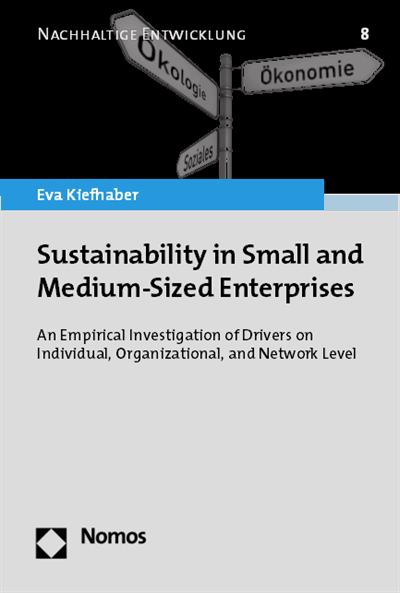
Sustainability in Small and Medium-Sized Enterprises
An Empirical Investigation of Drivers on Individual, Organizational, and Network Level- Autor:innen:
- Reihe:
- Nachhaltige Entwicklung, Band 8
- Verlag:
- 2018
Zusammenfassung
KMUs haben großes Potenzial, die Nachhaltigkeitsleistung der modernen Wirtschaft zu verbessern. Dieses Buch untersucht in drei Studien die Treiber von Nachhaltigkeit in KMUs: Eine qualitative Studie auf individueller Ebene zeigt, wie KMU-Geschäftsführer*innen ihre eigenen nachhaltigkeitsbezogenen Identitäten in ihrem Unternehmen verwirklichen und wie sie mit daraus entstehenden Konflikten umgehen. Eine qualitative Studie auf organisationaler Ebene untersucht, ob und wie Sozialkapital die Nachhaltigkeitsaktivitäten von KMUs fördert. Eine Mixed-Methods-Studie auf Netzwerkebene befasst sich mit möglichen Erfolgsfaktoren von interorganisationalen Nachhaltigkeitsnetzwerken hinsichtlich ihrer Relevanz für den Netzwerkerfolg. Das Buch schließt mit einem Vergleich der Ergebnisse über alle Ebenen hinweg, der Forscher*innen und Praktiker*innen einen umfassenden Überblick über die verwendeten Theorien, die wichtigsten Ergebnisse und mögliche Synergien für zukünftige Forschung bietet.
Publikation durchsuchen
Bibliographische Angaben
- Auflage
- 1/2018
- Copyrightjahr
- 2018
- ISBN-Print
- 978-3-8487-4740-5
- ISBN-Online
- 978-3-8452-9006-5
- Verlag
- Nomos, Baden-Baden
- Reihe
- Nachhaltige Entwicklung
- Band
- 8
- Sprache
- Englisch
- Seiten
- 202
- Produkttyp
- Monographie
Inhaltsverzeichnis
- Titelei/Inhaltsverzeichnis Kein Zugriff Seiten 1 - 23
- 1 Introduction Kein Zugriff Seiten 24 - 26
- 2.1 Small and Medium-Sized Enterprises in Management Research Kein Zugriff
- 2.2 Characteristics of Small and Medium-Sized Enterprises Kein Zugriff
- 2.3 Sustainability in the Business Context Kein Zugriff
- 2.4 Challenges of Sustainability in Small and Medium-Sized Enterprises Kein Zugriff
- 3.1 Need for Research at Multiple Levels Kein Zugriff
- 3.2 Research Approach of this Dissertation Kein Zugriff
- 3.3 National Settings of the Studies Included in this Dissertation Kein Zugriff
- 4.1.1 Research Questions Kein Zugriff
- 4.1.2 Identity Theory Kein Zugriff
- 4.1.3 The Role of Identities in Organizational Institutionalism Kein Zugriff
- 4.1.4 Owner-Managers’ Identities in the Sustainability Context Kein Zugriff
- 4.2.1 Sampling Kein Zugriff
- 4.2.2 Interview Setting and Questions Kein Zugriff
- 4.2.3 Qualitative Data Analysis Kein Zugriff
- 4.3.1 Sustainability-Related Identities in the Institutional System Kein Zugriff
- 4.3.2 Development of Sustainability-Related Identities in the Institutional System. Kein Zugriff
- 4.3.3 Additional Personal Value Spheres: Philanthropy and Nature Kein Zugriff
- 4.4 Results: Impact of Internal Conflicts on Identities Kein Zugriff
- 4.5.1 Identities Involved and Interaction with Institutional Environment Kein Zugriff
- 4.5.2 Circulatory Evolvement of Individual Identities through Conflict Kein Zugriff
- 4.6 Contribution Kein Zugriff
- 4.7 Limitations and Suggestions for Future Research Kein Zugriff
- 5.1.1 Research Questions Kein Zugriff
- 5.1.2 Social Capital Theory Kein Zugriff
- 5.1.3 Dimensions of Social Capital in Organizational Research Kein Zugriff
- 5.1.4 The Role of Social Capital for Sustainability Engagement of Small and Medium-Sized Enterprises Kein Zugriff
- 5.2.1 Challenges and Requirements of Measuring Sustainability in Small and Medium-Sized Enterprises Kein Zugriff
- 5.2.2 Sampling and Interview Setting Kein Zugriff
- 5.2.3 Development of the Interview Guide Kein Zugriff
- 5.2.4 Documentation and Code Structure Kein Zugriff
- 5.3.1 Level of Sustainability Activities Kein Zugriff
- 5.3.2 Owner-Manager’s Level of Sustainability Orientation Kein Zugriff
- 5.4.1 Sustainability-Relation of Social Capital Kein Zugriff
- 5.4.2 Owner-Manager’s Sustainability Orientation Kein Zugriff
- 5.4.3 Model of Social Capital and Sustainability in Small and Medium-Sized Enterprises and Related Propositions Kein Zugriff
- 5.5.1 The Different Effects as Reflected in the Interviews Kein Zugriff
- 5.5.2 Observed Patterns for the Effect of the Social Capital Dimensions Kein Zugriff
- 5.6 Contribution Kein Zugriff
- 5.7 Limitations and Suggestions for Future Research Kein Zugriff
- 6.1.1 Research Questions and Research Approach Kein Zugriff
- 6.1.2 Interorganizational Network Theory Kein Zugriff
- 6.2.1 Search String and Databases Kein Zugriff
- 6.2.2 Results: Definition and Assessment of Network Success Kein Zugriff
- 6.2.3 Results: Potential Success Factors of Interorganizational Networks Kein Zugriff
- 6.3.1 Sampling and Data Collection Kein Zugriff
- 6.3.2 Q Methodology as Assessment Technique Kein Zugriff
- 6.3.3 Data Analysis Kein Zugriff
- 6.4.1 Descriptive Analysis of the Factor Ratings Kein Zugriff
- 6.4.2 Focus Topics and Success Factor Adaptations Kein Zugriff
- 6.5.1 Network Characteristics Kein Zugriff
- 6.5.2 Propositions Related to Network Focus Kein Zugriff
- 6.5.3 Propositions Related to Network Function Kein Zugriff
- 6.5.4 Patterns Related to the Network’s Policy Orientation Kein Zugriff
- 6.6 Contribution Kein Zugriff
- 6.7 Limitations Kein Zugriff
- 7 Cross-Study Integration of Findings Kein Zugriff Seiten 163 - 166
- 8 Conclusion Kein Zugriff Seiten 167 - 168
- Appendices Kein Zugriff Seiten 169 - 178
- References Kein Zugriff Seiten 179 - 202
Literaturverzeichnis (352 Einträge)
Es wurden keine Treffer gefunden. Versuchen Sie einen anderen Begriff.
- Acquaah, M./Amoako-Gyampah, K./Nyathi, N. Q. (2014): Measuring and Valuing Social Capital – A Systematic Review, Johannesburg. Google Scholar öffnen doi.org/10.5771/9783845290065
- Addams, H. (2000): Social Discourse and Environmental Policy: An Application of Q Methodology, In: Addams, H./Proops, John (Eds.): Social Discourse and Environmental Policy, Celtenham, UK, Northhampton, MA, USA, pp. 100–122. Google Scholar öffnen doi.org/10.5771/9783845290065
- Adler, P. S./Kwon, S.-W. (2002): Social Capital: Prospects for a New Concept, In: Academy of Management Review, Vol. 27, No. 1, pp. 17–40. Google Scholar öffnen doi.org/10.5771/9783845290065
- Agranoff, R./McGuire, M. (2001): Big Questions in Public Network Management Research, In: Journal of Public Administration Research and Theory, Vol. 11, No. 3, pp. 295–326. Google Scholar öffnen doi.org/10.5771/9783845290065
- Aguinis, H./Glavas, A. (2012): What We Know and Don’t Know about Corporate Social Responsibility: A Review and Research Agenda, In: Journal of Management, Vol. 38, No. 4, pp. 932–968. Google Scholar öffnen doi.org/10.5771/9783845290065
- Aldakhil, A. M./Nataraja, S. (2014): Environmental Factors and Measures that Affect the Success of International Strategic Alliances, In: Journal of Marketing Management, Vol. 5, No. 1, pp. 17–37. Google Scholar öffnen doi.org/10.5771/9783845290065
- Alisat, S./Norris, J. E./Pratt, M. W./Matsuba, M. K./McAdams, D. P. (2014): Caring for the Earth. Generativity as a Mediator for the Prediction of Environmental Narratives from Identity among Activists and Nonactivists, In: Identity, Vol. 14, No. 3, pp. 177–194. Google Scholar öffnen doi.org/10.5771/9783845290065
- Alonso-Almeida, M. d. M./Llach, J./Marimon, F. (2014): A Closer Look at the ‘Global Reporting Initiative’ Sustainability Reporting as a Tool to Implement Environmental and Social Policies. A Worldwide Sector Analysis, In: Corporate Social Responsibility and Environmental Management, Vol. 21, No. 6, pp. 318–335. Google Scholar öffnen doi.org/10.5771/9783845290065
- Andrés, E. F./Pérez, M. E. L./Polo, I. M./Carrasco, R. V. (2012): Company Image and Corporate Social Responsibility: Reflecting with SMEs’ Managers, In: Marketing Intelligence and Planning, Vol. 30, No. 2, pp. 266–280. Google Scholar öffnen doi.org/10.5771/9783845290065
- Aragón-Correa, J. A./Hurtado-Torres, N./Sharma, S./García-Morales, V. J. (2008): Environmental Strategy and Performance in Small Firms: A Resource-Based Perspective, In: Journal of Environmental Management, Vol. 86, No. 1, pp. 88–103. Google Scholar öffnen doi.org/10.5771/9783845290065
- Aras, G./Crowther, D. (2009): Making Sustainable Development Sustainable, In: Management Decision, Vol. 47, No. 6, pp. 975–988. Google Scholar öffnen doi.org/10.5771/9783845290065
- Arend, R. J. (2013): Social and Environmental Performance at SMEs: Considering Motivations, Capabilities, and Instrumentalism, In: Journal of Business Ethics, Vol. 117, No. 3, pp. 1–21. Google Scholar öffnen doi.org/10.5771/9783845290065
- Ashforth, B. E./Mael, F. (1989): Social Identity Theory and the Organization, In: Academy of Management Review, Vol. 14, No. 1, pp. 20–39. Google Scholar öffnen doi.org/10.5771/9783845290065
- Ashforth, B. E./Schinoff, B. S./Rogers, K. M. (2015): “I Identify with Her,” “I Identify with Him.” Unpacking the Dynamics of Personal Identification in Organizations, In: Academy of Management Review, Vol. 41, No. 1, pp. 28–60. Google Scholar öffnen doi.org/10.5771/9783845290065
- Austrian Institute for SME Research (2014): SME-Data. http://www.kmuforschung.ac.at/index.php/en/sme-data-nace-rev-2, (14 Feb 2017). Google Scholar öffnen doi.org/10.5771/9783845290065
- Ayios, A./Jeurissen, R./Manning, P./Spence, L. J. (2014): Social Capital: A Review from an Ethics Perspective, In: Business Ethics: A European Review, Vol. 23, No. 1, pp. 108–124. Google Scholar öffnen doi.org/10.5771/9783845290065
- Bansal, P./DesJardine, M. R. (2014): Business Sustainability: It Is About Time, In: Strategic Organization, Vol. 12, No. 1, pp. 70–78. Google Scholar öffnen doi.org/10.5771/9783845290065
- Bansal, P./Gao, J./Qureshi, I. (2014): The Extensiveness of Corporate Social and Environmental Commitment across Firms over Time, In: Organization Studies, Vol. 35, No. 7, pp. 949–966. Google Scholar öffnen doi.org/10.5771/9783845290065
- Bansal, P./Roth, K. (2000): Why Companies Go Green: A Model of Ecological Responsiveness, In: Academy of Management Journal, Vol. 43, No. 4, pp. 717–736. Google Scholar öffnen doi.org/10.5771/9783845290065
- Barton, D. (2011): Capitalism for the Long Term, In: Harvard Business Review, March, pp. 1–5. Google Scholar öffnen doi.org/10.5771/9783845290065
- Baumast, A./Pape, Jens (Eds.) (2013): Betriebliches Nachhaltigkeitsmanagement, Stuttgart. Google Scholar öffnen doi.org/10.5771/9783845290065
- Becker, W./Ulrich, P. (2009): Mittelstand, KMU und Familienunternehmen in der Betriebswirtschaftslehre, In: WiSt – Wirtschaftswissenschaftliches Studium, Vol. 38, No. 1, pp. 2–7. Google Scholar öffnen doi.org/10.5771/9783845290065
- Bell, G. G. (2005): Clusters, Networks, and Firm Innovativeness, In: Strategic Management Journal, Vol. 26, No. 3, pp. 287–295. Google Scholar öffnen doi.org/10.5771/9783845290065
- Belliveau, M. A./O’Reilly, C. A./Wade, J. B. (1996): Social Capital at the Top: Effects of Social Similarity and Status on CEO Compensation, In: Academy of Management Journal, Vol. 39, No. 6, pp. 1568–1593. Google Scholar öffnen doi.org/10.5771/9783845290065
- Berghoff, H. (2006): The End of Family Business? The Mittelstand and German Capitalism in Transition, 1949–2000, In: Business History Review, Vol. 80, No. 02, pp. 263–295. Google Scholar öffnen doi.org/10.5771/9783845290065
- Berlemann, M./Jahr, V. (2014): Ist der deutsche Mittelstand tatsächlich ein Innovationsmotor?, In: Ifo Schnelldienst, Vol. 67, No. 17, pp. 22–28. Google Scholar öffnen doi.org/10.5771/9783845290065
- Berry, F. S./Brower, R. S./Choi, S. O./Goa, W. X./Jang, H./Kwon, M./Word, J. (2004): Three Traditions of Network Research: What the Public Management Research Agenda Can Learn from Other Research Communities, In: Public Administration Review, Vol. 64, No. 5, pp. 539–552. Google Scholar öffnen doi.org/10.5771/9783845290065
- Bertelsmann Stiftung (2016a): Policy Performance and Governance Capacities in the OECD and EU. Sustainable Governance Indicators 2016, Gütersloh. Google Scholar öffnen doi.org/10.5771/9783845290065
- Bertelsmann Stiftung (2016b): SDG Index & Dashboards. A Global Report, Gütersloh. Google Scholar öffnen doi.org/10.5771/9783845290065
- Bertelsmann Stiftung (2016c): SGI 2016 – Countries – Austria. http://www.sgi-network.org/2016/Austria, (15 Feb 2017). Google Scholar öffnen doi.org/10.5771/9783845290065
- Bertelsmann Stiftung (2016d): SGI 2016 – Countries – Germany. http://www.sgi-network.org/2016/Germany, (15 Feb 2017). Google Scholar öffnen doi.org/10.5771/9783845290065
- Bertelsmann Stiftung (2016e): SGI 2016 – Countries – New Zealand. http://www.sgi-network.org/2016/New_Zealand, (15 Feb 2017). Google Scholar öffnen doi.org/10.5771/9783845290065
- Bertelsmann Stiftung (2016f): SGI 2016 – Countries – Switzerland. http://www.sgi-network.org/2016/Switzerland, (15 Feb 2017). Google Scholar öffnen doi.org/10.5771/9783845290065
- Bertelsmann Stiftung (2016g): SGI 2016 Survey. http://www.sgi-network.org/2016/, (15 Feb 2017). Google Scholar öffnen doi.org/10.5771/9783845290065
- Bertelsmann Stiftung (2016h): SGI 2016 Survey Structure. http://www.sgi-network.org/2016/Survey_Structure, (16 Feb 2017). Google Scholar öffnen doi.org/10.5771/9783845290065
- Besser, T. L./Miller, N. (2011): The Structural Social, and Strategic Factors Associated With Successful Business Networks, In: Entrepreneurship & Regional Development, Vol. 23, 3/4, pp. 113–133. Google Scholar öffnen doi.org/10.5771/9783845290065
- Beugelsdijk, S./Schaik, T. van (2005): Differences in Social Capital between 54 Western European Regions, In: Regional Studies, Vol. 39, No. 8, pp. 1053–1064. Google Scholar öffnen doi.org/10.5771/9783845290065
- Blackburn, R. A./Smallbone, D. (2008): Researching Small Firms and Entrepreneurship in the U.K. Developments and Distinctiveness, In: Entrepreneurship: Theory & Practice, Vol. 32, No. 2, pp. 267–288. Google Scholar öffnen doi.org/10.5771/9783845290065
- Blundel, R./Monaghan, A./Thomas, C. (2013): SMEs and Environmental Responsibility. A Policy Perspective, In: Business Ethics: A European Review, Vol. 22, No. 3, pp. 246–262. Google Scholar öffnen doi.org/10.5771/9783845290065
- Borga, F./Citterio, A./Noci, G./Pizzurno, E. (2009): Sustainability Report in Small Enterprises: Case Studies in Italian Furniture Companies, In: Business Strategy and the Environment, Vol. 18, No. 3, pp. 162–176. Google Scholar öffnen doi.org/10.5771/9783845290065
- Borgatti, S. P./Foster, P. C. (2003): The Network Paradigm in Organizational Research: A Review and Typology, In: Journal of Management, Vol. 29, No. 6, pp. 991–1013. Google Scholar öffnen doi.org/10.5771/9783845290065
- Bos-Brouwers, H. E. J. (2010): Corporate Sustainability and Innovation in SMEs. Evidence of Themes and Activities in Practice, In: Business Strategy and the Environment, Vol. 19, No. 7, pp. 417–435. Google Scholar öffnen doi.org/10.5771/9783845290065
- Bourdieu, P. (1986): The Forms of Capital, In: Richardson, J. (Ed.): Handbook of Theory and Research for the Sociology of Education, Westport, CT, pp. 241–258. Google Scholar öffnen doi.org/10.5771/9783845290065
- Brass, D. J./Galaskiewicz, J./Greve, H. R./Tsai, W. (2004): Taking Stock of Networks and Organizations: A Multilevel Perspective, In: Academy of Management Journal, Vol. 47, No. 6, pp. 795–817. Google Scholar öffnen doi.org/10.5771/9783845290065
- Brío, J. A. del/Junquera, B. (2003): A Review of the Literature on Environmental Innovation Management in SMEs. Implications for Public Policies, In: Technovation, Vol. 23, No. 12, pp. 939–948. Google Scholar öffnen doi.org/10.5771/9783845290065
- Brown, S. R. (1980): Political Subjectivity: Applications of Q Methodology in Political Science, New Haven, London. Google Scholar öffnen doi.org/10.5771/9783845290065
- Brundtland, G. H. (1987): Our Common Future, Oxford. Google Scholar öffnen doi.org/10.5771/9783845290065
- Bryman, A. (2016): Social Research Methods, 5th Ed., Oxford. Google Scholar öffnen doi.org/10.5771/9783845290065
- Bueren, E. M. van/Klijn, E.-H./Koppenjan, J. F. M. (2003): Dealing with Wicked Problems in Networks: Analyzing an Environmental Debate from a Network Perspective, In: Journal of Public Administration Research and Theory, Vol. 13, No. 2, pp. 193–212. Google Scholar öffnen doi.org/10.5771/9783845290065
- Burke, P. J. (1980): The Self: Measurement Requirements from an Interactionist Perspective, In: Social Psychology Quarterly, Vol. 43, No. 1, pp. 18–29. Google Scholar öffnen doi.org/10.5771/9783845290065
- Burke, P. J./Reitzes, D. C. (1991): An Identity Theory Approach to Commitment, In: Social Psychology Quarterly, Vol. 54, No. 3, pp. 239–251. Google Scholar öffnen doi.org/10.5771/9783845290065
- Burke, P. J./Stets, J. E. (2009): Identity Theory, New York. Google Scholar öffnen doi.org/10.5771/9783845290065
- Burt, C./Stephenson, W. (1939): Alternative Views on Correlations between Persons, In: Psychometrika, Vol. 4, No. 4, pp. 269–281. Google Scholar öffnen doi.org/10.5771/9783845290065
- Burt, R. S. (1992): Structural Holes: The Social Structure of Competition, Cambridge. Google Scholar öffnen doi.org/10.5771/9783845290065
- Burt, R. S. (2000): The Network Structure of Social Capital, In: Research in Organizational Behaviour, Vol. 22, pp. 345–423. Google Scholar öffnen doi.org/10.5771/9783845290065
- Burton, B. K./Goldsby, M. (2009): Corporate Social Responsibility Orientation, Goals, and Behavior: A Study of Small Business Owners, In: Business & Society, Vol. 48, No. 1, pp. 88–104. Google Scholar öffnen doi.org/10.5771/9783845290065
- Byrch, C./Kearins, K./Milne, M./Morgan, R. (2007): Sustainable ”What”? A Cognitive Approach to Understanding Sustainable Development, In: Qualitative Research in Accounting & Management, Vol. 4, No. 1, pp. 26–52. Google Scholar öffnen doi.org/10.5771/9783845290065
- Calogirou, C./Sørensen, S. Y./Larsen, P. B./Alexopoulou, S./et al. (2010): SMEs and the Environment in the European Union, Brussels. Google Scholar öffnen doi.org/10.5771/9783845290065
- Campbell, J. L. (2007): Why Would Corporations Behave in Socially Responsible Ways? An Institutional Theory of Corporate Social Responsibility, In: Academy of Management Review, Vol. 32, No. 3, pp. 946–967. Google Scholar öffnen doi.org/10.5771/9783845290065
- Casson, M./Della Giusta, M. (2007): Entrepreneurship and Social Capital. Analysing the Impact of Social Networks on Entrepreneurial Activity from a Rational Action Perspective, In: International Small Business Journal, Vol. 25, No. 3, pp. 220–244. Google Scholar öffnen doi.org/10.5771/9783845290065
- Chan, R. Y. K. (2005): Does the Natural-Resource-Based View of the Firm Apply in an Emerging Economy? A Survey of Foreign Invested Enterprises in China, In: Journal of Management Studies, Vol. 42, No. 3, pp. 625–672. Google Scholar öffnen doi.org/10.5771/9783845290065
- Chell, E. (2015): Researching the Entrepreneurial Process Using the Critical Incident Technique, In: Neergaard, H. (Ed.): Handbook of Qualitative Research Techniques and Analysis in Entrepreneurship, Cheltenham, Northampton, Mass., pp. 199–223. Google Scholar öffnen doi.org/10.5771/9783845290065
- Chell, E./Pittaway, L. (1998): A Study of Entrepreneurship in the Restaurant and Café Industry. Exploratory Work Using the Critical Incident Technique as a Methodology, In: International Journal of Hospitality Management, Vol. 17, No. 1, pp. 23–32. Google Scholar öffnen doi.org/10.5771/9783845290065
- Chisholm, A. M./Nielsen, K. (2009): Social Capital and the Resource-Based View of the Firm, In: International Studies of Management and Organization, Vol. 39, No. 2, pp. 7–32. Google Scholar öffnen doi.org/10.5771/9783845290065
- Coleman, J. S. (1988): Social Capital in the Creation of Human Capital, In: American Journal of Sociology, 94 Suppl., pp. 95–120. Google Scholar öffnen doi.org/10.5771/9783845290065
- Coleman, J. S. (1990): Foundations of Social Theory, Cambridge. Google Scholar öffnen doi.org/10.5771/9783845290065
- Collins, E./Lawrence, S./Pavlovich, K./Ryan, C. (2007): Business Networks and the Uptake of Sustainability Practices: The Case of New Zealand, In: Journal of Cleaner Production, Vol. 15, 8/9, pp. 729–740. Google Scholar öffnen doi.org/10.5771/9783845290065
- Collins, E./Roper, J./Lawrence, S. (2010): Sustainability Practices: Trends in New Zealand Businesses, In: Business Strategy and the Environment, Vol. 19, No. 8, pp. 479–494. Google Scholar öffnen doi.org/10.5771/9783845290065
- Conscious Consumers (2016): How It All Works. http://consciousconsumers.org.nz/ accredit-business, (23 Feb 2016). Google Scholar öffnen doi.org/10.5771/9783845290065
- Constantinos, C./Sørensen, S. Y./Larsen, P. B./Alexopoulou, S./alteri (2010): SMEs and the Environment in the European Union, Greece. Google Scholar öffnen doi.org/10.5771/9783845290065
- Contractor, N. S./Wasserman, S./Faust, K. (2006): Testing Multitheoretical, Multilevel Hypotheses about Organizational Networks: An Analytic Framework and Empirical Example, In: Academy of Management Review, Vol. 31, No. 3, pp. 681–703. Google Scholar öffnen doi.org/10.5771/9783845290065
- Cooper, A. C./Willard, G. E./Woo, C. Y. (1986): Strategies of High Performing New and Small Firms: A Reexamination of the Niche Concept, In: Journal of Business Venturing, Vol. 1, No. 3, pp. 247–260. Google Scholar öffnen doi.org/10.5771/9783845290065
- Corsten, H./Roth, S. (2012): Nachhaltigkeit als integrierendes Konzept, In: Corsten, H./Roth, Stefan (Eds.): Nachhaltigkeit: Unternehmerisches Handeln in globaler Verantwortung, Dordrecht, pp. 1–13. Google Scholar öffnen doi.org/10.5771/9783845290065
- Courrent, J.-M./Gundolf, K. (2009): Proximity and Micro-Enterprise Manager’s Ethics: A French Empirical Study of Responsible Business Attitudes, In: Journal of Business Ethics, Vol. 88, No. 4, pp. 749–762. Google Scholar öffnen doi.org/10.5771/9783845290065
- Czarniawska, B. (2004): Narratives in Social Science Research, London, Thousand Oaks (CA), New Delhi. Google Scholar öffnen doi.org/10.5771/9783845290065
- Davies, I. A./Ryals, L. J. (2010): The Role of Social Capital in the Success of Fair Trade, In: Journal of Business Ethics, Vol. 96, No. 2, pp. 317–338. Google Scholar öffnen doi.org/10.5771/9783845290065
- Dawson, B. K./Young, L./Tu, C./Chongyi, F. (2014): Co-Innovation in Networks of Resources – A Case Study in the Chinese Exhibition Industry, In: Industrial Marketing Management, Vol. 43, No. 3, pp. 496–503. Google Scholar öffnen doi.org/10.5771/9783845290065
- DiMaggio, P. J./Powell, W. W. (1983): The Iron Cage Revisited: Institutional Isomorphism and Collective Rationality in Organizational Fields, In: American Sociological Review, Vol. 48, No. 2, pp. 147–160. Google Scholar öffnen doi.org/10.5771/9783845290065
- Dlouhá, J./Barton, A./Janouöková, S./Dlouhý, J. (2013): Social Learning Indicators in Sustainability-Oriented Regional Learning Networks, In: Journal of Cleaner Production, Vol. 49, pp. 64–73. Google Scholar öffnen doi.org/10.5771/9783845290065
- Duberley, J./Carrigan, M. (2013): The Career Identities of ‘Mumpreneurs’. Women’s Experiences of Combining Enterprise and Motherhood, In: International Small Business Journal, Vol. 31, No. 6, pp. 629–651. Google Scholar öffnen doi.org/10.5771/9783845290065
- Dyckhoff, H./Souren, R. (2008): Nachhaltige Unternehmensführung. Grundzüge industriellen Umweltmanagements, Berlin, Heidelberg. Google Scholar öffnen doi.org/10.5771/9783845290065
- Edelman (2016): 2016 Edelman Trust Barometer. Global Report. http://www.edelman.com/insights/intellectual-property/2016-edelman-trust-barometer/global-results/, (15 Apr 2017). Google Scholar öffnen doi.org/10.5771/9783845290065
- Edmondson, A. C./McManus, S. E. (2007): Methodological Fit in Management Field Research, In: Academy of Management Review, Vol. 32, No. 4, pp. 1155–1179. Google Scholar öffnen doi.org/10.5771/9783845290065
- Ehnert, I./Harry, W./Zink, K. J. (2014): Sustainability and HRM, In: Ehnert, I./Harry, W./Zink, Klaus J. (Eds.): Sustainability and Human Resource Management: Developing Sustainable Business Organizations, Berlin, Heidelberg, pp. 3–34. Google Scholar öffnen doi.org/10.5771/9783845290065
- Eidgenössisches Departement für Wirtschaft, Bildung und Forschung (2014): KMU in Zahlen: Firmen und Beschäftigte. https://www.kmu.admin.ch/kmu/de/home/kmu-politik/kmu-politik-zahlen-und-fakten/kmu-in-zahlen/firmen-und-beschaeftigte.html, (24 Feb 2017). Google Scholar öffnen doi.org/10.5771/9783845290065
- Eisenhardt, K. M. (1989): Building Theories from Case Study Research, In: Academy of Management Review, Vol. 14, No. 4, pp. 532–550. Google Scholar öffnen doi.org/10.5771/9783845290065
- Elkington, J. (1997): Cannibals with Forks. The Triple Bottom Line of 21st Century Business, Oxford. Google Scholar öffnen doi.org/10.5771/9783845290065
- European Commission (2003a): Responsible Entrepreneurship. A Collection of Good Practice Cases among Small and Medium-Sized Enterprises across Europe, Brussels. Google Scholar öffnen doi.org/10.5771/9783845290065
- European Commission (2003b): What is an SME? http://ec.europa.eu/growth/smes/business-friendly-environment/sme-definition/index_en.htm, (24 Feb 2017). Google Scholar öffnen doi.org/10.5771/9783845290065
- European Commission (2011): Communication from the Commission to the European Parliament, the Council, the European Economic and Social Committee and the Committee of the Regions. A Renewed EU Strategy 2011-14 for Corporate Social Responsibility, Brussels. Google Scholar öffnen doi.org/10.5771/9783845290065
- European Commission (2012): SMEs, Resource Efficiency and Green Markets. Flash Eurobarometer 342, Brussels. Google Scholar öffnen doi.org/10.5771/9783845290065
- Fassin, Y. (2008): SMEs and the Fallacy of Formalising CSR, In: Business Ethics: A European Review, Vol. 17, No. 4, pp. 364–378. Google Scholar öffnen doi.org/10.5771/9783845290065
- Fassin, Y./Rossem, A. van/Buelens, M. (2011): Small-Business Owner-Managers' Perceptions of Business Ethics and CSR-Related Concepts, In: Journal of Business Ethics, Vol. 98, No. 3, pp. 425–453. Google Scholar öffnen doi.org/10.5771/9783845290065
- Fassin, Y./Werner, A./Rossem, A. van/Signori, S./Garriga, E./Weltzien Hoivik, H. v./Schlierer, H.-J. (2015): CSR and Related Terms in SME Owner–Managers’ Mental Models in Six European Countries. National Context Matters, In: Journal of Business Ethics, Vol. 128, No. 2, pp. 433–456. Google Scholar öffnen doi.org/10.5771/9783845290065
- Feng, V. (2013): The Internal Complexity of Market Logics: Financial Sophistication and Price Determination, In: Boxenbaum, E./Lounsbury, Michael (Eds.): Institutional Logics in Action, Part B, Bingley, UK, pp. 275–317. Google Scholar öffnen doi.org/10.5771/9783845290065
- Florén, H./Tell, J. (2004): The Emergent Prerequisites of Managerial Learning in Small Firm Networks, In: Leadership Organization Development Journal, Vol. 25, No. 3, pp. 292–307. Google Scholar öffnen doi.org/10.5771/9783845290065
- Forbes, D. P. (1998): Measuring the Unmeasurable: Empirical Studies of Nonprofit Organization Effectiveness from 1977 to 1997, In: Nonprofit and Voluntary Sector Quarterly, Vol. 27, No. 2, pp. 183–202. Google Scholar öffnen doi.org/10.5771/9783845290065
- Forbes, S. L./Cohen, D. A./Cullen, R./Wratten, S. D./Fountain, J. (2009): Consumer Attitudes Regarding Environmentally Sustainable Wine. An Exploratory Study of the New Zealand Marketplace, In: Journal of Cleaner Production, Vol. 17, No. 13, pp. 1195–1199. Google Scholar öffnen doi.org/10.5771/9783845290065
- Freeman, R. E. (1984): Strategic Management: A Stakeholder Approach, Marshfield, MA, London. Google Scholar öffnen doi.org/10.5771/9783845290065
- Fueglistaller, U./Müller, C./Volery, T. (2004): Entrepreneurship. Modelle – Umsetzung – Perspektiven, Wiesbaden. Google Scholar öffnen doi.org/10.5771/9783845290065
- Fuller, T./Tian, Y. (2006): Social and Symbolic Capital and Responsible Entrepreneurship: An Empirical Investigation of SME Narratives, In: Journal of Business Ethics, Vol. 67, No. 3, pp. 287–304. Google Scholar öffnen doi.org/10.5771/9783845290065
- Gadenne, D. L./Kennedy, J./McKeiver, C. (2009): An Empirical Study of Environmental Awareness and Practices in SMEs, In: Journal of Business Ethics, Vol. 84, No. 1, pp. 45–63. Google Scholar öffnen doi.org/10.5771/9783845290065
- Gallo, P. J./Christensen, L. J. (2011): Firm Size Matters: An Empirical Investigation of Organizational Size and Ownership on Sustainability-Related Behaviors, In: Business & Society, Vol. 50, No. 2, pp. 315–349. Google Scholar öffnen doi.org/10.5771/9783845290065
- Gao, J./Bansal, P. (2013): Instrumental and Integrative Logics in Business Sustainability, In: Journal of Business Ethics, Vol. 112, No. 2, pp. 241–255. Google Scholar öffnen doi.org/10.5771/9783845290065
- Gargiulo, M./Benassi, M. (1999): The Dark Side of Social Capital, In: Leenders, Roger T. A. J./Gabbay, Shaul M. (Eds.): Corporate Social Capital and Liability, New York, pp. 298–322. Google Scholar öffnen doi.org/10.5771/9783845290065
- Gast, J./Gundolf, K./Cesinger, B. (2017): Doing Business in a Green Way. A Systematic Review of the Ecological Sustainability Entrepreneurship Literature and Future Research Directions, In: Journal of Cleaner Production, Vol. 147, pp. 44–56. Google Scholar öffnen doi.org/10.5771/9783845290065
- Gatersleben, B./Murtagh, N./Abrahamse, W. (2014): Values Identity and Pro-Environmental Behaviour, In: Contemporary Social Science, Vol. 9, No. 4, pp. 374–392. Google Scholar öffnen doi.org/10.5771/9783845290065
- Gelbmann, U./Baumgartner, R. J. (2012): Strategische Implementierung von CSR in KMU, In: Schneider, A./Schmidpeter, René (Eds.): Corporate Social Responsibility: Verantwortungsvolle Unternehmensführung in Theorie und Praxis, Berlin, Heidelberg, pp. 285–298. Google Scholar öffnen doi.org/10.5771/9783845290065
- German Council for Sustainable Development (2012): The German Sustainability Code. http://www.deutscher-nachhaltigkeitskodex.de/en/background/downloads-and-links.html, (21 Aug 2014). Google Scholar öffnen doi.org/10.5771/9783845290065
- German Federal Statistical Office (2014): More than 60% of the Persons Employed Worked in SMEs. https://www.destatis.de/EN/FactsFigures/NationalEconomyEnvironment/EnterprisesCrafts/SmallMediumSizedEnterprises/Current.html, (24 Feb 2017). Google Scholar öffnen doi.org/10.5771/9783845290065
- Gibb, A. A. (2000): SME Policy, Academic Research and the Growth of Ignorance, Mythical Concepts, Myths, Assumptions, Rituals and Confusions, In: International Small Business Journal, Vol. 18, No. 3, pp. 13–35. Google Scholar öffnen doi.org/10.5771/9783845290065
- Glanville, J. L./Bienenstock, E. J. (2009): A Typology for Understanding the Connections among Different Forms of Social Capital, In: American Behavioral Scientist, Vol. 52, No. 11, pp. 1507–1530. Google Scholar öffnen doi.org/10.5771/9783845290065
- Glaser, B. G./Strauss, A. L. (1967): The Discovery of Grounded Theory, Chicago, New York. Google Scholar öffnen doi.org/10.5771/9783845290065
- Gläser, J./Laudel, G. (2010): Experteninterviews und Qualitative Inhaltsanalyse, Wiesbaden. Google Scholar öffnen doi.org/10.5771/9783845290065
- Global Reporting Initiative (2013): G4 Sustainability Reporting Guidelines, Part 2: Implementation Manual, Amsterdam. Google Scholar öffnen doi.org/10.5771/9783845290065
- Goerzen, A./Beamish, P. W. (2005): The Effect of Alliance Network Diversity on Multinational Enterprise Performance, In: Strategic Management Journal, Vol. 26, No. 4, pp. 333–354. Google Scholar öffnen doi.org/10.5771/9783845290065
- Graafland, J./Ven, B. van de/Stoffele, N. (2004): Strategies and Instruments for Organising CSR by Small and Large Businesses in the Netherlands, In: Spence, Laura J., Habisch, André/Schmidpeter, René (Eds.): Responsibility and Social Capital: The World of Small and Medium Sized Enterprizes, Basingstoke, New York, pp. 129–153. Google Scholar öffnen doi.org/10.5771/9783845290065
- Granovetter, M. (1983): The Strength of Weak Ties: A Network Theory Revisited, In: Sociological Theory, Vol. 1, pp. 201–233. Google Scholar öffnen doi.org/10.5771/9783845290065
- Granovetter, M. (1992): Problems of Explanation in Economic Sociology, In: Nohria, N./Eccles, Robert G. (Eds.): Networks and Organizations: Structure, Form, and Action, Boston, pp. 25–56. Google Scholar öffnen doi.org/10.5771/9783845290065
- Greenwood, R./Oliver, C./Sahlin, K./Suddaby, R. (2008): Introduction, In: Greenwood, R./Oliver, C./Sahlin, K./Suddaby, Roy (Eds.): SAGE Handbook of Organizational Institutionalism, London, Thousand Oaks (CA), New Delhi, Singapore, pp. 1–46. Google Scholar öffnen doi.org/10.5771/9783845290065
- Guest, G./Bunce, A./Johnson, L. (2006): How Many Interviews Are Enough? An Experiment with Data Saturation and Variability, In: Field Methods, Vol. 18, No. 1, pp. 59–82. Google Scholar öffnen doi.org/10.5771/9783845290065
- Günterberg, B./Kayser, G. (2004): SMEs in Germany. Facts and Figures 2004, Bonn. Google Scholar öffnen doi.org/10.5771/9783845290065
- Hahn, T./Figge, F./Aragón-Correa, J. A./Sharma, S. (2017): Advancing Research on Corporate Sustainability, In: Business & Society, Vol. 56, No. 2, pp. 155–185. Google Scholar öffnen doi.org/10.5771/9783845290065
- Hahn, T./Pinkse, J./Preuss, L./Figge, F. (2015): Tensions in Corporate Sustainability. Towards an Integrative Framework, In: Journal of Business Ethics, Vol. 127, No. 2, pp. 297–316. Google Scholar öffnen doi.org/10.5771/9783845290065
- Hamann, R./Smith, J./Tashman, P./Marshall, R. S. (2017): Why Do SMEs Go Green? An Analysis of Wine Firms in South Africa, In: Business & Society, Vol. 56, No. 1, pp. 23–56. Google Scholar öffnen doi.org/10.5771/9783845290065
- Hanifan, L. J. (1916): The Rural School Community Center, In: Annals of the American Academy of Political and Social Science, Vol. 67, pp. 130–138. Google Scholar öffnen doi.org/10.5771/9783845290065
- Hansen, E. G./Klewitz, J. (2012): The Role of an SME’s Green Strategy in Public-Private Eco-Innovation Initiatives: the Case of Ecoprofit, In: Journal of Small Business and Entrepreneurship, Vol. 25, No. 4, pp. 451–477. Google Scholar öffnen doi.org/10.5771/9783845290065
- Hart, S. L. (1995): A Natural-Resource-Based View of the Firm, In: Academy of Management Review, Vol. 20, No. 4, pp. 986–1014. Google Scholar öffnen doi.org/10.5771/9783845290065
- Hasle, P./Limborg, H. J./Kallehave, T./Klitgaard, C./Andersen, T. R. (2012): The Working Environment in Small Firms. Responses from Owner-Managers, In: International Small Business Journal, Vol. 30, No. 6, pp. 622–639. Google Scholar öffnen doi.org/10.5771/9783845290065
- Hauff, M. v. (2014): Nachhaltige Entwicklung. Grundlagen und Umsetzung, 2nd Ed., München, Germany. Google Scholar öffnen doi.org/10.5771/9783845290065
- Haunschild, L./Wolter, H.-J. (2010): Volkswirtschaftliche Bedeutung von Familien- und Frauenunternehmen, Bonn. Google Scholar öffnen doi.org/10.5771/9783845290065
- Head, B. W. (2008): Assessing Network-based Collaborations: Effectiveness for Whom?, In: Public Management Review, Vol. 10, No. 6, pp. 733–749. Google Scholar öffnen doi.org/10.5771/9783845290065
- Heer, I./Mann, S. (2010): Acting under Spatial Restrictions: Success Factors of German Local Food-Marketing Networks, In: British Food Journal, Vol. 112, No. 3, pp. 285–293. Google Scholar öffnen doi.org/10.5771/9783845290065
- Helmig, B./Spraul, K./Ingenhoff, D. (2016): Under Positive Pressure. How Stakeholder Pressure Affects Corporate Social Responsibility Implementation, In: Business & Society, Vol. 55, No. 2, pp. 151–187. Google Scholar öffnen doi.org/10.5771/9783845290065
- Hemingway, C. A./Maclagan, P. W. (2004): Managers’ Personal Values as Drivers of Corporate Social Responsibility, In: Journal of Business Ethics, Vol. 50, No. 1, pp. 33–44. Google Scholar öffnen doi.org/10.5771/9783845290065
- Herranz, J. (2010): Multilevel Performance Indicators for Multisectoral Networks and Management, In: American Review of Public Administration, Vol. 40, No. 4, pp. 445–460. Google Scholar öffnen doi.org/10.5771/9783845290065
- Hinds, J./Sparks, P. (2008): Engaging with the Natural Environment. The Role of Affective Connection and Identity, In: Journal of Environmental Psychology, Vol. 28, No. 2, pp. 109–120. Google Scholar öffnen doi.org/10.5771/9783845290065
- Hirsh, J. B./Kang, S. K. (2016): Mechanisms of Identity Conflict: Uncertainty, Anxiety, and the Behavioral Inhibition System, In: Personality and Social Psychology Review, Vol. 20, No. 3, pp. 223–244. Google Scholar öffnen doi.org/10.5771/9783845290065
- Hitlin, S. (2003): Values as the Core of Personal Identity. Drawing Links between Two Theories of Self, In: Social Psychology Quarterly, Vol. 66, No. 2, p. 118. Google Scholar öffnen doi.org/10.5771/9783845290065
- Hitt, M. A./Beamish, P. W./Jackson, S. E./Mathieu, J. E. (2007): Building Theoretical and Empirical Bridges Across Levels. Multilevel Research in Management, In: Academy of Management Journal, Vol. 50, No. 6, pp. 1385–1399. Google Scholar öffnen doi.org/10.5771/9783845290065
- Hoang, H./Antoncic, B. (2003): Network-Based Research in Entrepreneurship: A Critical Review, In: Journal of Business Venturing, Vol. 18, No. 2, pp. 165–187. Google Scholar öffnen doi.org/10.5771/9783845290065
- Hoang, H./Gimeno, J. (2010): Becoming a Founder. How Founder Role Identity Affects Entrepreneurial Transitions and Persistence in Founding, In: Journal of Business Venturing, Vol. 25, No. 1, pp. 41–53. Google Scholar öffnen doi.org/10.5771/9783845290065
- Hofmann, K. H./Theyel, G./Wood, C. H. (2012): Identifying Firm Capabilities as Drivers of Environmental Management and Sustainability Practices – Evidence from Small and Medium-Sized Manufacturers, In: Business Strategy and the Environment, Vol. 21, No. 8, pp. 530–545. Google Scholar öffnen doi.org/10.5771/9783845290065
- Hogg, M. A./Terry, D. J./White, K. M. (1995): A Tale of Two Theories: A Critical Comparison of Identity Theory with Social Identity Theory, In: Social Psychology Quarterly, pp. 255–269. Google Scholar öffnen doi.org/10.5771/9783845290065
- Hörisch, J./Freeman, R. E./Schaltegger, S. (2014): Applying Stakeholder Theory in Sustainability Management. Links, Similarities, Dissimilarities, and a Conceptual Framework, In: Organization & Environment, Vol. 27, No. 4, pp. 328–346. Google Scholar öffnen doi.org/10.5771/9783845290065
- Hufnagel, J. (2015): Treiber für nachhaltiges unternehmerisches Handeln: Bedeutung von Spiritualität für Unternehmensgründer: Diplomarbeit, Kaiserslautern. Google Scholar öffnen doi.org/10.5771/9783845290065
- Human, S. E./Provan, K. G. (1997): An Emergent Theory of Structure and Outcomes in Small-Firm Strategic Manufacturing Networks, In: Academy of Management Journal, Vol. 40, No. 2, pp. 368–403. Google Scholar öffnen doi.org/10.5771/9783845290065
- IfM Bonn (2017): Family Enterprises as Defined by IfM Bonn. http://en.ifm-bonn.org/definitions/family-enterprises-as-defined-by-ifm-bonn/, (24 Feb 2017). Google Scholar öffnen doi.org/10.5771/9783845290065
- Inkpen, A. C./Tsang, E. W. K. (2005): Social Capital, Networks, and Knowledge Transfer, In: Academy of Management Review, Vol. 30, No. 1, pp. 146–165. Google Scholar öffnen doi.org/10.5771/9783845290065
- Jack, S. L. (2010): Approaches to Studying Networks: Implications and Outcomes, In: Journal of Business Venturing, Vol. 25, No. 1, pp. 120–137. Google Scholar öffnen doi.org/10.5771/9783845290065
- Jansson, J./Nilsson, J./Modig, F./Hed Vall, G. (2017): Commitment to Sustainability in Small and Medium-Sized Enterprises. The Influence of Strategic Orientations and Management Values, In: Business Strategy and the Environment, Vol. 26, No. 1, pp. 69–83. Google Scholar öffnen doi.org/10.5771/9783845290065
- Jenkins, H. (2004): A Critique of Conventional CSR Theory: An SME Perspective, In: Journal of General Management, Vol. 29, No. 4, pp. 37–57. Google Scholar öffnen doi.org/10.5771/9783845290065
- Jennings, P. D./Zandbergen, P. A. (1995): Ecologically Sustainable Organizations: An Institutional Approach, In: Academy of Management Review, Vol. 20, No. 4, pp. 1015–1052. Google Scholar öffnen doi.org/10.5771/9783845290065
- Jenssen, J. I./Nybakk, E. (2013): Inter-Organizational Networks and Innovation in Small, Knowledge-Intensive Firms: A Literature Review, In: International Journal of Innovation Management, Vol. 17, No. 2, p. 27. Google Scholar öffnen doi.org/10.5771/9783845290065
- Johansson, A. W. (2004): Narrating the Entrepreneur, In: International Small Business Journal, Vol. 22, No. 3, pp. 273–293. Google Scholar öffnen doi.org/10.5771/9783845290065
- Johnson, M. P./Schaltegger, S. (2016): Two Decades of Sustainability Management Tools for SMEs. How Far Have We Come?, In: Journal of Small Business Management, Vol. 54, No. 2, pp. 481–505. Google Scholar öffnen doi.org/10.5771/9783845290065
- Jones, C./Hesterly, W. S./Borgatti, S. P. (1997): A General Theory of Network Governance: Exchange Conditions and Social Mechanisms, In: Academy of Management Review, Vol. 22, No. 4, pp. 911–945. Google Scholar öffnen doi.org/10.5771/9783845290065
- Jones, M. T. (1999): The Institutional Determinants of Social Responsibility, In: Journal of Business Ethics, Vol. 20, No. 2, pp. 163–179. Google Scholar öffnen doi.org/10.5771/9783845290065
- Kenis, P./Provan, K. G. (2009): Towards an Exogenous Theory of Public Network Performance, In: Public Administration, Vol. 87, No. 3, pp. 440–456. Google Scholar öffnen doi.org/10.5771/9783845290065
- Keogh, W./Stewart, V. (2001): Identifying the Skill Requirements of the Workforce in SMEs: Findings from a European Social Fund Project, In: Journal of Small Business and Enterprise Development, Vol. 8, No. 2, pp. 140–149. Google Scholar öffnen doi.org/10.5771/9783845290065
- Khan, S. A./Tang, J./Zhu, R. (2013): The Impact of Environmental, Firm, and Relational Factors on Entrepreneurs’ Ethically Suspect Behaviors, In: Journal of Small Business Management, Vol. 51, No. 4, pp. 637–657. Google Scholar öffnen doi.org/10.5771/9783845290065
- Kickert, W. J. M./Klijn, E.-H./Koppenjan, J. F. M. (1997): Managing Complex Networks: Strategies for the Public Sector, London, Thousand Oaks, New Delhi. Google Scholar öffnen doi.org/10.5771/9783845290065
- Kiefhaber, E./Spraul, K. (2015): Social Capital as a Driver for Sustainability in Small and Medium-Sized Enterprises, The 75th Academy of Management Annual Meeting, Vancouver, Canada. Google Scholar öffnen doi.org/10.5771/9783845290065
- Klewitz, J./Hansen, E. G. (2014): Sustainability-Oriented Innovation of SMEs: A Systematic Review, In: Journal of Cleaner Production, Vol. 65, No. 0, pp. 57–75. Google Scholar öffnen doi.org/10.5771/9783845290065
- Klijn, E.-H./Steijn, B./Edelenbos, J. (2010): The Impact of Network Management on Outcomes in Governance Networks, In: Public Administration, Vol. 88, No. 4, pp. 1063–1082. Google Scholar öffnen doi.org/10.5771/9783845290065
- Klijn, E.-H./Ysa, T./Sierra, V./Berman, E./Edelenbos, J./Chen, D. Y. (2015): The Influence of Network Management and Complexity on Network Performance in Taiwan, Spain and the Netherlands, In: Public Management Review, Vol. 17, No. 5, pp. 736–764. Google Scholar öffnen doi.org/10.5771/9783845290065
- Knight, L./Pye, A. (2005): Network Learning: An Empirically Derived Model of Learning by Groups of Organizations, In: Human Relations, Vol. 58, No. 3, pp. 369–392. Google Scholar öffnen doi.org/10.5771/9783845290065
- Kollmuss, A./Agyeman, J. (2002): Mind the Gap. Why do People Act Environmentally and What are the Barriers to Pro-Environmental Behavior?, In: Environmental Education Research, Vol. 8, No. 3, pp. 239–260. Google Scholar öffnen doi.org/10.5771/9783845290065
- Koppenjan, J. F. M. (2008): Creating a Playing Field for Assessing the Effectiveness of Network Collaboration by Performance Measures, In: Public Management Review, Vol. 10, No. 6, pp. 699–714. Google Scholar öffnen doi.org/10.5771/9783845290065
- Kotey, B./Folker, C. (2007): Employee Training in SMEs: Effect of Size and Firm Type – Family and Nonfamily, In: Journal of Small Business Management, Vol. 45, No. 2, pp. 214–238. Google Scholar öffnen doi.org/10.5771/9783845290065
- Krumwiede, D./Hackert, A. M./Tokle, J./Vokurka, R. J. (2012): The Practice of Corporate Social Responsibility in Different Countries: A Study of Firms in Canada, Hungary, Italy, Lebanon, Taiwan and the United States, In: International Journal of Management, Vol. 29, No. 1, pp. 389–402. Google Scholar öffnen doi.org/10.5771/9783845290065
- Kuckartz, U. (2014): Qualitative Text Analysis: A Guide to Methods, Practice and Using Software, London, Thousand Oaks (CA), New Dehli, Singapore. Google Scholar öffnen doi.org/10.5771/9783845290065
- Kwon, S.-W./Adler, P. S. (2014): Social Capital: Maturation of a Field of Research, In: Academy of Management Review, Vol. 39, No. 4, pp. 412–422. Google Scholar öffnen doi.org/10.5771/9783845290065
- Lähdesmäki, M./Takala, T. (2012): Altruism in Business – An Empirical Study of Philanthropy in the Small Business Context, In: Social Responsibility Journal, Vol. 8, No. 3, pp. 373–388. Google Scholar öffnen doi.org/10.5771/9783845290065
- Larty, J./Hamilton, E. (2011): Structural Approaches to Narrative Analysis in Entrepreneurship Research. Exemplars from Two Researchers, In: International Small Business Journal, Vol. 29, No. 3, pp. 220–237. Google Scholar öffnen doi.org/10.5771/9783845290065
- Lawrence, S. R./Collins, E./Pavlovich, K./Arunachalam, M. (2006): Sustainability Practices of SMEs: The Case of NZ, In: Business Strategy and the Environment, Vol. 15, No. 4, pp. 242–257. Google Scholar öffnen doi.org/10.5771/9783845290065
- Leana, C. R./Buren, H. J. van (1999): Organizational Social Capital and Employment Practices, In: Academy of Management Review, Vol. 24, No. 3, pp. 538–555. Google Scholar öffnen doi.org/10.5771/9783845290065
- Lee, S. M./Koopman, J./Hollenbeck, J. R./Wang, L. C./Lanaj, K. (2015): The Team Descriptive Index (TDI): A Multidimensional Scaling Approach for Team Description, In: Academy of Management Discoveries, Vol. 1, No. 1, pp. 91–116. Google Scholar öffnen doi.org/10.5771/9783845290065
- Legrand, W./Sloan, P./Chen, J. S. (2017): Sustainability in the Hospitality Industry. Principles of Sustainable Operations, 3rd Ed., Abingdon, Oxon, New York, NY. Google Scholar öffnen doi.org/10.5771/9783845290065
- Leitch, C. M. (2015): Critical Incident Technique: Some Conclusions, In: Neergaard, H. (Ed.): Handbook of Qualitative Research Techniques and Analysis in Entrepreneurship, Cheltenham, Northampton, Mass., pp. 269–270. Google Scholar öffnen doi.org/10.5771/9783845290065
- Leitch, C. M./Hill, F. M. (2015): The Efficacy of the Qualitative Variant of the Critical Incident Technique (CIT) in Entrepreneurship Research, In: Neergaard, H. (Ed.): Handbook of Qualitative Research Techniques and Analysis in Entrepreneurship, Cheltenham, Northampton, Mass., pp. 224–250. Google Scholar öffnen doi.org/10.5771/9783845290065
- Lenssen, G./Kusyk, S. M./Lozano, J. M. (2007): SME Social Performance. A Four-Cell Typology of Key Drivers and Barriers on Social Issues and Their Implications for Stakeholder Theory, In: Corporate Governance: The International Journal of Business in Society, Vol. 7, No. 4, pp. 502–515. Google Scholar öffnen doi.org/10.5771/9783845290065
- Lepoutre, J./Heene, A. (2006): Investigating the Impact of Firm Size on Small Business Social Responsibility: A Critical Review, In: Journal of Business Ethics, Vol. 67, No. 3, pp. 257–273. Google Scholar öffnen doi.org/10.5771/9783845290065
- Lewis, J. M. (2011): The Future of Network Governance Research: Strength in Diversity and Synthesis, In: Public Administration, Vol. 89, No. 4, pp. 1221–1234. Google Scholar öffnen doi.org/10.5771/9783845290065
- Lewis, K. V. (2015): Enacting Entrepreneurship and Leadership. A Longitudinal Exploration of Gendered Identity Work, In: Journal of Small Business Management, Vol. 53, No. 3, pp. 662–682. Google Scholar öffnen doi.org/10.5771/9783845290065
- Li, L. (2008): A Review of Entrepreneurship Research Published in the Hospitality and Tourism Management Journals, In: Tourism Management, Vol. 29, No. 5, pp. 1013–1022. Google Scholar öffnen doi.org/10.5771/9783845290065
- Liao, J./Welsch, H. (2005): Roles of Social Capital in Venture Creation: Key Dimensions and Research Implications, In: Journal of Small Business Management, Vol. 43, No. 4, pp. 345–362. Google Scholar öffnen doi.org/10.5771/9783845290065
- Linnenluecke, M. K./Griffiths, A. (2010): Corporate Sustainability and Organizational Culture, In: Journal of World Business, Vol. 45, No. 4, pp. 357–366. Google Scholar öffnen doi.org/10.5771/9783845290065
- Linnenluecke, M. K./Griffiths, A. (2013): Firms and Sustainability. Mapping the Intellectual Origins and Structure of the Corporate Sustainability Field, In: Global Environmental Change, Vol. 23, No. 1, pp. 382–391. Google Scholar öffnen doi.org/10.5771/9783845290065
- Longenecker, J. G./McKinney, J. A./Moore, C. W. (1989): Ethics in Small Business, In: Journal of Small Business Management, Vol. 27, No. 1, pp. 27–31. Google Scholar öffnen doi.org/10.5771/9783845290065
- Loucks, E. S./Martens, M. L./Cho, C. H. (2010): Engaging Small- and Medium-Sized Businesses in Sustainability, In: Sustainability Accounting, Management and Policy Journal, Vol. 1, No. 2, pp. 178–200. Google Scholar öffnen doi.org/10.5771/9783845290065
- Lozano, R. (2015): A Holistic Perspective on Corporate Sustainability Drivers, In: Corporate Social Responsibility and Environmental Management, Vol. 22, No. 1, pp. 32–44. Google Scholar öffnen doi.org/10.5771/9783845290065
- Lozano, R./Carpenter, A./Huisingh, D. (2015): A Review of “Theories of the Firm” and Their Contributions to Corporate Sustainability, In: Journal of Cleaner Production, Vol. 106, No. 1, pp. 430–442. Google Scholar öffnen doi.org/10.5771/9783845290065
- Lynch-Wood, G./Williamson, D./Jenkins, W. (2009): The Over-Reliance on Self-Regulation in CSR Policy, In: Business Ethics: A European Review, Vol. 18, No. 1, pp. 52–65. Google Scholar öffnen doi.org/10.5771/9783845290065
- MacNabb, A./McCoy, J./Weinreich, P./Northover, M. (1993): Using Identity Structure Analysis (ISA) to Investigate Female Entrepreneurship, In: Entrepreneurship & Regional Development, Vol. 5, No. 4, pp. 301–313. Google Scholar öffnen doi.org/10.5771/9783845290065
- Macpherson, A./Wilson, A. (2003): Enhancing SMEs’ Capability. Opportunities in Supply Chain Relationships?, In: Journal of Small Business and Enterprise Development, Vol. 10, No. 2, pp. 167–179. Google Scholar öffnen doi.org/10.5771/9783845290065
- Malewicki, D. S. (2005): Member Involvement in Entrepreneur Network Organizations: The Role of Commitment and Trust, In: Journal of Developmental Entrepreneurship, Vol. 10, No. 02, pp. 141–166. Google Scholar öffnen doi.org/10.5771/9783845290065
- Mandell, M. P./Keast, R. (2008): Evaluating the Effectiveness of Interorganizational Relations through Networks: Developing a Framework for Revised Performance Measures, In: Public Management Review, Vol. 10, No. 6, pp. 715–731. Google Scholar öffnen doi.org/10.5771/9783845290065
- Marrewijk, M. van/Werre, M. (2003): Multiple Levels of Corporate Sustainability, In: Journal of Business Ethics, Vol. 44, 2-3, pp. 107–119. Google Scholar öffnen doi.org/10.5771/9783845290065
- Matten, D./Moon, J. (2008): “Implicit” and “Explicit” CSR: A Conceptual Framework for a Comparative Understanding of Corporate Social Responsibility, In: Academy of Management Review, Vol. 33, No. 2, pp. 404–424. Google Scholar öffnen doi.org/10.5771/9783845290065
- Mayring, P. (2004): Qualitative Content Analysis, In: Flick, U./Kardorff, E. v./Steinke, I. (Eds.): A Companion to Qualitative Research, London, Thousand Oaks (CA), New Delhi, pp. 266–269. Google Scholar öffnen doi.org/10.5771/9783845290065
- Mayring, P. (2010): Qualitative Inhaltsanalyse. Grundlagen und Techniken, Weinheim. Google Scholar öffnen doi.org/10.5771/9783845290065
- McAdams, D. P. (2001): The Psychology of Life Stories, In: Review of General Psychology, Vol. 5, No. 2, pp. 100–122. Google Scholar öffnen doi.org/10.5771/9783845290065
- McEvily, B./Zaheer, A. (2004): Architects of Trust: The Role of Network Facilitators in Geographical Clusters, In: Kramer, R. M./Cook, K. S. (Eds.): Trust and Distrust in Organizations: Dilemmas and Approaches, New York, pp. 189–213. Google Scholar öffnen doi.org/10.5771/9783845290065
- McGuire, M./Agranoff, R. (2011): The Limitations of Public Management Networks, In: Public Administration, Vol. 89, No. 2, pp. 265–284. Google Scholar öffnen doi.org/10.5771/9783845290065
- Meadows, D. H./Meadows, D. L./Randers, J./Behrens, W. W. (1972): The Limits to Growth. A Report for the Club of Rome's project on the Predicament of Mankind, New York. Google Scholar öffnen doi.org/10.5771/9783845290065
- Meier, K. J./O’Toole, L. J. (2005): Managerial Networking: Issues of Measurement and Research Design, In: Administration and Society, Vol. 37, No. 5, pp. 523–541. Google Scholar öffnen doi.org/10.5771/9783845290065
- Meyer, J. P./Allen, N. J. (1991): A Three-Component Conceptualization of Organizational Commitment, In: Human Resource Management Review, Vol. 1, No. 1, pp. 61–89. Google Scholar öffnen doi.org/10.5771/9783845290065
- Meyer, J. W./Rowan, B. (1977): Institutionalized Organizations: Formal Structure as Myth and Ceremony, In: American Journal of Sociology, Vol. 83, No. 2, pp. 340–363. Google Scholar öffnen doi.org/10.5771/9783845290065
- Mickiewicz, T./Sauka, A./Stephan, U. (2016): On the Compatibility of Benevolence and Self-Interest. Philanthropy and Entrepreneurial Orientation, In: International Small Business Journal, Vol. 34, No. 3, pp. 303–328. Google Scholar öffnen doi.org/10.5771/9783845290065
- Montiel, I. (2008): Corporate Social Responsibility and Corporate Sustainability. Separate Pasts, Common Futures, In: Organization & Environment, Vol. 21, No. 3, pp. 245–269. Google Scholar öffnen doi.org/10.5771/9783845290065
- Montiel, I./Ceballos, J. D. (2014): Defining and Measuring Corporate Sustainability: Are We There Yet?, In: Organization & Environment, Vol. 27, No. 2, pp. 113–139. Google Scholar öffnen doi.org/10.5771/9783845290065
- Moore, S. B./Manring, S. L. (2009): Strategy Development in Small and Medium-Sized Enterprises for Sustainability and Increased Value Creation, In: Journal of Cleaner Production, Vol. 17, No. 2, pp. 276–282. Google Scholar öffnen doi.org/10.5771/9783845290065
- Morris, M. H./Neumeyer, X./Jang, Y./Kuratko, D. F. (2016): Distinguishing Types of Entrepreneurial Ventures. An Identity-Based Perspective, In: Journal of Small Business Management, Published online first on 13 September 2016, pp. 1–22. Google Scholar öffnen doi.org/10.5771/9783845290065
- Murillo, D./Lozano, J. M. (2006): SMEs and CSR: An Approach to CSR in Their Own Words, In: Journal of Business Ethics, Vol. 67, No. 3, pp. 227–240. Google Scholar öffnen doi.org/10.5771/9783845290065
- Nahapiet, J./Ghoshal, S. (1998): Social Capital, Intellectual Capital, and the Organizational Advantage, In: Academy of Management Review, Vol. 23, No. 2, pp. 242–266. Google Scholar öffnen doi.org/10.5771/9783845290065
- Nelson, L. S. (2001): Environmental Networks: Relying on Process or Outcome for Motivation, In: Mandell, M. P. (Ed.): Getting Results through Collaboration: Networks and Network Structures for Public Policy and Management, Westport, Connecticut, London, pp. 89–103. Google Scholar öffnen doi.org/10.5771/9783845290065
- New Zealand Ministry of Business, Innovation & Employment (2016): Small Businesses in New Zealand. How Do They Compare with Larger Firms?, Wellington, NZ. Google Scholar öffnen doi.org/10.5771/9783845290065
- New Zealand Ministry of Business, Innovation and Employment (2014): The Small Business Sector Report 2014, Wellington, NZ. Google Scholar öffnen doi.org/10.5771/9783845290065
- Nissen, H. A./Evald, M. R./Clarke, A. H. (2014): Knowledge Sharing in Heterogeneous Teams through Collaboration and Cooperation: Exemplified through Public-Private-Innovation Partnerships, In: Industrial Marketing Management, Vol. 43, No. 3, pp. 473–482. Google Scholar öffnen doi.org/10.5771/9783845290065
- O’Donnell, A./Gilmore, A./Cummins, D./Carson, D. (2001): The Network Construct in Entrepreneurship Research: A Review and Critique, In: Management Decision, Vol. 39, No. 9, pp. 749–760. Google Scholar öffnen doi.org/10.5771/9783845290065
- O’Neil, I./Ucbasaran, D. (2016): Balancing “What Matters to Me” with “What Matters to Them”. Exploring the Legitimation Process of Environmental Entrepreneurs, In: Journal of Business Venturing, Vol. 31, No. 2, pp. 133–152. Google Scholar öffnen doi.org/10.5771/9783845290065
- Ostrom, E. (1990): Governing the Commons. The Evolution of Institutions for Collective Action, Cambridge. Google Scholar öffnen doi.org/10.5771/9783845290065
- O’Toole, L. J. (1997): Treating Networks Seriously: Practical and Research-Based Agendas in Public Administration, In: Public Administration Review, Vol. 57, No. 1, p. 45. Google Scholar öffnen doi.org/10.5771/9783845290065
- O’Toole, L. J. (2015): Networks and Networking. The Public Administrative Agendas, In: Public Administration Review, Vol. 75, No. 3, pp. 361–371. Google Scholar öffnen doi.org/10.5771/9783845290065
- Oyserman, D. (2009): Identity-Based Motivation. Implications for Action-Readiness, Procedural-Readiness, and Consumer Behavior, In: Journal of Consumer Psychology, Vol. 19, No. 3, pp. 250–260. Google Scholar öffnen doi.org/10.5771/9783845290065
- Pache, A.-C./Santos, F. (2013): Embedded in Hybrid Contexts: How Individuals in Organizations Respond to Competing Institutional Logics, In: Boxenbaum, E./Lounsbury, M. (Eds.): Institutional Logics in Action, Part B, Bingley, UK, pp. 3–35. Google Scholar öffnen doi.org/10.5771/9783845290065
- Parkhe, A./Wasserman, S./Ralston, D. A. (2006): New Frontiers in Network Theory Development, In: Academy of Management Review, Vol. 31, No. 3, pp. 560–568. Google Scholar öffnen doi.org/10.5771/9783845290065
- Parmar, B. L./Freeman, R. E./Harrison, J. S./Wicks, A. C./Purnell, L./Colle, S. de (2010): Stakeholder Theory: The State of the Art, In: Academy of Management Annals, Vol. 4, No. 1, pp. 403–445. Google Scholar öffnen doi.org/10.5771/9783845290065
- Parmigiani, A./Rivera-Santos, M. (2011): Clearing a Path through the Forest: A Meta-Review of Interorganizational Relationships, In: Journal of Management, Vol. 37, No. 4, pp. 1108–1136. Google Scholar öffnen doi.org/10.5771/9783845290065
- Pasupathi, M./Mansour, E./Brubaker, J. R. (2007): Developing a Life Story. Constructing Relations between Self and Experience in Autobiographical Narratives, In: Human Development, Vol. 50, 2-3, pp. 85–110. Google Scholar öffnen doi.org/10.5771/9783845290065
- Patton, M. Q. (2015): Qualitative Research and Evaluation Methods. Integrating Theory and Practice, 4th Ed., Los Angeles. Google Scholar öffnen doi.org/10.5771/9783845290065
- Perrini, F. (2006): SMEs and CSR Theory: Evidence and Implications from an Italian Perspective, In: Journal of Business Ethics, Vol. 67, No. 3, pp. 305–316. Google Scholar öffnen doi.org/10.5771/9783845290065
- Perrini, F./Russo, A./Tencati, A. (2007): CSR Strategies of SMEs and Large Firms. Evidence from Italy, In: Journal of Business Ethics, Vol. 74, No. 3, pp. 285–300. Google Scholar öffnen doi.org/10.5771/9783845290065
- Perrini, F./Tencati, A. (2006): Sustainability and Stakeholder Management: The Need for New Corporate Performance Evaluation and Reporting Systems, In: Business Strategy and the Environment, Vol. 15, No. 5, pp. 296–308. Google Scholar öffnen doi.org/10.5771/9783845290065
- Petersen, H./Klewitz, J./Schock, M. (2011): Nachhaltigkeitsmanagement und Innovationsfähigkeit im Mittelstand, In: Fischer, S./Seeger, B./Weihe, J. (Eds.): Die Dynamisierung des Innovationsgeschehens in einer Wirtschaftsregion: Dokumentation des Workshops zum Auftakt der Lüneburger Innovationsinitiative, Hamburg, pp. 41–50. Google Scholar öffnen doi.org/10.5771/9783845290065
- Phelps, C. C. (2010): A Longitudinal Study of the Influence of Alliance Network Structure and Composition on Firm Exploratory Innovation, In: Academy of Management Journal, Vol. 53, No. 4, pp. 890–913. Google Scholar öffnen doi.org/10.5771/9783845290065
- Pittaway, L./Robertson, M./Munir, K./Denyer, D./Neely, A. (2004): Networking and Innovation: A Systematic Review of the Evidence, In: International Journal of Management Reviews, Vol. 5, 3-4, pp. 137–168. Google Scholar öffnen doi.org/10.5771/9783845290065
- Podolny, J. M./Page, K. L. (1998): Network Forms of Organization, In: Annual Review of Sociology, Vol. 24, pp. 57–76. Google Scholar öffnen doi.org/10.5771/9783845290065
- Poldner, K./Shrivastava, P./Branzei, O. (2017): Embodied Multi-Discursivity. An Aesthetic Process Approach to Sustainable Entrepreneurship, In: Business & Society, Vol. 56, No. 2, pp. 214–252. Google Scholar öffnen doi.org/10.5771/9783845290065
- Popp, J. K./Milward, H. B./MacKean, G./Casebeer, A./Lindstrom, R. (2014): Inter-Organizational Networks: A Review of the Literature to Inform Practice, Washington D.C. Google Scholar öffnen doi.org/10.5771/9783845290065
- Portes, A. (1998): Social Capital: Its Origins and Applications in Modern Sociology, In: Annual Review of Sociology, Vol. 24, No. 1, pp. 1–24. Google Scholar öffnen doi.org/10.5771/9783845290065
- Portes, A. (2000): The Two Meanings of Social Capital, In: Sociological Forum, Vol. 15, No. 1, pp. 1–12. Google Scholar öffnen doi.org/10.5771/9783845290065
- Pratt, M. G. (2009): From the Editors: For the Lack of a Boilerplate: Tips on Writing Up (and Reviewing) Qualitative Research, In: Academy of Management Journal, Vol. 52, No. 5, pp. 856–862. Google Scholar öffnen doi.org/10.5771/9783845290065
- Preuss, L./Perschke, J. (2010): Slipstreaming the Larger Boats: Social Responsibility in Medium-Sized Businesses, In: Journal of Business Ethics, Vol. 92, No. 4, pp. 531–551. Google Scholar öffnen doi.org/10.5771/9783845290065
- Provan, K. G./Fish, A./Sydow, J. (2007): Interorganizational Networks at the Network Level: A Review of the Empirical Literature on Whole Networks, In: Journal of Management, Vol. 33, No. 3, pp. 479–516. Google Scholar öffnen doi.org/10.5771/9783845290065
- Provan, K. G./Kenis, P. (2008): Modes of Network Governance: Structure, Management, and Effectiveness, In: Journal of Public Administration Research and Theory, Vol. 18, No. 2, pp. 229–252. Google Scholar öffnen doi.org/10.5771/9783845290065
- Provan, K. G./Lemaire, R. H. (2012): Core Concepts and Key Ideas for Understanding Public Sector Organizational Networks: Using Research to Inform Scholarship and Practice, In: Public Administration Review, Vol. 72, No. 5, pp. 638–648. Google Scholar öffnen doi.org/10.5771/9783845290065
- Provan, K. G./Milward, H. B. (1995): A Preliminary Theory of Interorganizational Network Effectiveness: A Comparative Study of Four Community Mental Health Systems, In: Administrative Science Quarterly, Vol. 40, No. 1, pp. 1–33. Google Scholar öffnen doi.org/10.5771/9783845290065
- Provan, K. G./Milward, H. B. (2001): Do Networks Really Work? A Framework for Evaluating Public-Sector Organizational Networks, In: Public Administration Review, Vol. 61, No. 4, pp. 414–423. Google Scholar öffnen doi.org/10.5771/9783845290065
- Provan, K. G./Sebastian, J. G. (1998): Networks within Networks. Service Link Overlap Organizational Cliques, and Network Effectiveness, In: Academy of Management Journal, Vol. 41, No. 4, pp. 453–463. Google Scholar öffnen doi.org/10.5771/9783845290065
- Putnam, R. D. (1993): Making Democracy Work: Civic Traditions in Modern Italy, Princeton. Google Scholar öffnen doi.org/10.5771/9783845290065
- Raab, J./Mannak, R. S./Cambré, B. (2013): Combining Structure, Governance, and Context: A Configurational Approach to Network Effectiveness, In: Journal of Public Administration Research and Theory, Vol. 25, No. 2, pp. 479–511. Google Scholar öffnen doi.org/10.5771/9783845290065
- Rabl, T. (2012): Do Contextual Factors Matter?, In: Zeitschrift für Betriebswirtschaft, Vol. 82, S6, pp. 5–32. Google Scholar öffnen doi.org/10.5771/9783845290065
- Rainey, G. W., Jr./Busson, T. (2001): Assessing and Modeling Determinants of Capacity for Action in Networked Public Programs, In: Mandell, M. P. (Ed.): Getting Results through Collaboration: Networks and Network Structures for Public Policy and Management, Westport, Connecticut, London, pp. 49–71. Google Scholar öffnen doi.org/10.5771/9783845290065
- Ramarajan, L. (2014): Past, Present and Future Research on Multiple Identities. Toward an Intrapersonal Network Approach, In: Academy of Management Annals, Vol. 8, No. 1, pp. 589–659. Google Scholar öffnen doi.org/10.5771/9783845290065
- Rampersad, G./Quester, P./Troshani, I. (2010): Examining Network Factors: Commitment, Trust, Coordination and Harmony, In: Journal of Business and Industrial Marketing, Vol. 25, No. 7, pp. 487–500. Google Scholar öffnen doi.org/10.5771/9783845290065
- Reinecke, J./Ansari, S. (2016): Taming Wicked Problems. The Role of Framing in the Construction of Corporate Social Responsibility, In: Journal of Management Studies, Vol. 53, No. 3, pp. 299–329. Google Scholar öffnen doi.org/10.5771/9783845290065
- Rese, A./Baier, D. (2011): Success Factors for Innovation Management in Networks of Small and Medium Enterprises, In: R&D Management, Vol. 41, No. 2, pp. 138–155. Google Scholar öffnen doi.org/10.5771/9783845290065
- Revell, A./Blackburn, R. A. (2007): The Business Case for Sustainability? An Examination of Small Firms in the UK’s Construction and Restaurant Sectors, In: Business Strategy and the Environment, Vol. 16, No. 6, pp. 404–420. Google Scholar öffnen doi.org/10.5771/9783845290065
- Revell, A./Rutherfoord, R. (2003): UK Environmental Policy and the Small Firm: Broadening the Focus, In: Business Strategy and the Environment, Vol. 12, No. 1, pp. 26–35. Google Scholar öffnen doi.org/10.5771/9783845290065
- Revell, A./Stokes, D./Chen, H. (2010): Small Businesses and the Environment. Turning Over a New Leaf?, In: Business Strategy and the Environment, Vol. 19, No. 5, pp. 273–288. Google Scholar öffnen doi.org/10.5771/9783845290065
- Rhodes, R. A. W. (1996): The New Governance: Governing without Government, In: Political Studies, Vol. 44, No. 4, pp. 652–667. Google Scholar öffnen doi.org/10.5771/9783845290065
- Robins, G./Bates, L./Pattison, P. (2011): Networks Governance and Environmental Management: Conflict and Cooperation, In: Public Administration, Vol. 89, No. 4, pp. 1293–1313. Google Scholar öffnen doi.org/10.5771/9783845290065
- Robinson, R. B. (1982): The Importance of “Outsiders” in Small Firm Strategic Planning, In: Academy of Management Journal, Vol. 25, No. 1, pp. 80–93. Google Scholar öffnen doi.org/10.5771/9783845290065
- Roca, L. C./Searcy, C. (2012): An Analysis of Indicators Disclosed in Corporate Sustainability Reports, In: Journal of Cleaner Production, Vol. 20, No. 1, pp. 103–118. Google Scholar öffnen doi.org/10.5771/9783845290065
- Rodan, S. (2010): Structural Holes and Managerial Performance: Identifying the Underlying Mechanisms, In: Social Networks, Vol. 32, No. 3, pp. 168–179. Google Scholar öffnen doi.org/10.5771/9783845290065
- Rodan, S./Galunic, C. (2004): More than Network Structure: How Knowledge Heterogeneity Influences Managerial Performance and Innovativeness, In: Strategic Management Journal, Vol. 25, No. 6, pp. 541–562. Google Scholar öffnen doi.org/10.5771/9783845290065
- Ronen, S./Shenkar, O. (1985): Clustering Countries on Attitudinal Dimensions. A Review and Synthesis, In: Academy of Management Review, Vol. 10, No. 3, pp. 435–454. Google Scholar öffnen doi.org/10.5771/9783845290065
- Roxas, B./Coetzer, A. (2012): Institutional Environment, Managerial Attitudes and Environmental Sustainability Orientation of Small Firms, In: Journal of Business Ethics, Vol. 111, No. 4, pp. 461–476. Google Scholar öffnen doi.org/10.5771/9783845290065
- Roxas, B./Lindsay, V. (2012): Social Desirability Bias in Survey Research on Sustainable Development in Small Firms: an Exploratory Analysis of Survey Mode Effect, In: Business Strategy and the Environment, Vol. 21, No. 4, pp. 223–235. Google Scholar öffnen doi.org/10.5771/9783845290065
- Rozalia, G. M. (2008): Q Factor Analysis (Q-Methodology) as Data Analysis Technique, In: Annals of the University of Oradea, Economic Science Series, Vol. 17, No. 4, pp. 871–876. Google Scholar öffnen doi.org/10.5771/9783845290065
- Russo, A./Perrini, F. (2010): Investigating Stakeholder Theory and Social Capital: CSR in Large Firms and SMEs, In: Journal of Business Ethics, Vol. 91, No. 2, pp. 207–221. Google Scholar öffnen doi.org/10.5771/9783845290065
- Russo, A./Tencati, A. (2009): Formal vs. Informal CSR Strategies. Evidence from Italian Micro, Small, Medium-sized, and Large Firms, In: Journal of Business Ethics, Vol. 85, S2, pp. 339–353. Google Scholar öffnen doi.org/10.5771/9783845290065
- Ryan, R. M./Deci, E. L. (2000): Intrinsic and Extrinsic Motivations: Classic Definitions and New Directions, In: Contemporary Educational Psychology, Vol. 25, No. 1, pp. 54–67. Google Scholar öffnen doi.org/10.5771/9783845290065
- Salancik, G. R. (1995): WANTED: A Good Network Theory of Organization, In: Administrative Science Quarterly, Vol. 40, No. 2, pp. 345–349. Google Scholar öffnen doi.org/10.5771/9783845290065
- Salzmann, O./Ionescu-Somers, A./Steger, U. (2005): The Business Case for Corporate Sustainability: Literature Review and Research Options, In: European Management Journal, Vol. 23, No. 1, pp. 27–36. Google Scholar öffnen doi.org/10.5771/9783845290065
- Schaltegger, S./Wagner, M. (2011): Sustainable Entrepreneurship and Sustainability Innovation: Categories and Interactions, In: Business Strategy and the Environment, Vol. 20, No. 4, pp. 222–237. Google Scholar öffnen doi.org/10.5771/9783845290065
- Schaper, M. (2002a): Small Firms and Environmental Management. Predictors of Green Purchasing in Western Australian Pharmacies, In: International Small Business Journal, Vol. 20, No. 3, pp. 235–251. Google Scholar öffnen doi.org/10.5771/9783845290065
- Schaper, M. (2002b): The Challenge of Environmental Responsibility and Sustainable Development: Implications for SME and Entrepreneurship Academics, In: Fueglistaller, U. (Ed.): Radical Change in the Worls: Will SMEs Soar or Crash?, St. Gallen, pp. 541–553. Google Scholar öffnen doi.org/10.5771/9783845290065
- Schaper, M. (2010): Making Ecopreneurs. Developing Sustainable Entrepreneurship, 2nd Ed., London, New York. Google Scholar öffnen doi.org/10.5771/9783845290065
- Scherer, A. G./Palazzo, G. (2007): Toward a Political Conception of Corporate Responsibility. Business and Society Seen from a Habermasian Perspective, In: Academy of Management Review, Vol. 32, No. 4, pp. 1096–1120. Google Scholar öffnen doi.org/10.5771/9783845290065
- Schlierer, H.-J./Werner, A./Signori, S./Garriga, E./Weltzien Hoivik, H. v./van Rossem, A./Fassin, Y. (2012): How Do European SME Owner–Managers Make Sense of ‘Stakeholder Management’? Insights from a Cross-National Study, In: Journal of Business Ethics, Vol. 109, No. 1, pp. 39–51. Google Scholar öffnen doi.org/10.5771/9783845290065
- Schmidt, K.-H. (2000): Forschungskonzeptionen und Entwicklungsperspektiven der KMU-Theorie zu Beginn des 21. Jahrhunderts, In: Pleitner, H. J./Weber, W. (Eds.): Die KMU im 21. Jahrhundert – Impulse, Aussichten, Konzepte, St. Gallen, pp. 29–39. Google Scholar öffnen doi.org/10.5771/9783845290065
- Schüßler, E./Decker, C./Lerch, F. (2013): Networks of Clusters: A Governance Perspective, In: Industry and Innovation, Vol. 20, No. 4, pp. 357–377. Google Scholar öffnen doi.org/10.5771/9783845290065
- Sen, S./Cowley, J. (2013): The Relevance of Stakeholder Theory and Social Capital Theory in the Context of CSR in SMEs: An Australian Perspective, In: Journal of Business Ethics, Vol. 118, No. 2, pp. 413–427. Google Scholar öffnen doi.org/10.5771/9783845290065
- Settles, I. H. (2004): When Multiple Identities Interfere: The Role of Identity Centrality, In: Personality and Social Psychology Bulletin, Vol. 30, No. 4, pp. 487–500. Google Scholar öffnen doi.org/10.5771/9783845290065
- Shemmings, D./Ellingsen, I. T. (2012): Using Q Methodology in Qualitative Interviews, In: Gubrium, J. F./Holstein, J. A. (Eds.): The SAGE Handbook of Interview Research: The Complexity of the Craft, 2nd Ed., Thousand Oaks, CA, pp. 415–426. Google Scholar öffnen doi.org/10.5771/9783845290065
- Shepherd, D./Haynie, J. M. (2009): Family Business Identity Conflict, and an Expedited Entrepreneurial Process: A Process of Resolving Identity Conflict, In: Entrepreneurship: Theory & Practice, Vol. 33, No. 6, pp. 1245–1264. Google Scholar öffnen doi.org/10.5771/9783845290065
- Sherer, S. A. (2003): Critical Success Factors for Manufacturing Networks as Perceived by Network Coordinators, In: Journal of Small Business Management, Vol. 41, No. 4, pp. 325–345. Google Scholar öffnen doi.org/10.5771/9783845290065
- Siebels, J.-F./Knyphausen-Aufseß, D. z. (2012): A Review of Theory in Family Business Research: The Implications for Corporate Governance, In: International Journal of Management Reviews, Vol. 14, No. 3, pp. 280–304. Google Scholar öffnen doi.org/10.5771/9783845290065
- Silverman, D. (2011): Interpreting Qualitative Data. A Guide to the Principles of Qualitative Research, 4th Ed., London, Thousand Oaks (CA), New Delhi. Google Scholar öffnen doi.org/10.5771/9783845290065
- Skelcher, C./Sullivan, H. (2008): Theory-Driven Approaches to Analysing Collaborative Performance, In: Public Management Review, Vol. 10, No. 6, pp. 751–771. Google Scholar öffnen doi.org/10.5771/9783845290065
- Spence, L. J. (1999): Does Size Matter? The State of the Art in Small Business Ethics, In: Business Ethics: A European Review, Vol. 8, No. 3, pp. 163–174. Google Scholar öffnen doi.org/10.5771/9783845290065
- Spence, L. J. (2007): CSR and Small Business in a European Policy Context: The Five “C”s of CSR and Small Business Research Agenda, In: Business & Society Review, Vol. 112, No. 4, pp. 533–552. Google Scholar öffnen doi.org/10.5771/9783845290065
- Spence, L. J. (2016): Small Business Social Responsibility: Redrawing Core CSR Theory, In: Business & Society, Vol. 55, No. 1, pp. 23–55. Google Scholar öffnen doi.org/10.5771/9783845290065
- Spence, L. J./Schmidpeter, R./Habisch, A. (2003): Assessing Social Capital: Small and Medium Sized Enterprises in Germany and the UK, In: Journal of Business Ethics, Vol. 47, No. 1, pp. 17–29. Google Scholar öffnen doi.org/10.5771/9783845290065
- Spence, M./Gherib, J. B. B./Biwolé, V. O. (2011): Sustainable Entrepreneurship: Is Entrepreneurial Will Enough? A North-South Comparison, In: Journal of Business Ethics, Vol. 99, No. 3, pp. 335–367. Google Scholar öffnen doi.org/10.5771/9783845290065
- Spraul, K./Kiefhaber, E. (2018): Nachhaltigkeitsmanagement, In: Hauff, M. von/Nguyen, T. (Eds.): Fortschritte in der Nachhaltigkeitsforschung, Baden-Baden, pp. 33-53. Google Scholar öffnen doi.org/10.5771/9783845290065
- Stam, W./Elfring, T. (2008): Entrepreneurial Orientation and New Venture Performance: The Moderating Role of Intra- and Extraindustry Social Capital, In: Academy of Management Journal, Vol. 51, No. 1, pp. 97–111. Google Scholar öffnen doi.org/10.5771/9783845290065
- Starik, M./Kanashiro, P. (2013): Toward a Theory of Sustainability Management. Uncovering and Integrating the Nearly Obvious, In: Organization & Environment, Vol. 26, No. 1, pp. 7–30. Google Scholar öffnen doi.org/10.5771/9783845290065
- Statistics New Zealand (2013): 2013 Census. 2013 Quickstats about Culture and Identity, Wellington, NZ. Google Scholar öffnen doi.org/10.5771/9783845290065
- Steffen, W./Richardson, K./Rockström, J./Cornell, S. E./Fetzer, I./Bennett, E. M./Biggs, R./Carpenter, S. R./Vries, W. de/Wit, C. A. de/Folke, C./Gerten, D./Heinke, J./Mace, G. M./Persson, L. M./Ramanathan, V./Reyers, B./Sorlin, S. (2015): Planetary Boundaries: Guiding Human Development on a Changing Planet, In: Science, Vol. 347, No. 6223. Google Scholar öffnen doi.org/10.5771/9783845290065
- Stephenson, W. (1935): Technique of Factor Analysis, In: Nature, No. 136, p. 297. Google Scholar öffnen doi.org/10.5771/9783845290065
- Stewart, H./Gapp, R. (2014): Achieving Effective Sustainable Management. A Small-Medium Enterprise Case Study, In: Corporate Social Responsibility and Environmental Management, Vol. 21, No. 1, pp. 52–64. Google Scholar öffnen doi.org/10.5771/9783845290065
- Strannegård, L./Dobers, P. (2010): Unstable Identities. Stable Unsustainability, In: Sustainable Development, Vol. 18, No. 3, pp. 119–122. Google Scholar öffnen doi.org/10.5771/9783845290065
- Struyven, L./Hemel, L. van (2009): The Local Integration of Employment Services: Assessing Network Effectiveness of Local Job Centres in Flanders, In: Environment & Planning: International Journal of Urban and Regional Research, Vol. 27, No. 6, pp. 1055–1071. Google Scholar öffnen doi.org/10.5771/9783845290065
- Stryker, S. (1987): Identity Theory. Developments and Extensions, In: Yardley, K./Honess, T. (Eds.): Self and Identity: Psychological Perspectives, Chichester, UK, pp. 89–104. Google Scholar öffnen doi.org/10.5771/9783845290065
- Stryker, S./Burke, P. J. (2000): The Past, Present, and Future of an Identity Theory, In: Social Psychology Quarterly, Vol. 63, No. 4, pp. 284–297. Google Scholar öffnen doi.org/10.5771/9783845290065
- Stryker, S./Serpe, R. (1982): Commitment, Identity Salience, and Role Behavior: Theory and Research Example, In: Ickes, W./Knowles, E. S. (Eds.): Personality, Roles, and Social Behavior, New York, NY, pp. 199–218. Google Scholar öffnen doi.org/10.5771/9783845290065
- Sydow, J./Windeler, A. (1998): Organizing and Evaluating Interfirm Networks: A Structurationist Perspective on Network Processes and Effectiveness, In: Organization Science, Vol. 9, No. 3, pp. 265–284. Google Scholar öffnen doi.org/10.5771/9783845290065
- Tello, S./Yang, Y./Latham, S. (2012): Nascent Entrepreneurs Access and Use of Network Resources in a Technology Incubator, In: Journal of Small Business and Entrepreneurship, Vol. 25, pp. 375–397. Google Scholar öffnen doi.org/10.5771/9783845290065
- Thorgren, S./Wincent, J./Örtqvist, D. (2009): Designing Interorganizational Networks for Innovation: An Empirical Examination of Network Configuration, Formation and Governance, In: Journal of Engineering and Technology Management, Vol. 26, No. 3, pp. 148–166. Google Scholar öffnen doi.org/10.5771/9783845290065
- Thornton, P. H./Ocasio, W. (2008): Institutional Logics, In: Greenwood, R./Oliver, C./Sahlin, K./Suddaby, R. (Eds.): SAGE Handbook of Organizational Institutionalism, London, Thousand Oaks (CA), New Delhi, Singapore, pp. 99–129. Google Scholar öffnen doi.org/10.5771/9783845290065
- Thornton, P. H./Ocasio, W./Lounsbury, M. (2012): The Institutional Logics Perspective. A New Approach to Culture, Structure, and Process, Oxford. Google Scholar öffnen doi.org/10.5771/9783845290065
- Tran, B. (2008): Paradigms in Corporate Ethics: The Legality and Values of Corporate Ethics, in: Social Responsibility Journal, Vol. 4, No. 1/2, pp. 158-171. Google Scholar öffnen doi.org/10.5771/9783845290065
- Tsai, W./Ghoshal, S. (1998): Social Capital and Value Creation: The Role of Intrafirm Networks, In: Academy of Management Journal, Vol. 41, No. 4, pp. 464–476. Google Scholar öffnen doi.org/10.5771/9783845290065
- Turrini, A./Cristofoli, D./Frosini, F./Nasi, G. (2010): Networking Literature about Determinants of Network Effectiveness, In: Public Administration, Vol. 88, No. 2, pp. 528–550. Google Scholar öffnen doi.org/10.5771/9783845290065
- United Nations (2015): Millennium Development Goals. Background. http://www.un.org/millenniumgoals/bkgd.shtml, (16 Mar 2017). Google Scholar öffnen doi.org/10.5771/9783845290065
- United Nations (2017a): Micro-, Small and Medium-Sized Enterprises Day. Resolution A/71/L.60, New York. Google Scholar öffnen doi.org/10.5771/9783845290065
- United Nations (2017b): Sustainable Development Knowledge Platform. Agenda 21. https://sustainabledevelopment.un.org/outcomedocuments/agenda21, (16 Mar 2017). Google Scholar öffnen doi.org/10.5771/9783845290065
- United Nations Development Programme (2017): Sustainable Development Goals. http://www.undp.org/content/undp/en/home/sustainable-development-goals/, (16 Mar 2017). Google Scholar öffnen doi.org/10.5771/9783845290065
- United States International Trade Commission (2010): Small and Medium-Sized Enterprises: Overview of Participation in U.S. Exports, Washington D.C. Google Scholar öffnen doi.org/10.5771/9783845290065
- VDI (2006): VDI 4070 Page 1: Sustainable Management in Small and Medium-Sized Enterprises – Guidance Notes for Sustainable Management, Berlin. Google Scholar öffnen doi.org/10.5771/9783845290065
- Vermeir, I./Verbeke, W. (2006): Sustainable Food Consumption. Exploring the Consumer “Attitude – Behavioral Intention” Gap, In: Journal of Agricultural and Environmental Ethics, Vol. 19, No. 2, pp. 169–194. Google Scholar öffnen doi.org/10.5771/9783845290065
- Verweij, S./Klijn, E.-H./Edelenbos, J./Buuren, A. van (2013): What Makes Governance Networks Work? A Fuzzy Set Qualitative Comparative Analysis of 14 Dutch Spatial Planning Projects, In: Public Administration, Vol. 91, No. 4, pp. 1035–1055. Google Scholar öffnen doi.org/10.5771/9783845290065
- VHB (2015): VHB Jourqual 3. Teilrating KMU. http://vhbonline.org/vhb4you/jourqual/vhb-jourqual-3/teilrating-kmu/, (16 Mar 2017). Google Scholar öffnen doi.org/10.5771/9783845290065
- Voets, J./Dooren, W. van/Rynck, F. de (2008): A Framework for Assessing the Performance of Policy Networks, In: Public Management Review, Vol. 10, No. 6, pp. 773–790. Google Scholar öffnen doi.org/10.5771/9783845290065
- Volery, T./Gundolf, K. (2008): Entwicklungen in der deutschsprachigen Entrepreneurship- und KMU-Forschung: eine Artikelanalyse von 1997 bis 2006, In: Kraus, S. (Ed.): Stand und Perspektiven der deutschsprachigen Entrepreneurship- und KMU-Forschung, Stuttgart, pp. 65–78. Google Scholar öffnen doi.org/10.5771/9783845290065
- Vries, H. P. de/Hamilton, R. T./Voges, K. (2015): Antecedents of Ethnic Minority Entrepreneurship in New Zealand. An Intergroup Comparison, In: Journal of Small Business Management, Vol. 53, pp. 95–114. Google Scholar öffnen doi.org/10.5771/9783845290065
- Watts, S./Stenner, P. (2012): Doing Q Methodological Research: Theory, Method and Interpretation, London, Thousand Oaks, CA, New Delhi, Singapore. Google Scholar öffnen doi.org/10.5771/9783845290065
- Weber, M. (1921): Wirtschaft und Gesellschaft. Grundriss der verstehenden Soziologie, Tübingen. Google Scholar öffnen doi.org/10.5771/9783845290065
- Weber, M. (2008): The Business Case for Corporate Social Responsibility: A Company-Level Measurement Approach for CSR, In: European Management Journal, Vol. 26, No. 4, pp. 247–261. Google Scholar öffnen doi.org/10.5771/9783845290065
- Welsh, J. A./White, J. F. (1981): A Small Business Is Not A Little Big Business, In: Harvard Business Review, Vol. 59, No. 4, pp. 18–32. Google Scholar öffnen doi.org/10.5771/9783845290065
- Weltzien Hoivik, H. v./Melé, D. (2009): Can an SME Become a Global Corporate Citizen? Evidence from a Case Study, In: Journal of Business Ethics, Vol. 88, No. 3, pp. 551–563. Google Scholar öffnen doi.org/10.5771/9783845290065
- Werff, E. van der/Steg, L./Keizer, K. (2013): It is a Moral Issue. The Relationship between Environmental Self-Identity, Obligation-Based Intrinsic Motivation and Pro-Environmental Behaviour, In: Global Environmental Change, Vol. 23, No. 5, pp. 1258–1265. Google Scholar öffnen doi.org/10.5771/9783845290065
- Werner, A./Spence, L. J. (2004): Literature Review: Social Capital and SMEs, In: Spence, L. J., Habisch, A./Schmidpeter, R. (Eds.): Responsibility and Social Capital: The World of Small and Medium Sized Enterprizes, Basingstoke, New York, pp. 7–24. Google Scholar öffnen doi.org/10.5771/9783845290065
- Westermann-Behaylo, M./Berman, S. L./Buren, H. J. van (2014): The Influence of Institutional Logics on Corporate Responsibility toward Employees, In: Business & Society, Vol. 53, No. 5, pp. 714–746. Google Scholar öffnen doi.org/10.5771/9783845290065
- Wever, S. de/Martens, R./Vandenbempt, K. (2005): The Impact of Trust on Strategic Resource Acquisition through Interorganizational Networks: Towards a Conceptual Model, In: Human Relations, Vol. 58, No. 12, pp. 1523–1543. Google Scholar öffnen doi.org/10.5771/9783845290065
- Williams, S./Schaefer, A. (2013): Small and Medium-Sized Enterprises and Sustainability. Managers’ Values and Engagement with Environmental and Climate Change Issues, In: Business Strategy and the Environment, Vol. 22, No. 3, pp. 173–186. Google Scholar öffnen doi.org/10.5771/9783845290065
- Williamson, D./Lynch-Wood, G./Ramsay, J. (2006): Drivers of Environmental Behaviour in Manufacturing SMEs and the Implications for CSR, In: Journal of Business Ethics, Vol. 67, No. 3, pp. 317–330. Google Scholar öffnen doi.org/10.5771/9783845290065
- Wilson, M. (2003): Corporate Sustainability: What Is It and Where Does It Come From?, In: Ivey Business Journal, Vol. 67, No. 6, pp. 1–5. Google Scholar öffnen doi.org/10.5771/9783845290065
- Wincent, J./Anokhin, S./Örtqvist, D./Autio, E. (2010): Quality Meets Structure: Generalized Reciprocity and Firm-Level Advantage in Strategic Networks, In: Journal of Management Studies, Vol. 47, No. 4, pp. 597–624. Google Scholar öffnen doi.org/10.5771/9783845290065
- Witt, P. (2004): Entrepreneurs’ Networks and the Success of Start-ups, In: Entrepreneurship & Regional Development, Vol. 16, No. 5, pp. 391–412. Google Scholar öffnen doi.org/10.5771/9783845290065
- Wolfe, M. T./Shepherd, D. A. (2015): “Bouncing Back” From a Loss. Entrepreneurial Orientation, Emotions, and Failure Narratives, In: Entrepreneurship: Theory & Practice, Vol. 39, No. 3, pp. 675–700. Google Scholar öffnen doi.org/10.5771/9783845290065
- Woolcock, M. (1998): Social Capital and Economic Development: Toward a Theoretical Synthesis and Policy Framework, In: Theory and Society, Vol. 27, No. 2, pp. 151–208. Google Scholar öffnen doi.org/10.5771/9783845290065
- Wry, T./York, J. G. (2017): An Identity Based Approach to Social Enterprise, In: Academy of Management Review, Vol. 42, No. 3, pp. 437-460. Google Scholar öffnen doi.org/10.5771/9783845290065
- Xie, S./Hayase, K. (2007): Corporate Environmental Performance Evaluation: A Measurement Model and a New Concept, In: Business Strategy and the Environment, Vol. 16, No. 2, pp. 148–168. Google Scholar öffnen doi.org/10.5771/9783845290065
- Ysa, T./Sierra, V./Esteve, M. (2014): Determinants of Network Outcomes: The Impact of Management Strategies, In: Public Administration, Vol. 92, No. 3, pp. 636–655. Google Scholar öffnen doi.org/10.5771/9783845290065
- Zaheer, A./Gözübüyük, R./Milanov, H. (2010): It's the Connections: The Network Perspective in Interorganizational Research, In: Academy of Management Perspectives, Vol. 24, No. 1, pp. 62–77. Google Scholar öffnen doi.org/10.5771/9783845290065
- Zink, K. J. (2008): Nachhaltigkeitsstrategien im Human Resource Management (HRM), In: Hauff, M. v./Lingnau, V./Zink, K. J. (Eds.): Nachhaltiges Wirtschaften: Integrierte Konzepte, Baden-Baden, pp. 123–154. Google Scholar öffnen doi.org/10.5771/9783845290065
- Zucker, L. G. (1977): The Role of Institutionalization in Cultural Persistence, In: American Sociological Review, Vol. 42, No. 5, pp. 726–743. Google Scholar öffnen doi.org/10.5771/9783845290065