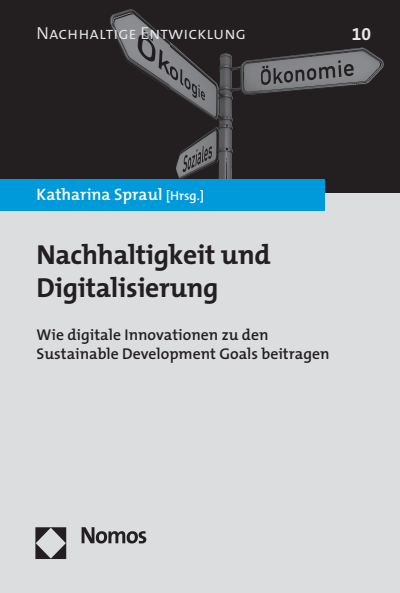
Nachhaltigkeit und Digitalisierung
Wie digitale Innovationen zu den Sustainable Development Goals beitragen- Herausgeber:innen:
- Reihe:
- Nachhaltige Entwicklung, Band 10
- Verlag:
- 2019
Zusammenfassung
Whether smartphone, smart home or smart city—digitalisation determines almost all areas of our lives today. The topic of sustainability is also omnipresent in 2019 and numerous challenges associated with it are currently being discussed. Digitalisation and sustainability can thus be regarded as the two megatrends of the 21st century.The question of whether digitalisation is an instrument for achieving sustainable development is increasingly at the centre of the debate. The Sustainable Development Goals (SDGs) developed by the United Nations as part of the 2030 Agenda are of particular interest for assessing digitalisation as a potential means of achieving sustainable development. With the help of empirical work by students from the University of Kaiserslautern, this edited volume provides answers to the question of how different digital technologies can help to achieve these 17 goals. With contributions byKatharina Spraul, Cynthia Friedrich, Matthias Klos, Florian Wiegner, Marius Wienand, Antonino-Enrico Bucceri, Jana Becher, Pierre Kohlmann, Teresa Körber, Viktoria Kruppenbacher
Publikation durchsuchen
Bibliographische Angaben
- Auflage
- 1/2019
- Copyrightjahr
- 2019
- ISBN-Print
- 978-3-8487-6238-5
- ISBN-Online
- 978-3-7489-0319-2
- Verlag
- Nomos, Baden-Baden
- Reihe
- Nachhaltige Entwicklung
- Band
- 10
- Sprache
- Deutsch
- Seiten
- 231
- Produkttyp
- Sammelband
Inhaltsverzeichnis
- Titelei/Inhaltsverzeichnis Kein Zugriff Seiten 1 - 14
- Autor:innen: |
- Autor:innen: |
- 1.1 Von den forstwirtschaftlichen Ursprüngen zu ‚Our Common Future‘ Kein ZugriffAutor:innen: |
- 1.2 Das erste Leitbild für eine nachhaltige Entwicklung Kein ZugriffAutor:innen: |
- 1.3 Von den Millennium Development Goals zu den Sustainable Development Goals Kein ZugriffAutor:innen: |
- Autor:innen: |
- 2.1 Der Begriff der Digitalisierung Kein ZugriffAutor:innen: |
- 2.2 Digitalisierung und Nachhaltigkeit als Transformationsprozesse Kein ZugriffAutor:innen: |
- 2.3 Der Einfluss der Digitalisierung auf die Nachhaltigkeit Kein ZugriffAutor:innen: |
- Autor:innen: |
- 3.1 Die Digitalisierung in der Agenda 2030 Kein ZugriffAutor:innen: |
- 3.2 Dematerialisierung und der Rebound-Effekt Kein ZugriffAutor:innen: |
- 3.3 Nachhaltigkeit als Wegweiser der Digitalisierung Kein ZugriffAutor:innen: |
- 3.4 Verbindung zweier Wirkmechanismen auf dem Weg zur Agenda 2030 Kein ZugriffAutor:innen: |
- Autor:innen:
- 1 Einleitung Kein ZugriffAutor:innen:
- Autor:innen:
- 2.1 Bildung für nachhaltige Entwicklung Kein ZugriffAutor:innen:
- 2.2 Die Initiative AIM2Flourish Kein ZugriffAutor:innen:
- 2.3 Appreciative Inquiry Kein ZugriffAutor:innen:
- Autor:innen:
- 3.1 Wahl des Forschungsdesigns Kein ZugriffAutor:innen:
- 3.2 Auswertung der Daten Kein ZugriffAutor:innen:
- 3.3 Darstellung der Ergebnisse Kein ZugriffAutor:innen:
- 3.4 Diskussion der Ergebnisse Kein ZugriffAutor:innen:
- 4 Zusammenfassung und Ausblick Kein ZugriffAutor:innen:
- Autor:innen:
- 1 Introduction Kein ZugriffAutor:innen:
- Autor:innen:
- 2.1 Sustainable Development Goals and blockchain technology Kein ZugriffAutor:innen:
- Autor:innen:
- 2.2.1 Blockchain as a novel data processing approach Kein ZugriffAutor:innen:
- 2.2.2 Practical implementation Kein ZugriffAutor:innen:
- Autor:innen:
- 3.1 Survey method Kein ZugriffAutor:innen:
- 3.2 Interview guide employed during the survey Kein ZugriffAutor:innen:
- 3.3 Conducting the interviews Kein ZugriffAutor:innen:
- 3.4 Transcription and coding structure Kein ZugriffAutor:innen:
- Autor:innen:
- 4.1 Current relevance of blockchain technology in regard of sustainability Kein ZugriffAutor:innen:
- 4.2 Potentially negative aspects using blockchain technology in climate action Kein ZugriffAutor:innen:
- 4.3 Future opportunities/perspectives Kein ZugriffAutor:innen:
- 5 Summary and outlook Kein ZugriffAutor:innen:
- Autor:innen:
- 1 Einleitung Kein ZugriffAutor:innen:
- 2 Energie als zentraler Faktor der Sustainable Development Goals Kein ZugriffAutor:innen:
- Autor:innen:
- 3.1 Das konventionelle Stromnetz – ein Auslaufmodell im Zeitalter der erneuerbaren Energien Kein ZugriffAutor:innen:
- 3.2 Smart Grids und Smart Meter – Die Zukunft des elektrischen Energiesystems im Zeichen der Digitalisierung Kein ZugriffAutor:innen:
- 4 Methodik zur qualitativen Erhebung des Zusammenhangs zwischen Digitalisierung und Nachhaltigkeit im deutschen Energiesektor Kein ZugriffAutor:innen:
- Autor:innen:
- 5.1 Die ökonomische Dimension – Verbesserte Effizienz und Versorgungssicherheit in den Energiesystemen Kein ZugriffAutor:innen:
- 5.2 Die ökologische Dimension – Dekarbonisierung durch intelligente Sektorenkopplung und geringere Abregelungsverluste Kein ZugriffAutor:innen:
- 5.3 Die soziale Dimension – Nachhaltiger Transformationsprozess auf Kosten der Privathaushalte Kein ZugriffAutor:innen:
- 6 Akzeptanz der Smart Meter bei Endkunden als Schlüsselfaktor für die Umsetzung digitaler Konzepte im Energiesektor Kein ZugriffAutor:innen:
- 7 Fazit und Ausblick Kein ZugriffAutor:innen:
- Autor:innen:
- 1 Introduction Kein ZugriffAutor:innen:
- 2 Sustainability and digitization in the energy sector Kein ZugriffAutor:innen:
- 3 Smart metering as a requirement for sustainable energy Kein ZugriffAutor:innen:
- Autor:innen:
- 4.1 Methodological approach Kein ZugriffAutor:innen:
- 4.2 Development of the criteria Kein ZugriffAutor:innen:
- 4.3 From energy provider to energy ,service’ provider Kein ZugriffAutor:innen:
- 4.4 Smart meter as an enabler to foster sustainability Kein ZugriffAutor:innen:
- 5 Summary and implications for research and practice Kein ZugriffAutor:innen:
- Autor:innen:
- 1 Introduction Kein ZugriffAutor:innen:
- Autor:innen:
- 2.1 Artificial intelligence Kein ZugriffAutor:innen:
- 2.2 Sustainable Development Goals Kein ZugriffAutor:innen:
- 3 Methodical approach Kein ZugriffAutor:innen:
- Autor:innen:
- 4.1 Application scenarios that contribute to sustainable development Kein ZugriffAutor:innen:
- 4.2 Crucial aspects for the usage of AI as a supporter of sustainable development and their implications Kein ZugriffAutor:innen:
- 4.3 Limitations and further research needs Kein ZugriffAutor:innen:
- 5 Conclusion and outlook Kein ZugriffAutor:innen:
- Autor:innen:
- 1 Introduction Kein ZugriffAutor:innen:
- Autor:innen:
- 2.1 Digitization Kein ZugriffAutor:innen:
- 2.2 Corporate digital responsibility Kein ZugriffAutor:innen:
- Autor:innen:
- 3.1 Coverage of IoTT applications in enterprises by DIN ISO 26000 Kein ZugriffAutor:innen:
- 3.2 Coverage of IoTT applications in enterprises by the CDR areas by Zimmermann Kein ZugriffAutor:innen:
- 3.3 Proposition of a comprehensive CDR concept for IoTT Kein ZugriffAutor:innen:
- 4 Summary and conclusion Kein ZugriffAutor:innen:
- Autor:innen:
- Autor:innen:
- 1.1 Research problem Kein ZugriffAutor:innen:
- 1.2 Research objective Kein ZugriffAutor:innen:
- Autor:innen:
- 2.1 Sustainable cities according to the Sustainable Development Goals Kein ZugriffAutor:innen:
- 2.2 Theoretical foundations of smart cities Kein ZugriffAutor:innen:
- 2.3 Governance – Integrating stakeholders in the smart cities Kein ZugriffAutor:innen:
- Autor:innen:
- 3.1 Research method Kein ZugriffAutor:innen:
- 3.2 Smart city rankings and the selection of analysed cities Kein ZugriffAutor:innen:
- Autor:innen:
- 3.3.1 Kaiserslautern Kein ZugriffAutor:innen:
- 3.3.2 Luxembourg Kein ZugriffAutor:innen:
- 3.3.3 Nancy Kein ZugriffAutor:innen:
- 4 Conclusion and outlook Kein ZugriffAutor:innen:
- Autor:innen:
- 1 Introduction Kein ZugriffAutor:innen:
- 2 Digital sustainable innovations Kein ZugriffAutor:innen:
- 3 Current situation of rural areas Kein ZugriffAutor:innen:
- Autor:innen:
- 4.1 Methodology Kein ZugriffAutor:innen:
- 4.2 E-Health Kein ZugriffAutor:innen:
- 4.3 Smart Farming Kein ZugriffAutor:innen:
- 4.4 Project Digitale Dörfer Kein ZugriffAutor:innen:
- 5 Conclusion Kein ZugriffAutor:innen: