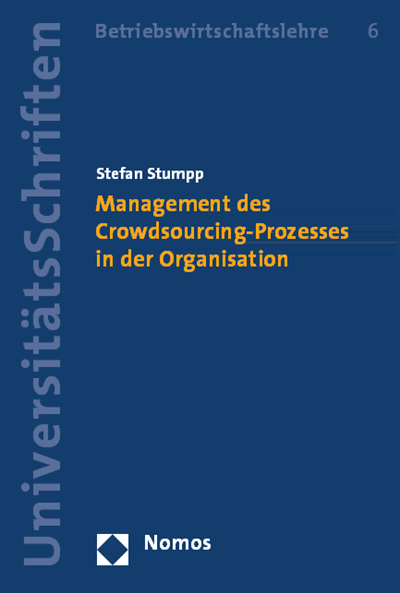
Management des Crowdsourcing-Prozesses in der Organisation
- Autor:innen:
- Reihe:
- Nomos Universitätsschriften - Betriebswirtschaftslehre, Band 6
- Verlag:
- 2019
Zusammenfassung
Crowdsourcing – die Einbindung einer großen Gruppe von Internetnutzern in die Wertschöpfung – gewinnt für Organisationen zunehmend an Bedeutung. Was dieses Prinzip so wertvoll macht, welche Bereiche der Organisation davon profitieren und wie diese Einbindung funktioniert, untersucht Stefan Stumpp in seinem Buch.
Auf der Basis einer systematischen Literaturrecherche, von Interviews mit Experten, Crowdsourcing-Praktikern sowie Innovationsentscheidern und einer Online-Befragung von 212 Organisationen wird ein Managementprozess entwickelt, der Organisationen als Anleitung dient, die Crowd auch in die eigene Wertschöpfung einzubinden. Darüber hinaus werden Einsatzbereiche entlang der Wertaktivitäten aufgezeigt und die Mehrwerte und Risiken von Crowdsourcing aufgezeigt.
Im Ergebnis wird vom Autor ein umfassendes Bild einer Methode gezeichnet, die es erlaubt, sich die Arbeitskraft, das Wissen, die Kreativität und auch die Vermögenswerte der Crowd zunutze zu machen.
Schlagworte
Publikation durchsuchen
Bibliographische Angaben
- Auflage
- 1/2019
- Copyrightjahr
- 2019
- ISBN-Print
- 978-3-8487-5809-8
- ISBN-Online
- 978-3-8452-9926-6
- Verlag
- Nomos, Baden-Baden
- Reihe
- Nomos Universitätsschriften - Betriebswirtschaftslehre
- Band
- 6
- Sprache
- Deutsch
- Seiten
- 215
- Produkttyp
- Monographie
Inhaltsverzeichnis
- Titelei/Inhaltsverzeichnis Kein Zugriff Seiten 1 - 20
- 1.1 Ausgangssituation Kein Zugriff
- 1.2 Problemstellung und Forschungsziel Kein Zugriff
- 1.3.1 Aufbau Kein Zugriff
- 1.3.2 Methodik Kein Zugriff
- 1.4 Wissenschaftliche Einordnung Kein Zugriff
- 2.1.1 Planung und Durchführung Kein Zugriff
- 2.1.2.1 Begriffsdefinition und Konzeptualisierung Kein Zugriff
- 2.1.2.2 Management und Gestaltung des CS-Prozesses Kein Zugriff
- 2.2.1 Einordnung in Open Innovation Kein Zugriff
- 2.2.2 Crowdsourcing in der Wertschöpfung Kein Zugriff
- 2.2.3.1 Crowdsourcing für Ideen und Problemlösungen Kein Zugriff
- 2.2.3.2 Crowdsourcing für Effizienzvorteile Kein Zugriff
- 2.2.3.3 Personal- und Fähigkeitenvermittlung Kein Zugriff
- 2.2.4.1 Crowdbegriff nach Gustave Le Bon Kein Zugriff
- 2.2.4.2 Kollektive „Intelligenz“ Kein Zugriff
- 2.2.4.3 Peer Production Kein Zugriff
- 2.2.4.4 Kognitiver Surplus Kein Zugriff
- 2.2.5 Zusammenfassung der Erkenntnisse im Übertrag Kein Zugriff
- 3 Implikationen aus dem theoretischen Bezugsrahmen Kein Zugriff Seiten 109 - 113
- 4.1.1 Planung Kein Zugriff
- 4.1.2 Durchführung Kein Zugriff
- 4.1.3.1 Bedeutung der derzeitigen und zukünftigen Einbindung externer Akteure und insbesondere der Crowd in die Organisation Kein Zugriff
- 4.1.3.2 Konfiguration: Textpassagen mit Aussagen über die strategische Implementierung einer Crowd Kein Zugriff
- 4.1.3.3 Chancen und Risiken: Textpassagen mit Aussagen über die möglichen Chancen und Risiken von Crowdsourcing für die Organisation Kein Zugriff
- 4.1.3.4 Anforderungen: Textpassagen mit Aussagen über die Anforderungen an eine Organisation bei der Implementierung von Crowdsourcing Kein Zugriff
- 4.1.3.5 Herausforderungen: Textpassagen mit Aussagen über die Herausforderungen für eine Organisation bei der Implementierung von Crowdsourcing Kein Zugriff
- 4.1.4 Übertrag Kein Zugriff
- 4.2.1 Planung der Stichprobe und Durchführung Kein Zugriff
- 4.2.2.1 Deskriptive Analysen Kein Zugriff
- 4.2.2.2 Bivariate Analysen Kein Zugriff
- 4.2.3 Übertrag Kein Zugriff
- 5.1 Zusammenhangs- und Ablaufmodellierung zum Management, zur Gestaltung und zur Konfiguration des CS-Prozesses in der Organisation Kein Zugriff
- 5.2 Rolle von Crowdsourcing in der Wertschöpfung der Organisation Kein Zugriff
- 5.3 Anwendungsbeispiel Bayer MaterialScience AG/Covestro AG: Crowdsourcing für Forschung und Marketing Kein Zugriff
- 6.1 Kritische Würdigung Kein Zugriff
- 6.2 Zusammenfassung und Fazit Kein Zugriff
- Literaturverzeichnis Kein Zugriff Seiten 203 - 215
Literaturverzeichnis (194 Einträge)
Es wurden keine Treffer gefunden. Versuchen Sie einen anderen Begriff.
- Accenture (2014): From workforce to crowdsource. URL: https://www.accenture.com/us-en/~/media/Accenture/Conversion-Assets/Microsites/Documents13/Accenture-Technology-Vision-2014-Trend2.pdf (Stand: 16.01.2017). Google Scholar öffnen doi.org/10.5771/9783845299266
- Al-Ani, A.; Stumpp, S.; Schildhauer, T. (2014): Crowd-Studie 2014 – Die Crowd als Partner der deutschen Wirtschaft. HIIG Discussion Paper Series, 2014-02. Google Scholar öffnen doi.org/10.5771/9783845299266
- Al-Ani, A.; Stumpp, S. (2015): Arbeiten in der Crowd und gewerkschaftliche Strategien. URL: http://ayad-al-ani.com/pdf/ayad-al-ani_Expertise_Gewerkschaftliche_Strategien_fuer_die_Crowd.pdf (Stand: 01.03.2017). Google Scholar öffnen doi.org/10.5771/9783845299266
- Al-Ani, A.; Stumpp, S. (2016): Rebalancing Interests and Power Structures on Crowdworking Google Scholar öffnen doi.org/10.5771/9783845299266
- Platforms. Internet Policy Review, 5, 2. Google Scholar öffnen doi.org/10.5771/9783845299266
- Amrollahi, A. (2015): A Process Modell for Crowdsourcing: Insights from the Literature on Implementation. Australasian Conference on Information Systems, Adelaide. Google Scholar öffnen doi.org/10.5771/9783845299266
- Angerer, T.; Foscht, T.; Swoboda, B. (2006): Mixed Methods – Ein neuer Zugang in der empirischen Marketingforschung. Journal für Marketing, 45, 3. Google Scholar öffnen doi.org/10.5771/9783845299266
- Anya, O.; Cefkin, M.; Dill, S.; Moore, R.; Stucky, S.; Omokaro, O. (2013): Making Crowdwork Work: Issues in Crowdsourcing for Organizations, Human Computation and Crowdsourcing. AAAI Technical Report CR-13-01. Google Scholar öffnen doi.org/10.5771/9783845299266
- ARD-ZDF Onlinestudie (2017): Neun von zehn Deutschen sind online. URL: http://www.ard-zdf-onlinestudie.de/ardzdf-onlinestudie-2017/ (Stand: 01.02.2018). Google Scholar öffnen doi.org/10.5771/9783845299266
- Arns, T. (2014): Crowdsourcing für Unternehmen – Leitfaden. Bundesverband Informationswirtschaft. URL: https://www.bitkom.org/Bitkom/Publikationen/Crowdsourcing-fuer-Unternehmen.html (Stand: 12.02.2018). Google Scholar öffnen doi.org/10.5771/9783845299266
- Bartl, M. (2008): Open Innovation!. HYVE White Paper. Google Scholar öffnen doi.org/10.5771/9783845299266
- Bauwens, M. (2005): The Political Economy of Peer Production. CTheory. URL: https://mmduvic.ca/index.php/ctheory/article/view/14464/5306 (Stand: 01.02.2018). Google Scholar öffnen doi.org/10.5771/9783845299266
- Bauwens, M.; Iacomella, F.; Mendoza, N. (2012): Report: Synthetic Overview of The Collaborative Economy. Orange Labs und P2P Foundation. URL: http://p2pfoundation.net/Synthetic_Overview_of_the_Collaborative_Economy (Stand: 01.02.2018). Google Scholar öffnen doi.org/10.5771/9783845299266
- Bayer (2016): Bayer Continues to Grow its Open Innovation Activities. URL: http://www.press.bayer.com/baynews/baynews.nsf/id/Bayer-Continues-to-Grow-its-Open-Innovation-Activities (Stand: 29.12.2017). Google Scholar öffnen doi.org/10.5771/9783845299266
- Bayus, L. B. (2012): Crowdsourcing New Product Ideas Over Time: An Analysis of the Dell Ideastorm Community. Management Science, 59, 1. Google Scholar öffnen doi.org/10.5771/9783845299266
- Beiersdorf (o.J.): Open Innovation. URL: http://www.beiersdorf.de/forschung/unsere-arbeitsweise/open-innovation (Stand: 15.03.2017). Google Scholar öffnen doi.org/10.5771/9783845299266
- Belleflamme, P.; Lambert, T.; & Schwienbacher, A. (2013): Crowdfunding: Tapping the right crowd. Journal of Business Venturing, forthcoming. Google Scholar öffnen doi.org/10.5771/9783845299266
- Benkler, Y. (2006): The Wealth of Networks: How Social Production Transforms Markets and Freedom. New Haven, London: Yale University Press. Google Scholar öffnen doi.org/10.5771/9783845299266
- Beuth, R. (2016): Die ehrwürdige Boaty McBoatface. ZEIT ONLINE. URL: http://www.zeit.de/digital/internet/2016-04/boaty-mcboatface-online-abstimmung-forschungsschiff-name (Stand: 01.02.2018). Google Scholar öffnen doi.org/10.5771/9783845299266
- Boes, A. (2016): Cloudworking und die Zukunft der Erwerbarbeit. ISF München, URL: http://www.hauptverband.at/cdscontent/load?contentid=10008.634958&version=1478244823 (Stand: 15.03.2017). Google Scholar öffnen doi.org/10.5771/9783845299266
- Blohm, I.; Leimeister, J. M. & Krcmar, H. (2013): Crowdsourcing: How to Benefit from (Too) Many Great Ideas. In: MIS Quarterly Executive, 4, 12. Google Scholar öffnen doi.org/10.5771/9783845299266
- Bogner, A.; Littig, B.; M., Wolfgang (2014): Interviews mit Experten: Eine praxisorientierte Einführung. Berlin Heidelberg New York: Springer-Verlag. Google Scholar öffnen doi.org/10.5771/9783845299266
- Bonabeau, E. (2009): Decisions 2.0: The Power of Collective Intelligence. Sloan Management Review, 50, 2. Google Scholar öffnen doi.org/10.5771/9783845299266
- Boudreau, K. J., Lakhani, K. R. (2013). Using the crowd as an innovation partner. Harvard Business Review, 91, 4. Google Scholar öffnen doi.org/10.5771/9783845299266
- Boudreau, K. J.; Lacetera, N.; Lakhani, K. R. (2011): Incentives and Problem Uncertainty in Innovation Contests: An Empirical Analysis. Management Science, 57, 5. Google Scholar öffnen doi.org/10.5771/9783845299266
- Bouncken, R. B., Komorek, M., Kraus, S. (2015): Crowdfunding: The Current State Of Research. The International Business & Economics Research Journal (Online), 14, 3. Google Scholar öffnen doi.org/10.5771/9783845299266
- Boutellier, R.; Gassmann, O.; Zedtwitz, M.v. (1998): Management of dispersed R&D Teams. R&D Management, 28, 1. Google Scholar öffnen doi.org/10.5771/9783845299266
- Brabham, D. C. (2008). Crowdsourcing as a Model for Problem Solving. Convergence: The International Journal of Research into New Media Technologies, 14, 1. Google Scholar öffnen doi.org/10.5771/9783845299266
- Brabham, D. C. (2013). Crowdsourcing. Cambridge, MA: MIT Press. Google Scholar öffnen doi.org/10.5771/9783845299266
- Brabham, D. C. (2009): Crowdsourcing the Public Participation Process for Planning Projects. Planning Theory, 8, 3. Google Scholar öffnen doi.org/10.5771/9783845299266
- Brabham, D. C.; Ribisl, K. M.; Kirchner, T. R.; Bernhardt, J. M. (2014): Crowdsourcing Applications for Public Health. American Journal of Preventive Medicine, 46, 2. Google Scholar öffnen doi.org/10.5771/9783845299266
- Bruns, A. (2010): Vom Prosumenten zum Produtzer. In: Blättel-Mink, B.; Hellmann, K.U. (Hrsg.): Prosumer Revisited. VS Verlag für Sozialwissenschaften | Springer Fachmedien Wiesbaden GmbH, Wiesbaden. Google Scholar öffnen doi.org/10.5771/9783845299266
- Bühl, A. (2008): SPSS 16 – Einführung in die moderne Datenanalyse. 11., überarbeitete erweiterte Auflage, Pearson Studium, München. Google Scholar öffnen doi.org/10.5771/9783845299266
- Burgard-Arp, N. (2016): Umfrage zeigt: Kunden lieben Crowd Service. Crowdsourcing Blog, URL: http://www.crowdsourcingblog.de/blog/2016/04/28/umfrage-zeigt-kunden-lieben-crowd-service/ (Stand: 01.03.2017). Google Scholar öffnen doi.org/10.5771/9783845299266
- Buytaert, W.; Zulkafli, Z.; Grainger, S.; Acosta, L.; Alemie. T. C.; Bastiaensen, J.; De Bièvre, B.; Bhusal, J.; Clark, J.; Dewulf, A.; Foggin, M.; Hannah, D. M.; Hergarten, C.; Isaeva, A.; Karpouzoglou, T.; Pandeya, B.; Paudel, D.; Sharma, K.; Steenhuis, T.; Tilahun, S.; Van Hecken, G.; Zhumanova, M. (2014): Citizen science in hydrology and water resources: opportunities for knowledge generation, ecosystem service management, and sustainable development. Earth Sci. 2, 26. Google Scholar öffnen doi.org/10.5771/9783845299266
- Cabiddu, F.; Castriotta, M.; Di Guardo, M. C.; Floreddu, P. (2013): Open innovation and crowdsourcing communities design: a cross case analysis. Designing Organizational Systems, 1. Google Scholar öffnen doi.org/10.5771/9783845299266
- Campillo-Lundbeck (2016): Ritter Sport bezaubert Einhorn-Fans mit Glitzer und Regenbogen-Schokolade. HORIZONT, URL: http://www.horizont.net/marketing/nachrichten/Elbkind-Ritter-Sport-bezaubert-mit-Glitzer-und-Regenbogen-Schokolade-die-Einhorn-Fans--143785 (Stand 28.02.2017). Google Scholar öffnen doi.org/10.5771/9783845299266
- Chesbrough, H. W.; Brunswicker, S. (2013): Managing Open Innovation in Large Firms. Berlin: Fraunhofer IRB Verlag. Google Scholar öffnen doi.org/10.5771/9783845299266
- Chesbrough, H. W.; Vanhaverbeke, W.; West, J. (2008): Open Innovation: Researching Google Scholar öffnen doi.org/10.5771/9783845299266
- a New Paradigm: Researching a New Paradigm. New York: Oxford University Press. Google Scholar öffnen doi.org/10.5771/9783845299266
- Chesbrough, H. W. (2003): The Era of Open Innovation, Sloan Management Review, 44, 3 (Spring). Google Scholar öffnen doi.org/10.5771/9783845299266
- Collins, L.; & Pierrakis, Y. (2012): The Venture Crowd. Crowdfunding Equity Investment into Business. Nesta, London. Google Scholar öffnen doi.org/10.5771/9783845299266
- Commerzbank (o. J.): Main Funders, der Finanzierungsmarktplatz für den Mittelstand. URL: https://www.firmenkunden.commerzbank.de/portal/de/cb/de/firmenkunden/angebote/anwendungen/main-funders-1/main_funders_1.html (Stand: 15.03.2017). Google Scholar öffnen doi.org/10.5771/9783845299266
- Covestro (2017): Covestro – führend bei Werkstofflösungen. URL: https://www.covestro.de/de (Stand: 11.12.2017). Google Scholar öffnen doi.org/10.5771/9783845299266
- Crone, D. L.; Williams, L. A. (2015): Crowdsourcing participants for psychological research in Australia: A test of Microworkers. Australian Journal of Psychology, doi: 10.1111/ajpy.12110. Google Scholar öffnen doi.org/10.5771/9783845299266
- Crowdhunter (2014): Jetzt Kandidaten vermitteln!. URL: http://www.crowdhunter.com/ (Stand: 15.03.2017). Google Scholar öffnen doi.org/10.5771/9783845299266
- Dahlander, L.; Gann, D. M. (2010): How open is innovation?. Research Policy, 39, 6. Google Scholar öffnen doi.org/10.5771/9783845299266
- D’Aveni, R. (1994): Hypercompetition. Managing the Dynamics of Strategic Maneuvering. The Free Press, New York. Google Scholar öffnen doi.org/10.5771/9783845299266
- Davis, J. G. (2011): From Crowdsourcing to Crowdservicing, IEEE Internet Computing, 15, 3. Google Scholar öffnen doi.org/10.5771/9783845299266
- Digout, J.; Azouri, M.; Decaudin, J.-M.; Rochard, S. (2013): Crowdsourcing, Outsourcing to Obtain a Creativity Group. The Arab Economics and Business Journal, 8. Google Scholar öffnen doi.org/10.5771/9783845299266
- Djelassi, S.; Decoopman, I. (2012): Customers' participation in product development through crowdsourcing: Issues and implications. Industrial Marketing Management, 42. Google Scholar öffnen doi.org/10.5771/9783845299266
- Dong, Z.; Camp, J. (2012): PeerSec: Towards Peer Production and Crowdsourcing for Enhanced Security. In Proceedings of the 7th USENIX Workshop on Hot Topics in Security (HotSec 12), Bellevue. Google Scholar öffnen doi.org/10.5771/9783845299266
- Eckl-Dorna, W. (2015): Toyota gibt tausende Brennstoffzellen-Patente frei – mit einem Hintergedanken. Manager Magazin, URL: http://www.manager-magazin.de/unternehmen/autoindustrie/brennstoffzellen-auto-mirai-toyota-gibt-5700-patente-bis-2020-frei-a-1011472.html, (Stand: 01.02.2018). Google Scholar öffnen doi.org/10.5771/9783845299266
- Ekman, Olof (2010): All about Karma. URL: https://www.jovoto.com/blog/creatives/community/all-about-karma/, (Stand: 01.02.2018). Google Scholar öffnen doi.org/10.5771/9783845299266
- Fähling, J.; Blohm, I.; Leimeister, J. M.; Krcmar, H.; Fischer, J. (2013): Pico-Jobs as an Open Innovation Tool for Utilising Crowdsourcing. In: Eriksson Lundström, J. S. Z.; Wiberg, M.; Hrastinski, S.; Edenius, M. & Ågerfalk, P. J.: Managing Open Innovation Technologies. Springer, Berlin, Heidelberg. Google Scholar öffnen doi.org/10.5771/9783845299266
- Feller, J.; Finnegan, P.; Hayes, J.; O’Reilly, P. (2012): ‘Orchestrating’ sustainable crowdsourcing: A characterisation of solver brokerages, Journal of Strategic Information Systems. 21. Google Scholar öffnen doi.org/10.5771/9783845299266
- Felstiner, A. (2011): Working the Crowd: Employment and Labor Law in the Crowdsourcing. Berkeley Journal of Employment and Labor Law, 32, 1. Google Scholar öffnen doi.org/10.5771/9783845299266
- Fichter, K. (2005): Innovation Communities: Die Rolle von Promotorennetzwerken bei Nachhaltigkeitsinnovationen. In: Pfriem, R. et al. (Hrsg.): Innovationen für eine nachhaltige Entwicklung. Deutscher Universitäts-Verlag, Wiesbaden. Google Scholar öffnen doi.org/10.5771/9783845299266
- Fiedler, S., Horsch, A. (2014): Crowdinvesting als Finanzierungsalternative. Zeitschrift für KMU und Entrepreneurship, 1. Google Scholar öffnen doi.org/10.5771/9783845299266
- Fiske, A. P. (1991): Structures of Social Life: The Four Elementary Forms of Human Relations: Communal Sharing, Authority Ranking, Equality Matching, Market Pricing. Free Press. Google Scholar öffnen doi.org/10.5771/9783845299266
- Für-Gründer.de (2016): Crowdfinanzierung in Deutschland. URL: https://www.fuer-gruender.de/fileadmin/mediapool/Publikation/Crowdfinanzierung_2016-Fuer-Gruender.de-Dentons.pdf (Stand: 15.03.2017). Google Scholar öffnen doi.org/10.5771/9783845299266
- Füller, J. (2010): Refining virtual co-creation from a consumer perspective. Google Scholar öffnen doi.org/10.5771/9783845299266
- California Management Review, 52, 2. Google Scholar öffnen doi.org/10.5771/9783845299266
- Gassenheimer, J. B.; Siguaw, J. A.; Hunter G. L. (2013): Exploring Motivations and the Capacity for Business Crowdsourcing. Academy of Marketing Science, 3. Google Scholar öffnen doi.org/10.5771/9783845299266
- Gassmann, O.; Enkel, E. (2006): Open Innovation – Die Öffnung des Innovationsprozesses Google Scholar öffnen doi.org/10.5771/9783845299266
- erhöht das Innovationspotential, Zeitschrift für Führung und Organisation zfo, 75. Google Scholar öffnen doi.org/10.5771/9783845299266
- Gassmann, O.; Friesike, S.; Daiber, M. (2014): Crowdsourcing as an Innovation Tool. In: Management of the Fuzzy Front End of Innovation. Gassmann, O.; Schweitzer, F., eds. S.: 75–87. Springer International Publishing. Google Scholar öffnen doi.org/10.5771/9783845299266
- Geiger, D.; Rosemann, M.; Fielt, E. (2011a): Crowdsourcing Information Systems – A Systems Theory Perspective, 22nd Australasian Conference on Information Systems 29th November to 2nd December 2011, Sydney. Google Scholar öffnen doi.org/10.5771/9783845299266
- Geiger, D.; Rosemann, M.; Fielt, E. (2012): Crowdsourcing Information Systems – Definition, Typology, and Design. Thirty Third International Conference on Information Systems, Orlando 2012. Google Scholar öffnen doi.org/10.5771/9783845299266
- Geiger, D., Seedorf, S., Schulze, T. Nickerson, R., Schader, M. (2011b): Managing the Crowd: Towards a Taxonomy of Crowdsourcing Processes. Proceed 7th AMCIS, Detroit, Michigan. Google Scholar öffnen doi.org/10.5771/9783845299266
- Geise, F. A. (2017): Integration of Consumers into New Product Development by Social Media-Based Crowdsourcing – Findings from the Consumer Goods Industry in Germany. In: Christodoulides, G. (Hrsg.): Advances in Advertising Research (Vol. VII), Springer Fachmedien Wiesbaden. Google Scholar öffnen doi.org/10.5771/9783845299266
- Georgi, S., Jung, R. (2010): Use of Swarm Intelligence to Involve Customers in Product Innovation, in: Bastiaens, T., Baumöl, U., Krämer,B. (Hrsg.), On Collective Intelligence, Advances in Soft Computing 76, Springer, Berlin. Google Scholar öffnen doi.org/10.5771/9783845299266
- Gupta, D. K.; Sharma, V. (2013): Exploring Crowdsourcing: A Viable Solution Towards Achieving Rapid and Qualitative Tasks. Library Hi Tech News, 2. Google Scholar öffnen doi.org/10.5771/9783845299266
- Günterberg, B.; Wolter, H.-J. (2003): Unternehmensgrößenstatistik 2001/2002 -Daten und Fakten, in: Institut für Mittelstandsforschung Bonn (Hrsg.): IfM Materialien Nr. 157, Bonn. Google Scholar öffnen doi.org/10.5771/9783845299266
- Hallerstede, S. H., Bullinger A. C., & Möslein K. M. (2012): Community-basierte Open Innovation von der Suche bis zur Implementierung – der Fall des Innovationsintermediärs innosabi. Multikonferenz Wirtschaftsinformatik 2012 (MKWI). Google Scholar öffnen doi.org/10.5771/9783845299266
- Hall, J.; Krueger, A. (2015): An analysis of the Labor Market for Uber’s driver. Partners in the united States. IRS Working Papers No 587, Prinecton. Google Scholar öffnen doi.org/10.5771/9783845299266
- Hammon, L.; Hippner, H. (2012): Crowdsourcing. Business & Information Systems Engineering. 4, 3. Google Scholar öffnen doi.org/10.5771/9783845299266
- Handelsblatt (2014): Natürlich erzeugt das Aufregung, URL: http://www.handelsblatt.com/unternehmen/handel-konsumgueter/uber-westeuropa-chef-in-deutschland-sind-alle-fahrten-versichert/10337470-2.html (Stand: 12.02.2018). Google Scholar öffnen doi.org/10.5771/9783845299266
- Haupt, S. (2003): Digitale Wertschöpfungsnetzwerke und kooperative Strategen in der deutschen Lackindustrie. Dissertation der Universität St. Gallen Nr. 2810, Difo-Druck. Google Scholar öffnen doi.org/10.5771/9783845299266
- Haute Innovation (2012): TPU mit Formgedächtnis – Open Innovation Wettbewerb gestartet. Zukunftsagentur für Material und Technologie, URL: http://www.haute-innovation.com/de/magazin/smart-materials/tpu-mit-formgedaechtnis.html (Stand: 12.02.2018). Google Scholar öffnen doi.org/10.5771/9783845299266
- Heipke, C. (2010): Crowdsourcing geospatial data. ISPRS Journal of Photogrammetry and Remote Sensing, 65. Google Scholar öffnen doi.org/10.5771/9783845299266
- Higgins J. P. T.; Green, S. (2008): Cochrane Handbook for Systematic Reviews of Interventions. Wiley-Blackwell. Google Scholar öffnen doi.org/10.5771/9783845299266
- Hippel, E. v. (2006): Democratizing Innovation. Cambridge: MIT Press, 2006. Google Scholar öffnen doi.org/10.5771/9783845299266
- Hirth, M.; Hoßfeld, T.; Tran-Gia, P. (2012): Analyzing costs and accuracy of validation mechanisms for crowdsourcing platforms. Mathematical and Computer Modelling, doi:10.1016/j.mcm.2012.01.006. Google Scholar öffnen doi.org/10.5771/9783845299266
- Hodges, K. (2015): Crowdsourcing early warnings of natural disasters. Science, 348, 6231. Google Scholar öffnen doi.org/10.5771/9783845299266
- Hoßfeld, T.; Hirth, M.; Tran-Gia, P. (2012): Crowdsourcing. Informatik Spektrum, 35, 3. Google Scholar öffnen doi.org/10.5771/9783845299266
- Hoßfeld, T.; Hirth, M.; Tran-Gia, P. (2011): Modeling of Crowdsourcing Platforms and Granularity of Work Organization in Future Internet. 23rd International Teletraffic Congress (ITC), San Francisco. Google Scholar öffnen doi.org/10.5771/9783845299266
- Howe, J. (2009): Crowdsourcing: Why the Power of the Crowd Is Driving the Future of Business, Crown Business. Google Scholar öffnen doi.org/10.5771/9783845299266
- Huang, Y.; Shema, A.; Xia, H. (2016): A proposed genome of mobile and situated crowdsourcing and its design implications for encouraging contributions. International Journal of Human-Computer Studies, Article in press. Google Scholar öffnen doi.org/10.5771/9783845299266
- IBM Connections Wiki (o. J.). URL: https://www-10.lotus.com/ldd/lcwiki.nsf (Stand: 10.02.2017). Google Scholar öffnen doi.org/10.5771/9783845299266
- Innosabi (2017): Crowdsourced Innovation Case Studies. URL: https://innosabi.com/akademie/innovation-case-studies/ (Stand: 01.03.2017). Google Scholar öffnen doi.org/10.5771/9783845299266
- Innovationskraftwerk (2017a): Woran kann sich Kunststoff erinnern? Übersicht. URL: http://blog.mobile.innovationskraftwerk.de/Wettbewerb/Bayer/Kunststoff-trifft-Gedaechtnis (Stand: 29.12.2017). Google Scholar öffnen doi.org/10.5771/9783845299266
- Innovationskraftwerk (2017b): Ideensucher. URL: http://blog.mobile.innovationskraftwerk.de/Plattform/Information/Ideensucher (Stand: 29.12.2017). Google Scholar öffnen doi.org/10.5771/9783845299266
- Innovationskraftwerk (2017c): Woran kann sich Kunststoff erinnern? Bewertung und Jury. URL: http://blog.mobile.innovationskraftwerk.de/Wettbewerb/Bayer/Kunststoff-trifft-Gedaechtnis/Details/70 (Stand: 29.12.2017). Google Scholar öffnen doi.org/10.5771/9783845299266
- Innovationskraftwerk (2017d): Woran kann sich Kunststoff erinnern? Gewinner. URL: http://blog.mobile.innovationskraftwerk.de/Wettbewerb/Bayer/Kunststoff-trifft-Gedaechtnis/Winner (Stand: 29.12.2017). Google Scholar öffnen doi.org/10.5771/9783845299266
- Ipeirotis, P. G.; Horton, J. J. (2011): The Need for Standardization in Crowdsourcing. CHI 2011, May 7–12, Vancouver, Canada. Google Scholar öffnen doi.org/10.5771/9783845299266
- Jain, R. (2010): Investigation of Governance Mechanisms for Crowdsourcing Initiatives. AMCIS 2010 Proceedings, 557. Google Scholar öffnen doi.org/10.5771/9783845299266
- Jemielniak, D. (2014). Common Knowledge? An Ethnography of Wikipedia. Stanford University Press, Stanford, California. Google Scholar öffnen doi.org/10.5771/9783845299266
- Jeppesen, L. B.; Lakhani, K. R. (2010): Marginality and Problem Solving Effectiveness in Broadcast Search. Organization Science, 21, 5. Google Scholar öffnen doi.org/10.5771/9783845299266
- Jovoto (2016): Future of Banking Creative Hub. URL: https://www.jovoto.com/creative-hubs/future-of-banking (Stand: 28.02.2017). Google Scholar öffnen doi.org/10.5771/9783845299266
- Kaiser, R. (2014): Qualitative Experteninterviews: Konzeptionelle Grundlagen und praktische Durchführung. Aufl. Wiesbaden: Springer Fachmedien Wiesbaden. Google Scholar öffnen doi.org/10.5771/9783845299266
- Kemper, A. (2010): Valuation of Network Effects in Software Markets. Springer-Verlag, Berlin Heidelberg. Google Scholar öffnen doi.org/10.5771/9783845299266
- Kollmann, T. (2009): E-Business Grundlagen elektronischer Geschäftsprozesse in der Net Economy. 3. Auflage, Gabler Verlag, Wiesbaden. Google Scholar öffnen doi.org/10.5771/9783845299266
- Kress, D.; Finn, M.; Turner, F. (2011): The Limits of Peer Production: Some Reminders from Max Weber for the Network Society. New Media & Society, 13, 2. Google Scholar öffnen doi.org/10.5771/9783845299266
- Kurbel, K.; Szulim, D.; Teuteberg, F. (1999): Internet-Unterstützung entlang der Porterschen Wertschöpfungskette – innovative Anwendungen und empirische Befunde. HMD-Praxis der Wirtschaftsinformatik, 207, 36. Google Scholar öffnen doi.org/10.5771/9783845299266
- Lakhani, K. R. (2016): Managing Communities and Contests to Innovate with Crowds. In: Harhoff, D., Lakhani, K. R. (Hrsg.): Revolutionizing Innovation – Users, Communities, and Open Innovation. The MIT Press, London. Google Scholar öffnen doi.org/10.5771/9783845299266
- Laudon, K. C.; Laudon, J.; Schoder, D. (2010): Wirtschaftsinformatik: Eine Einführung, 2. Auflage, Pearson Studium, München; Boston, Mass. Google Scholar öffnen doi.org/10.5771/9783845299266
- Le Bon, G. (1896): The Crowd – A Study of the Popular Mind. Batoche Books Kitchener 2001. Google Scholar öffnen doi.org/10.5771/9783845299266
- Leimeister, J. M. (2010): Collective Intelligence. Business & Information Systems Engineering, 2, 4. Google Scholar öffnen doi.org/10.5771/9783845299266
- Leimeister, J. M.; Huber, M.; Bretschneider, U.; Krcmar, H. (2009): Leveraging Crowdsourcing: Activation-Supporting Components for IT-Based Ideas Competition, Journal of Management Information Systems, 26, 1. Google Scholar öffnen doi.org/10.5771/9783845299266
- Leimeister, J. M.; Zogaj, S.; Blohm, I. (2015): Crowdwork – digitale Wertschöpfung in der Wolke. In: Brenner, C. (2015): Crowdwork – Zurück in die Zukunft?. Bund-Verlag, Frankfurt am Main. Google Scholar öffnen doi.org/10.5771/9783845299266
- Leimeister, J. M.; Zogaj, S. (2013): Neue Arbeitsorganisation durch Crowdsourcing, Arbeitspapier Nr. 287, Hans Böckler Stiftung. Google Scholar öffnen doi.org/10.5771/9783845299266
- Leimeister, J. M.; Zogaj, S.; Durward, D.; Blohm, I. (2016): Systematisierung und Analyse von Crowdsourcing-Anbietern und Crowd-Work-Projekten. Study der Hans Böckler Stiftung, Band 324. Google Scholar öffnen doi.org/10.5771/9783845299266
- Lévy, P. (1994): L’intelligence collective. Pour une anthropologie du cyberespace. La Découverte, Paris. Google Scholar öffnen doi.org/10.5771/9783845299266
- Lichtenthaler, U.; Ernst, H. (2006): Attitudes to externally organizing knowledge management tasks: a review, reconsideration and extension of the NIH syndrome. R&D Management 36, 4. Google Scholar öffnen doi.org/10.5771/9783845299266
- Li, C. (2010): Open Leadership. Jossey-Bass, San Francisco. Google Scholar öffnen doi.org/10.5771/9783845299266
- Lykourentzou, I.; Vergados, D. J.; Kapetanios, E.; Loumos, V. (2011): Collective Intelligence Systems: Classification and Modeling. Journal of Emerging Technologies in Web Intelligence, 3, 3. Google Scholar öffnen doi.org/10.5771/9783845299266
- Lorenz, J.; Rauhut, H.; Schweitzer, F.; Helbing, D. (2011): How Social Influence can Undermine the Wisdom of the Crowd. Proceedings of the National Academy of Sciences of the USA. 108, 22. Google Scholar öffnen doi.org/10.5771/9783845299266
- Majchrzak, A.; Malhotra, A. (2013): Towards an information systems perspective and research Google Scholar öffnen doi.org/10.5771/9783845299266
- agenda on crowdsourcing for innovation. Journal of Strategic Information Systems 22. Google Scholar öffnen doi.org/10.5771/9783845299266
- Malhotra, A.; Majchrzak, A. (2014): Managing Crowds in Innovation Challenges. California Management Review, 56, 4. Google Scholar öffnen doi.org/10.5771/9783845299266
- Malone, T. W.; Laubacher, R.; Dellarocas, C. (2010): Harnessing Crowds: Mapping the Genome of Collective Intelligence. MIT Sloan School Working Paper, 4732, 9. Google Scholar öffnen doi.org/10.5771/9783845299266
- Martin, C. W. (2009): Theoretische Modellbildung. In: Pickel, S.; Pickel, G.; Lauth, H.-J.; Jahn, D. (Eds.): Methoden der vergleichenden Politik- und Sozialwissenschaft: Neue Entwicklungen und Anwendungen. 1. Aufl., Berlin Heidelberg New York: Springer-Verlag. Google Scholar öffnen doi.org/10.5771/9783845299266
- Mayring, P. (2010): Design. In: Mey, Günter; Mruck, Katja (Hrsg.): Handbuch Qualitative Forschung in der Psychologie. Berlin Heidelberg New York: Springer-Verlag. Google Scholar öffnen doi.org/10.5771/9783845299266
- Mey, G.; Mruck, K. (2010): Handbuch Qualitative Forschung in der Psychologie. Berlin Heidelberg New York: Springer-Verlag. Google Scholar öffnen doi.org/10.5771/9783845299266
- Meuser, M.; Nagel, U. (2009). Das Experteninterview – konzeptionelle Grundlagen und methodische Anlage. In: S. Pickel, G. Pickel, H.-J. Lauth, & D.Jahn (Hrsg.), Methoden der vergleichenden Politik- und Sozialwissenschaft, SE, 23. Google Scholar öffnen doi.org/10.5771/9783845299266
- Michelis, D. (2014): Der vernetzte Konsument. Gabler Verlag, Springer Fachmedien, Wiesbaden. Google Scholar öffnen doi.org/10.5771/9783845299266
- Miller, P. (2010): Die Intelligenz des Schwarms. Was wir von Tieren für unser Leben in einer komplexen Welt lernen können. Campus-Verlag, Frankfurt am Main. Google Scholar öffnen doi.org/10.5771/9783845299266
- Mwila, Natasha Katuta (2013): Crowdsourcing in Small and Medium sized Enterprises. In: Small and Medium Enterprises: Concepts, Methodologies, Tools, and Applications. Information Resources Management Association. Google Scholar öffnen doi.org/10.5771/9783845299266
- Nawroth, G.; Wingartz, N.; Spitzley, A. Warschat, J. (2017): Open Innovation in der technischen Textilbranche. Fraunhofer Verlag. Google Scholar öffnen doi.org/10.5771/9783845299266
- Oehlrich, M. (2012): Betriebswirtschaftslehre – Eine Einführung am Businessplan-Prozess. Verlag Franz Vahlen, München. Google Scholar öffnen doi.org/10.5771/9783845299266
- Oliveira, F.; Ramos, I.; Santos, L. (2010): Definition of a Crowdsourcing Innovation Service for the European SMEs, Current Trends in Web Engineering, Lecture Notes in Computer Science, 6385. Google Scholar öffnen doi.org/10.5771/9783845299266
- Ostrom, E. (1999): Die Verfassung der Almende. Jenseits von Staat und Markt. Vahlen, 3. Auflage. Google Scholar öffnen doi.org/10.5771/9783845299266
- Pelzer, C. (2015): Elance-Odesk veröffentlich Jahresrückblick zum Online-Arbeitsmarkt. URL: http://www.crowdsourcingblog.de/blog/2015/03/15/elance-odesk-veroeffentlicht-jahresrueckblick-zum-online-arbeitsmarkt/ (Stand: 15.08.2016). Google Scholar öffnen doi.org/10.5771/9783845299266
- Pfannenmüller, J. (2016): Jovoto baut für Deutsche Bank einen Innovations-Think-Tank auf. W&V, URL: http://www.wuv.de/digital/jovoto_baut_fuer_deutsche_bank_einen_innovations_think_tank_auf (Stand: 28.02.2017). Google Scholar öffnen doi.org/10.5771/9783845299266
- Picot, A.; Baumann, O. (2009): Die Bedeutung der Organisationstheorie für die Entwicklung der Wirtschaftsinformatik, Wirtschaftsinformatik, 51, 1. Google Scholar öffnen doi.org/10.5771/9783845299266
- Piller, F. T. (2010): Open Innovation with Consumers: Crowdsourcing and Co-Creation at Threadless, Working Paper, Social Science Research Network. Google Scholar öffnen doi.org/10.5771/9783845299266
- Piller, F. T.; Hilgers, D.; Ihl, C. (2013): Open-Innovation-Plattformen aus wissenschaftlicher Sicht. In: Piller, F. T.; Hilgers, D. (Hrsg.): Praxishandbuch Technologietransfer, Symposion Publishing, 1. Auflage. Google Scholar öffnen doi.org/10.5771/9783845299266
- Poetz, M. K.; Schreier, M. (2012): The Value of Crowdsourcing: Can Users Really Compete with Professionals in Generating New Product Ideas? Journal of Product Innovation Management, 29, 2. Google Scholar öffnen doi.org/10.5771/9783845299266
- Porter, E. C.; Donthu, N., MacElroy, W. H.; Wydra, D. (2011): How to Foster and Sustain Engagement in Virtual Communities. California Management Review, 53, 4. Google Scholar öffnen doi.org/10.5771/9783845299266
- Porter, M. E. (1985): Competitive Advantage: Creating and Sustaining Superior Performance. THE FREE PRESS, New York. Google Scholar öffnen doi.org/10.5771/9783845299266
- Prpić, J.; Shukla, P. (2013): The Theory of Crowd Capital. In: Proceedings of the 46th Hawaii International Conference on Systems Sciences (3505–3514). Maui, Hawaii: IEEE Computer Society. Google Scholar öffnen doi.org/10.5771/9783845299266
- Pullen, A.; De Weerd-Nederhof, P.; Groen, A., Fisscher, O. (2008): Configurations of External SME Characteristics to Explain Differences in Innovation Performance. A proceedings of the High Technology Small Firms Conference 2008, Twente University, Netherlands. Google Scholar öffnen doi.org/10.5771/9783845299266
- Quill, H. (1963): “John Harrison, Copley Medallist, and the £20,000 longitude prize”, Notes and Records of the Royal Society of London, 18, 2. Google Scholar öffnen doi.org/10.5771/9783845299266
- Rahman, H.; Ramos, I. (2010): Open Innovation in SMEs: From Closed Boundaries to Networked Paradigm. Issues in Informing Science and Information Technology, 7. Google Scholar öffnen doi.org/10.5771/9783845299266
- Raithel, J. (2008): Quantitative Forschung – Ein Praxiskurs. VS Verlag für Sozialwissenschaften, 2. Auflage. Google Scholar öffnen doi.org/10.5771/9783845299266
- Rammer, C.; Czarnitzki, D.; Spielkamp, A. (2009): Innovation success of non-R&D-performers: Substituting technology by management in SMEs. Small Business Economics, 33, 1. Google Scholar öffnen doi.org/10.5771/9783845299266
- Redlich, T. (2011): Wertschöpfung in der Bottom-up-Ökonomie, Springer-Verlag Berlin Heidelberg. Google Scholar öffnen doi.org/10.5771/9783845299266
- Reichwald, R.; Piller, F. (2009): Interaktive Wertschöpfung : Open Innovation, Individualisierung und neue Formen der Arbeitsteilung. Springer-Verlag, Berlin Heidelberg New York. Google Scholar öffnen doi.org/10.5771/9783845299266
- Ritter Sport (2016): RITTER SPORT Einhorn wird nachproduziert! URL: https://www.ritter-sport.de/blog/2016/11/07/ritter-sport-einhorn-wird-nachproduziert/ (Stand: 28.02.2017). Google Scholar öffnen doi.org/10.5771/9783845299266
- Rosenstiel, L. von (2007): Basics of Organizational Psychology. Schäffer Poeschel, Stuttgart. Google Scholar öffnen doi.org/10.5771/9783845299266
- Rozin, V.; Margaliot, M. (2007): The Fuzzy Ant. Computational Intelligence Magazine, IEEE, 2, 4. Google Scholar öffnen doi.org/10.5771/9783845299266
- Rüggeberg, H.; Burmeister, K. (2008): Innovationsprozesse in kleinen und mittleren Unternehmen. Working Papers in Business and Management, 41, 6. Google Scholar öffnen doi.org/10.5771/9783845299266
- Sajja, P. S.; Akerkar, R. (2012): Intelligent Technologies for Web Application. Taylor & Francis Group, New York. Google Scholar öffnen doi.org/10.5771/9783845299266
- Scheiner, J. (2015): Bayer MaterialScience wird zu Covestro. Automobil-Industrie. URL: https://www.automobil-industrie.vogel.de/bayer-materialscience-wird-zu-covestro-a-492608/ (Stand: 11.12.2017). Google Scholar öffnen doi.org/10.5771/9783845299266
- Schenk, E.; Guittard, C. (2009): Crowdsourcing: What can be Outsourced to the Crowd, and Why. In Workshop on Open Source Innovation, Strasbourg, France. Google Scholar öffnen doi.org/10.5771/9783845299266
- Schenk, E.; Guittard, C. (2011): Towards a characterization of crowdsourcing practices. Journal of Innovation Economics & Management, 1, 7. Google Scholar öffnen doi.org/10.5771/9783845299266
- Schmidt, A. S. (2016): Arbeitsmärkte in der Plattformökonomie – Zur Funktionsweise und Herausforderungen von Crowdwork und Gigwork. Friedrich Ebert Stiftung, Abteilung Wirtschafts- und Sozialpolitik. Google Scholar öffnen doi.org/10.5771/9783845299266
- Schön, S. (2013): Macht mit im Web! Anreizsysteme zur Unterstützung von Aktivitäten bei Community- und Content-Plattformen. Social Media Band 6, Salzburg New Media Lab. Google Scholar öffnen doi.org/10.5771/9783845299266
- Schreier, M.; Odag, Ö. (2010): Mixed Methods. In G. Mey & K. Mruck (Eds.), Handbuch Qualitative Forschung in der Psychologie. Wiesbaden: VS Verlag Sozialwissenschaften. Google Scholar öffnen doi.org/10.5771/9783845299266
- Schildhauer, T.; Stumpp, S. (2015): Onlinepartizipation für den und mit dem modernen Verbraucher. In: Freytag, Michael (Hrsg.): Verbrauchervertrauen – Die neue vernetzte Welt: Herausforderungen für Unternehmen und Kunden, Frankfurter Allgemeine Buch. Google Scholar öffnen doi.org/10.5771/9783845299266
- Schimmelpfennig, C.; Jenewein, W. (2014): Der Etikettenschwindel mit der Schwarmintelligenz. Harvard Business Manager, URL: http://www.harvardbusinessmanager.de/blogs/warum-schwarmintelligenz-falsch-verstanden-wird-a-985858.html (Stand: 01.03.2017). Google Scholar öffnen doi.org/10.5771/9783845299266
- Schwienbacher, A.; & Larralde, B. (2012): Crowdfunding of small entrepreneurial ventures. In D. J. Cumming (ed.), The Oxford handbook of entrepreneurial finance. Oxford University Press, Oxford. Google Scholar öffnen doi.org/10.5771/9783845299266
- Seltzer, E.; Mahmoudi, D. (2012): Citizen Participation, Open Innovation, and Crowdsourcing: Challenges and Opportunities for Planning. Journal of Planning Literature, 1, 16. Google Scholar öffnen doi.org/10.5771/9783845299266
- Send, H.; Ebert, J.; Friesike, S.; Gollatz, K.; Schildhauer, T. (2014): Online Mitmachen und Entscheiden – Partizipationsstudie 2014. Berlin: Alexander von Humboldt Institut für Internet und Gesellschaft. Google Scholar öffnen doi.org/10.5771/9783845299266
- Shirky, C. (2010): Cognitive surplus: Creativity and generosity in a connected age. New York: Penguin Press. Google Scholar öffnen doi.org/10.5771/9783845299266
- Shirky, C. (2008): Here Comes Everybody: The Power of Organizing without Organizations. Penguin Group. Google Scholar öffnen doi.org/10.5771/9783845299266
- Shneiderman, B. (2000): Creating Creativity: User Interfaces for Supporting Innovation. ACM Transactions on Computer-Human Interaction (TOCHI), 7, 1. Google Scholar öffnen doi.org/10.5771/9783845299266
- Sivula, A.; Kantola, J. (2014): Combining Crowdsourcing and Porter’s Value Chain. International Journal of Advanced Logistics, 3, 1-2. Google Scholar öffnen doi.org/10.5771/9783845299266
- Stampfl, N. S. (2012): Neue Wertschöpfungsoptionen für Unternehmen am Beispiel von Crowdsourcing. In: Lembke, G.; Soyez, N. (Hrsg.): Digitale Meiden im Unternehmen: Perspektiven des betrieblichen Einsatzes von neuen Medien. Springer, Berlin. Google Scholar öffnen doi.org/10.5771/9783845299266
- Statistisches Bundesamt (2008): Klassifikation der Wirtschaftszweige, Ausgabe 2008, Deutsche Amtliche Statistik, URL: https://www.destatis.de/DE/Publikationen/Verzeichnis/KlassifikationWZ08_3100100089004.pdf?__blob=publicationFile (Stand: 12.2.2018). Google Scholar öffnen doi.org/10.5771/9783845299266
- Statistisches Bundesamt (2013): Unternehmensregister, URL: https://www.destatis.de/DE/ZahlenFakten/GesamtwirtschaftUmwelt/UnternehmenHandwerk/Unternehmensregister/Tabellen/UnternehmenBeschaeftigteUmsatzWZ08.html#Fussnote3 (Stand: 12.2.2018). Google Scholar öffnen doi.org/10.5771/9783845299266
- Strübing, J. (2008): Grounded Theory – Zur sozialtheoretischen und epistemologischen Fundierung des Verfahrens der empirisch begründeten Theoriebildung. 2., überarbeitete und erweiterte Auflage, VS Verlag für Sozialwissenschaften, Wiesbaden. Google Scholar öffnen doi.org/10.5771/9783845299266
- Sundic, M.; Leitner, K.-H. (2013): Crowdsourcing as an Innovation Strategy – A Study on Innovation Platforms in Austria and Switzerland. Digiworld Economic Journal, 89. Google Scholar öffnen doi.org/10.5771/9783845299266
- Surowiecki, J. (2004): The wisdom of crowds. Why the many are smarter than the few and how collective wisdom shapes business, economies, societies and nations. Little, Brown, London. Google Scholar öffnen doi.org/10.5771/9783845299266
- Swisscom Friends (o. J.): Swisscom Friends by mila. URL: https://www.mila.com/swisscom (Stand: 01.03.2017). Google Scholar öffnen doi.org/10.5771/9783845299266
- Terwiesch, T.; Xu, Y.: Innovation Contests, Open Innovation, and Multiagent Problem Solving Management Science, 54, 9. Google Scholar öffnen doi.org/10.5771/9783845299266
- Torgerson, C. (2003): Systematic Reviews. Continuum International Publishing Group, New York. Google Scholar öffnen doi.org/10.5771/9783845299266
- Unterberg, B. (2016): Maximizing ROI When Working With External Communities. Jovoto, URL: https://www.jovoto.com/blog/business/maximizing-roi-working-external-communities/ (Stand: 18.01.2017). Google Scholar öffnen doi.org/10.5771/9783845299266
- Valeri R.; Margaliot, M. (2007): The Fuzzy Ant. IEEE Computational Intelligence Magazine. Google Scholar öffnen doi.org/10.5771/9783845299266
- Van Delden, C. (2014): Crowdsourced Innovation – Revolutionizing Open Innovation with Crowdsourcing. München: innosabi Publishing. Google Scholar öffnen doi.org/10.5771/9783845299266
- West, J.; Sims, J. (2016): How Firms Leverage Crowds and Communities for Open Innovation. Erscheint in Allan Afuah, Christopher L. Tucci and Gianluigi Viscusi (Hrsg.): Creating and Capturing Value through Crowdsourcing. Google Scholar öffnen doi.org/10.5771/9783845299266
- Wexler, M. N. (2010): Reconfiguring the Sociology of the Crowd: Exploring Crowdsourcing. International Journal of Sociology and Social Policies, 31, ½. Google Scholar öffnen doi.org/10.5771/9783845299266
- Wotzlaw, S. (2016): Crowdsourcing-Projekt im Archiv. Stadt Köln, URL: http://www.stadt-koeln.de/politik-und-verwaltung/presse/crowdsourcing-projekt-im-archiv (Stand: 18.01.2017). Google Scholar öffnen doi.org/10.5771/9783845299266
- Wikhamn, B. R.; Wikhamn, W. (2013): Structuring of the open innovation field. Journal of Technology Management & Innovation, 8, 3. Google Scholar öffnen doi.org/10.5771/9783845299266
- Williams, Christopher (2013): Crowdsourcing Research: A Methodology for Investigating State Crime. State Crime Journal, 2, 1. Google Scholar öffnen doi.org/10.5771/9783845299266
- Wise, S.; Paton, R. A.; Gegenhuber, T. (2012): Value co‐creation through collective intelligence in the public sector: A review of US and European initiatives. VINE, 42, 2. Google Scholar öffnen doi.org/10.5771/9783845299266
- XING EmpfehlungsManager (o. J.). URL: https://recruiting.xing.com/de/e-recruiting-loesungen/empfehlungsmanager/ (Stand: 28.02.2017). Google Scholar öffnen doi.org/10.5771/9783845299266
- Yogeshwar, R. (2014): Top 100 2014: Innovationsasse. Ranga Yogeshwar präsentiert Deutschlands Innovationselite. München, Redline Wirtschaft. Google Scholar öffnen doi.org/10.5771/9783845299266
- Yoo, J.; Lee, K.; Choi, M. (2013): Crowdsourcing for Device Manufacturers in the Convergent Media Industry. Communications & Strategies, 89. Google Scholar öffnen doi.org/10.5771/9783845299266
- Zervas, G.; Proserpio, D.; Byers, J. (2015): The Rise of The Sharing Economy: Estimating the Impact of Airbnb on the Hotel Industry. Boston U. School of Management Research Paper, 2013-16. Google Scholar öffnen doi.org/10.5771/9783845299266
- Zhao, Yuxiang; Zhu, Qinghua (2014): Evaluation on crowdsourcing research: Current status and Future direction. Information Systems Frontiers, 16, 3. Google Scholar öffnen doi.org/10.5771/9783845299266
- Zhu, H.; Sick, N.; Leker, J. (2016): How to Use Crowdsourcing? A Comparative Case Study of Internal and External Idea Sourcing in the Chemical Industry. 2016 Proceedings of PICMET’16: Technology Management for Social Innovation. Google Scholar öffnen doi.org/10.5771/9783845299266
- Zogaj, S.; Bretschneider, U.; Leimeister, J. M. (2014): Managing Crowdsourced Software Testing – A Case Study Based Insight on the Challenges of a Crowdsourcing Intermediary. Journal of Business Economics. Google Scholar öffnen doi.org/10.5771/9783845299266