, um zu prüfen, ob Sie einen Vollzugriff auf diese Publikation haben.
Monographie Kein Zugriff
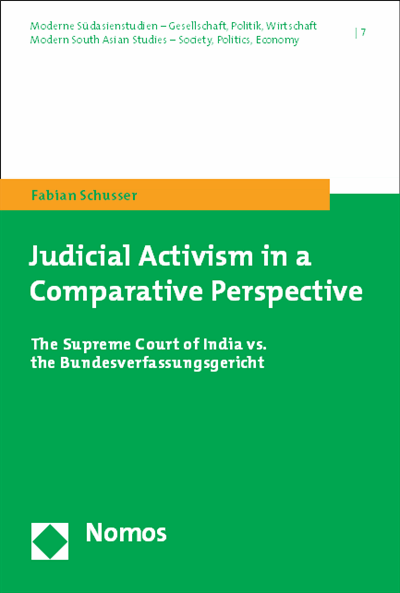
Judicial Activism in a Comparative Perspective
The Supreme Court of India vs. the Bundesverfassungsgericht- Autor:innen:
- Reihe:
- Moderne Südasienstudien - Modern South Asian Studies, Band 7
- Verlag:
- 2019
Zusammenfassung
Die vorliegende Arbeit untersucht das Phänomen des juristischen Aktivismus in vergleichender Perspektive. Beleuchtet werden die obersten Verfassungsgerichte in Indien und Deutschland: Der Supreme Court und das Bundesverfassungsgericht. Neben der Frage, welche Rolle die Gerichte im politischen Institutionengefüge spielen, wird geklärt, inwieweit sie als mächtig einzustufen sind. Als theoretische Grundlage für die Arbeit dient der historische Neo-Institutionalismus. Mittels dieser Theorie wird die Entwicklung der beiden Institutionen nachvollzogen und kritische Punkte in ihrer Geschichte identifiziert.
Schlagworte
Publikation durchsuchen
Bibliographische Angaben
- Auflage
- 1/2019
- Copyrightjahr
- 2019
- ISBN-Print
- 978-3-8487-5566-0
- ISBN-Online
- 978-3-8452-9744-6
- Verlag
- Nomos, Baden-Baden
- Reihe
- Moderne Südasienstudien - Modern South Asian Studies
- Band
- 7
- Sprache
- Englisch
- Seiten
- 169
- Produkttyp
- Monographie
Inhaltsverzeichnis
KapitelSeiten
- Titelei/Inhaltsverzeichnis Kein Zugriff Seiten 1 - 22
- Aims and scope Kein Zugriff
- Previous scholarship Kein Zugriff
- Chapter outline Kein Zugriff
- The puzzle: Measuring the power of courts Kein Zugriff
- Institutions Kein Zugriff
- History of neo-institutionalism Kein Zugriff
- Streams within neo-institutionalism Kein Zugriff
- Historical institutionalism: Central concepts Kein Zugriff
- Criticism: Historical institutionalism and political change Kein Zugriff
- Suitability of the theory Kein Zugriff
- Method, analytic narrative Kein Zugriff
- Constitutional courts Kein Zugriff
- Judicial interpretation Kein Zugriff
- Classical judicial review Kein Zugriff
- Judicial review in India Kein Zugriff
- Judicial review in Germany Kein Zugriff
- Structure and organization Kein Zugriff
- Original jurisdiction Kein Zugriff
- Appellate jurisdiction Kein Zugriff
- Advisory jurisdiction Kein Zugriff
- Public Interest Litigation Kein Zugriff
- The beginning of a new era: India and its new highest court Kein Zugriff
- Kesavananda Bharati and what the constitution really is: The Supreme Court and the Basic Structure Doctrine Kein Zugriff
- In the name of the people: The Public Interest Litigation Kein Zugriff
- Political role Kein Zugriff
- Structure and organization Kein Zugriff
- Constitutional complaint Kein Zugriff
- The abstract and concrete judicial review Kein Zugriff
- Other proceedings Kein Zugriff
- If there is law there shall be justice: The creation of the Bundesverfassungsgericht Kein Zugriff
- The first decades Kein Zugriff
- Battle Royale: The Bundesverfassungericht as a constitutional body Kein Zugriff
- The new Eastern politics of Willy Brandt and the BVerfG Kein Zugriff
- Political role Kein Zugriff
- Historical development and critical junctures Kein Zugriff
- Jurisdiction Kein Zugriff
- Judges and their appointment Kein Zugriff
- Legitimization Kein Zugriff
- Political role Kein Zugriff
- Power of the courts Kein Zugriff
- Judicial activism Kein Zugriff
- Purpose of the courts Kein Zugriff
- Suggestions for further research Kein Zugriff
- Bibliography Kein Zugriff Seiten 153 - 164
- Index Kein Zugriff Seiten 165 - 169
Literaturverzeichnis (177 Einträge)
Es wurden keine Treffer gefunden. Versuchen Sie einen anderen Begriff.
- 1950 AIR 124, 1950 S.C.R 594 https://indiankanoon.org/doc/456839/; accessed 03/31/2018. Google Scholar öffnen doi.org/10.5771/9783845297446
- 1975 AIR 2299 https://indiankanoon.org/doc/936707/; accessed 03/10/2018. Google Scholar öffnen doi.org/10.5771/9783845297446
- 1975 AIR 2092, 1976 S.C.R (1) 306 https://indiankanoon.org/doc/1553344/; accessed 03/27/2018. Google Scholar öffnen doi.org/10.5771/9783845297446
- Andersen, Uwe/Woyke, Wichard (2003). „Bundesverfassungsgericht“. Bundeszentrale für politische Bildung. http://www.bpb.de/nachschlagen/lexika/handwoerterbuch-politisches-system/40254/bundes¬verfassungs¬gericht?p=all; accessed 02/12/2013. Google Scholar öffnen doi.org/10.5771/9783845297446
- Annual Report of the Supreme Court of India 2016–17. http://supremecourtofindia.nic.in/pdf/AnnualReports/Annual%20Report%202016-17.pdf; accessed 03/30/2018. Google Scholar öffnen doi.org/10.5771/9783845297446
- Bassler, Yannick (2012). “Die versunkene ‘Insel der Demokratie’. Eine historisch-institutionalistische Analyse des politischen Systems Kirgistans“. In: Münchner Bei-träge zur Politikwissenschaft, herausgegeben vom Geschwister-Scholl-Institut für Politikwissenschaft der Ludwig-Maximilians-Universität München. http://epub.ub.uni-muenchen.de/12778/1/BAA_Bassler.pdf; accessed 10/28/2013. Google Scholar öffnen doi.org/10.5771/9783845297446
- Baxi, Upendra (1980). The Indian Supreme Court and Politics. Lucknow: Eastern Book Company. Google Scholar öffnen doi.org/10.5771/9783845297446
- Bell, Stephen (2011). “Do we really need a new ‘constructivist institutionalism’ to ex-plain institutional change?” British Journal of Political Science, vol. 41, issue 4, pp. 883–906. Google Scholar öffnen doi.org/10.5771/9783845297446
- Bell, Stephen (2012). “Where Are the Institutions? The Limits of Vivien Schmidt's Con-structivism”. British Journal of Political Science, vol. 42, issue 3, pp. 714–719. Google Scholar öffnen doi.org/10.5771/9783845297446
- Betz, Joachim (2007). “Politisches System”. Bundeszentrale für politische Bildung. http://www.bpb.de/izpb/9306/politisches-system?p=all; accessed 02/12/2013. Google Scholar öffnen doi.org/10.5771/9783845297446
- Blasberg, Georg (2003). Verfassungsgerichte als Ersatzgesetzgeber. Bern: Peter Lang. Google Scholar öffnen doi.org/10.5771/9783845297446
- Boulanger, Christian (2015). “Vergleichende Verfassungsgerichtsforschung”. In: van Ooyen, Robert Chr./Wöllers, Martin H.W. (eds.): Handbuch Bundesverfassungsge-richt im politischen System. Wiesbaden: VS, pp. 911–926. Google Scholar öffnen doi.org/10.5771/9783845297446
- Böcher, Michael (2012). “A theoretical framework for explaining the choice of instru-ments in environmental policy”. Policy and Economics, vol. 16, pp. 14–22. Google Scholar öffnen doi.org/10.5771/9783845297446
- Britannica Academic (2018a). https://academic-eb-com.ubproxy.ub.uni-heidelberg.de/levels/collegiate/article/Cornwallis-Code/26365 accessed 07/12/2018. Google Scholar öffnen doi.org/10.5771/9783845297446
- Britannica Academic (2018b). https://academic-eb-com.ubproxy.ub.uni-heidelberg.de/levels/collegiate/article/zamindar/78226 accessed 07/21/2018. Google Scholar öffnen doi.org/10.5771/9783845297446
- Burgess, Susan R. (1993). “Beyond Instrumental Politics. The New Institutionalism, Legal Rhetoric & Judicial Supremacy”. Polity, vol. 25, no. 3, pp. 445–459. Google Scholar öffnen doi.org/10.5771/9783845297446
- Bundestag (2018a). “Wahl der Richter des Bundesverfassungsgerichts”. Google Scholar öffnen doi.org/10.5771/9783845297446
- https://www.bundestag.de/blob/493592/bafe230e7b592f30de4761f1dcc3df5d/wd-3-258-16-pdf-data.pdf; accessed 01/30/2018. Google Scholar öffnen doi.org/10.5771/9783845297446
- BVerfG (2013a). “The Task“. http://www.bundesverfassungsgericht.de/en/organization/task.html; accessed 02/12/2013. Google Scholar öffnen doi.org/10.5771/9783845297446
- BVerfG (2013b). “Constitutional Complaint“. http://www.bundesverfassungsgericht.de/en/organization/verfassungsbeschwerde.html; accessed 02/12/2013. Google Scholar öffnen doi.org/10.5771/9783845297446
- BVerfG (2013c). “Organization“. http://www.bundesverfassungsgericht.de/en/organization/organization.html; accessed 02/12/2013. Google Scholar öffnen doi.org/10.5771/9783845297446
- BVerfG (2013d). “The Building”. Google Scholar öffnen doi.org/10.5771/9783845297446
- http://www.bundesverfassungsgericht.de/en/organization/building.html; accessed 02/12/2013. Google Scholar öffnen doi.org/10.5771/9783845297446
- BVerfG (2018a). “Concrete Judicial Review”. Google Scholar öffnen doi.org/10.5771/9783845297446
- http://www.bundesverfassungsgericht.de/DE/Verfahren/Wichtige-Verfahrensarten/Konkrete-Normenkontrolle/konkrete-normenkontrolle_node.html; accessed 01/18/2018. Google Scholar öffnen doi.org/10.5771/9783845297446
- BVerfG (2018b). “Abstract Judicial Review”. http://www.bundesverfassungsgericht.de/DE/Verfahren/Wichtige-Verfahrensarten/Abstrakte-Normenkontrolle/abstrakte-normenkontrolle_node.html; accessed 01/18/2018. Google Scholar öffnen doi.org/10.5771/9783845297446
- BVerfG (2018c). “Verfahren seit 7. September 1951 bis 31. Dezember 2016“. http://www.bundesverfassungsgericht.de/DE/Verfahren/Jahresstatistiken/2016/gb2016/A-I-1.pdf?__blob=publicationFile&v=2; accessed 01/23/2018. Google Scholar öffnen doi.org/10.5771/9783845297446
- BVerfG (2018d). “Verfahrenserledigungen von Verfassungsbeschwerden (einschließ-lich mitentschiedene Verfahren) der letzten fünf Geschäftsjahre“. Google Scholar öffnen doi.org/10.5771/9783845297446
- http://www.bundesverfassungsgericht.de/DE/Verfahren/Jahresstatistiken/2016/gb2016/A-IV-1.pdf?__blob=publicationFile&v=2; accessed 01/27/2018. Google Scholar öffnen doi.org/10.5771/9783845297446
- BVerfG (2018e). “Parteiverbotsverfahren”. http://www.bundesverfassungsgericht.de/DE/Verfahren/Wichtige-Verfahrensarten/Partei¬verbotsverfahren/parteiverbotsverfahren_node.html; accessed 01/28/2018. Google Scholar öffnen doi.org/10.5771/9783845297446
- BVerfG (2018f). “Organstreitverfahren”. Google Scholar öffnen doi.org/10.5771/9783845297446
- http://www.bundesverfassungsgericht.de/DE/Verfahren/Wichtige-Verfahrensarten/Organ¬streitverfahren/organstreitverfahren_node.html; accessed 01/28/2018. Google Scholar öffnen doi.org/10.5771/9783845297446
- BVerfG (2018g). „Bund-Länder-Streit“. Google Scholar öffnen doi.org/10.5771/9783845297446
- http://www.bundesverfassungsgericht.de/DE/Verfahren/Wichtige-Verfahrensarten/Bund-Laender-Streit/bund-laender-streit_node.html; accessed 01/28/2018. Google Scholar öffnen doi.org/10.5771/9783845297446
- BVerfG (2018h). “Wahlprüfungsbeschwerde”. Google Scholar öffnen doi.org/10.5771/9783845297446
- http://www.bundesverfassungsgericht.de/DE/Verfahren/Wichtige-Verfahrensarten/Wahl¬pruefungsbeschwerde/wahlpruefungsbeschwerde_node.html accessed 01/28/2018. Google Scholar öffnen doi.org/10.5771/9783845297446
- BVerfG (2018i). „Wirkung der Entscheidung“. Google Scholar öffnen doi.org/10.5771/9783845297446
- http://www.bundesverfassungsgericht.de/DE/Verfahren/Wichtige-Verfahrensarten/Wirkung-der-Entscheidung/wirkung-der-entscheidung_node.html; accessed 01/30/2018. Google Scholar öffnen doi.org/10.5771/9783845297446
- BVerfG, Beschluss vom 29. Mai 1973 – 2 BvQ 1/73 –, BVerfGE 35, 171–177. Google Scholar öffnen doi.org/10.5771/9783845297446
- BVerfG, Beschluss vom 04. Juni 1973 – 2 BvQ 1/73 –, BVerfGE 35, 193–202. Google Scholar öffnen doi.org/10.5771/9783845297446
- BVerfG, Beschluss vom 07. Juli 1975 – 1 BvR 274/72 –, BVerfGE 40, 141–179. Google Scholar öffnen doi.org/10.5771/9783845297446
- BVerfG, Beschluss vom 18. Mai 1982 – 1 BvR 602/78. Google Scholar öffnen doi.org/10.5771/9783845297446
- BVerfG, Urteil des Zweiten Senats vom 09. Dezember 2008 - 2 BvL 1/07 - Rn. (1–91). Google Scholar öffnen doi.org/10.5771/9783845297446
- BVerfG, Urteil des Zweiten Senats vom 17. Januar 2017 - 2 BvB 1/13 - Rn. (1-1010). Google Scholar öffnen doi.org/10.5771/9783845297446
- BVerfG, Urteil vom 28. Februar 1961 – 2 BvG 1/60 –, BVerfGE 12, 205–264. Google Scholar öffnen doi.org/10.5771/9783845297446
- BVerfG, Urteil vom 18. Juni 1973 – 2 BvQ 1/73 –, BVerfGE 35, 257–263. Google Scholar öffnen doi.org/10.5771/9783845297446
- BVerfG, Urteil vom 31. Juli 1973 – 2 BvF 1/73 –, BVerfGE 36, 1–37. Google Scholar öffnen doi.org/10.5771/9783845297446
- BVerfG, Urteil vom 27. Mai 1992 – 2 BvF 1/88 –, BVerfGE 86, 148–279. Google Scholar öffnen doi.org/10.5771/9783845297446
- Capoccia, Giovanni/Kelemen, R. Daniel Kelemen (2007). “The Study of Critical Junc-tures: Theory, Narrative, and Counterfactuals in Historical Institutionalism”. World Politics, vol. 59, no. 3, pp. 341–369. Google Scholar öffnen doi.org/10.5771/9783845297446
- Chandhoke, Neera (2005). “'Seeing' the State in India”. Economic and Political Weekly, vol. 40, no. 11, pp. 1033–1039. Google Scholar öffnen doi.org/10.5771/9783845297446
- Chaudhary, Pawan (2004). “Indian Judicial System: Its Nature & Structure and Distinc-tion between Law and Justice“. In: Verma, S.P. (ed.). Indian Judicial System. Need and Directions of Reforms. Delhi: Kanishka Publishers Distributors, pp. 23–37. Google Scholar öffnen doi.org/10.5771/9783845297446
- Chopra, Pran (ed.) (2006). The Supreme Court versus the Constitution. A Challenge to Federalism. New Delhi: Sage. Google Scholar öffnen doi.org/10.5771/9783845297446
- Chopra, Pran (2004). “The Constitution and Supreme Court”. Economic and Political Weekly, vol. 39, no. 30, pp. 3355–3359. Google Scholar öffnen doi.org/10.5771/9783845297446
- Clayton, Cornell/May, David A. (1999). “A Political Regimes Approach to the Analysis of Legal Decisions” Polity, vol. 32, no. 2, pp. 233–252. Google Scholar öffnen doi.org/10.5771/9783845297446
- Comparato, Scott A./McClurg, Scott D. (2007). “A Neo-Institutional Explanation of State Supreme Court Responses in Search and Seizure Cases”. American Politics Re-search, vol. 35, no. 5, pp. 726–754. Google Scholar öffnen doi.org/10.5771/9783845297446
- Conrad, Dieter (1995). “Rechtssystem und Verfassung“. In: Rothermund, Dietmar (ed.). Indien. Kultur, Geschichte, Politik, Wirtschaft, Umwelt. Ein Handbuch. München: C.H. Beck, pp. 409–426. Google Scholar öffnen doi.org/10.5771/9783845297446
- Constitution of India. https://www.india.gov.in/my-government/constitution-india/constitution-india-full-text; accessed 03/04/2015. Google Scholar öffnen doi.org/10.5771/9783845297446
- Constituent Assembly Debates on 24 May, 1949 Part Ii. Google Scholar öffnen doi.org/10.5771/9783845297446
- https://indiankanoon.org/doc/798115/; accessed 03/30/2018. Google Scholar öffnen doi.org/10.5771/9783845297446
- Dahl, Robert (1957). “Decision-Making in a Democracy. The Supreme Court as a Na-tional Policy-Maker”. In: Journal of Public Law 6, pp. 279–295. Google Scholar öffnen doi.org/10.5771/9783845297446
- Deutscher Bundestag (2018a). Google Scholar öffnen doi.org/10.5771/9783845297446
- https://www.bundestag.de/blob/196202/ee30d500ea94ebf8146d0ed7b12a8972/kapitel_10_01_statistik_zur_gesetzgebung-data.pdf; accessed 10/09/2018 Google Scholar öffnen doi.org/10.5771/9783845297446
- Dhavan, R. (2007). “Governance by Judiciary. Into the Next Millenium [sic]”. In: Dua, B.D., Sing, M.P., Saxena, R. Saxena (eds.). Indian Judiciary and Politics. The Changing Landscape. New Delhi: Manohar, pp. 73–105. Google Scholar öffnen doi.org/10.5771/9783845297446
- Dohrmann, Jona/Fischer, Alexander (2001). Public Interest Litigation in Indien. Ham-burg: GIGA German Institute of Global and Area Studies, Institut für Asien-Studien. https://crossasia-journals.ub.uni-heidelberg.de/index.php/ijb/article/view Google Scholar öffnen doi.org/10.5771/9783845297446
- /1251; accessed 03/04/2015. Google Scholar öffnen doi.org/10.5771/9783845297446
- Dua, B.D./Sing, M.P./Saxena, R. Saxena (eds.) (2007). Indian Judiciary and Politics. The Changing Landscape. New Delhi: Manohar. Google Scholar öffnen doi.org/10.5771/9783845297446
- Dua, B.D. 2007. “Introduction”. In: Dua, B.D./Singh, M.P./Saxena, R. (eds.). Indian Judiciary and Politics. The Changing Landscape. New Delhi: Manohar, pp. 15–40. Google Scholar öffnen doi.org/10.5771/9783845297446
- Dua, B.D. 2007. “India: A Study in Executive-Judicial Relations Revisited”. In: Dua, B.D./Singh, M.P./Saxena, R. (eds.). Indian Judiciary and Politics. The Changing Landscape. New Delhi: Manohar, pp. 357–414. Google Scholar öffnen doi.org/10.5771/9783845297446
- Dwarkadas Shrinivas Of Bombay vs. The Sholapur Spinning & Weaving 1954 SCR 674. https://www.sci.gov.in/jonew/judis/980.pdf; accessed 07/22/2018. Google Scholar öffnen doi.org/10.5771/9783845297446
- Ernst, Daniel R. (1998). „Law and American Political Development, 1877–1938”. Re-views in American History, vol. 26, no. 1, pp. 205–219. Google Scholar öffnen doi.org/10.5771/9783845297446
- Ethington, Philip/McDonagh, Eileen (1995). The Eclectic Center of the New Institution-alism. Axes of Analysis in Comparative Perspective. Social Science History, vol. 19, no. 4, pp. 467–477. Google Scholar öffnen doi.org/10.5771/9783845297446
- Federalist Papers No. 78. http://avalon.law.yale.edu/18th_century/fed78.asp; accessed 03/22/2018. Google Scholar öffnen doi.org/10.5771/9783845297446
- Fischbach, Sven (2011). Die verfassungsgerichtliche Kontrolle der Bundesregierung bei der Ausübung der Auswärtigen Gewalt. Möglichkeiten einer funktionell-rechtlichen Kontrollreduktion. Baden-Baden: Nomos. Google Scholar öffnen doi.org/10.5771/9783845297446
- Gadbois, George Harald (2017). Supreme Court of India. The Beginnings. New Delhi: Oxford University Press. Google Scholar öffnen doi.org/10.5771/9783845297446
- Garoupa, Nuno (2016): “Comparing Judicial Activism - Can we Say that the US Su-preme Court is more Activist than the German Constitutional Court?”. In: Revista Portuguesa de Filosofia, T. 72, Fasc. 4, Política e Filosofia I: A Democraciaem Questão / Politics and Philosophy I: Democracy in Question, pp. 1089–1105. Google Scholar öffnen doi.org/10.5771/9783845297446
- Gawron, Thomas/Rogowski, Ralf (2015). “Die Wirkung des Bundesverfassungsge-richts”. In: van Ooyen, Robert Chr./Wöllers, Martin H.W. (eds.): Handbuch Bundes-verfassungsgericht im politischen System. Wiesbaden: VS, pp. 153–168. Google Scholar öffnen doi.org/10.5771/9783845297446
- Gesetz über das Bundesverfassungsgericht (Bundesverfassungsgerichtsgesetz – BVer-fGG). https://www.gesetze-im-internet.de/bverfgg/; accessed 10/11/2016. Google Scholar öffnen doi.org/10.5771/9783845297446
- Ginsburg, Tom/Dixon, Rosalind (eds.) (2011). Comparative Constitutional law. Chel-tenham: Edward Elgar Publishing. Google Scholar öffnen doi.org/10.5771/9783845297446
- Goswami, Suparna (2017) “Study Finds India Is Asia's Most Corrupt Country, While Japan Comes In Last“. Google Scholar öffnen doi.org/10.5771/9783845297446
- https://www.forbes.com/sites/suparnagoswami/2017/03/08/study-finds-india-is-asias-most-corrupt-country-while-japan-comes-in-last/#7db260be1201; accessed 08/08/2018. Google Scholar öffnen doi.org/10.5771/9783845297446
- Grau, Andreas/Haunhorst, Regina/Würz, Markus (2016). Nachkriegsjahre, in: Lebendi-ges Museum Online, Stiftung Haus der Geschichte der Bundesrepublik Deutschland, „1949–55. Parlamentarische Demokratie: Bundesverfassungsgericht.“ http://www.hdg.de/lemo/html/DasGeteilteDeutschland/JahreDesAufbausInOstUndWest/ParlamentarischeDemokratie/bundesverfassungsgericht.html; accessed 02/12/ Google Scholar öffnen doi.org/10.5771/9783845297446
- 2013. Google Scholar öffnen doi.org/10.5771/9783845297446
- Grigoleit, Klaus Joachim (2015). “Bundesverfassungsgericht und die sozialliberale Koa-lition unter Willy Brandt”. In: van Ooyen, Robert Chr./Wöllers, Martin H.W. (eds.): Handbuch Bundesverfassungsgericht im politischen System. Wiesbaden: VS, pp. 231–243. Google Scholar öffnen doi.org/10.5771/9783845297446
- Grundgesetz für die Bundesrepublik Deutschland (GG). https://www.gesetze-im-internet.de/gg/BJNR000010949.html; accessed 02/26/2015. Google Scholar öffnen doi.org/10.5771/9783845297446
- Gusy, Christoph (2015). “Die Verfassungsbeschwerde”. In: van Ooyen, Robert Chr., Wöllers, Martin H.W. (eds.): Handbuch Bundesverfassungsgericht im politischen System. Wiesbaden: VS, pp. 333–348. Google Scholar öffnen doi.org/10.5771/9783845297446
- Hall, Peter A. (2010). “Historical Institutionalism in Rationalist and Sociological Per-spective“. In: Mahoney, James/Thelen, Kathleen (eds.). Explaining Institutional Change. Ambiguity, Agency and Power. Cambridge: Cambridge University Press, pp. 204–223. Google Scholar öffnen doi.org/10.5771/9783845297446
- Henne, Thomas (2015). “‘Smend oder Hennis‘ Bedeutung, Rezeption und Problematik der ,Lüth-Entscheidung‘ des Bundesverfassungsgerichts von 1958”. In: van Ooyen, Robert Chr./Wöllers, Martin H. W. (eds.): Handbuch Bundesverfassungsgericht im politischen System. Wiesbaden: VS, pp. 875–887. Google Scholar öffnen doi.org/10.5771/9783845297446
- Hira, Anil/Hira, Ron (2003). „The New Institutionalism.Contradictory Notions of Change“. In: The American Journal of Economics and Sociology, vol. 59, issue 2, pp. 267–282. Google Scholar öffnen doi.org/10.5771/9783845297446
- Höreth, Marcus (2015). “Wenn Richter mitregieren wollen: Selbstautorisierung beim BVerfG und dem EuGH im Vergleich”. In: van Ooyen, Robert Chr./Wöllers, Martin H.W. (eds.): Handbuch Bundesverfassungsgericht im politischen System. Wiesba-den: VS, pp. 231–243. Google Scholar öffnen doi.org/10.5771/9783845297446
- I.C. Golaknath & Ors vs. State Of Punjab & Anrs. (With Connected Petitions) 1967 SCR (2) 762 https://www.sci.gov.in/jonew/judis/2449.pdf; accessed 07/23/2018. Google Scholar öffnen doi.org/10.5771/9783845297446
- Indira Nehru Gandhi vs. Raj Narain. https://indiankanoon.org/doc/936707/; accessed 03/10/2018. Google Scholar öffnen doi.org/10.5771/9783845297446
- Jansen, Dorothea (2000). Der neue Institutionalismus. Antrittsvorlesung an der Deut-schen Hochschule für Verwaltungswissenschaften Speyer. 27. Juni 2000. http://www.dhv-speyer.de/jansen/download/SpeyererVortr%C3% Google Scholar öffnen doi.org/10.5771/9783845297446
- A4geInstitutionalismus.pdf; accessed 10/28/2013. Google Scholar öffnen doi.org/10.5771/9783845297446
- Jarass, Hans D./Pieroth, Bodo (2007). Grundgesetz für die Bundesrepublik Deutschland Kommentar. München: C.H. Beck. Google Scholar öffnen doi.org/10.5771/9783845297446
- Jäger, York (1987). “Entscheidungsverhalten und Hintergrundfaktoren der Bundesver-fassungsrichter.“ In: Zeitschrift für Rechtspolitik, vol. 20., no. 10, pp. 360–363. Google Scholar öffnen doi.org/10.5771/9783845297446
- Jestaedt, Matthias/Lepsius, Oliver/Möllers, Christoph/Schöneberger, Christoph (2011). Das entgrenzte Gericht. Eine kritische Bilanz nach sechzig Jahren Bundesverfas-sungsgericht. Berlin: Suhrkamp. Google Scholar öffnen doi.org/10.5771/9783845297446
- Karimbil Kunhikoman vs. State Of Kerala. 1962 SCR Supl. (1) 829 https://www.sci.gov.in/jonew/judis/4051.pdf; accessed 07/22/2018 Google Scholar öffnen doi.org/10.5771/9783845297446
- Kato, Junko. (1996). “Institutions and Rationality in Politics - Three Varieties of Neo-Institutionalists”. British Journal of Political Science, vol. 26, no. 4, pp. 553–582. Google Scholar öffnen doi.org/10.5771/9783845297446
- Kaufmann, Sabine/Ziegler, Wiebke (2013). “Geschichte des Bundesverfassungsge-richts“. Planet Wissen. http://www.planet-wissen.de/politik_geschichte/ Google Scholar öffnen doi.org/10.5771/9783845297446
- menschenrechte/ver¬fassung_in_deutschland/ge¬schichte_des_bvg.jsp; accessed 12/02/2013. Google Scholar öffnen doi.org/10.5771/9783845297446
- Kesavananda Sripadagalvaru and Ors vs. State Of Kerala And Anr Writ Petition (civil) 135 of 1970 https://www.sci.gov.in/jonew/judis/29981.pdf; accessed 04/08/2018. Google Scholar öffnen doi.org/10.5771/9783845297446
- Khosla, Sunil (2008). Judicial Activism in India. Problems and Prospects. Chandigarh: Arun Publishing House Pvt. Ltd. Google Scholar öffnen doi.org/10.5771/9783845297446
- Kneip, Sascha (2009). Verfassungsgerichte als demokratische Akteure. Der Beitrag des Bundesverfassungsgerichts zur Qualität der bundesdeutschen Demokratie. Recht und Politik. Baden-Baden: Nomos. Google Scholar öffnen doi.org/10.5771/9783845297446
- Koch, Sascha/Schemmann, Michael (eds.). 2009. Neo-Institutionalismus in der Erzie-hungswissenschaft. Grundlegende Texte und empirische Studien. Wiesbaden: VS. Google Scholar öffnen doi.org/10.5771/9783845297446
- Kranenpohl, Uwe (2010). Hinter dem Schleier des Beratungsgeheimnisses. Der Wil-lensbildungs- und Entscheidungsprozess des Bundesverfassungsgerichts. Wiesba-den: VS. Google Scholar öffnen doi.org/10.5771/9783845297446
- Kranenpohl, Uwe (2015). “Interne Einflussfaktoren auf Entscheidungen des Bundesver-fassungsgerichts”. In: van Ooyen, Robert Chr./Wöllers, Martin H.W. (eds.): Hand-buch Bundesverfassungsgericht im politischen System. Wiesbaden: VS, pp. 431–442. Google Scholar öffnen doi.org/10.5771/9783845297446
- Landfried, Christine (2015). “Die Wahl der Bundesverfassungsrichter und ihre Folgen für die Legitimität der Verfassungsgerichtsbarkeit”. In: van Ooyen, Robert Chr./Wöllers, Martin H.W. (eds.): Handbuch Bundesverfassungsgericht im politi-schen System. Wiesbaden: VS, pp. 369–388. Google Scholar öffnen doi.org/10.5771/9783845297446
- Lecours, André (2000). “Theorizing Cultural Identities: Historical Institutionalism as a Challenge to the Culturalists”. Canadian Journal of Political Science, vol. 33, no. 3, pp. 499–522. Google Scholar öffnen doi.org/10.5771/9783845297446
- Lembcke, Oliver W. (2013). “Autorität der Verfassungsgerichtsbarkeit – eine Skizze in vergleichender Absicht“. In: Wrase, Michael/Boulanger, Christian (eds.). Die Politik des Verfassungsrechts. Interdisziplinäre und vergleichende Perspektiven auf die Rolle und Funktion von Verfassungsgerichten. Baden-Baden: Nomos, pp. 37–65. Google Scholar öffnen doi.org/10.5771/9783845297446
- Lembcke, Oliver W. (2015). “Das Bundesverfassungsgericht und die Regierung Ade-nauer”. In: van Ooyen, Robert Chr./Wöllers, Martin H.W. (eds.): Handbuch Bundes-verfassungsgericht im politischen System. Wiesbaden: VS, pp. 231–243. Google Scholar öffnen doi.org/10.5771/9783845297446
- Lepsius, Oliver (2015). “Entscheiden durch Maßstabsbildung”. In: van Ooyen, Robert Chr./Wöllers, Martin H.W. (eds.): Handbuch Bundesverfassungsgericht im politi-schen System. Wiesbaden: VS, pp. 119–135. Google Scholar öffnen doi.org/10.5771/9783845297446
- Lhotta, Roland (2003). “Das Bundesverfassungsgericht als politischer Akteur: Plädoyer für eine neo-institutionalistische Ergänzung der Forschung”. Schweizerische Zeit-schrift für Politikwissenschaft, vol. 9, no. 3, pp. 142–153. Google Scholar öffnen doi.org/10.5771/9783845297446
- Lhotta, Roland (2006). “Der antiliberale Kern des neuen Institutionalismus in der Poli-tikwissenschaft. Überlegungen zum aktuellen Erscheinungsbild der Disziplin.“ Zeit-schrift für Politikwissenschaft, vol. 16, no. 1, pp. 7–28. Google Scholar öffnen doi.org/10.5771/9783845297446
- Luhmann, Niklas (2011). Organisation und Entscheidung. Wiesbaden: VS. Google Scholar öffnen doi.org/10.5771/9783845297446
- Lukes, Steven (2005). Power. A Radical View. Second Edition. Houndmills et al.: Pal-grave Macmillan. Google Scholar öffnen doi.org/10.5771/9783845297446
- Ma, Shu-Yun (2007). “Political Science at the Edge of Chaos? The Paradigmatic Impli-cations of Historical Institutionalism”. International Political Science Review, vol.28, no. 1, pp. 57–78. Google Scholar öffnen doi.org/10.5771/9783845297446
- Mahoney, James (2004). “Comparative-Historical Methodology”. Annual Review of Sociology, vol. 30, pp. 81–101. Google Scholar öffnen doi.org/10.5771/9783845297446
- Mahoney, James/Thelen, Kathleen (eds.) (2010). Explaining Institutional Change. Am-biguity, Agency and Power. Cambridge: Cambridge University Press. Google Scholar öffnen doi.org/10.5771/9783845297446
- Mahoney, James/Thelen, Kathleen (2010). “A Theory of Gradual Institutional Change”. In: Mahoney, James/Thelen, Kathleen (eds.). Explaining Institutional Change. Ambi-guity, Agency and Power. Cambridge: Cambridge University Press, pp. 1–37. Google Scholar öffnen doi.org/10.5771/9783845297446
- Melville, Gert/Rehberg, Karl-Siegbert (eds.) (2012). Dimensionen institutioneller Macht. Fallstudien von der Antike bis zur Gegenwart. Köln/Weimar/Wien: Böhlau. Google Scholar öffnen doi.org/10.5771/9783845297446
- Menon, N.R. Madhava (2006). “Basic Structure: After 30 Years”. In: Chopra, Pran (ed.). The Supreme Court versus the Constitution. A Challenge to Federalism. New Delhi: Sage, pp. 59–69. Google Scholar öffnen doi.org/10.5771/9783845297446
- Menzel, Jörg/Müller-Terpitz, Ralf (eds.) (2011). Verfassungsrechtsprechung. Tübingen: Mohr Siebeck. Google Scholar öffnen doi.org/10.5771/9783845297446
- Menzel, Jörg (2011). “Sechzig Jahre Verfassungsrechtsprechung. Einführende Überle-gungen zur Verfassungsgerichtsbarkeit, zum Bundesverfassungsgericht und zur Be-deutung seiner Judikate”. In: Menzel, Jörg/Müller-Terpitz, Ralf (eds.). Verfassungs-rechtsprechung. Tübingen: Mohr Siebeck, pp. 1–44. Google Scholar öffnen doi.org/10.5771/9783845297446
- Mitra, Subrata K. (1999). “Effects of institutional arrangements on political stability in South Asia”. Annual Review of Political Science, vol. 2, pp. 405–428. Google Scholar öffnen doi.org/10.5771/9783845297446
- Mitra, Subrata K. (2006). The Puzzle of India’s Governance: Culture, Context and Com-parative Theory. London: Routledge. Google Scholar öffnen doi.org/10.5771/9783845297446
- Mitra, Subrata K. (2017). Politics in India. Structure, Process and Policy. Oxon: Routledge. Google Scholar öffnen doi.org/10.5771/9783845297446
- Mody, Zia (2013). 10 Judgements that changed India. London: Penguin Books Ltd. Google Scholar öffnen doi.org/10.5771/9783845297446
- Mitra, Subrata K./Liebig, Michael (2016). Kautilya’s Arthashastra: An Intellectual Por-trait. The Classical Roots of Modern Politics in India. Baden-Baden: Nomos. Google Scholar öffnen doi.org/10.5771/9783845297446
- Niclauß, Karlheinz (2015). “Der Parlamentarische Rat und das Bundesverfassungsge-richt”. In: van Ooyen, Robert Chr./Wöllers, Martin H. W. (eds.): Handbuch Bundes-verfassungsgericht im politischen System. Wiesbaden: VS, pp. 192–204 Google Scholar öffnen doi.org/10.5771/9783845297446
- North, Douglass (1990). Institutions, Institutional Change and Economic Performance. Cambridge: Cambridge University Press. Google Scholar öffnen doi.org/10.5771/9783845297446
- Padhy, Sanghamitra (2004). A Review of Indian Supreme Court Judgements. Economic and Political Weekly, vol. 39, no. 46/47, pp. 5027–5032. Google Scholar öffnen doi.org/10.5771/9783845297446
- Patzelt, Werner J. (2015). “Die Wirkung des Bundesverfassungsgerichts”. In: van Ooyen, Robert Chr./Wöllers, Martin H.W. (eds.): Handbuch Bundesverfassungsge-richt im politischen System. Wiesbaden: VS, pp. 313–332 Google Scholar öffnen doi.org/10.5771/9783845297446
- Perry, Barbara A. (2001). The Israeli and United States Supreme Courts: A Comparative Reflection on their Symbols, Images, and Functions. The Review of Politics, vol. 63, no. 2, pp. 317–339. Google Scholar öffnen doi.org/10.5771/9783845297446
- Peters, Guy B./Pierre, Jon/King, Desmond S. (2005). “The Politics of Path Dependency: Political Conflict in Historical Institutionalism”. The Journal of Politics, vol. 67, no. 4, pp. 1275–1300. Google Scholar öffnen doi.org/10.5771/9783845297446
- Quint, Peter E. (2006). Leading a Constitutional Court: Perspectives from the Federal Republic of Germany. University of Pennsylvania Law Review, vol. 154, no. 6, Symposium: The Chief Justice and the Institutional Judiciary, pp. 1853–1878. Google Scholar öffnen doi.org/10.5771/9783845297446
- Radaelli, Claudio M./Dente, Bruno/Dossi, Samuele (2012). “Recasting institutionalism: institutional analysis and public policy”. European Political Science, vol. 11, pp. 537–550. Google Scholar öffnen doi.org/10.5771/9783845297446
- Rath, Christian (2013). Der Schiedsrichterstaat. Die Macht des Bundesverfassungsge-richts. Berlin: Klaus Wagenbach. Google Scholar öffnen doi.org/10.5771/9783845297446
- Rogowski, Ralf (2013). “Constitutional courts as autopoetic organisations“. In: Wrase, Michael/Boulanger, Christian (eds.). Die Politik des Verfassungsrechts. Interdiszipli-näre und vergleichende Perspektiven auf die Rolle und Funktion von Verfassungsge-richten. Baden-Baden: Nomos, pp. 123–136. Google Scholar öffnen doi.org/10.5771/9783845297446
- Rothermund, Dietmar (ed.) (1995). Indien. Kultur, Geschichte, Politik, Wirtschaft, Um-welt. Ein Handbuch. München: C.H. Beck. Google Scholar öffnen doi.org/10.5771/9783845297446
- Saghir Ahmad vs. The State of U.P. and Others 1955 SCR 707 https://www.sci.gov.in/jonew/judis/890.pdf accessed 07/22/2018. Google Scholar öffnen doi.org/10.5771/9783845297446
- sam/ddp/dpa/Reuters. Spiegel 2018a. “Bundesverfassungsgericht: Millionen Berufstätige bekommen alte Pendlerpauschale zurück”. http://www.spiegel.de/wirtschaft/bundesverfassungsgericht-millionen-berufstaetige-bekommen-alte-pendlerpauschale-zurueck-a-595285.html; accessed 01/29/2018. Google Scholar öffnen doi.org/10.5771/9783845297446
- Sathe, S.P. (2002). Judicial Activism in India. Transgressing Borders and Enforcing Limits. New Delhi: Oxford University Press, 2002. Google Scholar öffnen doi.org/10.5771/9783845297446
- Schlaich, Klaus/Korioth, Stefan (2015). Das Bundesverfassungsgericht. Stellung, Ver-fahren, Entscheidungen. München: C.H. Beck. Google Scholar öffnen doi.org/10.5771/9783845297446
- Schmidt, Vivien A. (2010). “Taking ideas and discourse seriously: explaining change through discursive institutionalism as the fourth ‘new institutionalism’”. European Political Science Review, vol. 2, no. 1, pp. 1–25. Google Scholar öffnen doi.org/10.5771/9783845297446
- Schmidt, Rainer/da Silva, Virgílio Afonso (eds.) (2012). Verfassung und Verfassungs-gericht. Deutschland und Brasilien im Vergleich. Baden-Baden. Nomos. Google Scholar öffnen doi.org/10.5771/9783845297446
- Schöttli, Jivanta (2009). Strategy and Vision in Politics. Jawaharlal Nehru‘s policy choices and the designing of political institutions. Dissertation. http://www.ub.uni-heidelberg.de/archiv/9977; accessed 10/26/2017. Google Scholar öffnen doi.org/10.5771/9783845297446
- Schulze, Holger (1997). “Neo-Institutionalismus. Ein analytisches Instrument zur Erklä-rung gesellschaftlicher Transformationsprozesse“. Osteuropa-Institut der Freien Uni-versität Berlin. Arbeitspapiere des Bereichs Politik und Gesellschaft. Klaus Segbers (ed.). no 4/1997; Google Scholar öffnen doi.org/10.5771/9783845297446
- http://www.oei.fu-berlin.de/politik/publikationen/AP04.pdf, accessed 10/28/2013. Google Scholar öffnen doi.org/10.5771/9783845297446
- Senge, Konstanze (2011). Das Neue am Neo-InstitutionaIismus. Der Neo-Institutionalismus im Kontext der Organisationswissenschaft. Wiesbaden: VS. Google Scholar öffnen doi.org/10.5771/9783845297446
- Sieckmann, Jan (2012). „Zum Verhältnis von Verfassung, Recht und Politik“. In: Schmidt, Rainer/ da Silva, Virgílio Afonso (eds.). Verfassung und Verfassungsge-richt. Deutschland und Brasilien im Vergleich. Baden-Baden. Nomos, pp. 43–58. Google Scholar öffnen doi.org/10.5771/9783845297446
- Singh, Mahendra Lal (2007). “Inconclusive Overview of Judicial Activism in India“. In: Dua, B.D./Singh, M.P./Saxena, R. (eds.). 2007. Indian Judiciary and Politics. The Changing Landscape. New Delhi: Manohar, pp. 121–139. Google Scholar öffnen doi.org/10.5771/9783845297446
- S.S. Rana & Co. Advocates http://www.ssrana.in/Intellectual%20Property/IP-Enforcement-And-Litigation/IP-Indian-Courts-Structure-in-India.aspx; accessed 08/28/2018. Google Scholar öffnen doi.org/10.5771/9783845297446
- State of Bihar vs. Maharajadhiraja Sir Kameshwar Singh of Darbangha and Others 1952 1 SCR 889 https://indiankanoon.org/doc/49043/; accessed 07/21/2018 Google Scholar öffnen doi.org/10.5771/9783845297446
- Sturm, Roland (2012). Das Bundesverfassungsgericht: Politik mit Richtern. Bundeszent-rale für politische Bildung. http://www.bpb.de/politik/grundfragen/deutsche-verhaeltnisse-eine-sozialkunde/138730/das-bundesverfassungsgericht-politik-mit-richtern; accessed 02/12/2013. Google Scholar öffnen doi.org/10.5771/9783845297446
- S.P. Gupta vs. President Of India And Ors. 1982 2 SCR 365 https://indiankanoon.org/doc/1294854/; accessed 02/09/2018. Google Scholar öffnen doi.org/10.5771/9783845297446
- Supreme Court Advocates-on-Record Association and another vs. Union of India Writ Petition (civil) 1303 of 1987 https://www.sci.gov.in/jonew/judis/29918.pdf; accessed 02/09/2018. Google Scholar öffnen doi.org/10.5771/9783845297446
- Supreme Court of India (2017). Handbook on Practice and Procedure and Office Proce-dure. https://www.sci.gov.in/practice-and-procedure; accessed 09/04/2018. Google Scholar öffnen doi.org/10.5771/9783845297446
- Supreme Court of India (2018a). http://supremecourtofindia.nic.in/jurisdiction; accessed 03/03/2018. Google Scholar öffnen doi.org/10.5771/9783845297446
- Supreme Court of India (2018b) http://www.supremecourtofindia.nic.in/chief-justice-judges; accessed 05/13/2018. Google Scholar öffnen doi.org/10.5771/9783845297446
- Supreme Court of India (2018c). http://www.supremecourtofindia.nic.in/statistics; ac-cessed 05/13/2018. Google Scholar öffnen doi.org/10.5771/9783845297446
- Supreme Court of India. Civil Appeal No. 2217 of 2018. https://www.sci.gov.in/supremecourt/2017/7075/7075_2017_Judgement_06-Mar-2018.pdf, accessed 04/04/2018. Google Scholar öffnen doi.org/10.5771/9783845297446
- Supreme Court of India vs. Civil Advisory Jurisdiction Special Reference Case 1 of 1998 https://www.sci.gov.in/jonew/judis/12948.pdf; accessed 02/09/2018. Google Scholar öffnen doi.org/10.5771/9783845297446
- The State of West Bengal vs. Mrs. Bela Banerjee and Others 1954 SCR 558 https://indiankanoon.org/doc/1890860/; accessed 07/21/2018. Google Scholar öffnen doi.org/10.5771/9783845297446
- The State of West Bengal vs. Subodh Gopal Bose and Others 1954 SCR 587 https://www.sci.gov.in/jonew/judis/984.pdf; accessed 07/22/2018. Google Scholar öffnen doi.org/10.5771/9783845297446
- van Ooyen, Robert Chr./Wöllers, Martin H.W. (eds.) (2015): Handbuch Bundesverfas-sungsgericht im politischen System. Wiesbaden: VS. Google Scholar öffnen doi.org/10.5771/9783845297446
- van Ooyen, Robert Chr./Wöllers, Martin H.W (2015). “Einführung zur 1. Auflage: Recht gegen Politik – politik- und rechtswissenschaftliche Versäumnisse bei der Er-forschung des Bundesverfassungsgericht”. In: van Ooyen, Robert Chr./Wöllers, Martin H.W. (eds.): Handbuch Bundesverfassungsgericht im politischen System. Wiesbaden: VS, pp. 3–11. Google Scholar öffnen doi.org/10.5771/9783845297446
- Verma, S.P. (ed.) (2004). Indian Judicial System. Need and Directions of Reforms. Del-hi: Kanishka Publishers Distributors. Google Scholar öffnen doi.org/10.5771/9783845297446
- Verney, Douglas S. (2007). “The struggle over Judicial Review: Supreme Court and Limited Government“. In: Dua, B.D./Singh, M.P./Saxena, R. (eds.). Indian Judiciary and Politics. The Changing Landscape. New Delhi: Manohar, pp. 41–72. Google Scholar öffnen doi.org/10.5771/9783845297446
- Vorländer, Hans (2012a). “Macht als Deutungsmacht. Das Bundesverfassungsgericht”. In: Schmidt, Rainer/da Silva, Virgilio Afonso (eds.). Verfassung und Verfassungsge-richt: Deutschland und Brasilien im Vergleich. Baden-Baden: Nomos, pp. 13–24. Google Scholar öffnen doi.org/10.5771/9783845297446
- Vorländer, Hans (2012b). “Macht als Deutungsmacht. Das Bundesverfassungsgericht”. In: Melville, Gert/Rehberg, Karl-Siegbert (eds.). Dimensionen institutioneller Macht. Fallstudien von der Antike bis zur Gegenwart. Köln/Weimar/Wien: Böhlau, pp. 197–216. Google Scholar öffnen doi.org/10.5771/9783845297446
- Voigt, Rüdiger (2015). “Das Bundesverfassungsgericht in rechtspolitologischer Sicht”. In: van Ooyen, Robert Chr./Wöllers, Martin H.W. (eds.): Handbuch Bundesverfas-sungsgericht im politischen System. Wiesbaden: VS, pp. 69–94. Google Scholar öffnen doi.org/10.5771/9783845297446
- Vorländer, Hans (2011). „Regiert Karlsruhe mit? Das Bundesverfassungs- Google Scholar öffnen doi.org/10.5771/9783845297446
- gericht zwischen Recht und Politik“. Aus Politik und Zeitgeschichte (APUZ), 35–36/2011. http://www.bpb.de/apuz/33164/regiert-karlsruhe-mit-das-bundes-verfassungsgericht-zwischen-recht-und-politik?p=all; accessed 02/12/2013. Google Scholar öffnen doi.org/10.5771/9783845297446
- Vorländer, Hans (2015). “Die Deutungsmacht des Bundesverfassungsgerichts”. In: van Ooyen, Robert Chr./Wöllers, Martin H.W. (eds.): Handbuch Bundesverfassungsge-richt im politischen System. Wiesbaden: VS, pp. 299–312. Google Scholar öffnen doi.org/10.5771/9783845297446
- Wrase, Michael/Boulanger, Christian (eds.) (2013). Die Politik des Verfassungsrechts. Interdisziplinäre und vergleichende Perspektiven auf die Rolle und Funktion von Ver-fassungsgerichten. Baden-Baden: Nomos. Google Scholar öffnen doi.org/10.5771/9783845297446
- Wrase, Michael (2013). “Verfassungsgerichtsforschung auf der Schnittstelle zwischen Rechts- und Politikwissenschaften – Überlegungen am Beispiel des Bundesverfas-sungsgerichts“. In: Wrase, Michael/Boulanger, Christian (eds.). Die Politik des Ver-fassungsrechts. Interdisziplinäre und vergleichende Perspektiven auf die Rolle und Funktion von Verfassungsgerichten. Baden-Baden: Nomos, pp. 21–36. Google Scholar öffnen doi.org/10.5771/9783845297446
- Zuck, Rüdiger (2015). “Die Wissenschaftlichen Mitarbeiter des Bundesverfassungsge-richts”. In: van Ooyen, Robert Chr./Wöllers, Martin H.W. (eds.): Handbuch Bundes-verfassungsgericht im politischen System. Wiesbaden: VS, pp. 443–458. Google Scholar öffnen doi.org/10.5771/9783845297446