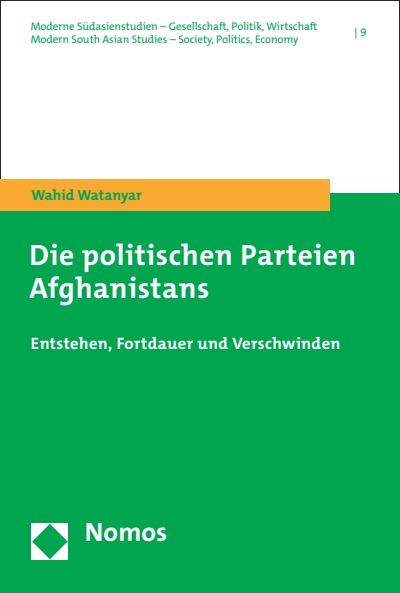
Die politischen Parteien Afghanistans
Entstehen, Fortdauer und Verschwinden- Autor:innen:
- Reihe:
- Moderne Südasienstudien - Modern South Asian Studies, Band 9
- Verlag:
- 2023
Zusammenfassung
Afghanistan steht seit 1979 im Fokus internationaler Interessen, doch seine lange parteipolitische Tradition wurde bislang kaum beachtet. Dieses Buch bietet einen Überblick über Afghanistans Parteien von 1964 bis 2021, die vor dem Hintergrund ausländischer Invasionen, Bürgerkriege und eines unabgeschlossenen Staatsbildungsprozesses um die politische Macht kämpften. Es liefert einen Beitrag zu den sozialwissenschaftlichen Forschungen über Parteipolitik, bewaffnete Gruppen, Demokratisierung und Entwicklung. Wahid Watanyar promovierte in Politikwissenschaften an der Ruprecht-Karls-Universität Heidelberg. Seine Forschungsschwerpunkte sind bewaffnete Gruppen und Konflikte, Parteien, Demokratisierung und die Politik Südasiens.
Schlagworte
Publikation durchsuchen
Bibliographische Angaben
- Copyrightjahr
- 2023
- ISBN-Print
- 978-3-8487-7454-8
- ISBN-Online
- 978-3-7489-3246-8
- Verlag
- Nomos, Baden-Baden
- Reihe
- Moderne Südasienstudien - Modern South Asian Studies
- Band
- 9
- Sprache
- Deutsch
- Seiten
- 339
- Produkttyp
- Monographie
Inhaltsverzeichnis
- Titelei/Inhaltsverzeichnis Kein Zugriff Seiten 1 - 14
- 1.1 Hintergründe und Erkenntnisinteresse der Untersuchung Kein Zugriff
- 1.2 Begriffserklärung Kein Zugriff
- 2.1 Politische Parteien und ihre Entstehung Kein Zugriff
- 2.2.1 Der Parteitypus Kein Zugriff
- 2.2.2 Parteifunktionen Kein Zugriff
- 2.2.3 Parteien in (Post-)Konfliktgesellschaften Kein Zugriff
- 2.3 Eigenschaften von Parteisystemen Kein Zugriff
- 2.4 Zwischenfazit Kein Zugriff
- 3.1 Dreidimensionale Analyse zur Parteitypbestimmung Kein Zugriff
- 3.2 Auswahl und Begründung der Analysekategorien Kein Zugriff
- 3.3 Verhältnis zwischen Staat und Parteisystem Kein Zugriff
- 4.1 Konzeptspezifikation Kein Zugriff
- 4.2 Spezifikation der Parteientypologie Kein Zugriff
- 4.3 Vorgehensweise und Methode Kein Zugriff
- 4.4 Experteninterviews Kein Zugriff
- 5.1 Historischer Überblick: das Entstehen der ersten politischen Bewegungen Afghanistans Kein Zugriff
- 5.2 Systempolitische Landschaft und Parteientwicklung Kein Zugriff
- 5.3 Politische Erbschaft und ihre Auswirkungen auf spätere Phasen Kein Zugriff
- 5.4 Zwischenfazit Kein Zugriff
- 6.1 Die großen politischen Bewegungen in der Vorkriegszeit Kein Zugriff
- 6.2.1 Die Moderaten Kein Zugriff
- 6.2.2 Die Evolution der marxistisch-leninistischen Partei Afghanistans Kein Zugriff
- 6.2.3 Die islamistischen Parteien Kein Zugriff
- People's Democratic Party of Afghanistan (PDPA) Kein Zugriff
- Jamyat-e Islami Afghanistan (JIA) und Hezb-e Islami Afghanistan (HIA) Kein Zugriff
- Klassifikation der Parteien in der Vorkriegsphase (1964-1978) Kein Zugriff
- 6.4 Funktionale Analyse der Parteien Kein Zugriff
- 6.5 Zwischenfazit Kein Zugriff
- 7.1 Charakterwandel der Parteien von der politischen zur militaristischen Ausrichtung Kein Zugriff
- 7.2.1 Noor Muhammad Taraki: der Mann des Ostens Kein Zugriff
- 7.2.2 Parcham und das Erbe der PDPA Kein Zugriff
- 7.3.1 Afghanistans schiitische Parteien Kein Zugriff
- 7.3.2 Die Taliban Kein Zugriff
- 7.3.3.1 Jamyat-e Islami Afghanistan (JIA) Kein Zugriff
- 7.3.3.2 Hezb-e Islami Afghanistan (HIA) Kein Zugriff
- People’s Democratic Party of Afghanistan (PDPA) Kein Zugriff
- Jamyat-e Islami Afghanistan (JIA) Kein Zugriff
- Hezb-e Islami Afghanistan (HIA) Kein Zugriff
- Klassifikation von Parteien der Kriegsphase (1978-2001) Kein Zugriff
- 7.5 Funktionale Analyse der Parteien Kein Zugriff
- 7.6 Zwischenfazit Kein Zugriff
- 8.1 Politische Systemänderung und die islamistischen Parteien: eine Einführung Kein Zugriff
- 8.2 Der Wiederaufbauprozess und das Konflikterbe der alten Parteien Kein Zugriff
- 8.3 Persistenzstrategien der Parteien in der Post-Taliban-Phase Kein Zugriff
- 8.4.1.1 Jamyat-e Islami Afghanistan (JIA) Kein Zugriff
- 8.4.1.2 Hezb-e Wahdat-e Islami Fraktionen Kein Zugriff
- 8.4.1.3 Junbush-e Milli Afghanistan (JM) Kein Zugriff
- 8.4.2.1 Hezb-e Islami Afghanistan (HIA) Kein Zugriff
- 8.4.2.2 Die Taliban: Reorganisierung und Wiederaufstieg nach ihrem Zerfall 2001 Kein Zugriff
- Jamyat-e Islami Afghanistan (JIA) Kein Zugriff
- Hezb-e Wahdat-e Islami Fraktionen (HW) Kein Zugriff
- Junbush-e Milli (JM) Kein Zugriff
- Hezb-e Islami Afghanistan (HIA) Kein Zugriff
- Die Taliban Kein Zugriff
- Klassifikation der Parteien der Post-2001-Phase Kein Zugriff
- 8.6 Funktionale Analyse der Parteien Kein Zugriff
- 8.7 Zwischenfazit Kein Zugriff
- 9.1 Politische Systeme und Parteienlandschaft Kein Zugriff
- 9.2 Diskussion der Kernbefunde Kein Zugriff
- 9.3 Ausblick Kein Zugriff
- Internetquellen Kein Zugriff
- Zusammenfassung Kein Zugriff
- Vorgehensweise in den Interviews Kein Zugriff
- Interviewfragen Kein Zugriff
- 19. Juli 2019 – Gespräch mit Ghairat Baheer Kein Zugriff
- Hintergrund Kein Zugriff
- Kernaussagen Kein Zugriff
- 22 September 2019 – Gespräch mit Waheed Benish Kein Zugriff
- Hintergrund Kein Zugriff
- Kernaussagen Kein Zugriff
- 20. September 2019 – Gespräch mit Shinkai Karokhail Kein Zugriff
- Hintergrund Kein Zugriff
- Kernaussagen Kein Zugriff
- 18. Juni 2019 – Gespräch mit Ismail Khan in Herat, Afghanistan Kein Zugriff
- Hintergrund Kein Zugriff
- Kernaussagen Kein Zugriff
- 20. September 2019 – Gespräch mit Abdulkarim Khuram Kein Zugriff
- Hintergrund Kein Zugriff
- Kernaussagen Kein Zugriff
- 20. September 2019 – Gespräch mit Farzana Kuchi Kein Zugriff
- Hintergrund Kein Zugriff
- Kernaussagen Kein Zugriff
- 2. September 2019 – Gespräch mit Suleiman Laiq Kein Zugriff
- Hintergrund Kein Zugriff
- Kernaussagen Kein Zugriff
- 16. September 2019 – Gespräch mit Abdul Hamid Majid Kein Zugriff
- Hintergrund Kein Zugriff
- Kernaussagen Kein Zugriff
- 2. September 2019 – Gespräch mit Hafiz Mansour Kein Zugriff
- Hintergrund Kein Zugriff
- Kernaussagen Kein Zugriff
- 1. August 2019 – Gespräch mit Dr. Mehdi Kein Zugriff
- Hintergrund Kein Zugriff
- Kernaussagen Kein Zugriff
- 24. Juli 2019 – Gespräch mit Waheed Mozhdah Kein Zugriff
- Hintergrund Kein Zugriff
- Kernaussagen Kein Zugriff
- 17. September 2019 - Gespräch mit M. Yusuf Rasheed Kein Zugriff
- Hintergrund Kein Zugriff
- Kernaussagen Kein Zugriff
- 17. September 2019 – Gespräch mit Abdulsatar Saadat Kein Zugriff
- Hintergrund Kein Zugriff
- Kernaussagen Kein Zugriff
Literaturverzeichnis (298 Einträge)
Es wurden keine Treffer gefunden. Versuchen Sie einen anderen Begriff.
- Abdulwakil 2016: From the Kingdom Absolute to the Fall of Democratic Republic of Afghanistan, Historical Events, vol. 1 - 2. Yosoufzadeh Verlag. Google Scholar öffnen DOI: 10.5771/9783748932468
- Aftanas, Jason M. 2014: Defeating Hezb-e-Islami-Gulbuddin: A Whole-of-Government Approach, Technical Report, in: Defense Technical Information Center. Google Scholar öffnen DOI: 10.5771/9783748932468
- Ahrari, M. Ehsan, 2000: China, Pakistan, and the" Taliban Syndrome", in Asian Survey 40(4): 658–71. Google Scholar öffnen DOI: 10.5771/9783748932468
- Akbar, Mansoor, 1988: Revolution and Counterrevolution in Afghanistan, in: Journal of Contemporary Asia 18(4): 458–72. Google Scholar öffnen DOI: 10.5771/9783748932468
- Allison, Michael E. 2010: The Legacy of Violence on Post-Civil War Elections: The Case of El Salvador, in: Studies in Comparative International Development 45(1): 104–24. Google Scholar öffnen DOI: 10.5771/9783748932468
- Amin, Tahir 1984: Afghan Resistance: Past, Present, and Future, in: Asian Survey 24(4): 373–99. Google Scholar öffnen DOI: 10.5771/9783748932468
- Amowitz, Lynn L., Michele Heisler, and Vincent Iacopino, 2003: A Population-Based Assessment of Women’s Mental Health and Attitudes toward Women’s Human Rights in Afghanistan, in: Journal of women’s health 12(6): 577–87. Google Scholar öffnen DOI: 10.5771/9783748932468
- Amstutz, J. Bruce 1994: Afghanistan: The First Five Years of Soviet Occupation, in: Diane Publishing. Google Scholar öffnen DOI: 10.5771/9783748932468
- Andishmand, M. Akram 2009: Afghanistan's People's Democratic Party Coup d'etat and Collapse (1978/1357- 1992/1371), in: Maiwand Press. Google Scholar öffnen DOI: 10.5771/9783748932468
- Angstrom, Jan 2008: Inviting the Leviathan: External Forces, War, and State-Building in Afghanistan, in: Small Wars & Insurgencies 19(3): 374–96. Google Scholar öffnen DOI: 10.5771/9783748932468
- Apter, David E. 1969a: Choices Between Political Systems, in: Comparative Government, Springer: 21–26. Google Scholar öffnen DOI: 10.5771/9783748932468
- ———1969b: The Political Party as a Modernizing Instrument, in: Comparative Government, Springer: 86–95. Google Scholar öffnen DOI: 10.5771/9783748932468
- Arnold, Anthony 1983: Afghanistan’s Two-Party Communism: Parcham and Khalq, in: Hoover Press. Google Scholar öffnen DOI: 10.5771/9783748932468
- ———1985: Afghanistan: The Soviet Invasion in Perspective, in: Hoover Press. Google Scholar öffnen DOI: 10.5771/9783748932468
- Arter, David 2016: When new party X has the ‘X factor’ On Resilient Entrepreneurial Parties, in: Party Politics, 22(1): 15-26. Google Scholar öffnen DOI: 10.5771/9783748932468
- Atkinson, David 2014: The Development of Left-Wing Political Thought and Organisation in Afghanistan, in: Revista de Științe Politice. Revue des Sciences Politiques (42): 157–68. Google Scholar öffnen DOI: 10.5771/9783748932468
- Ayub, Fatima and Kouvo, Sari 2008: Righting the course? Humanitarian intervention, the war on terror and the future of Afghanistan, in: International affairs, 84(4): 641-657. Google Scholar öffnen DOI: 10.5771/9783748932468
- Azimi, Mohammad Nabi 1998: Army and Politics in the last three decades in Afghanistan, in: Maiwand Publication Center, Saba Kitabkhana. Google Scholar öffnen DOI: 10.5771/9783748932468
- Baba, Nagjib. 1994: Afghanistan Today: 20 Months After The Collapse of The Communist Regime, in: Civilisations, vol. 43, no. 1.: 79–91. Google Scholar öffnen DOI: 10.5771/9783748932468
- Bacon, Tricia, and Byman, Daniel 2021: De-Talibanization and the Onset of Insurgency in Afghanistan, in: Studies in Conflict & Terrorism: 1–25. Google Scholar öffnen DOI: 10.5771/9783748932468
- Bartolini, Stefano 1998: Coalition Potential and Governmental Power, in: Comparing Party System Change, eds. Lane, Jan-Erik, and Paul Pennings. Routledge: 36-54. Google Scholar öffnen DOI: 10.5771/9783748932468
- Bartolini, Stefano, and Mair, Peter 2001: Challenge to Contemporary Political Parties, in: Political Parties and Democracy, eds. Diamond, Larry, and Richard Gunther. The Johns Hopkins University Press: 327-342. Google Scholar öffnen DOI: 10.5771/9783748932468
- Basedau, Matthias and Stroh, Alexander 2008: Measuring Party Institutionalization in Developing Countries: A New Research Instrument Applied to 28 African Political Parties, in: GIGA Working Paper No. 69: 1-28. Google Scholar öffnen DOI: 10.5771/9783748932468
- Bell, Arvid 2014: A Network in Transition: Actors, Interests, and Alliances in the Afghanistan Conflict as of Early 2014, in: PRIF Working Papers, 20: 1-30. Google Scholar öffnen DOI: 10.5771/9783748932468
- Berdal, Mats 2019: NATO’s Landscape of the Mind: Stabilisation and Statebuilding in Afghanistan, in: Ethnopolitics, 18(5): 526-543. Google Scholar öffnen DOI: 10.5771/9783748932468
- Berti, Benedetta 2016: Rebel Politics and the State: Between Conflict and Post-Conflict, Resistance and Co-Existence, in: Civil Wars 18(2): 118–36. Google Scholar öffnen DOI: 10.5771/9783748932468
- Bezhan, Faridullah. 2013: The Emergence of Political Parties and Political Dynamics in Afghanistan, 1964–73, in: Iranian studies 46(6): 921–41. Google Scholar öffnen DOI: 10.5771/9783748932468
- ———2014: Pan-Islamism in Afghanistan in the Early Twentieth Century: From Political Discourse to Government Policy, 1906–22, in: Islam and Christian–Muslim Relations 25(2): 193–210. Google Scholar öffnen DOI: 10.5771/9783748932468
- Bhatia, Michael, 2007: The Future of the Mujahideen: Legitimacy, Legacy and Demobilization in Post-Bonn Afghanistan, in: International Peacekeeping 14(1): 90–107. Google Scholar öffnen DOI: 10.5771/9783748932468
- Biezen, Ingrid van, Mair, Peter, and Poguntke, Thomas 2012: Going, going,... gone? The decline of party membership in contemporary Europe, in: European journal of political research, 51(1), 24-56. Google Scholar öffnen DOI: 10.5771/9783748932468
- Biezen, Ingrid van, and Poguntke, Thomas 2014: The Decline of Membership-Based Politics, in: Party Politics, 20(2), 205-216. Google Scholar öffnen DOI: 10.5771/9783748932468
- Bijlert, Martine van, and Ali Yawar, Adili 2016: When the Political Agreement Runs Out: On the Future of Afghanistan’s National Unity Government, in: Afghanistan Analysts Network. Google Scholar öffnen DOI: 10.5771/9783748932468
- Blais, Andere and Massicotte, Louis 2002: Electoral Systems, in: Lawrence, LeDuc, Niemi, Richard G. and Norris, Pipa (eds), Comparing Democracies 2. New Challenges in the Study of Elections and Voting. London: Sage Google Scholar öffnen DOI: 10.5771/9783748932468
- Blondel, Jean 1968: Party Systems and Patterns of Government in Western Democracies, in: Canadian Journal of Political Science/Revue canadienne de science politique 1(2): 180–203. Google Scholar öffnen DOI: 10.5771/9783748932468
- ———1969: Comparative Government: a Reader, Springer. Google Scholar öffnen DOI: 10.5771/9783748932468
- Bose, Srinjoy and Ibrahimi, Niamatullah 2017: Afghanistan’s Political Parties: A Tale of Incomplete Reform and Transformation, in: Afghanistan–Challenges and Prospects, Routledge: 122–40. Google Scholar öffnen DOI: 10.5771/9783748932468
- Bosi, Tanya D. 2003: Post-Conflict Reconstruction: The United Nations' Involvement in Afghanistan, in: NYL Sch. J. Hum. Rts., 19, 819. Google Scholar öffnen DOI: 10.5771/9783748932468
- Brahimi, Lakhdar. 2007: State Building in Crisis and Post-Conflict Countries, in: 7th Global Forum on Reinventing Government Building Trust in Government. Google Scholar öffnen DOI: 10.5771/9783748932468
- Brancati, Dawn and Snyder, Jack L. 2013: Time to kill: The impact of election timing on postconflict stability, in; Journal of Conflict Resolution, 57(5): 822-853. Google Scholar öffnen DOI: 10.5771/9783748932468
- Canfield, Robert L. 1989: Afghanistan: The Trajectory of Internal Alignments, in: Middle East Journal 43(4): 635–48. Google Scholar öffnen DOI: 10.5771/9783748932468
- Carothers, Thomas 2002: The End of the Transition Paradigm, in: Journal of democracy 13(1): 5–21. Google Scholar öffnen DOI: 10.5771/9783748932468
- Castillejo, Clare 2016: The Role of Ex-Rebel Parties in Building Peace, in: Norwegian Peacebuilding Resource Centre Special Report : 1-6. Google Scholar öffnen DOI: 10.5771/9783748932468
- Chandra, Vishal. 2005a: Politics in Post-Taliban Afghanistan: An Assessment, in: Strategic Analysis 29(2): 222–49. Google Scholar öffnen DOI: 10.5771/9783748932468
- ———2005b: Warlords and Karzai’s Balancing Act, in: Strategic Analysis 29(1): 155–61. Google Scholar öffnen DOI: 10.5771/9783748932468
- Chiaramonte, Alessandro, and Vincenzo, Emanuele 2017: Party system volatility, regeneration and de-institutionalization in Western Europe (1945–2015), in: Party Politics, 23(4): 376-388. Google Scholar öffnen DOI: 10.5771/9783748932468
- Chu, Yun- Han 2001: The Legacy of One-Party Hegemony in Taiwan, in: Political Parties and Democracy, eds. Diamond, Larry, and Richard Gunther. The Johns Hopkins University Press: 265-296. Google Scholar öffnen DOI: 10.5771/9783748932468
- Coldren, Lee O. 1985: Afghanistan in 1984: The Fifth Year of the Russo-Afghan War, in: Asian Survey 25(2): 169–79. Google Scholar öffnen DOI: 10.5771/9783748932468
- Coppedge, Michael 2001: Latin American Parties: Political Darwinism in the Lost Decade, in: Political Parties and Democracy, eds. Diamond, Larry and Richard Gunther, The John Hopkins University Press :173-205. Google Scholar öffnen DOI: 10.5771/9783748932468
- Croissant, Aurel 2008: Die Parteiensysteme Neuer Demokratien in Ostasien: Merkmale, Typen Und Institutionalisierungsgrad, in: Zeitschrift für Vergleichende Politikwissenschaft 2(1): 95–123. Google Scholar öffnen DOI: 10.5771/9783748932468
- Curtis, Devon and De Zeeuw, Jeroen 2009: Rebel Movements and Political Party Development in Post-Conflict Societies–A Short Literature Review, in: Ralph Bunche Institute for International Studies, Program on States and Security. Google Scholar öffnen DOI: 10.5771/9783748932468
- Curtis, Devon and Gyda M. Sindre 2019: Transforming State Visions: Ideology and Ideas in Armed Groups Turned Political Parties–Introduction to Special Issue, in: Government and Opposition 54(3): 387–414. Google Scholar öffnen DOI: 10.5771/9783748932468
- Dagher, Ruby 2018: Legitimacy and post-conflict state-building: the undervalued role of performance legitimacy, in: Conflict, Security & Development, 18(2): 85-111. Google Scholar öffnen DOI: 10.5771/9783748932468
- Dahl, Robert. A. (Ed.). 1966: Political oppositions in western democracies, Yale University Press Google Scholar öffnen DOI: 10.5771/9783748932468
- Dalton, Joshua 2014: A war of perception: the struggle for legitimacy, influence and power through media in post-2001 Afghanistan, in: Central Asian Survey, 33(3), 329-345. Google Scholar öffnen DOI: 10.5771/9783748932468
- Dalton, Russell J. and Wattenberg, Martin P. (Eds.). 2000: Parties Without Partisans: Political Change in Advanced Industrial Democracies, Oxford University Press. Google Scholar öffnen DOI: 10.5771/9783748932468
- ———2000a: Unthinkable Democracy: Political Change in Advanced Democracies, in: Parties Without Partisans: Political Change in Advanced Industrial Democracies, eds. Dalton, Russell. J., and Martin Wattenberg. Oxford University Press: 3-16. Google Scholar öffnen DOI: 10.5771/9783748932468
- Dawlatabadi, Basir Ahmad 1992: Political Parties and Movements in Afghanistan, Moalef Press. Google Scholar öffnen DOI: 10.5771/9783748932468
- Decker, Frank 2016: The “Alternative for Germany”: Factors Behind its Emergence and Profile of a New Right-Wing Populist Party, in: German Politics and Society, 34(2): 1-16. Google Scholar öffnen DOI: 10.5771/9783748932468
- Derksen, Deedee 2018: Hezb-e Islami, Peace, and Integration Into the Afghan Security Forces, in: United States Institute of Peace Special Report, Peaceworks No. 138: 1-33. Google Scholar öffnen DOI: 10.5771/9783748932468
- Diamond, Larry and Gunther, Richard 2001a: Introduction, in Political Parties and Democracy, eds. Diamond, Larry and Richard Gunther. The Johns Hopkins University Press: ix-xxxii Google Scholar öffnen DOI: 10.5771/9783748932468
- ———2001b: Types and Functions of Parties’. In Political Parties and Democracy, eds. Diamond, Larry, Gunther, Richard. The Johns Hopkins University Press: 3-34. Google Scholar öffnen DOI: 10.5771/9783748932468
- Dobbins, James 2008: After the Taliban: Nation-Building in Afghanistan, Potomac Books, Inc. Google Scholar öffnen DOI: 10.5771/9783748932468
- Dorronsoro, Gilles 1995: Afghanistan’s Civil War, in: Current History 94(588): 37. Google Scholar öffnen DOI: 10.5771/9783748932468
- ———2009: The Taliban's winning strategy in Afghanistan, in: Carnegie Endowment for International peace. Google Scholar öffnen DOI: 10.5771/9783748932468
- Downs, Anthony 1957: An Economic Theory of Political Action in a Democracy, in: Journal of political economy 65(2): 135–50. Google Scholar öffnen DOI: 10.5771/9783748932468
- Dressler, Jeffrey 2010: The Haqqani Network: From Pakistan to Afghanistan, in: Institute for the Study of War, Washington. Google Scholar öffnen DOI: 10.5771/9783748932468
- Dressler, Jeffrey and Forsberg, Carl 2010, The Quetta Shura Taliban in Southern Afghanistan, in: Institute for the Study of War, Washington DC. Google Scholar öffnen DOI: 10.5771/9783748932468
- Drummond, Andrew J. 2006: Electoral volatility and party decline in Western democracies: 1970–1995, in: Political Studies, 54(3): 628-647. Google Scholar öffnen DOI: 10.5771/9783748932468
- Dupree, Louis 1979: Afghanistan under the Khalq, in: Probs. Communism, 28, 34 Google Scholar öffnen DOI: 10.5771/9783748932468
- ———1980: Afghanistan, Princeton University Press, New Jersey Google Scholar öffnen DOI: 10.5771/9783748932468
- ———1984: Afghanistan in 1983: and still no solution, in: Asian Survey, 24(2), 229-239. Google Scholar öffnen DOI: 10.5771/9783748932468
- ———1987: The Soviet Union and Afghanistan in 1987, in: Current History 86(522): 333–35. Google Scholar öffnen DOI: 10.5771/9783748932468
- Duverger, Maurice 1959: Political parties: Their organization and activity in the modern state, Metheun & Co. Ltd Google Scholar öffnen DOI: 10.5771/9783748932468
- Edwards, David B. 1993: Summoning Muslims: Print, Politics, and Religious Ideology in Afghanistan, in: The Journal of Asian Studies 52(3): 609–28. Google Scholar öffnen DOI: 10.5771/9783748932468
- Ehrhart, Hans-Georg and Kaestner, Roland 2008: Afghanistan: Scheitern oder Strategiewechsel?, in: Institut für Friedensforschung und Sicherheitspolitik, Ausgabe 43. Google Scholar öffnen DOI: 10.5771/9783748932468
- Eliot, Theodore L. 1979: Afghanistan in 1990: Groping toward Peace?, in: Asian Survey 31(2): 125–33. Google Scholar öffnen DOI: 10.5771/9783748932468
- Elischer, Sebastian 2013: Political Parties in Africa: Ethnicity and Party Formation, Cambridge University Press. Google Scholar öffnen DOI: 10.5771/9783748932468
- Emadi, Hafizullah 1995: Exporting Iran’s Revolution: The Radicalization of the Shiite Movement in Afghanistan, in: Middle Eastern Studies 31(1): 1–12. Google Scholar öffnen DOI: 10.5771/9783748932468
- ——— 2010: Dynamics of Political Development in Afghanistan: The British, Russian, and American Invasions, Springer. Google Scholar öffnen DOI: 10.5771/9783748932468
- Emerson, Rupert 1966: Parties and National Integration in Africa, in: Political Parties and Political Development, eds. LaPalombara, Joseph, and Myron Weiner. Princeton University Press: 267-302. Google Scholar öffnen DOI: 10.5771/9783748932468
- Emminghaus, Christoph 2003: Politische Parteien im Demokratisierungsprozess. Struktur und Funktion afrikanischer Parteiensysteme, Springer. Google Scholar öffnen DOI: 10.5771/9783748932468
- Englehart, Neil and Grant, Patrick 2015: Governors, Governance, and Insurgency in Karzai’s Afghanistan: The Limits of Professionalism, in: Asian Survey 55(2): 299–324. Google Scholar öffnen DOI: 10.5771/9783748932468
- Fänge, Anders 1995: Afghanistan after April 1992: A Struggle for State and Ethnicity, in: Central Asian Survey 14(1): 17–24. Google Scholar öffnen DOI: 10.5771/9783748932468
- Farahi, Abdulghafar 2002: Afghanistan throughout the democratic and republican periods: 1964-1973, Danish Pubisher, Kabul. Google Scholar öffnen DOI: 10.5771/9783748932468
- Farhang, M. Sediq 1988: Afghanistan in the last five Centuries. 2. Auflage, Ariana O. Printer. Google Scholar öffnen DOI: 10.5771/9783748932468
- Fields, Mark and Ahmed, Ramsha 2011: A review of the 2001 Bonn Conference and application to the road ahead in Afghanistan, in: Institute for National Strategic Studies, Strategic Perspective No.8. Google Scholar öffnen DOI: 10.5771/9783748932468
- Finn, Devin M. 2009: Transformation of Rebel Movements into Political Parties in Transitions from Civil Conflict: A Study of Rebels’ Decision-Making amid Violence in El Salvador and Zimbabwe, PhD Thesis. University of Denver Google Scholar öffnen DOI: 10.5771/9783748932468
- Foschini, Fabrizio 2012: The Battle for Schools in Ghazni–or, Schools as a Battlefield, in: Afghanistan Analysts Network Google Scholar öffnen DOI: 10.5771/9783748932468
- Franco, Claudio and Giustozzi, Antonio 2016: Revolution in the Counter-Revolution: Efforts to Centralize the Taliban’s Military Leadership, in: Central Asian Affairs, 3(3), 249-286. Google Scholar öffnen DOI: 10.5771/9783748932468
- Ghubar, Ghulam Muhammad 1969: Afghanistan in the Course of History, vol. 1. Nashr-e Inqelab, Tehran Google Scholar öffnen DOI: 10.5771/9783748932468
- ———. 1999: Afghanistan in the Course of History, vol. 2. Maiwand Publisher, Virginia Google Scholar öffnen DOI: 10.5771/9783748932468
- Giustozzi, Antonio 2005: The Debate on Warlordism: The Importance of Military Legitimacy, in: Crisis States Research Centre, a discussion papers, 13 (13), London School of Economics and Political Scienc Google Scholar öffnen DOI: 10.5771/9783748932468
- ———2008: Afghanistan: Transition without End: An Analytical Narrative of Afghanistan, in: Crisis States Research Centre. Google Scholar öffnen DOI: 10.5771/9783748932468
- ———2013: March towards Democracy? The Development of Political Movements in Afghanistan, in: Central Asian Survey 32(3): 318–35. Google Scholar öffnen DOI: 10.5771/9783748932468
- ———2017: Afghanistan: Taliban’s organization and structure, Oslo: Land Info. Google Scholar öffnen DOI: 10.5771/9783748932468
- ———2019: The Taliban at War: 2001-2018, Oxford University Press. Google Scholar öffnen DOI: 10.5771/9783748932468
- Giustozzi, Antonio, and Orsini, Dominique 2009: Centre–Periphery Relations in Afghanistan: Badakhshan between Patrimonialism and Institution-Building. Central Asian Survey 28(1): 1–16. Google Scholar öffnen DOI: 10.5771/9783748932468
- Gläser, Jochen und Laudel, Gerit 2010: Experteninterviews und qualitative Inhaltsanalyse, Springer-Verlag Google Scholar öffnen DOI: 10.5771/9783748932468
- Goodhand, Jonathan and Hakimi, Aziz 2014: 90 Counterinsurgency, Local Militias, and Statebuilding in Afghanistan, United States Institute of Peace Washington, DC. Google Scholar öffnen DOI: 10.5771/9783748932468
- Goodhand, Jonathan, and Sedra, Mark 2007: Bribes or bargains? Peace conditionalities and ‘post-conflict’reconstruction in Afghanistan, in: International Peacekeeping, 14(1), 41-61. Google Scholar öffnen DOI: 10.5771/9783748932468
- ———2013: Rethinking Liberal Peacebuilding, Statebuilding and Transition in Afghanistan: An Introduction, in: Central Asian Survey 32(3): 239–54. Google Scholar öffnen DOI: 10.5771/9783748932468
- Goodhand, Jonathan, Suhrke, Astri, and Bose, Sirnjoy 2016: Flooding the lake? International democracy promotion and the political economy of the 2014 presidential election in Afghanistan, in: Conflict, Security and Development, vol. 16: 481-501. Google Scholar öffnen DOI: 10.5771/9783748932468
- Goodson, Larry P. 2001: Perverting Islam: Taliban social policy toward women, in: Central Asian Survey, 20(4), 415-426. Google Scholar öffnen DOI: 10.5771/9783748932468
- ———2005: Afghanistan in 2004: Electoral Progress and an Opium Boom, in: Asian Survey 45(1): 88–97. Google Scholar öffnen DOI: 10.5771/9783748932468
- ———2011: Afghanistan’s Endless War: State Failure, Regional Politics, and the Rise of the Taliban, University of Washington Press. Google Scholar öffnen DOI: 10.5771/9783748932468
- Gossman, Patricia. 2001: Afghanistan in the Balance, in: Middle East Report 31: 8–15. Google Scholar öffnen DOI: 10.5771/9783748932468
- Gschwend, Thomas und Schimmelfennig, Frank 2007: Forschungsdesign in der Politikwissenschaft: ein Dialog zwischen Theorie und Daten (Vol. 11), Campus Verlag. Google Scholar öffnen DOI: 10.5771/9783748932468
- Gunther, Richard, and Diamond, Larry 2003: Species of Political Parties: A New Typology, in: Party politics 9(2): 167–99. Google Scholar öffnen DOI: 10.5771/9783748932468
- Habibi, Abdulhai 1984: Afghan Constitutional Movements, Government Press. Google Scholar öffnen DOI: 10.5771/9783748932468
- Halliday, Fred, and Tanin, Zahir 1998: The Communist Regime in Afghanistan 1978–1992: Institutions and Conflicts, in: Europe-Asia Studies 50.8: 1357-1380. Google Scholar öffnen DOI: 10.5771/9783748932468
- Haqqani, Husain 2007: Afghanistan’s Islamist Groups, in: Current Trends in Islamist Ideology 5: 70–82. Google Scholar öffnen DOI: 10.5771/9783748932468
- Harmel, Robert, and Robertson, John 1985: Formation and Success of New Parties: A Cross-National Analysis, in: International Political Science Review, 6(4): 501-523. Google Scholar öffnen DOI: 10.5771/9783748932468
- Harpviken, Kristian Berg 1997: Transcending Traditionalism: The Emergence of Non-State Military Formations in Afghanistan, in: Journal of Peace Research 34(3): 271–87. Google Scholar öffnen DOI: 10.5771/9783748932468
- Hug, Simon 2000: Studying the Electoral Success of New Political Parties: a Methodological Note, in: Party Politics, 6(2), 187-197. Google Scholar öffnen DOI: 10.5771/9783748932468
- ———2001: Altering Party Systems: Strategic Behavior and the Emergence of New Political Parties in Western Democracies, University of Michigan Press. Google Scholar öffnen DOI: 10.5771/9783748932468
- ICG-Report. 2003. Disarmament and Reintegration in Afghanistan, in: International Crisis Group Asia Report N°65. Google Scholar öffnen DOI: 10.5771/9783748932468
- Ishiyama, John 2016: Introduction to the Special Issue “From Bullets to Ballots: The Transformation of Rebel Groups into Political Parties”, in: Democratization, vol. 23:6; 969-971. Google Scholar öffnen DOI: 10.5771/9783748932468
- Ishiyama, John, and Batta, Anna 2011: Swords into plowshares: The organizational transformation of rebel groups into political parties, in: Communist and post-communist studies, 44(4), 369-379. Google Scholar öffnen DOI: 10.5771/9783748932468
- Janda, Kenneth 1970: A Conceptual Framework for the Comparative Analysis of Political Parties, in: Comparative Politics Series.Vol.1. SN.:01-002. Google Scholar öffnen DOI: 10.5771/9783748932468
- Jarstad, Anna K. 2008: Dilemmas of war-to-democracy transitions: theories and concepts; in: Google Scholar öffnen DOI: 10.5771/9783748932468
- Jarstad, Anna K. and Sisk, Timothy D. 2008: From War to Democracy: Dilemmas of Peacebuilding, Cambridge University Press. Google Scholar öffnen DOI: 10.5771/9783748932468
- Johnson, Thomas H. 2006a: Afghanistan’s Post-Taliban Transition: The State of State-Building after War, in: Central Asian Survey 25(1–2): 1–26. Google Scholar öffnen DOI: 10.5771/9783748932468
- ———2006b: Democratic Nation Building in the Arc of Crisis: The Case of the Presidential Election in Afghanistan, in: Critical Issues Facing the Middle East, Springer, 125–46. Google Scholar öffnen DOI: 10.5771/9783748932468
- Johnson, Thomas H. and DuPee, Matthew C. 2012: Analysing the New Taliban Code of Conduct (Layeha): An Assessment of Changing Perspectives and Strategies of the Afghan Taliban, in: Central Asian Survey 31(1): 77–91. Google Scholar öffnen DOI: 10.5771/9783748932468
- Johnson, Thomas H. and Mason, Chris M. 2007: Understanding the Taliban and Insurgency in Afghanistan, in Orbis 51(1): 71–89. Google Scholar öffnen DOI: 10.5771/9783748932468
- Kaiser, Robert 2014: Qualitative Experteninterviews, Springer Fachmedien, Wiesbaden Google Scholar öffnen DOI: 10.5771/9783748932468
- Kakar, M. Hassan 1995: Afghanistan, University of California Press Google Scholar öffnen DOI: 10.5771/9783748932468
- Karp, Craig M. 1986: The War in Afghanistan, in: Foreign Affairs 64(5): 1026-1047. Google Scholar öffnen DOI: 10.5771/9783748932468
- Katz, Richard 2005: Party in Democratic Theory, in: Handbook of Party Politics, eds. Katz, Richard S., and William S. Crotty. Sage.: 34-46 Google Scholar öffnen DOI: 10.5771/9783748932468
- Katz, Richard and Mair, Peter (Eds.) 1994: How Parties Organize: Change and Adaptation in Party Organizations in Western Democracies, Sage. Google Scholar öffnen DOI: 10.5771/9783748932468
- ———1995: Changing Models of Party Organization and Party Democracy: The Emergence of the Cartel Party, in: Party Politics, 1(1), 5-28. Google Scholar öffnen DOI: 10.5771/9783748932468
- Katz, Richard and William J. Crotty (Eds) 2006: Handbook of Party Politics, Sage. Google Scholar öffnen DOI: 10.5771/9783748932468
- ———2006: Introduction; in: Handbook of Party Politics, eds. Katz, Richard and Crotty, William, Sage:1-4. Google Scholar öffnen DOI: 10.5771/9783748932468
- Katzman, Kenneth 2006: Afghanistan: elections, constitution, and government, CRS Report for Congress, in: Defense Technical Information Center. Google Scholar öffnen DOI: 10.5771/9783748932468
- Khalilzad, Zalmay 1995: Afghanistan in 1994: Civil War and Disintegration, in: Asian Survey 35(2): 147–52. Google Scholar öffnen DOI: 10.5771/9783748932468
- Kirchheimer, Otto 1965: Der Wandel des westeuropäischen Parteisystems, in: Politische Vierteljahresschrift, 6(1): 20-41 Google Scholar öffnen DOI: 10.5771/9783748932468
- Kitschelt, Herbert and Wilkinson, Steven (Eds.) 2007: Citizen-politician linkages: an introduction. Patrons, clients, and policies: Patterns of democratic accountability and political competition, Cambridge University Press. Google Scholar öffnen DOI: 10.5771/9783748932468
- Klapdor, Dominik 2009: From Rebels to Politicians: Explaining Rebel to Party Transformations After Civil War: The case of Nepal, in: Working Paper Series, No.09-94. Google Scholar öffnen DOI: 10.5771/9783748932468
- Kushkaky, Sabahuddin 1986: The Constitutional Decade: The Afghans' Neglect and the Russians' Opportunism, Shura-e saqfaty-e Jahad-e Afghanistan, Peshawar. Google Scholar öffnen DOI: 10.5771/9783748932468
- Lago, Ignacio and Martínez, Fabra 2011: Why New Parties?, in: Party Politics, 17(1): 3-20 Google Scholar öffnen DOI: 10.5771/9783748932468
- ———2015: Political Parties and Political Development (SPD-6), Princeton University Press. Google Scholar öffnen DOI: 10.5771/9783748932468
- Lane, Jan-Erik and Pennings, Paul (Eds.) 1998a: Comparing party system change, Routledge. Google Scholar öffnen DOI: 10.5771/9783748932468
- ———1998b: Introduction, in: Comparing Party System Change, eds. Lane, Jan-Erik, and Paul Pennings. Routledge: 1-18. Google Scholar öffnen DOI: 10.5771/9783748932468
- LaPalombara, Joseph, and Weiner, Myron (Eds) 1969a: Political Parties and Political Development, Princeton University Press. Google Scholar öffnen DOI: 10.5771/9783748932468
- ———1969b: The Origin and Development of Political Parties, in: Political Parties and Political Development, eds. LaPalombara, Joseph, and Myron Weiner. Princeton University Press: 3-39. Google Scholar öffnen DOI: 10.5771/9783748932468
- Larson, Anna 2015: Political Parties in Afghanistan, in: US Institute of Peace Special Report, N. 362. Google Scholar öffnen DOI: 10.5771/9783748932468
- Lister, Sarah 2009: Changing the Rules? State-Building and Local Government in Afghanistan, in: The Journal of Development Studies 45(6): 990–1009. Google Scholar öffnen DOI: 10.5771/9783748932468
- Ludin, Qaseem 2019: How Peace Was Made: An Inside Account of Talks Between the Afghan Government and Hezb-e Islami, in: United States Institute of Peace. Google Scholar öffnen DOI: 10.5771/9783748932468
- Lyons, Terrence 2004: Post-conflict Elections and the Process of Demilitarizing Politics: The Role of Electoral Administration, in: Democratization, 11(3): 36-62. Google Scholar öffnen DOI: 10.5771/9783748932468
- Maaß, Citha, D 2006: National Reconciliation in Afghanistan: Conflict History and the Search for an Afghan Approach, in: Internationales Asienforum 36(1/2), 5. Google Scholar öffnen DOI: 10.5771/9783748932468
- MacAlister, Adam 2011: Unnecessary Evil: The Necessary Exclusion of Gulbuddin Hekmatyar, in: Samall Wars Journal. Google Scholar öffnen DOI: 10.5771/9783748932468
- ———2013: ‘Hybrid Statebuilding’. In New Agendas in Statebuilding, Routledge: 23–41.s.o. Google Scholar öffnen DOI: 10.5771/9783748932468
- Mackenzie, Richard 1988: The Afghan War, in: Air Force Magazine 9: 150–53. Google Scholar öffnen DOI: 10.5771/9783748932468
- Mair, Peter 2002: Comparing party systems, in: Comparing democracies, 2: 88-107 Google Scholar öffnen DOI: 10.5771/9783748932468
- ———1994: Party Organizations: From Civil Society to the State, in: How Parties Organize: Change and Adaptation in Party Organizations in Western Democracies, eds. Katz, Richard, and Peter Mair. Sage: 1-20. Google Scholar öffnen DOI: 10.5771/9783748932468
- Mair, Peter, Müller, Woflgang, and Plasser, Fritz 2004: One introduction: electoral challenges and party responses. Political parties and electoral change: Party responses to electoral markets, Sage. Google Scholar öffnen DOI: 10.5771/9783748932468
- Majroh, Shamsuddin 2012: My Life, in: Afghanistan Times. Google Scholar öffnen DOI: 10.5771/9783748932468
- Malejacq, Romain AA. 2020: Conclusion: Beyond Warlord Survival, in: Warlord Survival, Cornell University Press: 161–74. Google Scholar öffnen DOI: 10.5771/9783748932468
- Maley, William 1993: The Future of Islamic Afghanistan, in: Security Dialogue 24(4): 383–96. Google Scholar öffnen DOI: 10.5771/9783748932468
- ———2020: The Afghanistan Wars, Bloomsbury Publishing. Google Scholar öffnen DOI: 10.5771/9783748932468
- ———2013: Statebuilding in Afghanistan: Challenges and Pathologies, in: Central Asian Survey 32(3): 255–70. Google Scholar öffnen DOI: 10.5771/9783748932468
- Maor, Moshe 1997: Political Parties and Party Systems: Comparative Approaches and the British Experience, Routledge. Google Scholar öffnen DOI: 10.5771/9783748932468
- Marsden, Peter 1998: The Taliban: War, Religion and the New Order in Afghanistan, Palgrave Macmillan. Google Scholar öffnen DOI: 10.5771/9783748932468
- Marshall, Michael Christopher and Ishiyama, John 2016: Does Political Inclusion of Rebel Parties Promote Peace after Civil Conflict?, in: Democratization 23(6): 1009–1025. Google Scholar öffnen DOI: 10.5771/9783748932468
- Metge, Pierre 1985: Die Sowjetunion in Afghanistan: von der Zusammenarbeit zur Besetzung; 1947 bis 1986, in: Militärpolitik 45/46=Jg.9. Google Scholar öffnen DOI: 10.5771/9783748932468
- Milani, Mohsen M. 2006: Iran’s Policy towards Afghanistan, in: The Middle East Journal 60(2): 235–279. Google Scholar öffnen DOI: 10.5771/9783748932468
- Misdaq, Nabi 2006: Afghanistan: Political frailty and external interference, Routledge Google Scholar öffnen DOI: 10.5771/9783748932468
- Morlok, Martin 2018: Demokratie und Wahlen, in: Politik als rechtlich geordneter Prozess, Nomos: 11–78. Google Scholar öffnen DOI: 10.5771/9783748932468
- Muirhead, Russell 2006: A Defense of Party Spirit, in: Perspectives on Politics, 4(4): 713-727. Google Scholar öffnen DOI: 10.5771/9783748932468
- ———2014: The Promise of Party in a Polarized Age, Harvard University Press. Google Scholar öffnen DOI: 10.5771/9783748932468
- Mukhopadhyay, Dipali 2009: Disguised Warlordism and Combatanthood in Balkh: The Persistence of Informal Power in the Formal Afghan State, in: Conflict, Security & Development 9(4): 535–64. Google Scholar öffnen DOI: 10.5771/9783748932468
- ———2014: Warlords, strongman governors, and the state in Afghanistan, Cambridge University Press. Google Scholar öffnen DOI: 10.5771/9783748932468
- Muradi, Saheb Nazar 2015: Afghanistan During the 20th Century: From Abdurrahman to Hamid Karzai, Saeed publisher, Iran. Google Scholar öffnen DOI: 10.5771/9783748932468
- Murphy, Eamon, and Malik, Ahmad Rashid 2009: Pakistan Jihad: The Making of Religious Terrorism, in: IPRI Journal 1(2): 17–19. Google Scholar öffnen DOI: 10.5771/9783748932468
- Na, N. Wee 2018: Opium Production and Countering Terrorism Financing in Afghanistan: Lessons from Thailand’s Royal Projects, in: Counter Terrorist Trends and Analyses, 10(2): 1-5. Google Scholar öffnen DOI: 10.5771/9783748932468
- Najibullah, Heela 2017: Reconciliation and Social Healing in Afghanistan: A Transrational and Elicitive Analysis Towards Transformation, Springer. Google Scholar öffnen DOI: 10.5771/9783748932468
- Niedermayer, Oskar (Ed.) 2013a: Handbuch Parteienforschung, Springer. Google Scholar öffnen DOI: 10.5771/9783748932468
- ———2013b: Die Analyse einzelner Parteien, in: Handbuch Parteienforschung, eds. Niedermayer, Oskar. Springer: 61-79. Google Scholar öffnen DOI: 10.5771/9783748932468
- ———2013c: Die Analyse von Parteiensystemen, in: Handbuch Parteienforschung, eds. Niedermayer, Oskar. Springer: 83-116 Google Scholar öffnen DOI: 10.5771/9783748932468
- Ollapally, Deepa M. 2003: Unfinished Business in Afghanistan: Warlordism, Reconstruction, and Ethnic Harmony, in: United States Institute of Peace. Google Scholar öffnen DOI: 10.5771/9783748932468
- Ordeshook, Peter, and Shvetsova, Olga V. 1994: Ethnic heterogeneity, district magnitude, and the number of parties, in: American journal of political science, Band (Heft): 100-123. Google Scholar öffnen DOI: 10.5771/9783748932468
- Ostrogorskij, Moisej J. 1902: Democracy and the organization of political parties: The United States (Vol. 2). Transaction Publishers. Google Scholar öffnen DOI: 10.5771/9783748932468
- Özerdem, Alpaslan 2002: Disarmament, Demobilisation and Reintegration of Former Combatants in Afghanistan: Lessons Learned from a Cross-Cultural Perspective, in: Third world quarterly, 23(5): 961-975. Google Scholar öffnen DOI: 10.5771/9783748932468
- Paktin, Raz Muhammad 2015: Afghanistan after World War II, Danish publisher, Kabul. Google Scholar öffnen DOI: 10.5771/9783748932468
- Panjsheri, Dastgeer 1999: The rise and fall of "People, Democratic Party of Afghanistan", Afghan Press Center, Peshawar. Google Scholar öffnen DOI: 10.5771/9783748932468
- Pedersen, Mogens N. 1982: Towards a new typology of party lifespans and minor parties, in: Scandinavian political studies, 5(1): 1-16. Google Scholar öffnen DOI: 10.5771/9783748932468
- Ponzio, Richard J. 2007: Transforming Political Authority: UN Democratic Peacebuilding in Afghanistan, in: Global Governance, vol. 13, No.2, 255-275. Google Scholar öffnen DOI: 10.5771/9783748932468
- Qazi, Shehzad 2010: The ‘Neo-Taliban’ and Counterinsurgency in Afghanistan, in: Third World Quarterly, 31(3): 485-499. Google Scholar öffnen DOI: 10.5771/9783748932468
- Rashid, Ahmed 1999: The Taliban: Exporting Extremism, in: Foreign Affairs Band: 22–35. Google Scholar öffnen DOI: 10.5771/9783748932468
- ———2010: Taliban: The Power of Militant Islam in Afghanistan and Beyond, Bloomsbury Publishing. Google Scholar öffnen DOI: 10.5771/9783748932468
- Reilly, Benjamin 2008: Post-War Elections: Uncertain Turning Points of Transition, Cambridge University Press. Google Scholar öffnen DOI: 10.5771/9783748932468
- Reilly, Ben, Norlund, P. and Newman, Edward 2008: Political Parties in Conflict-Prone Societies: Regulation, Engineering and Democratic Development, in: United Nations University Press. Google Scholar öffnen DOI: 10.5771/9783748932468
- Reshtia, Said Qasem 1997: The Political Memories of Sayed Qassem Reshtia: From 1932 to 1992, Afghan Press Center, Peshawar. Google Scholar öffnen DOI: 10.5771/9783748932468
- Reuveny, Rafael and Prakash, Aseem 1999: The Afghanistan War and the Breakdown of the Soviet Union, in: Review of International Studies 25(4): 693–708. Google Scholar öffnen DOI: 10.5771/9783748932468
- Richardson, Bradley 2001: Japan’s “1955 System” and beyond, in: Political Parties and Democracy, eds. Diamond, Larry, and Richard Gunther. The Johns Hopkins University Press: 143-166. Google Scholar öffnen DOI: 10.5771/9783748932468
- Richmond, Oliver 2014: Failed Statebuilding, Yale University Press. Google Scholar öffnen DOI: 10.5771/9783748932468
- Riphenburg, Carol J. 2007: Electoral systems in a divided society: The case of Afghanistan, in: British Journal of Middle Eastern Studies, 34(1): 1-21. Google Scholar öffnen DOI: 10.5771/9783748932468
- Roumanias, Costas, Skouras, Spyros, and Christodoulakis, Nicos 2020: Crisis and extremism. How does an extreme far right emerge in a modern democracy? Evidence from Greece’s Golden Dawn, in: Journal of Elections, Public Opinion and Parties (Band?): 1-22. Google Scholar öffnen DOI: 10.5771/9783748932468
- Roy, Olivier 1984: The Origins of the Islamist Movement in Afghanistan, in: Central Asian Survey 3(2): 117–27. Google Scholar öffnen DOI: 10.5771/9783748932468
- ———1990: Islam and Resistance in Afghanistan, Cambridge University Press. Google Scholar öffnen DOI: 10.5771/9783748932468
- ———2002: Islamic Radicalism in Afghanistan and Pakistan, CNR, Paris. Google Scholar öffnen DOI: 10.5771/9783748932468
- Rubin, Barnett R. 2006: Peace Building and State-Building in Afghanistan: Constructing Sovereignty for Whose Security?, in: Third World Quarterly 27(1): 175–85. Google Scholar öffnen DOI: 10.5771/9783748932468
- ———1999: Afghanistan under the Taliban, in: Current History, 98(625), 79-91. Google Scholar öffnen DOI: 10.5771/9783748932468
- ———1992: The Fragmentation of Afghanistan: State Formation and Collapse in the International System, Yale University Press. Google Scholar öffnen DOI: 10.5771/9783748932468
- Rubin, Barnett R. and Gagnon, Georgette 2016: The US Presence and Afghanistan’s National Unity Government: Preserving and Broadening the Political Settlement, in: New York Center on International Cooperation. Google Scholar öffnen DOI: 10.5771/9783748932468
- Rufyikiri, Gervais 2017: The Post-Wartime Trajectory of CNDD-FDD Party in Burundi: A Façade Transformation of Rebel Movement to Political Party, in: Civil Wars 19(2): 220–48. Google Scholar öffnen DOI: 10.5771/9783748932468
- Rustow, Dankwart A. 1968: The Development of Parties in Turkey, in: Political Parties and Political Development, eds. LaPalombara, Joseph, and Myron Weiner, Princeton University Press: 107–134. Google Scholar öffnen DOI: 10.5771/9783748932468
- Sahar, Arif 2014: Ethnicizing Masses in Post-Bonn Afghanistan: The Case of the 2004 and 2009 Presidential Elections, in: Asian Journal of Political Science 22(3): 289–314. Google Scholar öffnen DOI: 10.5771/9783748932468
- Saikal, Amin 2012: Afghanistan: The status of the Shi'ite Hazara minority, in: Journal of Muslim Minority Affairs, 32(1): 80-87. Google Scholar öffnen DOI: 10.5771/9783748932468
- Samuels, Kirsti 2009: Postwar Constitution Building: Opportunities and challenges, in: The dilemmas of statebuilding: confronting the contradictions of postwar peace operations, eds. Paris, Roland, and Sisk, Timothy D., Routledge: 173-195. Google Scholar öffnen DOI: 10.5771/9783748932468
- Sartori, Giovanni 1976: Parties and party systems: A framework for analysis, Cambridge University Press. Google Scholar öffnen DOI: 10.5771/9783748932468
- Schetter, Conrad 2005: Ethnoscapes, National Territorialisation, and the Afghan War, in: Geopolitics 10 (1): 50–75. Google Scholar öffnen DOI: 10.5771/9783748932468
- Schmeidl, Susanne. 2016: The contradictions of democracy in Afghanistan: elites, elections and ‘people’s rule’post-2001, in: Conflict, Security & Development, 16(6), 575-594. Google Scholar öffnen DOI: 10.5771/9783748932468
- Sharan, Timor 2011: The Dynamics of Elite Networks and Patron–Client Relations in Afghanistan, in: Europe-Asia Studies, 63(6): 1109-1127. Google Scholar öffnen DOI: 10.5771/9783748932468
- Sharan, Timor and Bose, Sirnjoy 2016: Political networks and the 2014 Afghan presidential election: power restructuring, ethnicity and state stability, in: Conflict, Security & Development, 16(6), 613-633. Google Scholar öffnen DOI: 10.5771/9783748932468
- Shefayee, Amanullah 2017: Leftism in Afghanistan: An Analysis of the Records of Marxists-Leninists, Andesha Publisher, Kabul. Google Scholar öffnen DOI: 10.5771/9783748932468
- Siddiqi, Ismail M. 1989: Afghan conflicts and Soviet intervention-perception, reality and resolution, in: GeoJournal, 18(2): 123-132. Google Scholar öffnen DOI: 10.5771/9783748932468
- Simonsen, Sven Gunnar 2004: Ethnicising Afghanistan?: Inclusion and Exclusion in Post-Bonn Institution Building, in: Third World Quarterly 25(4): 707–29. Google Scholar öffnen DOI: 10.5771/9783748932468
- Sindre, Gyda M. 2019: Adapting to Peacetime Politics? Rebranding and Ideological Change in Former Rebel Parties, in: Government and opposition 54(3): 485–512. Google Scholar öffnen DOI: 10.5771/9783748932468
- Sindre, Gyda M. 2016: Internal Party Democracy in Former Rebel Parties, in: Party Politics 22(4): 501–11. Google Scholar öffnen DOI: 10.5771/9783748932468
- Sindre, Gyda M. and Söderström, Johanna 2016: Understanding Armed Groups and Party Politics, in: Civil Wars 18(2): 109–17. Google Scholar öffnen DOI: 10.5771/9783748932468
- Smith, Shane A. 2014: Afghanistan after the Occupation: Examining the Post-Soviet Withdrawal and the Najibullah Regime It Left Behind, 1989–1992, in: The Historian 76(2): 308–343. Google Scholar öffnen DOI: 10.5771/9783748932468
- Söderlund, Peter 2008: Retrospective voting and electoral volatility: A Nordic perspective, in: Scandinavian Political Studies, 31(2): 217-240. Google Scholar öffnen DOI: 10.5771/9783748932468
- Srivastava, Mahavir P. 1980: Soviet intervention in Afghanistan, Ess Ess Publications, New Dehli. Google Scholar öffnen DOI: 10.5771/9783748932468
- Steinberg, Guido, and Wörmer, Nils 2013: Exploring Iran & Saudi Arabia’s Interests in Afghanistan & Pakistan: Stakeholders or Spoilers-A Zero Sum Game; in Barcelona Center for International Affairs. Part 1:12. Google Scholar öffnen DOI: 10.5771/9783748932468
- Stenersen, Anne 2010: The Taliban insurgency in Afghanistan-organization, leadership and worldview, in; Norwegian Defense Research Establishment, Report no. 2010/00359. Google Scholar öffnen DOI: 10.5771/9783748932468
- Stewart, Malcolm 2019: Afghanistan’s Opium Economy, in: Undergraduate Journal of Political Science, 16: 57. Google Scholar öffnen DOI: 10.5771/9783748932468
- Strøm, Kaare 2000: Parties at the Core of Government, in: In Parties Without Partisans: Political Change in Advanced Industrial Democracies, eds. Dalton, Russell. J., Martin Wattenberg. Oxford University Press: 180-207. Google Scholar öffnen DOI: 10.5771/9783748932468
- Strøm, Kaare and Svåsand, Lars (Eds.) 1997: Challenges to Political Parties: The Case of Norway, University of Michigan Press. Google Scholar öffnen DOI: 10.5771/9783748932468
- Suhrke, Astri, Kristian Harpviken, Berg, and Strand, Arne 2004: Conflictual peacebuilding: Afghanistan two years after Bonn, in: Chr. Michelsen Institute, Report. Google Scholar öffnen DOI: 10.5771/9783748932468
- Suhrke, Astri 2007: Reconstruction as Modernisation: the ‘Post-Conflict’ Project in Afghanistan, in: Third World Quarterly, 28(7): 1291-1308. Google Scholar öffnen DOI: 10.5771/9783748932468
- Suryadinata, Leo 2007: The decline of the Hegemonic Party System in Indonesia: Golkar after the fall of Soeharto, in: Contemporary Southeast Asia, Band (Heft): 333-358. Google Scholar öffnen DOI: 10.5771/9783748932468
- Tanin, Zahir 2004: Afghanistan Dar Qarni Bestum, 1900-1996 (Afghanistan during the Twentieth Century, 1900-1996), Ebrahim Shariati Publisher, Tehran. Google Scholar öffnen DOI: 10.5771/9783748932468
- Tarzi, Shah M. 1991: Politics of the Afghan Resistance Movement: Cleavages, Disunity, and Fragmentation, in: Asian Survey 31(6): 479–95. Google Scholar öffnen DOI: 10.5771/9783748932468
- Tavits, Margit 2006: Party System Change: Testing a Model of New Party Entry, in: Party Politics, 12(1): 99-119. Google Scholar öffnen DOI: 10.5771/9783748932468
- Tchalakov, Mara 2013: The Northern Alliance Prepares for Afghan Elections in 2014, in: The Institute for the Study of War, Report. Google Scholar öffnen DOI: 10.5771/9783748932468
- Thier, Alexander and Chopra, Jarat 2002a: The road ahead: political and institutional reconstruction in Afghanistan, in: Third World Quarterly, 23(5): 893-907. Google Scholar öffnen DOI: 10.5771/9783748932468
- ———2002b: Considerations for political and institutional reconstruction in Afghanistan, in: The Brown Journal of World Affairs, 8(2), 43-59. Google Scholar öffnen DOI: 10.5771/9783748932468
- Tiwari, Smita 2016: Understanding Taliban and the Peace Process, in: Indian Council of World Affairs, Issue Brief. Google Scholar öffnen DOI: 10.5771/9783748932468
- Urban, Mark 1988: War in Afghanistan, The Machmillan Press LTD, London Google Scholar öffnen DOI: 10.5771/9783748932468
- Biezen, van I., Mair, Peter, and Poguntke, Thomas. 2012: Going, going,... gone? The decline of party membership in contemporary Europe, in: European journal of political research, 51(1), 24-56. Google Scholar öffnen DOI: 10.5771/9783748932468
- Wardak, Ali 2004: Building a post-war justice system in Afghanistan, in: Crime, Law and Social Change, 41, 319-341. Google Scholar öffnen DOI: 10.5771/9783748932468
- Watanyar, Wahid 2022: Contingency, inclusion, and democracy: A critical analysis of Jamyat-e-Islami in the Afghan state-building process, ibn The Effects of Rebel Parties on Governance, Democracy and Stability after Civil Wars, eds. Ishiyama, John, and Sindre, Gyda M., Routledge: 225-237. Google Scholar öffnen DOI: 10.5771/9783748932468
- Weber, Max 1919: Geistige Arbeit als Beruf: vier Vorträge vor dem Freistudentischen Bund; 2. Vortrag: Politik als Beruf. Google Scholar öffnen DOI: 10.5771/9783748932468
- Weinbaum, Marvin G. 1972: Afghanistan: Nonparty Parliamentary Democracy, in: The Journal of Developing Areas 7(1): 57–74. Google Scholar öffnen DOI: 10.5771/9783748932468
- ———1991: War and peace in Afghanistan: The Pakistani role, in: Middle East Journal, 45(1), 71-85. Google Scholar öffnen DOI: 10.5771/9783748932468
- Weinberg, Leonar 2009: Political Parties and Terrorist Groups. 2nd ed, Routledge. Google Scholar öffnen DOI: 10.5771/9783748932468
- White, John Kenneth 2005: What Is a Political Party?, in: Handbook of Party Politics, eds. Katz, Richard S., and William J. Crotty. Sage: 5-15. Google Scholar öffnen DOI: 10.5771/9783748932468
- Whiteley, Paul F. 2011: Is the Party Over? The Decline of Party Activism and Membership Across the Democratic World, in: Party Politics, 17(1): 21-44. Google Scholar öffnen DOI: 10.5771/9783748932468
- Wiesendahl, Elmar 1980: Parteien und Demokratie: Eine soziologische Analyse paradigmatischer Ansätze der Parteienforschung, in: Verlag für Sozialwissenschaften. Google Scholar öffnen DOI: 10.5771/9783748932468
- Wilke, Boris 2004: Staatsbildung in Afghanistan? Zwischenbilanz der internationalen Präsenz am Hindukusch, in: SWP, Research Report. Google Scholar öffnen DOI: 10.5771/9783748932468
- Williams, Brain Glyn 2007: Writing the Dostum name: Field Research With an Uzbek Warlord in Afghan Turkistan, in: Publication of the Central Eurasian Studies Society, 6(1/2): 2. Google Scholar öffnen DOI: 10.5771/9783748932468
- ———2008: Dostum: Afghanistan’s Embattled Warlord, in: Terrorism Monitor,7: 1-4. Google Scholar öffnen DOI: 10.5771/9783748932468
- ———2010: General Dostum and the Mazar i Sharif Campaign: new light on the role of Northern Alliance warlords in Operation Enduring Freedom, in: Small Wars & Insurgencies, 21(4), 610-632. Google Scholar öffnen DOI: 10.5771/9783748932468
- Wimmer, Andreas, and Conrad Schetter. 2002. State-Formation First: Recommendations for Reconstruction and Peace-Making in Afghanistan. ZEF Discussion Papers on Development Policy. Google Scholar öffnen DOI: 10.5771/9783748932468
- ———2003: Putting State-Formation First: Some Recommendations for Reconstruction and Peace-Making in Afghanistan, in: Journal of International Development: The Journal of the Development Studies Association 15(5): 525–39. Google Scholar öffnen DOI: 10.5771/9783748932468
- Wissendahl, Elmar 2013: Parteienforschung im Rahmen der Sozialwissenschaften, in: Handbuch Parteienforschung, ed. Niedermayer, Oskar, Springer: 13-59. Google Scholar öffnen DOI: 10.5771/9783748932468
- Wolinetz, Steven 2005: Party Systems and Party System Types, in: Handbook of Party Politics, eds. Katz, Richard S., and William Crotty. Sage: 51-62. Google Scholar öffnen DOI: 10.5771/9783748932468
- Wolkenstein, Fabio 2013: Drei Funktionen politischer Parteien in repräsentativen Demokratien, in: Momentum Quarterly – Zeitschrift für sozialen Fortschritt, 2(2): 92-107. Google Scholar öffnen DOI: 10.5771/9783748932468
- Internetquellen Google Scholar öffnen DOI: 10.5771/9783748932468
- Afsar, Shahid, Chris, Samples, and Wood, Thomas 2008: The Taliban: An Organizational Analysis, in: Military Review, 88(3), 58-73 https://bit.ly/3Lcc4vl (20.06.2021). Google Scholar öffnen DOI: 10.5771/9783748932468
- Ariana News 2018: Head of Hezb-e-Islami Reacts to Hekmatyar’s Decision, in: https://ariananews.af/head-of-hezb-e-islami-reacts-to-hekmatyars-decision/ (20. 07. 2021). Google Scholar öffnen DOI: 10.5771/9783748932468
- BBC Farsi. 2019. انشعاب شماری از 'اعضای ارشد' حزب اسلامی حکمتیار. https://bbc.in/3k7oQON (20.07.2021). Google Scholar öffnen DOI: 10.5771/9783748932468
- Berman, Eli, Michael J. Callen, Clark Gibson, and James D. Long 2014. Election Fairness and Government Legitimacy in Afghanistan, in: National Bureau of Economic Research, 1-50 https://tinyurl.com/29rtxb2c (26.09.2023). Google Scholar öffnen DOI: 10.5771/9783748932468
- Bijlert, Martine van 2009a: How to Win an Afghan Election’. Afghanistan Analysts Network. shorturl.at/csKLT (20.07.2021). Google Scholar öffnen DOI: 10.5771/9783748932468
- ———2009b: Polling Day Fraud in the Afghan Elections’. Afghanistan Analysts Network. shorturl.at/ghvDQ (20.07. 2021). Google Scholar öffnen DOI: 10.5771/9783748932468
- Clark, K. 2013: A Leader Apologises: General Dostum, elections and war crimes, in: Afghanistan Analyst Network, 1-5. https://bit.ly/3lKafIH (20.07.2021). Google Scholar öffnen DOI: 10.5771/9783748932468
- Dupree, Louis 1979: Afghanistan under the Khalq, in: https://bit.ly/3tzPQJQ (14.07.2021). Google Scholar öffnen DOI: 10.5771/9783748932468
- Ebrahimi, Naimatullah 2013: Afghanistan's Islamic Unity Party, twenty years after the death of its first leader, in: Etilaat Roz. https://bit.ly/2XcMhOb (12.09.2021). Google Scholar öffnen DOI: 10.5771/9783748932468
- Fox, David 2009: Exiled Afghan general Dostum returns as vote looms, in: Reuters. https://reut.rs/3CIyptN (15.09.2021). Google Scholar öffnen DOI: 10.5771/9783748932468
- Giustozzi, A. 2010: Don’t Call That World a World, in: Afghanistan Analysts Network. https://bit.ly/3zCCM83 (20.09.2021). Google Scholar öffnen DOI: 10.5771/9783748932468
- ———2017: Afghanistan: Taliban’s organization and structure, in: Landinfo Bericht, https://bit.ly/3C3UBhO (20.07.2021). Google Scholar öffnen DOI: 10.5771/9783748932468
- International Criminal Court 2016: Report on Preliminary Examination Activities, in: https://bit.ly/2Y6Wvji (29.09.2021). Google Scholar öffnen DOI: 10.5771/9783748932468
- Lutfi, Zuhara 2021: Afghanistan and PDPA. An Interview with BBC-Farsi. https://bit.ly/3lj4uBF (30.07.2021). Google Scholar öffnen DOI: 10.5771/9783748932468
- Malejacq, Romain AA 2015: Warlords and the Coalition in Afghanistan, in: Mattox, G.A.; Grenier, S.M. (ed.), Coalition Challenges in Afghanistan: The Politics of Alliance, pp. 31-44 https://repository.ubn.ru.nl/handle/2066/149817 (01.08. 2023) Google Scholar öffnen DOI: 10.5771/9783748932468
- Minority Rights Group International 2021. Afghanistan: https://minorityrights.org/country/afghanistan/ (25.08.2023). Google Scholar öffnen DOI: 10.5771/9783748932468
- Mashal, Mujib 2018: ‘‘No Shame’: Afghan General’s Victory Lap Stuns a Victim of Rape, in: The New York Times. https://nyti.ms/2XKPuop (15.09.2021). Google Scholar öffnen DOI: 10.5771/9783748932468
- National Democratic Institute (NDI) 2011: Political Parties in Afghanistan: A Review of the State of Political Parties after the 2009 and 2010 Elections. Google Scholar öffnen DOI: 10.5771/9783748932468
- Nordland, R. 2014: Afghan Presidential Rivals Finally Agree on Power-Sharing Deal, in: The New York Times, A13-L Google Scholar öffnen DOI: 10.5771/9783748932468
- Osman, Borhan 2013: Adding the Ballot to the Bullet? Hezb-e Islami in Transition: https://bit.ly/3k6sHvB (14.07.2021). Google Scholar öffnen DOI: 10.5771/9783748932468
- ———2017: Charismatic, Absolutist, Divisive: Hekmatyar and the impact of his return, in: Afghanistan Analysts Network (July 20, 2021). Google Scholar öffnen DOI: 10.5771/9783748932468
- Rondeaux, C. 2008: Afghan Rebel positioned for key role, in: The Washington Post. shorturl.at/gqBM2 (20.07.2021). Google Scholar öffnen DOI: 10.5771/9783748932468
- Ruttig, Thomas 2017: Atta for President” Again? The Struggle for the Afghan Presidency and Jamiat’s Leadership, in: Afghanistan Analysts Network (20.07.2021). Google Scholar öffnen DOI: 10.5771/9783748932468
- ———2016: In Search of a Peace Process: A ‘New’ HPC and an Ultimatum for the Taleban, in: Afghanistan Analysts Network (20.07.2021). Google Scholar öffnen DOI: 10.5771/9783748932468
- ———2014: Bomb and Ballot: The Many Strands and Tactics of Hezb-e Islami, in: Afghanistan Analysts Network (20.07.2021). Google Scholar öffnen DOI: 10.5771/9783748932468
- ———2013a: Still Temporary and Exclusive: A new leadership for Jamiat, in: In Afghanistan Analysts Network (20.07.2021). Google Scholar öffnen DOI: 10.5771/9783748932468
- ——— 2013b: New Trouble in the Jombesh: Dostum reasserts leadership, in: Afghanistan Analysts Network (20.07.2021) Google Scholar öffnen DOI: 10.5771/9783748932468
- ———2012: Flash to the Past: Power Play before the 2002 Emergency Loya Jirga, in: Afghan Analysts Network 27. Google Scholar öffnen DOI: 10.5771/9783748932468
- ———2008: Afghanistan-Institutionen ohne Demokratie: strukturelle Schwächen des Staatsaufbaus und Ansätze für eine politische Stabilisierung: https://www.ssoar.info/ssoar/handle/document/24886 (20.07.2021) Google Scholar öffnen DOI: 10.5771/9783748932468
- ———2006: Islamists, Leftists–and a Void in the Center: Afghanistan’s Political Parties and Where They Come from (1902-2006), in: shorturl.at/iBDV8 (20.07.2021). Google Scholar öffnen DOI: 10.5771/9783748932468
- Shalizi, Hamid 2008: Afghan police surround warlord Dostum's house’. In Reuters. https://reut.rs/3hYO9AY (15.08.2021). Google Scholar öffnen DOI: 10.5771/9783748932468
- Sharifi, M. Ali 2019: Idiocy motives among Shia groups in Afghanistan. In Jamia- Al- Musatfa, Al- Alamia: http://journals.miu.ac.ir/article_4428.html (20.07.2021). Google Scholar öffnen DOI: 10.5771/9783748932468
- Suroush, Qayoom 2014: Elections 2014 (11): How the Hazaras voted in Bamyan, in: Afghanistan Analysts Networks. Google Scholar öffnen DOI: 10.5771/9783748932468
- Special Inspector General for Afghanistan Reconstruction Reports (SIGAR, 2016) https://www.sigar.mil/pdf/quarterlyreports/2016-10-30qr.pdf (01.05.2021). Google Scholar öffnen DOI: 10.5771/9783748932468
- Special Inspector General for Afghanistan Reconstruction Reports (SIGAR, 2014) https://www.sigar.mil/pdf/quarterlyreports/2014jan30qr.pdf (01.05.2021). Google Scholar öffnen DOI: 10.5771/9783748932468
- Special Inspector General for Afghanistan Reconstruction Reports (SIGAR, 2013). https://www.sigar.mil/pdf/quarterlyreports/2013-10-30qr.pdf (01.05.2021). Google Scholar öffnen DOI: 10.5771/9783748932468
- The Taliban Sources Projects, 2020: Department of Culture Studies and Oriental Languages, University of Oslo: https://bit.ly/3qJZfSc ( 15.08 2023). Google Scholar öffnen DOI: 10.5771/9783748932468
- United Nations Office on Drugs and Crime, World Drug Report 2017. United Nations publication, Sales No. E.17.XI.6. ( 15.08 2023) Google Scholar öffnen DOI: 10.5771/9783748932468