, um zu prüfen, ob Sie einen Vollzugriff auf diese Publikation haben.
Monographie Kein Zugriff
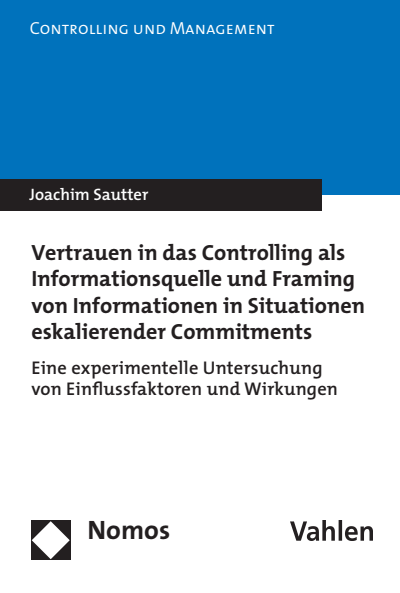
Vertrauen in das Controlling als Informationsquelle und Framing von Informationen in Situationen eskalierender Commitments
Eine experimentelle Untersuchung von Einflussfaktoren und Wirkungen- Autor:innen:
- Reihe:
- Controlling und Management, Band 20
- Verlag:
- 2020
Zusammenfassung
Die Versorgung von Entscheidungsträgern mit Informationen ist eine der wesentlichen Aufgaben des Controllings. Der Autor stellt sich in dieser Arbeit der Aufgabe, die Wirksamkeit der Informationsversorgung durch das Controlling zu verbessern, indem er einerseits die Wirkungen des Vertrauens in das Controlling als Informationsquelle und des Framings von Informationen in Entscheidungssituationen und andererseits auch die Einflussfaktoren des Vertrauens in das Controlling experimentell untersucht.
Publikation durchsuchen
Bibliographische Angaben
- Auflage
- 1/2020
- Copyrightjahr
- 2020
- ISBN-Print
- 978-3-8487-7790-7
- ISBN-Online
- 978-3-7489-2195-0
- Verlag
- Nomos, Baden-Baden
- Reihe
- Controlling und Management
- Band
- 20
- Sprache
- Deutsch
- Seiten
- 270
- Produkttyp
- Monographie
Inhaltsverzeichnis
KapitelSeiten
- Titelei/Inhaltsverzeichnis Kein Zugriff Seiten 1 - 30
- 1.1 Problemstellung Kein Zugriff
- Einflussfaktoren des Vertrauens in das Controlling Kein Zugriff
- Einfluss der Informationsquelle auf die Bewertung und Nutzung von Informationen Kein Zugriff
- Framing in Situationen eskalierender Commitments und mögliche Interaktion des Framings mit dem Vertrauen in die Informationsquelle Kein Zugriff
- 1.3 Zielsetzung, Forschungsfragen und Relevanz Kein Zugriff
- 1.4 Untersuchungsdesign und Aufbau der Arbeit Kein Zugriff
- 2.1.1 Definition und Kennzeichnung des Escalation of Commitment Kein Zugriff
- 2.1.2 Erklärungsansätze und der Entscheidungszyklus eskalierender Commitments Kein Zugriff
- 2.2.1 Definition und Kennzeichnung interpersonellen Vertrauens Kein Zugriff
- 2.2.2 Determinanten des Vertrauens und das Modell interpersonellen Vertrauens von Mayer, Davis und Schoorman Kein Zugriff
- 2.3.1 Definition und Kennzeichnung des Framings Kein Zugriff
- 2.3.2 Framing im Escalation of Commitment Kein Zugriff
- 2.4 Herleitung des konzeptionellen Bezugsrahmens Kein Zugriff
- 2.5.1 Einflussfaktoren des Vertrauens in Situationen eskalierender Commitments Kein Zugriff
- 2.5.2 Einflüsse des Vertrauens und des Framings auf die Eskalationstendenz Kein Zugriff
- 2.5.3 Zusammenfassung der Forschungshypothesen und Forschungsmodell Kein Zugriff
- 2.6.1 Diskussion möglicher Forschungsmethoden Kein Zugriff
- 2.6.2 Gütekriterien experimenteller Untersuchungen Kein Zugriff
- 3.1 Vorgehen bei den Faktoren- und Reliabilitätsanalysen Kein Zugriff
- 3.2.1.1 Operationalisierung Kein Zugriff
- 3.2.1.2 Faktoren- und Reliabilitätsanalysen Kein Zugriff
- 3.2.2 Framing der Information Kein Zugriff
- 3.3.1.1 Operationalisierung Kein Zugriff
- 3.3.1.2 Faktoren- und Reliabilitätsanalysen Kein Zugriff
- 3.3.2.1 Operationalisierung Kein Zugriff
- 3.3.2.2 Faktoren- und Reliabilitätsanalysen Kein Zugriff
- 3.3.3.1 Operationalisierung Kein Zugriff
- 3.3.3.2 Faktoren- und Reliabilitätsanalyse Kein Zugriff
- 3.3.4.1 Operationalisierung Kein Zugriff
- 3.3.4.2 Faktoren- und Reliabilitätsanalyse Kein Zugriff
- 3.3.5.1 Operationalisierung Kein Zugriff
- 3.3.5.2 Faktoren- und Reliabilitätsanalyse Kein Zugriff
- 3.3.6 Eskalationstendenz Kein Zugriff
- 3.3.7 Risikoneigung Kein Zugriff
- 4.1.1.1 Grundlagen der Varianzanalyse (ohne und mit Messwiederholung) Kein Zugriff
- 4.1.1.2 Prämissen der Varianzanalyse (ohne und mit Messwiederholung) Kein Zugriff
- 4.1.2.1 Grundlagen der regressionsbasierten Moderations- und Mediationsanalyse Kein Zugriff
- 4.1.2.2 Prämissen der regressionsbasierten Moderations- und Mediationsanalyse Kein Zugriff
- 4.2.1.1 Zielsetzung und grundlegende Informationen zu Aufbau und Durchführung Kein Zugriff
- 4.2.1.2 Ablauf des Experimentes Kein Zugriff
- 4.2.2.1 Teilnehmer des ersten Experimentes Kein Zugriff
- 4.2.2.2 Prüfung der Manipulation von Fähigkeit, Wohlwollen und Integrität Kein Zugriff
- 4.2.2.3 Einflüsse der wahrgenommenen Vertrauenswürdigkeit und derer Determinanten auf das Vertrauen Kein Zugriff
- Einfluss der Vertrauensneigung auf die wahrgenommene Vertrauenswürdigkeit Kein Zugriff
- Einfluss der Vertrauensneigung auf das Vertrauen Kein Zugriff
- 4.2.3 Zusammenfassende Prüfung der Forschungshypothesen und Diskussion der Ergebnisse des ersten Experimentes Kein Zugriff
- 4.3.1.1 Zielsetzung und grundlegende Informationen zu Aufbau und Durchführung Kein Zugriff
- 4.3.1.2 Ablauf des Experimentes Kein Zugriff
- 4.3.2.1 Teilnehmer des zweiten Experimentes Kein Zugriff
- 4.3.2.2 Einflussfaktoren des Vertrauens Kein Zugriff
- 4.3.2.3 Einflüsse von Vertrauen und Framing auf die Eskalationstendenz Kein Zugriff
- 4.3.3 Zusammenfassende Prüfung der Forschungshypothesen und Diskussion der Ergebnisse des zweiten Experimentes Kein Zugriff
- 5.1 Zusammenfassung der Erkenntnisse anhand der Forschungsfragen Kein Zugriff
- 5.2.1 Implikationen für die Entwicklung von Vertrauen in Controller Kein Zugriff
- 5.2.2 Implikationen für die Informationsbereitstellung zur Entscheidungsunterstützung Kein Zugriff
- 5.3 Limitationen und Ansatzpunkte für weitere Forschung Kein Zugriff
- 5.4 Fazit Kein Zugriff
- Bitte stellen Sie sich folgende Situation vor: Kein Zugriff
- Im Jahr 2016: Kein Zugriff
- Im Jahr 2017: Kein Zugriff
- Literaturverzeichnis Kein Zugriff Seiten 257 - 270
Literaturverzeichnis (193 Einträge)
Es wurden keine Treffer gefunden. Versuchen Sie einen anderen Begriff.
- Aguinis, Herman/Bradley, Kyle J. (2014), Best practice recommendations for designing and implementing experimental vignette methodology studies, in: Organizational Research Methods, Vol. 17, 2014 (4), S. 351–371. Google Scholar öffnen DOI: 10.5771/9783748921950
- Ajzen, Icek (1991), The theory of planned behavior, in: Organizational Behavior and Human Decision Processes, Vol. 50, 1991 (2), S. 179–211. Google Scholar öffnen DOI: 10.5771/9783748921950
- Ajzen, Icek (2002), Perceived behavioral control, self-efficacy, locus of control, and the theory of planned behavior, in: Journal of Applied Social Psychology, Vol. 32, 2002 (4), S. 665–683. Google Scholar öffnen DOI: 10.5771/9783748921950
- Alarcon, Gene M./Lyons, Joseph B./Christensen, James C. (2016), The effect of propensity to trust and familiarity on perceptions of trustworthiness over time, in: Personality and Individual Differences, Vol. 94, 2016, S. 309–315. Google Scholar öffnen DOI: 10.5771/9783748921950
- Alexander, Svatopluk/Fahn, Sven/Schäfer, Marisa/Vink, Daniel/Pedell, Burkhard/Sautter, Joachim (2017), SAP® S/4HANA Finance – ein Akzelerator für die digitale Transformation im Finanzbereich?, in: Controlling, 29. Jg., 2017K, S. 91–94. Google Scholar öffnen DOI: 10.5771/9783748921950
- Appelman, Alyssa/Sundar, S. Shyam (2016), Measuring message credibility: Construction and validation of an exclusive scale, in: Journalism & Mass Communication Quarterly, Vol. 93, 2016 (1), S. 59–79. Google Scholar öffnen DOI: 10.5771/9783748921950
- Arkes, Hal R./Blumer, Catherine (1985), The psychology of sunk cost, in: Organizational Behavior and Human Decision Processes, Vol. 35, 1985 (1), S. 124–140. Google Scholar öffnen DOI: 10.5771/9783748921950
- Armitage, Christopher J./Conner, Mark (1999), Distinguishing perceptions of control from self-efficacy: Predicting consumption of a low-fat diet using the Theory of Planned Behavior, in: Journal of Applied Social Psychology, Vol. 29, 1999 (1), S. 72–90. Google Scholar öffnen DOI: 10.5771/9783748921950
- Atzmüller, Christiane/Steiner, Peter M. (2010), Experimental vignette studies in survey research, in: Methodology, Vol. 6, 2010 (3), S. 128–138. Google Scholar öffnen DOI: 10.5771/9783748921950
- Aubert, Benoit A./Kelsey, Barbara L. (2003), Further understanding of trust and performance in virtual teams, in: Small Group Research, Vol. 34, 2003 (5), S. 575–618. Google Scholar öffnen DOI: 10.5771/9783748921950
- Auspurg, Katrin/Hinz, Thomas/Liebig, Stefan (2009), Komplexität von Vignetten, Lerneffekte und Plausibilität im Faktoriellen Survey, in: Methoden, Daten, Analysen, 3. Jg., 2009 (1), S. 59–96. Google Scholar öffnen DOI: 10.5771/9783748921950
- Backhaus, Klaus/Erichson, Bernd/Plinke, Wulff/Weiber, Rolf (2018), Multivariate Analysemethoden: Eine anwendungsorientierte Einführung, 15. Aufl., Berlin. Google Scholar öffnen DOI: 10.5771/9783748921950
- Backhaus, Klaus/Erichson, Bernd/Weiber, Rolf (2015), Fortgeschrittene Multivariate Analysemethoden: Eine anwendungsorientierte Einführung, 3. Aufl., Berlin, Heidelberg. Google Scholar öffnen DOI: 10.5771/9783748921950
- Baird, Inga Skromme/Thomas, Howard (1985), Toward a contingency model of strategic risk taking, in: Academy of Management Review, Vol. 10, 1985 (2), S. 230–243. Google Scholar öffnen DOI: 10.5771/9783748921950
- Baldvinsdottir, Gudrun/Hagberg, Andreas/Johansson, Inga‐Lill/Jonäll, Kristina/Marton, Jan (2011), Accounting research and trust: A literature review, in: Qualitative Research in Accounting & Management, Vol. 8, 2011 (4), S. 382–424. Google Scholar öffnen DOI: 10.5771/9783748921950
- Baron, Reuben M./Kenny, David A. (1986), The moderator–mediator variable distinction in social psychological research: Conceptual, strategic, and statistical considerations, in: Journal of Personality and Social Psychology, Vol. 51, 1986 (6), S. 1173–1182. Google Scholar öffnen DOI: 10.5771/9783748921950
- Bateman, Thomas S./Zeithaml, Carl P. (1989), The psychological context of strategic decisions: A model and convergent experimental findings, in: Strategic Management Journal, Vol. 10, 1989 (1), S. 59–74. Google Scholar öffnen DOI: 10.5771/9783748921950
- Bazerman, Max H./Giuliano, Toni/Appelman, Alan (1984), Escalation of commitment in individual and group decision making, in: Organizational Behavior and Human Performance, Vol. 33, 1984 (2), S. 141–152. Google Scholar öffnen DOI: 10.5771/9783748921950
- Becerra, Manuel/Gupta, Anil K. (2003), Perceived trustworthiness within the organization: The moderating impact of communication frequency on trustor and trustee effects, in: Organization Science, Vol. 14, 2003 (1), S. 32–44. Google Scholar öffnen DOI: 10.5771/9783748921950
- Becerra, Manuel/Lunnan, Randi/Huemer, Lars (2008), Trustworthiness, risk, and the transfer of tacit and explicit knowledge between alliance partners, in: Journal of Management Studies, Vol. 45, 2008 (4), S. 691–713. Google Scholar öffnen DOI: 10.5771/9783748921950
- Berkovits, Ilona/Hancock, Gregory R./Nevitt, Jonathan (2000), Bootstrap resampling approaches for repeated measure designs: Relative robustness to sphericity and normality violations, in: Educational and Psychological Measurement, Vol. 60, 2000 (6), S. 877–892. Google Scholar öffnen DOI: 10.5771/9783748921950
- Bigley, Gregory A./Pearce, Jone L. (1998), Straining for shared meaning in organization science: Problems of trust and distrust, in: Academy of Management Review, Vol. 23, 1998 (3), S. 405–421. Google Scholar öffnen DOI: 10.5771/9783748921950
- Boettcher, William A./Cobb, Michael D. (2009), “Don’t let them die in vain”: Casualty frames and public tolerance for escalating commitment in Iraq, in: Journal of Conflict Resolution, Vol. 53, 2009 (5), S. 677–697. Google Scholar öffnen DOI: 10.5771/9783748921950
- Bonner, Sarah E. (2008), Judgment and decision making in accounting, Upper Saddle River, New Jersey. Google Scholar öffnen DOI: 10.5771/9783748921950
- Boon, Susan D./Holmes, John G. (1991), The dynamics of interpersonal trust: resolving uncertainty in the face of risk, in: Hinde, Robert A./Groebel, Jo (Hrsg.), Cooperation and prosocial behaviour, 1991, Cambridge. Google Scholar öffnen DOI: 10.5771/9783748921950
- Brockner, Joel (1992), The escalation of commitment to a failing course of action: Toward theoretical progress, in: Academy of Management Review, Vol. 17, 1992 (1), S. 39–61. Google Scholar öffnen DOI: 10.5771/9783748921950
- Burt, Jan/Hampton, Clark (2018), Moderation and mediation in behavioural accounting research, in: Libby, Theresa/Thorne, Linda (Hrsg.), The Routledge companion to behavioral accounting research, 2018, London, S. 373–387. Google Scholar öffnen DOI: 10.5771/9783748921950
- Butler, John K. (1991), Toward understanding and measuring conditions of trust: Evolution of a conditions of trust inventory, in: Journal of Management, Vol. 17, 1991 (3), S. 643–663. Google Scholar öffnen DOI: 10.5771/9783748921950
- Camerer, Colin F./Weber, Roberto A. (1999), The econometrics and behavioral economics of escalation of commitment: A re-examination of Staw and Hoang’s NBA data, in: Journal of Economic Behavior & Organization, Vol. 39, 1999 (1), S. 59–82. Google Scholar öffnen DOI: 10.5771/9783748921950
- Campbell, Donald Thomas/Stanley, Julian Cecil (1963), Experimental and quasi-experimental designs for research, Boston. Google Scholar öffnen DOI: 10.5771/9783748921950
- Castaldo, Sandro/Premazzi, Katia/Zerbini, Fabrizio (2010), The meaning(s) of trust. A content analysis on the diverse conceptualizations of trust in scholarly research on business relationships, in: Journal of Business Ethics, Vol. 96, 2010 (4), S. 657–668. Google Scholar öffnen DOI: 10.5771/9783748921950
- Chong, Vincent K./Ferdiansah, Irdam (2011), The effect of trust-in-superior and truthfulness on budgetary slack: An experimental investigation, in: Advances in Management Accounting, Vol. 19, 2011, S. 55–73. Google Scholar öffnen DOI: 10.5771/9783748921950
- Chow, Chee W./Harrison, Paul/Lindquist, Timothy/Wu, Anne (1997), Escalating commitment to unprofitable projects: Replication and cross-cultural extension, in: Management Accounting Research, Vol. 8, 1997 (3), S. 347–361. Google Scholar öffnen DOI: 10.5771/9783748921950
- Chung, Chung Joo/Kim, Hyunjung/Kim, Jang Hyun (2010), An anatomy of the credibility of online newspapers, in: Online Information Review, Vol. 34, 2010 (5), S. 669–685. Google Scholar öffnen DOI: 10.5771/9783748921950
- Church, Bryan K./Ackert, Lucy F. (2018), Experimental economics: A primer for accounting researchers, in: Libby, Theresa/Thorne, Linda (Hrsg.), The Routledge companion to behavioral accounting research, 2018, London, S. 193–212. Google Scholar öffnen DOI: 10.5771/9783748921950
- Coletti, Angela L./Sedatole, Karen L./Towry, Kristy L. (2005), The effect of control systems on trust and cooperation in collaborative environments, in: The Accounting Review, Vol. 80, 2005 (2), S. 477–500. Google Scholar öffnen DOI: 10.5771/9783748921950
- Colquitt, Jason A./Rodell, Jessica B. (2011), Justice, trust, and trustworthiness: A longitudinal analysis integrating three theoretical perspectives, in: Academy of Management Journal, Vol. 54, 2011 (6), S. 1183–1206. Google Scholar öffnen DOI: 10.5771/9783748921950
- Colquitt, Jason A./Scott, Brent A./LePine, Jeffrey A. (2007), Trust, trustworthiness, and trust propensity: A meta-analytic test of their unique relationships with risk taking and job performance, in: Journal of Applied Psychology, Vol. 92, 2007 (4), S. 909–927. Google Scholar öffnen DOI: 10.5771/9783748921950
- Costa, Ana Cristina (2003), Work team trust and effectiveness, in: Personnel Review, Vol. 32, 2003 (5), S. 605–622. Google Scholar öffnen DOI: 10.5771/9783748921950
- Cuellar, Michael J./Keil, Mark/Johnson, Roy D. (2006), The deaf effect response to bad news reporting in information systems projects, in: e-Service Journal, Vol. 5, 2006 (1), S. 75–97. Google Scholar öffnen DOI: 10.5771/9783748921950
- Curseu, Petru Lucian/Schruijer, Sandra G. L./Fodor, Oana C. (2016), Decision rules, escalation of commitment and sensitivity to framing in group decision-making, in: Management Decision, Vol. 54, 2016 (7), S. 1649–1668. Google Scholar öffnen DOI: 10.5771/9783748921950
- Davis, James H./Schoorman, F. David/Mayer, Roger C./Tan, Hwee Hoon (2000), The trusted general manager and business unit performance: Empirical evidence of a competitive advantage, in: Strategic Management Journal, Vol. 21, 2000 (5), S. 563–576. Google Scholar öffnen DOI: 10.5771/9783748921950
- Davis, Mark A./Bobko, Philip (1986), Contextual effects on escalation processes in public sector decision making, in: Organizational Behavior and Human Decision Processes, Vol. 37, 1986 (1), S. 121–138. Google Scholar öffnen DOI: 10.5771/9783748921950
- Dennis, Alan R. (1996), Information exchange and use in group decision making: You can lead a group to information, but you can't make it think, in: MIS Quarterly, Vol. 20, 1996 (4), S. 433–457. Google Scholar öffnen DOI: 10.5771/9783748921950
- Dennis, Alan R./Robert, Lionel P./Curtis, Aaron M./Kowalczyk, Stacy T./Hasty, Bryan K. (2012), Trust is in the eye of the beholder: A vignette study of postevent behavioral controls' effects on individual trust in virtual teams, in: Information Systems Research, Vol. 23, 2012 (2), S. 546–558. Google Scholar öffnen DOI: 10.5771/9783748921950
- Dietz, Graham/Den Hartog, Deanne N. (2006), Measuring trust inside organisations, in: Personnel Review, Vol. 35, 2006 (5), S. 557–588. Google Scholar öffnen DOI: 10.5771/9783748921950
- Döring, Nicola/Bortz, Jürgen (2016), Forschungsmethoden und Evaluation in den Sozial- und Humanwissenschaften, 5. Aufl., Berlin, Heidelberg. Google Scholar öffnen DOI: 10.5771/9783748921950
- Dusenbury, Richard (1994), The effect of prepayment position on individual taxpayers' preferences for risky tax-filing options, in: Journal of the American Taxation Association, Vol. 16, 1994 (1), S. 1–16. Google Scholar öffnen DOI: 10.5771/9783748921950
- Eisinga, Rob/Grotenhuis, Manfred te/Pelzer, Ben (2013), The reliability of a two-item scale: Pearson, Cronbach, or Spearman-Brown?, in: International journal of public health, Vol. 58, 2013 (4), S. 637–642. Google Scholar öffnen DOI: 10.5771/9783748921950
- Erceg-Hurn, David M./Mirosevich, Vikki M. (2008), Modern robust statistical methods: An easy way to maximize the accuracy and power of your research, in: The American psychologist, Vol. 63, 2008 (7), S. 591–601. Google Scholar öffnen DOI: 10.5771/9783748921950
- Eschweiler, Maurice/Evanschitzky, Heiner/Woisetschläger, David (2007), Ein Leitfaden zur Anwendung varianzanalytisch ausgerichteter Laborexperimente, in: WiSt - Wirtschaftswissenschaftliches Studium, 36. Jg., 2007 (12), S. 546–554. Google Scholar öffnen DOI: 10.5771/9783748921950
- Fabrigar, Leandre R./Wegener, Duane T./MacCallum, Robert C./Strahan, Erin J. (1999), Evaluating the use of exploratory factor analysis in psychological research, in: Psychological Methods, Vol. 4, 1999 (3), S. 272–299. Google Scholar öffnen DOI: 10.5771/9783748921950
- Fehrenbacher, Dennis D. (2013), Design of incentive systems: Experimental approach to incentive and sorting effects, Heidelberg u.a. Google Scholar öffnen DOI: 10.5771/9783748921950
- Fehrenbacher, Dennis D./Kaplan, Steven E./Pedell, Burkhard (2017), The relation between individual characteristics and compensation contract selection, in: Management Accounting Research, Vol. 34, 2017, S. 1–18. Google Scholar öffnen DOI: 10.5771/9783748921950
- Feldman, Gilad/Wong, Kin F. E. (2018), When action-inaction framing leads to higher escalation of commitment: A new inaction-effect perspective on the sunk-cost fallacy, in: Psychological science, Vol. 29, 2018 (4), S. 537–548. Google Scholar öffnen DOI: 10.5771/9783748921950
- Field, Andy (2018), Discovering statistics using IBM SPSS statistics, 5. Aufl., London. Google Scholar öffnen DOI: 10.5771/9783748921950
- Fischer, Daniel (2017), Eskalation und Deeskalation von Commitments: Eine empirische Untersuchung der Rolle erlebter und antizipierter Emotionen, Wiesbaden. Google Scholar öffnen DOI: 10.5771/9783748921950
- Frazier, M. Lance/Johnson, Paul D./Fainshmidt, Stav (2013), Development and validation of a propensity to trust scale, in: Journal of Trust Research, Vol. 3, 2013 (2), S. 76–97. Google Scholar öffnen DOI: 10.5771/9783748921950
- Fulmer, C. Ashley/Gelfand, Michele J. (2012), At what level (and in whom) we trust: Trust across multiple organizational levels, in: Journal of Management, Vol. 38, 2012 (4), S. 1167–1230. Google Scholar öffnen DOI: 10.5771/9783748921950
- Garland, Howard/Newport, Stephanie (1991), Effects of absolute and relative sunk costs on the decision to persist with a course of action, in: Organizational Behavior and Human Decision Processes, Vol. 48, 1991 (1), S. 55–69. Google Scholar öffnen DOI: 10.5771/9783748921950
- Gill, Harjinder/Boies, Kathleen/Finegan, Joan E./McNally, Jeffrey (2005), Antecedents of trust: Establishing a boundary condition for the relation between propensity to trust and intention to trust, in: Journal of Business and Psychology, Vol. 19, 2005 (3), S. 287–302. Google Scholar öffnen DOI: 10.5771/9783748921950
- Gillespie, Nicole (2003), Measuring trust in working relationships: The behavioural trust inventory, paper presented at the Academy of Management Meeting, Seattle. Google Scholar öffnen DOI: 10.5771/9783748921950
- Gillespie, Nicole (2015), Survey measures of trust in organizational contexts: an overview, in: Lyon, Fergus/Möllering, Guido/Saunders, Mark N. K. (Hrsg.), Handbook of research methods on trust, 2. Aufl., 2015, Cheltenham, S. 225–239. Google Scholar öffnen DOI: 10.5771/9783748921950
- Glaser, Wilhelm Robert (1978), Varianzanalyse, Stuttgart. Google Scholar öffnen DOI: 10.5771/9783748921950
- Gomez, Carolina/Sanchez, Juan I. (2013), Cultural boundaries of self-justification and prospect theories in escalation of commitment: A US-Mexico comparison, in: The International Journal of Human Resource Management, Vol. 24, 2013 (13), S. 2646–2656. Google Scholar öffnen DOI: 10.5771/9783748921950
- Govier, Trudy (1994), Is it a jungle out there? Trust, distrust and the construction of social reality, in: Dialogue, Vol. 33, 1994 (2), S. 237–252. Google Scholar öffnen DOI: 10.5771/9783748921950
- Haupenthal, Markus (2017), Die Zusammensetzung von Produktpreisen und der Einfluss von Produktbewertungen, Kapazitäts- und Produktportfolioveränderungen und Akquisitionen auf die Preisentwicklung: Eine empirische Analyse am Beispiel von schottischem Single Malt Whisky. Google Scholar öffnen DOI: 10.5771/9783748921950
- Hayes, Andrew F. (2018), Introduction to mediation, moderation, and conditional process analysis: A regression-based approach, 2. Aufl. Google Scholar öffnen DOI: 10.5771/9783748921950
- He, Xin/Mittal, Vikas (2007), The effect of decision risk and project stage on escalation of commitment, in: Organizational Behavior and Human Decision Processes, Vol. 103, 2007 (2), S. 225–237. Google Scholar öffnen DOI: 10.5771/9783748921950
- Hendrickx, Laurie/Vlek, Charles/Oppewal, Harmen (1989), Relative importance of scenario information and frequency information in the judgment of risk, in: Acta Psychologica, Vol. 72, 1989 (1), S. 41–63. Google Scholar öffnen DOI: 10.5771/9783748921950
- Hertweck, Dieter (2003), Escalating Commitment als Ursache gescheiterter DV-Projekte: Methoden und Werkzeuge zur Deeskalation, Wiesbaden. Google Scholar öffnen DOI: 10.5771/9783748921950
- Heyns, Marita/Rothmann, Sebastiaan (2015), Dimensionality of trust: An analysis of the relations between propensity, trustworthiness and trust, in: SA Journal of Industrial Psychology, Vol. 41, 2015 (1), S. 1–12. Google Scholar öffnen DOI: 10.5771/9783748921950
- Himme, Alexander (2009), Gütekriterien der Messung: Reliabilität, Validität und Generalisierbarkeit, in: Albers, Sönke/Klapper, Daniel/Konradt, Udo/Walter, Achim/Wolf, Joachim (Hrsg.), Methodik der empirischen Forschung, 2009, Wiesbaden, S. 485–500. Google Scholar öffnen DOI: 10.5771/9783748921950
- Holt, Charles A./Laury, Susan (2002), Risk aversion and incentive effects, in: The American Economic Review, Vol. 92, 2002 (5), S. 1644–1655. Google Scholar öffnen DOI: 10.5771/9783748921950
- Homburg, Christian (2017), Marketingmanagement: Strategie – Instrumente – Umsetzung – Unternehmensführung, 6. Aufl., Wiesbaden. Google Scholar öffnen DOI: 10.5771/9783748921950
- Horváth, Péter/Gleich, Ronald/Seiter, Mischa (2015), Controlling, 13. Aufl., München. Google Scholar öffnen DOI: 10.5771/9783748921950
- Hoyer, Wayne D./MacInnis, Deborah J./Pieters, Rik (2013), Consumer behavior, 6. Aufl., Mason, Ohio. Google Scholar öffnen DOI: 10.5771/9783748921950
- Huber, Frank/Meyer, Frederik/Lenzen, Michael (2014), Grundlagen der Varianzanalyse: Konzeption – Durchführung – Auswertung, Wiesbaden. Google Scholar öffnen DOI: 10.5771/9783748921950
- Jani, Arpan (2011), Escalation of commitment in troubled IT projects: Influence of project risk factors and self-efficacy on the perception of risk and the commitment to a failing project, in: International Journal of Project Management, Vol. 29, 2011 (7), S. 934–945. Google Scholar öffnen DOI: 10.5771/9783748921950
- Jarvenpaa, Sirkka L./Knoll, Kathleen/Leidner, Dorothy E. (1998), Is anybody out there? Antecedents of trust in global virtual teams, in: Journal of Management Information Systems, Vol. 14, 1998 (4), S. 29–64. Google Scholar öffnen DOI: 10.5771/9783748921950
- Järvenpää, Marko (2007), Making business partners: A case study on how management accounting culture was changed, in: European Accounting Review, Vol. 16, 2007 (1), S. 99–142. Google Scholar öffnen DOI: 10.5771/9783748921950
- Johansson, Tobias/Wennblom, Gabriella (2017), In female supervisors male subordinates trust!? An experiment on supervisor and subordinate gender and the perceptions of tight control, in: Journal of Management Control, Vol. 28, 2017 (3), S. 321–345. Google Scholar öffnen DOI: 10.5771/9783748921950
- Kahneman, Daniel/Tversky, Amos (1979), Prospect theory: An analysis of decision under risk, in: Econometrica, Vol. 47, 1979 (2), S. 263–291. Google Scholar öffnen DOI: 10.5771/9783748921950
- Kaiser, Henry F. (1960), The application of electronic computers to factor analysis, in: Educational and Psychological Measurement, Vol. 20, 1960 (1), S. 141–151. Google Scholar öffnen DOI: 10.5771/9783748921950
- Kaiser, Henry F./Rice, John (1974), Little Jiffy, Mark IV, in: Educational and Psychological Measurement, Vol. 34, 1974 (1), S. 111–117. Google Scholar öffnen DOI: 10.5771/9783748921950
- Keil, Mark/Mann, Joan/Rai, Arun (2000), Why software projects escalate: an empirical analysis and test of four theoretical models, in: MIS Quarterly, Vol. 24, 2000 (4), S. 631–664. Google Scholar öffnen DOI: 10.5771/9783748921950
- Keil, Mark/Tan, Bernard C. Y./Wei, Kwok-Kee/Saarinen, Timo/Tuunainen, Virpi/Wassenaar, Arjen (2000a), A cross-cultural study on escalation of commitment behavior in software projects, in: MIS Quarterly, Vol. 24, 2000 (2), S. 299–325. Google Scholar öffnen DOI: 10.5771/9783748921950
- Keil, Mark/Wallace, Linda/Turk, Dan/Dixon-Randall, Gayle/Nulden, Urban (2000b), An investigation of risk perception and risk propensity on the decision to continue a software development project, in: Journal of Systems and Software, Vol. 53, 2000 (2), S. 145–157. Google Scholar öffnen DOI: 10.5771/9783748921950
- Koch, Rembert (1994), Betriebliches Berichtswesen als Informations- und Steuerungsinstrument, Frankfurt am Main. Google Scholar öffnen DOI: 10.5771/9783748921950
- Koschate, Nicole (2008), Experimentelle Marktforschung, in: Herrmann, Andreas/Homburg, Christian/Klarmann, Martin (Hrsg.), Handbuch Marktforschung: Methoden – Anwendungen – Praxisbeispiele, 3. Aufl., 2008, Wiesbaden, S. 107–121. Google Scholar öffnen DOI: 10.5771/9783748921950
- Krause, Diana E. (2010), Macht und Vertrauen in Innovationsprozessen, 2. Aufl., Wiesbaden. Google Scholar öffnen DOI: 10.5771/9783748921950
- Kunz, Jennifer/Linder, Stefan (2011), ZP-Stichwort: Vignetten-Experiment, in: Zeitschrift für Planung & Unternehmenssteuerung, 21. Jg., 2011 (2), S. 211–222. Google Scholar öffnen DOI: 10.5771/9783748921950
- Küpper, Hans-Ulrich/Friedl, Gunther/Hofmann, Christian/Hofmann, Yvette/Pedell, Burkhard (2013), Controlling: Konzeption, Aufgaben, Instrumente, 6. Aufl., Stuttgart. Google Scholar öffnen DOI: 10.5771/9783748921950
- Kwong, Jessica Y. Y./Wong, Kin Fai Ellick (2014), Reducing and exaggerating escalation of commitment by option partitioning, in: Journal of Applied Psychology, Vol. 99, 2014 (4), S. 697–712. Google Scholar öffnen DOI: 10.5771/9783748921950
- LaMothe, Ethan G./Bobek, Donna (2018), A modern guide to preliminary data analysis and data cleansing in behavioural accounting research, in: Libby, Theresa/Thorne, Linda (Hrsg.), The Routledge companion to behavioral accounting research, 2018, London, S. 327–348. Google Scholar öffnen DOI: 10.5771/9783748921950
- Lapierre, Laurent M. (2007), Supervisor trustworthiness and subordinates' willingness to provide extra-role efforts, in: Journal of Applied Social Psychology, Vol. 37, 2007 (2), S. 272–297. Google Scholar öffnen DOI: 10.5771/9783748921950
- Laux, Helmut/Gillenkirch, Robert M./Schenk-Mathes, Heike Y. (2014), Entscheidungstheorie, 9. Aufl., Berlin. Google Scholar öffnen DOI: 10.5771/9783748921950
- Lee, Jong Seok/Cuellar, Michael J./Keil, Mark/Johnson, Roy D. (2014), The role of a bad news reporter in information technology project escalation: A deaf effect perspective, in: ACM SIGMIS Database, Vol. 45, 2014 (3), S. 8–29. Google Scholar öffnen DOI: 10.5771/9783748921950
- Levin, Irwin P./Gaeth, Gary J. (1988), How consumers are affected by the framing of attribute information before and after consuming the product, in: Journal of Consumer Research, Vol. 15, 1988 (3), S. 374–378. Google Scholar öffnen DOI: 10.5771/9783748921950
- Levin, Irwin P./Schneider, Sandra L./Gaeth, Gary J. (1998), All frames are not created equal: A typology and critical analysis of framing effects, in: Organizational Behavior and Human Decision Processes, Vol. 76, 1998 (2), S. 149–188. Google Scholar öffnen DOI: 10.5771/9783748921950
- Lewis, J. David/Weigert, Andrew (1985), Trust as a social reality, in: Social Forces, Vol. 63, 1985 (4), S. 967–985. Google Scholar öffnen DOI: 10.5771/9783748921950
- Libby, Robert (1981), Accounting and human information processing: Theory and applications, Englewood Cliffs. Google Scholar öffnen DOI: 10.5771/9783748921950
- Luckett, Peter F./Eggleton, Ian R. C. (1991), Feedback and management accounting: A review of research into behavioural consequences, in: Accounting, Organizations and Society, Vol. 16, 1991 (4), S. 371–394. Google Scholar öffnen DOI: 10.5771/9783748921950
- Lyu, Serena C./Ferrin, Donald L. (2018), Determinants, consequences and functions of interpersonal trust within organizations, in: Searle, Rosalind H./Nienaber, Ann-Marie I./Sitkin, Sim B. (Hrsg.), The Routledge companion to trust, 2018, Abingdon, New York, S. 65–104. Google Scholar öffnen DOI: 10.5771/9783748921950
- MacCallum, Robert C./Zhang, Shaobo/Preacher, Kristopher J./Rucker, Derek D. (2002), On the practice of dichotomization of quantitative variables, in: Psychological Methods, Vol. 7, 2002 (1), S. 19–40. Google Scholar öffnen DOI: 10.5771/9783748921950
- Maccrimmon, Kenneth R./Wehrung, Donald A. (1985), A portfolio of risk measures, in: Theory and Decision, Vol. 19, 1985 (1), S. 1–29. Google Scholar öffnen DOI: 10.5771/9783748921950
- Mackinnon, David P./Lockwood, Chondra M./Williams, Jason (2004), Confidence limits for the indirect effect: Distribution of the product and resampling methods, in: Multivariate Behavioral Research, Vol. 39, 2004 (1), S. 99–128. Google Scholar öffnen DOI: 10.5771/9783748921950
- Mahlendorf, Matthias D. (2008), Eskalation des Commitments bei scheiternden Projekten: Eine empirische Untersuchung kognitiver Eskalationsfaktoren und verhaltenswissenschaftlich basierter Controllingmaßnahmen, 2. Aufl., Vallendar. Google Scholar öffnen DOI: 10.5771/9783748921950
- Mayer, Roger C./Davis, James H. (1999), The effect of the performance appraisal system on trust for management: A field quasi-experiment, in: Journal of Applied Psychology, Vol. 84, 1999 (1), S. 123–136. Google Scholar öffnen DOI: 10.5771/9783748921950
- Mayer, Roger C./Davis, James H./Schoorman, F. David (1995), An integrative model of organizational trust, in: Academy of Management Review, Vol. 20, 1995 (3), S. 709–734. Google Scholar öffnen DOI: 10.5771/9783748921950
- Mayer, Roger C./Gavin, Mark B. (2005), Trust in management and performance: Who minds the shop while the employees watch the boss?, in: Academy of Management Journal, Vol. 48, 2005 (5), S. 874–888. Google Scholar öffnen DOI: 10.5771/9783748921950
- McAllister, D. J. (1995), Affect- and cognition-based trust as foundations for interpersonal cooperation in organizations, in: Academy of Management Journal, Vol. 38, 1995 (1), S. 24–59. Google Scholar öffnen DOI: 10.5771/9783748921950
- McCall, Morgan W./Kaplan, Robert E. (1985), Whatever it takes: Decision makers at work, Englewood Cliffs. Google Scholar öffnen DOI: 10.5771/9783748921950
- McEvily, Bill/Perrone, Vincenzo/Zaheer, Akbar (2003), Trust as an organizing principle, in: Organization Science, Vol. 14, 2003 (1), S. 91–103. Google Scholar öffnen DOI: 10.5771/9783748921950
- McEvily, Bill/Tortoriello, Marco (2011), Measuring trust in organisational research: Review and recommendations, in: Journal of Trust Research, Vol. 1, 2011 (1), S. 23–63. Google Scholar öffnen DOI: 10.5771/9783748921950
- McMillan, Jeffrey J./White, Richard A. (1993), Auditors' belief revisions and evidence search: The effect of hypothesis frame, confirmation bias, and professional skepticism, in: The Accounting Review, Vol. 68, 1993 (3), S. 443–465. Google Scholar öffnen DOI: 10.5771/9783748921950
- McNamara, Gerry/Moon, Henry/Bromiley, Philip (2002), Banking on commitment: Intended and unintended consequences of an organization's attempt to attenuate escalation of commitment, in: Academy of Management Journal, Vol. 45, 2002 (2), S. 443–452. Google Scholar öffnen DOI: 10.5771/9783748921950
- McNamara, Kelly/Dennis, Alan R./Carte, Traci A. (2008), It's the thought that counts: The mediating effects of information processing in virtual team decision making, in: Information Systems Management, Vol. 25, 2008 (1), S. 20–32. Google Scholar öffnen DOI: 10.5771/9783748921950
- Meyerowitz, Beth E./Chaiken, Shelly (1987), The effect of message framing on breast self-examination attitudes, intentions, and behavior, in: Journal of Personality and Social Psychology, Vol. 52, 1987 (3), S. 500–510. Google Scholar öffnen DOI: 10.5771/9783748921950
- Mittal, Vikas/Ross, William T. (1998), The impact of positive and negative affect and issue framing on issue interpretation and risk taking, in: Organizational Behavior and Human Decision Processes, Vol. 76, 1998 (3), S. 298–324. Google Scholar öffnen DOI: 10.5771/9783748921950
- Moorman, Christine/Zaltman, Gerald/Deshpande, Rohit (1992), Relationships between providers and users of market research: The dynamics of trust within and between organizations, in: Journal of Marketing Research, Vol. 29, 1992 (3), S. 314–328. Google Scholar öffnen DOI: 10.5771/9783748921950
- Nakayachi, Kazuya/Watabe, Motoki (2005), Restoring trustworthiness after adverse events: The signaling effects of voluntary “Hostage Posting” on trust, in: Organizational Behavior and Human Decision Processes, Vol. 97, 2005 (1), S. 1–17. Google Scholar öffnen DOI: 10.5771/9783748921950
- Nitzl, Christian (2012), Vertrauen zwischen Manager und Controller: Eine empirische Untersuchung der Einflussfaktoren mithilfe der Partial Least Square (PLS)-Methode, Hamburg. Google Scholar öffnen DOI: 10.5771/9783748921950
- Nitzl, Christian/Hirsch, Bernhard (2013), Die Entstehung von interpersonellem Vertrauen am Beispiel der Manager-Controller-Interaktion, in: Vollmar, Jens/Becker, Roman/Hoffend, Isabella (Hrsg.), Macht des Vertrauens: Perspektiven und aktuelle Herausforderungen im unternehmerischen Kontext, 2013, Wiesbaden, S. 37–51. Google Scholar öffnen DOI: 10.5771/9783748921950
- Nitzl, Christian/Hirsch, Bernhard (2016), The drivers of a superior’s trust formation in his subordinate: The manager–management accountant example, in: Journal of Accounting & Organizational Change, Vol. 12, 2016 (4), S. 472–503. Google Scholar öffnen DOI: 10.5771/9783748921950
- Northcraft, Gregory B./Wolf, Gerrit (1984), Dollars, sense, and sunk costs: A life cycle model of resource allocation decisions, in: Academy of Management Review, Vol. 9, 1984 (2), S. 225–234. Google Scholar öffnen DOI: 10.5771/9783748921950
- Nunnally, Jum C. (1978), Psychometric theory, 2. Aufl., New York, u. a. Google Scholar öffnen DOI: 10.5771/9783748921950
- Parayitam, Satyanarayana/Dooley, Robert S. (2009), The interplay between cognitive- and affective conflict and cognition- and affect-based trust in influencing decision outcomes, in: Journal of Business Research, Vol. 62, 2009 (8), S. 789–796. Google Scholar öffnen DOI: 10.5771/9783748921950
- Patzelt, Holger/Shepherd, Dean A. (2008), The decision to persist with underperforming alliances: The role of trust and control, in: Journal of Management Studies, Vol. 45, 2008 (7), S. 1217–1243. Google Scholar öffnen DOI: 10.5771/9783748921950
- Pavlou, Paul A./Fygenson, Mendel (2006), Understanding and predicting electronic commerce adoption: An extension of the theory of planned behavior, in: MIS Quarterly, Vol. 30, 2006 (1), S. 115–143. Google Scholar öffnen DOI: 10.5771/9783748921950
- Pfeiffer, Felix (2006), Eskalierendes Commitment und präferenzkonsistente Informationsbewertung: Der Umgang mit Expertenmeinungen bei zweifelhaftem Entscheidungserfolg, Göttingen. Google Scholar öffnen DOI: 10.5771/9783748921950
- Pornpitakpan, Chanthika (2004), The persuasiveness of source credibility: A critical review of five decades' evidence, in: Journal of Applied Social Psychology, Vol. 34, 2004 (2), S. 243–281. Google Scholar öffnen DOI: 10.5771/9783748921950
- Preacher, Kristopher J./Hayes, Andrew F. (2004), SPSS and SAS procedures for estimating indirect effects in simple mediation models, in: Behavior Research Methods, Instruments, & Computers, Vol. 36, 2004 (4), S. 717–731. Google Scholar öffnen DOI: 10.5771/9783748921950
- Preacher, Kristopher J./Hayes, Andrew F. (2008), Asymptotic and resampling strategies for assessing and comparing indirect effects in multiple mediator models, in: Behavior Research Methods, Vol. 40, 2008 (3), S. 879–891. Google Scholar öffnen DOI: 10.5771/9783748921950
- Priem, Richard L./Weibel, Antoinette A. (2015), Measuring the decision to trust using metric conjoint analysis, in: Lyon, Fergus/Möllering, Guido/Saunders, Mark N. K. (Hrsg.), Handbook of research methods on trust, 2. Aufl., 2015, Cheltenham, S. 265–278. Google Scholar öffnen DOI: 10.5771/9783748921950
- Rack, Oliver/Christophersen, Timo (2009), Experimente, in: Albers, Sönke/Klapper, Daniel/Konradt, Udo/Walter, Achim/Wolf, Joachim (Hrsg.), Methodik der empirischen Forschung, 2009, Wiesbaden. Google Scholar öffnen DOI: 10.5771/9783748921950
- Rasch, Björn/Friese, Malte/Hofmann, Wilhelm/Naumann, Ewald (2014), Quantitative Methoden 2: Einführung in die Statistik für Psychologen und Sozialwissenschaftler, 4. Aufl., Berlin, Heidelberg. Google Scholar öffnen DOI: 10.5771/9783748921950
- Remus, William (1996), Will behavioral research on managerial decision making generalize to managers?, in: Managerial and Decision Economics, Vol. 17, 1996 (1), S. 93–101. Google Scholar öffnen DOI: 10.5771/9783748921950
- Rhodes, Ryan E./Courneya, Kerry S. (2003), Self-efficacy, controllability and intention in the theory of planned behavior: Measurement redundancy or causal independence?, in: Psychology & Health, Vol. 18, 2003 (1), S. 79–91. Google Scholar öffnen DOI: 10.5771/9783748921950
- Riesenhuber, Maximilian (2006), Die Fehlentscheidung: Ursache und Eskalation, Wiesbaden. Google Scholar öffnen DOI: 10.5771/9783748921950
- Röber, Björn (2018), Escalation of commitment in internationalization processes: The role of bounded rationality in the Uppsala Model, Cham. Google Scholar öffnen DOI: 10.5771/9783748921950
- Robert, Lionel P./Dennis, Alan R./Hung, Yu-Ting Caisy (2009), Individual swift trust and knowledge-based trust in face-to-face and virtual team members, in: Journal of Management Information Systems, Vol. 26, 2009 (2), S. 241–279. Google Scholar öffnen DOI: 10.5771/9783748921950
- Rose, Jacob M./Roberts, F. Douglas/Rose, Anna M. (2004), Affective responses to financial data and multimedia: The effects of information load and cognitive load, in: International Journal of Accounting Information Systems, Vol. 5, 2004 (1), S. 5–24. Google Scholar öffnen DOI: 10.5771/9783748921950
- Ross, Jerry/Staw, Barry M. (1993), Organizational escalation and exit: Lessons from the shoreham nuclear power plant, in: Academy of Management Journal, Vol. 36, 1993 (4), S. 701–732. Google Scholar öffnen DOI: 10.5771/9783748921950
- Rousseau, Denise M./Sitkin, Sim B./Burt, Ronald S./Camerer, Colin (1998), Not so different after all: A cross-discipline view of trust, in: Academy of Management Review, Vol. 23, 1998 (3), S. 393–404. Google Scholar öffnen DOI: 10.5771/9783748921950
- Rutledge, Robert W. (1994), Escalation of commitment in groups and the moderating effects of information framing, in: Management Research News, Vol. 17, 19941/2, S. 12–24. Google Scholar öffnen DOI: 10.5771/9783748921950
- Rutledge, Robert W./Harrell, Adrian (1993), Escalating commitment to an ongoing project: The effects of responsibility and framing of accounting information, in: International Journal of Management, Vol. 10, 1993 (3), S. 300–313. Google Scholar öffnen DOI: 10.5771/9783748921950
- Salter, Stephen B./Lewis, Philip A./Juarez Valdes, Luis Felipe (2004), Aqui No Se Habla Agencia. An examination of the impact of adverse selection and framing in decision-making: A US/Mexico comparison, in: Journal of International Financial Management and Accounting, Vol. 15, 2004 (2), S. 93–117. Google Scholar öffnen DOI: 10.5771/9783748921950
- Salter, Stephen B./Sharp, David J. (2001), Agency effects and escalation of commitment: Do small national culture differences matter?, in: The International Journal of Accounting, Vol. 36, 2001 (1), S. 33–45. Google Scholar öffnen DOI: 10.5771/9783748921950
- Salter, Stephen B./Sharp, David J./Chen, Yasheng (2013), The moderating effects of national culture on escalation of commitment, in: Advances in Accounting, Vol. 29, 2013 (1), S. 161–169. Google Scholar öffnen DOI: 10.5771/9783748921950
- Sautter, Joachim (2016), Budgetary Slack, in: Controlling, 28. Jg., 20164/5, S. 281–282. Google Scholar öffnen DOI: 10.5771/9783748921950
- Schäffer, Utz/Steiners, Daniel (2004), Zur Nutzung von Controllinginformationen, in: Zeitschrift für Planung & Unternehmenssteuerung, 15. Jg., 2004 (4), S. 377–404. Google Scholar öffnen DOI: 10.5771/9783748921950
- Schäffer, Utz/Weber, Jürgen (2012), Zukunftsthemen des Controllings, in: Controlling, 24. Jg., 2012 (2), S. 78–84. Google Scholar öffnen DOI: 10.5771/9783748921950
- Schepanski, A./Shearer, T. (1995), A prospect theory account of the income tax withholding phenomenon, in: Organizational Behavior and Human Decision Processes, Vol. 63, 1995 (2), S. 174–186. Google Scholar öffnen DOI: 10.5771/9783748921950
- Schildberg-Hörisch, Hannah (2018), Are risk preferences stable?, in: Journal of Economic Perspectives, Vol. 32, 2018 (2), S. 135–154. Google Scholar öffnen DOI: 10.5771/9783748921950
- Schildmeyer, Gerrit/Horváth, Péter (2018), Weiterentwicklung des Planungssystems bei Bayer, in: Controlling, 30. Jg., 2018 (6), S. 72–76. Google Scholar öffnen DOI: 10.5771/9783748921950
- Schmidt, Jeffrey B./Calantone, Roger J. (2002), Escalation of commitment during new product development, in: Journal of the Academy of Marketing Science, Vol. 30, 2002 (2), S. 103–118. Google Scholar öffnen DOI: 10.5771/9783748921950
- Schoorman, F. David/Mayer, Roger C./Davis, James H. (2007), An integrative model of organizational trust: Past, present, and future, in: Academy of Management Review, Vol. 32, 2007 (2), S. 344–354. Google Scholar öffnen DOI: 10.5771/9783748921950
- Schoorman, F. David/Mayer, Roger C./Davis, James H. (2016), Empowerment in veterinary clinics: The role of trust in delegation, in: Journal of Trust Research, Vol. 6, 2016 (1), S. 76–90. Google Scholar öffnen DOI: 10.5771/9783748921950
- Schoorman, F. David/Mayer, Roger C./Douglas, Christina A./Hetrick, Christopher T. (1994), Escalation of commitment and the framing effect: An empirical investigation, in: Journal of Applied Social Psychology, Vol. 24, 1994 (6), S. 509–528. Google Scholar öffnen DOI: 10.5771/9783748921950
- Schultze, Thomas/Pfeiffer, Felix/Schulz-Hardt, Stefan (2012), Biased information processing in the escalation paradigm: Information search and information evaluation as potential mediators of escalating commitment, in: Journal of Applied Psychology, Vol. 97, 2012 (1), S. 16–32. Google Scholar öffnen DOI: 10.5771/9783748921950
- Schultze, Thomas/Schulz-Hardt, Stefan (2015), The impact of biased information and corresponding meta-information on escalating commitment, in: Journal of Economic Psychology, Vol. 49, 2015, S. 108–119. Google Scholar öffnen DOI: 10.5771/9783748921950
- Sharp, David J./Salter, Stephen B. (1997), Project escalation and sunk costs: A test of the international generalizability of agency and prospect theories, in: Journal of International Business Studies, Vol. 28, 1997 (1), S. 101–121. Google Scholar öffnen DOI: 10.5771/9783748921950
- Shooter, Wynn/Paisley, Karen/Sibthorp, Jim (2012), Fostering trust in outdoor leaders: The role of personal attributes, in: Journal of Experiential Education, Vol. 35, 2012 (1), S. 222–237. Google Scholar öffnen DOI: 10.5771/9783748921950
- Sitkin, Sim B./Weingart, Laurie R. (1995), Determinants of risky decision-making behavior: A test of the mediating role of risk perceptions and propensity, in: Academy of Management Journal, Vol. 38, 1995 (6), S. 1573–1592. Google Scholar öffnen DOI: 10.5771/9783748921950
- Skarlicki, Daniel P./Turner, R. Anthony (2014), Unfairness begets unfairness: Victim derogation bias in employee ratings, in: Organizational Behavior and Human Decision Processes, Vol. 124, 2014 (1), S. 34–46. Google Scholar öffnen DOI: 10.5771/9783748921950
- Sleesman, Dustin J./Conlon, Donald E./McNamara, Gerry/Miles, Jonathan E. (2012), Cleaning up the big muddy: A meta-analytic review of the determinants of escalation of commitment, in: Academy of Management Journal, Vol. 55, 2012 (3), S. 541–562. Google Scholar öffnen DOI: 10.5771/9783748921950
- Slovic, Paul (1986), Informing and educating the public about risk, in: Risk Analysis, Vol. 6, 1986 (4), S. 403–415. Google Scholar öffnen DOI: 10.5771/9783748921950
- Slovic, Paul (1987), Perception of risk, in: Science, Vol. 236, 1987 (4799), S. 280–285. Google Scholar öffnen DOI: 10.5771/9783748921950
- Späth, Julia F. (2008), Interpersonelles Vertrauen in Organisationen: Eine empirische Untersuchung der Einflussfaktoren und Verhaltenswirkungen, Frankfurt am Main. Google Scholar öffnen DOI: 10.5771/9783748921950
- Staw, Barry M. (1976), Knee-deep in the big muddy: A study of escalating commitment to a chosen course of action, in: Organizational Behavior and Human Performance, Vol. 16, 1976 (1), S. 27–44. Google Scholar öffnen DOI: 10.5771/9783748921950
- Staw, Barry M. (1981), The escalation of commitment to a course of action, in: Academy of Management Review, Vol. 6, 1981 (4), S. 577–587. Google Scholar öffnen DOI: 10.5771/9783748921950
- Staw, Barry M./Ross, Jerry (1987), Behavior in escalation situations: antecedents, prototypes, and solutions, in: Research in Organizational Behavior, Vol. 9, 1987, S. 39–78. Google Scholar öffnen DOI: 10.5771/9783748921950
- Staw, Barry M./Ross, Jerry (1989), Understanding behavior in escalation situations, in: Science, Vol. 246, 1989 (4927), S. 216–220. Google Scholar öffnen DOI: 10.5771/9783748921950
- Steinkühler, Dominik/Mahlendorf, Matthias D./Brettel, Malte (2014), How self-justification indirectly drives escalation of commitment, in: Schmalenbach Business Review, Vol. 66, 2014 (2), S. 191–222. Google Scholar öffnen DOI: 10.5771/9783748921950
- Tank, Ann Katarina (2017), Einflussfaktoren und Wirkungen neuronaler Prozesse der Informationsgewichtung, Informationsaufnahme und Informationsverarbeitung in ökonomischen Entscheidungssituationen: Eine Untersuchung mittels funktioneller Magnetresonanztomographie (fMRT), Baden-Baden. Google Scholar öffnen DOI: 10.5771/9783748921950
- Taschner, Andreas (2015), Management Reporting und Behavioral Accounting: Verhaltenswirkungen des Berichtswesens im Unternehmen, Wiesbaden. Google Scholar öffnen DOI: 10.5771/9783748921950
- Taylor, Shirley/Todd, Peter A. (1995), Understanding information technology usage: A test of competing models, in: Information Systems Research, Vol. 6, 1995 (2), S. 144–176. Google Scholar öffnen DOI: 10.5771/9783748921950
- Trumbo, Craig W./McComas, Katherine A. (2003), The function of credibility in information processing for risk perception, in: Risk Analysis, Vol. 23, 2003 (2), S. 343–353. Google Scholar öffnen DOI: 10.5771/9783748921950
- Tversky, Amos/Kahneman, Daniel (1981), The framing of decisions and the psychology of choice, in: Science, Vol. 211, 1981 (4481), S. 453–458. Google Scholar öffnen DOI: 10.5771/9783748921950
- Vlek, Charles/Stallen, Pieter-Jan (1980), Rational and personal aspects of risk, in: Acta Psychologica, Vol. 45, 19801-3, S. 273–300. Google Scholar öffnen DOI: 10.5771/9783748921950
- Walsh, James P. (1995), Managerial and organizational cognition: Notes from a trip down memory lane, in: Organization Science, Vol. 6, 1995 (3), S. 280–321. Google Scholar öffnen DOI: 10.5771/9783748921950
- Wason, Kelly D./Polonsky, Michael J./Hyman, Michael R. (2002), Designing vignette studies in marketing, in: Australasian Marketing Journal (AMJ), Vol. 10, 2002 (3), S. 41–58. Google Scholar öffnen DOI: 10.5771/9783748921950
- Weber, Jürgen/Schäffer, Utz (2016), Einführung in das Controlling, 15. Aufl., Stuttgart. Google Scholar öffnen DOI: 10.5771/9783748921950
- Weiber, Rolf/Mühlhaus, Daniel (2014), Strukturgleichungsmodellierung: Eine anwendungsorientierte Einführung in die Kausalanalyse mit Hilfe von AMOS, SmartPLS und SPSS, 2. Aufl., Berlin, Heidelberg. Google Scholar öffnen DOI: 10.5771/9783748921950
- Williams, Damien J./Noyes, Jan M. (2007), How does our perception of risk influence decision-making? Implications for the design of risk information, in: Theoretical Issues in Ergonomics Science, Vol. 8, 2007 (1), S. 1–35. Google Scholar öffnen DOI: 10.5771/9783748921950
- Williams, Steve/Zainuba, Mohamed/Jackson, Robert (2008), Determinants of managerial risk perceptions and intentions, in: Journal of Management Research, Vol. 8, 2008 (2), S. 59–75. Google Scholar öffnen DOI: 10.5771/9783748921950
- Wong, Kin Fai Ellick (2005), The role of risk in making decisions under escalation situations, in: Applied Psychology, Vol. 54, 2005 (4), S. 584–607. Google Scholar öffnen DOI: 10.5771/9783748921950
- Yakovleva, Maria/Reilly, Richard R./Werko, Robert (2010), Why do we trust? Moving beyond individual to dyadic perceptions, in: Journal of Applied Psychology, Vol. 95, 2010 (1), S. 79–91. Google Scholar öffnen DOI: 10.5771/9783748921950
- Zayer, Eric (2007), Verspätete Projektabbrüche in F&E: Eine verhaltensorientierte Analyse, Wiesbaden. Google Scholar öffnen DOI: 10.5771/9783748921950
- Zhang, Hongchun/van de Walle, Steven/Zhuo, Yue (2016), Does trust in the performance measurement organization influence how public managers use performance information?, in: Public Performance & Management Review, Vol. 40, 2016 (2), S. 409–430. Google Scholar öffnen DOI: 10.5771/9783748921950
- Zhao, Xinshu/Lynch, John G./Chen, Qimei (2010), Reconsidering Baron and Kenny: Myths and truths about mediation analysis, in: Journal of Consumer Research, Vol. 37, 2010 (2), S. 197–206. Google Scholar öffnen DOI: 10.5771/9783748921950
- Zikmund, William G./Babin, Barry J./Carr, Jon C./Griffin, Mitch (2013), Business research methods, 9. Aufl., Mason, Ohio. Google Scholar öffnen DOI: 10.5771/9783748921950