, um zu prüfen, ob Sie einen Vollzugriff auf diese Publikation haben.
Sammelband Kein Zugriff
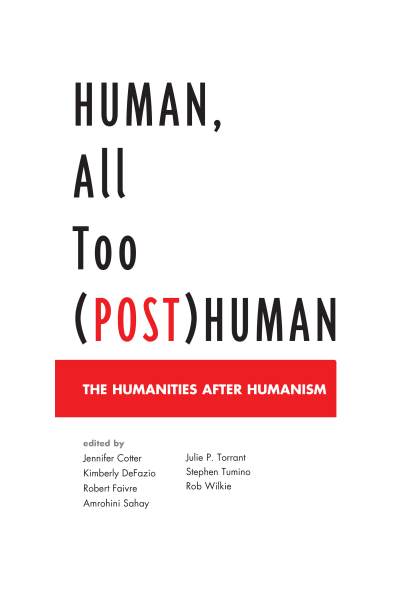
Human, All Too (Post)Human
The Humanities after Humanism
Herausgeber:innen:
| | | | | |
Verlag:
2016
Zusammenfassung
The contemporary has marked itself off from modernity by questioning its humanism that centers the world around the human as the moral subject of free will and self-determination, the bearer of universal essence that is the basis of human rights. Modernism normalizes humanism through language as referential, a set of interrelated signs that correspond to the empirical reality outside it. Humanist modernity, in other words, is seen in the contemporary as a regime that, by separating the human from the non-human and insisting on language as correspondence, not only fails to engage the emerging forms of social relations in which the boundaries of human and machine are fading but is also indifferent to the difference between the “other”’s life and other lives. Human, All Too (Post)Human: The Humanities after Humanism argues that the Nietzschean tendencies that provide the philosophical boundaries of post-humanism do not undo humanism but reform it, constructing a parallel discourse that saves humanism from itself.
Grounded in materialist analysis of social life, Human, All Too (Post)Human argues that humanism and post-humanism are cultural discourses that normalize different stages of capitalism—analog and digital capitalism. They are different orders of property relations. The question, the writers argue, is not humanism or post-humanism, namely cultural representations, but the material relations of production that are centered on wage labor. Language, free will, or human rights are not the issues since “Right can never be higher than the economic structure of society and its cultural development conditioned thereby.” The question that shapes all questions, in Human, All Too (Post)Human is freedom from (wage) labor.
Schlagworte
Publikation durchsuchen
Bibliographische Angaben
Auflage
1/2016
Copyrightjahr
2016
ISBN-Print
978-1-4985-0573-4
ISBN-Online
978-1-4985-0574-1
Verlag
Lexington, Lanham
Sprache
Englisch
Seiten
244
Produkttyp
Sammelband
Inhaltsverzeichnis
KapitelSeiten
Table of Contents Kein Zugriff
Acknowledgments Kein Zugriff
Introduction Kein Zugriff Seiten 1 - 12
Chapter One: The New Class Common-Sense Kein Zugriff
Chapter Two: Loving Transnationalism Kein Zugriff
Chapter Three: “Theory Too Becomes A Material Force” Kein Zugriff
Chapter Four: Mind over Matter and Other Posthumanist Feminist Tales Kein Zugriff
Chapter Five: Ghostly Objectivity Kein Zugriff
Chapter Six: The Commune, NOT the Common Kein Zugriff
Chapter Seven: Posthumanist Metaphysics and the Necessity of Dialectics Kein Zugriff
Chapter Eight: The “Event-al” Logic of Disaster and “Left” Extinctionism Kein Zugriff
Index Kein Zugriff Seiten 237 - 242
About the Contributors Kein Zugriff Seiten 243 - 244
Ähnliche Veröffentlichungen
aus dem Schwerpunkt "Soziologie allgemein"
Sammelband Vollzugriff
Christoph T. Burmeister, Thorsten Hertel, Sophia Richter