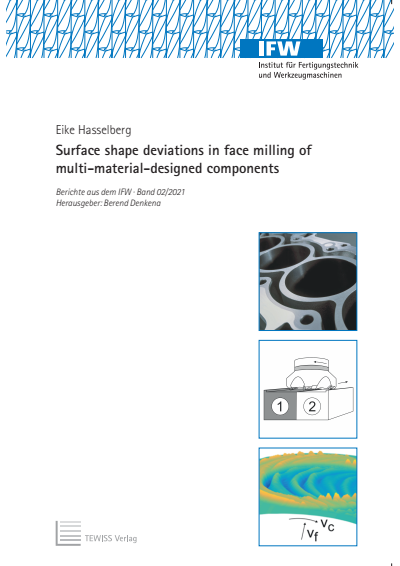
Multi-material-designed components allow engineers to compose each zone of a component with the most qualified material in accordance with local demands. In machining of multi-material-designed components new challenges arise. Significant shape deviations of workpiece surfaces occur that do not occur in machining of single materials. Surface shape deviations are an important quality aspect concerning further assembly of parts or functionality in service. The identification of causes requires the holistic consideration of the interaction between machine tool, cutting tool, workpiece material properties, process parameters and process strategy. Characteristic shape deviations are identified in dependence of their cause. The machined surface shape is predicted using mechanical, semi-empirical and numerical models. Surface imperfections are analyzed experimentally. Finally, guidelines for the improvement of the surface quality are compiled to prevent wastage and refining operations.
Schlagworte
Publikation durchsuchen
Bibliographische Angaben
Auflage
1/2021
Copyrightjahr
2021
ISBN-Online
978-3-95900-564-7
Verlag
TEWISS, Garbsen
Reihe
Berichte aus dem IFW
Band
02/2021
Sprache
Deutsch
Seiten
160
Produkttyp
Monographie
Inhaltsverzeichnis
KapitelSeiten
Vorwort Kein Zugriff
Abstract Kein Zugriff
Kurzfassung Kein Zugriff
Table of contents Kein Zugriff
Symbols and abbreviations Kein Zugriff
1 Introduction Kein Zugriff Seiten 1 - 2
2.1 Multi-material-designed components Kein Zugriff
2.2 Machining of multi-material-designed components Kein Zugriff
2.3 Face milling operations Kein Zugriff
2.4 General machinability of polyurethane, aluminum and cast iron Kein Zugriff
2.5 Conclusions on the state of the art Kein Zugriff
3 Objective and approach Kein Zugriff Seiten 37 - 39
4.1 Preliminary machining tests on polyurethane materials Kein Zugriff
4.2 Material properties of workpieces Kein Zugriff
4.3 Specimen size and process strategy Kein Zugriff
5.1 Face milling setup Kein Zugriff
5.2 Compliance of cutting tool Kein Zugriff
5.3 Contour and surface metrology Kein Zugriff
5.4 Chip formation analysis Kein Zugriff
6.1 Identification of characteristic shape deviations Kein Zugriff
6.2 Definition and evaluation of characteristic indicators Kein Zugriff
7.1 Modeling approach Kein Zugriff
7.2 Process force model Kein Zugriff
7.3 Cutting tool deflection model Kein Zugriff
7.4 Surface roughness model Kein Zugriff
7.5 FE analysis of material transition Kein Zugriff
8.1 Surface height difference Kein Zugriff
8.2 Height difference at material joint Kein Zugriff
8.3 Transition waviness Kein Zugriff
8.4 Surface roughness deviation Kein Zugriff
8.5 Surface imperfections Kein Zugriff
8.6 Flatness deviation Kein Zugriff
9.1 Cylinder crankcase machining in analogy Kein Zugriff
9.2 Guidelines for machining of multi-material components Kein Zugriff Seiten 134 - 136
10 Summary and outlook Kein Zugriff Seiten 137 - 139