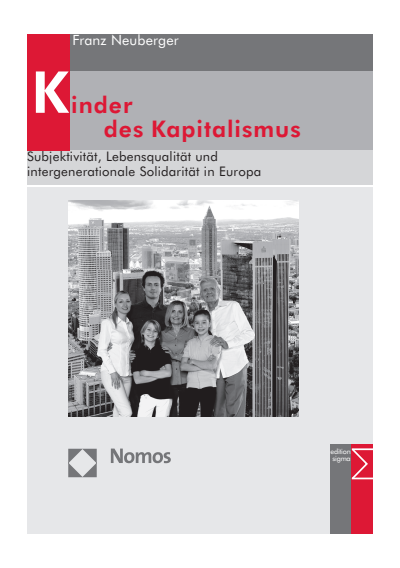
Kinder des Kapitalismus
Subjektivität, Lebensqualität und intergenerationale Solidarität in Europa- Autor:innen:
- Verlag:
- 2015
Zusammenfassung
Grundsätzliche Diskussionen über das „gute Leben“ sind selten geworden – heute erscheint es uns zeitgemäß, das „gute Leben“ als „Lebensqualität“ mit den Methoden der empirischen Sozialforschung zu untersuchen. Neuberger befasst sich in diesem Buch sowohl empirisch als auch theoretisch mit der Frage, welche Rolle die Beziehung zu Kindern und Enkeln für die Lebensqualität der Generation 50 plus in Europa spielt. Mithilfe quantitativer Daten aus 16 europäischen Ländern zeigt er, dass der „Nutzen“ von Kindern und Enkeln nicht nur von der Art der intergenerationalen Beziehungen, sondern auch vom sozialen Status der (Groß-)Eltern sowie von makroökonomischen Bedingungen abhängig ist.
Doch bleibt der Autor nicht bei quantitativen Analysen stehen. Er fragt auch nach den gesellschaftlichen Umständen, unter denen das Konzept „Lebensqualität“ überhaupt wissenschaftliche Geltung beanspruchen und vom „Nutzen“ von Kindern die Rede sein kann. So leistet Neuberger nicht nur einen innovativen Beitrag zur familiensoziologischen Forschung, sondern macht gleichzeitig die eigene Studie zum Objekt soziologischer Betrachtung und entwickelt Konzepte und Kategorien der Familiensoziologie kritisch weiter.
Publikation durchsuchen
Bibliographische Angaben
- Auflage
- 1/2015
- Copyrightjahr
- 2015
- ISBN-Print
- 978-3-8487-2337-9
- ISBN-Online
- 978-3-8452-6441-7
- Verlag
- Nomos, Baden-Baden
- Sprache
- Deutsch
- Seiten
- 309
- Produkttyp
- Monographie
Inhaltsverzeichnis
- Titelei/Inhaltsverzeichnis Kein Zugriff Seiten 1 - 13
- Kinder des Kapitalismus Kein Zugriff Seiten 14 - 21
- Moderne Subjekte: Gouvernementalität, Lebensqualität und Ambivalenz Kein Zugriff Seiten 22 - 113
- Lebensqualität: Individuelle und kontextuelle Faktoren Kein Zugriff Seiten 114 - 163
- Kinder und Lebensqualität Kein Zugriff Seiten 164 - 225
- Enkelkinder und Lebensqualität Kein Zugriff Seiten 226 - 265
- Was ist der Fall? – Empirisches Fazit Kein Zugriff Seiten 266 - 271
- Was steckt dahinter? – Soziologie und Ideologie Kein Zugriff Seiten 272 - 279
- Literatur Kein Zugriff Seiten 280 - 304
- Verzeichnis der Abbildungen und Tabellen Kein Zugriff Seiten 305 - 306
- Abkürzungsverzeichnis Kein Zugriff Seiten 307 - 309
Literaturverzeichnis (490 Einträge)
Es wurden keine Treffer gefunden. Versuchen Sie einen anderen Begriff.
- Abbott, A. (2001): Chaos of disciplines. Chicago: The University of Chicago Press Google Scholar öffnen DOI: 10.5771/9783845264417
- Abella, A. (2008): Soldiers of reason: The Rand Corporation and the rise of the American empire. Orlando/FL: Harcourt Google Scholar öffnen DOI: 10.5771/9783845264417
- Abrams, M. A. (1969): Analysis of a life-satisfaction index. In: Journal of Gerontology: So¬cial Sciences, (4), S. 470–474 Google Scholar öffnen DOI: 10.5771/9783845264417
- Acemoglu, D./Robinson, J. (2008): The Role of Institutions in Growth and Development. Washington/D.C.: The World Bank Google Scholar öffnen DOI: 10.5771/9783845264417
- Acemoglu, D./Robinson, J. A. (2013): Warum Nationen scheitern: Die Ursprünge von Macht, Wohlstand und Armut. Frankfurt/M.: Fischer Google Scholar öffnen DOI: 10.5771/9783845264417
- Adena, M./Myck, M. (2013): 6 Poverty and transitions in key areas of quality of life. In: Börsch-Supan, A./Brandt, M./Litwin, H./Weber, G. (eds.): Active ageing and solidarity between generations in Europe. Berlin, Boston: De Gruyter, S. 55–73 Google Scholar öffnen DOI: 10.5771/9783845264417
- Adler, N. E./Epel, E. S./Castellazzo, G./Ickovics, J. R. (2000): Relationship of subjective and objective social status with psychological and physiological functioning: Preliminary data in healthy, White women. In: Health Psychology, 19 (6), S. 586–592 Google Scholar öffnen DOI: 10.5771/9783845264417
- Adler, N. E./Marmot, M./McEwen, B./Stewart, J. (eds.). (1999): Annals of the New York Academy of Sciences: Vol. 896. Socioeconomic status and health in industrial nations: Social, psychological, and biological pathways. New York: New York Academy of Sciences Google Scholar öffnen DOI: 10.5771/9783845264417
- Adorno, T. W. (1967): Sociology and Psychology. In: New Left Review, (46), S. 67–80 Google Scholar öffnen DOI: 10.5771/9783845264417
- Adorno, T. W. (1943–1969/2003): Graeculus (II). Notizen zu Philosophie und Gesellschaft 1943–1969. In: Tiedemann, R. (Hg.): Frankfurter Adorno Blätter VIII. München: Ed. text + kritik Google Scholar öffnen DOI: 10.5771/9783845264417
- Agamben, G. (2008): Homo sacer: Die Souveränität der Macht und das nackte Leben. Frank-furt/M.: Suhrkamp Google Scholar öffnen DOI: 10.5771/9783845264417
- Allen, R./Wiles, J. L. (2013): How Older People Position Their Late-Life Childlessness: A Qualitative Study. In: Journal of Marriage and Family, 75 (1), S. 206–220 Google Scholar öffnen DOI: 10.5771/9783845264417
- Althusser, L. (1984): Essay on Ideology. London: Verso Google Scholar öffnen DOI: 10.5771/9783845264417
- Altonji, J. G./Hayashi, F./Kotliko., L. J. (1997): Parental Altruism and Inter Vivos Transfers: Theory and Evidence. In: Journal of Political Economy, 105 (6), S. 1121–1166 Google Scholar öffnen DOI: 10.5771/9783845264417
- Andersen-Ranberg, K./Petersen, I./Frederiksen, H./Mackenbach, J. P./Christensen, K. (2009): Cross-national differences in grip strength among 50+ year-old Europeans: results from the SHARE study. In: European Journal of Ageing, 6 (3), S. 227–236 Google Scholar öffnen DOI: 10.5771/9783845264417
- Andrews, F. M. (1974): Social indicators of perceived life quality. In: Social Indicators Re-search, 1 (3), S. 279–299 Google Scholar öffnen DOI: 10.5771/9783845264417
- Angelini, V./Laferrère, A. (2013): Friendship, housing environment and economic resources: what influences social network size after age 50? In: Börsch-Supan, A./Brandt, M./Lit-win, H./Weber, G. (eds.): Active ageing and solidarity between generations in Europe. Berlin, Boston: De Gruyter, S. 323–336 Google Scholar öffnen DOI: 10.5771/9783845264417
- Arnold, M. B. (1960a): Emotion and Personality. Vol. I: Psychological Aspects. New York: Columbia University Press Google Scholar öffnen DOI: 10.5771/9783845264417
- Arnold, M. B. (1960b): Emotion and Personality. Vol II: Neurological and Physiological As-pects. New York: Columbia University Press Google Scholar öffnen DOI: 10.5771/9783845264417
- Arránz Becker, O./Lois, D. (2013): Competing Pleasures? The Impact of Leisure Time Use on the Transition to Parenthood. In: Journal of Family Issues, 34 (5), S. 661–688 Google Scholar öffnen DOI: 10.5771/9783845264417
- Attias-Donfut, C./Ogg, J./Wolff, F.-C. (2005): European patterns of intergenerational financial and time transfers. In: European Journal of Ageing, 2 (3), S. 161–173 Google Scholar öffnen DOI: 10.5771/9783845264417
- Ayres, L. (2000): Narratives of family caregiving: The process of making meaning. In: Re-search in Nursing & Health, 23 (6), S. 424–434 Google Scholar öffnen DOI: 10.5771/9783845264417
- Baayen, R. H./Davidson, D. J./Bates, D. M. (2008): Mixed-effects modeling with crossed random effects for subjects and items. In: Journal of Memory and Language, 59 (4), Google Scholar öffnen DOI: 10.5771/9783845264417
- S. 390–412 Google Scholar öffnen DOI: 10.5771/9783845264417
- Bache, I. (2013): Measuring quality of life for public policy: an idea whose time has come? Agenda-setting dynamics in the European Union. In: Journal of European Public Policy, 20 (1), S. 21–38 Google Scholar öffnen DOI: 10.5771/9783845264417
- Bachur, J. P. (2013): Kapitalismus und funktionale Differenzierung: Eine kritische Rekon-struktion. Baden-Baden: Nomos Google Scholar öffnen DOI: 10.5771/9783845264417
- Bacon, E./Milne, D. L./Sheikh, A. I./Freeston, M. H. (2009): Positive Experiences in Care-givers: An Exploratory Case Series. In: Behavioural and Cognitive Psychotherapy, 37 (1), S. 95–114 Google Scholar öffnen DOI: 10.5771/9783845264417
- Bates, D. M. (2010): Correlated random effects in Imer and false convergence (Internet: https:// stat.ethz.ch/pipermail/r-sig-mixed-models/2010q2/003921.html; Zugriff am 25. Februar 2014) Google Scholar öffnen DOI: 10.5771/9783845264417
- Baumeister, R. F./Masicampo, E. J./DeWall, C. N. (2009): Prosocial Benefits of Feeling Free: Disbelief in Free Will Increases Aggression and Reduces Helpfulness. In: Personality and Social Psychology Bulletin, 35 (2), S. 260–268 Google Scholar öffnen DOI: 10.5771/9783845264417
- Beck, U. (1986): Risikogesellschaft: Auf dem Weg in eine andere Moderne. Frankfurt/M.: Suhrkamp Google Scholar öffnen DOI: 10.5771/9783845264417
- Becker, G. S. (1976): The Economic Approach to Human Behavior. Chicago, London: Chi-cago University Press Google Scholar öffnen DOI: 10.5771/9783845264417
- Becker, G. S. (1991 [1981]): A treatise on the family. Cambridge: Harvard University Press Google Scholar öffnen DOI: 10.5771/9783845264417
- Becker, K. (Hg.) (2010): Grenzverschiebungen des Kapitalismus: Umkämpfte Räume und Orte des Widerstands. Frankfurt/M.: Campus Google Scholar öffnen DOI: 10.5771/9783845264417
- Ben-Porath, Y. (1982): Economics and the Family-Match or Mismatch? A Review of Becker’s A Treatise on the Family. In: Journal of Economic Literature, 20 (2), S. 52–64 Google Scholar öffnen DOI: 10.5771/9783845264417
- Bengtson, V./Giarrusso, R./Mabry, J. B./Silverstein, M. (2002): Solidarity, conflict, and am-bivalence: Complementary or competing perspectives on intergenerational relationships? In: Journal of Marriage and Family, 64 (3), S. 568–576 Google Scholar öffnen DOI: 10.5771/9783845264417
- Bengtson, V. L./Kuypers, J. A. (1971): Generational Difference and the Developmental Stake. In: The International Journal of Aging and Human Development, 2 (4), S. 249–260 Google Scholar öffnen DOI: 10.5771/9783845264417
- Bengtson, V. L./Martin, P. (2001): Families and intergenerational relationships in aging so-cieties: comparing the United States with German-speaking countries. In: Zeitschrift für Gerontologie und Geriatrie, 34 (3), S. 207–217 Google Scholar öffnen DOI: 10.5771/9783845264417
- Bengtson, V. L./Roberts, R. E. (1991): Intergenerational Solidarity in Aging Families. An Example of Formal Theory Construction. In: Journal of Marriage and Family, 53 (4), Google Scholar öffnen DOI: 10.5771/9783845264417
- S. 856–870 Google Scholar öffnen DOI: 10.5771/9783845264417
- Bentham, J. (1789): An Introduction to The Principles of Morals and Legislation. London Google Scholar öffnen DOI: 10.5771/9783845264417
- Berg-Weger, M./Rubio, D. M./Tebb, S. S. (2001): Strengths-based practice with family caregivers of the chronically lll: Qualitative insights. In: Families in Society – The Jour¬nal of Contemporary Social Services, 82 (3), S. 263–272 Google Scholar öffnen DOI: 10.5771/9783845264417
- Berger, F./Fend, H. (2005): Kontinuität und Wandel in der affektiven Beziehung zwischen El-tern und Kindern vom Jugend- bis ins Erwachsenenalter. In: Zeitschrift für Soziologie der Erziehung und Sozialisation, 25 (1), S. 8–31 Google Scholar öffnen DOI: 10.5771/9783845264417
- Berger, P. L./Luckmann, T. (1980 [1969]): Die gesellschaftliche Konstruktion der Wirklich-keit. Frankfurt/M.: Fischer Google Scholar öffnen DOI: 10.5771/9783845264417
- Biggs, S./Powell, J. L. (2009): Eine foucauldianische Analyse des Alters und der Macht wohl-fahrtsstaatlicher Politik. In: Dyk, S. v./Lessenich, S. (Hg.): Die Jungen Alten. Frank-furt/M., New York: Campus, S. 186–206 Google Scholar öffnen DOI: 10.5771/9783845264417
- Black, D./Townsend, P./Davidson, N./Whitehead, M. (1990): Inequalities in health: The Black Report. London, New York: Penguin and Viking Penguin Google Scholar öffnen DOI: 10.5771/9783845264417
- Blanc, D./Wolff, F.-C. (2006): Leaving Home in Europe: The Role of Parents’ and Children’s Incomes. In: Review of Economics of the Household, 4 (1), S. 53–73 Google Scholar öffnen DOI: 10.5771/9783845264417
- Blanchflower, D. G./Oswald, A. J. (2008): Is well-being U-shaped over the life cycle? In: Social Science & Medicine, 66, S. 1733–1749 Google Scholar öffnen DOI: 10.5771/9783845264417
- Blane, D./Netuveli, G./Bartley, M. (2007): Does quality of life at older ages vary with socio-economic position? In: Sociology – The Journal of the British Sociological Association, 41 (4), S. 717–726 Google Scholar öffnen DOI: 10.5771/9783845264417
- Bleuler, E. (1911): Vortrag über Ambivalenz. In: Zentralblatt für Psychoanalyse, 1 (1), Google Scholar öffnen DOI: 10.5771/9783845264417
- S. 266–268 Google Scholar öffnen DOI: 10.5771/9783845264417
- Blinkert, B./Klie, T. (2004): Gesellschaftlicher Wandel und demographische Veränderungen als Herausforderungen für die Sicherstellung der Versorgung von pflegebedürftigen Menschen. In: Sozialer Fortschritt, 53 (11–12), S. 319–325 Google Scholar öffnen DOI: 10.5771/9783845264417
- Blossfeld, H./Huinink, J. (1991): Human Capital Investments or Norms of Role Transition? How Women’s Schooling and Career Affect the Process of Family Formation. In: Ameri¬can Journal of Sociology, 97 (1), S. 143–168 Google Scholar öffnen DOI: 10.5771/9783845264417
- Blossfeld, H./Jaenichen, U. (1992): Educational Expansion and Changes in Womens Entry Into Marriage and Motherhood in the Federal-Republic-of-Germany. In: Journal of Marriage and Family, 53 (2), S. 302–315 Google Scholar öffnen DOI: 10.5771/9783845264417
- Boltanski, L./Chiapello, È. (2006): Der neue Geist des Kapitalismus. Konstanz: UVK Google Scholar öffnen DOI: 10.5771/9783845264417
- BMFSFJ (2001): Dritter Bericht zur Lage der älteren Generation in Deutschland. Alter und Gesellschaft. Stellungnahme der Bundesregierung. Bonn Google Scholar öffnen DOI: 10.5771/9783845264417
- Börsch-Supan, A./Schuth, M. (2013): Early retirement, mental health and social networks. In: Börsch-Supan, A./Brandt, M./Litwin, H./Weber, G. (eds.): Active ageing and solidarity between generations in Europe. Berlin, Boston: De Gruyter, S. 337–348 Google Scholar öffnen DOI: 10.5771/9783845264417
- Bortz, J./Schuster, C. (2010): Statistik für Human- und Sozialwissenschaftler. Berlin: Springer Google Scholar öffnen DOI: 10.5771/9783845264417
- Bottan, N. L./Perez Truglia, R. N. (2008): Deconstructing the Hedonic Treadmill: Is Happiness Autoregressive? (Internet: http://mpra.ub.uni-muenchen.de/20340/; Zugriff am 10. Januar 2011) Google Scholar öffnen DOI: 10.5771/9783845264417
- Bowers, B. F./Myers, B. J. (1999): Grandmothers providing care for grandchildren: Conse-quences of various levels of caregiving. In: Family Relations, 48 (3), S. 303–311 Google Scholar öffnen DOI: 10.5771/9783845264417
- Brandt, M. (2009): Hilfe zwischen Generationen: Ein europäischer Vergleich. Wiesbaden: VS Google Scholar öffnen DOI: 10.5771/9783845264417
- Brandt, M./Deindl, C. (2013): Intergenerational Transfers to Adult Children in Europe: Do Social Policies Matter? In: Journal of Marriage and Family, 75 (1), S. 235–251 Google Scholar öffnen DOI: 10.5771/9783845264417
- Brandt, M./Deindl, C./Haberkern, K./Szydlik, M. (2008): Reciprocity between adult genera-tions: Family transfers over the life course. In: Zeitschrift für Gerontologie und Geria¬trie, 41 (5), S. 374–381 Google Scholar öffnen DOI: 10.5771/9783845264417
- Brandt, M./Haberkern, K./Szydlik, M. (2009): Intergenerational Help and Care in Europe. In: European Sociological Review, 25 (5), S. 585–601 Google Scholar öffnen DOI: 10.5771/9783845264417
- Brickman, P./Campbell, D. T. (1971): Hedonic Relativism and Planning the Good Society. In: Appley, M. H. (ed.): Adaption-level theory. New York: Academic Press, S. 281–305 Google Scholar öffnen DOI: 10.5771/9783845264417
- Brickman, P./Coates, D./Janoff-Bulman, R. (1978): Lottery winners and accident victims: Is happiness relative? In: Journal of Personality and Social Psychology, 36 (8), S. 917–927 Google Scholar öffnen DOI: 10.5771/9783845264417
- Brieler, U. (2002): ‚Erfahrungstiere’ und ‚Industriesoldaten’: Marx und Foucault über das his-torische Denken, das Subjekt und die Geschichte der Gegenwart. In: Martschukat, J. (Hg.): Geschichte schreiben mit Foucault. Frankfurt/M.: Campus, S. 42–78 Google Scholar öffnen DOI: 10.5771/9783845264417
- Bröckling, U. (2002): Jeder könnte, aber nicht alle können. Konturen des unternehmerischen Selbst. In: Mittelweg, 36 (4), S. 1–15 (Internet: http://www.eurozine.com/articles/2002-10-02-broeckling-de.html; Zugriff am 12. August 2014) Google Scholar öffnen DOI: 10.5771/9783845264417
- Bröckling, U. (2007): Das unternehmerische Selbst: Soziologie einer Subjektivierungsform. Frankfurt/M.: Suhrkamp Google Scholar öffnen DOI: 10.5771/9783845264417
- Bröckling, U./Krasmann, S./Lemke, T. (Hg.) (2000): Gouvernementalität der Gegenwart. Stu-dien zur Ökonomisierung des Sozialen. Frankfurt/M.: Suhrkamp Google Scholar öffnen DOI: 10.5771/9783845264417
- Brockmann, H. (2010): Why are Middle-Aged People so Depressed? Evidence from West Germany. In: Social Indicators Research, 97 (1), S. 23–42 Google Scholar öffnen DOI: 10.5771/9783845264417
- Brown, J. D. (1993): Self-esteem and self-evaluation: Feeling is believing. In: Suls, J. (ed.): Psychological Perspectives of the Self. Hillsdale: Lawrence Erlbaum Assoc. Inc., S. 27–58 Google Scholar öffnen DOI: 10.5771/9783845264417
- Brugiavini, A./Buia, R. E./Pasini, G./Zantomio, F. (2013): 32 Long-term care and reciprocity: does helping with grandchildren result in the receipt of more help at older ages? In: Börsch-Supan, A./Brandt, M./Litwin, H./Weber, G. (eds.): Active ageing and solidarity between generations in Europe. Berlin, Boston: De Gruyter, S. 369–378 Google Scholar öffnen DOI: 10.5771/9783845264417
- Brüsemeister, T. (2007): Die Gesellschaft als organisierte Erwartungs-Enttäuschungs-Spirale – George Ritzers These der McDonaldisierung. In: Schimank, U. (Hg.): Soziologische Gegenwartsdiagnosen. Wiesbaden: VS, S. 277–293 Google Scholar öffnen DOI: 10.5771/9783845264417
- Buber, I./Engelhardt, H. (2008): Children’s impact on the mental health of their older mothers and fathers: findings from the Survey of Health, Ageing and Retirement in Europe. In: European Journal of Ageing, 5 (1), S. 31–45 Google Scholar öffnen DOI: 10.5771/9783845264417
- Callon, M. (2006): What does it mean to say that economics is performative? CSI Working Paper Series 005 (Internet: https://halshs.archives-ouvertes.fr/halshs-00091596/document; Zugriff am 13. Januar 2014) Google Scholar öffnen DOI: 10.5771/9783845264417
- Canguilhem, G. (1980): What is psychology? In: Ideology and Consciousness, (7), S. 37–50 Google Scholar öffnen DOI: 10.5771/9783845264417
- Cantor, M. H. (1975): Life Space and the Social Support System of the Inner City Elderly of New York. In: The Gerontologist, 15 (1), S. 23–27 Google Scholar öffnen DOI: 10.5771/9783845264417
- Castel, R. (2000): Die Metamorphosen der sozialen Fragen: Eine Chronik der Lohnarbeit. Konstanz: Universitätsverlag Google Scholar öffnen DOI: 10.5771/9783845264417
- Chang, E./Wilber, K. H./Silverstein, M. (2010): The effects of childlessness on the care and psychological well-being of older adults with disabilities. In: Aging & Mental Health, 14 (6), S. 712–719 Google Scholar öffnen DOI: 10.5771/9783845264417
- Chapin, F. S. (1922): The Measurement of Social Status by The Use of The Social Status Scale. Minneapolis: The University of Minnesota Press Google Scholar öffnen DOI: 10.5771/9783845264417
- Choi, N. G. (2003): Coresidence between Unmarried Aging Parents and their Adult Children: Who Moved in with Whom and Why? In: Research on Aging, 25 (4), S. 384–404 Google Scholar öffnen DOI: 10.5771/9783845264417
- Chzhen, Y./Bradshaw, J. (2012): Lone parents, poverty and policy in the European Union. In: Journal of European Social Policy, 22 (5), S. 487–506 Google Scholar öffnen DOI: 10.5771/9783845264417
- Coall, D. A./Hertwig, R. (2011): Grandparental Investment: A Relic of the Past or a Resource for the Future? In: Current Directions in Psychological Science, 20 (2), S. 93–98 Google Scholar öffnen DOI: 10.5771/9783845264417
- Connidis, I. A./McMullin, J. A. (2002a): Ambivalence, family ties, and doing sociology. In: Journal of Marriage and Family, 64 (3), S. 594–601 Google Scholar öffnen DOI: 10.5771/9783845264417
- Connidis, I. A./McMullin, J. A. (2002b): Sociological ambivalence and family ties: A critical perspective. In: Journal of Marriage and Family, 64 (3), S. 558–567 Google Scholar öffnen DOI: 10.5771/9783845264417
- Cook, R. D. (1977): Detection of influential observations in linear regression. In: Technomet-rics, 19, S. 15–18 Google Scholar öffnen DOI: 10.5771/9783845264417
- Copeland, J. R., Beekman, A. T./Dewey, M. E./Hooijer, C./Jordan, A./Lawlor, B. A./Lobo, A./Magnusson, H./Mann, A. H./Meller, I./Prince, M. J./Reischies, F./Turrina, C./Wilson, K. C. (1999): Depression in Europe. Geographical distribution among older people. In: The British Journal of Psychiatry, 174 (4), S. 312–321 Google Scholar öffnen DOI: 10.5771/9783845264417
- Costa, P. T./McCrae, R. R. (1980): Influence of extraversion and neuroticism on subjective well-being: Happy and unhappy people. In: Journal of Personality and Social Psychol-ogy, 38 (4), S. 668–678 Google Scholar öffnen DOI: 10.5771/9783845264417
- Cox, D./Jakubson, G. (1995): The Connection between Public Transfers and Private Inter-family Transfers. In: Journal of Public Economics, 57 (1), S. 129–167 Google Scholar öffnen DOI: 10.5771/9783845264417
- Crimmins, E. M./Ingegneri, D. G. (1990): Interaction and living arrangements of older parents and their children. Past trends, present determinants, future implications. In: Research on Aging, 12 (1), S. 3–35 Google Scholar öffnen DOI: 10.5771/9783845264417
- Cronbach, L. J. (1951): Coefficient alpha and the internal structure of tests. In: Psycho-metrika, 16 (3), S. 297–334 Google Scholar öffnen DOI: 10.5771/9783845264417
- Curran, S. (2002): Agency, accountability, and embedded relations: ‘What’s love got to do with it?’. In: Journal of Marriage and Family, 64 (3), S. 577–584 Google Scholar öffnen DOI: 10.5771/9783845264417
- Dannefer, D. (1984): Adult Development and Social Theory: A Paradigmatic Reappraisal. In: American Sociological Review, 49 (1), S. 100–116 Google Scholar öffnen DOI: 10.5771/9783845264417
- Dath, D. (2008a): Für immer in Honig. Berlin: Verbrecher-Verlag Google Scholar öffnen DOI: 10.5771/9783845264417
- Dath, D. (2008b): Maschinenwinter: Wissen, Technik, Sozialismus; eine Streitschrift. Frank-furt/M.: Suhrkamp Google Scholar öffnen DOI: 10.5771/9783845264417
- Dath, D. (2014): Feldeváye: Roman der letzten Künste. Berlin: Suhrkamp Google Scholar öffnen DOI: 10.5771/9783845264417
- Dath, D./Kirchner, B. (2012): Der Implex: Sozialer Fortschritt: Geschichte und Idee. Berlin: Suhrkamp Google Scholar öffnen DOI: 10.5771/9783845264417
- Davey, A./Savla, J./Janke, M./Anderson, S. (2009): Grandparent-Grandchild Relationships: From Families in Contexts to Families as Contexts. In: International Journal of Aging & Human Development, 69 (4), S. 311–325 Google Scholar öffnen DOI: 10.5771/9783845264417
- Davidov, E. (ed.) (2011): Cross-cultural analysis: Methods and applications. New York: Routledge Google Scholar öffnen DOI: 10.5771/9783845264417
- Dean, A./Kolody, B./Wood, P. (1990): Effects of Social Support from Various Sources on Depression in Elderly Persons. In: Journal of Health and Social Behavior, 31 (2), Google Scholar öffnen DOI: 10.5771/9783845264417
- S. 148–161 Google Scholar öffnen DOI: 10.5771/9783845264417
- Deaton, A./Stone, A. A. (2014): Evaluative and hedonic wellbeing among those with and without children at home. In: Proceedings of the National Academy of Sciences, 111 (4), S. 1328–1333 Google Scholar öffnen DOI: 10.5771/9783845264417
- Degiuli, F. (2010): The burden of long-term care: how Italian family care-givers become em-ployers. In: Ageing & Society, 30 (Part 5), S. 755–777 Google Scholar öffnen DOI: 10.5771/9783845264417
- Deindl, C./Brandt, M. (2011): Financial support and practical help between older parents and their middle-aged children in Europe. In: Ageing & Society, 31, S. 645–662 Google Scholar öffnen DOI: 10.5771/9783845264417
- Delaney, P. (2014): Gouvernementalität in der alternden Gesellschaft: Wohnen im Alter zwi-schen Neoliberalismus und Solidarität. Berlin: edition sigma Google Scholar öffnen DOI: 10.5771/9783845264417
- Deleuze, G. (1992): Foucault. Frankfurt/M.: Suhrkamp Google Scholar öffnen DOI: 10.5771/9783845264417
- Deleuze, G. (1993): Postskriptum über die Kontrollgesellschaften. In: Deleuze, G. (Hg.): Un-terhandlungen. Frankfurt/M.: Suhrkamp, S. 254–262 Google Scholar öffnen DOI: 10.5771/9783845264417
- Diekmann, A. (2004): Empirische Sozialforschung. Grundlagen, Methoden, Anwendungen. Reinbek: Rowohlt Google Scholar öffnen DOI: 10.5771/9783845264417
- Diener, E. (ed.) (2000): Culture and subjective well-being. Cambridge/MA: MIT Press Google Scholar öffnen DOI: 10.5771/9783845264417
- Diener, E./Suh, E. M. (1999): National differences in subjective well-being. In: Kahneman, D./Diener, E./Schwarz, N. (eds.): Well-being: The foundations of hedonic psychology. New York: Russel Sage Foundation, S. 434–450 Google Scholar öffnen DOI: 10.5771/9783845264417
- Diener, E./Suh, E. M. (2000): Measuring Subjective Well-being to Compare the Quality of Life of Cultures. In: Diener, E. (ed.): Culture and subjective well-being. Cambridge/MA: MIT Press, S. 3–12 Google Scholar öffnen DOI: 10.5771/9783845264417
- Dörre, K. (2009): Die neue Landnahme. Dynamiken und Grenzen des Finanzkapitalismus. In: Dörre, K./Lessenich, S./Rosa, H. (Hg.): Soziologie – Kapitalismus – Kritik. Frankfurt/M.: Suhrkamp, S. 21–86 Google Scholar öffnen DOI: 10.5771/9783845264417
- Dörre, K./Lessenich, S./Rosa, H. (Hg.) (2009): Soziologie – Kapitalismus – Kritik: Eine De-batte. Frankfurt/M.: Suhrkamp Google Scholar öffnen DOI: 10.5771/9783845264417
- Donzelot, J. (1988): The Promotion of the Social. In: Economy & Society, 17, S. 395–427 Google Scholar öffnen DOI: 10.5771/9783845264417
- Dresher, M. (1961): Games of Strategy: Theory and Applications. Englewood Cliff/NJ: Pren-tice-Hall Google Scholar öffnen DOI: 10.5771/9783845264417
- Drew, L. M./Silverstein, M. (2004): Inter-generational role investments of great-grandparents: Consequences for psychological well-being. In: Ageing & Society, 24 (Part 1), S. 95–111 Google Scholar öffnen DOI: 10.5771/9783845264417
- Drew, L. M./Silverstein, M. (2007): Grandparents’ psychological well-being after loss of contact with their grandchildren. In: Journal of Family Psychology, 21 (3), S. 372–379 Google Scholar öffnen DOI: 10.5771/9783845264417
- Duckheim, S. (2012): Reklame für die Welt, wie sie ist. In: Braunstein, D. (Hg.): Alles falsch. Berlin: Verbrecher Verlag, S. 65–110 Google Scholar öffnen DOI: 10.5771/9783845264417
- Dühmen, R. (1990): Kultur und Alltag in der Frühen Neuzeit: Erster Band: Das Haus und seine Menschen 16.–18. Jahrhundert. München: C. H. Beck Google Scholar öffnen DOI: 10.5771/9783845264417
- Dunn, T. A./Philipps, J. W. (1998): Intergenerational Co-Residence and Children’s Incomes (Internet: https: //www.maxwell.syr.edu/cpr/publications/aging_studies/Abstract_Paper_ No_14/; Zugriff am 7. Januar 2013) Google Scholar öffnen DOI: 10.5771/9783845264417
- Durkheim, É. (1997 [1893]): The division of labor in society. New York/NY: The free Press Google Scholar öffnen DOI: 10.5771/9783845264417
- Dykstra, P. A. (2009a): Childless old age. In: Uhlenberg, P. (ed.): International Handbook of Population Aging. New York: Springer, S. 671–690 Google Scholar öffnen DOI: 10.5771/9783845264417
- Dykstra, P. A. (2009b): Older adult loneliness: myths and realities. In: European Journal of Ageing, 6 (2), S. 90–101 Google Scholar öffnen DOI: 10.5771/9783845264417
- Dykstra, P. A./Hagestad, G. O. (2007): Childlessness and Parenthood in Two Centuries: Dif-ferent Roads Different Maps? In: Journal of Family Issues, 28 (11), S. 1518–1532 Google Scholar öffnen DOI: 10.5771/9783845264417
- Easterlin, R. A. (2001): Income and happiness: Towards a unified theory. In: Economic Jour-nal, 111 (473), S. 465–484 Google Scholar öffnen DOI: 10.5771/9783845264417
- Easterlin, R. A. (2006): Life cycle happiness and its sources – Intersections of psychology, economics, and demography. In: Journal of Economic Psychology, 27 (4), S. 463–482 Google Scholar öffnen DOI: 10.5771/9783845264417
- Easterlin, R. A. (2009): Lost in transition: Life satisfaction on the road to capitalism. In: Jour-nal of Economic Behaviour & Organization, 71 (2), S. 130–145 Google Scholar öffnen DOI: 10.5771/9783845264417
- Edelman, P./Hughes, S. (1990): The Impact of Community Care on Provision of Informal Care to Homebound Elderly Persons. In: Journals of Gerontology, 45 (2), S74–S84 Google Scholar öffnen DOI: 10.5771/9783845264417
- Ehrenberg, A. (2008): Das erschöpfte Selbst: Depression und Gesellschaft in der Gegenwart. Frankfurt/M.: Suhrkamp Google Scholar öffnen DOI: 10.5771/9783845264417
- Ermisch, J./Di Salvo, P. (1997): The Economic Determinants of Young People’s Household Formation. In: Economica, 64 (256), S. 627–644 Google Scholar öffnen DOI: 10.5771/9783845264417
- Esping-Andersen, G. (1990): The Three Worlds of Welfare Capitalism. Cambridge: Polity Press Google Scholar öffnen DOI: 10.5771/9783845264417
- Etzioni, A. (1994): Jenseits des Egoismus-Prinzips: Ein neues Bild. Stuttgart: Schäffer-Poeschel Google Scholar öffnen DOI: 10.5771/9783845264417
- European Commission (2009): Communication from the Commission to the Council and the European parliament – GDP and beyond: measuring progress in a changing world. Brus-sels: European Commission Google Scholar öffnen DOI: 10.5771/9783845264417
- Faraway, J. J. (2005): Extending the Linear Model with R: Generalized Linear, Mixed Effects and Nonparametric Regression Models. Boca Raton: Chapman & Hall/CRC Google Scholar öffnen DOI: 10.5771/9783845264417
- Faria, H. J./Morales, D. R./Pineda, N./Montesinos, H. M. (2012): Can capitalism restrain pub-lic perceived corruption? Some evidence. In: Journal of Institutional Economics, 8 (4), S. 511–535 Google Scholar öffnen DOI: 10.5771/9783845264417
- Farquhar, M. (1995): Elderly people’s Definitions of quality of life. In: Social Science & Medicine, 41 (10), S. 1439–1446 Google Scholar öffnen DOI: 10.5771/9783845264417
- Fenger, H. (2007): Welfare regimes in Central and Eastern Europe: Incorporating post-com-munist countries in a welfare regime typology. In: Contemporary Issues and Ideas in So-cial Sciences, 3 (2), S. 1–30 Google Scholar öffnen DOI: 10.5771/9783845264417
- Fergusson, E./Maughan, B./Golding, J. (2008): Which children receive grandparental care and what effect does it have? In: Journal of Child Psychology and Psychiatry, 49 (2), S. 161–169 Google Scholar öffnen DOI: 10.5771/9783845264417
- Fernandez-Ballesteros, R. (2011): Quality of Life in Old Age: Problematic Issues. In: Applied Research in Quality of Life, 6 (1), S. 21–40 Google Scholar öffnen DOI: 10.5771/9783845264417
- Ferragina, E./Seeleib-Kaiser, M. (2011): Thematic Review: Welfare regime debate: past, pre-sent, futures? In: Policy & Politics, 39 (4), S. 583–611 Google Scholar öffnen DOI: 10.5771/9783845264417
- Ferring, D./Michels, T./Boll, T./Filipp, S.-H. (2009): Emotional relationship quality of adult children with ageing parents: on solidarity, conflict and ambivalence. In: European Jour-nal of Ageing, 6 (4), S. 253–265 Google Scholar öffnen DOI: 10.5771/9783845264417
- Ferriss, A. L. (2006): History of QoL Studies from a sociological Perspective. In: Sirgy, M. J./ Michalos, A. C./Ferriss, A. L./Easterlin, R. A./Patrick, D./Pavot, W. (eds.): The quality-of-life (QOL) research movement: Past, present, and future. In: Social Indicators Re-search, 76 (3), S. 363–377 Google Scholar öffnen DOI: 10.5771/9783845264417
- Feyerabend, P. (1986): Wider den Methodenzwang. Frankfurt/M.: Suhrkamp Google Scholar öffnen DOI: 10.5771/9783845264417
- Fingerman, K. L./Chen, P. C./Hay, E./Cichy, K. E./Lefkowitz, E. S. (2006): Ambivalent reac-tions in the parent and offspring relationship. In: Journals of Gerontology Series B-Psy-chological Sciences and Social Sciences, 61 (3), P152–P160 Google Scholar öffnen DOI: 10.5771/9783845264417
- Fingerman, K. L./Hay, E. L./Birditt, K. S. (2004): The best of ties, the worst of ties: Close, problematic, and ambivalent social relationships. In: Journal of Marriage and Family, 66 (3), S. 792–808 Google Scholar öffnen DOI: 10.5771/9783845264417
- Fingerman, K. L./Pitzer, L./Lefkowitz, E. S./Birditt, K. S./Mroczek, D. (2008): Ambivalent Relationship Qualities Between Adults and Their Parents: Implications for the Well-Be-ing of Both Parties. In: Journals of Gerontology Series B-Psychological Sciences and Social Sciences, 63(6), P362–P371 Google Scholar öffnen DOI: 10.5771/9783845264417
- Fonseca, R./Kapteyn, A./Lee, J./Zamarro, G./Feeney, K. (2013): 12 Financial and subjective well-being of older Europeans. In: Börsch-Supan, A./Brandt, M./Litwin, H./Weber, G. (eds.): Active ageing and solidarity between generations in Europe. Berlin, Boston: De Gruyter, S. 137–146 Google Scholar öffnen DOI: 10.5771/9783845264417
- Foucault, M. (1974): Die Ordnung der Dinge. Frankfurt/M.: Suhrkamp Google Scholar öffnen DOI: 10.5771/9783845264417
- Foucault, M. (1977): Überwachen und Strafen. Die Geburt des Gefängnisses. Frankfurt/M.: Suhrkamp Google Scholar öffnen DOI: 10.5771/9783845264417
- Foucault, M. (1983): Der Wille zum Wissen. Sexualität und Wahrheit 1. Frankfurt/M.: Suhr-kamp Google Scholar öffnen DOI: 10.5771/9783845264417
- Foucault, M. (1987): Das Subjekt und die Macht. In: Dreyfus, H. L./Rabinow, P./Foucault, M. (Hg.): Michel Foucault. Frankfurt/M.: Athenäum, S. 241–261 Google Scholar öffnen DOI: 10.5771/9783845264417
- Foucault, M. (1993): Technologien des Selbst. In: Martin, L. H./Huck, G./Hutton, P. H. (Hg.): Technologien des Selbst. Frankfurt/M.: Fischer, S. 24–62 Google Scholar öffnen DOI: 10.5771/9783845264417
- Foucault, M. (2000a): Die Gouvernementalität. In: Bröckling, U./Krasmann, S./Lemke, T. (Hg.): Gouvernementalität der Gegenwart. Studien zur Ökonomisierung des Sozialen. Frankfurt/M.: Suhrkamp, S. 41–67 Google Scholar öffnen DOI: 10.5771/9783845264417
- Foucault, M. (2000b): Staatsphobie. In: Bröckling, U./Krasmann, S./Lemke, T. (Hg.): Gouver-nementalität der Gegenwart. Studien zur Ökonomisierung des Sozialen. Frankfurt/M.: Suhrkamp, S. 68–71 Google Scholar öffnen DOI: 10.5771/9783845264417
- Foucault, M. (2005): Analytik der Macht. Frankfurt/M.: Suhrkamp Google Scholar öffnen DOI: 10.5771/9783845264417
- Foucault, M. (1982/2007): Subjekt und Macht. In: Defert, D./Ewald, F. (Hg.): Michel Foucault: Ästhetik der Existenz. Frankfurt/M.: Suhrkamp, S. 81–104 (The Subject and Power. In: Dreyfus, H./Rabinow, P./Foucault, M.: Beyond Structuralism and Hermeneutics. Chi¬cago 1982, S. 208–226) Google Scholar öffnen DOI: 10.5771/9783845264417
- Foucault, M. (2009): Nietzsche, die Genealogie, die Historie. In: Foucault, M./Defert, D./ Gehring, P. (Hg.): Geometrie des Verfahrens. Frankfurt/M.: Suhrkamp, S. 181–205 Google Scholar öffnen DOI: 10.5771/9783845264417
- Fox, A. J./Goldblatt, P. O./Jones, D. R. (1985): Social class mortality differentials: Artefact, selection or life circumstances? In: Journal of Epidemiology & Community Health, 39 (1), S. 1–8 Google Scholar öffnen DOI: 10.5771/9783845264417
- Fox, J. (2008): Applied Regression Analysis and Generalized Linear Models. Los Angeles/ CA: Sage Publications Google Scholar öffnen DOI: 10.5771/9783845264417
- Fox, J./Weisenberg, S. (2011): An R Companion to Applied Regression. Los Angeles/CA: Sage Publications Google Scholar öffnen DOI: 10.5771/9783845264417
- Freud, S./Erdheim, M. (Hg.) (1991 [1913]): Totem und Tabu. Frankfurt/M.: Fischer Google Scholar öffnen DOI: 10.5771/9783845264417
- Frey, B. S./Stutzer, A./Neckermann, S. (2009): Der Staat als Glücksmaximierer? In: Zeit¬schrift für Staats- und Europawissenschaften, 1 (3–4), S. 724–741 Google Scholar öffnen DOI: 10.5771/9783845264417
- Friedman, M. (1984): Kapitalismus und Freiheit. Frankfurt/M.: Piper Google Scholar öffnen DOI: 10.5771/9783845264417
- Fukuyama, F. (1989): The End of History? The National Interest (Internet: http://www.wes jones.com/eoh.htm; Zugriff am 27. Januar 2014) Google Scholar öffnen DOI: 10.5771/9783845264417
- Fuller-Thomson, E./Minkler, M. (2001): American grandparents providing extensive child care to their grandchildren: Prevalence and profile. In: Gerontologist, 41 (2), S. 201–209 Google Scholar öffnen DOI: 10.5771/9783845264417
- Gaalen, R. I. v./Dykstra, P. A. (2006): Solidarity and conflict between adult children and par-ents: A latent class analysis. In: Journal of Marriage and Family, 68 (4), S. 947–960 Google Scholar öffnen DOI: 10.5771/9783845264417
- Gaalen, R. I. v./Dykstra, P. A./Komter, A. E. (2010): Where is the exit? Intergenerational am-bivalence and relationship quality in high contact ties. In: Journal of Aging Studies, 24 (2), S. 105–114 Google Scholar öffnen DOI: 10.5771/9783845264417
- Galison, P. (2005): Das Bild des Ich. In: Borck, C. (Hg.): Psychographien. Zürich: Diaphanes. S. 111–140 Google Scholar öffnen DOI: 10.5771/9783845264417
- Galton, F. (1887): Hereditary Genius: an inquiry into its laws and consequences. New York: D. Appleton and Company Google Scholar öffnen DOI: 10.5771/9783845264417
- Gaymu, J./Springer, S. (2012): How does Living Alone or with a Partner influence Life Satis-faction among older Men and Women in Europe? In: Population and Development Re-view, (67), S. 45–74 Google Scholar öffnen DOI: 10.5771/9783845264417
- Gelman, A./Hill, J. (2007): Data Analysis Using Regression and Multilevel/Hierarchical Models. Cambridge: Cambridge University Press Google Scholar öffnen DOI: 10.5771/9783845264417
- Giarrusso, R./Feng, D./Silverstein, M./Bengtson, V. L. (2001): Grandparent-Adult Grandchild Affection and Consensus: Cross-Generational and Cross-Ethnic Comparisons. In: Jour-nal of Family Issues, 22 (4), S. 456–477 Google Scholar öffnen DOI: 10.5771/9783845264417
- Gibb, C. A. (1954): Leadership. In: Fiske, S. T./Gilbert, D. T./Gardener, L. (eds.): Handbook of social psychology. Hoboken/NJ: Wiley, S. 877–920 Google Scholar öffnen DOI: 10.5771/9783845264417
- Giddens, A. (1984): The constitution of society: Outline of a theory of structuration. Cam-bridge/UK: Polity Press Google Scholar öffnen DOI: 10.5771/9783845264417
- Gindin, S./Panitch, L. (2012): The making of global capitalism: The political economy of American empire. London, Brooklyn/NY: Verso Google Scholar öffnen DOI: 10.5771/9783845264417
- Göckenjan, G. (2009): Vom ‚tätigen Leben’ zum ‚aktiven Alter’: Alter und Alterszuschreibung im historischen Wandel. In: Dyk, S. v./Lessenich, S. (Hg.): Die Jungen Alten. Frank¬furt/M., New York: Campus, S. 235–255 Google Scholar öffnen DOI: 10.5771/9783845264417
- Goel, R. K./Ram, R. (2013): Economic uncertainty and corruption: evidence from a large cross-country data set. In: Applied Economics, 45 (24), S. 3462–3468 Google Scholar öffnen DOI: 10.5771/9783845264417
- Goethe, J. W. (2009 [1774]): Die Leiden des jungen Werther. Hamburg: Zeitverlag Gerd Bu-cerius GmbH Google Scholar öffnen DOI: 10.5771/9783845264417
- Gordo-López, Á. J. (ed.) (1999): Cyberpsychology. London: MacMillan Google Scholar öffnen DOI: 10.5771/9783845264417
- Gordon, C. (1991): Governemental rationality: an introduction. In: Burchell, G./Gordon, C./ Miller, P. (ed.): The Foucault Effect. Studies in Governmentality. London: Harvester Wheatsheaf, S. 1–51 Google Scholar öffnen DOI: 10.5771/9783845264417
- Gouldner, A. W. (1960): The Norm of Reciprocity – A Preliminary Statement. In: American Sociological Review, 25 (2), S. 161–178 Google Scholar öffnen DOI: 10.5771/9783845264417
- Graeber, D. (2012): Schulden. Brooklyn: Melville House Publishing and Klett-Cotta Google Scholar öffnen DOI: 10.5771/9783845264417
- Gramsci, A. (1991 [1920]): Gefängnishefte: Bd. I. Hamburg Google Scholar öffnen DOI: 10.5771/9783845264417
- Gray, A. (2005): The Changing Availability of Grandparents as Carers and its Implications for Childcare Policy in the UK. In: Journal of Social Policy, 34 (04), S. 557–577 Google Scholar öffnen DOI: 10.5771/9783845264417
- Greco, M. (2000): Homo Vacuus. Alexithymie und das neoliberale Gebot des Selbstseins. In: Bröckling, U./Krasmann, S./Lemke, T. (Hg.): Gouvernementalität der Gegenwart. Stu-dien zur Ökonomisierung des Sozialen. Frankfurt/M.: Suhrkamp, S. 265–285 Google Scholar öffnen DOI: 10.5771/9783845264417
- Greene, V. L. (1983): Substitution between formally and informally provided care for the impaired elderly in the community. In: Medical Care, 21 (6), S. 609–619 Google Scholar öffnen DOI: 10.5771/9783845264417
- Haan, M./Kaplan, G./Syme, S. L. (1989): Socioeconomic Status and health: Old observations and new thougths. In: Bunker, J./Gomby, D./Kehrer, B. (eds.): Pathways to health: The role of social factors. Menlo Park/CA: Henry J. Kaiser Family Foundation Google Scholar öffnen DOI: 10.5771/9783845264417
- Haberkern, K. (2007): Zeitverwendung und Arbeitsteilung in Paarhaushalten. In: Zeitschrift für Familienforschung, 19 (2), S. 159–185 Google Scholar öffnen DOI: 10.5771/9783845264417
- Haberkern, K./Szydlik, M. (2010): State care provision, societal opinion and children’s care of older parents in II European countries. In: Ageing & Society, 30 (Part 2), S. 299–323 Google Scholar öffnen DOI: 10.5771/9783845264417
- Hacking, I. (1990): The Taming of Chance. Cambridge/UK, New York: Cambridge Univer¬sity Press Google Scholar öffnen DOI: 10.5771/9783845264417
- Hacking, I. (1991): How should we do the history of statistics? In: Burchell, G./Gordon, C./Miller, P. (eds.): The Foucault Effect. Studies in Governmentality. London: Harvester Wheatsheaf, S. 181–196 Google Scholar öffnen DOI: 10.5771/9783845264417
- Hagestad, G. O. (2006): Transfers between grandparents and grandchildren: The importance of taking a three generation perspective. In: Zeitschrift für Familienforschung, 18, Google Scholar öffnen DOI: 10.5771/9783845264417
- S. 315–332 Google Scholar öffnen DOI: 10.5771/9783845264417
- Hagestad, G. O./Uhlenberg, P. (2006): Should We Be Concerned About Age Segregation? Some Theoretical and Empirical Explorations. In: Research on Aging, 28 (6), S. 638–653 Google Scholar öffnen DOI: 10.5771/9783845264417
- Han, B.-C. (2014): Psychopolitik: Neoliberalismus und die neuen Machttechniken. Frank-furt/M.: Fischer Google Scholar öffnen DOI: 10.5771/9783845264417
- Hank, K./Buber, I. (2009): Grandparents Caring for Their Grandchildren Findings From the 2004 Survey of Health, Ageing, and Retirement in Europe. In: Journal of Family Issues, 30 (1), S. 53–73 Google Scholar öffnen DOI: 10.5771/9783845264417
- Hank, K./Wagner, M. (2013): Parenthood, Marital Status, and Well-Being in Later Life: Evi-dence from SHARE. In: Social Indicators Research, 114 (2), S. 639–653 Google Scholar öffnen DOI: 10.5771/9783845264417
- Hansen, T. (2012): Parenthood and Happiness: a Review of Folk Theories Versus Empirical Evidence. In: Social Indicators Research, 108 (1), S. 29–64 Google Scholar öffnen DOI: 10.5771/9783845264417
- Hansen, T./Slagsvold, B./Moum, T. (2009): Childlessness and Psychological Well-Being in Midlife and Old Age: An Examination of Parental Status Effects Across a Range of Out¬comes. In: Social Indicators Research, 94 (2), S. 343–362 Google Scholar öffnen DOI: 10.5771/9783845264417
- Harreveld, F. v./Pligt, J. v. d./Liver, Y. N. d. (2009): The Agony of Ambivalence and Ways to Resolve It: Introducing the MAID Model. In: Personality and Social Psychology Re-view, 13 (1), S. 45–61 Google Scholar öffnen DOI: 10.5771/9783845264417
- Harvey, D. (1984): The Limits to Capital. London: Blackwell Publishing Google Scholar öffnen DOI: 10.5771/9783845264417
- Hayslip, B./Kaminski, P. L. (2005): Grandparents raising their grandchildren: A review of the literature and suggestions for practice. In: Gerontologist, 45 (2), S. 262–269 Google Scholar öffnen DOI: 10.5771/9783845264417
- Headey, B./Veenhoven, R./Wearing, A. (1991): Top-down versus bottom-up theories of sub-jective well-being. In: Social Indicators Research, 24 (1), S. 81–100 Google Scholar öffnen DOI: 10.5771/9783845264417
- Helliwell, J. F. (2007): Well-being and social capital: Does suicide pose a puzzle? In: Social Indicators Research, 81 (3), S. 455–496 Google Scholar öffnen DOI: 10.5771/9783845264417
- Helliwell, J. F./Huang, H. (2008): How’s your government? International evidence linking good government and well-being. In: British Journal of Political Science, 38 (4), S. 595–619 Google Scholar öffnen DOI: 10.5771/9783845264417
- Hillcoat-Nalletamby, S./Phillips, J. E. (2011): Sociological Ambivalence Revisited. In: Soci-ology – The Journal of the British Sociological Association, 45 (2), S. 202–217 Google Scholar öffnen DOI: 10.5771/9783845264417
- Hillmann, K.-H. (1994): Wörterbuch der Soziologie. Stuttgart: Alfred Kröner Verlag Google Scholar öffnen DOI: 10.5771/9783845264417
- Hirt, S./Sellar, C./Young, C. (2013): Neoliberal Doctrine Meets the Eastern Bloc: Resistance, Appropriation and Purification in Post-Socialist Spaces. In: Europe-Asia Studies, 65 (7), S. 1243–1254 Google Scholar öffnen DOI: 10.5771/9783845264417
- Hodge, R. W./Treiman, D. J. (1968): Class identification in the United States. In: American Journal of Sociology, (73), S. 535–547 Google Scholar öffnen DOI: 10.5771/9783845264417
- Hoffmann, L. W./Hoffmann, M. L. (1973): The Value of Children to Parents. In: Fawcett, J. T. (ed.): Psychological Perspectives on Population. New York: Basic Books, S. 19–76 Google Scholar öffnen DOI: 10.5771/9783845264417
- Hollway, W. (1991): Work psychology and organizational behavior: Managing the individual at work. London: Sage Publications Google Scholar öffnen DOI: 10.5771/9783845264417
- Holmberg, S./Rothstein, B. (2011): Dying of corruption. In: Health Economics Policy and Law, 6 (4), S. 529–547 Google Scholar öffnen DOI: 10.5771/9783845264417
- Holmes, L. (2006): Rotten states? Corruption, post-communism, and neoliberalism. Durham: Duke University Press Google Scholar öffnen DOI: 10.5771/9783845264417
- Holst, H. (2010): Die Internalisierung des Reservearmeemechanismus: Grenztransformatio¬nen am Beispiel der strategischen Nutzung von Leiharbeit. In: Becker, K. (Hg.): Grenz-verschiebungen des Kapitalismus. Frankfurt/M.: Campus, S. 182–299 Google Scholar öffnen DOI: 10.5771/9783845264417
- Holstein, M. B./Minkler, M. (2009): Das Selbst, die Gesellschaft und die ‚neue Gerontologie’. In: Dyk, S. v./Lessenich, S. (Hg.): Die Jungen Alten. Frankfurt/M., New York: Campus, S. 207–232 Google Scholar öffnen DOI: 10.5771/9783845264417
- Homans, G. C. (1958): Social Behavior as Exchange. In: American Journal of Sociology, 63, S. 597–606 Google Scholar öffnen DOI: 10.5771/9783845264417
- Höpflinger, F./Hummel, C./Hugentobler, V. (2006): Enkelkinder und ihre Grosseltern: Inter-generationelle Beziehungen im Wandel. Zürich: Seismo Google Scholar öffnen DOI: 10.5771/9783845264417
- Horkheimer, M./Adorno, T. W. (1988): Dialektik der Aufklärung. Frankfurt/M.: Fischer Google Scholar öffnen DOI: 10.5771/9783845264417
- Horn, C. (2014): Wer gibt den Ton an? In: Direkte Aktion, (September/Oktober), S. 1 Google Scholar öffnen DOI: 10.5771/9783845264417
- Horn, E. (2002): Test und Theater: Zur Anthropologie der Eignung im 20. Jahrhundert. In: Ul-rich Bröckling, U./Horn,E. (Hg.): Anthropologie der Arbeit, Tübingen 2002, S. 109–125 Google Scholar öffnen DOI: 10.5771/9783845264417
- Hox, J. (2002): Multilevel Analysis. New York: Taylor & Francis Group Google Scholar öffnen DOI: 10.5771/9783845264417
- Hughes, M. E./Waite, L. J./LaPierre, T. A./Luo, Y. (2007): All in the family: The impact of caring for grandchildren on grandparents’ health. In: Journals of Gerontology Series B-Psychological Sciences and Social Sciences, 62 (2), S108–S119 Google Scholar öffnen DOI: 10.5771/9783845264417
- Huijts, T./Kraaykamp, G./Subramanian, S. V. (2013): Childlessness and Psychological Well-Being in Context: A Multilevel Study on 24 European Countries. In: European Socio-logical Review, 29 (1), S. 32–47 Google Scholar öffnen DOI: 10.5771/9783845264417
- Huppelschoten, A. G./Dongen, A. J. C. M. v./Verhaak, C. M./Smeenk, J. M. J./Kremer, J. A./ M./Nelen, W. L. D. M. (2013): Differences in quality of life and emotional status between infertile women and their partners. In: Human Reproduction, 28 (8), S. 2168–2176 Google Scholar öffnen DOI: 10.5771/9783845264417
- Hyde, M./Wiggins, R. D./Higgs, P./Blane, D. B. (2003): A measure of quality of life in early old age: the theory, development and properties of a needs satisfaction model (CASP-19). In: Aging & Mental Health, 7 (3), S. 186–194 Google Scholar öffnen DOI: 10.5771/9783845264417
- Iecovich, E. (2008): Caregiving burden, community services, and quality of life of primary caregivers of frail elderly persons. In: Journal of Applied Gerontology, 27 (3), S. 309–330 Google Scholar öffnen DOI: 10.5771/9783845264417
- Igel, C./Brandt, M./Haberkern, K./Szydlik, M. (2009): Specialization between Family and State Intergenerational Time Transfers in Western Europe. In: Journal of Comparative Family Studies, 40 (2, Sp. Iss. SI), S. 203–226 Google Scholar öffnen DOI: 10.5771/9783845264417
- Igel, C./Szydlik, M. (2011): Grandchild care and welfare state arrangements in Europe. In: Journal of European Social Policy, 21 (3), S. 210–224 Google Scholar öffnen DOI: 10.5771/9783845264417
- Illouz, E. (2011): Die Errettung der modernen Seele: Therapien, Gefühle und die Kultur der Selbsthilfe. Frankfurt/M.: Suhrkamp Google Scholar öffnen DOI: 10.5771/9783845264417
- International Monetary Fund (2012): http://www.imf.org/external/pubs/ft/weo/2012/01/weodata/ index.aspx (Zugriff am 4. November 2013) Google Scholar öffnen DOI: 10.5771/9783845264417
- Isengard, B./Szydlik, M. (2012): Living Apart (or) Together? Coresidence of Elderly Parents and Their Adult Children in Europe. In: Research on Aging, 34 (4), S. 449–474 Google Scholar öffnen DOI: 10.5771/9783845264417
- Jackman, M. R./Jachman, R. W. (1973): An Interpretation of the relation between objective and subjective social status. In: American Sociological Review, (38), S. 569–582 Google Scholar öffnen DOI: 10.5771/9783845264417
- Jacobs, M. (2013): Beyond the Social Market: Rethinking Capitalism and Public Policy. In: The Political Quarterly, 84 (1), S. 16–27 Google Scholar öffnen DOI: 10.5771/9783845264417
- Jameson, F. (2007): Mythen der Moderne. Berlin: Kadmos Google Scholar öffnen DOI: 10.5771/9783845264417
- Jann, B. (2005): Einführung in die Statistik. München: Oldenbourg Google Scholar öffnen DOI: 10.5771/9783845264417
- Jappens, M./Bavel, J. v. (2012): Regional family cultures and child care by grandparents in Europe. In: Demographic Research, 27, S. 85–120 Google Scholar öffnen DOI: 10.5771/9783845264417
- Kahn, J. R./Goldscheider, F./García-Manglano, J. (2013): Growing Parental Economic Power in Parent-Adult Child Households: Coresidence and Financial Dependency in the United States, 1960–2010. In: Demography, 50 (4), S. 1449–1475 Google Scholar öffnen DOI: 10.5771/9783845264417
- Kahneman, D./Krueger, A. B./Schkade, D./Schwarz, N./Stone, A. (2004): Toward National Well-Being Accounts. In: American Economic Review, 94 (2), S. 429–434 Google Scholar öffnen DOI: 10.5771/9783845264417
- Kalmijn, M./Graaf, P. M. d. (2012): Life Course Changes of Children and Well-being of Par-ents. In: Journal of Marriage and Family, 74 (2), S. 269–280 Google Scholar öffnen DOI: 10.5771/9783845264417
- Kaufman, G./Uhlenberg, P. (1998): Effects of Life Course Transitions on the Quality of Re-lationships between Adult Children and Their Parents. In: Journal of Marriage and Fam-ily, 60 (4), S. 924 Google Scholar öffnen DOI: 10.5771/9783845264417
- Kaufmann, D./Kraay, A./Mastruzzi, M. (2004): Governance matters III: Governance indicators for 1996, 1998, 2000, and 2002. In: World Bank Economic Review, 18 (2), S. 253–287 Google Scholar öffnen DOI: 10.5771/9783845264417
- Kaufmann, F.-X. (2003): Varianten des Wohlfahrtsstaats: Der deutsche Sozialstaat im inter-nationalen Vergleich. Frankfurt/M.: Suhrkamp Google Scholar öffnen DOI: 10.5771/9783845264417
- Kiecolt, K. J./Blieszner, R./Savla, J. (2011): Long-Term Influences of Intergenerational Am-bivalence on Midlife Parents’ Psychological Well-being. In: Journal of Marriage and Family, 73 (2), S. 369–382 Google Scholar öffnen DOI: 10.5771/9783845264417
- Kitayama, S./Markus, H. R./Matsumoto, H./Norasakkunkit, V. (1997): Individual and collec-tive processes in the construction of the self: Self-enhancement tendencies in the United States and self-criticism in Japan. In: Journal of Personality and Social Psychology, 72, S. 1245–1267 Google Scholar öffnen DOI: 10.5771/9783845264417
- Kluegel, J. R./Singleton, R./Starnes, C. E. (1977): Subjective Class Identification: A Multiple Indicator Approach. In: American Sociological Review, 42 (4), S. 599–611 Google Scholar öffnen DOI: 10.5771/9783845264417
- Knoester, C. (2003): Transitions in Young Adulthood and the Relationship between Parent and Offspring Well-Being. In: Social Forces, 81 (4), S. 1431–1457 Google Scholar öffnen DOI: 10.5771/9783845264417
- Kohli, M. (1999): Private and Public Transfers between generations: Linking the family and the state. In: European Societies, (1), S. 81–104 Google Scholar öffnen DOI: 10.5771/9783845264417
- Kohli, M. (2005): Soziologische Theoriebildung und empirische Alternsforschung. In: Amann, A./Majce, G. (Hg.): Soziologie in interdisziplinären Netzwerken. Wien: Böhlau, S. 141–152 Google Scholar öffnen DOI: 10.5771/9783845264417
- Kopp, J./Steinbach, A. (2009): Generationenbeziehungen. In: Kölner Zeitschrift für Soziolo¬gie und Sozialpsychologie, 61 (2), S. 283–294 Google Scholar öffnen DOI: 10.5771/9783845264417
- Koppetsch, C. (2013): Die Wiederkehr der Konformität: Streifzüge durch die gefährdete Mitte. Frankfurt/M.: Campus Google Scholar öffnen DOI: 10.5771/9783845264417
- Korchmaros, J. D./Kenny, D. A. (2001): Emotional Closeness as a Mediator of the Effect of Genetic Relatedness on Altruism. In: Psychological Science, 12 (3), S. 262–265 Google Scholar öffnen DOI: 10.5771/9783845264417
- Künemund, H./Rein, M. (1999): There is more to receiving than needing: theoretical argu-ments and empirical explorations of crowding in and crowding out. In: Ageing & Soci-ety, 19 (Part 1), S. 93–121 Google Scholar öffnen DOI: 10.5771/9783845264417
- Land, N. (2013): Kritik am transzendentalen Miserabilismus. In: Avanessian, A. (Hg.): #Ak-zeleration. Berlin: Merve, S. 17–20 Google Scholar öffnen DOI: 10.5771/9783845264417
- Lawton, L./Silverstein, M./Bengtson, V. (1994): Affection, Social Contact and Geographical Distance between Adult Children and their Parents. In: Journal of Marriage and Family, 56 (1), S. 57–68 Google Scholar öffnen DOI: 10.5771/9783845264417
- Layard, R. (2006): Happiness and public policy: A challenge to the profession. In: Economic Journal, 116 (510), C24–C33 Google Scholar öffnen DOI: 10.5771/9783845264417
- Lazarus, R. S. (1966): Psychological Stress and the Coping Process. New York: McGraw-Hill Google Scholar öffnen DOI: 10.5771/9783845264417
- Lazarus, R. S./Folkman, S. (1984): Stress, Appraisal, and Coping. New York: Springer Pub-lishing Company Google Scholar öffnen DOI: 10.5771/9783845264417
- Lazarus, R. S./Monat, A. (1977): Stress and Coping, an anthology. New York: Columbia Uni-versity Press Google Scholar öffnen DOI: 10.5771/9783845264417
- Lecky, P. (1945): Self-consistency: A Theory of Personality. New York: Island Google Scholar öffnen DOI: 10.5771/9783845264417
- Lessenich, S. (1998a): Relations matter: De-Kommodifizierung als Verteilungsproblem. In: Les¬senich, S. (Hg.): Welten des Wohlfahrtskapitalismus. Frankfurt/M.: Campus, S. 91–108 Google Scholar öffnen DOI: 10.5771/9783845264417
- Lessenich, S. (Hg.) (1998b): Welten des Wohlfahrtskapitalismus: Der Sozialstaat in verglei-chender Perspektive. Frankfurt/M.: Campus Google Scholar öffnen DOI: 10.5771/9783845264417
- Lessenich, S. (2009): Mobilität und Kontrolle. Zur Dialektik der Aktivgesellschaft. In: Dörre, K./Lessenich, S./Rosa, H. (Hg.): Soziologie – Kapitalismus – Kritik. Frankfurt/M.: Suhr-kamp, S. 126–180 Google Scholar öffnen DOI: 10.5771/9783845264417
- Lessenich, S./Denninger, T./Richter, A./Dyk, S. v. (2010): Die ‚Aufwertung’ des Alters: Eine gesellschaftliche Farce. In: Mittelweg, 36 (5), S. 15–33 Google Scholar öffnen DOI: 10.5771/9783845264417
- Lindstrom, M./Mohseni, M. (2009): Social capital, political trust and self-reported psychologi-cal health: A population-based study. In: Social Science & Medicine, 68 (3), S. 436–443 Google Scholar öffnen DOI: 10.5771/9783845264417
- Lingsom, S. (1992): Home Help and Filial Support – The Effect of Public Services on Adults Help to Aging Parents. In: Tidsskrift for Samfunnsforskining, 33 (5), S. 443–464 Google Scholar öffnen DOI: 10.5771/9783845264417
- Litwak, E. (1985): Helping the elderly: the complementary roles of informal networks and formal systems. New York: Guilford Press Google Scholar öffnen DOI: 10.5771/9783845264417
- Litwin, H./Sapir, E. V. (2009): Perceived Income Adequacy Among Older Adults in 12 Countries: Findings From the Survey of Health, Ageing, and Retirement in Europe. In: Gerontologist, 49 (3), S. 397–406 Google Scholar öffnen DOI: 10.5771/9783845264417
- Liu, L.-J./Guo, Q. (2007): Loneliness and health-related quality of life for the empty nest eld-erly in the rural area of a mountainous county in China. In: Quality of Life Research, 16 (8), S. 1275–1280 Google Scholar öffnen DOI: 10.5771/9783845264417
- Lo, M./Liu, Y.-H. (2009): Quality of life among older grandparent caregivers: a pilot study. In: Journal of Advanced Nursing, 65 (7), S. 1475–1484 Google Scholar öffnen DOI: 10.5771/9783845264417
- Lorey, I. (2006): Der Traum von der regierbaren Stadt. Zu Pest, Policey und Staatsraison (Internet: http://transform.eipcp.net/transversal/1007/lorey/de; Zugriff am 9. November 2014) Google Scholar öffnen DOI: 10.5771/9783845264417
- Lowenstein, A. (2007): Solidarity-conflict and ambivalence: Testing two conceptual frame-works and their impact on quality of life for older family members. In: Journals of Ger-ontology Series B-Psychological Sciences and Social Sciences, 62 (2), S100–S107 Google Scholar öffnen DOI: 10.5771/9783845264417
- Lowenstein, A./Katz, R./Gur-Yaish, N. (2007): Reciprocity in parent-child exchange and life satisfaction among the elderly: A cross-national perspective. In: Journal of Social Issues, 63 (4), S. 865–883 Google Scholar öffnen DOI: 10.5771/9783845264417
- Luhmann, N. (1993): ‚Was ist der Fall?’ und ‚Was steckt dahinter?’: Die zwei Soziologien und die Gesellschaftstheorie. In: Zeitschrift für Soziologie, 22 (4), S. 245–260 Google Scholar öffnen DOI: 10.5771/9783845264417
- Luhmann, N. (1994 [1988]): Die Wirtschaft der Gesellschaft. Frankfurt/M.: Suhrkamp Google Scholar öffnen DOI: 10.5771/9783845264417
- Luhmann, N. (2000): Paradoxien des Entscheidens. In: Luhmann, N.: Organisation und Ent-scheidung. Opladen: Westdeutscher Verlag, S. 123–151 Google Scholar öffnen DOI: 10.5771/9783845264417
- Luhmann, N. (2004): Die Realität der Massenmedien. Wiesbaden: VS Google Scholar öffnen DOI: 10.5771/9783845264417
- Lundberg, S./Pollak, R. A. (1994): Noncooperative bargaining models of marriage. In: Ameri-can Economic Review, 84, S. 132–137 Google Scholar öffnen DOI: 10.5771/9783845264417
- Lundberg, S./Pollak, R. A. (1996): Bargaining and distribution in marriage. In: Journal of Economic Perspectives, 10, S. 139–158 Google Scholar öffnen DOI: 10.5771/9783845264417
- Lüscher, K. (2002): Intergenerational ambivalence: Further steps in theory and research. In: Journal of Marriage and Family, 64 (3), S. 585–593 Google Scholar öffnen DOI: 10.5771/9783845264417
- Lüscher, K./Pillemer, K. (1998): Intergenerational ambivalence: A new approach to the study of parent-child relations in later life. In: Journal of Marriage and Family, 60 (2), S. 413–425 Google Scholar öffnen DOI: 10.5771/9783845264417
- Lyons, K. S./Zarit, S. H./Townsend, A. L. (2000): Families and formal service usage: stability and change in patterns of interface. In: Aging & Mental Health, 4 (3), S. 234–243 Google Scholar öffnen DOI: 10.5771/9783845264417
- Lyotard, J. F. (1986): Das postmoderne Wissen: Ein Bericht. Wien: Edition Passagen Google Scholar öffnen DOI: 10.5771/9783845264417
- Maasen, S./Sutter, B. (2007a): Introduction: Reviving a Sociology of Willing Selves. In: Maasen, S./Sutter, B. (eds.): On Willing Selves. Neoliberal Politics vis-à-vis the Neuro-scientific Challenge. Hampshire: Palgrave MacMillan, S. 1–19 Google Scholar öffnen DOI: 10.5771/9783845264417
- Maasen, S./Sutter, B. (2007b): Self and Morality. In: Maasen, S./Sutter, B. (eds.): On Willing Selves. Neoliberal Politics vis-à-vis the Neuroscientific Challenge. Hampshire: Palgrave MacMillan, S. 189–192 Google Scholar öffnen DOI: 10.5771/9783845264417
- Malter, F./Börsch-Supan, A. (2013a): SHARE Compliance Profiles – Wave 4 (Internet: http:// www.share-project.org/fileadmin/pdf_documentation/SHARE_Wave4_ComplianceProfiles_ v14_AT.pdf; Zugriff am 15. April 2013) Google Scholar öffnen DOI: 10.5771/9783845264417
- Malter, F./Börsch-Supan, A. (2013b): SHARE Wave 4: Innovations & Methodology (Internet: http://www.share-project.org/fileadmin/pdf_documentation/Method_FRB_FINAL.pdf; Google Scholar öffnen DOI: 10.5771/9783845264417
- Zugriff am 15. Mai 2014) Google Scholar öffnen DOI: 10.5771/9783845264417
- Malthus, T. R. (1798): An Essay on the Principle of Population: As It Affects the Future Im-provement of Society (Internet: http://www.econlib.org/library/Malthus/malPop.html; Zugriff am 9. November 2014 [Library of Economics and Liberty]) Google Scholar öffnen DOI: 10.5771/9783845264417
- Mancini, J. A./Blieszner, R. (1989): Aging Parents and Adult Children: Research Themes in Intergenerational Relations. In: Journal of Marriage and Family, 51 (2), S. 275–290 Google Scholar öffnen DOI: 10.5771/9783845264417
- Marshall, V. W. (1995): The micro-macro link in the sociology of aging. In: Hummel, C./ Lalive d’Epinay, C. (eds.): Images of Aging in Western Society: Proceedings of the 2nd ‘Images of Aging’ Conference, Sierre (Switzerland), July 1993. Geneva: Centre for Interdisciplinary Gerontology, University of Geneva, S. 337–371 Google Scholar öffnen DOI: 10.5771/9783845264417
- Marshall, V. W./Matthews, S. H./Rosenthal, C. J. (1993): Elusiveness of family life: A chal-lenge for the sociology of aging. In: Maddox, G. L./Lawton, M. P. (eds.): Annual Re-view of gerontology and geriatrics: Focus on kinship, aging, and social change. New York: Springer, S. 39–72 Google Scholar öffnen DOI: 10.5771/9783845264417
- Marx, K. (2009 [1867]): Das Kapital: Kritik der politischen Ökonomie. Köln: Anaconda Google Scholar öffnen DOI: 10.5771/9783845264417
- Maslow, A. H. (1968): Towards a Psychology of Being. New York: Van Nostrand Google Scholar öffnen DOI: 10.5771/9783845264417
- Mayo, E. (2003 [1933]): The human problems of an industrial civilization. London: Rout¬ledge Google Scholar öffnen DOI: 10.5771/9783845264417
- McGill, R./Tukey, J. W/Larsen, W. A. (1978): Variations of Box Plots. In: The American Statistician, 32 (1), S. 12 Google Scholar öffnen DOI: 10.5771/9783845264417
- Meer, T. v. d./Scheepers, P./Grotenhuis, M. te (2009): States as Molders of informal Relations? In: European Societies, 11 (2), S. 233–255 Google Scholar öffnen DOI: 10.5771/9783845264417
- Merton, R. K./Barber, E. (1963): Sociological ambivalence. In: Tiryakian, E. (ed.): Sociologi-cal theory: Values and sociocultural change. New York: Free Press, S. 91–120 Google Scholar öffnen DOI: 10.5771/9783845264417
- Michalos, A. C. (2006): Conceptual and philosophical foundations. In: Sirgy, M. J./Michalos, A. C./Ferriss, A. L./Easterlin, R. A./Patrick, D./Pavot, W. (eds.): The quality-of-life (QOL) research movement: Past, present, and future. In: Social Indicators Research, 76 (3), Google Scholar öffnen DOI: 10.5771/9783845264417
- S. 343–363 Google Scholar öffnen DOI: 10.5771/9783845264417
- Mikl-Horke, G. (2001): Soziologie: historischer Kontext und soziologische Theorie-Entwürfe. Wien: Oldenburg Google Scholar öffnen DOI: 10.5771/9783845264417
- Milanovic, B. (2012): Global Inequality: From Class to Location, from Proletarians to Mi-grants. In: Global Policy, 3 (2), S. 125–134 Google Scholar öffnen DOI: 10.5771/9783845264417
- Milanovic, B. (2013): Global Income Inequality in Numbers: in History and Now. In: Global Policy, 4 (2), S. 198–208 Google Scholar öffnen DOI: 10.5771/9783845264417
- Miller, P./Rose, N. (1995): Production, identity, and democracy. In: Theory and Society, 24 (3), S. 427–467 Google Scholar öffnen DOI: 10.5771/9783845264417
- Mincer, J. (1974): Schooling, Experience and Earning. New York: Columbia University Press Google Scholar öffnen DOI: 10.5771/9783845264417
- Mitchell, W. C. (1918): Bentham’s felicific calculus. In: Political Science Quarterly, 33, Google Scholar öffnen DOI: 10.5771/9783845264417
- S. 161–183 Google Scholar öffnen DOI: 10.5771/9783845264417
- Mohd Hairi, F./Mackenbach, J. P./Andersen-Ranberg, K./Avendano, M. (2010): Does socio-economic status predict grip strength in older Europeans? Results from the SHARE study in non-institutionalised men and women aged 50+. In: Journal of Epidemiology & Community Health, 64 (9), S. 829–837 Google Scholar öffnen DOI: 10.5771/9783845264417
- Moore, W. E./Sheldon, E. B. (1965): Monitoring Social Change: A Conceptual and Pro-grammatic Statement. In: Proceedings of the Social Statistics Section, 1965, Washington/D.C., S. 144–149 Google Scholar öffnen DOI: 10.5771/9783845264417
- Motel-Klingebiel, A./Gordo, L. R./Betzin, J. (2009): Welfare states and quality of later life: distributions and predictions in a comparative perspective. In: European Journal of Age-ing, 6 (2), S. 67–78 Google Scholar öffnen DOI: 10.5771/9783845264417
- Motel-Klingebiel, A./Tesch-Roemer, C./Kondratowitz, H.-J. (2003): The Role of Family for Quality of Life in Old Age: A Comparative Perspective. In: Bengtson, V. L./Lowenstein, A. (eds.): Global Aging and Challenges to Families. New York: Aldine de Gruyter, Google Scholar öffnen DOI: 10.5771/9783845264417
- S. 327–355 Google Scholar öffnen DOI: 10.5771/9783845264417
- Motel-Klingebiel, A./Tesch-Roemer, C./Kondratowitz, H. J. v. (2005): Welfare states do not crowd out the family: evidence for mixed responsibility from comparative analyses. In: Ageing & Society, 25 (Part 6), S. 863–882 Google Scholar öffnen DOI: 10.5771/9783845264417
- Mudrazija, S. (2013): The balance of intergenerational family transfers: a life-cycle perspec-tive. In: European Journal of Ageing, 11 (3), S. 249–259 Google Scholar öffnen DOI: 10.5771/9783845264417
- Munich Center for the Economics of Aging (2013): Questionnaire Wave 4: CAPI main questionnaire (Internet: http://www.share-project.org/fileadmin/pdf_questionnaire_wave_4/ SHARE_DE_wave4_main_questionnaire.pdf; Zugriff am 9. Dezember 2013) Google Scholar öffnen DOI: 10.5771/9783845264417
- Musil, C./Warner, C./Zauszniewski, J./Wykle, M./Standing, T. (2009): Grandmother Care-giving, Family Stress and Strain, and Depressive Symptoms. In: Western Journal of Nursing Research, 31 (3), S. 389–408 Google Scholar öffnen DOI: 10.5771/9783845264417
- Musil, C. M./Gordon, N. L./Warner, C. B./Zauszniewski, J. A./Standing, T./Wykle, M. (2011): Grandmothers and Caregiving to Grandchildren: Continuity, Change, and Out¬comes Over 24 Months. In: The Gerontologist, 51 (1), S. 86–100 Google Scholar öffnen DOI: 10.5771/9783845264417
- Nakazato, N./Schimmack, U./Oishi, S. (2011): Effect of Changes in Living Conditions on Well-Being: A Prospective Top-Down Bottom-Up Model. In: Social Indicators Re-search, 100 (1), S. 115–135 Google Scholar öffnen DOI: 10.5771/9783845264417
- Nassehi, A. (2003): Geschlossenheit und Offenheit. Studien zur Theorie der modernen Gesell-schaft. Frankfurt/M.: Suhrkamp Google Scholar öffnen DOI: 10.5771/9783845264417
- Nassehi, A. (2006): Der soziologische Diskurs der Moderne. Frankfurt/M.: Suhrkamp Google Scholar öffnen DOI: 10.5771/9783845264417
- Nassehi, A. (2007): The Person as an Effect of Communication. In: Maasen, S./Sutter, B. (eds.): On Willing Selves. Neoliberal Politics vis-à-vis the Neuroscientific Challenge. Hampshire: Palgrave MacMillan, S. 100–120 Google Scholar öffnen DOI: 10.5771/9783845264417
- Nassehi, A./Weber, G. (1989): Tod, Modernität und Gesellschaft. Entwurf einer Theorie der Todesverdrängung. Westdeutscher Verlag. Opladen Google Scholar öffnen DOI: 10.5771/9783845264417
- Nauck, B. (2001): Der Wert von Kindern für ihre Eltern: ‚Value of Children’ als spezielle Handlungstheorie des generativen Verhaltens und von Generationenbeziehungen im in-terkulturellen Vergleich. In: Kölner Zeitschrift für Soziologie und Sozialpsychologie, 53 (3), S. 407–435 Google Scholar öffnen DOI: 10.5771/9783845264417
- Nauck, B. (2005): Changing Value of Children: An Action Theory of Fertility Behaviour and Intergenerational Relationships in Cross-Cultural Comparison. In: Friedlmeier, W. (ed.): Culture and human development. Hove/East Sussex: Psychology Press, S. 183–202 Google Scholar öffnen DOI: 10.5771/9783845264417
- Nauck, B./Klaus, D. (2007): The Varying Value of Children: Empirical Results from Eleven Societies in Asia, Africa and Europe. In: Current Sociology, 55 (4), S. 487–503 Google Scholar öffnen DOI: 10.5771/9783845264417
- Nelson, S. K./Kushlev, K./English, T./Dunn, E. W./Lyubomirsky, S. (2013): In: Defense of Parenthood: Children Are Associated With More Joy Than Misery. In: Psychological Science, 24 (1), S. 3–10 Google Scholar öffnen DOI: 10.5771/9783845264417
- Neuberger, F. S./Haberkern, K. (2014): Structured ambivalence in grandchild care and the quality of life among European grandparents. In: European Journal of Ageing, 11 (2), Google Scholar öffnen DOI: 10.5771/9783845264417
- S. 171–181 Google Scholar öffnen DOI: 10.5771/9783845264417
- Nietzsche, F. (1886): Jenseits von Gut und Böse: Vorspiel einer Philosophie der Zukunft. Leipzig: C. C. Naumann. Google Scholar öffnen DOI: 10.5771/9783845264417
- Noelker, L. S./Bass, D. M. (1989): Home Care for Elderly Persons – Linkages Between For-mal and Informal Caregivers. In: Journals of Gerontology, 44 (2), S63–S70 Google Scholar öffnen DOI: 10.5771/9783845264417
- Nugin, R. (2013): Individualism and its different faces: some cases from post-socialist Esto-nia. In: Journal of Youth Studies, 16 (7), S. 809–829 Google Scholar öffnen DOI: 10.5771/9783845264417
- Odum, H. W. (1936): Southern Regions of the United States. Chapel Hill/NC: The University of North Carolina Press Google Scholar öffnen DOI: 10.5771/9783845264417
- OECD (2012): The Future of Families to 2030. Paris, Bristol: Organisation for Economic Cooperation and Development and University Presses Marketing Google Scholar öffnen DOI: 10.5771/9783845264417
- Offe, C. (1993): Zur Typologie von sozialpolitischen ‚Regimes’. In: Zeitschrift für Sozialre-form, (39), S. 83–86 Google Scholar öffnen DOI: 10.5771/9783845264417
- Ogburn, W. (1933): Recent Social Trends in the United States: Report of the President’s Commission on Social Trends. New York: McGraw-Hill Google Scholar öffnen DOI: 10.5771/9783845264417
- Oishi, S. (2000): Goals as Cornerstones of Subjective Well-being: Linking Individuals and Cultures. In: Diener, E. (ed.): Culture and subjective well-being. Cambridge/MA: MIT Press, S. 87–112 Google Scholar öffnen DOI: 10.5771/9783845264417
- Olimpieva, I./Pachenkov, O. (2013): Corrupt Intermediaries in Post-Socialist Russia: Muta-tions of Economic Institutions. In: Europe-Asia Studies, 65 (7), S. 1364–1376 Google Scholar öffnen DOI: 10.5771/9783845264417
- Opp, K. (2009): Das individualistische Erklärungsprogramm in der Soziologie. Entwicklung, Stand und Probleme. In: Zeitschrift für Soziologie, 38 (1), S. 26–47 Google Scholar öffnen DOI: 10.5771/9783845264417
- Oswald, A. J./Powdthavee, N. (2008): Does happiness adapt? A longitudinal study of disabil-ity with implications for economists and judges. In: Journal of Public Economics, 92 (5–6), S. 1061–1077 Google Scholar öffnen DOI: 10.5771/9783845264417
- Oswald, A. J./Wu, S. (2010): Objective Confirmation of Subjective Measures of Human Well-Being: Evidence from the U.S.A. In: Science, (327), S. 576–579 Google Scholar öffnen DOI: 10.5771/9783845264417
- Ott, N. (1998): Der familienökonomische Ansatz von Gary S. Becker. In: Pies, I. (Hg.): Gary Beckers ökonomischer Imperialismus. Tübingen: Mohr Siebeck, S. 63–90 Google Scholar öffnen DOI: 10.5771/9783845264417
- Parker, I. (2009): Critical Psychology and Revolutionary Marxism. In: Theory & Psychology, 19, S. 71–92 Google Scholar öffnen DOI: 10.5771/9783845264417
- Parsons, T. (1942): Age and Sex in the Social Structure of the United States. In: American Sociological Review, 7 (5), S. 604–616 Google Scholar öffnen DOI: 10.5771/9783845264417
- Parsons, T. (1951): The Social System. Glencoe/IL: The free Press Google Scholar öffnen DOI: 10.5771/9783845264417
- Penninx, B. W. J./Tilburg, T./Boeke, A. J. P./Deeg, D. J. H./Kriegsman, D. M. W./Eijk, J. Th. M. v. (1998): Effects of social support and personal coping resources on depressive symptoms: Different for various chronic diseases? In: Health Psychology, 17 (6), Google Scholar öffnen DOI: 10.5771/9783845264417
- S. 551–558 Google Scholar öffnen DOI: 10.5771/9783845264417
- Perez-Truglia, R. (2012): On the causes and consequences of hedonic adaptation. In: Journal of Economic Psychology, 33 (6), S. 1182–1192 Google Scholar öffnen DOI: 10.5771/9783845264417
- Perrig-Chiello, P./Höpflinger, F./Suter, C. (2008): Generationen – Strukturen und Beziehun-gen: Generationenbericht Schweiz/Synthesebericht des Nationalen Forschungspro-gramms 52 ‚Kindheit, Jugend und Generationenbeziehungen in einer sich wandelnden Gesellschaft’. Zürich: Seismo Google Scholar öffnen DOI: 10.5771/9783845264417
- Pescosolido, B. (2011): Social connectedness in health, morbidity and mortality, and health care – the contributions, limits and further potential of Health and Retirement Study: Article 11. In: Forum for Health Economics & Policy, 14 (3), S. 1-16 Google Scholar öffnen DOI: 10.5771/9783845264417
- Pfau-Effinger, B. (2005): Welfare State Policies and the Development of Care Arrangements. In: European Societies, 7 (2), S. 321–347 Google Scholar öffnen DOI: 10.5771/9783845264417
- Pfohl, S. J. (2009): Images of deviance and social control: A sociological history. Long Grove/IL: Waveland Press Google Scholar öffnen DOI: 10.5771/9783845264417
- Piketty, T./Goldhammer, A. (2014): Capital in the twenty-first century. Cambridge/MA: Har-vard University Press Google Scholar öffnen DOI: 10.5771/9783845264417
- Pillemer, K./Suitor, J. J. (1991): Will I Ever Escape My Child’s Problems – Effects of Adult Children’s Problems on Elderly Parents. In: Journal of Marriage and Family, 53 (3), Google Scholar öffnen DOI: 10.5771/9783845264417
- S. 585–594 Google Scholar öffnen DOI: 10.5771/9783845264417
- Pillemer, K./Suitor, J. J. (2002): Explaining mothers’ ambivalence toward their adult children. In: Journal of Marriage and Family, 64 (3), S. 602–613 Google Scholar öffnen DOI: 10.5771/9783845264417
- Pillemer, K./Suitor, J. J./Mock, S. E./Sabir, M./Pardo, T. B./Sechrist, J. (2007): Capturing the Complexity of Intergenerational Relations: Exploring Ambivalence within Later-Life Families. In: Journal of Social Issues, 63 (4), S. 775–791 Google Scholar öffnen DOI: 10.5771/9783845264417
- Pohrt, W. (2012): Kapitalismus forever: Über Krise, Krieg, Revolution, Evolution, Christen-tum und Islam. Berlin: Edition Tiamat Google Scholar öffnen DOI: 10.5771/9783845264417
- Pohrt, W. (2013): Das allerletzte Gefecht: Über den universellen Kapitalismus, den Kommu-nismus als Episode und die Menschheit als Amöbe. Berlin: Edition Tiamat Google Scholar öffnen DOI: 10.5771/9783845264417
- Polanyi, K./Jelinek, H. (1995 [1944]): The great transformation: Politische und ökonomische Ursprünge von Gesellschaften und Wirtschaftssystemen. Frankfurt/M.: Suhrkamp Google Scholar öffnen DOI: 10.5771/9783845264417
- Popenoe, D. (1988): Disturbing the Nest: Family Change and Decline in Modern Societies. New York: Aldine de Gruyter Google Scholar öffnen DOI: 10.5771/9783845264417
- Priester, J. R./Petty, R. E. (1996): The Gradual Threshold Model of Ambivalence: Relating the Positive and Negative Bias of Attitudes to Subjective Ambivalence. In: Journal of Personality and Social Psychology, 71 (3), S. 431–449 Google Scholar öffnen DOI: 10.5771/9783845264417
- Prince, M. J./Reischies, F./Beekman, A. T./Fuhrer, R./Jonker, C./Kivela, S. L./Lawlor, B. A./Lobo, A./Magnusson, H./Fichter, M./Van Oyen, H./Roelands, M./Skoog, I./Turrina, C./Copeland, J. R. (1999): Development of the EURO-D scale – a European, Union initiative to compare symptoms of depression in 14 European centres. In: The British Journal of Psychiatry, 174 (4), S. 330–338 Google Scholar öffnen DOI: 10.5771/9783845264417
- Rand Cooperation (2014): Games of Strategy: Theory and Applications (Internet: http://www. rand.org/pubs/commercial_books/CB149-1.html; Zugriff am 9. Mai 2014) Google Scholar öffnen DOI: 10.5771/9783845264417
- Rayo, L./Becker, G. S. (2007): Evolutionary efficiency and happiness. In: Journal of Political Economy, 115 (2), S. 302–337 Google Scholar öffnen DOI: 10.5771/9783845264417
- Reckwitz, A. (2004): Die Entwicklung des Vokabulars der Handlungstheorien: Von den zweck- und normorientierten Modellen zu den Kultur- und Praxistheorien. In: Gabriel, M. (Hg.): Paradigmen der akteurszentrierten Soziologie. Wiesbaden: VS, S. 303–328 Google Scholar öffnen DOI: 10.5771/9783845264417
- Reckwitz, A. (2006): Das hybride Subjekt: Eine Theorie der Subjektkulturen von der bürger-lichen Moderne zur Postmoderne. Göttingen Google Scholar öffnen DOI: 10.5771/9783845264417
- Reckwitz, A. (2008): Kritische Gesellschaftstheorie heute. Zum Verhältnis von Poststruktura-lismus und Kritischer Theorie. In: Reckwitz, A. (Hg.): Unscharfe Grenzen. Perspektiven der Kultursoziologie. Bielefeld: transcript, S. 283–299 Google Scholar öffnen DOI: 10.5771/9783845264417
- Reckwitz, A. (2012): Die Erfindung der Kreativität: Zum Prozess gesellschaftlicher Ästheti-sierung. Frankfurt/M.: Suhrkamp Google Scholar öffnen DOI: 10.5771/9783845264417
- Reil-Held, A. (2006): Crowding out or crowding in? Public and private transfers in Germany. In: European Journal of Population – Revue Europeenne de Demographie, 22 (3), Google Scholar öffnen DOI: 10.5771/9783845264417
- S. 263–280 Google Scholar öffnen DOI: 10.5771/9783845264417
- Reisenzein, R. (2006): Arnold’s theory of emotion in historical perspective. In: Cognition & Emotion, 20 (7), S. 920–951 Google Scholar öffnen DOI: 10.5771/9783845264417
- Reisenzein, R. (2009): Emotions as metarepresentational states of mind: Naturalizing the be-lief-desire theory of emotion. In: Cognitive Systems Research, 10 (1), S. 6–20 Google Scholar öffnen DOI: 10.5771/9783845264417
- Rieger, E. (1998): Soziologische Theorie und Sozialpolitik im entwickelten Wohlfahrtsstaat. In: Lessenich, S. (Hg.): Welten des Wohlfahrtskapitalismus. Frankfurt/M.: Campus, Google Scholar öffnen DOI: 10.5771/9783845264417
- S. 59–90 Google Scholar öffnen DOI: 10.5771/9783845264417
- Ritzer, G. (2004): The McDonaldization of society. Thousand Oaks/CA: Pine Forge Press Google Scholar öffnen DOI: 10.5771/9783845264417
- Roethlisberger, F. (1966): Die Hawthorne-Experimente. Berlin Google Scholar öffnen DOI: 10.5771/9783845264417
- Rogers, C. (1965): Client-Centered Therapy: Its Current Practice, Implication, and Theory. Boston: Houghton Mifflin Google Scholar öffnen DOI: 10.5771/9783845264417
- Room, R. (1976): Ambivalence as a Sociological Explanation: The Case of Cultural Explana-tions of Alcohol Problems. In: American Sociological Review, 41 (6), S. 1047–1065 Google Scholar öffnen DOI: 10.5771/9783845264417
- Rosa, H. (2004): Four levels of self-interpretation: A paradigm for interpretive social philoso-phy and political criticism. In: Philosophy & Social Criticism, (30), S. 691–720 Google Scholar öffnen DOI: 10.5771/9783845264417
- Rosa, H. (2009): Kapitalismus als Dynamisierungsspirale – Soziologie als Gesellschaftskritik. In: Dörre, K./Lessenich, S./Rosa, H. (Hg.): Soziologie – Kapitalismus – Kritik. Frank-furt/M.: Suhrkamp, S. 87–125 Google Scholar öffnen DOI: 10.5771/9783845264417
- Rosa, H. (2012): Weltbeziehungen im Zeitalter der Beschleunigung: Umrisse einer neuen Ge-sellschaftskritik. Berlin: Suhrkamp Google Scholar öffnen DOI: 10.5771/9783845264417
- Rose, N. (1990): Governing the Soul. The Shaping of the Private Self. New York: Routledge Google Scholar öffnen DOI: 10.5771/9783845264417
- Rose, N. (1998): Inventing our Selves: Psychology, Power and Personhood. Cambridge: Cambridge University Press Google Scholar öffnen DOI: 10.5771/9783845264417
- Rose, N. (1999): Powers of Freedom: Refraiming Political Thought. Arcata/CA Google Scholar öffnen DOI: 10.5771/9783845264417
- Rosenzweig, F. (2010 [1920]): Hegel und der Staat. Berlin: Suhrkamp Google Scholar öffnen DOI: 10.5771/9783845264417
- Rössel, J. (2009): Sozialstrukturanalyse: Eine kompakte Einführung. Wiesbaden: VS Google Scholar öffnen DOI: 10.5771/9783845264417
- Rossi, A. S. R. P. H. (1990): Of Human Bonding: Parent-Child Relations Across the Life Course. New York: Aldine de Gruyter Google Scholar öffnen DOI: 10.5771/9783845264417
- Rowe, J. W./Kahn, R. L. (1997): Successful Aging. In: The Gerontologist, 37 (4), S. 433–440 Google Scholar öffnen DOI: 10.5771/9783845264417
- Ryan, R. M. (1995): Psychological needs and the faciliation of integrative process. In: Journal of Personality and Social Psychology, 63, S. 397–427 Google Scholar öffnen DOI: 10.5771/9783845264417
- Ryan, R. M./Sheldon, K. M./Kasser, T./Deci, E. L. (1996): All goals are not created equal. In: Gollwitzer, P. M./Bargh, J. A. (eds.): The psychology of action: Linking Cognition and Motivation to Behavior. New York: Guilford Press, S. 7–26 Google Scholar öffnen DOI: 10.5771/9783845264417
- Sack, F./Lindenberg, M. (2001): Abweichung und Kriminalität. In: Joas, H. (Hg.): Lehrbuch der Soziologie. Frankfurt/M.: Campus, S. 169-197 Google Scholar öffnen DOI: 10.5771/9783845264417
- Saris, W. E./Gallhofer, I. (2007): Can questions travel successfully? In: European Social Sur-vey/Jowell, R. (eds.): Measuring attitudes cross-nationally. London: SAGE, S. 53–79 Google Scholar öffnen DOI: 10.5771/9783845264417
- Scambler, G./Higgs, P. (1999): Stratification, Class and Health: Class Relations and Health Inequalities in High Modernity. In: Sociology, 33 (2), S. 275–296 Google Scholar öffnen DOI: 10.5771/9783845264417
- Schäppi, H./Schöni, W./Tanner, J. (1986): Ende der Arbeitsteilung und arbeitspolitischer Pa-radigmenwechsel? Überlegungen zu einer offensiven gewerkschaftlichen Technologie-politik. In: Widerspruch, (11), S. 43–58 Google Scholar öffnen DOI: 10.5771/9783845264417
- Schimank, U. (2008): Kapitalistische Gesellschaft – differenzierungstheoretisch konzipiert: Beitrag zur Tagung der Sektion Wirtschaftssoziologie der Deutschen Gesellschaft für Soziologie ‚Theoretische Ansätze der Wirtschaftssoziologie’ (Internet: http://www.mpifg. de/wirtschaftssoziologie-0802/papers/Schimank-Kapges.pdf; Zugriff am 6. Dezember 2013) Google Scholar öffnen DOI: 10.5771/9783845264417
- Schimank, U. (2009): Die Moderne: Eine funktional differenzierte kapitalistische Gesellschaft. In: Berliner Journal für Soziologie, 19 (3), S. 327–351 Google Scholar öffnen DOI: 10.5771/9783845264417
- Schimank, U. (2011): Wohlfahrtsgesellschaften als funktionaler Antagonismus von Kapita-lismus und Demokratie: Ein immer labilerer Mechanismus? (Internet: http://www.mpifg. de/pu/workpap/wp11-2.pdf; Zugriff am 20. Dezember 2014) Google Scholar öffnen DOI: 10.5771/9783845264417
- Schirrmacher, F. (2013): Ego: Das Spiel des Lebens. München: Karl Blessing Verlag Google Scholar öffnen DOI: 10.5771/9783845264417
- Schmid, T./Brandt, M./Haberkern, K. (2011): Gendered support to older parents: do welfare states matter? In: European Journal of Ageing, 9 (1), S. 39–50 Google Scholar öffnen DOI: 10.5771/9783845264417
- Schopenhauer, A. (1978 [1841]): Preisschrift über die Freiheit des Willens. Hamburg: Felix Meiner Google Scholar öffnen DOI: 10.5771/9783845264417
- Schultz, T. W. (1973): The Value of Children: An Economic Perspective. In: Journal of Politi-cal Economy, 81 (2), S. 2–13 Google Scholar öffnen DOI: 10.5771/9783845264417
- Schussler, K. F./Fisher, G. A. (1985): Quality of life research and sociology. In: Annual Re-view of Sociology, 11, S. 139–149 Google Scholar öffnen DOI: 10.5771/9783845264417
- Schwarz, B./Trommsdorff, G. (2005): The relation between attachment and intergenerational support. In: European Journal of Ageing, 2 (3), S. 192–199 Google Scholar öffnen DOI: 10.5771/9783845264417
- Schwarz, B./Trommsdorff, G./Albert, I./Mayer, B. (2005): Adult Parent-Child Relationships: Relationship Quality, Support, and Reciprocity. In: Applied Psychology, 54 (3), S. 396–417 Google Scholar öffnen DOI: 10.5771/9783845264417
- Schwarz, N./Strack, F. (1999): Reports of Subjective Well-Being: Judgmental Processes and Their Methodological Implications. In: Kahneman, D./Diener, E./Schwarz, N. (eds.): Well-being: The foundations of hedonic psychology. New York: Russel Sage Founda-tion, S. 61–84 Google Scholar öffnen DOI: 10.5771/9783845264417
- Sennett, R. (1998): Der flexible Mensch. Die Kultur des neuen Kapitalismus. Berlin: Berliner Taschenbuch Verlag Google Scholar öffnen DOI: 10.5771/9783845264417
- Shanas, E. (1979): Social Myth as Hypothesis-Case of the Family-Relations of Old-People. In: Gerontologist, 19 (1), S. 3–9 Google Scholar öffnen DOI: 10.5771/9783845264417
- Sheldon, E. B./Moore, W. E. (eds.) (1968): Indicators of social change: Concepts and measure¬ments. New York: Russel Sage Foundation Google Scholar öffnen DOI: 10.5771/9783845264417
- Shelton, N./Grundy, E. (2000): Proximity of Adult Children to their Parents in Great Britain. In: International Journal of Population Geography, 6 (3), S. 181–195 Google Scholar öffnen DOI: 10.5771/9783845264417
- Siegrist, J. (2005): Social reciprocity and health: New scientific evidence and policy implica-tions. In: Psychoneuroendocrinology, 30 (10), S. 1033–1038 Google Scholar öffnen DOI: 10.5771/9783845264417
- Silverstein, M./Bengtson, V. L./Lawton, L. (1997): Intergenerational solidarity and the struc-ture of adult child parent relationships in American families. In: American Journal of Sociology, 103 (2), S. 429–460 Google Scholar öffnen DOI: 10.5771/9783845264417
- Silverstein, M./Giarrusso, R. (2010): Aging and Family Life: A Decade Review. In: Journal of Marriage and Family, 72 (5), S. 1039–1058 Google Scholar öffnen DOI: 10.5771/9783845264417
- Silverstein, M./Giarrusso, R./Bengtson, V. L. (2003): Grandparents and grandchildren in fami-ly systems. A socio-developmental perspective. In: Bengtson, V. L./Lowenstein, A. (eds.): Global Aging and Challenges to Families. New York: Aldine de Gruyter, S. 75–102 Google Scholar öffnen DOI: 10.5771/9783845264417
- Silverstein, M./Long, J. D. (1998): Trajectories of Grandparents’ Perceived Solidarity with Adult Grandchildren: A Growth Curve Analysis over 23 Years. In: Journal of Marriage and Family, 60 (4), S. 912 Google Scholar öffnen DOI: 10.5771/9783845264417
- Silverstein, M./Parrott, T. M./Bengtson, V. L. (1995): Factors that predispose middle-aged sons and daughters to provide social support to older parents. In: Journal of Marriage and Family, 57 (2), S. 465–475 Google Scholar öffnen DOI: 10.5771/9783845264417
- Sloterdijk, P. (2011): Stress und Freiheit. Berlin: Suhrkamp Google Scholar öffnen DOI: 10.5771/9783845264417
- Sloterdijk, P. (2013): Reflexionen eines nicht mehr Unpolitischen: Dankrede von Peter Sloter-dijk zur Entgegennahme des Ludwig-Börne-Preises 2013. Frankfurt/M.: Suhrkamp Google Scholar öffnen DOI: 10.5771/9783845264417
- Sloterdijk, P. (2014): Du musst dein Leben steigern! In: Schweizer Monat, (Sonderthema 16), S. 22–30 Google Scholar öffnen DOI: 10.5771/9783845264417
- Smelser, N. J. (1998): The Rational and the Ambivalent in the Social Sciences: 1997 Presi-dential Address. In: American Sociological Review, 63 (1), S. 1 Google Scholar öffnen DOI: 10.5771/9783845264417
- Smith, S. (1980): The concept of the good life. In: Depew, D. J. (ed.): The Greeks and The Good Life. Indianapolis: Hackett Pub., S. 17–32 Google Scholar öffnen DOI: 10.5771/9783845264417
- Smithgall, C./Mason, S./Michels, L./LiCalsi, C./Goerge, R. (2009): Intergenerational and In-terconnected: Mental Health and Well-Being in Grandparent Caregiver Families. In: Families in Society – The Journal of Contemporary Social Services, 90 (2), S. 167–175 Google Scholar öffnen DOI: 10.5771/9783845264417
- Smits, A. (2010): Moving close to parents and adult children in the Netherlands: the influence of support needs. In: Demographic Research, 22, S. 985–1014 Google Scholar öffnen DOI: 10.5771/9783845264417
- Snijders, T. A./Berkhof, J. (2008): Diagnostic Checks for Multilevel Models. In: Leeuw, J. d./ Meijer, E (eds.): Handbook of multilevel analysis. New York: Springer, S. 141–176 Google Scholar öffnen DOI: 10.5771/9783845264417
- Snijders, T. A./Bosker, R. J. (1999): Multilevel Analysis: An introduction to basic and ad-vanced multilevel modeling. London: Sage Publications Google Scholar öffnen DOI: 10.5771/9783845264417
- Sombart, W. (1969 [1902]): Der moderne Kapitalismus. Berlin: Duncker & Humblot Google Scholar öffnen DOI: 10.5771/9783845264417
- Speare, A./Avery, R. (1993): Who helps Whom in older Parent-Child Families. In: Journals of Gerontology, 48 (2), S64–S73 Google Scholar öffnen DOI: 10.5771/9783845264417
- Springer, S. (2012): Neoliberalism as discourse: between Foucauldian political economy and Marxian poststructuralism. In: Critical Discourse Studies, 9 (2), S. 133–147 Google Scholar öffnen DOI: 10.5771/9783845264417
- Stanca, L. (2012): Suffer the little children: Measuring the effects of parenthood on well-be-ing worldwide. In: Journal of Economic Behavior & Organization, 81 (3), S. 742–750 Google Scholar öffnen DOI: 10.5771/9783845264417
- Steenbergen, M. R./Jones, B. S. (2002): Modeling Multilevel Data Structures. In: American Journal of Political Science, 46 (1), S. 218–237 Google Scholar öffnen DOI: 10.5771/9783845264417
- Steinbach, A. (2008): Intergenerational solidarity and ambivalence: Types of relationships in German families. In: Journal of Comparative Family Studies, 39 (1), 115–127 Google Scholar öffnen DOI: 10.5771/9783845264417
- Steinberg, L. (2001): We Know Some Things: Parent-Adolescent Relationships in Retrospect and Prospect. In: Journal of Research on Adolescence, 11 (1), S. 1–19 Google Scholar öffnen DOI: 10.5771/9783845264417
- Stenning, A./Hörschelmann, K. (2008): History, Geography and Difference in the Post-so-cialist World: Or, Do We Still Need Post-Socialism? In: Antipode, 40 (2), S. 312–335 Google Scholar öffnen DOI: 10.5771/9783845264417
- Stiegler, B. (2009): Von der Biopolitik zur Psychomacht: Die Logik der Sorge I.2. Frank-furt/M.: Suhrkamp Google Scholar öffnen DOI: 10.5771/9783845264417
- Stierlin, H. (1976): Eltern und Kinder – Das Drama der Trennung und Versöhnung im Ju-gendalter. Frankfurt/M.: Suhrkamp Google Scholar öffnen DOI: 10.5771/9783845264417
- Stiglitz, J. E./Sen, A./Fitoussi, J.-P. (eds.) (2009): Report by the Commission on the Measurement of Economic Performance and Social Progress (Internet: www.stiglitz-sen-fitoussi.fr; Zugriff am 10. November 2014) Google Scholar öffnen DOI: 10.5771/9783845264417
- Stoeckel, K. J./Litwin, H. (2013): 24 Personal social networks in Europe: do people from dif-ferent countries have different interpersonal solidarities? In: Börsch-Supan, A./Brandt, M./Litwin, H./Weber, G. (eds.): Active ageing and solidarity between generations in Europe. Berlin, Boston: De Gruyter, S. 277-287 Google Scholar öffnen DOI: 10.5771/9783845264417
- Streeck, W. (2011): Taking capitalism seriously: towards an institutionalist approach to con-temporary political economy. In: Socio-Economic Review, (9), S. 137–167 Google Scholar öffnen DOI: 10.5771/9783845264417
- Suh, E. M. (2000): Self, the Hyphen between Culture and Well-being: Linking Individuals and Cultures. In: Diener, E. (ed.): Culture and subjective well-being. Cambridge/MA: MIT Press, S. 63–86 Google Scholar öffnen DOI: 10.5771/9783845264417
- Suh, E. M./Diener, E./Oishi, S./Triandis, H. C. (1998): The shifting basis of life satisfaction judgements across cultures: Emotions versus norms. In: Journal of Personality and So¬cial Psychology, 74, S. 482–493 Google Scholar öffnen DOI: 10.5771/9783845264417
- Suitor, J. J./Gilligan, M./Pillemer, K. (2011): Conceptualizing and Measuring Intergeneratio¬nal Ambivalence in Later Life. In: Journals of Gerontology Series B-Psychological Sciences and Social Sciences, 66 (6), S. 769–781 Google Scholar öffnen DOI: 10.5771/9783845264417
- Swain, A. (2006): Soft capitalism and a hard industry: virtualism, the ’transition industry’ and the restructuring of the Ukrainian coal industry. In: Transactions of the Institute of Brit-ish Geographers, 31 (2), S. 208–223 Google Scholar öffnen DOI: 10.5771/9783845264417
- Szreter, S. (2002): The state of social capital: Bringing back in power, politics, and history. In: Theory and Society, (31), S. 573–621 Google Scholar öffnen DOI: 10.5771/9783845264417
- Szydlik, M. (2000): Lebenslange Solidarität? Generationenbeziehungen zwischen erwachse-nen Kindern und Eltern. Opladen: Leske + Budrich Google Scholar öffnen DOI: 10.5771/9783845264417
- Szydlik, M. (2008): Intergenerational solidarity and conflict. In: Journal of Comparative Family Studies, 39 (1), S. 97–114 Google Scholar öffnen DOI: 10.5771/9783845264417
- Tandoc, Jr./Edson C./Takahashi, B. (2013): The Complex Road to Happiness: The Influence of Human Development, a Healthy Environment and a Free Press. In: Social Indicators Research, 113 (1), S. 537–550 Google Scholar öffnen DOI: 10.5771/9783845264417
- Tatarkiewicz, W. (1976): Analysis of Happiness. The Hague: Martinus Nijho Google Scholar öffnen DOI: 10.5771/9783845264417
- Taylor, C. (1996): Quellen des Selbst: Die Entstehung der neuzeitlichen Identität. Frank-furt/M.: Suhrkamp Google Scholar öffnen DOI: 10.5771/9783845264417
- Thiele, D. M./Whelan, T. A. (2008): The relationship between grandparent satisfaction, mean-ing, and generativity. In: International Journal of Aging & Human Development, 66 (1), S. 21–48 Google Scholar öffnen DOI: 10.5771/9783845264417
- Thomas, W. I./Thomas, D. S. (1928): The child in America: Behavior problems and programs. New York: Knopf Google Scholar öffnen DOI: 10.5771/9783845264417
- Thompson, M. M./Zanna, M. P./Griffin, D. W. (1995): Let’s not be indifferent about (attitu-dinal) ambivalence. In: Petty, R. E. (ed.): Attitude Strength. Mahwah/NJ: Lawrence Erlbaum Associates, S. 361–385 Google Scholar öffnen DOI: 10.5771/9783845264417
- Tilly, C. (1998): Durable inequality. Berkeley: University of California Press Google Scholar öffnen DOI: 10.5771/9783845264417
- Tocqueville, A. d./Oelckers, T. (2007 [1856]): Der alte Staat und die Revolution. Münster: Hoof Google Scholar öffnen DOI: 10.5771/9783845264417
- Transparency International (2012): http://www.transparency.org/cpi2012/in_detail (Zugriff am 4. November 2013) Google Scholar öffnen DOI: 10.5771/9783845264417
- Tyc, V. L. (1992): Psychosocial Adaption of Children and Adolescent with limb deficiencies – A Review. In: Clinical Psychology Review, 12 (3), S. 275–291 Google Scholar öffnen DOI: 10.5771/9783845264417
- Uchino, B. N./Holt-Lunstad, J./Smith, T. W./Bloor, L. (2004): Heterogeneity in social net-works: A comparison of different models linking relationships to psychological out-comes. In: Journal of Social and Clinical Psychology, 23 (2), S. 123–139 Google Scholar öffnen DOI: 10.5771/9783845264417
- Uhlenberg, P./Hammil, B. G. (1998): Frequency of Grandparent Contact With Grandchild Sets: Six Factors That Make a Difference. In: Gerontologist, 38 (3), S. 276–285 Google Scholar öffnen DOI: 10.5771/9783845264417
- Umberson, D. (1992): Relationships between Adult Children and Their Parents: Psychologi¬cal Consequences for Both Generations. In: Journal of Marriage and Family, 54 (3), Google Scholar öffnen DOI: 10.5771/9783845264417
- S. 664–674 Google Scholar öffnen DOI: 10.5771/9783845264417
- UNESCO (2006): International Standard Classification of Education ISCED 1997 (Internet: http://www. uis.unesco.org/Library/Documents/isced97-en.pdf; Zugriff am 27. Februar 2014) Google Scholar öffnen DOI: 10.5771/9783845264417
- Veenhoven, R. (1996): Happy life-expectancy – A comprehensive measure of quality-of-life in nations. In: Social Indicators Research, 39 (1), S. 1–58 Google Scholar öffnen DOI: 10.5771/9783845264417
- Veenhoven, R. (1999): Quality-of-life in individualistic society. In: Social Indicators Re-search, 48 (2), S. 157–186 Google Scholar öffnen DOI: 10.5771/9783845264417
- Veenhoven, R. (2002): Why social policy needs subjective indicators. In: Social Indicators Research, 58 (1–3), S. 33–45 Google Scholar öffnen DOI: 10.5771/9783845264417
- Veyne, P. (1988): Brot und Spiele: Gesellschaftliche Macht und politische Herrschaft in der Antike. Frankfurt/M.: Campus Google Scholar öffnen DOI: 10.5771/9783845264417
- Veyne, P. (2009): Foucault: Der Philosoph als Samurai. Stuttgart: Reclam Google Scholar öffnen DOI: 10.5771/9783845264417
- Vogl, J. (2011): Das Gespenst des Kapitals. Zürich: diaphenes Google Scholar öffnen DOI: 10.5771/9783845264417
- Wagner, P. (1995): Soziologie der Moderne: Freiheit und Disziplin. Frankfurt/M.: Campus Google Scholar öffnen DOI: 10.5771/9783845264417
- Wahrendorf, M./Ribet, C./Zins, M./Goldberg, M./Siegrist, J. (2010): Perceived reciprocity in social exchange and health functioning in early old age: Prospective findings from the GAZEL study. In: Aging & Mental Health, 14 (4), S. 425–432 Google Scholar öffnen DOI: 10.5771/9783845264417
- Walker, A. (2010): Ageing and Quality of Life in Europe. In: Dannefer, D./Phililipson, C. (eds.): The SAGE Handbook of Social Gerontology. London: Sage Publications, S. 573–586 Google Scholar öffnen DOI: 10.5771/9783845264417
- Walker, A. J./Thompson, L. (1983): Intimicy and Intergenerational Aid and Contact among Mothers and Daughters. In: Journal of Marriage and Family, 45 (4), S. 841–849 Google Scholar öffnen DOI: 10.5771/9783845264417
- Ward, R. A. (2008): Multiple parent-adult child relations and well-being in middle and later life. In: Journals of Gerontology Series B-Psychological Sciences and Social Sciences, 63 (4), S239–S247 Google Scholar öffnen DOI: 10.5771/9783845264417
- Ward, R. A./Spitze, G. (1992): Consequences of Parent-Adult Child Coresidence: A Review and Research Agenda. In: Journal of Family Issues, 13 (4), S. 553–572 Google Scholar öffnen DOI: 10.5771/9783845264417
- Weber, M. (1934): Die protestantische Ethik und der Geist des Kapitalismus. Tübingen: J. C. B. Mohr Google Scholar öffnen DOI: 10.5771/9783845264417
- Weber, M./Winckelmann, J. (2002 [1921]): Wirtschaft und Gesellschaft: Grundriss der ver-stehenden Soziologie. Tübingen: Mohr-Siebeck Google Scholar öffnen DOI: 10.5771/9783845264417
- Welzel, C./Inglehart, R. (2010): Agency, Values, and Well-Being: A Human Development Model. In: Social Indicators Research, 97 (1), S. 43–63 Google Scholar öffnen DOI: 10.5771/9783845264417
- Welzer, H. (2014): Selbst denken: Eine Anleitung zum Widerstand. Frankfurt/M.: Fischer Google Scholar öffnen DOI: 10.5771/9783845264417
- Whitback, L. B./Hoyt, D. R./Huck, S. M. (1993): Family Relationship History, Contemporary Parent-Grandparent Relationship Quality, and the Grandparent-Grandchild Relationship. In: Journal of Marriage and Family, 55 (4), S. 1025–1035 Google Scholar öffnen DOI: 10.5771/9783845264417
- White, L./Edwards, J. N. (1990): Emptying the Nest and Parental Well-Being: An Analysis of National Panel Data. In: American Sociological Review, 55 (2), S. 235-242 Google Scholar öffnen DOI: 10.5771/9783845264417
- Wiggins, R. D./Higgs, P. F./Hyde, M./Blane, D. B. (2004): Quality of life in the third age: key predictors of the CASP-19 measure. In: Ageing & Society, 24 (Part 5), S. 693–708 Google Scholar öffnen DOI: 10.5771/9783845264417
- Wilhelm, P. G. (2002): International Validation of the Corruption Perceptions Index: Impli-cations for Business Ethics and Entrepreneurship Education. In: Journal of Business Ethics, 35 (3), S. 177–189 Google Scholar öffnen DOI: 10.5771/9783845264417
- Wilkinson, R. G. (1999): Health, hierarchy, and social anxiety. In: Adler, N. E./Marmot, M./ McEwen, B./Stewart, J. (eds.): Annals of the New York Academy of Sciences, Vol. 896. New York: New York Academy of Sciences, S. 48–63 Google Scholar öffnen DOI: 10.5771/9783845264417
- Wilkinson, R. G./Pickett, K. E. (2009): Income Inequality and Social Dysfunction. In: Annual Review of Sociology, 35 (1), S. 493–511 Google Scholar öffnen DOI: 10.5771/9783845264417
- Willke, G. (2006): Kapitalismus. Frankfurt/M.: Campus Google Scholar öffnen DOI: 10.5771/9783845264417
- Willson, A. E./Shuey, K. M./Elder, G. H. (2003): Ambivalence in the relationship of adult children to aging parents and in-laws. In: Journal of Marriage and Family, 65 (4), 1055–1072 Google Scholar öffnen DOI: 10.5771/9783845264417
- Willson, A. E./Shuey, K. M./Elder, J. G. H. (2006): Ambivalence in mother-adult child rela-tions: A dyadic analysis. In: Social Psychology Quarterly, 69 (3), S. 235–252 Google Scholar öffnen DOI: 10.5771/9783845264417
- Wolfe, A. (1989): Whoose Keeper? Social Science and Moral Obligation. Berkeley: Univer¬sity of Chicago Press Google Scholar öffnen DOI: 10.5771/9783845264417
- Wolff, C. (2011 [1720]): Philosophia Rationalis Sive Logica. Veronae: Nabu Press Google Scholar öffnen DOI: 10.5771/9783845264417
- Young, C./Light, D. (2001): Place, national identity and post-socialist transformations: an introduction. In: Political Geography, 20 (8), S. 941–955 Google Scholar öffnen DOI: 10.5771/9783845264417
- Zaninotto, P./Falaschetti, E./Sacker, A. (2009): Age trajectories of quality of life among older adults: results from the English Longitudinal Study of Ageing. In: Quality of Life Re-search, 18 (10), S. 1301–1309 Google Scholar öffnen DOI: 10.5771/9783845264417
- Zarit, S. H./Reever, K. E./Bachpeterson, J. (1980): Relatives of the impaired Elderly – Corre-lates of Feelings of Burden. In: Gerontologist, 20 (6), S. 649–655 Google Scholar öffnen DOI: 10.5771/9783845264417
- Zhang, Z./Hayward, M. D. (2001): Childlessness and the Psychological Well-Being of Older Persons. In: Journals of Gerontology: Social Sciences, 56B (5), S. 311–320 Google Scholar öffnen DOI: 10.5771/9783845264417
- Žižek, S. (2011): Die bösen Geister des himmlischen Bereichs: Der linke Kampf um das 21. Jahrhundert. Frankfurt/M.: Fischer Google Scholar öffnen DOI: 10.5771/9783845264417