, to see if you have full access to this publication.
Monograph No access
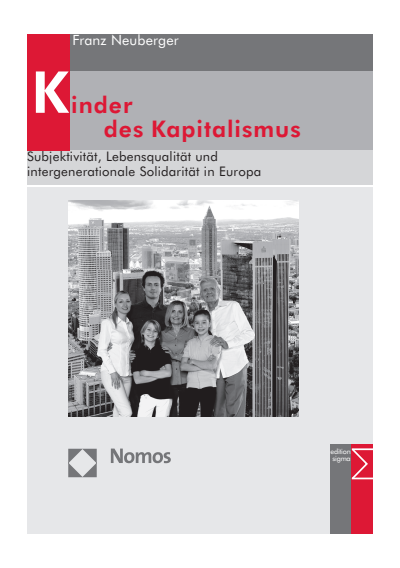
Kinder des Kapitalismus
Subjektivität, Lebensqualität und intergenerationale Solidarität in Europa- Authors:
- Publisher:
- 2015
Search publication
Bibliographic data
- Edition
- 1/2015
- Copyright Year
- 2015
- ISBN-Print
- 978-3-8487-2337-9
- ISBN-Online
- 978-3-8452-6441-7
- Publisher
- Nomos, Baden-Baden
- Language
- German
- Pages
- 309
- Product Type
- Monograph
Table of contents
ChapterPages
- Titelei/Inhaltsverzeichnis No access Pages 1 - 13
- Kinder des Kapitalismus No access Pages 14 - 21
- Moderne Subjekte: Gouvernementalität, Lebensqualität und Ambivalenz No access Pages 22 - 113
- Lebensqualität: Individuelle und kontextuelle Faktoren No access Pages 114 - 163
- Kinder und Lebensqualität No access Pages 164 - 225
- Enkelkinder und Lebensqualität No access Pages 226 - 265
- Was ist der Fall? – Empirisches Fazit No access Pages 266 - 271
- Was steckt dahinter? – Soziologie und Ideologie No access Pages 272 - 279
- Literatur No access Pages 280 - 304
- Verzeichnis der Abbildungen und Tabellen No access Pages 305 - 306
- Abkürzungsverzeichnis No access Pages 307 - 309
Bibliography (490 entries)
No match found. Try another term.
- Abbott, A. (2001): Chaos of disciplines. Chicago: The University of Chicago Press Open Google Scholar DOI: 10.5771/9783845264417
- Abella, A. (2008): Soldiers of reason: The Rand Corporation and the rise of the American empire. Orlando/FL: Harcourt Open Google Scholar DOI: 10.5771/9783845264417
- Abrams, M. A. (1969): Analysis of a life-satisfaction index. In: Journal of Gerontology: So¬cial Sciences, (4), S. 470–474 Open Google Scholar DOI: 10.5771/9783845264417
- Acemoglu, D./Robinson, J. (2008): The Role of Institutions in Growth and Development. Washington/D.C.: The World Bank Open Google Scholar DOI: 10.5771/9783845264417
- Acemoglu, D./Robinson, J. A. (2013): Warum Nationen scheitern: Die Ursprünge von Macht, Wohlstand und Armut. Frankfurt/M.: Fischer Open Google Scholar DOI: 10.5771/9783845264417
- Adena, M./Myck, M. (2013): 6 Poverty and transitions in key areas of quality of life. In: Börsch-Supan, A./Brandt, M./Litwin, H./Weber, G. (eds.): Active ageing and solidarity between generations in Europe. Berlin, Boston: De Gruyter, S. 55–73 Open Google Scholar DOI: 10.5771/9783845264417
- Adler, N. E./Epel, E. S./Castellazzo, G./Ickovics, J. R. (2000): Relationship of subjective and objective social status with psychological and physiological functioning: Preliminary data in healthy, White women. In: Health Psychology, 19 (6), S. 586–592 Open Google Scholar DOI: 10.5771/9783845264417
- Adler, N. E./Marmot, M./McEwen, B./Stewart, J. (eds.). (1999): Annals of the New York Academy of Sciences: Vol. 896. Socioeconomic status and health in industrial nations: Social, psychological, and biological pathways. New York: New York Academy of Sciences Open Google Scholar DOI: 10.5771/9783845264417
- Adorno, T. W. (1967): Sociology and Psychology. In: New Left Review, (46), S. 67–80 Open Google Scholar DOI: 10.5771/9783845264417
- Adorno, T. W. (1943–1969/2003): Graeculus (II). Notizen zu Philosophie und Gesellschaft 1943–1969. In: Tiedemann, R. (Hg.): Frankfurter Adorno Blätter VIII. München: Ed. text + kritik Open Google Scholar DOI: 10.5771/9783845264417
- Agamben, G. (2008): Homo sacer: Die Souveränität der Macht und das nackte Leben. Frank-furt/M.: Suhrkamp Open Google Scholar DOI: 10.5771/9783845264417
- Allen, R./Wiles, J. L. (2013): How Older People Position Their Late-Life Childlessness: A Qualitative Study. In: Journal of Marriage and Family, 75 (1), S. 206–220 Open Google Scholar DOI: 10.5771/9783845264417
- Althusser, L. (1984): Essay on Ideology. London: Verso Open Google Scholar DOI: 10.5771/9783845264417
- Altonji, J. G./Hayashi, F./Kotliko., L. J. (1997): Parental Altruism and Inter Vivos Transfers: Theory and Evidence. In: Journal of Political Economy, 105 (6), S. 1121–1166 Open Google Scholar DOI: 10.5771/9783845264417
- Andersen-Ranberg, K./Petersen, I./Frederiksen, H./Mackenbach, J. P./Christensen, K. (2009): Cross-national differences in grip strength among 50+ year-old Europeans: results from the SHARE study. In: European Journal of Ageing, 6 (3), S. 227–236 Open Google Scholar DOI: 10.5771/9783845264417
- Andrews, F. M. (1974): Social indicators of perceived life quality. In: Social Indicators Re-search, 1 (3), S. 279–299 Open Google Scholar DOI: 10.5771/9783845264417
- Angelini, V./Laferrère, A. (2013): Friendship, housing environment and economic resources: what influences social network size after age 50? In: Börsch-Supan, A./Brandt, M./Lit-win, H./Weber, G. (eds.): Active ageing and solidarity between generations in Europe. Berlin, Boston: De Gruyter, S. 323–336 Open Google Scholar DOI: 10.5771/9783845264417
- Arnold, M. B. (1960a): Emotion and Personality. Vol. I: Psychological Aspects. New York: Columbia University Press Open Google Scholar DOI: 10.5771/9783845264417
- Arnold, M. B. (1960b): Emotion and Personality. Vol II: Neurological and Physiological As-pects. New York: Columbia University Press Open Google Scholar DOI: 10.5771/9783845264417
- Arránz Becker, O./Lois, D. (2013): Competing Pleasures? The Impact of Leisure Time Use on the Transition to Parenthood. In: Journal of Family Issues, 34 (5), S. 661–688 Open Google Scholar DOI: 10.5771/9783845264417
- Attias-Donfut, C./Ogg, J./Wolff, F.-C. (2005): European patterns of intergenerational financial and time transfers. In: European Journal of Ageing, 2 (3), S. 161–173 Open Google Scholar DOI: 10.5771/9783845264417
- Ayres, L. (2000): Narratives of family caregiving: The process of making meaning. In: Re-search in Nursing & Health, 23 (6), S. 424–434 Open Google Scholar DOI: 10.5771/9783845264417
- Baayen, R. H./Davidson, D. J./Bates, D. M. (2008): Mixed-effects modeling with crossed random effects for subjects and items. In: Journal of Memory and Language, 59 (4), Open Google Scholar DOI: 10.5771/9783845264417
- S. 390–412 Open Google Scholar DOI: 10.5771/9783845264417
- Bache, I. (2013): Measuring quality of life for public policy: an idea whose time has come? Agenda-setting dynamics in the European Union. In: Journal of European Public Policy, 20 (1), S. 21–38 Open Google Scholar DOI: 10.5771/9783845264417
- Bachur, J. P. (2013): Kapitalismus und funktionale Differenzierung: Eine kritische Rekon-struktion. Baden-Baden: Nomos Open Google Scholar DOI: 10.5771/9783845264417
- Bacon, E./Milne, D. L./Sheikh, A. I./Freeston, M. H. (2009): Positive Experiences in Care-givers: An Exploratory Case Series. In: Behavioural and Cognitive Psychotherapy, 37 (1), S. 95–114 Open Google Scholar DOI: 10.5771/9783845264417
- Bates, D. M. (2010): Correlated random effects in Imer and false convergence (Internet: https:// stat.ethz.ch/pipermail/r-sig-mixed-models/2010q2/003921.html; Zugriff am 25. Februar 2014) Open Google Scholar DOI: 10.5771/9783845264417
- Baumeister, R. F./Masicampo, E. J./DeWall, C. N. (2009): Prosocial Benefits of Feeling Free: Disbelief in Free Will Increases Aggression and Reduces Helpfulness. In: Personality and Social Psychology Bulletin, 35 (2), S. 260–268 Open Google Scholar DOI: 10.5771/9783845264417
- Beck, U. (1986): Risikogesellschaft: Auf dem Weg in eine andere Moderne. Frankfurt/M.: Suhrkamp Open Google Scholar DOI: 10.5771/9783845264417
- Becker, G. S. (1976): The Economic Approach to Human Behavior. Chicago, London: Chi-cago University Press Open Google Scholar DOI: 10.5771/9783845264417
- Becker, G. S. (1991 [1981]): A treatise on the family. Cambridge: Harvard University Press Open Google Scholar DOI: 10.5771/9783845264417
- Becker, K. (Hg.) (2010): Grenzverschiebungen des Kapitalismus: Umkämpfte Räume und Orte des Widerstands. Frankfurt/M.: Campus Open Google Scholar DOI: 10.5771/9783845264417
- Ben-Porath, Y. (1982): Economics and the Family-Match or Mismatch? A Review of Becker’s A Treatise on the Family. In: Journal of Economic Literature, 20 (2), S. 52–64 Open Google Scholar DOI: 10.5771/9783845264417
- Bengtson, V./Giarrusso, R./Mabry, J. B./Silverstein, M. (2002): Solidarity, conflict, and am-bivalence: Complementary or competing perspectives on intergenerational relationships? In: Journal of Marriage and Family, 64 (3), S. 568–576 Open Google Scholar DOI: 10.5771/9783845264417
- Bengtson, V. L./Kuypers, J. A. (1971): Generational Difference and the Developmental Stake. In: The International Journal of Aging and Human Development, 2 (4), S. 249–260 Open Google Scholar DOI: 10.5771/9783845264417
- Bengtson, V. L./Martin, P. (2001): Families and intergenerational relationships in aging so-cieties: comparing the United States with German-speaking countries. In: Zeitschrift für Gerontologie und Geriatrie, 34 (3), S. 207–217 Open Google Scholar DOI: 10.5771/9783845264417
- Bengtson, V. L./Roberts, R. E. (1991): Intergenerational Solidarity in Aging Families. An Example of Formal Theory Construction. In: Journal of Marriage and Family, 53 (4), Open Google Scholar DOI: 10.5771/9783845264417
- S. 856–870 Open Google Scholar DOI: 10.5771/9783845264417
- Bentham, J. (1789): An Introduction to The Principles of Morals and Legislation. London Open Google Scholar DOI: 10.5771/9783845264417
- Berg-Weger, M./Rubio, D. M./Tebb, S. S. (2001): Strengths-based practice with family caregivers of the chronically lll: Qualitative insights. In: Families in Society – The Jour¬nal of Contemporary Social Services, 82 (3), S. 263–272 Open Google Scholar DOI: 10.5771/9783845264417
- Berger, F./Fend, H. (2005): Kontinuität und Wandel in der affektiven Beziehung zwischen El-tern und Kindern vom Jugend- bis ins Erwachsenenalter. In: Zeitschrift für Soziologie der Erziehung und Sozialisation, 25 (1), S. 8–31 Open Google Scholar DOI: 10.5771/9783845264417
- Berger, P. L./Luckmann, T. (1980 [1969]): Die gesellschaftliche Konstruktion der Wirklich-keit. Frankfurt/M.: Fischer Open Google Scholar DOI: 10.5771/9783845264417
- Biggs, S./Powell, J. L. (2009): Eine foucauldianische Analyse des Alters und der Macht wohl-fahrtsstaatlicher Politik. In: Dyk, S. v./Lessenich, S. (Hg.): Die Jungen Alten. Frank-furt/M., New York: Campus, S. 186–206 Open Google Scholar DOI: 10.5771/9783845264417
- Black, D./Townsend, P./Davidson, N./Whitehead, M. (1990): Inequalities in health: The Black Report. London, New York: Penguin and Viking Penguin Open Google Scholar DOI: 10.5771/9783845264417
- Blanc, D./Wolff, F.-C. (2006): Leaving Home in Europe: The Role of Parents’ and Children’s Incomes. In: Review of Economics of the Household, 4 (1), S. 53–73 Open Google Scholar DOI: 10.5771/9783845264417
- Blanchflower, D. G./Oswald, A. J. (2008): Is well-being U-shaped over the life cycle? In: Social Science & Medicine, 66, S. 1733–1749 Open Google Scholar DOI: 10.5771/9783845264417
- Blane, D./Netuveli, G./Bartley, M. (2007): Does quality of life at older ages vary with socio-economic position? In: Sociology – The Journal of the British Sociological Association, 41 (4), S. 717–726 Open Google Scholar DOI: 10.5771/9783845264417
- Bleuler, E. (1911): Vortrag über Ambivalenz. In: Zentralblatt für Psychoanalyse, 1 (1), Open Google Scholar DOI: 10.5771/9783845264417
- S. 266–268 Open Google Scholar DOI: 10.5771/9783845264417
- Blinkert, B./Klie, T. (2004): Gesellschaftlicher Wandel und demographische Veränderungen als Herausforderungen für die Sicherstellung der Versorgung von pflegebedürftigen Menschen. In: Sozialer Fortschritt, 53 (11–12), S. 319–325 Open Google Scholar DOI: 10.5771/9783845264417
- Blossfeld, H./Huinink, J. (1991): Human Capital Investments or Norms of Role Transition? How Women’s Schooling and Career Affect the Process of Family Formation. In: Ameri¬can Journal of Sociology, 97 (1), S. 143–168 Open Google Scholar DOI: 10.5771/9783845264417
- Blossfeld, H./Jaenichen, U. (1992): Educational Expansion and Changes in Womens Entry Into Marriage and Motherhood in the Federal-Republic-of-Germany. In: Journal of Marriage and Family, 53 (2), S. 302–315 Open Google Scholar DOI: 10.5771/9783845264417
- Boltanski, L./Chiapello, È. (2006): Der neue Geist des Kapitalismus. Konstanz: UVK Open Google Scholar DOI: 10.5771/9783845264417
- BMFSFJ (2001): Dritter Bericht zur Lage der älteren Generation in Deutschland. Alter und Gesellschaft. Stellungnahme der Bundesregierung. Bonn Open Google Scholar DOI: 10.5771/9783845264417
- Börsch-Supan, A./Schuth, M. (2013): Early retirement, mental health and social networks. In: Börsch-Supan, A./Brandt, M./Litwin, H./Weber, G. (eds.): Active ageing and solidarity between generations in Europe. Berlin, Boston: De Gruyter, S. 337–348 Open Google Scholar DOI: 10.5771/9783845264417
- Bortz, J./Schuster, C. (2010): Statistik für Human- und Sozialwissenschaftler. Berlin: Springer Open Google Scholar DOI: 10.5771/9783845264417
- Bottan, N. L./Perez Truglia, R. N. (2008): Deconstructing the Hedonic Treadmill: Is Happiness Autoregressive? (Internet: http://mpra.ub.uni-muenchen.de/20340/; Zugriff am 10. Januar 2011) Open Google Scholar DOI: 10.5771/9783845264417
- Bowers, B. F./Myers, B. J. (1999): Grandmothers providing care for grandchildren: Conse-quences of various levels of caregiving. In: Family Relations, 48 (3), S. 303–311 Open Google Scholar DOI: 10.5771/9783845264417
- Brandt, M. (2009): Hilfe zwischen Generationen: Ein europäischer Vergleich. Wiesbaden: VS Open Google Scholar DOI: 10.5771/9783845264417
- Brandt, M./Deindl, C. (2013): Intergenerational Transfers to Adult Children in Europe: Do Social Policies Matter? In: Journal of Marriage and Family, 75 (1), S. 235–251 Open Google Scholar DOI: 10.5771/9783845264417
- Brandt, M./Deindl, C./Haberkern, K./Szydlik, M. (2008): Reciprocity between adult genera-tions: Family transfers over the life course. In: Zeitschrift für Gerontologie und Geria¬trie, 41 (5), S. 374–381 Open Google Scholar DOI: 10.5771/9783845264417
- Brandt, M./Haberkern, K./Szydlik, M. (2009): Intergenerational Help and Care in Europe. In: European Sociological Review, 25 (5), S. 585–601 Open Google Scholar DOI: 10.5771/9783845264417
- Brickman, P./Campbell, D. T. (1971): Hedonic Relativism and Planning the Good Society. In: Appley, M. H. (ed.): Adaption-level theory. New York: Academic Press, S. 281–305 Open Google Scholar DOI: 10.5771/9783845264417
- Brickman, P./Coates, D./Janoff-Bulman, R. (1978): Lottery winners and accident victims: Is happiness relative? In: Journal of Personality and Social Psychology, 36 (8), S. 917–927 Open Google Scholar DOI: 10.5771/9783845264417
- Brieler, U. (2002): ‚Erfahrungstiere’ und ‚Industriesoldaten’: Marx und Foucault über das his-torische Denken, das Subjekt und die Geschichte der Gegenwart. In: Martschukat, J. (Hg.): Geschichte schreiben mit Foucault. Frankfurt/M.: Campus, S. 42–78 Open Google Scholar DOI: 10.5771/9783845264417
- Bröckling, U. (2002): Jeder könnte, aber nicht alle können. Konturen des unternehmerischen Selbst. In: Mittelweg, 36 (4), S. 1–15 (Internet: http://www.eurozine.com/articles/2002-10-02-broeckling-de.html; Zugriff am 12. August 2014) Open Google Scholar DOI: 10.5771/9783845264417
- Bröckling, U. (2007): Das unternehmerische Selbst: Soziologie einer Subjektivierungsform. Frankfurt/M.: Suhrkamp Open Google Scholar DOI: 10.5771/9783845264417
- Bröckling, U./Krasmann, S./Lemke, T. (Hg.) (2000): Gouvernementalität der Gegenwart. Stu-dien zur Ökonomisierung des Sozialen. Frankfurt/M.: Suhrkamp Open Google Scholar DOI: 10.5771/9783845264417
- Brockmann, H. (2010): Why are Middle-Aged People so Depressed? Evidence from West Germany. In: Social Indicators Research, 97 (1), S. 23–42 Open Google Scholar DOI: 10.5771/9783845264417
- Brown, J. D. (1993): Self-esteem and self-evaluation: Feeling is believing. In: Suls, J. (ed.): Psychological Perspectives of the Self. Hillsdale: Lawrence Erlbaum Assoc. Inc., S. 27–58 Open Google Scholar DOI: 10.5771/9783845264417
- Brugiavini, A./Buia, R. E./Pasini, G./Zantomio, F. (2013): 32 Long-term care and reciprocity: does helping with grandchildren result in the receipt of more help at older ages? In: Börsch-Supan, A./Brandt, M./Litwin, H./Weber, G. (eds.): Active ageing and solidarity between generations in Europe. Berlin, Boston: De Gruyter, S. 369–378 Open Google Scholar DOI: 10.5771/9783845264417
- Brüsemeister, T. (2007): Die Gesellschaft als organisierte Erwartungs-Enttäuschungs-Spirale – George Ritzers These der McDonaldisierung. In: Schimank, U. (Hg.): Soziologische Gegenwartsdiagnosen. Wiesbaden: VS, S. 277–293 Open Google Scholar DOI: 10.5771/9783845264417
- Buber, I./Engelhardt, H. (2008): Children’s impact on the mental health of their older mothers and fathers: findings from the Survey of Health, Ageing and Retirement in Europe. In: European Journal of Ageing, 5 (1), S. 31–45 Open Google Scholar DOI: 10.5771/9783845264417
- Callon, M. (2006): What does it mean to say that economics is performative? CSI Working Paper Series 005 (Internet: https://halshs.archives-ouvertes.fr/halshs-00091596/document; Zugriff am 13. Januar 2014) Open Google Scholar DOI: 10.5771/9783845264417
- Canguilhem, G. (1980): What is psychology? In: Ideology and Consciousness, (7), S. 37–50 Open Google Scholar DOI: 10.5771/9783845264417
- Cantor, M. H. (1975): Life Space and the Social Support System of the Inner City Elderly of New York. In: The Gerontologist, 15 (1), S. 23–27 Open Google Scholar DOI: 10.5771/9783845264417
- Castel, R. (2000): Die Metamorphosen der sozialen Fragen: Eine Chronik der Lohnarbeit. Konstanz: Universitätsverlag Open Google Scholar DOI: 10.5771/9783845264417
- Chang, E./Wilber, K. H./Silverstein, M. (2010): The effects of childlessness on the care and psychological well-being of older adults with disabilities. In: Aging & Mental Health, 14 (6), S. 712–719 Open Google Scholar DOI: 10.5771/9783845264417
- Chapin, F. S. (1922): The Measurement of Social Status by The Use of The Social Status Scale. Minneapolis: The University of Minnesota Press Open Google Scholar DOI: 10.5771/9783845264417
- Choi, N. G. (2003): Coresidence between Unmarried Aging Parents and their Adult Children: Who Moved in with Whom and Why? In: Research on Aging, 25 (4), S. 384–404 Open Google Scholar DOI: 10.5771/9783845264417
- Chzhen, Y./Bradshaw, J. (2012): Lone parents, poverty and policy in the European Union. In: Journal of European Social Policy, 22 (5), S. 487–506 Open Google Scholar DOI: 10.5771/9783845264417
- Coall, D. A./Hertwig, R. (2011): Grandparental Investment: A Relic of the Past or a Resource for the Future? In: Current Directions in Psychological Science, 20 (2), S. 93–98 Open Google Scholar DOI: 10.5771/9783845264417
- Connidis, I. A./McMullin, J. A. (2002a): Ambivalence, family ties, and doing sociology. In: Journal of Marriage and Family, 64 (3), S. 594–601 Open Google Scholar DOI: 10.5771/9783845264417
- Connidis, I. A./McMullin, J. A. (2002b): Sociological ambivalence and family ties: A critical perspective. In: Journal of Marriage and Family, 64 (3), S. 558–567 Open Google Scholar DOI: 10.5771/9783845264417
- Cook, R. D. (1977): Detection of influential observations in linear regression. In: Technomet-rics, 19, S. 15–18 Open Google Scholar DOI: 10.5771/9783845264417
- Copeland, J. R., Beekman, A. T./Dewey, M. E./Hooijer, C./Jordan, A./Lawlor, B. A./Lobo, A./Magnusson, H./Mann, A. H./Meller, I./Prince, M. J./Reischies, F./Turrina, C./Wilson, K. C. (1999): Depression in Europe. Geographical distribution among older people. In: The British Journal of Psychiatry, 174 (4), S. 312–321 Open Google Scholar DOI: 10.5771/9783845264417
- Costa, P. T./McCrae, R. R. (1980): Influence of extraversion and neuroticism on subjective well-being: Happy and unhappy people. In: Journal of Personality and Social Psychol-ogy, 38 (4), S. 668–678 Open Google Scholar DOI: 10.5771/9783845264417
- Cox, D./Jakubson, G. (1995): The Connection between Public Transfers and Private Inter-family Transfers. In: Journal of Public Economics, 57 (1), S. 129–167 Open Google Scholar DOI: 10.5771/9783845264417
- Crimmins, E. M./Ingegneri, D. G. (1990): Interaction and living arrangements of older parents and their children. Past trends, present determinants, future implications. In: Research on Aging, 12 (1), S. 3–35 Open Google Scholar DOI: 10.5771/9783845264417
- Cronbach, L. J. (1951): Coefficient alpha and the internal structure of tests. In: Psycho-metrika, 16 (3), S. 297–334 Open Google Scholar DOI: 10.5771/9783845264417
- Curran, S. (2002): Agency, accountability, and embedded relations: ‘What’s love got to do with it?’. In: Journal of Marriage and Family, 64 (3), S. 577–584 Open Google Scholar DOI: 10.5771/9783845264417
- Dannefer, D. (1984): Adult Development and Social Theory: A Paradigmatic Reappraisal. In: American Sociological Review, 49 (1), S. 100–116 Open Google Scholar DOI: 10.5771/9783845264417
- Dath, D. (2008a): Für immer in Honig. Berlin: Verbrecher-Verlag Open Google Scholar DOI: 10.5771/9783845264417
- Dath, D. (2008b): Maschinenwinter: Wissen, Technik, Sozialismus; eine Streitschrift. Frank-furt/M.: Suhrkamp Open Google Scholar DOI: 10.5771/9783845264417
- Dath, D. (2014): Feldeváye: Roman der letzten Künste. Berlin: Suhrkamp Open Google Scholar DOI: 10.5771/9783845264417
- Dath, D./Kirchner, B. (2012): Der Implex: Sozialer Fortschritt: Geschichte und Idee. Berlin: Suhrkamp Open Google Scholar DOI: 10.5771/9783845264417
- Davey, A./Savla, J./Janke, M./Anderson, S. (2009): Grandparent-Grandchild Relationships: From Families in Contexts to Families as Contexts. In: International Journal of Aging & Human Development, 69 (4), S. 311–325 Open Google Scholar DOI: 10.5771/9783845264417
- Davidov, E. (ed.) (2011): Cross-cultural analysis: Methods and applications. New York: Routledge Open Google Scholar DOI: 10.5771/9783845264417
- Dean, A./Kolody, B./Wood, P. (1990): Effects of Social Support from Various Sources on Depression in Elderly Persons. In: Journal of Health and Social Behavior, 31 (2), Open Google Scholar DOI: 10.5771/9783845264417
- S. 148–161 Open Google Scholar DOI: 10.5771/9783845264417
- Deaton, A./Stone, A. A. (2014): Evaluative and hedonic wellbeing among those with and without children at home. In: Proceedings of the National Academy of Sciences, 111 (4), S. 1328–1333 Open Google Scholar DOI: 10.5771/9783845264417
- Degiuli, F. (2010): The burden of long-term care: how Italian family care-givers become em-ployers. In: Ageing & Society, 30 (Part 5), S. 755–777 Open Google Scholar DOI: 10.5771/9783845264417
- Deindl, C./Brandt, M. (2011): Financial support and practical help between older parents and their middle-aged children in Europe. In: Ageing & Society, 31, S. 645–662 Open Google Scholar DOI: 10.5771/9783845264417
- Delaney, P. (2014): Gouvernementalität in der alternden Gesellschaft: Wohnen im Alter zwi-schen Neoliberalismus und Solidarität. Berlin: edition sigma Open Google Scholar DOI: 10.5771/9783845264417
- Deleuze, G. (1992): Foucault. Frankfurt/M.: Suhrkamp Open Google Scholar DOI: 10.5771/9783845264417
- Deleuze, G. (1993): Postskriptum über die Kontrollgesellschaften. In: Deleuze, G. (Hg.): Un-terhandlungen. Frankfurt/M.: Suhrkamp, S. 254–262 Open Google Scholar DOI: 10.5771/9783845264417
- Diekmann, A. (2004): Empirische Sozialforschung. Grundlagen, Methoden, Anwendungen. Reinbek: Rowohlt Open Google Scholar DOI: 10.5771/9783845264417
- Diener, E. (ed.) (2000): Culture and subjective well-being. Cambridge/MA: MIT Press Open Google Scholar DOI: 10.5771/9783845264417
- Diener, E./Suh, E. M. (1999): National differences in subjective well-being. In: Kahneman, D./Diener, E./Schwarz, N. (eds.): Well-being: The foundations of hedonic psychology. New York: Russel Sage Foundation, S. 434–450 Open Google Scholar DOI: 10.5771/9783845264417
- Diener, E./Suh, E. M. (2000): Measuring Subjective Well-being to Compare the Quality of Life of Cultures. In: Diener, E. (ed.): Culture and subjective well-being. Cambridge/MA: MIT Press, S. 3–12 Open Google Scholar DOI: 10.5771/9783845264417
- Dörre, K. (2009): Die neue Landnahme. Dynamiken und Grenzen des Finanzkapitalismus. In: Dörre, K./Lessenich, S./Rosa, H. (Hg.): Soziologie – Kapitalismus – Kritik. Frankfurt/M.: Suhrkamp, S. 21–86 Open Google Scholar DOI: 10.5771/9783845264417
- Dörre, K./Lessenich, S./Rosa, H. (Hg.) (2009): Soziologie – Kapitalismus – Kritik: Eine De-batte. Frankfurt/M.: Suhrkamp Open Google Scholar DOI: 10.5771/9783845264417
- Donzelot, J. (1988): The Promotion of the Social. In: Economy & Society, 17, S. 395–427 Open Google Scholar DOI: 10.5771/9783845264417
- Dresher, M. (1961): Games of Strategy: Theory and Applications. Englewood Cliff/NJ: Pren-tice-Hall Open Google Scholar DOI: 10.5771/9783845264417
- Drew, L. M./Silverstein, M. (2004): Inter-generational role investments of great-grandparents: Consequences for psychological well-being. In: Ageing & Society, 24 (Part 1), S. 95–111 Open Google Scholar DOI: 10.5771/9783845264417
- Drew, L. M./Silverstein, M. (2007): Grandparents’ psychological well-being after loss of contact with their grandchildren. In: Journal of Family Psychology, 21 (3), S. 372–379 Open Google Scholar DOI: 10.5771/9783845264417
- Duckheim, S. (2012): Reklame für die Welt, wie sie ist. In: Braunstein, D. (Hg.): Alles falsch. Berlin: Verbrecher Verlag, S. 65–110 Open Google Scholar DOI: 10.5771/9783845264417
- Dühmen, R. (1990): Kultur und Alltag in der Frühen Neuzeit: Erster Band: Das Haus und seine Menschen 16.–18. Jahrhundert. München: C. H. Beck Open Google Scholar DOI: 10.5771/9783845264417
- Dunn, T. A./Philipps, J. W. (1998): Intergenerational Co-Residence and Children’s Incomes (Internet: https: //www.maxwell.syr.edu/cpr/publications/aging_studies/Abstract_Paper_ No_14/; Zugriff am 7. Januar 2013) Open Google Scholar DOI: 10.5771/9783845264417
- Durkheim, É. (1997 [1893]): The division of labor in society. New York/NY: The free Press Open Google Scholar DOI: 10.5771/9783845264417
- Dykstra, P. A. (2009a): Childless old age. In: Uhlenberg, P. (ed.): International Handbook of Population Aging. New York: Springer, S. 671–690 Open Google Scholar DOI: 10.5771/9783845264417
- Dykstra, P. A. (2009b): Older adult loneliness: myths and realities. In: European Journal of Ageing, 6 (2), S. 90–101 Open Google Scholar DOI: 10.5771/9783845264417
- Dykstra, P. A./Hagestad, G. O. (2007): Childlessness and Parenthood in Two Centuries: Dif-ferent Roads Different Maps? In: Journal of Family Issues, 28 (11), S. 1518–1532 Open Google Scholar DOI: 10.5771/9783845264417
- Easterlin, R. A. (2001): Income and happiness: Towards a unified theory. In: Economic Jour-nal, 111 (473), S. 465–484 Open Google Scholar DOI: 10.5771/9783845264417
- Easterlin, R. A. (2006): Life cycle happiness and its sources – Intersections of psychology, economics, and demography. In: Journal of Economic Psychology, 27 (4), S. 463–482 Open Google Scholar DOI: 10.5771/9783845264417
- Easterlin, R. A. (2009): Lost in transition: Life satisfaction on the road to capitalism. In: Jour-nal of Economic Behaviour & Organization, 71 (2), S. 130–145 Open Google Scholar DOI: 10.5771/9783845264417
- Edelman, P./Hughes, S. (1990): The Impact of Community Care on Provision of Informal Care to Homebound Elderly Persons. In: Journals of Gerontology, 45 (2), S74–S84 Open Google Scholar DOI: 10.5771/9783845264417
- Ehrenberg, A. (2008): Das erschöpfte Selbst: Depression und Gesellschaft in der Gegenwart. Frankfurt/M.: Suhrkamp Open Google Scholar DOI: 10.5771/9783845264417
- Ermisch, J./Di Salvo, P. (1997): The Economic Determinants of Young People’s Household Formation. In: Economica, 64 (256), S. 627–644 Open Google Scholar DOI: 10.5771/9783845264417
- Esping-Andersen, G. (1990): The Three Worlds of Welfare Capitalism. Cambridge: Polity Press Open Google Scholar DOI: 10.5771/9783845264417
- Etzioni, A. (1994): Jenseits des Egoismus-Prinzips: Ein neues Bild. Stuttgart: Schäffer-Poeschel Open Google Scholar DOI: 10.5771/9783845264417
- European Commission (2009): Communication from the Commission to the Council and the European parliament – GDP and beyond: measuring progress in a changing world. Brus-sels: European Commission Open Google Scholar DOI: 10.5771/9783845264417
- Faraway, J. J. (2005): Extending the Linear Model with R: Generalized Linear, Mixed Effects and Nonparametric Regression Models. Boca Raton: Chapman & Hall/CRC Open Google Scholar DOI: 10.5771/9783845264417
- Faria, H. J./Morales, D. R./Pineda, N./Montesinos, H. M. (2012): Can capitalism restrain pub-lic perceived corruption? Some evidence. In: Journal of Institutional Economics, 8 (4), S. 511–535 Open Google Scholar DOI: 10.5771/9783845264417
- Farquhar, M. (1995): Elderly people’s Definitions of quality of life. In: Social Science & Medicine, 41 (10), S. 1439–1446 Open Google Scholar DOI: 10.5771/9783845264417
- Fenger, H. (2007): Welfare regimes in Central and Eastern Europe: Incorporating post-com-munist countries in a welfare regime typology. In: Contemporary Issues and Ideas in So-cial Sciences, 3 (2), S. 1–30 Open Google Scholar DOI: 10.5771/9783845264417
- Fergusson, E./Maughan, B./Golding, J. (2008): Which children receive grandparental care and what effect does it have? In: Journal of Child Psychology and Psychiatry, 49 (2), S. 161–169 Open Google Scholar DOI: 10.5771/9783845264417
- Fernandez-Ballesteros, R. (2011): Quality of Life in Old Age: Problematic Issues. In: Applied Research in Quality of Life, 6 (1), S. 21–40 Open Google Scholar DOI: 10.5771/9783845264417
- Ferragina, E./Seeleib-Kaiser, M. (2011): Thematic Review: Welfare regime debate: past, pre-sent, futures? In: Policy & Politics, 39 (4), S. 583–611 Open Google Scholar DOI: 10.5771/9783845264417
- Ferring, D./Michels, T./Boll, T./Filipp, S.-H. (2009): Emotional relationship quality of adult children with ageing parents: on solidarity, conflict and ambivalence. In: European Jour-nal of Ageing, 6 (4), S. 253–265 Open Google Scholar DOI: 10.5771/9783845264417
- Ferriss, A. L. (2006): History of QoL Studies from a sociological Perspective. In: Sirgy, M. J./ Michalos, A. C./Ferriss, A. L./Easterlin, R. A./Patrick, D./Pavot, W. (eds.): The quality-of-life (QOL) research movement: Past, present, and future. In: Social Indicators Re-search, 76 (3), S. 363–377 Open Google Scholar DOI: 10.5771/9783845264417
- Feyerabend, P. (1986): Wider den Methodenzwang. Frankfurt/M.: Suhrkamp Open Google Scholar DOI: 10.5771/9783845264417
- Fingerman, K. L./Chen, P. C./Hay, E./Cichy, K. E./Lefkowitz, E. S. (2006): Ambivalent reac-tions in the parent and offspring relationship. In: Journals of Gerontology Series B-Psy-chological Sciences and Social Sciences, 61 (3), P152–P160 Open Google Scholar DOI: 10.5771/9783845264417
- Fingerman, K. L./Hay, E. L./Birditt, K. S. (2004): The best of ties, the worst of ties: Close, problematic, and ambivalent social relationships. In: Journal of Marriage and Family, 66 (3), S. 792–808 Open Google Scholar DOI: 10.5771/9783845264417
- Fingerman, K. L./Pitzer, L./Lefkowitz, E. S./Birditt, K. S./Mroczek, D. (2008): Ambivalent Relationship Qualities Between Adults and Their Parents: Implications for the Well-Be-ing of Both Parties. In: Journals of Gerontology Series B-Psychological Sciences and Social Sciences, 63(6), P362–P371 Open Google Scholar DOI: 10.5771/9783845264417
- Fonseca, R./Kapteyn, A./Lee, J./Zamarro, G./Feeney, K. (2013): 12 Financial and subjective well-being of older Europeans. In: Börsch-Supan, A./Brandt, M./Litwin, H./Weber, G. (eds.): Active ageing and solidarity between generations in Europe. Berlin, Boston: De Gruyter, S. 137–146 Open Google Scholar DOI: 10.5771/9783845264417
- Foucault, M. (1974): Die Ordnung der Dinge. Frankfurt/M.: Suhrkamp Open Google Scholar DOI: 10.5771/9783845264417
- Foucault, M. (1977): Überwachen und Strafen. Die Geburt des Gefängnisses. Frankfurt/M.: Suhrkamp Open Google Scholar DOI: 10.5771/9783845264417
- Foucault, M. (1983): Der Wille zum Wissen. Sexualität und Wahrheit 1. Frankfurt/M.: Suhr-kamp Open Google Scholar DOI: 10.5771/9783845264417
- Foucault, M. (1987): Das Subjekt und die Macht. In: Dreyfus, H. L./Rabinow, P./Foucault, M. (Hg.): Michel Foucault. Frankfurt/M.: Athenäum, S. 241–261 Open Google Scholar DOI: 10.5771/9783845264417
- Foucault, M. (1993): Technologien des Selbst. In: Martin, L. H./Huck, G./Hutton, P. H. (Hg.): Technologien des Selbst. Frankfurt/M.: Fischer, S. 24–62 Open Google Scholar DOI: 10.5771/9783845264417
- Foucault, M. (2000a): Die Gouvernementalität. In: Bröckling, U./Krasmann, S./Lemke, T. (Hg.): Gouvernementalität der Gegenwart. Studien zur Ökonomisierung des Sozialen. Frankfurt/M.: Suhrkamp, S. 41–67 Open Google Scholar DOI: 10.5771/9783845264417
- Foucault, M. (2000b): Staatsphobie. In: Bröckling, U./Krasmann, S./Lemke, T. (Hg.): Gouver-nementalität der Gegenwart. Studien zur Ökonomisierung des Sozialen. Frankfurt/M.: Suhrkamp, S. 68–71 Open Google Scholar DOI: 10.5771/9783845264417
- Foucault, M. (2005): Analytik der Macht. Frankfurt/M.: Suhrkamp Open Google Scholar DOI: 10.5771/9783845264417
- Foucault, M. (1982/2007): Subjekt und Macht. In: Defert, D./Ewald, F. (Hg.): Michel Foucault: Ästhetik der Existenz. Frankfurt/M.: Suhrkamp, S. 81–104 (The Subject and Power. In: Dreyfus, H./Rabinow, P./Foucault, M.: Beyond Structuralism and Hermeneutics. Chi¬cago 1982, S. 208–226) Open Google Scholar DOI: 10.5771/9783845264417
- Foucault, M. (2009): Nietzsche, die Genealogie, die Historie. In: Foucault, M./Defert, D./ Gehring, P. (Hg.): Geometrie des Verfahrens. Frankfurt/M.: Suhrkamp, S. 181–205 Open Google Scholar DOI: 10.5771/9783845264417
- Fox, A. J./Goldblatt, P. O./Jones, D. R. (1985): Social class mortality differentials: Artefact, selection or life circumstances? In: Journal of Epidemiology & Community Health, 39 (1), S. 1–8 Open Google Scholar DOI: 10.5771/9783845264417
- Fox, J. (2008): Applied Regression Analysis and Generalized Linear Models. Los Angeles/ CA: Sage Publications Open Google Scholar DOI: 10.5771/9783845264417
- Fox, J./Weisenberg, S. (2011): An R Companion to Applied Regression. Los Angeles/CA: Sage Publications Open Google Scholar DOI: 10.5771/9783845264417
- Freud, S./Erdheim, M. (Hg.) (1991 [1913]): Totem und Tabu. Frankfurt/M.: Fischer Open Google Scholar DOI: 10.5771/9783845264417
- Frey, B. S./Stutzer, A./Neckermann, S. (2009): Der Staat als Glücksmaximierer? In: Zeit¬schrift für Staats- und Europawissenschaften, 1 (3–4), S. 724–741 Open Google Scholar DOI: 10.5771/9783845264417
- Friedman, M. (1984): Kapitalismus und Freiheit. Frankfurt/M.: Piper Open Google Scholar DOI: 10.5771/9783845264417
- Fukuyama, F. (1989): The End of History? The National Interest (Internet: http://www.wes jones.com/eoh.htm; Zugriff am 27. Januar 2014) Open Google Scholar DOI: 10.5771/9783845264417
- Fuller-Thomson, E./Minkler, M. (2001): American grandparents providing extensive child care to their grandchildren: Prevalence and profile. In: Gerontologist, 41 (2), S. 201–209 Open Google Scholar DOI: 10.5771/9783845264417
- Gaalen, R. I. v./Dykstra, P. A. (2006): Solidarity and conflict between adult children and par-ents: A latent class analysis. In: Journal of Marriage and Family, 68 (4), S. 947–960 Open Google Scholar DOI: 10.5771/9783845264417
- Gaalen, R. I. v./Dykstra, P. A./Komter, A. E. (2010): Where is the exit? Intergenerational am-bivalence and relationship quality in high contact ties. In: Journal of Aging Studies, 24 (2), S. 105–114 Open Google Scholar DOI: 10.5771/9783845264417
- Galison, P. (2005): Das Bild des Ich. In: Borck, C. (Hg.): Psychographien. Zürich: Diaphanes. S. 111–140 Open Google Scholar DOI: 10.5771/9783845264417
- Galton, F. (1887): Hereditary Genius: an inquiry into its laws and consequences. New York: D. Appleton and Company Open Google Scholar DOI: 10.5771/9783845264417
- Gaymu, J./Springer, S. (2012): How does Living Alone or with a Partner influence Life Satis-faction among older Men and Women in Europe? In: Population and Development Re-view, (67), S. 45–74 Open Google Scholar DOI: 10.5771/9783845264417
- Gelman, A./Hill, J. (2007): Data Analysis Using Regression and Multilevel/Hierarchical Models. Cambridge: Cambridge University Press Open Google Scholar DOI: 10.5771/9783845264417
- Giarrusso, R./Feng, D./Silverstein, M./Bengtson, V. L. (2001): Grandparent-Adult Grandchild Affection and Consensus: Cross-Generational and Cross-Ethnic Comparisons. In: Jour-nal of Family Issues, 22 (4), S. 456–477 Open Google Scholar DOI: 10.5771/9783845264417
- Gibb, C. A. (1954): Leadership. In: Fiske, S. T./Gilbert, D. T./Gardener, L. (eds.): Handbook of social psychology. Hoboken/NJ: Wiley, S. 877–920 Open Google Scholar DOI: 10.5771/9783845264417
- Giddens, A. (1984): The constitution of society: Outline of a theory of structuration. Cam-bridge/UK: Polity Press Open Google Scholar DOI: 10.5771/9783845264417
- Gindin, S./Panitch, L. (2012): The making of global capitalism: The political economy of American empire. London, Brooklyn/NY: Verso Open Google Scholar DOI: 10.5771/9783845264417
- Göckenjan, G. (2009): Vom ‚tätigen Leben’ zum ‚aktiven Alter’: Alter und Alterszuschreibung im historischen Wandel. In: Dyk, S. v./Lessenich, S. (Hg.): Die Jungen Alten. Frank¬furt/M., New York: Campus, S. 235–255 Open Google Scholar DOI: 10.5771/9783845264417
- Goel, R. K./Ram, R. (2013): Economic uncertainty and corruption: evidence from a large cross-country data set. In: Applied Economics, 45 (24), S. 3462–3468 Open Google Scholar DOI: 10.5771/9783845264417
- Goethe, J. W. (2009 [1774]): Die Leiden des jungen Werther. Hamburg: Zeitverlag Gerd Bu-cerius GmbH Open Google Scholar DOI: 10.5771/9783845264417
- Gordo-López, Á. J. (ed.) (1999): Cyberpsychology. London: MacMillan Open Google Scholar DOI: 10.5771/9783845264417
- Gordon, C. (1991): Governemental rationality: an introduction. In: Burchell, G./Gordon, C./ Miller, P. (ed.): The Foucault Effect. Studies in Governmentality. London: Harvester Wheatsheaf, S. 1–51 Open Google Scholar DOI: 10.5771/9783845264417
- Gouldner, A. W. (1960): The Norm of Reciprocity – A Preliminary Statement. In: American Sociological Review, 25 (2), S. 161–178 Open Google Scholar DOI: 10.5771/9783845264417
- Graeber, D. (2012): Schulden. Brooklyn: Melville House Publishing and Klett-Cotta Open Google Scholar DOI: 10.5771/9783845264417
- Gramsci, A. (1991 [1920]): Gefängnishefte: Bd. I. Hamburg Open Google Scholar DOI: 10.5771/9783845264417
- Gray, A. (2005): The Changing Availability of Grandparents as Carers and its Implications for Childcare Policy in the UK. In: Journal of Social Policy, 34 (04), S. 557–577 Open Google Scholar DOI: 10.5771/9783845264417
- Greco, M. (2000): Homo Vacuus. Alexithymie und das neoliberale Gebot des Selbstseins. In: Bröckling, U./Krasmann, S./Lemke, T. (Hg.): Gouvernementalität der Gegenwart. Stu-dien zur Ökonomisierung des Sozialen. Frankfurt/M.: Suhrkamp, S. 265–285 Open Google Scholar DOI: 10.5771/9783845264417
- Greene, V. L. (1983): Substitution between formally and informally provided care for the impaired elderly in the community. In: Medical Care, 21 (6), S. 609–619 Open Google Scholar DOI: 10.5771/9783845264417
- Haan, M./Kaplan, G./Syme, S. L. (1989): Socioeconomic Status and health: Old observations and new thougths. In: Bunker, J./Gomby, D./Kehrer, B. (eds.): Pathways to health: The role of social factors. Menlo Park/CA: Henry J. Kaiser Family Foundation Open Google Scholar DOI: 10.5771/9783845264417
- Haberkern, K. (2007): Zeitverwendung und Arbeitsteilung in Paarhaushalten. In: Zeitschrift für Familienforschung, 19 (2), S. 159–185 Open Google Scholar DOI: 10.5771/9783845264417
- Haberkern, K./Szydlik, M. (2010): State care provision, societal opinion and children’s care of older parents in II European countries. In: Ageing & Society, 30 (Part 2), S. 299–323 Open Google Scholar DOI: 10.5771/9783845264417
- Hacking, I. (1990): The Taming of Chance. Cambridge/UK, New York: Cambridge Univer¬sity Press Open Google Scholar DOI: 10.5771/9783845264417
- Hacking, I. (1991): How should we do the history of statistics? In: Burchell, G./Gordon, C./Miller, P. (eds.): The Foucault Effect. Studies in Governmentality. London: Harvester Wheatsheaf, S. 181–196 Open Google Scholar DOI: 10.5771/9783845264417
- Hagestad, G. O. (2006): Transfers between grandparents and grandchildren: The importance of taking a three generation perspective. In: Zeitschrift für Familienforschung, 18, Open Google Scholar DOI: 10.5771/9783845264417
- S. 315–332 Open Google Scholar DOI: 10.5771/9783845264417
- Hagestad, G. O./Uhlenberg, P. (2006): Should We Be Concerned About Age Segregation? Some Theoretical and Empirical Explorations. In: Research on Aging, 28 (6), S. 638–653 Open Google Scholar DOI: 10.5771/9783845264417
- Han, B.-C. (2014): Psychopolitik: Neoliberalismus und die neuen Machttechniken. Frank-furt/M.: Fischer Open Google Scholar DOI: 10.5771/9783845264417
- Hank, K./Buber, I. (2009): Grandparents Caring for Their Grandchildren Findings From the 2004 Survey of Health, Ageing, and Retirement in Europe. In: Journal of Family Issues, 30 (1), S. 53–73 Open Google Scholar DOI: 10.5771/9783845264417
- Hank, K./Wagner, M. (2013): Parenthood, Marital Status, and Well-Being in Later Life: Evi-dence from SHARE. In: Social Indicators Research, 114 (2), S. 639–653 Open Google Scholar DOI: 10.5771/9783845264417
- Hansen, T. (2012): Parenthood and Happiness: a Review of Folk Theories Versus Empirical Evidence. In: Social Indicators Research, 108 (1), S. 29–64 Open Google Scholar DOI: 10.5771/9783845264417
- Hansen, T./Slagsvold, B./Moum, T. (2009): Childlessness and Psychological Well-Being in Midlife and Old Age: An Examination of Parental Status Effects Across a Range of Out¬comes. In: Social Indicators Research, 94 (2), S. 343–362 Open Google Scholar DOI: 10.5771/9783845264417
- Harreveld, F. v./Pligt, J. v. d./Liver, Y. N. d. (2009): The Agony of Ambivalence and Ways to Resolve It: Introducing the MAID Model. In: Personality and Social Psychology Re-view, 13 (1), S. 45–61 Open Google Scholar DOI: 10.5771/9783845264417
- Harvey, D. (1984): The Limits to Capital. London: Blackwell Publishing Open Google Scholar DOI: 10.5771/9783845264417
- Hayslip, B./Kaminski, P. L. (2005): Grandparents raising their grandchildren: A review of the literature and suggestions for practice. In: Gerontologist, 45 (2), S. 262–269 Open Google Scholar DOI: 10.5771/9783845264417
- Headey, B./Veenhoven, R./Wearing, A. (1991): Top-down versus bottom-up theories of sub-jective well-being. In: Social Indicators Research, 24 (1), S. 81–100 Open Google Scholar DOI: 10.5771/9783845264417
- Helliwell, J. F. (2007): Well-being and social capital: Does suicide pose a puzzle? In: Social Indicators Research, 81 (3), S. 455–496 Open Google Scholar DOI: 10.5771/9783845264417
- Helliwell, J. F./Huang, H. (2008): How’s your government? International evidence linking good government and well-being. In: British Journal of Political Science, 38 (4), S. 595–619 Open Google Scholar DOI: 10.5771/9783845264417
- Hillcoat-Nalletamby, S./Phillips, J. E. (2011): Sociological Ambivalence Revisited. In: Soci-ology – The Journal of the British Sociological Association, 45 (2), S. 202–217 Open Google Scholar DOI: 10.5771/9783845264417
- Hillmann, K.-H. (1994): Wörterbuch der Soziologie. Stuttgart: Alfred Kröner Verlag Open Google Scholar DOI: 10.5771/9783845264417
- Hirt, S./Sellar, C./Young, C. (2013): Neoliberal Doctrine Meets the Eastern Bloc: Resistance, Appropriation and Purification in Post-Socialist Spaces. In: Europe-Asia Studies, 65 (7), S. 1243–1254 Open Google Scholar DOI: 10.5771/9783845264417
- Hodge, R. W./Treiman, D. J. (1968): Class identification in the United States. In: American Journal of Sociology, (73), S. 535–547 Open Google Scholar DOI: 10.5771/9783845264417
- Hoffmann, L. W./Hoffmann, M. L. (1973): The Value of Children to Parents. In: Fawcett, J. T. (ed.): Psychological Perspectives on Population. New York: Basic Books, S. 19–76 Open Google Scholar DOI: 10.5771/9783845264417
- Hollway, W. (1991): Work psychology and organizational behavior: Managing the individual at work. London: Sage Publications Open Google Scholar DOI: 10.5771/9783845264417
- Holmberg, S./Rothstein, B. (2011): Dying of corruption. In: Health Economics Policy and Law, 6 (4), S. 529–547 Open Google Scholar DOI: 10.5771/9783845264417
- Holmes, L. (2006): Rotten states? Corruption, post-communism, and neoliberalism. Durham: Duke University Press Open Google Scholar DOI: 10.5771/9783845264417
- Holst, H. (2010): Die Internalisierung des Reservearmeemechanismus: Grenztransformatio¬nen am Beispiel der strategischen Nutzung von Leiharbeit. In: Becker, K. (Hg.): Grenz-verschiebungen des Kapitalismus. Frankfurt/M.: Campus, S. 182–299 Open Google Scholar DOI: 10.5771/9783845264417
- Holstein, M. B./Minkler, M. (2009): Das Selbst, die Gesellschaft und die ‚neue Gerontologie’. In: Dyk, S. v./Lessenich, S. (Hg.): Die Jungen Alten. Frankfurt/M., New York: Campus, S. 207–232 Open Google Scholar DOI: 10.5771/9783845264417
- Homans, G. C. (1958): Social Behavior as Exchange. In: American Journal of Sociology, 63, S. 597–606 Open Google Scholar DOI: 10.5771/9783845264417
- Höpflinger, F./Hummel, C./Hugentobler, V. (2006): Enkelkinder und ihre Grosseltern: Inter-generationelle Beziehungen im Wandel. Zürich: Seismo Open Google Scholar DOI: 10.5771/9783845264417
- Horkheimer, M./Adorno, T. W. (1988): Dialektik der Aufklärung. Frankfurt/M.: Fischer Open Google Scholar DOI: 10.5771/9783845264417
- Horn, C. (2014): Wer gibt den Ton an? In: Direkte Aktion, (September/Oktober), S. 1 Open Google Scholar DOI: 10.5771/9783845264417
- Horn, E. (2002): Test und Theater: Zur Anthropologie der Eignung im 20. Jahrhundert. In: Ul-rich Bröckling, U./Horn,E. (Hg.): Anthropologie der Arbeit, Tübingen 2002, S. 109–125 Open Google Scholar DOI: 10.5771/9783845264417
- Hox, J. (2002): Multilevel Analysis. New York: Taylor & Francis Group Open Google Scholar DOI: 10.5771/9783845264417
- Hughes, M. E./Waite, L. J./LaPierre, T. A./Luo, Y. (2007): All in the family: The impact of caring for grandchildren on grandparents’ health. In: Journals of Gerontology Series B-Psychological Sciences and Social Sciences, 62 (2), S108–S119 Open Google Scholar DOI: 10.5771/9783845264417
- Huijts, T./Kraaykamp, G./Subramanian, S. V. (2013): Childlessness and Psychological Well-Being in Context: A Multilevel Study on 24 European Countries. In: European Socio-logical Review, 29 (1), S. 32–47 Open Google Scholar DOI: 10.5771/9783845264417
- Huppelschoten, A. G./Dongen, A. J. C. M. v./Verhaak, C. M./Smeenk, J. M. J./Kremer, J. A./ M./Nelen, W. L. D. M. (2013): Differences in quality of life and emotional status between infertile women and their partners. In: Human Reproduction, 28 (8), S. 2168–2176 Open Google Scholar DOI: 10.5771/9783845264417
- Hyde, M./Wiggins, R. D./Higgs, P./Blane, D. B. (2003): A measure of quality of life in early old age: the theory, development and properties of a needs satisfaction model (CASP-19). In: Aging & Mental Health, 7 (3), S. 186–194 Open Google Scholar DOI: 10.5771/9783845264417
- Iecovich, E. (2008): Caregiving burden, community services, and quality of life of primary caregivers of frail elderly persons. In: Journal of Applied Gerontology, 27 (3), S. 309–330 Open Google Scholar DOI: 10.5771/9783845264417
- Igel, C./Brandt, M./Haberkern, K./Szydlik, M. (2009): Specialization between Family and State Intergenerational Time Transfers in Western Europe. In: Journal of Comparative Family Studies, 40 (2, Sp. Iss. SI), S. 203–226 Open Google Scholar DOI: 10.5771/9783845264417
- Igel, C./Szydlik, M. (2011): Grandchild care and welfare state arrangements in Europe. In: Journal of European Social Policy, 21 (3), S. 210–224 Open Google Scholar DOI: 10.5771/9783845264417
- Illouz, E. (2011): Die Errettung der modernen Seele: Therapien, Gefühle und die Kultur der Selbsthilfe. Frankfurt/M.: Suhrkamp Open Google Scholar DOI: 10.5771/9783845264417
- International Monetary Fund (2012): http://www.imf.org/external/pubs/ft/weo/2012/01/weodata/ index.aspx (Zugriff am 4. November 2013) Open Google Scholar DOI: 10.5771/9783845264417
- Isengard, B./Szydlik, M. (2012): Living Apart (or) Together? Coresidence of Elderly Parents and Their Adult Children in Europe. In: Research on Aging, 34 (4), S. 449–474 Open Google Scholar DOI: 10.5771/9783845264417
- Jackman, M. R./Jachman, R. W. (1973): An Interpretation of the relation between objective and subjective social status. In: American Sociological Review, (38), S. 569–582 Open Google Scholar DOI: 10.5771/9783845264417
- Jacobs, M. (2013): Beyond the Social Market: Rethinking Capitalism and Public Policy. In: The Political Quarterly, 84 (1), S. 16–27 Open Google Scholar DOI: 10.5771/9783845264417
- Jameson, F. (2007): Mythen der Moderne. Berlin: Kadmos Open Google Scholar DOI: 10.5771/9783845264417
- Jann, B. (2005): Einführung in die Statistik. München: Oldenbourg Open Google Scholar DOI: 10.5771/9783845264417
- Jappens, M./Bavel, J. v. (2012): Regional family cultures and child care by grandparents in Europe. In: Demographic Research, 27, S. 85–120 Open Google Scholar DOI: 10.5771/9783845264417
- Kahn, J. R./Goldscheider, F./García-Manglano, J. (2013): Growing Parental Economic Power in Parent-Adult Child Households: Coresidence and Financial Dependency in the United States, 1960–2010. In: Demography, 50 (4), S. 1449–1475 Open Google Scholar DOI: 10.5771/9783845264417
- Kahneman, D./Krueger, A. B./Schkade, D./Schwarz, N./Stone, A. (2004): Toward National Well-Being Accounts. In: American Economic Review, 94 (2), S. 429–434 Open Google Scholar DOI: 10.5771/9783845264417
- Kalmijn, M./Graaf, P. M. d. (2012): Life Course Changes of Children and Well-being of Par-ents. In: Journal of Marriage and Family, 74 (2), S. 269–280 Open Google Scholar DOI: 10.5771/9783845264417
- Kaufman, G./Uhlenberg, P. (1998): Effects of Life Course Transitions on the Quality of Re-lationships between Adult Children and Their Parents. In: Journal of Marriage and Fam-ily, 60 (4), S. 924 Open Google Scholar DOI: 10.5771/9783845264417
- Kaufmann, D./Kraay, A./Mastruzzi, M. (2004): Governance matters III: Governance indicators for 1996, 1998, 2000, and 2002. In: World Bank Economic Review, 18 (2), S. 253–287 Open Google Scholar DOI: 10.5771/9783845264417
- Kaufmann, F.-X. (2003): Varianten des Wohlfahrtsstaats: Der deutsche Sozialstaat im inter-nationalen Vergleich. Frankfurt/M.: Suhrkamp Open Google Scholar DOI: 10.5771/9783845264417
- Kiecolt, K. J./Blieszner, R./Savla, J. (2011): Long-Term Influences of Intergenerational Am-bivalence on Midlife Parents’ Psychological Well-being. In: Journal of Marriage and Family, 73 (2), S. 369–382 Open Google Scholar DOI: 10.5771/9783845264417
- Kitayama, S./Markus, H. R./Matsumoto, H./Norasakkunkit, V. (1997): Individual and collec-tive processes in the construction of the self: Self-enhancement tendencies in the United States and self-criticism in Japan. In: Journal of Personality and Social Psychology, 72, S. 1245–1267 Open Google Scholar DOI: 10.5771/9783845264417
- Kluegel, J. R./Singleton, R./Starnes, C. E. (1977): Subjective Class Identification: A Multiple Indicator Approach. In: American Sociological Review, 42 (4), S. 599–611 Open Google Scholar DOI: 10.5771/9783845264417
- Knoester, C. (2003): Transitions in Young Adulthood and the Relationship between Parent and Offspring Well-Being. In: Social Forces, 81 (4), S. 1431–1457 Open Google Scholar DOI: 10.5771/9783845264417
- Kohli, M. (1999): Private and Public Transfers between generations: Linking the family and the state. In: European Societies, (1), S. 81–104 Open Google Scholar DOI: 10.5771/9783845264417
- Kohli, M. (2005): Soziologische Theoriebildung und empirische Alternsforschung. In: Amann, A./Majce, G. (Hg.): Soziologie in interdisziplinären Netzwerken. Wien: Böhlau, S. 141–152 Open Google Scholar DOI: 10.5771/9783845264417
- Kopp, J./Steinbach, A. (2009): Generationenbeziehungen. In: Kölner Zeitschrift für Soziolo¬gie und Sozialpsychologie, 61 (2), S. 283–294 Open Google Scholar DOI: 10.5771/9783845264417
- Koppetsch, C. (2013): Die Wiederkehr der Konformität: Streifzüge durch die gefährdete Mitte. Frankfurt/M.: Campus Open Google Scholar DOI: 10.5771/9783845264417
- Korchmaros, J. D./Kenny, D. A. (2001): Emotional Closeness as a Mediator of the Effect of Genetic Relatedness on Altruism. In: Psychological Science, 12 (3), S. 262–265 Open Google Scholar DOI: 10.5771/9783845264417
- Künemund, H./Rein, M. (1999): There is more to receiving than needing: theoretical argu-ments and empirical explorations of crowding in and crowding out. In: Ageing & Soci-ety, 19 (Part 1), S. 93–121 Open Google Scholar DOI: 10.5771/9783845264417
- Land, N. (2013): Kritik am transzendentalen Miserabilismus. In: Avanessian, A. (Hg.): #Ak-zeleration. Berlin: Merve, S. 17–20 Open Google Scholar DOI: 10.5771/9783845264417
- Lawton, L./Silverstein, M./Bengtson, V. (1994): Affection, Social Contact and Geographical Distance between Adult Children and their Parents. In: Journal of Marriage and Family, 56 (1), S. 57–68 Open Google Scholar DOI: 10.5771/9783845264417
- Layard, R. (2006): Happiness and public policy: A challenge to the profession. In: Economic Journal, 116 (510), C24–C33 Open Google Scholar DOI: 10.5771/9783845264417
- Lazarus, R. S. (1966): Psychological Stress and the Coping Process. New York: McGraw-Hill Open Google Scholar DOI: 10.5771/9783845264417
- Lazarus, R. S./Folkman, S. (1984): Stress, Appraisal, and Coping. New York: Springer Pub-lishing Company Open Google Scholar DOI: 10.5771/9783845264417
- Lazarus, R. S./Monat, A. (1977): Stress and Coping, an anthology. New York: Columbia Uni-versity Press Open Google Scholar DOI: 10.5771/9783845264417
- Lecky, P. (1945): Self-consistency: A Theory of Personality. New York: Island Open Google Scholar DOI: 10.5771/9783845264417
- Lessenich, S. (1998a): Relations matter: De-Kommodifizierung als Verteilungsproblem. In: Les¬senich, S. (Hg.): Welten des Wohlfahrtskapitalismus. Frankfurt/M.: Campus, S. 91–108 Open Google Scholar DOI: 10.5771/9783845264417
- Lessenich, S. (Hg.) (1998b): Welten des Wohlfahrtskapitalismus: Der Sozialstaat in verglei-chender Perspektive. Frankfurt/M.: Campus Open Google Scholar DOI: 10.5771/9783845264417
- Lessenich, S. (2009): Mobilität und Kontrolle. Zur Dialektik der Aktivgesellschaft. In: Dörre, K./Lessenich, S./Rosa, H. (Hg.): Soziologie – Kapitalismus – Kritik. Frankfurt/M.: Suhr-kamp, S. 126–180 Open Google Scholar DOI: 10.5771/9783845264417
- Lessenich, S./Denninger, T./Richter, A./Dyk, S. v. (2010): Die ‚Aufwertung’ des Alters: Eine gesellschaftliche Farce. In: Mittelweg, 36 (5), S. 15–33 Open Google Scholar DOI: 10.5771/9783845264417
- Lindstrom, M./Mohseni, M. (2009): Social capital, political trust and self-reported psychologi-cal health: A population-based study. In: Social Science & Medicine, 68 (3), S. 436–443 Open Google Scholar DOI: 10.5771/9783845264417
- Lingsom, S. (1992): Home Help and Filial Support – The Effect of Public Services on Adults Help to Aging Parents. In: Tidsskrift for Samfunnsforskining, 33 (5), S. 443–464 Open Google Scholar DOI: 10.5771/9783845264417
- Litwak, E. (1985): Helping the elderly: the complementary roles of informal networks and formal systems. New York: Guilford Press Open Google Scholar DOI: 10.5771/9783845264417
- Litwin, H./Sapir, E. V. (2009): Perceived Income Adequacy Among Older Adults in 12 Countries: Findings From the Survey of Health, Ageing, and Retirement in Europe. In: Gerontologist, 49 (3), S. 397–406 Open Google Scholar DOI: 10.5771/9783845264417
- Liu, L.-J./Guo, Q. (2007): Loneliness and health-related quality of life for the empty nest eld-erly in the rural area of a mountainous county in China. In: Quality of Life Research, 16 (8), S. 1275–1280 Open Google Scholar DOI: 10.5771/9783845264417
- Lo, M./Liu, Y.-H. (2009): Quality of life among older grandparent caregivers: a pilot study. In: Journal of Advanced Nursing, 65 (7), S. 1475–1484 Open Google Scholar DOI: 10.5771/9783845264417
- Lorey, I. (2006): Der Traum von der regierbaren Stadt. Zu Pest, Policey und Staatsraison (Internet: http://transform.eipcp.net/transversal/1007/lorey/de; Zugriff am 9. November 2014) Open Google Scholar DOI: 10.5771/9783845264417
- Lowenstein, A. (2007): Solidarity-conflict and ambivalence: Testing two conceptual frame-works and their impact on quality of life for older family members. In: Journals of Ger-ontology Series B-Psychological Sciences and Social Sciences, 62 (2), S100–S107 Open Google Scholar DOI: 10.5771/9783845264417
- Lowenstein, A./Katz, R./Gur-Yaish, N. (2007): Reciprocity in parent-child exchange and life satisfaction among the elderly: A cross-national perspective. In: Journal of Social Issues, 63 (4), S. 865–883 Open Google Scholar DOI: 10.5771/9783845264417
- Luhmann, N. (1993): ‚Was ist der Fall?’ und ‚Was steckt dahinter?’: Die zwei Soziologien und die Gesellschaftstheorie. In: Zeitschrift für Soziologie, 22 (4), S. 245–260 Open Google Scholar DOI: 10.5771/9783845264417
- Luhmann, N. (1994 [1988]): Die Wirtschaft der Gesellschaft. Frankfurt/M.: Suhrkamp Open Google Scholar DOI: 10.5771/9783845264417
- Luhmann, N. (2000): Paradoxien des Entscheidens. In: Luhmann, N.: Organisation und Ent-scheidung. Opladen: Westdeutscher Verlag, S. 123–151 Open Google Scholar DOI: 10.5771/9783845264417
- Luhmann, N. (2004): Die Realität der Massenmedien. Wiesbaden: VS Open Google Scholar DOI: 10.5771/9783845264417
- Lundberg, S./Pollak, R. A. (1994): Noncooperative bargaining models of marriage. In: Ameri-can Economic Review, 84, S. 132–137 Open Google Scholar DOI: 10.5771/9783845264417
- Lundberg, S./Pollak, R. A. (1996): Bargaining and distribution in marriage. In: Journal of Economic Perspectives, 10, S. 139–158 Open Google Scholar DOI: 10.5771/9783845264417
- Lüscher, K. (2002): Intergenerational ambivalence: Further steps in theory and research. In: Journal of Marriage and Family, 64 (3), S. 585–593 Open Google Scholar DOI: 10.5771/9783845264417
- Lüscher, K./Pillemer, K. (1998): Intergenerational ambivalence: A new approach to the study of parent-child relations in later life. In: Journal of Marriage and Family, 60 (2), S. 413–425 Open Google Scholar DOI: 10.5771/9783845264417
- Lyons, K. S./Zarit, S. H./Townsend, A. L. (2000): Families and formal service usage: stability and change in patterns of interface. In: Aging & Mental Health, 4 (3), S. 234–243 Open Google Scholar DOI: 10.5771/9783845264417
- Lyotard, J. F. (1986): Das postmoderne Wissen: Ein Bericht. Wien: Edition Passagen Open Google Scholar DOI: 10.5771/9783845264417
- Maasen, S./Sutter, B. (2007a): Introduction: Reviving a Sociology of Willing Selves. In: Maasen, S./Sutter, B. (eds.): On Willing Selves. Neoliberal Politics vis-à-vis the Neuro-scientific Challenge. Hampshire: Palgrave MacMillan, S. 1–19 Open Google Scholar DOI: 10.5771/9783845264417
- Maasen, S./Sutter, B. (2007b): Self and Morality. In: Maasen, S./Sutter, B. (eds.): On Willing Selves. Neoliberal Politics vis-à-vis the Neuroscientific Challenge. Hampshire: Palgrave MacMillan, S. 189–192 Open Google Scholar DOI: 10.5771/9783845264417
- Malter, F./Börsch-Supan, A. (2013a): SHARE Compliance Profiles – Wave 4 (Internet: http:// www.share-project.org/fileadmin/pdf_documentation/SHARE_Wave4_ComplianceProfiles_ v14_AT.pdf; Zugriff am 15. April 2013) Open Google Scholar DOI: 10.5771/9783845264417
- Malter, F./Börsch-Supan, A. (2013b): SHARE Wave 4: Innovations & Methodology (Internet: http://www.share-project.org/fileadmin/pdf_documentation/Method_FRB_FINAL.pdf; Open Google Scholar DOI: 10.5771/9783845264417
- Zugriff am 15. Mai 2014) Open Google Scholar DOI: 10.5771/9783845264417
- Malthus, T. R. (1798): An Essay on the Principle of Population: As It Affects the Future Im-provement of Society (Internet: http://www.econlib.org/library/Malthus/malPop.html; Zugriff am 9. November 2014 [Library of Economics and Liberty]) Open Google Scholar DOI: 10.5771/9783845264417
- Mancini, J. A./Blieszner, R. (1989): Aging Parents and Adult Children: Research Themes in Intergenerational Relations. In: Journal of Marriage and Family, 51 (2), S. 275–290 Open Google Scholar DOI: 10.5771/9783845264417
- Marshall, V. W. (1995): The micro-macro link in the sociology of aging. In: Hummel, C./ Lalive d’Epinay, C. (eds.): Images of Aging in Western Society: Proceedings of the 2nd ‘Images of Aging’ Conference, Sierre (Switzerland), July 1993. Geneva: Centre for Interdisciplinary Gerontology, University of Geneva, S. 337–371 Open Google Scholar DOI: 10.5771/9783845264417
- Marshall, V. W./Matthews, S. H./Rosenthal, C. J. (1993): Elusiveness of family life: A chal-lenge for the sociology of aging. In: Maddox, G. L./Lawton, M. P. (eds.): Annual Re-view of gerontology and geriatrics: Focus on kinship, aging, and social change. New York: Springer, S. 39–72 Open Google Scholar DOI: 10.5771/9783845264417
- Marx, K. (2009 [1867]): Das Kapital: Kritik der politischen Ökonomie. Köln: Anaconda Open Google Scholar DOI: 10.5771/9783845264417
- Maslow, A. H. (1968): Towards a Psychology of Being. New York: Van Nostrand Open Google Scholar DOI: 10.5771/9783845264417
- Mayo, E. (2003 [1933]): The human problems of an industrial civilization. London: Rout¬ledge Open Google Scholar DOI: 10.5771/9783845264417
- McGill, R./Tukey, J. W/Larsen, W. A. (1978): Variations of Box Plots. In: The American Statistician, 32 (1), S. 12 Open Google Scholar DOI: 10.5771/9783845264417
- Meer, T. v. d./Scheepers, P./Grotenhuis, M. te (2009): States as Molders of informal Relations? In: European Societies, 11 (2), S. 233–255 Open Google Scholar DOI: 10.5771/9783845264417
- Merton, R. K./Barber, E. (1963): Sociological ambivalence. In: Tiryakian, E. (ed.): Sociologi-cal theory: Values and sociocultural change. New York: Free Press, S. 91–120 Open Google Scholar DOI: 10.5771/9783845264417
- Michalos, A. C. (2006): Conceptual and philosophical foundations. In: Sirgy, M. J./Michalos, A. C./Ferriss, A. L./Easterlin, R. A./Patrick, D./Pavot, W. (eds.): The quality-of-life (QOL) research movement: Past, present, and future. In: Social Indicators Research, 76 (3), Open Google Scholar DOI: 10.5771/9783845264417
- S. 343–363 Open Google Scholar DOI: 10.5771/9783845264417
- Mikl-Horke, G. (2001): Soziologie: historischer Kontext und soziologische Theorie-Entwürfe. Wien: Oldenburg Open Google Scholar DOI: 10.5771/9783845264417
- Milanovic, B. (2012): Global Inequality: From Class to Location, from Proletarians to Mi-grants. In: Global Policy, 3 (2), S. 125–134 Open Google Scholar DOI: 10.5771/9783845264417
- Milanovic, B. (2013): Global Income Inequality in Numbers: in History and Now. In: Global Policy, 4 (2), S. 198–208 Open Google Scholar DOI: 10.5771/9783845264417
- Miller, P./Rose, N. (1995): Production, identity, and democracy. In: Theory and Society, 24 (3), S. 427–467 Open Google Scholar DOI: 10.5771/9783845264417
- Mincer, J. (1974): Schooling, Experience and Earning. New York: Columbia University Press Open Google Scholar DOI: 10.5771/9783845264417
- Mitchell, W. C. (1918): Bentham’s felicific calculus. In: Political Science Quarterly, 33, Open Google Scholar DOI: 10.5771/9783845264417
- S. 161–183 Open Google Scholar DOI: 10.5771/9783845264417
- Mohd Hairi, F./Mackenbach, J. P./Andersen-Ranberg, K./Avendano, M. (2010): Does socio-economic status predict grip strength in older Europeans? Results from the SHARE study in non-institutionalised men and women aged 50+. In: Journal of Epidemiology & Community Health, 64 (9), S. 829–837 Open Google Scholar DOI: 10.5771/9783845264417
- Moore, W. E./Sheldon, E. B. (1965): Monitoring Social Change: A Conceptual and Pro-grammatic Statement. In: Proceedings of the Social Statistics Section, 1965, Washington/D.C., S. 144–149 Open Google Scholar DOI: 10.5771/9783845264417
- Motel-Klingebiel, A./Gordo, L. R./Betzin, J. (2009): Welfare states and quality of later life: distributions and predictions in a comparative perspective. In: European Journal of Age-ing, 6 (2), S. 67–78 Open Google Scholar DOI: 10.5771/9783845264417
- Motel-Klingebiel, A./Tesch-Roemer, C./Kondratowitz, H.-J. (2003): The Role of Family for Quality of Life in Old Age: A Comparative Perspective. In: Bengtson, V. L./Lowenstein, A. (eds.): Global Aging and Challenges to Families. New York: Aldine de Gruyter, Open Google Scholar DOI: 10.5771/9783845264417
- S. 327–355 Open Google Scholar DOI: 10.5771/9783845264417
- Motel-Klingebiel, A./Tesch-Roemer, C./Kondratowitz, H. J. v. (2005): Welfare states do not crowd out the family: evidence for mixed responsibility from comparative analyses. In: Ageing & Society, 25 (Part 6), S. 863–882 Open Google Scholar DOI: 10.5771/9783845264417
- Mudrazija, S. (2013): The balance of intergenerational family transfers: a life-cycle perspec-tive. In: European Journal of Ageing, 11 (3), S. 249–259 Open Google Scholar DOI: 10.5771/9783845264417
- Munich Center for the Economics of Aging (2013): Questionnaire Wave 4: CAPI main questionnaire (Internet: http://www.share-project.org/fileadmin/pdf_questionnaire_wave_4/ SHARE_DE_wave4_main_questionnaire.pdf; Zugriff am 9. Dezember 2013) Open Google Scholar DOI: 10.5771/9783845264417
- Musil, C./Warner, C./Zauszniewski, J./Wykle, M./Standing, T. (2009): Grandmother Care-giving, Family Stress and Strain, and Depressive Symptoms. In: Western Journal of Nursing Research, 31 (3), S. 389–408 Open Google Scholar DOI: 10.5771/9783845264417
- Musil, C. M./Gordon, N. L./Warner, C. B./Zauszniewski, J. A./Standing, T./Wykle, M. (2011): Grandmothers and Caregiving to Grandchildren: Continuity, Change, and Out¬comes Over 24 Months. In: The Gerontologist, 51 (1), S. 86–100 Open Google Scholar DOI: 10.5771/9783845264417
- Nakazato, N./Schimmack, U./Oishi, S. (2011): Effect of Changes in Living Conditions on Well-Being: A Prospective Top-Down Bottom-Up Model. In: Social Indicators Re-search, 100 (1), S. 115–135 Open Google Scholar DOI: 10.5771/9783845264417
- Nassehi, A. (2003): Geschlossenheit und Offenheit. Studien zur Theorie der modernen Gesell-schaft. Frankfurt/M.: Suhrkamp Open Google Scholar DOI: 10.5771/9783845264417
- Nassehi, A. (2006): Der soziologische Diskurs der Moderne. Frankfurt/M.: Suhrkamp Open Google Scholar DOI: 10.5771/9783845264417
- Nassehi, A. (2007): The Person as an Effect of Communication. In: Maasen, S./Sutter, B. (eds.): On Willing Selves. Neoliberal Politics vis-à-vis the Neuroscientific Challenge. Hampshire: Palgrave MacMillan, S. 100–120 Open Google Scholar DOI: 10.5771/9783845264417
- Nassehi, A./Weber, G. (1989): Tod, Modernität und Gesellschaft. Entwurf einer Theorie der Todesverdrängung. Westdeutscher Verlag. Opladen Open Google Scholar DOI: 10.5771/9783845264417
- Nauck, B. (2001): Der Wert von Kindern für ihre Eltern: ‚Value of Children’ als spezielle Handlungstheorie des generativen Verhaltens und von Generationenbeziehungen im in-terkulturellen Vergleich. In: Kölner Zeitschrift für Soziologie und Sozialpsychologie, 53 (3), S. 407–435 Open Google Scholar DOI: 10.5771/9783845264417
- Nauck, B. (2005): Changing Value of Children: An Action Theory of Fertility Behaviour and Intergenerational Relationships in Cross-Cultural Comparison. In: Friedlmeier, W. (ed.): Culture and human development. Hove/East Sussex: Psychology Press, S. 183–202 Open Google Scholar DOI: 10.5771/9783845264417
- Nauck, B./Klaus, D. (2007): The Varying Value of Children: Empirical Results from Eleven Societies in Asia, Africa and Europe. In: Current Sociology, 55 (4), S. 487–503 Open Google Scholar DOI: 10.5771/9783845264417
- Nelson, S. K./Kushlev, K./English, T./Dunn, E. W./Lyubomirsky, S. (2013): In: Defense of Parenthood: Children Are Associated With More Joy Than Misery. In: Psychological Science, 24 (1), S. 3–10 Open Google Scholar DOI: 10.5771/9783845264417
- Neuberger, F. S./Haberkern, K. (2014): Structured ambivalence in grandchild care and the quality of life among European grandparents. In: European Journal of Ageing, 11 (2), Open Google Scholar DOI: 10.5771/9783845264417
- S. 171–181 Open Google Scholar DOI: 10.5771/9783845264417
- Nietzsche, F. (1886): Jenseits von Gut und Böse: Vorspiel einer Philosophie der Zukunft. Leipzig: C. C. Naumann. Open Google Scholar DOI: 10.5771/9783845264417
- Noelker, L. S./Bass, D. M. (1989): Home Care for Elderly Persons – Linkages Between For-mal and Informal Caregivers. In: Journals of Gerontology, 44 (2), S63–S70 Open Google Scholar DOI: 10.5771/9783845264417
- Nugin, R. (2013): Individualism and its different faces: some cases from post-socialist Esto-nia. In: Journal of Youth Studies, 16 (7), S. 809–829 Open Google Scholar DOI: 10.5771/9783845264417
- Odum, H. W. (1936): Southern Regions of the United States. Chapel Hill/NC: The University of North Carolina Press Open Google Scholar DOI: 10.5771/9783845264417
- OECD (2012): The Future of Families to 2030. Paris, Bristol: Organisation for Economic Cooperation and Development and University Presses Marketing Open Google Scholar DOI: 10.5771/9783845264417
- Offe, C. (1993): Zur Typologie von sozialpolitischen ‚Regimes’. In: Zeitschrift für Sozialre-form, (39), S. 83–86 Open Google Scholar DOI: 10.5771/9783845264417
- Ogburn, W. (1933): Recent Social Trends in the United States: Report of the President’s Commission on Social Trends. New York: McGraw-Hill Open Google Scholar DOI: 10.5771/9783845264417
- Oishi, S. (2000): Goals as Cornerstones of Subjective Well-being: Linking Individuals and Cultures. In: Diener, E. (ed.): Culture and subjective well-being. Cambridge/MA: MIT Press, S. 87–112 Open Google Scholar DOI: 10.5771/9783845264417
- Olimpieva, I./Pachenkov, O. (2013): Corrupt Intermediaries in Post-Socialist Russia: Muta-tions of Economic Institutions. In: Europe-Asia Studies, 65 (7), S. 1364–1376 Open Google Scholar DOI: 10.5771/9783845264417
- Opp, K. (2009): Das individualistische Erklärungsprogramm in der Soziologie. Entwicklung, Stand und Probleme. In: Zeitschrift für Soziologie, 38 (1), S. 26–47 Open Google Scholar DOI: 10.5771/9783845264417
- Oswald, A. J./Powdthavee, N. (2008): Does happiness adapt? A longitudinal study of disabil-ity with implications for economists and judges. In: Journal of Public Economics, 92 (5–6), S. 1061–1077 Open Google Scholar DOI: 10.5771/9783845264417
- Oswald, A. J./Wu, S. (2010): Objective Confirmation of Subjective Measures of Human Well-Being: Evidence from the U.S.A. In: Science, (327), S. 576–579 Open Google Scholar DOI: 10.5771/9783845264417
- Ott, N. (1998): Der familienökonomische Ansatz von Gary S. Becker. In: Pies, I. (Hg.): Gary Beckers ökonomischer Imperialismus. Tübingen: Mohr Siebeck, S. 63–90 Open Google Scholar DOI: 10.5771/9783845264417
- Parker, I. (2009): Critical Psychology and Revolutionary Marxism. In: Theory & Psychology, 19, S. 71–92 Open Google Scholar DOI: 10.5771/9783845264417
- Parsons, T. (1942): Age and Sex in the Social Structure of the United States. In: American Sociological Review, 7 (5), S. 604–616 Open Google Scholar DOI: 10.5771/9783845264417
- Parsons, T. (1951): The Social System. Glencoe/IL: The free Press Open Google Scholar DOI: 10.5771/9783845264417
- Penninx, B. W. J./Tilburg, T./Boeke, A. J. P./Deeg, D. J. H./Kriegsman, D. M. W./Eijk, J. Th. M. v. (1998): Effects of social support and personal coping resources on depressive symptoms: Different for various chronic diseases? In: Health Psychology, 17 (6), Open Google Scholar DOI: 10.5771/9783845264417
- S. 551–558 Open Google Scholar DOI: 10.5771/9783845264417
- Perez-Truglia, R. (2012): On the causes and consequences of hedonic adaptation. In: Journal of Economic Psychology, 33 (6), S. 1182–1192 Open Google Scholar DOI: 10.5771/9783845264417
- Perrig-Chiello, P./Höpflinger, F./Suter, C. (2008): Generationen – Strukturen und Beziehun-gen: Generationenbericht Schweiz/Synthesebericht des Nationalen Forschungspro-gramms 52 ‚Kindheit, Jugend und Generationenbeziehungen in einer sich wandelnden Gesellschaft’. Zürich: Seismo Open Google Scholar DOI: 10.5771/9783845264417
- Pescosolido, B. (2011): Social connectedness in health, morbidity and mortality, and health care – the contributions, limits and further potential of Health and Retirement Study: Article 11. In: Forum for Health Economics & Policy, 14 (3), S. 1-16 Open Google Scholar DOI: 10.5771/9783845264417
- Pfau-Effinger, B. (2005): Welfare State Policies and the Development of Care Arrangements. In: European Societies, 7 (2), S. 321–347 Open Google Scholar DOI: 10.5771/9783845264417
- Pfohl, S. J. (2009): Images of deviance and social control: A sociological history. Long Grove/IL: Waveland Press Open Google Scholar DOI: 10.5771/9783845264417
- Piketty, T./Goldhammer, A. (2014): Capital in the twenty-first century. Cambridge/MA: Har-vard University Press Open Google Scholar DOI: 10.5771/9783845264417
- Pillemer, K./Suitor, J. J. (1991): Will I Ever Escape My Child’s Problems – Effects of Adult Children’s Problems on Elderly Parents. In: Journal of Marriage and Family, 53 (3), Open Google Scholar DOI: 10.5771/9783845264417
- S. 585–594 Open Google Scholar DOI: 10.5771/9783845264417
- Pillemer, K./Suitor, J. J. (2002): Explaining mothers’ ambivalence toward their adult children. In: Journal of Marriage and Family, 64 (3), S. 602–613 Open Google Scholar DOI: 10.5771/9783845264417
- Pillemer, K./Suitor, J. J./Mock, S. E./Sabir, M./Pardo, T. B./Sechrist, J. (2007): Capturing the Complexity of Intergenerational Relations: Exploring Ambivalence within Later-Life Families. In: Journal of Social Issues, 63 (4), S. 775–791 Open Google Scholar DOI: 10.5771/9783845264417
- Pohrt, W. (2012): Kapitalismus forever: Über Krise, Krieg, Revolution, Evolution, Christen-tum und Islam. Berlin: Edition Tiamat Open Google Scholar DOI: 10.5771/9783845264417
- Pohrt, W. (2013): Das allerletzte Gefecht: Über den universellen Kapitalismus, den Kommu-nismus als Episode und die Menschheit als Amöbe. Berlin: Edition Tiamat Open Google Scholar DOI: 10.5771/9783845264417
- Polanyi, K./Jelinek, H. (1995 [1944]): The great transformation: Politische und ökonomische Ursprünge von Gesellschaften und Wirtschaftssystemen. Frankfurt/M.: Suhrkamp Open Google Scholar DOI: 10.5771/9783845264417
- Popenoe, D. (1988): Disturbing the Nest: Family Change and Decline in Modern Societies. New York: Aldine de Gruyter Open Google Scholar DOI: 10.5771/9783845264417
- Priester, J. R./Petty, R. E. (1996): The Gradual Threshold Model of Ambivalence: Relating the Positive and Negative Bias of Attitudes to Subjective Ambivalence. In: Journal of Personality and Social Psychology, 71 (3), S. 431–449 Open Google Scholar DOI: 10.5771/9783845264417
- Prince, M. J./Reischies, F./Beekman, A. T./Fuhrer, R./Jonker, C./Kivela, S. L./Lawlor, B. A./Lobo, A./Magnusson, H./Fichter, M./Van Oyen, H./Roelands, M./Skoog, I./Turrina, C./Copeland, J. R. (1999): Development of the EURO-D scale – a European, Union initiative to compare symptoms of depression in 14 European centres. In: The British Journal of Psychiatry, 174 (4), S. 330–338 Open Google Scholar DOI: 10.5771/9783845264417
- Rand Cooperation (2014): Games of Strategy: Theory and Applications (Internet: http://www. rand.org/pubs/commercial_books/CB149-1.html; Zugriff am 9. Mai 2014) Open Google Scholar DOI: 10.5771/9783845264417
- Rayo, L./Becker, G. S. (2007): Evolutionary efficiency and happiness. In: Journal of Political Economy, 115 (2), S. 302–337 Open Google Scholar DOI: 10.5771/9783845264417
- Reckwitz, A. (2004): Die Entwicklung des Vokabulars der Handlungstheorien: Von den zweck- und normorientierten Modellen zu den Kultur- und Praxistheorien. In: Gabriel, M. (Hg.): Paradigmen der akteurszentrierten Soziologie. Wiesbaden: VS, S. 303–328 Open Google Scholar DOI: 10.5771/9783845264417
- Reckwitz, A. (2006): Das hybride Subjekt: Eine Theorie der Subjektkulturen von der bürger-lichen Moderne zur Postmoderne. Göttingen Open Google Scholar DOI: 10.5771/9783845264417
- Reckwitz, A. (2008): Kritische Gesellschaftstheorie heute. Zum Verhältnis von Poststruktura-lismus und Kritischer Theorie. In: Reckwitz, A. (Hg.): Unscharfe Grenzen. Perspektiven der Kultursoziologie. Bielefeld: transcript, S. 283–299 Open Google Scholar DOI: 10.5771/9783845264417
- Reckwitz, A. (2012): Die Erfindung der Kreativität: Zum Prozess gesellschaftlicher Ästheti-sierung. Frankfurt/M.: Suhrkamp Open Google Scholar DOI: 10.5771/9783845264417
- Reil-Held, A. (2006): Crowding out or crowding in? Public and private transfers in Germany. In: European Journal of Population – Revue Europeenne de Demographie, 22 (3), Open Google Scholar DOI: 10.5771/9783845264417
- S. 263–280 Open Google Scholar DOI: 10.5771/9783845264417
- Reisenzein, R. (2006): Arnold’s theory of emotion in historical perspective. In: Cognition & Emotion, 20 (7), S. 920–951 Open Google Scholar DOI: 10.5771/9783845264417
- Reisenzein, R. (2009): Emotions as metarepresentational states of mind: Naturalizing the be-lief-desire theory of emotion. In: Cognitive Systems Research, 10 (1), S. 6–20 Open Google Scholar DOI: 10.5771/9783845264417
- Rieger, E. (1998): Soziologische Theorie und Sozialpolitik im entwickelten Wohlfahrtsstaat. In: Lessenich, S. (Hg.): Welten des Wohlfahrtskapitalismus. Frankfurt/M.: Campus, Open Google Scholar DOI: 10.5771/9783845264417
- S. 59–90 Open Google Scholar DOI: 10.5771/9783845264417
- Ritzer, G. (2004): The McDonaldization of society. Thousand Oaks/CA: Pine Forge Press Open Google Scholar DOI: 10.5771/9783845264417
- Roethlisberger, F. (1966): Die Hawthorne-Experimente. Berlin Open Google Scholar DOI: 10.5771/9783845264417
- Rogers, C. (1965): Client-Centered Therapy: Its Current Practice, Implication, and Theory. Boston: Houghton Mifflin Open Google Scholar DOI: 10.5771/9783845264417
- Room, R. (1976): Ambivalence as a Sociological Explanation: The Case of Cultural Explana-tions of Alcohol Problems. In: American Sociological Review, 41 (6), S. 1047–1065 Open Google Scholar DOI: 10.5771/9783845264417
- Rosa, H. (2004): Four levels of self-interpretation: A paradigm for interpretive social philoso-phy and political criticism. In: Philosophy & Social Criticism, (30), S. 691–720 Open Google Scholar DOI: 10.5771/9783845264417
- Rosa, H. (2009): Kapitalismus als Dynamisierungsspirale – Soziologie als Gesellschaftskritik. In: Dörre, K./Lessenich, S./Rosa, H. (Hg.): Soziologie – Kapitalismus – Kritik. Frank-furt/M.: Suhrkamp, S. 87–125 Open Google Scholar DOI: 10.5771/9783845264417
- Rosa, H. (2012): Weltbeziehungen im Zeitalter der Beschleunigung: Umrisse einer neuen Ge-sellschaftskritik. Berlin: Suhrkamp Open Google Scholar DOI: 10.5771/9783845264417
- Rose, N. (1990): Governing the Soul. The Shaping of the Private Self. New York: Routledge Open Google Scholar DOI: 10.5771/9783845264417
- Rose, N. (1998): Inventing our Selves: Psychology, Power and Personhood. Cambridge: Cambridge University Press Open Google Scholar DOI: 10.5771/9783845264417
- Rose, N. (1999): Powers of Freedom: Refraiming Political Thought. Arcata/CA Open Google Scholar DOI: 10.5771/9783845264417
- Rosenzweig, F. (2010 [1920]): Hegel und der Staat. Berlin: Suhrkamp Open Google Scholar DOI: 10.5771/9783845264417
- Rössel, J. (2009): Sozialstrukturanalyse: Eine kompakte Einführung. Wiesbaden: VS Open Google Scholar DOI: 10.5771/9783845264417
- Rossi, A. S. R. P. H. (1990): Of Human Bonding: Parent-Child Relations Across the Life Course. New York: Aldine de Gruyter Open Google Scholar DOI: 10.5771/9783845264417
- Rowe, J. W./Kahn, R. L. (1997): Successful Aging. In: The Gerontologist, 37 (4), S. 433–440 Open Google Scholar DOI: 10.5771/9783845264417
- Ryan, R. M. (1995): Psychological needs and the faciliation of integrative process. In: Journal of Personality and Social Psychology, 63, S. 397–427 Open Google Scholar DOI: 10.5771/9783845264417
- Ryan, R. M./Sheldon, K. M./Kasser, T./Deci, E. L. (1996): All goals are not created equal. In: Gollwitzer, P. M./Bargh, J. A. (eds.): The psychology of action: Linking Cognition and Motivation to Behavior. New York: Guilford Press, S. 7–26 Open Google Scholar DOI: 10.5771/9783845264417
- Sack, F./Lindenberg, M. (2001): Abweichung und Kriminalität. In: Joas, H. (Hg.): Lehrbuch der Soziologie. Frankfurt/M.: Campus, S. 169-197 Open Google Scholar DOI: 10.5771/9783845264417
- Saris, W. E./Gallhofer, I. (2007): Can questions travel successfully? In: European Social Sur-vey/Jowell, R. (eds.): Measuring attitudes cross-nationally. London: SAGE, S. 53–79 Open Google Scholar DOI: 10.5771/9783845264417
- Scambler, G./Higgs, P. (1999): Stratification, Class and Health: Class Relations and Health Inequalities in High Modernity. In: Sociology, 33 (2), S. 275–296 Open Google Scholar DOI: 10.5771/9783845264417
- Schäppi, H./Schöni, W./Tanner, J. (1986): Ende der Arbeitsteilung und arbeitspolitischer Pa-radigmenwechsel? Überlegungen zu einer offensiven gewerkschaftlichen Technologie-politik. In: Widerspruch, (11), S. 43–58 Open Google Scholar DOI: 10.5771/9783845264417
- Schimank, U. (2008): Kapitalistische Gesellschaft – differenzierungstheoretisch konzipiert: Beitrag zur Tagung der Sektion Wirtschaftssoziologie der Deutschen Gesellschaft für Soziologie ‚Theoretische Ansätze der Wirtschaftssoziologie’ (Internet: http://www.mpifg. de/wirtschaftssoziologie-0802/papers/Schimank-Kapges.pdf; Zugriff am 6. Dezember 2013) Open Google Scholar DOI: 10.5771/9783845264417
- Schimank, U. (2009): Die Moderne: Eine funktional differenzierte kapitalistische Gesellschaft. In: Berliner Journal für Soziologie, 19 (3), S. 327–351 Open Google Scholar DOI: 10.5771/9783845264417
- Schimank, U. (2011): Wohlfahrtsgesellschaften als funktionaler Antagonismus von Kapita-lismus und Demokratie: Ein immer labilerer Mechanismus? (Internet: http://www.mpifg. de/pu/workpap/wp11-2.pdf; Zugriff am 20. Dezember 2014) Open Google Scholar DOI: 10.5771/9783845264417
- Schirrmacher, F. (2013): Ego: Das Spiel des Lebens. München: Karl Blessing Verlag Open Google Scholar DOI: 10.5771/9783845264417
- Schmid, T./Brandt, M./Haberkern, K. (2011): Gendered support to older parents: do welfare states matter? In: European Journal of Ageing, 9 (1), S. 39–50 Open Google Scholar DOI: 10.5771/9783845264417
- Schopenhauer, A. (1978 [1841]): Preisschrift über die Freiheit des Willens. Hamburg: Felix Meiner Open Google Scholar DOI: 10.5771/9783845264417
- Schultz, T. W. (1973): The Value of Children: An Economic Perspective. In: Journal of Politi-cal Economy, 81 (2), S. 2–13 Open Google Scholar DOI: 10.5771/9783845264417
- Schussler, K. F./Fisher, G. A. (1985): Quality of life research and sociology. In: Annual Re-view of Sociology, 11, S. 139–149 Open Google Scholar DOI: 10.5771/9783845264417
- Schwarz, B./Trommsdorff, G. (2005): The relation between attachment and intergenerational support. In: European Journal of Ageing, 2 (3), S. 192–199 Open Google Scholar DOI: 10.5771/9783845264417
- Schwarz, B./Trommsdorff, G./Albert, I./Mayer, B. (2005): Adult Parent-Child Relationships: Relationship Quality, Support, and Reciprocity. In: Applied Psychology, 54 (3), S. 396–417 Open Google Scholar DOI: 10.5771/9783845264417
- Schwarz, N./Strack, F. (1999): Reports of Subjective Well-Being: Judgmental Processes and Their Methodological Implications. In: Kahneman, D./Diener, E./Schwarz, N. (eds.): Well-being: The foundations of hedonic psychology. New York: Russel Sage Founda-tion, S. 61–84 Open Google Scholar DOI: 10.5771/9783845264417
- Sennett, R. (1998): Der flexible Mensch. Die Kultur des neuen Kapitalismus. Berlin: Berliner Taschenbuch Verlag Open Google Scholar DOI: 10.5771/9783845264417
- Shanas, E. (1979): Social Myth as Hypothesis-Case of the Family-Relations of Old-People. In: Gerontologist, 19 (1), S. 3–9 Open Google Scholar DOI: 10.5771/9783845264417
- Sheldon, E. B./Moore, W. E. (eds.) (1968): Indicators of social change: Concepts and measure¬ments. New York: Russel Sage Foundation Open Google Scholar DOI: 10.5771/9783845264417
- Shelton, N./Grundy, E. (2000): Proximity of Adult Children to their Parents in Great Britain. In: International Journal of Population Geography, 6 (3), S. 181–195 Open Google Scholar DOI: 10.5771/9783845264417
- Siegrist, J. (2005): Social reciprocity and health: New scientific evidence and policy implica-tions. In: Psychoneuroendocrinology, 30 (10), S. 1033–1038 Open Google Scholar DOI: 10.5771/9783845264417
- Silverstein, M./Bengtson, V. L./Lawton, L. (1997): Intergenerational solidarity and the struc-ture of adult child parent relationships in American families. In: American Journal of Sociology, 103 (2), S. 429–460 Open Google Scholar DOI: 10.5771/9783845264417
- Silverstein, M./Giarrusso, R. (2010): Aging and Family Life: A Decade Review. In: Journal of Marriage and Family, 72 (5), S. 1039–1058 Open Google Scholar DOI: 10.5771/9783845264417
- Silverstein, M./Giarrusso, R./Bengtson, V. L. (2003): Grandparents and grandchildren in fami-ly systems. A socio-developmental perspective. In: Bengtson, V. L./Lowenstein, A. (eds.): Global Aging and Challenges to Families. New York: Aldine de Gruyter, S. 75–102 Open Google Scholar DOI: 10.5771/9783845264417
- Silverstein, M./Long, J. D. (1998): Trajectories of Grandparents’ Perceived Solidarity with Adult Grandchildren: A Growth Curve Analysis over 23 Years. In: Journal of Marriage and Family, 60 (4), S. 912 Open Google Scholar DOI: 10.5771/9783845264417
- Silverstein, M./Parrott, T. M./Bengtson, V. L. (1995): Factors that predispose middle-aged sons and daughters to provide social support to older parents. In: Journal of Marriage and Family, 57 (2), S. 465–475 Open Google Scholar DOI: 10.5771/9783845264417
- Sloterdijk, P. (2011): Stress und Freiheit. Berlin: Suhrkamp Open Google Scholar DOI: 10.5771/9783845264417
- Sloterdijk, P. (2013): Reflexionen eines nicht mehr Unpolitischen: Dankrede von Peter Sloter-dijk zur Entgegennahme des Ludwig-Börne-Preises 2013. Frankfurt/M.: Suhrkamp Open Google Scholar DOI: 10.5771/9783845264417
- Sloterdijk, P. (2014): Du musst dein Leben steigern! In: Schweizer Monat, (Sonderthema 16), S. 22–30 Open Google Scholar DOI: 10.5771/9783845264417
- Smelser, N. J. (1998): The Rational and the Ambivalent in the Social Sciences: 1997 Presi-dential Address. In: American Sociological Review, 63 (1), S. 1 Open Google Scholar DOI: 10.5771/9783845264417
- Smith, S. (1980): The concept of the good life. In: Depew, D. J. (ed.): The Greeks and The Good Life. Indianapolis: Hackett Pub., S. 17–32 Open Google Scholar DOI: 10.5771/9783845264417
- Smithgall, C./Mason, S./Michels, L./LiCalsi, C./Goerge, R. (2009): Intergenerational and In-terconnected: Mental Health and Well-Being in Grandparent Caregiver Families. In: Families in Society – The Journal of Contemporary Social Services, 90 (2), S. 167–175 Open Google Scholar DOI: 10.5771/9783845264417
- Smits, A. (2010): Moving close to parents and adult children in the Netherlands: the influence of support needs. In: Demographic Research, 22, S. 985–1014 Open Google Scholar DOI: 10.5771/9783845264417
- Snijders, T. A./Berkhof, J. (2008): Diagnostic Checks for Multilevel Models. In: Leeuw, J. d./ Meijer, E (eds.): Handbook of multilevel analysis. New York: Springer, S. 141–176 Open Google Scholar DOI: 10.5771/9783845264417
- Snijders, T. A./Bosker, R. J. (1999): Multilevel Analysis: An introduction to basic and ad-vanced multilevel modeling. London: Sage Publications Open Google Scholar DOI: 10.5771/9783845264417
- Sombart, W. (1969 [1902]): Der moderne Kapitalismus. Berlin: Duncker & Humblot Open Google Scholar DOI: 10.5771/9783845264417
- Speare, A./Avery, R. (1993): Who helps Whom in older Parent-Child Families. In: Journals of Gerontology, 48 (2), S64–S73 Open Google Scholar DOI: 10.5771/9783845264417
- Springer, S. (2012): Neoliberalism as discourse: between Foucauldian political economy and Marxian poststructuralism. In: Critical Discourse Studies, 9 (2), S. 133–147 Open Google Scholar DOI: 10.5771/9783845264417
- Stanca, L. (2012): Suffer the little children: Measuring the effects of parenthood on well-be-ing worldwide. In: Journal of Economic Behavior & Organization, 81 (3), S. 742–750 Open Google Scholar DOI: 10.5771/9783845264417
- Steenbergen, M. R./Jones, B. S. (2002): Modeling Multilevel Data Structures. In: American Journal of Political Science, 46 (1), S. 218–237 Open Google Scholar DOI: 10.5771/9783845264417
- Steinbach, A. (2008): Intergenerational solidarity and ambivalence: Types of relationships in German families. In: Journal of Comparative Family Studies, 39 (1), 115–127 Open Google Scholar DOI: 10.5771/9783845264417
- Steinberg, L. (2001): We Know Some Things: Parent-Adolescent Relationships in Retrospect and Prospect. In: Journal of Research on Adolescence, 11 (1), S. 1–19 Open Google Scholar DOI: 10.5771/9783845264417
- Stenning, A./Hörschelmann, K. (2008): History, Geography and Difference in the Post-so-cialist World: Or, Do We Still Need Post-Socialism? In: Antipode, 40 (2), S. 312–335 Open Google Scholar DOI: 10.5771/9783845264417
- Stiegler, B. (2009): Von der Biopolitik zur Psychomacht: Die Logik der Sorge I.2. Frank-furt/M.: Suhrkamp Open Google Scholar DOI: 10.5771/9783845264417
- Stierlin, H. (1976): Eltern und Kinder – Das Drama der Trennung und Versöhnung im Ju-gendalter. Frankfurt/M.: Suhrkamp Open Google Scholar DOI: 10.5771/9783845264417
- Stiglitz, J. E./Sen, A./Fitoussi, J.-P. (eds.) (2009): Report by the Commission on the Measurement of Economic Performance and Social Progress (Internet: www.stiglitz-sen-fitoussi.fr; Zugriff am 10. November 2014) Open Google Scholar DOI: 10.5771/9783845264417
- Stoeckel, K. J./Litwin, H. (2013): 24 Personal social networks in Europe: do people from dif-ferent countries have different interpersonal solidarities? In: Börsch-Supan, A./Brandt, M./Litwin, H./Weber, G. (eds.): Active ageing and solidarity between generations in Europe. Berlin, Boston: De Gruyter, S. 277-287 Open Google Scholar DOI: 10.5771/9783845264417
- Streeck, W. (2011): Taking capitalism seriously: towards an institutionalist approach to con-temporary political economy. In: Socio-Economic Review, (9), S. 137–167 Open Google Scholar DOI: 10.5771/9783845264417
- Suh, E. M. (2000): Self, the Hyphen between Culture and Well-being: Linking Individuals and Cultures. In: Diener, E. (ed.): Culture and subjective well-being. Cambridge/MA: MIT Press, S. 63–86 Open Google Scholar DOI: 10.5771/9783845264417
- Suh, E. M./Diener, E./Oishi, S./Triandis, H. C. (1998): The shifting basis of life satisfaction judgements across cultures: Emotions versus norms. In: Journal of Personality and So¬cial Psychology, 74, S. 482–493 Open Google Scholar DOI: 10.5771/9783845264417
- Suitor, J. J./Gilligan, M./Pillemer, K. (2011): Conceptualizing and Measuring Intergeneratio¬nal Ambivalence in Later Life. In: Journals of Gerontology Series B-Psychological Sciences and Social Sciences, 66 (6), S. 769–781 Open Google Scholar DOI: 10.5771/9783845264417
- Swain, A. (2006): Soft capitalism and a hard industry: virtualism, the ’transition industry’ and the restructuring of the Ukrainian coal industry. In: Transactions of the Institute of Brit-ish Geographers, 31 (2), S. 208–223 Open Google Scholar DOI: 10.5771/9783845264417
- Szreter, S. (2002): The state of social capital: Bringing back in power, politics, and history. In: Theory and Society, (31), S. 573–621 Open Google Scholar DOI: 10.5771/9783845264417
- Szydlik, M. (2000): Lebenslange Solidarität? Generationenbeziehungen zwischen erwachse-nen Kindern und Eltern. Opladen: Leske + Budrich Open Google Scholar DOI: 10.5771/9783845264417
- Szydlik, M. (2008): Intergenerational solidarity and conflict. In: Journal of Comparative Family Studies, 39 (1), S. 97–114 Open Google Scholar DOI: 10.5771/9783845264417
- Tandoc, Jr./Edson C./Takahashi, B. (2013): The Complex Road to Happiness: The Influence of Human Development, a Healthy Environment and a Free Press. In: Social Indicators Research, 113 (1), S. 537–550 Open Google Scholar DOI: 10.5771/9783845264417
- Tatarkiewicz, W. (1976): Analysis of Happiness. The Hague: Martinus Nijho Open Google Scholar DOI: 10.5771/9783845264417
- Taylor, C. (1996): Quellen des Selbst: Die Entstehung der neuzeitlichen Identität. Frank-furt/M.: Suhrkamp Open Google Scholar DOI: 10.5771/9783845264417
- Thiele, D. M./Whelan, T. A. (2008): The relationship between grandparent satisfaction, mean-ing, and generativity. In: International Journal of Aging & Human Development, 66 (1), S. 21–48 Open Google Scholar DOI: 10.5771/9783845264417
- Thomas, W. I./Thomas, D. S. (1928): The child in America: Behavior problems and programs. New York: Knopf Open Google Scholar DOI: 10.5771/9783845264417
- Thompson, M. M./Zanna, M. P./Griffin, D. W. (1995): Let’s not be indifferent about (attitu-dinal) ambivalence. In: Petty, R. E. (ed.): Attitude Strength. Mahwah/NJ: Lawrence Erlbaum Associates, S. 361–385 Open Google Scholar DOI: 10.5771/9783845264417
- Tilly, C. (1998): Durable inequality. Berkeley: University of California Press Open Google Scholar DOI: 10.5771/9783845264417
- Tocqueville, A. d./Oelckers, T. (2007 [1856]): Der alte Staat und die Revolution. Münster: Hoof Open Google Scholar DOI: 10.5771/9783845264417
- Transparency International (2012): http://www.transparency.org/cpi2012/in_detail (Zugriff am 4. November 2013) Open Google Scholar DOI: 10.5771/9783845264417
- Tyc, V. L. (1992): Psychosocial Adaption of Children and Adolescent with limb deficiencies – A Review. In: Clinical Psychology Review, 12 (3), S. 275–291 Open Google Scholar DOI: 10.5771/9783845264417
- Uchino, B. N./Holt-Lunstad, J./Smith, T. W./Bloor, L. (2004): Heterogeneity in social net-works: A comparison of different models linking relationships to psychological out-comes. In: Journal of Social and Clinical Psychology, 23 (2), S. 123–139 Open Google Scholar DOI: 10.5771/9783845264417
- Uhlenberg, P./Hammil, B. G. (1998): Frequency of Grandparent Contact With Grandchild Sets: Six Factors That Make a Difference. In: Gerontologist, 38 (3), S. 276–285 Open Google Scholar DOI: 10.5771/9783845264417
- Umberson, D. (1992): Relationships between Adult Children and Their Parents: Psychologi¬cal Consequences for Both Generations. In: Journal of Marriage and Family, 54 (3), Open Google Scholar DOI: 10.5771/9783845264417
- S. 664–674 Open Google Scholar DOI: 10.5771/9783845264417
- UNESCO (2006): International Standard Classification of Education ISCED 1997 (Internet: http://www. uis.unesco.org/Library/Documents/isced97-en.pdf; Zugriff am 27. Februar 2014) Open Google Scholar DOI: 10.5771/9783845264417
- Veenhoven, R. (1996): Happy life-expectancy – A comprehensive measure of quality-of-life in nations. In: Social Indicators Research, 39 (1), S. 1–58 Open Google Scholar DOI: 10.5771/9783845264417
- Veenhoven, R. (1999): Quality-of-life in individualistic society. In: Social Indicators Re-search, 48 (2), S. 157–186 Open Google Scholar DOI: 10.5771/9783845264417
- Veenhoven, R. (2002): Why social policy needs subjective indicators. In: Social Indicators Research, 58 (1–3), S. 33–45 Open Google Scholar DOI: 10.5771/9783845264417
- Veyne, P. (1988): Brot und Spiele: Gesellschaftliche Macht und politische Herrschaft in der Antike. Frankfurt/M.: Campus Open Google Scholar DOI: 10.5771/9783845264417
- Veyne, P. (2009): Foucault: Der Philosoph als Samurai. Stuttgart: Reclam Open Google Scholar DOI: 10.5771/9783845264417
- Vogl, J. (2011): Das Gespenst des Kapitals. Zürich: diaphenes Open Google Scholar DOI: 10.5771/9783845264417
- Wagner, P. (1995): Soziologie der Moderne: Freiheit und Disziplin. Frankfurt/M.: Campus Open Google Scholar DOI: 10.5771/9783845264417
- Wahrendorf, M./Ribet, C./Zins, M./Goldberg, M./Siegrist, J. (2010): Perceived reciprocity in social exchange and health functioning in early old age: Prospective findings from the GAZEL study. In: Aging & Mental Health, 14 (4), S. 425–432 Open Google Scholar DOI: 10.5771/9783845264417
- Walker, A. (2010): Ageing and Quality of Life in Europe. In: Dannefer, D./Phililipson, C. (eds.): The SAGE Handbook of Social Gerontology. London: Sage Publications, S. 573–586 Open Google Scholar DOI: 10.5771/9783845264417
- Walker, A. J./Thompson, L. (1983): Intimicy and Intergenerational Aid and Contact among Mothers and Daughters. In: Journal of Marriage and Family, 45 (4), S. 841–849 Open Google Scholar DOI: 10.5771/9783845264417
- Ward, R. A. (2008): Multiple parent-adult child relations and well-being in middle and later life. In: Journals of Gerontology Series B-Psychological Sciences and Social Sciences, 63 (4), S239–S247 Open Google Scholar DOI: 10.5771/9783845264417
- Ward, R. A./Spitze, G. (1992): Consequences of Parent-Adult Child Coresidence: A Review and Research Agenda. In: Journal of Family Issues, 13 (4), S. 553–572 Open Google Scholar DOI: 10.5771/9783845264417
- Weber, M. (1934): Die protestantische Ethik und der Geist des Kapitalismus. Tübingen: J. C. B. Mohr Open Google Scholar DOI: 10.5771/9783845264417
- Weber, M./Winckelmann, J. (2002 [1921]): Wirtschaft und Gesellschaft: Grundriss der ver-stehenden Soziologie. Tübingen: Mohr-Siebeck Open Google Scholar DOI: 10.5771/9783845264417
- Welzel, C./Inglehart, R. (2010): Agency, Values, and Well-Being: A Human Development Model. In: Social Indicators Research, 97 (1), S. 43–63 Open Google Scholar DOI: 10.5771/9783845264417
- Welzer, H. (2014): Selbst denken: Eine Anleitung zum Widerstand. Frankfurt/M.: Fischer Open Google Scholar DOI: 10.5771/9783845264417
- Whitback, L. B./Hoyt, D. R./Huck, S. M. (1993): Family Relationship History, Contemporary Parent-Grandparent Relationship Quality, and the Grandparent-Grandchild Relationship. In: Journal of Marriage and Family, 55 (4), S. 1025–1035 Open Google Scholar DOI: 10.5771/9783845264417
- White, L./Edwards, J. N. (1990): Emptying the Nest and Parental Well-Being: An Analysis of National Panel Data. In: American Sociological Review, 55 (2), S. 235-242 Open Google Scholar DOI: 10.5771/9783845264417
- Wiggins, R. D./Higgs, P. F./Hyde, M./Blane, D. B. (2004): Quality of life in the third age: key predictors of the CASP-19 measure. In: Ageing & Society, 24 (Part 5), S. 693–708 Open Google Scholar DOI: 10.5771/9783845264417
- Wilhelm, P. G. (2002): International Validation of the Corruption Perceptions Index: Impli-cations for Business Ethics and Entrepreneurship Education. In: Journal of Business Ethics, 35 (3), S. 177–189 Open Google Scholar DOI: 10.5771/9783845264417
- Wilkinson, R. G. (1999): Health, hierarchy, and social anxiety. In: Adler, N. E./Marmot, M./ McEwen, B./Stewart, J. (eds.): Annals of the New York Academy of Sciences, Vol. 896. New York: New York Academy of Sciences, S. 48–63 Open Google Scholar DOI: 10.5771/9783845264417
- Wilkinson, R. G./Pickett, K. E. (2009): Income Inequality and Social Dysfunction. In: Annual Review of Sociology, 35 (1), S. 493–511 Open Google Scholar DOI: 10.5771/9783845264417
- Willke, G. (2006): Kapitalismus. Frankfurt/M.: Campus Open Google Scholar DOI: 10.5771/9783845264417
- Willson, A. E./Shuey, K. M./Elder, G. H. (2003): Ambivalence in the relationship of adult children to aging parents and in-laws. In: Journal of Marriage and Family, 65 (4), 1055–1072 Open Google Scholar DOI: 10.5771/9783845264417
- Willson, A. E./Shuey, K. M./Elder, J. G. H. (2006): Ambivalence in mother-adult child rela-tions: A dyadic analysis. In: Social Psychology Quarterly, 69 (3), S. 235–252 Open Google Scholar DOI: 10.5771/9783845264417
- Wolfe, A. (1989): Whoose Keeper? Social Science and Moral Obligation. Berkeley: Univer¬sity of Chicago Press Open Google Scholar DOI: 10.5771/9783845264417
- Wolff, C. (2011 [1720]): Philosophia Rationalis Sive Logica. Veronae: Nabu Press Open Google Scholar DOI: 10.5771/9783845264417
- Young, C./Light, D. (2001): Place, national identity and post-socialist transformations: an introduction. In: Political Geography, 20 (8), S. 941–955 Open Google Scholar DOI: 10.5771/9783845264417
- Zaninotto, P./Falaschetti, E./Sacker, A. (2009): Age trajectories of quality of life among older adults: results from the English Longitudinal Study of Ageing. In: Quality of Life Re-search, 18 (10), S. 1301–1309 Open Google Scholar DOI: 10.5771/9783845264417
- Zarit, S. H./Reever, K. E./Bachpeterson, J. (1980): Relatives of the impaired Elderly – Corre-lates of Feelings of Burden. In: Gerontologist, 20 (6), S. 649–655 Open Google Scholar DOI: 10.5771/9783845264417
- Zhang, Z./Hayward, M. D. (2001): Childlessness and the Psychological Well-Being of Older Persons. In: Journals of Gerontology: Social Sciences, 56B (5), S. 311–320 Open Google Scholar DOI: 10.5771/9783845264417
- Žižek, S. (2011): Die bösen Geister des himmlischen Bereichs: Der linke Kampf um das 21. Jahrhundert. Frankfurt/M.: Fischer Open Google Scholar DOI: 10.5771/9783845264417