Monographie Open Access Vollzugriff
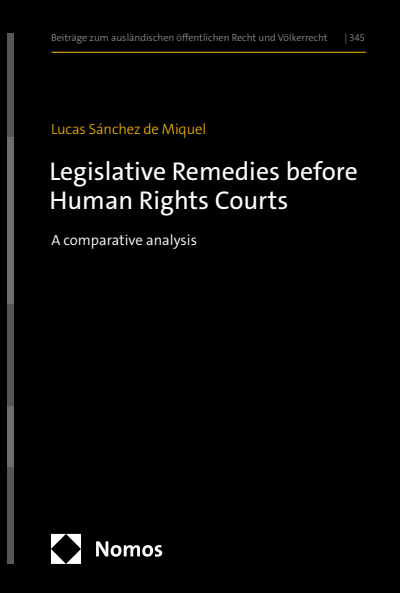
Legislative Remedies before Human Rights Courts
A comparative analysis- Autor:innen:
- Reihe:
- Beiträge zum ausländischen öffentlichen Recht und Völkerrecht, Band 345
- Verlag:
- 2025
Zusammenfassung
Dieses Buch untersucht die Anordnungen der Menschenrechtsgerichtshöfe zur Reform von innerstaatlichen Gesetzen. In dieser umfassenden Studie über gesetzgeberische Rechtsfolgemaßnahmen wird die Praxis der drei regionalen Menschenrechtsgerichtshöfe vergleichend analysiert und normativ bewertet. Es wird der Frage nachgegangen, ob diese Rechtsfolgemaßnahmen eine Besonderheit der Menschenrechtsgerichtsbarkeit sind, wann und wie sie eingesetzt werden und welche Folgen sie haben. Das Buch zeigt dabei, dass die Verwendung von gesetzgeberischen Rechtsfolgemaßnahmen das Selbstverständnis der einzelnen Menschenrechtsgerichtshöfe widerspiegelt, sowie auch den Kontext, in dem sie tätig sind, und ihre sich entwickelnde Rolle in den jeweiligen Regionen.
Schlagworte
Publikation durchsuchen
Bibliographische Angaben
- Auflage
- 1/2025
- Copyrightjahr
- 2025
- ISBN-Print
- 978-3-7560-2322-6
- ISBN-Online
- 978-3-7489-4971-8
- Verlag
- Nomos, Baden-Baden
- Reihe
- Beiträge zum ausländischen öffentlichen Recht und Völkerrecht
- Band
- 345
- Sprache
- Englisch
- Seiten
- 426
- Produkttyp
- Monographie
Inhaltsverzeichnis
KapitelSeiten
- Acknowledgements
- List of Abbreviations
- 1. “Legislative …”
- 2. “… Remedies …”
- 3. “…before Human Rights Courts”
- 1. Identifying Legislative Measures: the Special Case of Legislative Remedies before the ECtHR
- 2. Comparing the Three Regional Human Rights Courts
- III. Structure and Overview
- 1. General Obligations to Legislate
- a) Obligations to legislate in order to protect specific rights
- b) Obligations to legislate in order to protect specific groups
- c) Obligations to legislate in order to prevent and punish specific acts
- d) Obligations to modify or repeal domestic laws
- 3. Implicit Obligations to Legislate
- 4. From Obligations to Legislate to Legislative Remedies: Is There a Victims’ Right to Legislative Reforms?
- a) The ‘victim requirement’ before human rights courts
- i. Potential and possible victims before the ECtHR
- ii. Self-executing laws before the IACtHR
- iii. The absence of a victim requirement before the ACtHPR
- 2. The Advisory Review of Legislation
- 3. From the Review of Legislation to Legislative Remedies
- a) Diverging constitutional elements of regional human rights courts
- b) Individual vs. constitutional justice before human rights courts
- 2. Legislative Remedies as a Sign of Increased Constitutionalisation
- a) The effects on the domestic legal order
- b) The predominantly positive nature of legislative remedies before human rights courts
- c) The moment of the legislative process for issuing remedies
- a) The increased intrusiveness of legislative remedies
- b) The legitimacy of legislative remedies
- c) Legislative remedies and the efficiency of human rights courts
- Interim Conclusion: Domestic Laws in Three Stages of Human Rights Adjudication
- 1. The Legal Basis for the ICJ’s Remedial Competence
- 2. The Precedent at the PCIJ: Factory at Chorzów
- a) Cessation in the ICJ’s case law
- b) Legislative reforms as cessation
- a) Restitution in the ICJ’s case law
- b) Legislative reforms as restitution
- a) Compensation in the ICJ’s case law
- b) Legislative reforms as compensation
- a) Satisfaction in the ICJ’s case law
- b) Legislative reforms as satisfaction
- a) Guarantees of non-repetition in the ICJ’s case law
- b) Legislative reforms as guarantees of non-repetition
- Interim Conclusion: The Particular Functions of Remedies in General International Adjudication as a Barrier for Legislative Measures
- 1. The ARSIWA vis-à-vis the UN Basic Principles
- 2. The Special Function of Remedies in International Human Rights Adjudication
- a) The ECHR’s limited remedial provision
- b) The ACHR’s expansive remedial provision
- c) The ACHPR’s concise yet wide remedial provision
- 4. The Specialty of Remedies According to Human Rights Courts
- Interim Conclusion: The Progressive Specialisation of Remedies before Human Rights Courts
- a) The evolution of the ECtHR’s remedial practice
- b) The evolution of the IACtHR’s remedial practice
- c) The evolution of the ACtHPR’s remedial practice
- a) The remedial landscape before the European Court of Human Rights
- b) The remedial landscape before the Inter-American Court of Human Rights
- c) The remedial landscape before the African Court of Human and Peoples’ Rights
- a) Restitution
- b) Compensation
- c) Satisfaction
- d) Rehabilitation
- e) Guarantees of Non-Repetition
- 1. The Special Case of Legislative Remedies before the ECtHR
- 2. Human Rights Courts: Positive or Negative Legislators?
- 3. Legislative Remedies as Guarantees of Non-Repetition?
- Interim Conclusion: The Self-Understanding of International Courts in Light of their Remedial Practice
- a) Indigenous communities
- b) Children
- c) Prisoners
- d) Women
- e) Persons with disabilities
- i) The independence of judges and prosecutors
- ii) Restrictions to the military jurisdiction
- b) The right to be judged within a reasonable time
- c) The right to appeal before a higher court
- d) The enforcement of domestic judgments
- e) Other due process rights
- a) Property rights in the context of transitions to democracy
- b) Property rights in the context of state succession
- c) Property rights in post-conflict situations
- d) Property rights of indigenous communities
- a) The incompatibility of electoral laws before the ACtHPR
- b) Prisoners’ voting rights before the ECtHR
- c) Political participation and the rights of elected officials before the IACtHR
- a) Statelessness in the context of state succession
- b) Deprivation of citizenship in the context of migration
- a) The offences of libel, slander and defamation
- b) The regulation of public access to information
- c) Other freedom of expression-related issues
- 7. Amnesty Laws
- 8. Mandatory Death Penalty
- 9. Constitutional Issues
- 10. Codification of Criminal Offences
- 11. Others
- II. Different Intensities in the Use of Legislative Remedies
- Interim Conclusion: A Common Understanding with Different Priorities
- a) Judicial review of legislation and parliamentary sovereignty
- b) The additional complexity of the international judicial review of legislation
- 2. Deference and Democratic Conditions
- 3. A ‘Margin of Deliberation’
- 1. The ECtHR’s Margin of Appreciation Doctrine vis-à-vis the Legislature
- 2. The IACtHR’s Conventionality Control Doctrine vis-à-vis the Legislature
- a) Negative legislative remedies and the specification of a provision
- b) Positive legislative remedies and the specification of an outcome
- c) Neutral legislative remedies and the attached discretion
- a) The European approach: prescribing the introduction of a domestic remedy
- b) The Inter-American approach: referrals to the reasoning
- c) The African approach: prioritising legislative incompatibilities
- Interim Conclusion: A Margin of Deliberation for Legislative Remedies
- a) Resisting the ECtHR
- b) Limiting access to the ACtHPR
- c) Exiting the ACHR
- a) The ‘Interlaken Process’ in Europe
- b) The ‘Five Presidents Declaration’ in the Americas
- 1. Empirical Studies on Compliance with Legislative Remedies
- 2. The Reasons for the Low Rates of Compliance with Legislative Remedies
- 3. Impact beyond Compliance
- 1. Changes in the Use of Legislative Remedies
- 2. Lowering of Compliance Requirements
- Interim Conclusion: System-Dependent Consequences of Legislative Remedies
- I. Main Findings
- II. Nomative Assessment
- BibliographySeiten 367 - 396 Download Kapitel (PDF)
- A. Treaties
- 1. Permanent Court of International Justice
- 2. International Court of Justice
- 3. Inter-American Court of Human Rights
- 4. European Court of Human Rights
- 5. African Court of Human and Peoples’ Rights
- 6. Domestic Courts
- 7. Arbitral Aawards
- 1. Organization of American States
- 2. Council of Europe
- 3. African Union
- 4. United Nations
- 5. Others