, um zu prüfen, ob Sie einen Vollzugriff auf diese Publikation haben.
Sammelband Kein Zugriff
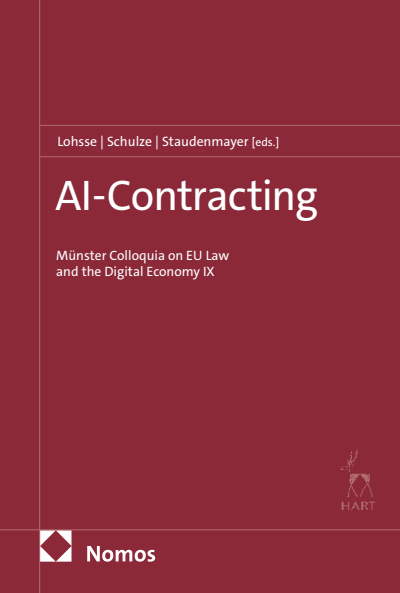
AI-Contracting
Münster Colloquia on EU Law and the Digital Economy IX- Herausgeber:innen:
- | |
- Verlag:
- 2026
Zusammenfassung
KI-Verträge werden in der Industrie zunehmend eingesetzt, da sie Kosteneinsparungen und Synergieeffekte durch einen effizienteren und schnelleren Vertragsprozess versprechen. Diese werfen neue und ungelöste Fragen auf, an die das Vertragsrecht nicht angepasst ist. Im Mittelpunkt steht die Frage, ob und inwieweit bestehende zivilrechtliche Regelungen auf Verträge anwendbar sind, die von oder mit KI-Systemen geschlossen werden. Die Beiträge untersuchen u.a. die Voraussetzungen für den Abschluss solcher Verträge, den Umfang der vorvertraglichen Informationspflichten und die Widerrufsrechte der Verbraucher. In diesem Zusammenhang wird nicht nur die dogmatische Einordnung diskutiert, sondern auch der praktische Regelungsbedarf herausgearbeitet.
Publikation durchsuchen
Bibliographische Angaben
- Auflage
- 1/2026
- Copyrightjahr
- 2026
- ISBN-Print
- 978-3-7560-3345-4
- ISBN-Online
- 978-3-7489-6309-7
- Verlag
- Nomos, Baden-Baden
- Sprache
- Englisch
- Seiten
- 321
- Produkttyp
- Sammelband
Inhaltsverzeichnis
KapitelSeiten
- Preface Kein Zugriff Seiten 1 - 6
- Autor:innen: | |
- I. Autonomous contracting as a possible challenge for contract law Kein Zugriff
- II. Responses at an international level Kein Zugriff
- 1. Scope of the UN Model Law Kein Zugriff
- 2. The ‘enabling’ approach of the UN Model Law Kein Zugriff
- 1. Fundamental questions and overarching perspectives Kein Zugriff
- a) AI as a contracting party? Kein Zugriff
- b) Attribution to the user or to the operator Kein Zugriff
- c) Validity of the Contract Kein Zugriff
- d) Conclusion of consumer contracts with AI Kein Zugriff
- 2. Attribution of knowledge and pre-contractual information duties Kein Zugriff
- a) A broad spectrum of positions Kein Zugriff
- b) The approach of the UN Model Law Kein Zugriff
- V. Conclusion – Follow-up to the UN Model Law Kein Zugriff
- Autor:innen:
- 1. Automated technologies in contracting Kein Zugriff
- 2. Developing use-cases Kein Zugriff
- 3. Benefits, costs and risks Kein Zugriff
- 1. Definitions Kein Zugriff
- 2. Scope Kein Zugriff
- a) The general rule Kein Zugriff
- b) Terms in computer code Kein Zugriff
- c) Dynamic information Kein Zugriff
- a) Clarifying who is behind an automated action Kein Zugriff
- b) How to attribute an automated action Kein Zugriff
- a) The concept of an unexpected action Kein Zugriff
- b) A specific approach to unexpected actions Kein Zugriff
- c) The delicate balance in risk allocation Kein Zugriff
- 6. Other issues Kein Zugriff
- III. Relevant areas outside the scope of the Model Law on Automated Contracting Kein Zugriff
- IV. Conclusion Kein Zugriff
- Autor:innen:
- I. Introduction Kein Zugriff
- II. AI Contracting Today Kein Zugriff
- a) Smart Contracts Kein Zugriff
- b) Artificial General Intelligence Kein Zugriff
- 2. Why Might “Intent” Matter in the Law of Contract Kein Zugriff
- a) AI as an Autonomous Legal Person Kein Zugriff
- b) AI as Agents of the User Kein Zugriff
- c) AI as a Tool to Create and Perform Contracts Kein Zugriff
- IV. Is the Real Problem the Guardrails? Kein Zugriff
- V. The Question of Mistake and Misunderstandings Kein Zugriff
- VI. Conclusion Kein Zugriff
- Autor:innen:
- Abstract: Kein Zugriff
- I. Contract law in a quandary: (AI) automated contracting or intuitu hominis contracts Kein Zugriff
- 1. From electronic contracting to automated contracting: the principle of non-discrimination in UNCITRAL texts Kein Zugriff
- 2. Principle of non-discrimination and law-compliant Automated Decision-Making in the ELI Guiding Principles Kein Zugriff
- 3. Legal recognition of automated contracting, technology neutrality, and right to use Kein Zugriff
- 1. The meaning and the relevance of attribution in automated contracting Kein Zugriff
- 2. Attribution rules and factors in the MLAC Kein Zugriff
- 3. Typology of risks and risk-allocation solutions in automated contracting Kein Zugriff
- IV. AI contracting and intuitu hominis contracts in human-machine hybrid societies Kein Zugriff
- Autor:innen:
- I. Introduction: The Enigmatic Nature of AI Contracts and Party Attribution Kein Zugriff
- 1. No legal personality to AI Kein Zugriff
- 2. The developer is too far away Kein Zugriff
- 3. The provider as the contractual partner? Kein Zugriff
- 1. UNCITRAL Model Law on Automated Contracting Kein Zugriff
- 2. ELI Guiding Principles and Model Rules on Digital Assistants for Consumer Contracts Kein Zugriff
- 3. Wendehorst Discussion Draft: Principles for AI in Contracting, Version 3.0 (PAIC 3.0) Kein Zugriff
- 1. The Operator as the Attributable Party Kein Zugriff
- 2. Limitations on Attribution: Reasonable Expectations Kein Zugriff
- 3. The Role of Agreed Procedures (Party Autonomy) Kein Zugriff
- V. Conclusion Kein Zugriff
- Autor:innen:
- I. Introduction Kein Zugriff
- 1. Defining AI Agents Kein Zugriff
- 2. The Rise of Agentic Commerce Kein Zugriff
- 1. Towards a Digital Fairness Act Kein Zugriff
- a) Rethinking Consumer Protection by Design: From Buttons to APIs Kein Zugriff
- b) Digital Vulnerability 2.0: Manipulation by and of AI Agents Kein Zugriff
- c) Shifting Focus: From Contract Law to Design Requirements for AI Agents Kein Zugriff
- d) Towards an Average Consumer Test for AI Agents? Kein Zugriff
- IV. Conclusions Kein Zugriff
- Autor:innen:
- 1. Contract Automation: From Simple Digital Tools to Autonomous Contracting Kein Zugriff
- 2. AI-Assisted Contract Drafting and Review Kein Zugriff
- 3. Contracting Through AI Agents Kein Zugriff
- 4. Broader Technological and Economic Context Kein Zugriff
- 5. Towards a New Contract Paradigm Kein Zugriff
- a) Regulatory Architecture Kein Zugriff
- b) Relevance to AI Contracting Kein Zugriff
- a) Background and Rationale Kein Zugriff
- b) Scope of Application Kein Zugriff
- aa) Legal Recognition of Automated Systems Kein Zugriff
- bb) Attribution and Legal Effects Kein Zugriff
- cc) Transparency and Disclosure Kein Zugriff
- dd) General Principles Kein Zugriff
- a) Consumer-focused, Risk-based Approach Kein Zugriff
- b) Dual Contractual Focus: Supply and Use Kein Zugriff
- c) Attribution and Legal Effects Kein Zugriff
- d) Regulatory Alignment Kein Zugriff
- 1. The Transition from Gap-Filling to Code-Filling Kein Zugriff
- 2. De-Stickying of Defaults Rules: Eroding the Nudging Effect Kein Zugriff
- 3. From Benchmarks to Black Boxes: Eroding the Yardstick Function of Default Rules Kein Zugriff
- IV. Conclusion: Towards AI-Responsive Default Rules Kein Zugriff
- Autor:innen:
- I. Introduction Kein Zugriff
- II. Knowledge, Information, and AI systems Kein Zugriff
- III. The ELI DACC and information duties Kein Zugriff
- IV. Attribution in other model rules Kein Zugriff
- V. Conclusions Kein Zugriff
- Autor:innen:
- I. Introduction Kein Zugriff
- 1. AI Kein Zugriff
- 2. Automation & Autonomy Kein Zugriff
- 3. Agents Kein Zugriff
- III. Objectivity and Technology Neutrality of Contract Law Kein Zugriff
- IV. Vending Machines as Examples of Technological Progress Kein Zugriff
- V. The Model Law on Automated Contracting Kein Zugriff
- VI. Final Observations Kein Zugriff
- Autor:innen:
- Abstract Kein Zugriff
- I. Introduction Kein Zugriff
- a) US Uniform Electronic Transactions Act (UETA) 1999 Kein Zugriff
- b) Electronic Signatures in Global and National Commerce Act (ESIGN) 2000 Kein Zugriff
- c) Model Computer Information Transactions Act (MCITA) 1999/2002 Kein Zugriff
- d) Draft Article 2 Uniform Commercial Code (UCC) 2003 Kein Zugriff
- e) Canadian Uniform Electronic Commerce Act (Consolidation) 2011 Kein Zugriff
- f) E-Commerce Law of the People’s Republic of China 2018 Kein Zugriff
- g) Guernsey Electronic Transactions (Electronic Agents) Ordinance 2019 Kein Zugriff
- a) German Federal Supreme Court on mistake in computer declarations Kein Zugriff
- b) Singapore Court of Appeal: Quoine v B2C2 Kein Zugriff
- aa) The 2005 UN Convention on the Use of Electronic Communications in International Contracts Kein Zugriff
- bb) Further UNCITRAL work in the field Kein Zugriff
- aa) Background and general aspects Kein Zugriff
- bb) Attribution Kein Zugriff
- cc) Unexpected outcomes Kein Zugriff
- a) The 2023 Interim Report on “ADM readiness” Kein Zugriff
- aa) Background and general aspects Kein Zugriff
- bb) Attribution and unexpected outcomes Kein Zugriff
- a) Background and relationship with UNCITRAL and ELI work Kein Zugriff
- aa) Level 1: Identification of operator Kein Zugriff
- bb) Level 2: Attribution of the electronic agent as such Kein Zugriff
- cc) Level 3: Attribution of the concrete output Kein Zugriff
- aa) Relationship with Part III on framework arrangements Kein Zugriff
- bb) Relationship with Part IV on the application of general contract law Kein Zugriff
- Comments: Kein Zugriff
- Comments: Kein Zugriff
- Comments: Kein Zugriff
- Comments: Kein Zugriff
- Comments: Kein Zugriff
- Comments: Kein Zugriff
- Comments: Kein Zugriff
- Comments: Kein Zugriff
- Comments: Kein Zugriff
- Comments: Kein Zugriff
- Comments: Kein Zugriff
- Comments: Kein Zugriff
- Comments: Kein Zugriff
- Comments: Kein Zugriff
- Comments: Kein Zugriff
- Comments: Kein Zugriff
- Comments: Kein Zugriff
- Autor:innen:
- I. The new world of AI contracting Kein Zugriff
- 1. The common core: Error, fraud, and duress Kein Zugriff
- 2. German law and the PECL Kein Zugriff
- 1. What is AI? Kein Zugriff
- 2. AI is not human Kein Zugriff
- aa) Attribution of the refrigerator’s order Kein Zugriff
- bb) Relevance of the error Kein Zugriff
- b) PECL Kein Zugriff
- c) The proposed rules Kein Zugriff
- a) German law Kein Zugriff
- b) PECL Kein Zugriff
- c) The proposed rules Kein Zugriff
- 3. Prompt injection Kein Zugriff
- a) German law Kein Zugriff
- b) PECL Kein Zugriff
- c) The proposed rules Kein Zugriff
- d) Threats against AI systems Kein Zugriff
- V. Conclusion Kein Zugriff