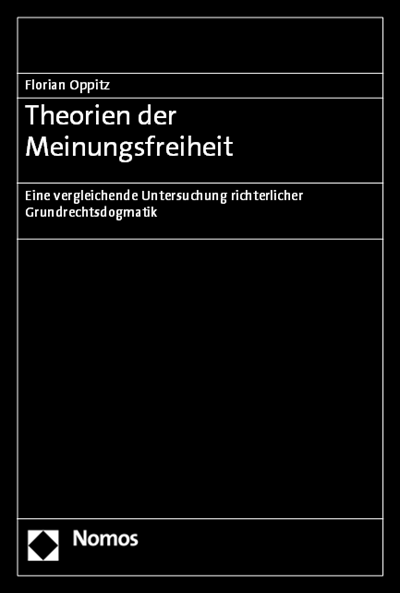
Theorien der Meinungsfreiheit
Eine vergleichende Untersuchung richterlicher Grundrechtsdogmatik- Autor:innen:
- Verlag:
- 2018
Zusammenfassung
Die gerichtliche Interpretation des Grundrechts auf Meinungsfreiheit folgt drei Theorien: Free speech, freedom of expression oder Meinungsfreiheit sollen geschützt sein, weil es der Demokratie, der Entfaltung der Persönlichkeit und der Suche nach Wahrheit zugutekommt. Das Buch analysiert, wie das BVerfG, der EGMR und der US Supreme Court diese Theorien gebildet und in ihrer Rechtsprechung zur Meinungsfreiheit angewendet haben.
Die Theorie eines Grundrechts bildet die Schnittmenge von Rechtswissenschaft und Rechtsphilosophie. Die Gerichte entwickeln aber keinen vollständigen theoretischen Entwürfen, sodass ihre Ansichten zu Demokratie, Persönlichkeit und Wahrheit aus verstreuten Theorie-Formeln der Urteile rekonstruiert werden müssen. Ein Vergleich mit den entsprechenden philosophischen Theoriebildungen zeigt, wie die richterliche Grundrechtstheorie einerseits keinem einzelnen philosophischen System zugeordnet werden kann, andererseits auch in sich selbst wenig konsistent ist.
Publikation durchsuchen
Bibliographische Angaben
- Auflage
- 1/2018
- Copyrightjahr
- 2018
- ISBN-Print
- 978-3-8487-5038-2
- ISBN-Online
- 978-3-8452-9210-6
- Verlag
- Nomos, Baden-Baden
- Sprache
- Deutsch
- Seiten
- 264
- Produkttyp
- Monographie
Inhaltsverzeichnis
- Titelei/Inhaltsverzeichnis Kein Zugriff Seiten 1 - 12
- 1. Einleitung Kein Zugriff Seiten 13 - 26
- 2.1. Theorie und Schutzbereich Kein Zugriff
- 2.2. Theorie und Abwägung Kein Zugriff
- 2.3.1. Rawls Kein Zugriff
- 2.3.2. Dworkin Kein Zugriff
- 2.3.3. Habermas Kein Zugriff
- 2.3.4. Somek Kein Zugriff
- 3.1.1. Die Persönlichkeit Kein Zugriff
- 3.1.2. Die Kritik der rechtswissenschaftlichen Forschung Kein Zugriff
- 3.1.3. Persönlichkeitsbilder Kein Zugriff
- 3.1.4. Selbstbestimmung als Grundprinzip Kein Zugriff
- 3.2.1. Von Kant bis Schelling Kein Zugriff
- 3.2.2. Hegel Kein Zugriff
- 3.3. Theorieformeln Kein Zugriff
- 4.1.1. „In einer demokratischen Gesellschaft“ Kein Zugriff
- 4.1.2. Das Recht auf freie Wahlen Kein Zugriff
- 4.1.3.1. Pluralismus Kein Zugriff
- 4.1.3.2. Frieden Kein Zugriff
- 4.1.3.3. Respekt Kein Zugriff
- 4.2.1. Schutzdemokratie und Entwicklungsdemokratie Kein Zugriff
- 4.2.2. Gesetzesdemokratie und Beteiligungsdemokratie Kein Zugriff
- 4.2.3. Elitendemokratie und Beratungsdemokratie Kein Zugriff
- 4.3. Die Demokratie-Theorie des EGMR Kein Zugriff
- 5.1.1. Der Staat als Verpflichteter des Grundrechts Kein Zugriff
- 5.1.2.1. Anstiftung zum Rechtsbruch Kein Zugriff
- 5.1.2.2. Beschimpfungen Kein Zugriff
- 5.1.2.3. Obszönität (Obscenity) Kein Zugriff
- 5.1.3.1. Inhaltsbezogene Normen Kein Zugriff
- 5.1.3.2. Zensur (Prior Restraint) Kein Zugriff
- 5.1.3.3. Üble Nachrede (Defamation) Kein Zugriff
- 5.1.3.4. Verletzung der Privatsphäre Kein Zugriff
- 5.1.4.1. Werbung (Commercial Speech) Kein Zugriff
- 5.1.4.2. Inhaltsneutrale Einschränkungen Kein Zugriff
- 5.1.4.3. Parteispenden und Wahlkampfausgaben Kein Zugriff
- 5.1.5.1. Staatsbedienstete Kein Zugriff
- 5.1.5.2. Heeresdienst Kein Zugriff
- 5.1.5.3. Gefängnisse Kein Zugriff
- 5.1.5.4. Schulen Kein Zugriff
- 5.1.6. Die Medien Kein Zugriff
- 5.2.1. Die Geschichte des Ideenmarktes Kein Zugriff
- 5.2.2. Die Gebrauchsweise des Ausdrucks „Ideenmarkt“ Kein Zugriff
- 5.3.1. Wahrheit als philosophischer Begriff Kein Zugriff
- 5.3.2.1. Charles Sanders Peirce Kein Zugriff
- 5.3.2.2. John Stuart Mill Kein Zugriff
- 5.3.3.1. Externe Kritik: Kein Markt Kein Zugriff
- 5.3.3.2. Interne Kritik: Marktversagen Kein Zugriff
- 6. Ergebnisse Kein Zugriff Seiten 249 - 252
- Literatur Kein Zugriff Seiten 253 - 264
Literaturverzeichnis (270 Einträge)
Es wurden keine Treffer gefunden. Versuchen Sie einen anderen Begriff.
- Ackerloff, G, The Market for ‚Lemons‘: Qualitative Uncertainty and the Market Mechanism, 84 The Quarterly Journal of Economics (1970) 488 Google Scholar öffnen DOI: 10.5771/9783845292106
- Adler, A, Performance Anxiety: Medusa, Sex, and the First Amendment, 21 Yale Journal of Law & the Humanities (2009) 227 Google Scholar öffnen DOI: 10.5771/9783845292106
- Alexander, L, Low Value Speech, 83 Northwestern University Law Review (1989) 547 Google Scholar öffnen DOI: 10.5771/9783845292106
- Alexander, L / Horton, P, The Impossibility of a Free Speech Principle, 78 Northwestern University Law Review (1984) 1319 Google Scholar öffnen DOI: 10.5771/9783845292106
- Alexy, R, On Balancing and Subsumption. A Structural Comparison, Ratio Juris 16 (2003) 443 Google Scholar öffnen DOI: 10.5771/9783845292106
- Alexy, R, Theorie der Grundrechte (1985), Frankfurt/M (1994) Google Scholar öffnen DOI: 10.5771/9783845292106
- Arai, Y, Article 10: Freedom of Expression, in: Harris, D / O’Boyle, M / Warbrick, C (Hg), Law of the European Convention on Human Rights2, Oxford-New York (2009) 443 Google Scholar öffnen DOI: 10.5771/9783845292106
- Badura, P / Dreier, H (Hg) Festschrift - 50 Jahre Bundesverfassungsgericht, Tübingen (2001) Google Scholar öffnen DOI: 10.5771/9783845292106
- Baker, C E, Scope of the First Amendment Freedom of Speech, 25 UCLA Law Review (1978) 964 Google Scholar öffnen DOI: 10.5771/9783845292106
- Baldus, M, Der Kernbereich privater Lebensgestaltung – absolut geschützt, aber abwägungsoffen, JZ 2008, 218 Google Scholar öffnen DOI: 10.5771/9783845292106
- Bambauer, D E, Shopping Badly, 77 University of Colorado Law Review (2006) 649 Google Scholar öffnen DOI: 10.5771/9783845292106
- Barber, B R, Three Scenarios for the Future of Technology and Strong Democracy, 113 Political Science Quarterly (1998/99) 573 Google Scholar öffnen DOI: 10.5771/9783845292106
- Barendt, E, Freedom of Speech2, Oxford - New York (2005) Google Scholar öffnen DOI: 10.5771/9783845292106
- Bar-Gil, O / Parchomovsky, G, A Marketplace for Ideas?, 84 Texas Law Review (2005/06) 395 Google Scholar öffnen DOI: 10.5771/9783845292106
- Barron, J A, The Pentagon Papers Case and the Wikileaks Controversy: National Security and the First Amendment, 1 Wake Forest Journal of Law and Policy (2011) 49 Google Scholar öffnen DOI: 10.5771/9783845292106
- Bedau, H A, „Anarchical Fallacies”. Bentham’s Attack on Human Rights, 22 Human Rights Quarterly (2000) 261 Google Scholar öffnen DOI: 10.5771/9783845292106
- Bell, D, John Stuart Mill on Colonies, 38 Political Theory (2010) 34 Google Scholar öffnen DOI: 10.5771/9783845292106
- Bell, J, O Say, Can You See: Free Expression by the light of Fiery Crosses, 39 Harvard Civil Rights – Civil Liberties Law Review (2004) 335 Google Scholar öffnen DOI: 10.5771/9783845292106
- Bellamy, R, ‚Dethroning Politics‘: Liberalism, Constitutionalism and Democracy in the Thought of F. A. Hayek, 24 British Journal of Political Science (1994) 419 Google Scholar öffnen DOI: 10.5771/9783845292106
- Benhabib, S, Another Universalism: On the Unity and Diversity of Human Rights, 81 Proceedings and Addresses of the American Philosophical Association (2007) 7 Google Scholar öffnen DOI: 10.5771/9783845292106
- Bentham, J, An Introduction to the Principles of Morals and Legislation, London (1789) Google Scholar öffnen DOI: 10.5771/9783845292106
- Bentham, J, Principles of Penal Law, London (1771) Google Scholar öffnen DOI: 10.5771/9783845292106
- Berka, W, Die Gesetzesvorbehalte der Europäischen Menschenrechtskonvention, ZÖR (1986) 71 Google Scholar öffnen DOI: 10.5771/9783845292106
- Berka, W, Medienfreiheit und Persönlichkeitsschutz, Wien - New York (1982) Google Scholar öffnen DOI: 10.5771/9783845292106
- Bezanson, R P, The Government Speech Forum, 83 Iowa Law Review (1998) 953 Google Scholar öffnen DOI: 10.5771/9783845292106
- Bezemek, C, Freie Meinungsäußerung, Wien (2015) Google Scholar öffnen DOI: 10.5771/9783845292106
- Blackburn, S, Truth. A Guide for the Perplexed, London (2005) Google Scholar öffnen DOI: 10.5771/9783845292106
- Blocher, J, Institutions in the Marketplace of Ideas, Duke Law Journal (2008) 821 Google Scholar öffnen DOI: 10.5771/9783845292106
- Bloustein, E J, The Origin, Validity, and Interrelationships of the Political Values Served by Freedom of Expression, 33 Rutgers Law Review (1981) 372 Google Scholar öffnen DOI: 10.5771/9783845292106
- Bowring, B, Negating Pluralist Democracy: The European Court of Human Rights Forgets the Rights of the Electors, KHRP Legal Review Volume 11 (2007) 71 Google Scholar öffnen DOI: 10.5771/9783845292106
- Brennan, W J, The Supreme Court and the Meiklejohn Interpretation of the First Amendment, 79 Harvard Law Review (1965) 1 Google Scholar öffnen DOI: 10.5771/9783845292106
- Britz, G, Freie Entfaltung durch Selbstdarstellung, Tübingen (2007) Google Scholar öffnen DOI: 10.5771/9783845292106
- Brugger, W, Grundrechte und Verfassungsgerichtsbarkeit in den Vereinigten Staaten von Amerika, Tübingen (1987) Google Scholar öffnen DOI: 10.5771/9783845292106
- Buchheim, T / Hermanni, F (Hg), „Alle Persönlichkeit ruht auf einem dunkeln Grunde“. Schellings Philosophie der Personalität, Berlin (2004) Google Scholar öffnen DOI: 10.5771/9783845292106
- Bush, D, The ‘Marketplace of Ideas:’ Is Judge Posner Chasing Don Quixote’s Windmills?, 32 Arizona State Law Journal (2000) 1107 Google Scholar öffnen DOI: 10.5771/9783845292106
- Calvert, M D / Bunker C, An „Actual Problem” in First Amendment Jurisprudence? Examining the Immediate Impact of Brown’s Proof-of-Causation Doctrine on Free Speech and Its Compatibility with the Marketplace Theory. 35 Hastings Communications & Entertainment Law Journal (2013) 391 Google Scholar öffnen DOI: 10.5771/9783845292106
- Carmi, G E, Dignity – The Enemy from Within, 9 Journal of Constitutional Law (2007) 957 Google Scholar öffnen DOI: 10.5771/9783845292106
- Carnap, R, Wahrheit und Bewährung (1936), in: Skirbekk, G, Wahrheitstheorien (1977) 89 Google Scholar öffnen DOI: 10.5771/9783845292106
- Cass, R A, Commercial Speech, Constitutionalism, Collective Choice, 56 Cincinnati Law Review (1988) 1317 Google Scholar öffnen DOI: 10.5771/9783845292106
- Cass, R A, The Perils of Positive Thinking: Constitutional Interpretation and Negative First Amendment Theory, 34 UCLA Law Review (1987) 1405 Google Scholar öffnen DOI: 10.5771/9783845292106
- Chemerinsky, E, Constitutional Law5, New York (2015) Google Scholar öffnen DOI: 10.5771/9783845292106
- Chemerinsky, E, Content Neutrality as a Central Problem of Freedom of Speech, 74 Southern California Law Review (2000) 49 Google Scholar öffnen DOI: 10.5771/9783845292106
- Coase, R, The Market for Goods and the Market for Ideas, 64 The American Economic Review (1974) 384 Google Scholar öffnen DOI: 10.5771/9783845292106
- Coase, R, The Problem of Social Cost, 3 Journal of Law and Economics (1960) 1 Google Scholar öffnen DOI: 10.5771/9783845292106
- Cohen-Eliya, M / Porat, I, American balancing and German proportionality: The historical origins, 8 International Journal of Constitutional Law (2010) 263 Google Scholar öffnen DOI: 10.5771/9783845292106
- Cornils, M, § 168 – Allgemeine Handlungsfreiheit, in: Isensee, J / Kirchhof, P (Hg), Handbuch des Staatsrechts VII, Heidelberg (2009) Google Scholar öffnen DOI: 10.5771/9783845292106
- Cunningham, F, Theories of Democracy. A Critical Introduction, London (2002) Google Scholar öffnen DOI: 10.5771/9783845292106
- Degenhart, C, Die allgemeine Handlungsfreiheit des Art 2 I GG, JuS 1990, 161 Google Scholar öffnen DOI: 10.5771/9783845292106
- Denninger, E et al (Hg), Kommentar zum Grundgesetz für die Bundesrepublik Deutschland3, München (2003) Google Scholar öffnen DOI: 10.5771/9783845292106
- Desoi, M / Knierim, A, Intimsphäre und Kernbereichsschutz, DÖV 2011, 398 Google Scholar öffnen DOI: 10.5771/9783845292106
- Di Fabio, U, Zur Theorie eines grundrechtlichen Wertesystems, in: Merten, D / Papier, H-J (Hg) Handbuch der Grundrechte in Deutschland und Europa II, Heidelberg (2006) § 46 Google Scholar öffnen DOI: 10.5771/9783845292106
- Dicke, K, „The Marketplace of Ideas“ und der menschenrechtliche Gehalt der Meinungsfreiheit, in: Schwardtländer, J / Willoweit, D (Hg), Meinungsfreiheit – Grundgedanken und Geschichte in Europa und USA, Kehl/Rhein (1986) 65 Google Scholar öffnen DOI: 10.5771/9783845292106
- Dreier, H (Hg), Grundgesetz. Kommentar, Tübingen (1996) Google Scholar öffnen DOI: 10.5771/9783845292106
- Dreier, H, Art 2 I, in: Dreier, H (Hg), Grundgesetz. Kommentar, Tübingen (1996) Google Scholar öffnen DOI: 10.5771/9783845292106
- Dürig, G, Der Grundrechtssatz von der Menschenwürde, AöR 81 (1956) 117 Google Scholar öffnen DOI: 10.5771/9783845292106
- Duttge, G, Freiheit für alle oder allgemeine Handlungsfreiheit?, NJW 1997, 3353 Google Scholar öffnen DOI: 10.5771/9783845292106
- Dworkin, R, Justice for Hedgehogs, Cambridge - London (2011) Google Scholar öffnen DOI: 10.5771/9783845292106
- Dworkin, R, Rights as Trumps, in: Waldron, J (Hg), Theories of Rights, Oxford - New York (1984) 153 Google Scholar öffnen DOI: 10.5771/9783845292106
- Dworkin, R, Sovereign Virtue, Cambridge - London (2000) Google Scholar öffnen DOI: 10.5771/9783845292106
- Dworkin, R, Taking Rights Seriously, Cambridge - London (1977) Google Scholar öffnen DOI: 10.5771/9783845292106
- Eiffler, S, Die ‘wehrhafte Demokratie’ in der Rechtsprechung des Europäischen Gerichtshofs für Menschenrechte, Kritische Justiz 2003, 218 Google Scholar öffnen DOI: 10.5771/9783845292106
- Engelmann, S G, „Indirect Legislation“: Bentham’s Liberal Government, 35 Polity (2003) 369 Google Scholar öffnen DOI: 10.5771/9783845292106
- Errera, R, Freedom of Speech in Europe, in: Nolte, G (Hg), European and US Constitutionalism, Cambridge (2005) 23 Google Scholar öffnen DOI: 10.5771/9783845292106
- Evers, H-U, Zur Auslegung von Art 2 Abs I des Grundgesetzes, insbesondere zur Persönlichkeitskerntheorie, AöR 90 (1965) 88 Google Scholar öffnen DOI: 10.5771/9783845292106
- Fagundes, D, State Actors as First Amendment Speakers, 100 Northwestern University Law Review (2006) 1637 Google Scholar öffnen DOI: 10.5771/9783845292106
- Fallon, R H, Two Senses of Autonomy, 46 Stanford Law Review (1994) 875 Google Scholar öffnen DOI: 10.5771/9783845292106
- Farber, D, The First Amendment2, St Paul, MN (2003) Google Scholar öffnen DOI: 10.5771/9783845292106
- Fichte, J G, Grundlage des Naturrechts (1796/1797), in: Medicus, F (Hg), Fichte. Werke, Auswahl in sechs Bänden II, Leipzig (1926) Google Scholar öffnen DOI: 10.5771/9783845292106
- Fichte, J G, Sonnenklarer Bericht an das größere Publikum, über das eigentliche Wesen der neuesten Philosophie, Berlin (1801) Google Scholar öffnen DOI: 10.5771/9783845292106
- Fichte, J G, Die Staatslehre (1813), postum Berlin (1820) Google Scholar öffnen DOI: 10.5771/9783845292106
- Fichte, J G, Zweite Einleitung in die Wissenschaftslehre (1797), in: Medicus, F (Hg), Fichte. Werke, Auswahl in sechs Bänden III, Leipzig (1926) Google Scholar öffnen DOI: 10.5771/9783845292106
- Fish, S, Fraught with Death, 64 University of Colorado Law Review (1993) 1061 Google Scholar öffnen DOI: 10.5771/9783845292106
- Ford, J C, The Fundamentals of Holmes‘ Juristic Philosophy, 11 Fordham Law Review (1942) 255 Google Scholar öffnen DOI: 10.5771/9783845292106
- Friauf, K H / Höfling, W (Hg), Berliner Kommentar zum Grundgesetz, Berlin (2000 -) Google Scholar öffnen DOI: 10.5771/9783845292106
- Frowein, J A, Meinungsfreiheit und Demokratie, EuGRZ 2008, 117 Google Scholar öffnen DOI: 10.5771/9783845292106
- Galloway, R W, Basic Free Speech Analysis, 31 Santa Clara L. Rev. (1991) 883 Google Scholar öffnen DOI: 10.5771/9783845292106
- Galuppo, M C, „Constitutional Hermeneutics and Pluralism“, in: Soeteman, A (Hg), „Pluralism and Law: Proceedings of the 20th IVR World Congress Amsterdam“, Stuttgart 2001 (2003) Vol 2, 128 Google Scholar öffnen DOI: 10.5771/9783845292106
- Garibaldi, O M, On the Ideological Content of Human Rights Instruments. The Clause ‘In a Democratic Society’, in: Buergenthal, T (Hg) Contemporary Issues in International Law, Kehl/Rhein (1984) 23 Google Scholar öffnen DOI: 10.5771/9783845292106
- Goethe, J W und Schiller, F, Über epische und dramatische Dichtung (1797), in: Wiese, B (Hg) Deutsche Dramaturgie4, Tübingen (1979) Google Scholar öffnen DOI: 10.5771/9783845292106
- Goethe, J W, Aus meinem Leben. Dichtung und Wahrheit (1808), Goethe’s Werke, 25. Band, Stuttgart – Tübingen 1830 Google Scholar öffnen DOI: 10.5771/9783845292106
- Goethe, J W, Wilhelm Meisters Lehrjahre. Dritter Band, Berlin (1795) Google Scholar öffnen DOI: 10.5771/9783845292106
- Goethe, J W, Zahme Xenien III (1823), Goethe’s Werke, 3. Band, Stuttgart – Tübingen 1827 Google Scholar öffnen DOI: 10.5771/9783845292106
- Goldman, A I / Cox, J C, Speech, Truth and the Free Market for Ideas, 2 Legal Theory (1996) 1 Google Scholar öffnen DOI: 10.5771/9783845292106
- Goldman, A I / Shaked, M, An Economic Model of Scientific Activity and Truth Acquisition, 63 Philosophical Studies (1991) 31 Google Scholar öffnen DOI: 10.5771/9783845292106
- Grabenwarter, C / Pabel, K, Europäische Menschenrechtskonvention5, München-Basel-Wien (2012) Google Scholar öffnen DOI: 10.5771/9783845292106
- Greenawalt, K, Free Speech Justifications, 89 Columbia Law Review (1989) 119 Google Scholar öffnen DOI: 10.5771/9783845292106
- Greenawalt, K, Insults and Epithets: Are They Protected Speech?, 42 Rutgers Law Review (1990) 287 Google Scholar öffnen DOI: 10.5771/9783845292106
- Greer, S, ‘Balancing’ and the European Court of Human Rights: A Contribution to the Habermas-Alexy Debate, 63 Cambridge Law Journal (2004) 412 Google Scholar öffnen DOI: 10.5771/9783845292106
- Grimm, D, Soziale Voraussetzungen und verfassungsrechtliche Gewährleistungen der Meinungsfreiheit, in: Schwardtländer, J / Willoweit, D (Hg), Meinungsfreiheit – Grundgedanken und Geschichte in Europa und USA, Kehl/Rhein (1986) 65 Google Scholar öffnen DOI: 10.5771/9783845292106
- Günther, K, Ein normativer Begriff von Kohärenz für eine Theorie der juristischen Argumentation, Rechtstheorie (1989) 163 Google Scholar öffnen DOI: 10.5771/9783845292106
- Haack, S, The Pragmatist Theory of Truth, 27 The British Journal for the Philosophy of Science (1976) 231 Google Scholar öffnen DOI: 10.5771/9783845292106
- Habermas, J, Faktizität und Geltung, Frankfurt/Main (1992) Google Scholar öffnen DOI: 10.5771/9783845292106
- Habermas, J, Vorbereitende Bemerkungen zu einer Theorie der kommunikativen Kompetenz, in: Habermas, J / Luhmann, N, Theorie der Gesellschaft oder Sozialtechnologie?, Frankfurt/Main (1971) 136 Google Scholar öffnen DOI: 10.5771/9783845292106
- Habermas, J / Luhmann, N, Theorie der Gesellschaft oder Sozialtechnologie?, Frankfurt/Main (1971) Google Scholar öffnen DOI: 10.5771/9783845292106
- Hain, K-E, Konkretisierung der Menschenwürde durch Abwägung?, Der Staat 45 (2006) 189 Google Scholar öffnen DOI: 10.5771/9783845292106
- Harris, D / O’Boyle, M / Warbrick, C (Hg), Law of the European Convention on Human Rights2, Oxford-New York (2009) Google Scholar öffnen DOI: 10.5771/9783845292106
- Hayek, F A, Law, Legislation and Liberty, Vol 2, Chicago (1973) Google Scholar öffnen DOI: 10.5771/9783845292106
- Hayek, F A, Law, Legislation and Liberty, Vol 3, Chicago (1973) Google Scholar öffnen DOI: 10.5771/9783845292106
- Hayek, F A, The Constitution of Liberty, Chicago (1960) Google Scholar öffnen DOI: 10.5771/9783845292106
- Healy, T, The Justice Who Changed His Mind, 39 Journal of Supreme Court History (2014) 35 Google Scholar öffnen DOI: 10.5771/9783845292106
- Hegel, G W F, Grundlinien der Philosophie des Rechts (1820), Werke Band 7, Frankfurt/Main (1986) Google Scholar öffnen DOI: 10.5771/9783845292106
- Hegel, G W F, Phänomenologie des Geistes (1807), Werke Band 3, Frankfurt/Main (1986) Google Scholar öffnen DOI: 10.5771/9783845292106
- Hegel, G W F, Philosophische Propädeutik (1808-1813), Werke Band 4, Frankfurt/Main (1986) Google Scholar öffnen DOI: 10.5771/9783845292106
- Heinrich, R, Wahrheit, Stuttgart (2009) Google Scholar öffnen DOI: 10.5771/9783845292106
- Heins, M, Viewpoint Discrimination, 24 Hastings Constitutional Law Quarterly (1996) 99 Google Scholar öffnen DOI: 10.5771/9783845292106
- Heißl, G, Grundrechtskollisionen, Wien (2017) Google Scholar öffnen DOI: 10.5771/9783845292106
- Held, D, Models of Democracy3, Cambridge-Malden (2006) Google Scholar öffnen DOI: 10.5771/9783845292106
- Hesse, K, Grundzüge des Verfassungsrechts der Bundesrepublik Deuschland8, Heidelberg (1975) Google Scholar öffnen DOI: 10.5771/9783845292106
- Heyman, S J, Ideological Conflict and the First Amendment, 78 Chicago-Kent Law Review (2003) 531 Google Scholar öffnen DOI: 10.5771/9783845292106
- Heyman, S J, Righting the Balance. An Inquiry into the Foundations and Limits of Freedom of Expression, 78 Boston University Law Review (1998) 1275 Google Scholar öffnen DOI: 10.5771/9783845292106
- Hochhuth, M, Die Meinungsfreiheit im System des Grundgesetzes, Tübingen (2007) Google Scholar öffnen DOI: 10.5771/9783845292106
- Höfling, W, Art 2, in: Friauf, K H / Höfling, W (Hg), Berliner Kommentar zum Grundgesetz, Berlin (2000 -) Google Scholar öffnen DOI: 10.5771/9783845292106
- Hofmann, H, Menschenrechtliche Autonomieansprüche, JZ 1992, 165 Google Scholar öffnen DOI: 10.5771/9783845292106
- Holmes, O W, The Gas-Strokers‘ Strike, 7 American Law Review (1873) 582 Google Scholar öffnen DOI: 10.5771/9783845292106
- Hopkins, W W, The Supreme Court Defines the Marketplace of Ideas, 73 Journalism and Mass Communications Quarterly (1996) 41 Google Scholar öffnen DOI: 10.5771/9783845292106
- Hoppe, H-H, F. A. Hayek on Government and Social Evolution: A Critique, 7 The Review of Austrian Economics (1994) 67 Google Scholar öffnen DOI: 10.5771/9783845292106
- Ho, D E / Schauer, F, Testing the Marketplace of Ideas, 90 New York University Law Review (2015) 1160 Google Scholar öffnen DOI: 10.5771/9783845292106
- Hufen, F, Schutz der Persönlichkeit und Recht auf informationelle Selbstbestimmung, in: Badura, P / Dreier, H (Hg) Festschrift - 50 Jahre Bundesverfassungsgericht, Band II, Tübingen (2001) 105 Google Scholar öffnen DOI: 10.5771/9783845292106
- Hutter, A, Das geschichtliche Wesen der Personalität, in: Buchheim, T / Hermanni, F (Hg), „Alle Persönlichkeit ruht auf einem dunkeln Grunde“. Schellings Philosophie der Personalität, Berlin (2004) 73. Google Scholar öffnen DOI: 10.5771/9783845292106
- Ignatieff, M (Hg), American Exceptionalism and Human Rights, Princeton (2005) Google Scholar öffnen DOI: 10.5771/9783845292106
- Ingber, S, The Marketplace of Ideas. A Legitimizing Myth, 1984 Duke Law Journal 1 Google Scholar öffnen DOI: 10.5771/9783845292106
- Isensee, J / Kirchhof, P (Hg), Handbuch des Staatsrechts III, Heidelberg (2005) Google Scholar öffnen DOI: 10.5771/9783845292106
- Isensee, J / Kirchhof, P (Hg), Handbuch des Staatsrechts VII, Heidelberg (2009) Google Scholar öffnen DOI: 10.5771/9783845292106
- James, W, Der Wahrheitsbegriff des Pragmatismus, in: Skirbekk, G, Wahrheitstheorien (1977) 49 Google Scholar öffnen DOI: 10.5771/9783845292106
- Jarass, H D / Pieroth, B, Grundgesetz für die Bundesrepublik Deutschland. Kommentar14, München (2016) Google Scholar öffnen DOI: 10.5771/9783845292106
- Jestaedt, M, Meinungsfreiheit, in: Merten, D / Papier, H-J (Hg) Handbuch der Grundrechte in Deutschland und Europa IV, Heidelberg (2011) 875 Google Scholar öffnen DOI: 10.5771/9783845292106
- Johnson, K, Government by Insurance Company, 29 Western Political Quarterly (1976) 177 Google Scholar öffnen DOI: 10.5771/9783845292106
- Joo, T, The Worst Test of Truth: The ‘Marketplace of Ideas’ as Faulty Metaphor, 89 Tulane Law Review (2014) 383 Google Scholar öffnen DOI: 10.5771/9783845292106
- Kahl, W, Neuere Entwicklungslinien der Grundrechtsdogmatik, AöR 131 (2006) 579 Google Scholar öffnen DOI: 10.5771/9783845292106
- Kahl, W, Vom weiten Schutzbereich zum engen Gewährleistungsgehalt, Der Staat 2004, 167 Google Scholar öffnen DOI: 10.5771/9783845292106
- Kalven, The New York Times Case. A Note on ‘The Central Meaning of the First Amendment’, The Supreme Court Review (1964) 191 Google Scholar öffnen DOI: 10.5771/9783845292106
- Kant, I, Die Metaphysik der Sitten (1797), Akademieausgabe Band VI, Berlin (1907) Google Scholar öffnen DOI: 10.5771/9783845292106
- Kant, I, Die Religion innerhalb der Grenzen der bloßen Vernunft (1793), Akademieausgabe Band VI, Berlin (1907) Google Scholar öffnen DOI: 10.5771/9783845292106
- Kant, I, Grundlegung zur Metaphysik der Sitten (1785), Akademieausgabe Band IV, Berlin (1911) Google Scholar öffnen DOI: 10.5771/9783845292106
- Kant, I, Handschriftlicher Nachlass, Akademieausgabe Band XVIII, Berlin (1928) Google Scholar öffnen DOI: 10.5771/9783845292106
- Kant, I, Kritik der praktischen Vernunft (1788), Akademieausgabe Band V, Berlin (1913) Google Scholar öffnen DOI: 10.5771/9783845292106
- Kant, I, Kritik der Urteilskraft (1790), Akademieausgabe Band V, Berlin (1913) Google Scholar öffnen DOI: 10.5771/9783845292106
- Karst, K L, Equality as a Central Principle in the First Amendment, 43 University of Chicago Law Review (1975) 20 Google Scholar öffnen DOI: 10.5771/9783845292106
- Keane, D, Attacking Hate Speech under Article 17 of the European Convention on Human Rights, Netherlands Quarterly of Human Rights, Vol. 25/4 (2007) 641 Google Scholar öffnen DOI: 10.5771/9783845292106
- Kersch, K I, How Conduct Became Speech and Speech Became Conduct, 8 University of Pennsylvania Journal of Constitutional Law (2006) 255 Google Scholar öffnen DOI: 10.5771/9783845292106
- Kirkham, R L, Theories of Truth, Cambridge-London (1992) Google Scholar öffnen DOI: 10.5771/9783845292106
- Kozel, R J, Reconceptualizing Public Employee Speech, 99 Northwestern University Law Review (2005) 1007 Google Scholar öffnen DOI: 10.5771/9783845292106
- Krotoszynski, R J, Dissent, Free Speech, and the Continuing Search for the ‘Central Meaning’ of the First Amendment, 98 Michigan Law Review (2000) 1613 Google Scholar öffnen DOI: 10.5771/9783845292106
- Krüger, H, Neues zur Freiheit der Persönlichkeitsentfaltung und deren Schranken, NJW 1955, 201 Google Scholar öffnen DOI: 10.5771/9783845292106
- Kube, H, § 148 – Persönlichkeitsrecht, in: Isensee, J / Kirchhof, P (Hg), Handbuch des Staatsrechts VII, Heidelberg (2009) Google Scholar öffnen DOI: 10.5771/9783845292106
- Künne, W, Conceptions of Truth, Oxford (2003) Google Scholar öffnen DOI: 10.5771/9783845292106
- Leahy, C T, The First Amendment Gone Awry, 150 University of Pennsylvania law Review (2002) 1021 Google Scholar öffnen DOI: 10.5771/9783845292106
- Legg, C, Charles Peirce’s Limit Concept of Truth, 9 Philosophy Compass (2014) 204 Google Scholar öffnen DOI: 10.5771/9783845292106
- Liebermann, D, Bentham’s Democracy, 28 Oxford Journal of Legal Studies (2008) 605 Google Scholar öffnen DOI: 10.5771/9783845292106
- Lloyd, E A, Feyerabend, Mill, and Pluralism, in: Proceedings of the 1996 Biennial Meetings of the Philosophy of Science Association. Part II: Symposia Papers, Special Issue of Philosophy of Science 64 (1997) 396 Google Scholar öffnen DOI: 10.5771/9783845292106
- Macklem, P, Guarding the Perimeter: Militant Democracy and Religious Freedom in Europe, http://papers.ssrn.com/sol3/papers.cfm?abstract_id=1660649. Google Scholar öffnen DOI: 10.5771/9783845292106
- Macpherson, C B, The Political Theory of Possessive Individualism: From Hobbes to Locke, Oxford (1962) Google Scholar öffnen DOI: 10.5771/9783845292106
- Mangoldt, H / Klein, F, Das Bonner Grundgesetz I, Berlin (1966) Google Scholar öffnen DOI: 10.5771/9783845292106
- Mankiw, N G / Taylor, M P, Grundzüge der Volkswirtschaftslehre4, Stuttgart (2008) Google Scholar öffnen DOI: 10.5771/9783845292106
- Marks, S, The European Convention on Human Rights and its ‘Democratic Society’, British Yearbook of International Law 1995, 209 Google Scholar öffnen DOI: 10.5771/9783845292106
- Marshall W P, In Defense of the Search for Truth as a First Amendment Justification, 30 Georgia Law Review (1995) 1 Google Scholar öffnen DOI: 10.5771/9783845292106
- Medearis, J, Schumpeter, the New Deal, and Democracy, 91 American Political Science Review (1997) 819 Google Scholar öffnen DOI: 10.5771/9783845292106
- Meiklejohn, A, The First Amendment Is an Absolute, 1961 Supreme Court Review, 245 Google Scholar öffnen DOI: 10.5771/9783845292106
- Menand, L, The Metaphysical Club, New York (2001) Google Scholar öffnen DOI: 10.5771/9783845292106
- Merten, D / Papier, H-J (Hg) Handbuch der Grundrechte in Deutschland und Europa II, Heidelberg (2006) Google Scholar öffnen DOI: 10.5771/9783845292106
- Merten, D / Papier, H-J (Hg) Handbuch der Grundrechte in Deutschland und Europa IV, Heidelberg (2011) Google Scholar öffnen DOI: 10.5771/9783845292106
- Meyer, T, Was ist Demokratie? Eine diskursive Einführung, Wiesbaden (2009) Google Scholar öffnen DOI: 10.5771/9783845292106
- Meyerson, M I, The Neglected History of the Prior Restraint Doctrine, 34 Indiana Law Review (2001) 295 Google Scholar öffnen DOI: 10.5771/9783845292106
- Mill, J, Education. Encyclopedia Britannica, London (1816-1824) Google Scholar öffnen DOI: 10.5771/9783845292106
- Mill, J S, On Liberty (1859), in: Acton, H B (Hg), Utilitarianism; Liberty; Representative government / John Stuart Mill, London (1972) Google Scholar öffnen DOI: 10.5771/9783845292106
- Mill, J S, Considerations on Representative Government (1861), in: Acton, H B (Hg), Utilitarianism; Liberty; Representative government / John Stuart Mill, London (1972) Google Scholar öffnen DOI: 10.5771/9783845292106
- Miller, T J, James Madison’s Republic of „Mean Extent“ Theory: Avoiding the Scylla and Charybdis of Republican Government, 39 Polity (2007) 545 Google Scholar öffnen DOI: 10.5771/9783845292106
- Mowbray, A, The Role of the European Court of Human Rights in the Promotion of Democracy, 1999 Public Law 703 Google Scholar öffnen DOI: 10.5771/9783845292106
- Murchison, B C, Speech and the Truth-Seeking Value, 39 Columbia Journal of Law & The Arts (2015) 55 Google Scholar öffnen DOI: 10.5771/9783845292106
- Neurath, O, Soziologie im Physikalismus, Leipzig (1931) Google Scholar öffnen DOI: 10.5771/9783845292106
- Nieuwenhuis, A, Freeedom of Speech: USA vs Germany and Europe, 18 Netherlands Quarterly of Human Rights (2000) 195 Google Scholar öffnen DOI: 10.5771/9783845292106
- Nieuwenhuis, A, The Concept of Pluralism in the Case-Law of the European Court of Human Rights, European Constitutional Law Review 3 (2007) 367 Google Scholar öffnen DOI: 10.5771/9783845292106
- Nolte, G (Hg), European and US Constitutionalism, Cambridge (2005) Google Scholar öffnen DOI: 10.5771/9783845292106
- Novalis, Fragmente (1798), Novalis Schriften. Band 2: Das philosophische Werk, Stuttgart (1980) Google Scholar öffnen DOI: 10.5771/9783845292106
- Nozick, R, Anarchy, State, and Utopia, New York (1974) Google Scholar öffnen DOI: 10.5771/9783845292106
- O’Connell, R, Realising political equality: the European Court of Human Rights and positive obligations in a democracy, 61 Northern Ireland Legal Quarterly (2010) 263 Google Scholar öffnen DOI: 10.5771/9783845292106
- Oppitz, F, Der Demokratiebegriff des EGMR, juridikum (2013) 412 Google Scholar öffnen DOI: 10.5771/9783845292106
- Oppitz, F, Pluralismus, Frieden und Respekt: Die Grundprinzipien der Meinungsfreiheit, ZÖR (2009) 277 Google Scholar öffnen DOI: 10.5771/9783845292106
- Oppitz, F, Zerfall und Integration. Eine Studie zur Sozialphilosophie Hegels, Diss Wien (1999) Google Scholar öffnen DOI: 10.5771/9783845292106
- Passaportis, M, A Law and Norms Critique of the Constitutional Law of Defamation, 90 Virginia Law Review (2004) 1985 Google Scholar öffnen DOI: 10.5771/9783845292106
- Pateman, C, Participation and Democratic Theory, Cambridge (1970) Google Scholar öffnen DOI: 10.5771/9783845292106
- Pateman, C, Social Choice or Democracy?, 97 Ethics (1986) 39 Google Scholar öffnen DOI: 10.5771/9783845292106
- Peirce, C S, How to Make Our Ideas Clear, Popular Science Monthly, Vol 12 (1878) 286 Google Scholar öffnen DOI: 10.5771/9783845292106
- Peirce, C S, The Fixation of Belief, Popular Science Monthly, Vol 12 (1877) 1 Google Scholar öffnen DOI: 10.5771/9783845292106
- Peirce, C S, What Pragmatism Is, The Monist (1905) 161 Google Scholar öffnen DOI: 10.5771/9783845292106
- Peters, H, Die freie Entfaltung der Persönlichkeit als Verfassungsziel, in: Constantopoulos, D S / Wehberg, H, Gegenwartsprobleme des Internationalen Rechtes und der Rechtsphilosophie: Festschrift für Rudolf Laun für seinen siebzigsten Geburtstag, Hamburg (1953) 673 Google Scholar öffnen DOI: 10.5771/9783845292106
- Piety, T, Market Failure in the Marketplace of Ideas, 41 Loyola of Los Angeles Law Review (2007) 181 Google Scholar öffnen DOI: 10.5771/9783845292106
- Podlech, A, Art 2, in: Denninger et al (Hg), Kommentar zum Grundgesetz für die Bundesrepublik Deutschland3 (2003) Google Scholar öffnen DOI: 10.5771/9783845292106
- Ponomarenko, I, The Unbearable Lightness of Balancing, 49 UBC Law Review (2016) 1103 Google Scholar öffnen DOI: 10.5771/9783845292106
- Posner, R A, Pragmatism versus Purposivism in First Amendment Analysis, 54 Stanford Law Review (2002) 737 Google Scholar öffnen DOI: 10.5771/9783845292106
- Post, R, Participatory Democracy and Free Speech, 97 Virginia Law Review (2011) 477 Google Scholar öffnen DOI: 10.5771/9783845292106
- Post, R, Reconciling Theory and Doctrine in First Amendment Jurisprudence, 88 California Law Review (2000) 2353 Google Scholar öffnen DOI: 10.5771/9783845292106
- Post, R, The Constitutional Status of Commercial Speech, 48 UCLA Law Review (2000) 1 Google Scholar öffnen DOI: 10.5771/9783845292106
- Prager, J, Moral Integration and Political Inclusion, 59 Social Forces (1981) 918 Google Scholar öffnen DOI: 10.5771/9783845292106
- Rabban, D M, The Emergence of Modern First Amendment Doctrine, 50 University of Chicago Law Review (1983) 1205 Google Scholar öffnen DOI: 10.5771/9783845292106
- Rabban, D M, The First Amendment in Its Forgotten Years, 90 Yale Law Journal (1981) 514 Google Scholar öffnen DOI: 10.5771/9783845292106
- Rawls, J, A Theory of Justice, Cambridge/Ma (1971) Google Scholar öffnen DOI: 10.5771/9783845292106
- Rawls, J, Political Liberalism, New York (1993) Google Scholar öffnen DOI: 10.5771/9783845292106
- Raz, J, Free Expression and Personal Identification, 11 Oxford Journal of Legal Studies (1991) 303 Google Scholar öffnen DOI: 10.5771/9783845292106
- Redish, M H, The Content Distinction in First Amendment Analysis, 34 Stanford Law Review (1981) 113 Google Scholar öffnen DOI: 10.5771/9783845292106
- Redish, M H, The Value of Free Speech, 130 University of Pennsylvania Law Review (1982) 591 Google Scholar öffnen DOI: 10.5771/9783845292106
- Rescher, N, Die Kriterien der Wahrheit, in: Skirbekk, G, Wahrheitstheorien (1977) 370 Google Scholar öffnen DOI: 10.5771/9783845292106
- Rogat, Y, The Judge as Spectator, 31 University of Chicago Law Review (1964) 213 Google Scholar öffnen DOI: 10.5771/9783845292106
- Rosen, M D, Religious Institutions, Liberal States, and the Political Architecture of Overlapping Spheres, University of Illinois Law Review (2014) 737 Google Scholar öffnen DOI: 10.5771/9783845292106
- Rosen, M D, When are Constitutional Rights Non-Absolute? McCutcheon, Conflicts, and the Sufficiency Question, 56 William and Mary Law Review (2015) 1561 Google Scholar öffnen DOI: 10.5771/9783845292106
- Rossiter, C (Hg), The Federalist Papers, New York (1999) Google Scholar öffnen DOI: 10.5771/9783845292106
- Rushton, J, Economic Analysis of Freedom of Expression, 21 Georgia State University Law Review (2005) 693 Google Scholar öffnen DOI: 10.5771/9783845292106
- Sarvasy, W, J. S. Mill’s Theory of Democracy, 16 Polity (1984) 567 Google Scholar öffnen DOI: 10.5771/9783845292106
- Scanlon, T, A Theory of Freedom of Expression, 1 Philosophy and Public Affairs (1972) 204 Google Scholar öffnen DOI: 10.5771/9783845292106
- Schauer, F, Facts and the First Amendment, 57 UCLA Law Review (2010) 897 Google Scholar öffnen DOI: 10.5771/9783845292106
- Schauer, F, Free Speech on Tuesdays, 34 Law and Philosophy (2015) 119 Google Scholar öffnen DOI: 10.5771/9783845292106
- Schauer, F, Freedom of Expression Adjudication in Europe and America: A Case Study in Comparative Constitutional Architecture, Harvard University KSG Faculty Research Working Paper Series 2005, 11 (https://research.hks.harvard.edu/publications/getFile.aspx?Id=165) Google Scholar öffnen DOI: 10.5771/9783845292106
- Schauer, F, Must Speech be Special?, 78 Northwestern University Law Review (1984) 1284 Google Scholar öffnen DOI: 10.5771/9783845292106
- Schauer, F, Reflections on the Value of Truth, 41 Case Western Reserve Law Review (1991) 699 Google Scholar öffnen DOI: 10.5771/9783845292106
- Schauer, F, The Exceptional First Amendment, in: Ignatieff, M (Hg), American Exceptionalism and Human Rights, Princeton (2005) 29 Google Scholar öffnen DOI: 10.5771/9783845292106
- Schelling, F W J, Briefwechsel 1786-1799, in: Möller, I / Schieche, W (Hg), Schelling. Historisch-kritische Ausgabe, Reihe III/1, Stuttgart – Bad Cannstatt (2001) Google Scholar öffnen DOI: 10.5771/9783845292106
- Schelling, F W J, Denkmal der Schrift von den göttlichen Dingen, Tübingen (1812) Google Scholar öffnen DOI: 10.5771/9783845292106
- Schelling, F W J, Philosophische Untersuchungen über das Wesen der menschlichen Freiheit (1809), Reutlingen 1834 Google Scholar öffnen DOI: 10.5771/9783845292106
- Schelling, F W J, Vom Ich als Prinzip der Philosophie, Tübingen (1795) Google Scholar öffnen DOI: 10.5771/9783845292106
- Schilcher, B / Koller, P / Funk, H-C (Hg), Regeln, Prinzipien und Elemente im System des Rechts, Wien (2000) Google Scholar öffnen DOI: 10.5771/9783845292106
- Schiller, F, Über die ästhetische Erziehung des Menschen (1795), in: Jung, A (Hg), Schiller‘s Briefe über die ästhetische Erziehung des Menschen, Leipzig (1875) Google Scholar öffnen DOI: 10.5771/9783845292106
- Schmidt, M G, Demokratietheorien. Eine Einführung5, Wiesbaden (2010) Google Scholar öffnen DOI: 10.5771/9783845292106
- Schmidt-Jortzig, E, § 162 - Meinungs- und Informationsfreiheit, in: Isensee, J / Kirchhof, P (Hg), Handbuch des Staatsrechts VII, Heidelberg (2009) 875 Google Scholar öffnen DOI: 10.5771/9783845292106
- Schofield, P, Utility and Democracy, Oxford - New York (2006) Google Scholar öffnen DOI: 10.5771/9783845292106
- Schumpeter, J A, Business Cycles, New York - London (1939) Google Scholar öffnen DOI: 10.5771/9783845292106
- Schumpeter, J A, Capitalism, Socialism and Democracy, New York (1943) Google Scholar öffnen DOI: 10.5771/9783845292106
- Schwardtländer, J / Willoweit, D (Hg), Meinungsfreiheit – Grundgedanken und Geschichte in Europa und USA, Kehl/Rhein (1986) Google Scholar öffnen DOI: 10.5771/9783845292106
- Shaman, J M, The Theory of Low-Value Speech, 48 SMU Law Review (1995) 297 Google Scholar öffnen DOI: 10.5771/9783845292106
- Shiffrin, S, Speech Matters: On Lying, Morality, and the Law, Princeton (2014) Google Scholar öffnen DOI: 10.5771/9783845292106
- Shiffrin, S H, The First Amendment and Economic Regulation, 78 Northwestern University Law Review (1983) 1212 Google Scholar öffnen DOI: 10.5771/9783845292106
- Skirbekk, G, Wahrheitstheorien, Frankfurt/Main (1977) Google Scholar öffnen DOI: 10.5771/9783845292106
- Soeteman, A (Hg), „Pluralism and Law: Proceedings of the 20th IVR World Congress Amsterdam“, Stuttgart 2001 Google Scholar öffnen DOI: 10.5771/9783845292106
- Solum, L B, Freedom of Communicative Action: A Theory of the First Amendment Freedom of Speech, 83 Northwestern University Law Review (1989) 54 Google Scholar öffnen DOI: 10.5771/9783845292106
- Somek, A, Eine egalitäre Alternative zur Güterabwägung, in: Schilcher, B / Koller, P / Funk, H-C (Hg), Regeln, Prinzipien und Elemente im System des Rechts, Wien (2000) 193 Google Scholar öffnen DOI: 10.5771/9783845292106
- Somek, A, Individualism, Oxford - New York (2008) Google Scholar öffnen DOI: 10.5771/9783845292106
- Spencer, M G, Hume and Madison on Faction, 59 William and Mary Quarterly (2002) 869 Google Scholar öffnen DOI: 10.5771/9783845292106
- Steiner, H J, Two Sides of the Same Coin? Democracy and International Human Rights, 41 Israel Law Review (2008) 445 Google Scholar öffnen DOI: 10.5771/9783845292106
- Stern, K, Das Staatsrecht der Bundesrepublik Deutschland, Band IV/1, München (2006) Google Scholar öffnen DOI: 10.5771/9783845292106
- Stimson, S C / Milgate, M, Utility, Property, and Political Participation: James Mill on Democratic Reform, 87 American Political Science Review (1993) 901 Google Scholar öffnen DOI: 10.5771/9783845292106
- Stone, G R, Content-Neutral Restrictions, 54 University of Chicago Law Review (1987) 46 Google Scholar öffnen DOI: 10.5771/9783845292106
- Stone, G R / Seidman, L M / Sunstein, C R / Tushnet, M V / Karlan, P S, The First Amendment2, New York (2003) Google Scholar öffnen DOI: 10.5771/9783845292106
- Sullivan, K M, Free Speech and Unfree Markets, 42 UCLA Law Review (1995) 949 Google Scholar öffnen DOI: 10.5771/9783845292106
- Sunstein, C R, Democracy and the Problem of Free Speech, New York (1993) Google Scholar öffnen DOI: 10.5771/9783845292106
- Sunstein, C R, Does Red Lion Still Roar?, 60 Administrative Law Review (2008) 767 Google Scholar öffnen DOI: 10.5771/9783845292106
- Sunstein, C R, Television and the Public Interest, 88 California Law Review (2000) 499 Google Scholar öffnen DOI: 10.5771/9783845292106
- Sunstein, C R, The First Amendment in Cyberspace, 104 Yale Law Journal (1995) 1757 Google Scholar öffnen DOI: 10.5771/9783845292106
- Tarski, A, Die semantische Konzeption der Wahrheit und die Grundlagen der Semantik (1944), in: Skirbekk, G, Wahrheitstheorien (1977) 153 Google Scholar öffnen DOI: 10.5771/9783845292106
- Ten Cate, I M, Speech, Truth, and Freedom: An Examination of John Stuart Mill’s and Justice Oliver Wendell Holmes’s Free Speech Defenses, 22 Yale Journal of Law & the Humanities (2010) 35 Google Scholar öffnen DOI: 10.5771/9783845292106
- Thomas, J J R, Weber and Direct Democracy, 35 The British Journal of Sociology (1984) 216 Google Scholar öffnen DOI: 10.5771/9783845292106
- Thorgeirsdottir, H, Journalism worthy of the name: An affirmative Reading of Article 10 of the ECHR, Netherlands Quarterly of Human Rights (2004) 601 Google Scholar öffnen DOI: 10.5771/9783845292106
- Tsesis, A, Free Speech Constitutionalism, 2015 University of Illinois Law Review (2015) 1015 Google Scholar öffnen DOI: 10.5771/9783845292106
- Vanberg, V J, The ‘science-as-market’ analogy: a constitutional economics perspective, Constitutional Political Economy (2010) 28 Google Scholar öffnen DOI: 10.5771/9783845292106
- Vegleris, P, Valeur et signification de la clause ‘dans une société démocratique’ dans la Convention européenne des Droits de l’Homme, Revue des Droits de l’Homme (1968) 219 Google Scholar öffnen DOI: 10.5771/9783845292106
- Versteeg, M / Zackin E, American Constitutional Exceptionalism Revisited, 81 University of Chicago Law Review (2014) 1641 Google Scholar öffnen DOI: 10.5771/9783845292106
- Vidmar, J, Multiparty Democracy: International and European Human Rights Law Perspectives, 23 Leiden Journal of International Law (2010) 209 Google Scholar öffnen DOI: 10.5771/9783845292106
- Volokh, E, In Defense of the Marketplace of Ideas, 97 Virginia Law Review (2011) 595 Google Scholar öffnen DOI: 10.5771/9783845292106
- Volokh, E, Symbolic Expression and the Original Meaning of the Frist Amendment, 97 Georgetown Law Journal (2009) 1057 Google Scholar öffnen DOI: 10.5771/9783845292106
- Waldron, J (Hg), Theories of Rights, Oxford-New York (1984) Google Scholar öffnen DOI: 10.5771/9783845292106
- Weber, M, Gesammelte politische Schriften, Winckelmann, J. (Hg) Tübingen (1988) Google Scholar öffnen DOI: 10.5771/9783845292106
- Weber, M, Der Reichspräsident (1919), Berliner Börsenzeitung vom 25. Februar 1919 Google Scholar öffnen DOI: 10.5771/9783845292106
- Weber, M, Politik als Beruf, München und Leipzig (1919) Google Scholar öffnen DOI: 10.5771/9783845292106
- Weber, M, Wirtschaft und Gesellschaft, Tübingen (1922) Google Scholar öffnen DOI: 10.5771/9783845292106
- Weinman, H, The FCC Fairness Doctrine and Informed Social Choice, 8 Harvard Journal on Legislation (1971) 333 Google Scholar öffnen DOI: 10.5771/9783845292106
- Weinrib, J, When Trumps Clash: Dworkin and the Doctrine of Proportionality (2016), https://ssrn.com/abstract=2832405 Google Scholar öffnen DOI: 10.5771/9783845292106
- Whittaker, C, Derridean Diagnosis of Marketplace Ills, Brigham Young University Law Review (2011) 1293 Google Scholar öffnen DOI: 10.5771/9783845292106
- Wintrich, J M, Die Problematik der Grundrechte, Wiesbaden (1957) Google Scholar öffnen DOI: 10.5771/9783845292106
- Wonnell, C T, Truth and Marketplace of Ideas, 19 University of California Davis Law Review (1986) 669 Google Scholar öffnen DOI: 10.5771/9783845292106
- Wright, R G, A Rationale from J.S. Mill for the Free Speech Clause, Supreme Court Review (1985) 149 Google Scholar öffnen DOI: 10.5771/9783845292106
- Yablon, R, Voting, Spending, and the Right to Participate, 111 Northwestern Law Review (2017) 655 Google Scholar öffnen DOI: 10.5771/9783845292106
- Youn, M, First Amendment Fault Lines, 5 Harvard Law & Policy Review (2011) 135 Google Scholar öffnen DOI: 10.5771/9783845292106