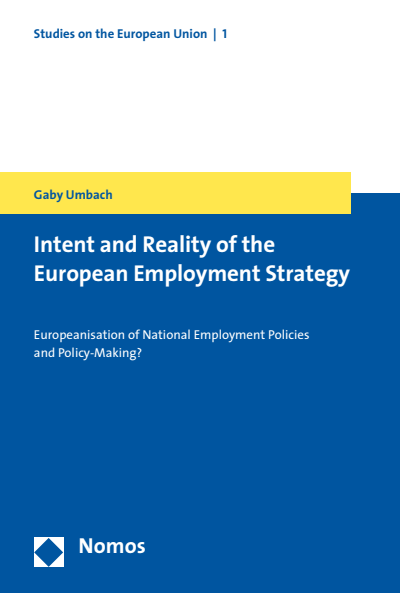
Intent and Reality of the European Employment Strategy
Europeanisation of National Employment Policies and Policy-Making?- Autor:innen:
- Reihe:
- Studies on the European Union, Band 1
- Verlag:
- 2009
Zusammenfassung
Mit ihren spezifischen Merkmalen als neues Politikinstrument – wie etwa ihrem rechtlich nicht bindenden Charakter, dem Ziel des gegenseitigen Politiklernens durch Austausch bester Praktiken oder gemeinsamen Evaluierungsprozessen – stellt die Europäische Beschäftigungsstrategie (EBS) und die mit ihr Anwendung findende Offene Methode der Koordinierung (OMK) beschäftigungspolitische Akteure in der EU vor die neuen Herausforderungen von Politik-Koordinierung, die die Politikgestaltung im europäischen Mehrebenensystem neu prägen.
Das vorliegende Buch beschäftigt sich intensiv mit diesen unterschiedlichen Facetten der EBS und ihrer Wirkung. Es geht dabei über bisherige Einzelstudien zur EBS hinaus und befasst sich nicht nur mit deren Entstehung, Entwicklung und Merkmalen. Es kontrastiert vielmehr den eigenen Anspruch der EBS mit ihrer politischen Realität und untersucht theoretisch hoch reflektiert deren Einfluss auf Politik-Koordinierungsstrukturen, Beschäftigungspolitiken und zugrunde liegenden Ideen sowie deren Zusammenspiel mit anderen wirtschaftspolitischen Bereichen. Neben der EU-Ebene dienen Großbritannien und Deutschland als Fallbeispiele für mitgliedstaatliche Anpassungsprozesse. Das Buch verankert seine Wirkungsanalyse sehr fundiert in der wissenschaftstheoretischen Debatte um Europäisierung und Politikkonvergenz, um deren Anwendbarkeit im Falle der EBS kritisch zu analysieren. Es komplettiert damit Europäisierungsstudien zu regulativer Politik durch die Analyse des Einflusses weicher Politik-Koordinierung im europäischen Mehrebenensystem.
Publikation durchsuchen
Bibliographische Angaben
- Auflage
- 1/2009
- Copyrightjahr
- 2009
- ISBN-Print
- 978-3-8329-4128-4
- ISBN-Online
- 978-3-8452-1247-0
- Verlag
- Nomos, Baden-Baden
- Reihe
- Studies on the European Union
- Band
- 1
- Sprache
- Englisch
- Seiten
- 487
- Produkttyp
- Monographie
Inhaltsverzeichnis
- Titelei/Inhaltsverzeichnis Kein Zugriff Seiten 2 - 4Autor:innen:
- Foreword and Acknowledgement Kein Zugriff Seiten 5 - 14Autor:innen:
- List of Graphs and Tables Kein Zugriff Seiten 15 - 18Autor:innen:
- List of Abbreviations Kein Zugriff Seiten 19 - 26Autor:innen:
- Research Focus: Key Aspects, Core Questions, and Most Distant Cases as Spine of Analysis Kein Zugriff Seiten 27 - 31Autor:innen:
- Research Design: Variables, Theses, and Methodology Kein Zugriff Seiten 31 - 35Autor:innen:
- Structure and Division: The Road Map for the Train of Thought Kein Zugriff Seiten 35 - 37Autor:innen:
- Autor:innen:
- The Governance Concept: Development and Surplus of an Analytical Approach Kein ZugriffAutor:innen:
- Autor:innen:
- Systemic Premises: A Political System of Increasing Interweavement Kein ZugriffAutor:innen:
- Functional Characteristics: Policy-Making under the Conditions of Interdependence Kein ZugriffAutor:innen:
- Structural and Procedural Features: European Multilevel Policy Networks and Policy-Making Kein ZugriffAutor:innen:
- Autor:innen:
- Emergence and Expansion: A New Policy Instrument Rooting in National Reluctance to Transfer Sovereignty Kein ZugriffAutor:innen:
- Characteristic Features: ‘Let’s Co-ordinate’ – Achieving Better Practice by Exchanging Best Practice Kein ZugriffAutor:innen:
- Restrictions and Benefits: ‘Much Talk about Nothing’ or ‘Change through Exchange’? Kein ZugriffAutor:innen:
- Autor:innen:
- Multiple Definitions and Latent Concept Stretching – An Analytical ‘Wunderkind’ within a Conceptual ‘Tower of Babel’ Kein ZugriffAutor:innen:
- Autor:innen:
- Domains of Europeanisation: Domestic Targets of Adaptation Pressure – Increasing Complexity to Enhance Conceptual Lucidity Kein ZugriffAutor:innen:
- Categories of Europeanisation: Domestic Change between Retrenchment and Transformation Kein ZugriffAutor:innen:
- Autor:innen:
- Europeanisation of Public Policies: Means and Results of Policy Change in-between Policy Diffusion, Transfer, and Convergence Kein ZugriffAutor:innen:
- Europeanisation and Institutional Change: Institutional Isomorphism on the Winning Track? Kein ZugriffAutor:innen:
- The ‘Whole Picture’ of Europeanisation: Key Elements Boosting or Blocking Domestic Change Kein ZugriffAutor:innen:
- Autor:innen:
- The United Kingdom: Integrated Leadership, Centralised Polity, ‘Trimmed’ Pluralism, Few Veto Points Kein ZugriffAutor:innen:
- Germany: Fragmented Leadership, De-centralised Polity, ‘Corporatist Style’ Pluralism, Several Veto Points Kein ZugriffAutor:innen:
- Autor:innen:
- The United Kingdom: Beveridge, De-regulation Thatcherite Style, and Blatcherism – Fast Track towards ‘New Labour’ Doing it the ‘Third Way’ Kein ZugriffAutor:innen:
- Germany: Bismarckian System, ORDO-Liberalism, Neo-liberalist Monetarism, Re-Unification – The Path towards ‘Neue Mitte’ Hunting for Growth Kein ZugriffAutor:innen:
- The Constraints of Supranationalisation and Internationalisation: The Impact of European Economic and Monetary Integration, OECD, and IMF Kein ZugriffAutor:innen:
- Europeanisation of Domestic Employment Policy Co-ordination Structures: Adaptation and Change Leading to Institutional Isomorphism? Kein Zugriff Seiten 158 - 165Autor:innen:
- Europeanisation of Employment Policies: Policy Transfer and Diffusion Leading to ?-Convergence? Kein Zugriff Seiten 165 - 168Autor:innen:
- Applicability of the Europeanisation Approach: Misfit and Adaptation Pressure – Omnipotent Concepts To Explain Change Instigated by the OMC? Kein Zugriff Seiten 168 - 170Autor:innen:
- From Rome to Essen: The Long Way from Supplementing the Single Market towards the Headstone of the Luxembourg Process Kein Zugriff Seiten 171 - 178Autor:innen:
- Autor:innen:
- From Essen to Amsterdam: The Formal Constitutionalisation of the EES Kein ZugriffAutor:innen:
- From Amsterdam to Luxembourg: The Pre-Ratification Kick-Off of the Luxembourg Process Kein ZugriffAutor:innen:
- From the Luxembourg Process to Lisbon and Beyond: The Lisbon Strategy Putting the EES into the Sustainability Context Kein ZugriffAutor:innen:
- The ‘Legal Constitution’ of the Luxembourg Process: Structural-Procedural Aspects of the Written Proto-Type OMC Kein Zugriff Seiten 189 - 195Autor:innen:
- The Underlying ‘Policy ID’: Spotlight at the Initial What of the EES Kein Zugriff Seiten 195 - 199Autor:innen:
- Autor:innen:
- The First Five Years: Positive Interim Assessment, Rocketing Complexity – The EES Achieving Better Practice by Exchange of Best Practice? Kein ZugriffAutor:innen:
- Autor:innen:
- Structural-Procedural Adaptation Aiming at Enhanced Synergy and Coherence: ‘Slimlining’ the EES? Kein ZugriffAutor:innen:
- The 2003 New ‘Policy ID’ of the EES: From Four Pillars to Three Overarching Targets Kein ZugriffAutor:innen:
- The 2003 and 2004 ‘Kok Reports’: Initiating the Re-Launch of the EES and the Lisbon Strategy – Re-Energising Implementation, Re-Calibrating Priorities Kein ZugriffAutor:innen:
- The 2005 Renewal of the Lisbon Strategy: Welding EGs and BEPG – Integrated Guidelines for Growth and Jobs Kein ZugriffAutor:innen:
- In How Far?: European Employment Policy Co-ordination and the Constraints of Supra- and International Economic Integration Kein Zugriff Seiten 218 - 228Autor:innen:
- Why and When?: The Slow Path of Bottom-up Europeanisation – Economic Mal-Performance Accelerating Up-Loading Processes Kein Zugriff Seiten 228 - 230Autor:innen:
- How?: New Ways of Europeanisation – Networking, Mutual Exchange and Learning as the Key to Domestic Change Kein Zugriff Seiten 230 - 235Autor:innen:
- What?: A New ‘Policy ID’ to Europeanise National Employment Policies – The Activation Paradigm’s Potential to Attain ?-Convergence Kein Zugriff Seiten 235 - 239Autor:innen:
- In How Far?: A New Mode of Governance Constrained by the Supranational Macro-Economic Integration Paradigm Kein Zugriff Seiten 239 - 240Autor:innen:
- The European Commission: The ‘Primary Administrator’ of the EES – Analysing, Preparing, Evaluating, Negotiating, and Drafting Kein Zugriff Seiten 241 - 250Autor:innen:
- The Council of the EU: Multilevel Switchboard of the New ‘Third Wayism’ Co-ordination Structure – The EES-PCN Going ‘A Little’ Public Kein Zugriff Seiten 250 - 255Autor:innen:
- The ‘Others’: The European Council, EP, ECOSOC, and CoR – The Eagle of Processes and the Mere ‘Also-Rans’? Kein Zugriff Seiten 255 - 256Autor:innen:
- The Social Partners: The EES-related Supranational Social Dialogue – Real Integration or Just Friendly Lip Service? Kein Zugriff Seiten 256 - 263Autor:innen:
- Interim Assessment: The Supranational Part of the EES-PCN – A New Integrated PCN Interlinking Socio-Economic Policy Co-ordination Processes? Kein Zugriff Seiten 263 - 270Autor:innen:
- Autor:innen:
- The Department for Work and Pensions: Pilotage of the British Part of the EES-PCN – Guiding, Steering, and Compiling the UK NAP Kein ZugriffAutor:innen:
- The Department of Trade and Industry: Channelling the Social Partners – Business as Usual? Kein ZugriffAutor:innen:
- Her Majesty’s Treasury: Paramount Economic Overlook – Who Pays, Surveys Kein ZugriffAutor:innen:
- The ‘Others’: No. 10, the DfES, Parliament and the Devolved Administrations – Additional Protagonists or the Play’s Extras? Kein ZugriffAutor:innen:
- The Social Partners: British Social Dialogue Traditions and the UK Part of the EES-PCN – Strait-Jacket for New Ways of Policy Co-ordination? Kein ZugriffAutor:innen:
- Interim Assessment: The UK Part of the EES-PCN – ‘Doing it the British Way’ in the Shadow of Centralisation Kein ZugriffAutor:innen:
- Autor:innen:
- The Ministry of Finance: Pulling the Strings – Technical Lead as a Matter of Principle Kein ZugriffAutor:innen:
- The Ministry of Economics and Labour: The ‘Window to the Outside World’ – Keeping an Eye on Policy Contents Kein ZugriffAutor:innen:
- The ‘Others’: Inter-ministerial Co-ordination, the Subnational Level, and Parliament – Just Small Cogwheels within the German Part of the EES-PCN? Kein ZugriffAutor:innen:
- The Social Partners: German Social Dialogue Traditions and the Domestic Part of the EES-PCN – The Hare and the Hedgehog? Kein ZugriffAutor:innen:
- Interim Assessment: The German Part of the EES-PCN – De-centralisation as Process-Guiding Principle – ‘If it Works for Us it also Works for Brussels’ Kein ZugriffAutor:innen:
- Autor:innen:
- ‘Building the Base’ in 1997/98: The ‘New Deal’ and the EES – Fraternal Twins See the Light of Day? Kein ZugriffAutor:innen:
- Further ‘Constructing the House’ in 1999: The Extension of the New Deals – Tending to All-embrace the Workforce Kein ZugriffAutor:innen:
- Taking Care of ‘Interior Fittings’ in 2000: Consolidating Domestic Policies in the Light of Good Performance Kein ZugriffAutor:innen:
- ‘Corralling the Plot’ and ‘Unshuttering the Windows’ in 2001: Defending and Fine-Tuning Policy Choices For a More Inclusive Labour Market Kein ZugriffAutor:innen:
- ‘Outbuilding the House’ and ‘Designing the Grounds’ in 2002: Keeping to the Domestic Approach and Adapting Structurally to Devolution Kein ZugriffAutor:innen:
- ‘Extending the Driveway’: Expanding Existing Policy Approaches under the Streamlined EES (2003-2005) – Europeanisation Impact Intensified or Blurred? Kein Zugriff Seiten 339 - 348Autor:innen:
- Interim Assessment: The EES’s Impact on British Employment Policy Priorities – Policy Transfer and Diffusion leading to ?-Convergence? Kein Zugriff Seiten 348 - 356Autor:innen:
- Autor:innen:
- Adapting the ‘Old Edifice’ to New Functions in 1998: The Conservative-Liberal Coalition Government’s Remedies and the First German NAP Kein ZugriffAutor:innen:
- ‘Tearing down Old Walls’ and ‘Building the Base’ in 1999: The ‘Neue Mitte’ and the Start of Its Socio-Economic Reforms Kein ZugriffAutor:innen:
- Cost Control to Continue Re-Construction in 2000: Laying the Budgetary Grounds for Further Socio-Economic Reforms Kein ZugriffAutor:innen:
- Waiting for the ‘Blueprint’ to be Designed in 2001: Evaluating Existing Approaches Instead of Launching New Activities Kein ZugriffAutor:innen:
- The Start of ‘Fast-Track Construction’ in 2002: Reform Boost after Years of ‘Dawdling over’ Substantial Modernisation Kein ZugriffAutor:innen:
- ‘Speeding up the Construction Process’: Post Reform Boost Trends under the Streamlined EES (2003-2005) – Europeanisation Impact Intensified or Blurred? Kein Zugriff Seiten 392 - 405Autor:innen:
- Interim Assessment: The EES’s Impact on German Employment Policy Priorities – Policy Transfer and Diffusion leading to ?-Convergence? Kein Zugriff Seiten 405 - 412Autor:innen:
- Autor:innen:
- The National Level: Domestic Institutional Paths and Interactions Running into the EES-PCN – Europeanisation Leading to Institutional Isomorphism? Kein ZugriffAutor:innen:
- The Impact of the EES on European Multilevel Policy Network Structures: A Lock, Stock, and Barrel New Performance or New Lyrics in Old Sceneries? Kein ZugriffAutor:innen:
- British and German Employment Policies under the EES: Proximity and Rapprochement to its ‘Policy ID’ – Converging Trends, Remaining Differences Kein Zugriff Seiten 429 - 438Autor:innen:
- The EES, the OMC, and Europeanisation: Impact without Analytical Grounds or a Case of ‘Phantom’ Adaptation Pressure? Kein Zugriff Seiten 438 - 441Autor:innen:
- Explanative Benefits and the Need to Broaden the Analytical View in order to Explain Domestic Change and Persistence Kein Zugriff Seiten 441 - 443Autor:innen:
- Annex Kein Zugriff Seiten 444 - 448Autor:innen:
- Interviews Kein Zugriff Seiten 449 - 449Autor:innen:
- Sources Kein Zugriff Seiten 449 - 458Autor:innen:
- Literature Kein Zugriff Seiten 458 - 487Autor:innen: