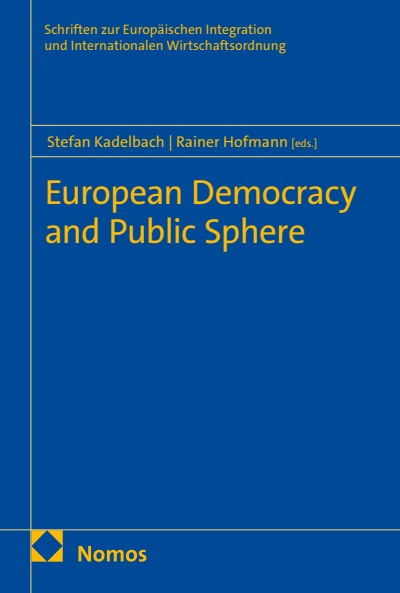
In vielen EU-Mitgliedstaaten sind Anzeichen für eine Beeinträchtigung der demokratischen Kultur zu beobachten. Das Walter-Hallstein-Kolloquium, das im März 2024 an der Goethe-Universität Frankfurt stattfand, befasste sich vor dem Hintergrund der Europawahlen 2024 mit dem Thema „Europäische Demokratie und Öffentlichkeit“. Das interdisziplinäre Symposium brachte Expert:innen aus dem Europarecht, der Geschichtswissenschaft und Politik zusammen, um die Beziehung zwischen dem politischen Diskurs und den europäischen Werten bzw. Grundprinzipien wie Demokratie, Rechtsstaatlichkeit und Bürgerrechten zu untersuchen. Zu den Referent:innen gehörten Niall Bond, Sven Simon, Kriszta Kovács, Irena Lipowicz, Emilio Castorina und Skirgailė Žalimienė. Mit Beiträgen von Ass. Prof. Dr. Niall Bond | Prof. Dr. Emilio Castorina | Prof. Dr. Dr. Rainer Hofmann | Prof. Dr. Stefan Kadelbach, LL.M. | Ass. Prof. Kriszta Kovács, PhD (habil.) | Prof. Dr. Irena Lipowicz | Prof. Dr. Sven Simon | Prof. Dr. Skirgailė Žaltauskaitė-Žalimienė
Publikation durchsuchen
Bibliographische Angaben
Auflage
1/2026
Copyrightjahr
2026
ISBN-Print
978-3-7560-3607-3
ISBN-Online
978-3-7489-6762-0
Verlag
Nomos, Baden-Baden
Reihe
Schriften zur Europäischen Integration und Internationalen Wirtschaftsordnung
Band
74
Sprache
Englisch
Seiten
122
Produkttyp
Sammelband
Inhaltsverzeichnis
KapitelSeiten
Preface Kein Zugriff
Autor:innen: |
A. Threats to Democracy in Europe Kein Zugriff
B. The Framework of the Treaties Kein Zugriff
C. Approaches to the topic Kein Zugriff
Autor:innen:
A. Introduction Kein Zugriff
B. The meaning of the European Community Kein Zugriff
C. Consequences for a European normative political order Kein Zugriff
D. Democracy without a demos Kein Zugriff
Autor:innen:
A. Introduction Kein Zugriff
I. Ontological dissatisfaction Kein Zugriff
II. Cultural dissatisfaction Kein Zugriff
C. Digitalization as a driving force for the authoritarian backlash Kein Zugriff
D. The impact of the authoritarian backlash on the institutions Kein Zugriff
E. Local resistance Kein Zugriff
F. What needs to be done Kein Zugriff
Autor:innen:
A. Introduction Kein Zugriff
B. The Concepts of Constitutional and National Identity in Positive Law Kein Zugriff
C. Varied Judicial Understandings of Identity Kein Zugriff
D. An Example: Human Dignity as an Element of Constitutional Identity Kein Zugriff
E. The Role of the ECJ: Differentiating Between Valid and Invalid Forms of National Identity Claims Kein Zugriff
F. A Possible Way Forward Kein Zugriff
G. Concluding Remarks Kein Zugriff
Autor:innen:
A. Introduction Kein Zugriff
I. The Rule of Law and Human Rights Kein Zugriff
II. The Rule of Law as a Practical Concept: international courts’ approach Kein Zugriff
III. The Rule of Law as a Fundamental and Binding Value within Europe Kein Zugriff
IV. The Relationship between the Rule of Law and Human Rights Kein Zugriff
I. International Human Rights Standards in Lithuania Kein Zugriff
II. Definition of the Rule of Law from a Lithuanian Perspective Kein Zugriff
III. The Right to an Effective Judicial Remedy as an Essential Requirement of the Rule of Law Kein Zugriff
IV. The Right to Privacy and the Rule of Law Kein Zugriff
D. Coclusions Kein Zugriff
Autor:innen:
A. Setting the scene: supranational democracy in Europe Kein Zugriff
B. Criticism of the European model of democracy Kein Zugriff
I. National fragmentation of political discourse Kein Zugriff
II. Lack of an inner-parliamentary public Kein Zugriff
III. Different national traditions of a free mandate Kein Zugriff
IV. Distorting powers of the rapporteur Kein Zugriff
V. Non-representative composition of committees Kein Zugriff
VI. Inadequate responsiveness of European lawmaking Kein Zugriff
VII. Cumbersome amending of EU law Kein Zugriff
D. Conclusions Kein Zugriff
Autor:innen:
A. European citizenship as the fundamental status of Member States’ citizens in the “community of law” Kein Zugriff
B. Its “independent structure” with respect to national citizenships Kein Zugriff
C. The health crisis and the economic crisis: a contradictory trend in European citizenship Kein Zugriff
D. The Coronavirus pandemic and the “opening” of the Union towards a European system of multilevel solidarity Kein Zugriff
E. The economic conditionality clause and the “rupture” of the legal status of European citizenship Kein Zugriff
F. From the “ecological crisis” to a relaunch of European citizenship? Kein Zugriff
Authors Kein Zugriff Seiten 121 - 122
Ähnliche Veröffentlichungen
aus der Reihe "Schriften zur Europäischen Integration und Internationalen Wirtschaftsordnung"