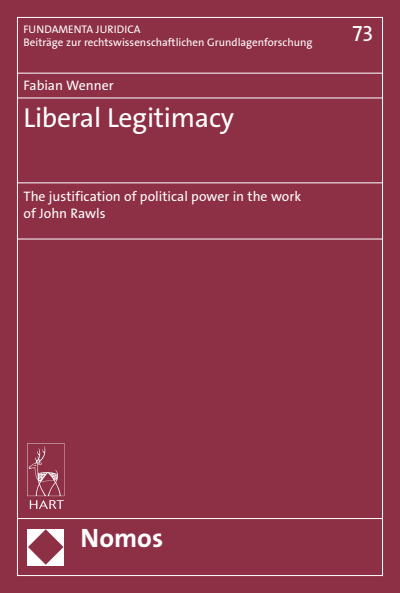
Liberal Legitimacy
The justification of political power in the work of John Rawls- Autor:innen:
- Reihe:
- Fundamenta Juridica, Band 73
- Verlag:
- 2020
Zusammenfassung
Die Rechtfertigung politischer Macht ist Voraussetzung ihrer Legitimität. Das Buch systematisiert die Erscheinungsformen dieser liberalen Intuition und entwickelt unter Rekurs auf John Rawls die Idee, Legitimität durch öffentliche Rechtfertigung zu generieren. Auf der einen Seite verteidigt es den politischen Liberalismus als eine für pluralistische Gesellschaften geeignete Legitimitätstheorie, die die demokratischen Institutionen innewohnenden normativen Potentiale verwirklichen hilft. Auf der anderen Seite lotet es seine Grenzen aus und argumentiert, dass öffentliche Rechtfertigung nicht alle Bürger gleichermaßen adressiert: Die Verteidiger liberaler Legitimität müssen sich über die beschränkte Reichweite ihrer Begründungsressourcen im Klaren sein.
Schlagworte
Publikation durchsuchen
Bibliographische Angaben
- Auflage
- 1/2020
- Copyrightjahr
- 2020
- ISBN-Print
- 978-3-8487-6867-7
- ISBN-Online
- 978-3-7489-0963-7
- Verlag
- Nomos, Baden-Baden
- Reihe
- Fundamenta Juridica
- Band
- 73
- Sprache
- Englisch
- Seiten
- 223
- Produkttyp
- Monographie
Inhaltsverzeichnis
- Titelei/Inhaltsverzeichnis Kein Zugriff Seiten 1 - 10
- The liberal perspective on legitimacy Kein Zugriff
- The challenge of pluralism and public justification Kein Zugriff
- Legitimacy as public justification in Rawls’s work Kein Zugriff
- The structure of the book Kein Zugriff
- 1.1.1 The political system Kein Zugriff
- 1.1.2 The means of the political system Kein Zugriff
- 1.2 Concepts and conceptions of legitimacy Kein Zugriff
- 1.3.1 Weber’s belief-based conception of legitimacy Kein Zugriff
- 1.3.2 Beetham’s hybrid conception of legitimacy Kein Zugriff
- 1.4.1 Legitimacy and the resolution of political disagreements Kein Zugriff
- 1.4.2 Legitimacy, the justification of coercion, and obligation Kein Zugriff
- 1.4.3 The standards of legitimacy Kein Zugriff
- 1.5 Conclusion of the chapter Kein Zugriff
- 2.1 Two ideas of consent Kein Zugriff
- 2.2 Voluntarist accounts and their shortcomings Kein Zugriff
- 2.3.1 The point of contractualist theories Kein Zugriff
- 2.3.2 The normative role of reasons in contractualist theories Kein Zugriff
- 2.3.3 The example of Kant’s contractualism Kein Zugriff
- 2.4.1 From philosophical to public justification Kein Zugriff
- 2.4.2 The challenge of legitimacy as public justification Kein Zugriff
- 2.5 Conclusion of the chapter Kein Zugriff
- 3.1 The nature of justification and reflective equilibrium Kein Zugriff
- 3.2.1 The contractualist device of the original position Kein Zugriff
- 3.2.2.1 Society as a system of fair cooperation Kein Zugriff
- 3.2.2.2 The two moral powers as the basis of freedom and equality Kein Zugriff
- 3.2.3 The original position as a device of representation Kein Zugriff
- 3.2.4 The argument from the original position Kein Zugriff
- 3.3.1 The application of the principles of justice Kein Zugriff
- 3.3.2 Justice, legitimacy, and obligation Kein Zugriff
- 3.4.1 Stability for the right reasons Kein Zugriff
- 3.4.2 The normative role of stability in Theory Kein Zugriff
- 3.4.3 The idea of a well-ordered society Kein Zugriff
- 3.4.4 The argument for convergence on justice as fairness Kein Zugriff
- 3.5 Conclusion of the chapter Kein Zugriff
- 4.1 Reasonable disagreement and the burdens of judgment Kein Zugriff
- 4.2 Reasonable disagreement and the fundamentals of Theory Kein Zugriff
- 4.3 The problems with reasonable disagreement and pluralism Kein Zugriff
- 4.4 Conclusion of the chapter Kein Zugriff
- 5.1.1 The three features of a political conception Kein Zugriff
- 5.1.2 The content of public political culture and the process of justification Kein Zugriff
- 5.1.3 Reasonable conceptions of justice and generic liberalism Kein Zugriff
- 5.1.4.1 The role of PL’s argument for a liberal conception of justice Kein Zugriff
- 5.1.4.2 The normative foundation of PL’s argument for a liberal conception of justice Kein Zugriff
- 5.2.1 The epistemic components of reasonableness Kein Zugriff
- 5.2.2.1 The idea of reasonable citizens Kein Zugriff
- 5.2.2.2 Impermissible conceptions of the good and comprehensive doctrines Kein Zugriff
- 5.2.3 Unreasonable citizens and public justification Kein Zugriff
- 5.2.4 The rights of unreasonable citizens Kein Zugriff
- 5.2.5 Vagueness and the limits of reasonable disagreement Kein Zugriff
- 5.3.1 The idea of overlapping consensus Kein Zugriff
- 5.3.2 The road to an overlapping consensus Kein Zugriff
- 5.3.3 Reasonable comprehensive doctrines and overlapping consensus Kein Zugriff
- 5.3.4 Legitimacy and overlapping consensus Kein Zugriff
- 5.4.1 The constitutional framework and legitimacy Kein Zugriff
- 5.4.2.1 The idea of public reason Kein Zugriff
- 5.4.2.2 Range of application Kein Zugriff
- 5.4.3.1 Public reason as a normative notion (not primarily epistemic) Kein Zugriff
- 5.4.3.2 Public reason and dependence on comprehensive doctrines Kein Zugriff
- 5.4.3.3 The historical contingency of public reason Kein Zugriff
- 5.4.3.4 The indeterminacy of public reason Kein Zugriff
- 5.4.3.5 Public reason, neutrality, and public justification Kein Zugriff
- 5.4.3.6 Political liberalism and unrealistic views of the political Kein Zugriff
- 5.5 Conclusion of the chapter Kein Zugriff
- 6.1 The duties of citizens who reject political liberalism Kein Zugriff
- 6.2 The normative authority of partially illegitimate legislation Kein Zugriff
- 6.3 The political and philosophical status of political liberalism Kein Zugriff
- 6.4 Conclusion of the chapter Kein Zugriff
- Conclusion Kein Zugriff Seiten 208 - 212
- Bibliography Kein Zugriff Seiten 213 - 223