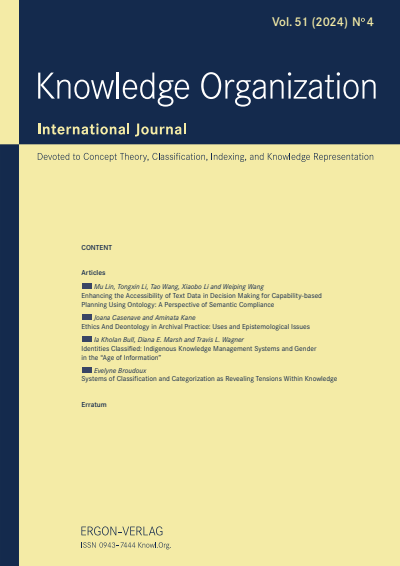
Cover der Ausgabe: KO KNOWLEDGE ORGANIZATION Jahrgang 50 (2023), Heft 4
Ausgabe Open Access Vollzugriff

Jahrgang 50 (2023), Heft 4

KO KNOWLEDGE ORGANIZATION
Autor:innen:
Zeitschrift:
KO KNOWLEDGE ORGANIZATION
Verlag:
 2023

Publikation durchsuchen


Bibliographische Angaben

ISSN-Print
0943-7444
ISSN-Online
2942-3309
Verlag
Nomos, Baden-Baden
Sprache
Englisch
Produkttyp
Ausgabe

Artikel

Cover der Ausgabe: KO KNOWLEDGE ORGANIZATION Jahrgang 50 (2023), Heft 4
Artikel
Open Access Vollzugriff

Seite 243 - 244
Nomos Verlagsgesellschaft mbH & Co. KG, Baden-Baden 2023

Cover der Ausgabe: KO KNOWLEDGE ORGANIZATION Jahrgang 50 (2023), Heft 4
Artikel
Open Access Vollzugriff

Seite 245 - 256
Nomos Verlagsgesellschaft mbH & Co. KG, Baden-Baden 2023
Autor:innen:

Cover der Ausgabe: KO KNOWLEDGE ORGANIZATION Jahrgang 50 (2023), Heft 4
Artikel
Open Access Vollzugriff

Seite 257 - 271
Nomos Verlagsgesellschaft mbH & Co. KG, Baden-Baden 2023
Autor:innen:

Cover der Ausgabe: KO KNOWLEDGE ORGANIZATION Jahrgang 50 (2023), Heft 4
Artikel
Open Access Vollzugriff

Seite 272 - 289
In this study, a mixed-methods research approach was employed, integrating social network analysis, descriptive analysis, and inferential statistical analysis to examine the health topic subject directories and the interconnections among health...
Nomos Verlagsgesellschaft mbH & Co. KG, Baden-Baden 2023
Autor:innen:

Cover der Ausgabe: KO KNOWLEDGE ORGANIZATION Jahrgang 50 (2023), Heft 4
Artikel
Open Access Vollzugriff

Seite 290 - 300
Nomos Verlagsgesellschaft mbH & Co. KG, Baden-Baden 2023
Autor:innen:

Cover der Ausgabe: KO KNOWLEDGE ORGANIZATION Jahrgang 50 (2023), Heft 4
Artikel
Open Access Vollzugriff

Seite 301 - 315
Nomos Verlagsgesellschaft mbH & Co. KG, Baden-Baden 2023
Autor:innen:

Cover der Ausgabe: KO KNOWLEDGE ORGANIZATION Jahrgang 50 (2023), Heft 4
Artikel
Open Access Vollzugriff

Seite 316 - 316
Nomos Verlagsgesellschaft mbH & Co. KG, Baden-Baden 2023

Cover der Ausgabe: KO KNOWLEDGE ORGANIZATION Jahrgang 50 (2023), Heft 4
Artikel
Open Access Vollzugriff

Seite 317 - 317
Nomos Verlagsgesellschaft mbH & Co. KG, Baden-Baden 2023

Cover der Ausgabe: KO KNOWLEDGE ORGANIZATION Jahrgang 50 (2023), Heft 4
Artikel
Open Access Vollzugriff

Seite 318 - 318
Nomos Verlagsgesellschaft mbH & Co. KG, Baden-Baden 2023

Literaturverzeichnis (254 Einträge)

  1. Abdul Rahman, A. R and Mohezar, S.2020. “Ensuring continued use of a digital library: a qualitative approach.” The Electronic Library 38, no. 3:513-530.https://doi.org 0.1108/EL-12-2019-0294 Google Scholar öffnen doi.org/10.5771/0943-7444-2023-4-245
  2. Abubakar, Mohammed Abubakar, Hamzah Elrehail, Maher Ahmad Alatailat and Alev Elçi. Google Scholar öffnen doi.org/10.5771/0943-7444-2023-4-245
  3. 2019. “Knowledge Management, Decision-making Style and Organizational Performance.” Journal of Innovation & Knowledge 4, no.2:104-114 https://doi.org/10.1016/j.jik.2017.07.003. Google Scholar öffnen doi.org/10.5771/0943-7444-2023-4-245
  4. Adamides, Emmanuel, and Nikos Karacapilidis. 2020. “Information Technology for Supporting the Development and Maintenance of Open Innovation Capabilities.” Journal of Innovation & Knowledge 5, no. 1:29-38. https://doi.org/10.1016/j.jik.2018.07.001 Google Scholar öffnen doi.org/10.5771/0943-7444-2023-4-245
  5. Al-Ababneh, Mukhles. 2020. Linking Ontology, Epistemology and Research methodology. Science & Philosophy 8, no.1:75-91. https://papers.ssrn.com/sol3/papers.cfm?abstract_id=3708935 Google Scholar öffnen doi.org/10.5771/0943-7444-2023-4-245
  6. Alamäki Ari, Amir Dirin, and Jyrki Suomala .2021. “Students' Expectations and Social Media Sharing in Adopting Augmented Reality.” The International Journal of Information and Learning Technology 38, no.2: 196-208. https://doi.org/10.1108/IJILT-05-2020-0072. Google Scholar öffnen doi.org/10.5771/0943-7444-2023-4-245
  7. Bereznoy, Alexey, Dirk Meissner, and Veronica Scuotto. 2021. “The intertwining of Knowledge Sharing and Creation in the Digital Platform Based Ecosystem. A Conceptual Study on the Lens of the Open Innovation Approach.” Journal of Knowledge Management 25, no. 8: 2022-2042. https://doi.org/10.1108/JKM-10-2020-0769 Google Scholar öffnen doi.org/10.5771/0943-7444-2023-4-245
  8. Bolisani, Ettore, and Constantin Bratianu. 2018. “The Emergence of Knowledge Management”. In Emergent Knowledge Strategies: Strategic Thinking in Knowledge Management, edited by Ettore Bolisani, and Constantin Bratianu, 23-47. Springer International Publishing. Google Scholar öffnen doi.org/10.5771/0943-7444-2023-4-245
  9. Nagpal, Shaveta Dargan, Shally Bansal, Munish Kumar, and Ajay Mittal. 2022. “Augmented Reality: A Comprehensive Review”. Archives of Computational Methods in Engineering, 30, no. 2: 1057-1080. https://doi.org/10.1007/s11831-022-09831-7. Google Scholar öffnen doi.org/10.5771/0943-7444-2023-4-245
  10. Ensan, Faezeh and Weichang Du.2019. “Ad hoc Retrieval Via Entity Linking and Semantic Similarity.” Knowledge and Information Systems, 58:551-583. https://doi.org/10.1007/s10115-018-1190-1 Google Scholar öffnen doi.org/10.5771/0943-7444-2023-4-245
  11. Finlay, Elizabeth.2019. “Library Provision of Intellectual Access to Open Access Journal Articles.” The Serials Librarian 77, nos. 1/2: 6-14. https://doi.org/10.1080/0361526X.2019.1628161 Google Scholar öffnen doi.org/10.5771/0943-7444-2023-4-245
  12. Gadenne,Volker. 2016.“Is Popper’s Third World Autonomous?” Philosophy of the Social Sciences 46, no. 3:288-303. https://doi.org/10.1177/0048393116639228 Google Scholar öffnen doi.org/10.5771/0943-7444-2023-4-245
  13. Gamji, Musa Bara’u, Kurten Kara, Qaribu Yahaya Nasidi, and Aisha Ibrahim Abdul.2021. “The Challenges of Digital Divide and the Use of Web 2.0 Platforms as Knowledge Sharing Tools Among Nigerian Academics.” Information Development 38, no. 1, 149–159. https://doi.org/10.1177/0266666920981669 Google Scholar öffnen doi.org/10.5771/0943-7444-2023-4-245
  14. Garcia-Marco, Francisco Javier.2016. “Enhancing the Visibility and Relevance of Thesauri in the Web: Searching For a Hub in the Linked Data Environment.” Knowledge Organization 43, no. 3:193-202. https://doi.org/10.5771/0943-7444-2016-3-193 Google Scholar öffnen doi.org/10.5771/0943-7444-2023-4-245
  15. Guan Jiancheng, Yan Yan and Jing Jing Zhang.2017. “The Impact of Collaboration and Knowledge Networks on Citations.” Journal of Informetrics 11, no.2: 407-422. https://doi.org/10.1016/j.joi.2017.02.007 Google Scholar öffnen doi.org/10.5771/0943-7444-2023-4-245
  16. Guo Shanshan, Wenyu Zhang and Shuai Zhang. 2017. “A PageRank-based Collaborative Filtering Recommendation Approach in Digital Libraries.” Tehnički Vjesnik 24, no. 4:1051-1058. https://doi.org/10.17559/TV-20160602011232 Google Scholar öffnen doi.org/10.5771/0943-7444-2023-4-245
  17. Guo Weiyu, Ruixiang Jia, and Ying Zhang. 2021. “Semantic Link Network Based Knowledge Graph Representation and Construction.” Journal of Artificial Intelligence 3, no.2: 73-79. https://doi.org/10.32604/jai.2021.018648 Google Scholar öffnen doi.org/10.5771/0943-7444-2023-4-245
  18. Jiang, Yongchang, Xiaoli Man and Honglu Wang. 2022. “The Characteristic, Principle and Method of Collaborative Construction of Context Ontology Based on Concept Lattice Integration in Context-Aware System.” Journal of the China Society for Scientific and Technical Information 41, no. 6: 558-573. https://doi.org/10.3772/j.issn.1000-0135.2022.06.002 Google Scholar öffnen doi.org/10.5771/0943-7444-2023-4-245
  19. Jiang, Yongchang. 2010. “Dynamic Knowledge Architecture Based on Knowledge Network: Space Perspectives and Mechanism Analysis.” Journal of Library Science in China 4:115-124. https://doi.org/10.13530/j.cnki.jlis.2010.04.016. Google Scholar öffnen doi.org/10.5771/0943-7444-2023-4-245
  20. Jiang, Yongchang. 2011. “Knowledge Network Construction Based on Semantic Linking of Knowledge Element.” Information Studies: Theory and Application 34, no.5:50-53. https://doi.org/10.16353/j.cnki.1000-7490.2011.05.005. Google Scholar öffnen doi.org/10.5771/0943-7444-2023-4-245
  21. Jiang, Yongchang .2018. “The Collaborative Innovation Mechanism of Knowledge Fusion Transformation Integrating Multi-Cognition.” Studies in Science of Science 36, no.11:1946-1952+2029. https://doi.org/10.16192/j.cnki.1003-2053.2018.11.004. Google Scholar öffnen doi.org/10.5771/0943-7444-2023-4-245
  22. Kiran, Mandava Kranthi, and K Thammi Reddy. 2018. “An Approach Towards Establishing Reference Linking in Desktop Reference Manager.” Journal of Information & Knowledge Management, 17, no.3:1850034. https://doi.org/10.1142/S021964921850034X Google Scholar öffnen doi.org/10.5771/0943-7444-2023-4-245
  23. Kuusk, Anastacia, and Jing Gao. 2015.“Consolidating People, Process and Technology to Bridge the Great Wall of Operational and Information Technologies.” In Engineering Asset Management-Systems, Professional Practices and Certification: Proceedings of the 8th World Congress on Engineering Asset Management & 3rd International Conference on Utility Management & Safet, 30 october – 1st november 2013 Hong Kong, edited by Peter W. Tse, Joseph Mathew, King Wong, Rocky Lam, and C.N.Ko. Springer, 1715-1726. https://doi.org/10.1007/978-3-319-09507-3_147 Google Scholar öffnen doi.org/10.5771/0943-7444-2023-4-245
  24. Langer, Nicolas, Andreas Pedroni and Lutz Jäncke. 2013.“The problem of Thresholding in Small-World Network Analysis.” PloS one 8, no.1. https://doi.org/10.1371/journal.pone.0053199 Google Scholar öffnen doi.org/10.5771/0943-7444-2023-4-245
  25. Le Dinh, Thang, Louis Rinfret, Louis Raymond, and Dong Thi Bich Thuy. 2013. “Towards the Reconciliation of Knowledge Management and e‐Collaboration Systems.” Interactive Technology and Smart Education 10, no.2:95-115. https://doi.org/10. 10.1108/ITSE-09-2012-0022. Google Scholar öffnen doi.org/10.5771/0943-7444-2023-4-245
  26. Li Shuqing, Fusen Jiao, Yong Zhang, and Xia Xu.2019 “Problems and Changes in Digital Libraries in the Age of Big Data from the Perspective of User Services”. The Journal of Academic Librarianship, 45, no.1: 22-30. https://doi.org/10.1016/j.acalib.2018.11.012. Google Scholar öffnen doi.org/10.5771/0943-7444-2023-4-245
  27. Liu, Yunmei, Liu Yang, and Min Chen. 2021. “A New Citation Concept: Triangular Citation in the Literature”. Journal of Informatics 15, no.2:101141. https://doi.org/10.1016/j.joi.2021.101141 Google Scholar öffnen doi.org/10.5771/0943-7444-2023-4-245
  28. Netto, Cristiane Mendes, Gercina Ângela Borém de Oliveira Lima, and Ivo Pierozzi Junior. 2016. “An Application of Facet Analysis Theory and Concept Maps for Faceted Search in a Domain Ontology: Preliminary Studies.” Knowledge Organization 43, no.4: 254-264. https:// doi.org/10.5771/0943-7444-2016-4-254 Google Scholar öffnen doi.org/10.5771/0943-7444-2023-4-245
  29. Noh, Younghee, Patricia R. Ladd, and Kyoungsik Na.2015. “A Study Analyzing Reference Linking Service in Digital Libraries.” International Journal of Knowledge Content Development and Technology 5, no.1:69-88. https://doi.org/10.5865/IJKCT.2015.5.1.069 Google Scholar öffnen doi.org/10.5771/0943-7444-2023-4-245
  30. Nonaka, Ikujiro, and Hirotaka Takeuchi. 1995.Knowledge Creating Company: How Japanese Companies Create the Dynamics of Innovation. New York: Oxford University Press, 26-65. Google Scholar öffnen doi.org/10.5771/0943-7444-2023-4-245
  31. Pyrounakis, George, Mara Nikolaidou, and Michael Hatzopoulos. 2017. “Building digital Collections Using Open Source Digital Repository Software.” International Journal of Digital Library Systems 34, no.1:10-24. https://doi.org/10.4018/ijdls.2014010102 Google Scholar öffnen doi.org/10.5771/0943-7444-2023-4-245
  32. Ricciardi, Francesca, Valter Cantino, and Cecilia Rossignoli. 2021. “Organisational Learning for the Common Good: an Emerging Model.” Knowledge Management Research & Practice 19, no. 3:277-290. https://doi.org/10.1080/14778238.2019.1673676 Google Scholar öffnen doi.org/10.5771/0943-7444-2023-4-245
  33. Saier, Tarek and Michael Färber. 2020. “unarXive: a Large Scholarly Data Set with Publications’ Full-Text, Annotated In-text Citations, and Links to Metadata.” Scientometrics 125, no.3:3085-3108. https://doi.org/10.1007/s11192-020-03382-z Google Scholar öffnen doi.org/10.5771/0943-7444-2023-4-245
  34. Scott, Rachel Elizabeth, and Gail Barton. 2018. “Promoting Interlibrary Loan in the Traditional Catalog and Discovery Layer: Two Pilot Projects.” Library Resources & Technical Services 62, no. 2:74. Google Scholar öffnen doi.org/10.5771/0943-7444-2023-4-245
  35. Sun, Changpu. 2021. “Interpretation of Quantum Mechanics and Karl Popper’s Three Worlds.” Bulletin of Chinese Academy of Sciences (Chinese Version) 36, no. 3: 296-307. https://doi.org/10.16418/j.issn.1000-3045.20210201003 Google Scholar öffnen doi.org/10.5771/0943-7444-2023-4-245
  36. Thelwall, Mike, Pardeep Sud, and David Wilkinson. 2012.“Link and Co-Inlink Network Diagrams with URL Citations or Title Mentions.” Journal of the American Society for Information Science and Technology 63, no. 4: 805-816. https://doi.org/10.1002/asi.21709 Google Scholar öffnen doi.org/10.5771/0943-7444-2023-4-245
  37. Tóth, Géza and Iagoba Apellaniz. 2014. “Quantum Metrology From a Quantum Information Science Perspective.” Journal of Physics A: Mathematical and Theoretical 47, no. 42. https://doi.org/10.1088/1751-8113/47/42/424006 Google Scholar öffnen doi.org/10.5771/0943-7444-2023-4-245
  38. Wang, Zhongyi, Lixin Xia and Yuhai Li.2019.Construction of Interdisciplinary Multi-Granularity Knowledge Representation Model in Digital Library Based on Knowledge Content. Journal of Library Science in China 45, no. 6:50-64. https://doi.org/10.13530/j.cnki.jlis.190050. Google Scholar öffnen doi.org/10.5771/0943-7444-2023-4-245
  39. Wen, Youkui and Yuying Jiao. 2009. “Semantic Graph of Knowledge Unit on Wiki Platform.” Journal of the China Society for Scientific and Technical Information 6:870-877. https://doi.org/10.3772/j.issn.1000-0135.2009.06.012 Google Scholar öffnen doi.org/10.5771/0943-7444-2023-4-245
  40. Young, Sarah. 2019. Harness the Power of the DOI: Digital Object Identifiers and What They Can Do for You. Campbell Systematic Reviews 15, no. 4 :e1063 https://doi.org/10.1002/cl2.1063 Google Scholar öffnen doi.org/10.5771/0943-7444-2023-4-245
  41. Zhang Qixuan , Xinyi Weng, Guangyou Zhou, Yi Zhang and Jimmy Xiangji Huang. 2022. “ARL: An Adaptive Reinforcement Learning Framework for Complex Question Answering Over Knowledge Base.” Information Processing & Management 59, no. 3:102933. https://doi.org/10.1016/j.ipm.2022.102933 Google Scholar öffnen doi.org/10.5771/0943-7444-2023-4-245
  42. Zhang, Junsheng, Yunchuan Sun, and Changqing Yao.2017. “Semantically Linking Events for Massive Scientific Literature Research.” The Electronic Library 35, no.4:724-744. https://doi.org/10.1108/EL-09-2016-0198 Google Scholar öffnen doi.org/10.5771/0943-7444-2023-4-245
  43. Zhou, Xiaoying. 2010. “Studies on Development phases, Development Motivation, Type and its characteristic of knowledge Linkage.” Library And Information Service 54, no.12:36-40. https://doi.org/cnki:sun:tsqb.0.2010-12-013 Google Scholar öffnen doi.org/10.5771/0943-7444-2023-4-245
  44. Zhu, Xiang and Yunqiu Zhang. 2020. “Co-word Analysis Method Based on Meta-path of Subject Knowledge Network.” Scientometrics 123, no. 2:753-766. https://doi.org/10.1007/s11192-020-03400-0 Google Scholar öffnen doi.org/10.5771/0943-7444-2023-4-245
  45. Ambrosino, Angela, Mario Cedrini, John B Davis, Stefano Fiori, Marco Guerzoni and Massimiliano Nuccio. 2018. “What topic Modelling Could Reveal About the Evolution of Economics.” Journal of Economic Methodology 25, no. 4:329-348. https://doi.org/10.1080/1350178X.2018.1529215 Google Scholar öffnen doi.org/10.5771/0943-7444-2023-4-257
  46. Blei, David M., Andrew Y. Ng, and Michael I. Jordan. 2003. “Latent Dirichlet Allocation.” Machine Learning Research 3: 993-1022. https://dl.acm.org/doi/10.5555/944919.944937 Google Scholar öffnen doi.org/10.5771/0943-7444-2023-4-257
  47. Blei, David M. 2012. “Probabilistic topic models.” Communications of the ACM 55, no.4:77-84. https://doi.org/10.1145/2133806.2133826 Google Scholar öffnen doi.org/10.5771/0943-7444-2023-4-257
  48. Chen, Yong, Hui Zhang, Rui Liu, Zhiwen Ye, and Jianying Lin. 2019. “Experimental explorations on short text topic mining between LDA and NMF based Schemes.” Knowledge-Based Systems 163, no. 1:1-13 https://doi.org/10.1016/j.knosys.2018.08.011 Google Scholar öffnen doi.org/10.5771/0943-7444-2023-4-257
  49. Chang, Jonathan, Jordan Boyd-Graber, Sean Gerrish, Chong Wang and David M. Blei 2009. “Reading Tea Leaves: How Humans Interpret Topic Models.” In Proceedings of the 22nd International Conference on Neural Information Processing Systems (NIPS'09), Red Hook, NY, USA, Curran Associates Inc, 288-296. https://dl.acm.org/doi/10.5555/2984093.2984126 Google Scholar öffnen doi.org/10.5771/0943-7444-2023-4-257
  50. Dayeen, Fazle Rabbi, Abhinav S. Sharma, and Sybil Derrible. 2020. “A Text Mining Analysis of the Climate Change Literature in Industrial Ecology.” Journal of Industrial Ecology 24, no.2: 276-284. https://doi.org/10.1111/jiec.12998 Google Scholar öffnen doi.org/10.5771/0943-7444-2023-4-257
  51. Devlin, Jacob, Ming-Wei Chang, Kenton Lee, and Kristina Toutanova. 2019. “BERT: Pre-training of Deep Bidirectional Transformers for Language Understanding.” In Proceedings of the 2019 Conference of the North American Chapter of the Association for Computational Linguistics: Human Language Technologies (NAACL), Minneapolis, Minnesota. Association for Computational Linguistics, 4171-4186. https://doi.org/10.48550/arXiv.1810.04805 Google Scholar öffnen doi.org/10.5771/0943-7444-2023-4-257
  52. Greene, Derekand and James P. Cross. 2017. “Exploring the Political Agenda of the European Parliament Using a Dynamic Topic Modeling Approach.” Political Analysis 25, no.1:77-94. https://doi.org/10.1017/pan.2016.7 Google Scholar öffnen doi.org/10.5771/0943-7444-2023-4-257
  53. Han, Xiaoyao. 2020. “Evolution of Research Topics in LIS Between 1996 and 2019: an Analysis Based on Latent Dirichlet Allocation Topic Model.” Scientometrics 125: 2561-2595. https://doi.org/10.1007/s11192-020-03721-0 Google Scholar öffnen doi.org/10.5771/0943-7444-2023-4-257
  54. Heaton, Jeff. 2015. “Artificial Intelligence for Humans, Volume 3: Deep Learning and Neural Networks. Chesterfield: Heaton Research, Inc. Google Scholar öffnen doi.org/10.5771/0943-7444-2023-4-257
  55. Huang, Lu, Xiang Chen, Yi Zhang, Changtian Wang, Xiaoli Cao and Jiarun Liu. 2022. “Identification of Topic Evolution: Network Analytics With Piecewise Linear Representation and Word Embedding.” Scientometrics 127:5353-5383. https://doi.org/10.1007/s11192-022-04273-1 Google Scholar öffnen doi.org/10.5771/0943-7444-2023-4-257
  56. lhan, Nagehan and Şule Gündüz Öğüdücü. 2015. “Predicting Community Evolution Based on Time Series Modeling.” In Proceedings of the 2015 IEEE/ACM International Conference on Advances in Social Networks Analysis and Mining (ASONAM), Paris, France, IEEE, edited by Jian Pei, Fabrizio Silvestri and Jie Tang, 1509-1516. https://doi.org/10.1145/2808797.2808913 Google Scholar öffnen doi.org/10.5771/0943-7444-2023-4-257
  57. Jia Jia, Lu Qing, and Yang Fan. 2023. “Trend Analysis of Global Carbon Neutrality Related Field Research: Based on Machine Learning and Bibliometrics.” Science Focus 18, no. 1:27-44. https://doi.org/10.15978/j.cnki.1673-5668.202301006 Google Scholar öffnen doi.org/10.5771/0943-7444-2023-4-257
  58. Jiang, Lei, Tao Zhang, and Taihua Huang. 2022. “Empirical Research of Hot Topic Recognition and its Evolution Path Method for Scientific and Technological Literature.” Adv. Comput. Intell. Intell. Inform 26, no. 3:299-308. http://dx.doi.org/10.20965/jaciii.2022.p0299 Google Scholar öffnen doi.org/10.5771/0943-7444-2023-4-257
  59. Kim, Ha Jin, Jeong Yoo Kyung and Min Song. 2016. “Content- and Proximity-based Author Co-citation Analysis Using Citation Sentences.” Journal of Informetrics 10, no. 4:954–966. https://doi.org/10.1016/j.joi.2016.07.007 Google Scholar öffnen doi.org/10.5771/0943-7444-2023-4-257
  60. Lee, Daniel D. and Seung H. Sebastian. 1999. “Learning the parts of objects by non-negative matrix factorization.” Nature 401:788-791. https://doi.org/10.1038/44565 Google Scholar öffnen doi.org/10.5771/0943-7444-2023-4-257
  61. Li, Bohan, Hao Zhou, Junxian He, Mingxuan Wang, Yiming Yang, and Lei Li. 2020. On the Sentence Embeddings from Pre-trained Language Models. In Proceedings of the 2020 Conference on Empirical Methods in Natural Language Processing (EMNLP), Online. Association for Computational Linguistics, 9119-9130. http://dx.doi.org/10.18653/v1/2020.emnlp-main.733 Google Scholar öffnen doi.org/10.5771/0943-7444-2023-4-257
  62. Macfarlane, Andrew, Sondess Missaoui, and Sylwia Frankowska-Takhari. 2020. “On Machine Learning and Knowledge Organization in Multimedia Information Retrieval.” Knowledge Organization 47, no.1:45-55. https://doi.org/10.5771/0943-7444-2020-1-45. Google Scholar öffnen doi.org/10.5771/0943-7444-2023-4-257
  63. Mahesh, Batta. 2020. “Machine Learning Algorithms-A Review.” International Journal of Science and Research 9:381-386. http://dx.doi.org/10.21275/ART20203995 Google Scholar öffnen doi.org/10.5771/0943-7444-2023-4-257
  64. Mikolov, Tomas, Ilya Sutskever, Kai Chen, Greg Corrado, and Jeffrey Dean. 2013. “Distributed Representations of Words and Phrases and Their Compositionality.” Advances in Neural Information Processing Systems 26: 3111-3119. https://dl.acm.org/doi/10.5555/2999792.2999959 Google Scholar öffnen doi.org/10.5771/0943-7444-2023-4-257
  65. Mohotti, Wathsala Anupama and Richi Nayak. 2021. “Discovering cluster evolution patterns with the Cluster Association-aware matrix factorization.” Knowledge and Information Systems 63:1397-1428. https://doi.org/10.1007/s10115-021-01561-9 Google Scholar öffnen doi.org/10.5771/0943-7444-2023-4-257
  66. O'Callaghan, Derek, Greene Derek, Carthy Joe, and Cunningham. 2015. “An Analysis of the Coherence of Descriptors in Topic Modeling.” Expert Systems with Applications (ESWA) 42, no.13:5645-5657. https://doi.org/10.1016/j.eswa.2015.02.055 Google Scholar öffnen doi.org/10.5771/0943-7444-2023-4-257
  67. Wang, Yuanyuan and Yajuan Zhao. 2018. “Evolution Analysis of Technological Topic: An Approach Based on Non-negative Matrix Factorization.” Library and Information Service 62, no. 10:94-105. https://www.cnki.net/kcms/doi/10.13266/j.issn.0252-3116.2018.10.013.html Google Scholar öffnen doi.org/10.5771/0943-7444-2023-4-257
  68. Xi, Xiaowen, Ying Guo, Xinna Song, and Jin Wang. 2021. “Research on the Technical Similarity Visualization Based on Word2vec and LDA Topic Model.” Journal of the China Society for Scientific and Technical Information 40, no. 9:974-983. https://doi.org/10.3772/j.issn.1000-0135.2021.09.007 Google Scholar öffnen doi.org/10.5771/0943-7444-2023-4-257
  69. Xie, Qing, Xinyuan Zhang, Ying Ding, and Min Song. 2020. “Monolingual and Multilingual Topic Analysis Using LDA and BERT Embeddings.” Informetrics 14, no. 3:1751-1577. https://doi.org/10.1016/j.joi.2020.101055 Google Scholar öffnen doi.org/10.5771/0943-7444-2023-4-257
  70. Zhang Dongxin and Min Zhang. 2022. “A Review on Application Studies of LDA Topic Models in Library and Information Science Field.” Documentation, Information & Knowledge 39, no. 6:143-157. https://doi.org/10.13366/j.dik.2022.06.143 Google Scholar öffnen doi.org/10.5771/0943-7444-2023-4-257
  71. Zhu, Hengmin, Li Qian, Wang Qin, Jing Wei, and Chao Shen. 2022. “Evolution Analysis of Online Topics Based on ‘Word-topic’ Coupling Network.” Scientometrics 127:3767-3792. https://doi.org/10.1007/s11192-022-04439-x Google Scholar öffnen doi.org/10.5771/0943-7444-2023-4-257
  72. Ahmed, Terry. 2019. “MedlinePlus at 21: A Website Devoted to Consumer Health Information.” Information Services & Use 39, no. 1/2: 5-14. https://doi.org/10.3233/ISU-180038 Google Scholar öffnen doi.org/10.5771/0943-7444-2023-4-272
  73. Baird, Aaron, Michael F. Furukawa, and T. S. Raghu. 2012. “Understanding Contingencies Associated with the Early Adoption of Customer-Facing Web Portals.” Journal of Management Information Systems 29, no. 2: 293–324. http://www.jstor.org/stable/41713891. Google Scholar öffnen doi.org/10.5771/0943-7444-2023-4-272
  74. Barnes, John Arundel. 1954. “Class and Committees in a Norwegian Island Parish.” Human relations 7, no. 1: 39-58. https://doi.org/10.1177/001872675400700102 Google Scholar öffnen doi.org/10.5771/0943-7444-2023-4-272
  75. Bernhardt, Jay M., and Elizabeth M. Felter. 2004. “Online Pediatric Information Seeking among Mothers of Young Children: Results from a Qualitative Study using Focus Groups.” Journal of medical Internet research 6, no.1: e36. https://doi.org/10.2196/jmir.6.1.e7 Google Scholar öffnen doi.org/10.5771/0943-7444-2023-4-272
  76. Borgatti, Stephen P., Ajay Mehra, Daniel J. Brass, and Giuseppe Labianca. 2009. “Network Analysis in the Social Sciences.” Science 323, no. 5916: 892-95. https://doi.org/10.1126/science.1165821 Google Scholar öffnen doi.org/10.5771/0943-7444-2023-4-272
  77. Borgatti, Stephen P., Martin G. Everett, and Jeffrey C. Johnson. 2013. Analyzing Social Networks. Los Angeles, CA: SAGE Publications. Google Scholar öffnen doi.org/10.5771/0943-7444-2023-4-272
  78. Bouche, Gauthier and Virginie Migeot. 2008. “Parental Use of the Internet to Seek Health Information and Primary Care Utilisation for their Child: A Cross-Sectional Study.” BMC Public Health 8: 1-9. https://doi.org/10.1186/1471-2458-8-300 Google Scholar öffnen doi.org/10.5771/0943-7444-2023-4-272
  79. Bray, Lucy, Victoria Appleton, and Ashley Sharpe. 2019. “‘If I Knew What Was Going to Happen, it Wouldn’t Worry Me So Much’: Children’s, Parents’ and Health Professionals’ Perspectives on Information for Children Undergoing a Procedure.” Journal of Child Health Care 23, no. 4: 626-38. https://doi.org 10.1177/1367493519870654 Google Scholar öffnen doi.org/10.5771/0943-7444-2023-4-272
  80. Chambers, Duncan, Paul Wilson, Carl Thompson, and Melissa Harden. 2012. “Social Network Analysis in Healthcare Settings: A Systematic Scoping Review.” PLoS ONE 7, no. 8: e41911. https://doi.org/10.1371/journal.pone.0041911 Google Scholar öffnen doi.org/10.5771/0943-7444-2023-4-272
  81. Chung, Young Mee, and Young-Hee Noh. 2003. “Developing a Specialized Directory System by Automatically Classifying Web Documents.” Journal of Information Science 29, no. 2: 117-26. https://doi.org/10.1177/016555150302900204 Google Scholar öffnen doi.org/10.5771/0943-7444-2023-4-272
  82. Coleman, James S. 1986. “Social Theory, Social Research, and a Theory of Action.” American Journal of Sociology 91, no. 6: 1309-35. https://www.jstor.org/stable/2779798 Google Scholar öffnen doi.org/10.5771/0943-7444-2023-4-272
  83. Dalton, Louise, Elizabeth Rapa, and Alan Stein. 2020. “Protecting the psychological health of children through effective communication about COVID-19.” The Lancet Child & Adolescent Health 4, no.5: 346-47. https://doi.org/10.1016/S2352-4642(20)30097-3 Google Scholar öffnen doi.org/10.5771/0943-7444-2023-4-272
  84. Ellis-Danquah, La Ventra. 2004. “Addressing Health Disparities: African American Consumer Information Resources on the Web.” Medical Reference Services Quarterly 23, no. 4: 61-73. https://doi.org/10.1300/J115v23n04_06 Google Scholar öffnen doi.org/10.5771/0943-7444-2023-4-272
  85. Ellis, David, and Ana Vasconcelos. 2000. “The Relevance of Facet Analysis for World Wide Web Subject Organization and Searching.” Journal of Internet Cataloging 2, nos. 3/4: 96-114. https://doi.org/10.1300/J141v02n03_07 Google Scholar öffnen doi.org/10.5771/0943-7444-2023-4-272
  86. Fallis, Don, and Martin Frické. 2002. “Indicators of Accuracy of Consumer Health Information on the Internet: A Study of Indicators Relating to Information for Managing Fever in Children in the Home.” Journal of the American Medical Informatics Association 9, no. 1:73-79. https://doi.org/10.1136/jamia.2002.0090073 Google Scholar öffnen doi.org/10.5771/0943-7444-2023-4-272
  87. Freeman, Linton C. 1978. “Centrality in Social Networks Conceptual Clarification.” Social Networks 1, no. 3: 215–39. https://doi.org/10.1016/0378-8733(78)90021-7 Google Scholar öffnen doi.org/10.5771/0943-7444-2023-4-272
  88. Gray, Caryl. 2005. “Health and Medical Resources: Information for the Consumer.” Journal of Library Administration 44, nos. 1/2: 395-428. https://doi.org/10.1300/J111v44n01_05 Google Scholar öffnen doi.org/10.5771/0943-7444-2023-4-272
  89. Gray, Nicola J., Jonathan D. Klein, Peter R. Noyce, Tracy S. Sesselberg, and Judith A. Cantrill. 2005. “Health Information-Seeking Behaviour in Adolescence: The Place of the Internet.” Social Science & Medicine 60, no. 7: 1467-78. https://doi.org/10.1016/j.socscimed.2004.08.010 Google Scholar öffnen doi.org/10.5771/0943-7444-2023-4-272
  90. Horrigan, John B., Lee Rainie, and Michael Cornfield. 2003. “Part Three: The Portals.” Pew Research Center: Internet, Science & Tech. Pew Research Center, December 31, 2019. https://www.pewresearch.org/internet/2003/03/20/part-three-the-portals/. Google Scholar öffnen doi.org/10.5771/0943-7444-2023-4-272
  91. Impicciatore, Piero, Chiara Pandolfini, Nicola Casella, and Maurizio Bonati. 1997. “Reliability of Health Information for the Public on the World Wide Web: Systematic Survey of Advice on Managing Fever in Children at Home.” BMJ: British Medical Journal 314, no. 7098: 1875-79. https://doi.org/10.1136/bmj.314.7098.1875 Google Scholar öffnen doi.org/10.5771/0943-7444-2023-4-272
  92. Izenberg, Neil, and Debra A. Lieberman. 1998. “The Web, Communication Trends, and Children's Health Part 4: How Children Use the Web.” Clinical Pediatrics 37, no.6: 335-40. https://doi.org/10.1177/000992289803700601 Google Scholar öffnen doi.org/10.5771/0943-7444-2023-4-272
  93. Khoo, Kaylyn, Penny Bolt, Franz E. Babl, Susan Jury, and Ran D. Goldman. 2008. “Health Information Seeking by Parents in the Internet Age.” Journal of Pediatrics and Child Health 44, nos. 7/8: 419-23. https://doi.org/10.1111/j.1440-1754.2008.01322.x Google Scholar öffnen doi.org/10.5771/0943-7444-2023-4-272
  94. Kim, Eunkyung, Jiran Hou, Jeong Yeob Han, and Itai Himelboim. 2016. “Predicting Retweeting Behavior on Breast Cancer Social Networks: Network and Content Characteristics.” Journal of Health Communication 21, no. 4: 479-86. https://doi.org/10.1080/10810730.2015.1103326 Google Scholar öffnen doi.org/10.5771/0943-7444-2023-4-272
  95. Kuperminc, Michelle N., and Richard D. Stevenson. 2008. “Growth and Nutrition Disorders in Children with Cerebral Palsy.” Developmental disabilities research reviews 14, no. 2: 137-46. https://doi.org/10.1002/ddrr.14 Google Scholar öffnen doi.org/10.5771/0943-7444-2023-4-272
  96. Li, Yuelin, Xiaojun Yuan, and Ruoqi Che. 2021. “An Investigation of Task Characteristics and Users’ Evaluation of Interaction Design in Different Online Health Information Systems.” Information Processing & Management 58, no. 3:102476. https://doi.org/10.1016/j.ipm.2020.102476 Google Scholar öffnen doi.org/10.5771/0943-7444-2023-4-272
  97. Liu, Jia Jia, Yanping Bao, Xiaolin Huang, Jie Shi, and Lin Lu. 2020. “Mental Health Considerations for Children Quarantined Because of COVID-19.” The Lancet Child & Adolescent Health 4, no.5: 347-49. https://doi.org/10.1016/S2352-4642(20)30096-1 Google Scholar öffnen doi.org/10.5771/0943-7444-2023-4-272
  98. Luke, Douglas A., and Jenine K. Harris. 2007. “Network Analysis in Public Health: History, Methods, and Applications.” Annual Review of Public Health 28, no. 1: 69–93. https://doi.org/10.1146/annurev.publhealth.28.021406.144132 Google Scholar öffnen doi.org/10.5771/0943-7444-2023-4-272
  99. Ma, Dan, Meiyun Zuo, and Liu Liu. 2021. “The Information Needs of Chinese Family Members of Cancer Patients in the Online Health Community: What and Why?” Information Processing & Management 58, no. 3: 102517. https://doi.org/10.1016/j.ipm.2021.102517 Google Scholar öffnen doi.org/10.5771/0943-7444-2023-4-272
  100. McClung, H. Juhling, Robert D. Murray, and Leo A. Heitlinger. 1998. “The Internet as a Source for Current Patient Information.” Pediatrics 101, no. 6: e2. https://doi.org/10.1542/peds.101.6.e2 Google Scholar öffnen doi.org/10.5771/0943-7444-2023-4-272
  101. Meppelink, Corine S., Edith G. Smit, Marieke L. Fransen, and Nicola Diviani. 2019. “I was Right About Vaccination”: Confirmation Bias and Health Literacy in Online Health Information Seeking." Journal of Health Communication 24, no.2: 129-40. https://doi.org/10.1080/10810730.2019.1583701 Google Scholar öffnen doi.org/10.5771/0943-7444-2023-4-272
  102. Mertens, Frédéric, Johanne Saint-Charles, and Donna Mergler. 2012. “Social Communication Network Analysis of the Role of Participatory Research in the Adoption of New Fish Consumption Behaviors.” Social Science & Medicine 75, no.4: 643-50. https://doi.org/10.1016/j.socscimed.2011.10.016 Google Scholar öffnen doi.org/10.5771/0943-7444-2023-4-272
  103. Miller, Naomi, Eve-Marie Lacroix, and Joyce EB Backus. 2000. “MEDLINEplus: Building and Maintaining the National Library of Medicine's Consumer Health Web Service.” Bulletin of the Medical Library Association 88, no. 1: 11-17. https://www.ncbi.nlm.nih.gov/pmc/articles/PMC35193/ Google Scholar öffnen doi.org/10.5771/0943-7444-2023-4-272
  104. Möller, Judith, Robbert Nicolai van de Velde, Lisa Merten, and Cornelius Puschmann. 2020. “Explaining Online News Engagement based on Browsing Behavior: Creatures of Habit?” Social Science Computer Review 38, no. 5: 616-32. https://doi.org/10.1177/0894439319828012 Google Scholar öffnen doi.org/10.5771/0943-7444-2023-4-272
  105. Naidu, Rahul, June Nunn, and Jennifer D. Irwin. 2015. “The Effect of Motivational Interviewing on Oral Healthcare Knowledge, Attitudes and Behaviour of Parents and Caregivers of Preschool Children: An Exploratory Cluster Randomised Controlled Study.” BMC Oral Health 15: 1-15. https://doi.org/10.1186/s12903-015-0068-9 Google Scholar öffnen doi.org/10.5771/0943-7444-2023-4-272
  106. Naskar, Debashis, and Subhashis Das. 2019. “HNS Ontology Using Faceted Approach.” Knowledge Organization 46, no.3: 187-98. https://doi.org/10.5771/0943-7444-2019-3-187 Google Scholar öffnen doi.org/10.5771/0943-7444-2023-4-272
  107. Nie, Liqiang, Yiliang Zhao, Mohammad Akbari, Jialie Shen, and Tat-Seng Chua. 2014. “Bridging the Vocabulary Gap between Health Seekers and Healthcare Knowledge.” IEEE Transactions on Knowledge and Data Engineering 27, no. 2: 396-409. https://doi.org/10.1109/TKDE.2014.2330813. Google Scholar öffnen doi.org/10.5771/0943-7444-2023-4-272
  108. Oh, Kyong Eun, Soohyung Joo, and Eun-Ja Jeong. 2015. “Online Consumer Health Information Organization: Users’ Perspectives on Faceted Navigation.” Knowledge Organization 42, no.3: 176-86. https://doi.org/10.5771/0943-7444-2015-3-176 Google Scholar öffnen doi.org/10.5771/0943-7444-2023-4-272
  109. Otte, Evelien, and Ronald Rousseau. 2002. “Social Network Analysis: A Powerful Strategy, Also for the Information Sciences.” Journal of information Science 28, no. 6: 441-53. https://doi.org/10.1177/016555150202800601 Google Scholar öffnen doi.org/10.5771/0943-7444-2023-4-272
  110. Pandolfini, Chiara, Piero Impicciatore, and Maurizio Bonati. 2000. “Parents on the Web: Risks for Quality Management of Cough in Children.” Pediatrics 105, no. 1: e1. https://doi.org/10.1542/peds.105.1.e1 Google Scholar öffnen doi.org/10.5771/0943-7444-2023-4-272
  111. Pang, Patrick Cheong-Iao, Shanton Chang, Karin Verspoor, and Jon Pearce. 2016. “Designing Health Websites Based on Users’ Web-Based Information-seeking Behaviors: A mixed-Method Observational Study.” Journal of Medical Internet Research 18, no. 6: e145. https://doi:10.2196/jmir.5661 Google Scholar öffnen doi.org/10.5771/0943-7444-2023-4-272
  112. Postigo, Hector. 2011. “Questioning the Web 2.0 Discourse: Social Roles, Production, Values, and the Case of the Human Rights Portal.” The Information Society 27, no. 3: 181-93. https://doi:10.1080/01972243.2011.566759. Google Scholar öffnen doi.org/10.5771/0943-7444-2023-4-272
  113. Pow, Janette, Kaberi Gayen, Lawrie Elliott, and Robert Raeside. 2012. “Understanding Complex Interactions Using Social Network Analysis.” Journal of Clinical Nursing 21, no. 19-20: 2772-79. https://doi.org/10.1111/j.1365-2702.2011.04036.x Google Scholar öffnen doi.org/10.5771/0943-7444-2023-4-272
  114. Qiao, Wanxin, Zhijun Yan, and Xiaohan Wang. 2021. “Join or not: The Impact of Physicians’ Group Joining Behavior on their Online Demand and Reputation in Online Health Communities.” Information Processing & Management 58, no. 5: 102634. https://doi.org/10.1016/j.ipm.2021.102634 Google Scholar öffnen doi.org/10.5771/0943-7444-2023-4-272
  115. Sage, Adam, Delesha Carpenter, Robyn Sayner, Kathleen Thomas, Larry Mann, Sandy Sulzer, Adrian Sandler, and Betsy Sleath. 2018. “Online Information-Seeking Behaviors of Parents of Children with ADHD.” Clinical Pediatrics 57, no.1: 52-56. https://doi.org/10.1177/0009922817691821 Google Scholar öffnen doi.org/10.5771/0943-7444-2023-4-272
  116. Schilling, Katherine, and Anna M. McDaniel. 2010. “Development and Evaluation of a Cancer Information Web Portal: The Impact of Design and Presentation on User Engagement.” Journal of Consumer Health on the Internet 14, no. 3: 242-62. https://doi.org/10.1080/15398285.2010.501736 Google Scholar öffnen doi.org/10.5771/0943-7444-2023-4-272
  117. Segaran, Toby. 2007. Programming Collective Intelligence: Building Smart Web 2.0 Applications. Sebastopol, CA: O'Reilly. Google Scholar öffnen doi.org/10.5771/0943-7444-2023-4-272
  118. Silventoinen, Karri, José Maia, Aline Jelenkovic, Sara Pereira, Élvio Gouveia, António Antunes, Martine Thomis, Johan Lefevre, Jaakko Kaprio, and Duarte Freitas. 2021. “Genetics of Somatotype and Physical Fitness in Children and Adolescents.” American Journal of Human Biology 33, no. 3: e23470. https://doi.org/10.1002/ajhb.23470. Google Scholar öffnen doi.org/10.5771/0943-7444-2023-4-272
  119. Smith, Kirsten P., and Nicholas A. Christakis. 2008. “Social Networks and Health.” Annual Review of Sociology 34: 405-29. https://doi.org/10.1146/annurev.soc.34.040507.134601 Google Scholar öffnen doi.org/10.5771/0943-7444-2023-4-272
  120. Tandi Lwoga, Edda, and Neema Florence Mosha. 2013. “Information Seeking Behaviour of Parents and Caregivers of Children with Mental Illness in Tanzania.” Library Review 62, no. 8/9: 567-84. https://doi.org/10.1108/LR-10-2012-0116 Google Scholar öffnen doi.org/10.5771/0943-7444-2023-4-272
  121. Yang, Han, Zhijun Yan, Lin Jia, and Huigang Liang. 2021. “The Impact of Team Diversity on Physician Teams’ Performance in Online Health Communities.” Information Processing & Management 58, no. 1: 102421. https://doi.org/10.1016/j.ipm.2020.102421 Google Scholar öffnen doi.org/10.5771/0943-7444-2023-4-272
  122. Yang, Hsin-Chang, and Chung-Hong Lee. 2004. “A Text Mining Approach on Automatic Generation of Web Directories and Hierarchies.” Expert Systems with Applications 27, no.4: 645-63. https://doi.org/10.1016/j.eswa.2004.06.009 Google Scholar öffnen doi.org/10.5771/0943-7444-2023-4-272
  123. Yeo, Myung-Ho, Yoon-Kyeong Lee, Kyu-Jong Roh, Hyeong-Soon Park, Hak-Sin Kim, Jun-Ho Park, Tae-Ho Kang, Hak-Yong, and Jae-Soo Yoo. 2010. “Design and Implementation of a Directory System for Disease Services.” International Journal of Contents 6, no. 1: 59–64. https://doi.org/10.5392/IJoC.2010.6.1.059 Google Scholar öffnen doi.org/10.5771/0943-7444-2023-4-272
  124. Zhang, Jin, and Dietmar Wolfram. 2009. “Visual Analysis of Obesity‐related Query Terms on HealthLink.” Online Information Review 33, no.1: 43-57. https://doi.org/10.1108/14684520910944382 Google Scholar öffnen doi.org/10.5771/0943-7444-2023-4-272
  125. Zhang, Jin, Shanshan Zhai, Hongxia Liu, and Jennifer Ann Stevenson. 2015. “Social Network Analysis on a Topic‐based Navigation Guidance System in a Public Health Portal.” Journal of the Association for Information Science and Technology 67, no.5: 1068-88. https://doi.org/10.1002/asi.23468 Google Scholar öffnen doi.org/10.5771/0943-7444-2023-4-272
  126. Zhang, Jin, Shanshan Zhai, Jennifer Ann Stevenson, and Lixin Xia. 2016. “Optimization of the Subject Directory in a Government Agriculture Department Web Portal.” Journal of the Association for Information Science and Technology 67, no. 9: 2166-80. https://doi.org/10.1002/asi.23550 Google Scholar öffnen doi.org/10.5771/0943-7444-2023-4-272
  127. Zhang, Jin, and Yiming Zhao. 2013. “A User Term Visualization Analysis based on a Social Question and Answer Log.” Information Processing & Management 49, no. 5: 1019-48. https://doi.org/ 10.1016/j.ipm.2013.04.003 Google Scholar öffnen doi.org/10.5771/0943-7444-2023-4-272
  128. Zhao, Yuehua, Kejun Chen, Jiaer Peng, Jiaqing Wang, and Ningyuan Song. 2022. “Diverse Needs and Cooperative Deeds: Comprehending Users’ Identities in Online Health Communities.” Information Processing & Management 59, no. 5: 103060. https://doi.org/10.1016/j.ipm.2022.103060 Google Scholar öffnen doi.org/10.5771/0943-7444-2023-4-272
  129. Zhu, Yifan, and Jin Zhang. 2020. “Social Network Analysis of the Mental Health Sub-Topic on the Medlineplus Subject Directory.” Information Research: an International Electronic Journal 25, no. 4: paper 876. https://doi.org/10.47989/irpaper876 Google Scholar öffnen doi.org/10.5771/0943-7444-2023-4-272
  130. Bautista-Puig, Núria, Daniela De Filippo, Elba Mauleón, and Elías Sanz-Casado. 2019. “Scientific Landscape of Citizen Science Publications: Dynamics, Content and Presence in Social Media”. Publications 7, no.1: article 12. https://doi.org/10.3390/publications7010012 Google Scholar öffnen doi.org/10.5771/0943-7444-2023-4-290
  131. Beck, Ulrich, Anthony Giddens, and Scott Lash. 1994. Reflexive Modernization: Politics, Tradition, and Aesthetics in the Modern Social Order. Stanford: Stanford University Press. Google Scholar öffnen doi.org/10.5771/0943-7444-2023-4-290
  132. Böhme, Gernot, Wolfgang Krohn, and Wolfgang van den Daele. 1973. “Die Finalisierung der Wissenschaft.” Zeitschrift für Soziologie 2, no. 2: 128–44. https://doi.org/10.1515/zfsoz-1973-0202 Google Scholar öffnen doi.org/10.5771/0943-7444-2023-4-290
  133. Channell, David F. 2017. History of Technoscience: Erasing the Boundaries between Science and Technology. Book Series: History and Philosophy of Technoscience, Volume: 12. Oxford, UK: Routledge. Google Scholar öffnen doi.org/10.5771/0943-7444-2023-4-290
  134. Chubin, Daryl. E. 1987. ”Research Evaluation and the Generation of Big Science Policy”. Knowledge: Creation, Diffusion, Utilization 9, no. 2: 254-77. https://doi.org/10.1177/0164025987009002006 Google Scholar öffnen doi.org/10.5771/0943-7444-2023-4-290
  135. Cohn, Jeffrey P. 2008. “Citizen Science: Can Volunteers Do Real Research?“ BioScience 58, no. 3: 192-7. https://doi.org/10.1641/B580303 Google Scholar öffnen doi.org/10.5771/0943-7444-2023-4-290
  136. Cole, Stephen and Gary S. Meyer. 1985. “Little Science, Big Science Revisited”. Scientometrics 7, nos. 3/6: 443-58. https://doi.org/10.1007/bf02017160 Google Scholar öffnen doi.org/10.5771/0943-7444-2023-4-290
  137. Crease, Robert P. and Catherine Westfall. 2016. “The New Big Science”. Physics Today 69, no. 5:30-6. https://doi.org/10.1063/PT.3.3167 Google Scholar öffnen doi.org/10.5771/0943-7444-2023-4-290
  138. Danermark, Berth. 2003. “Book review of Nowotny et al. ‘Re-Thinking Science’”. Acta Sociologica 46, no. 2: 166-9. https://www.jstor.org/stable/4194975 Google Scholar öffnen doi.org/10.5771/0943-7444-2023-4-290
  139. Etzkowitz, Henry. 1998. “The Norms of Entrepreneurial Science: Cognitive Effects of the New University-Industry Linkages”. Research Policy 27, no. 8: 823-33. Google Scholar öffnen doi.org/10.5771/0943-7444-2023-4-290
  140. Etzkowitz, Henry and Loet Leydesdorff. 1998. “The Endless Transition: A Triple Helix of University–Industry–Government Relations.” Minerva 36, no. 3: 271–288. https://www.jstor.org/stable/i40085867 Google Scholar öffnen doi.org/10.5771/0943-7444-2023-4-290
  141. Forman, Paul. 2007. “The Primacy of Science in Modernity, of Technology in Postmodernity, and of Ideology in the History of Technology.” History and Technology 23, no. 1/2: 1–152. https://doi.org/10.1080/07341510601092191 Google Scholar öffnen doi.org/10.5771/0943-7444-2023-4-290
  142. Funtowicz, Silvio O. and Jerome R. Ravetz. 1993. “The Emergence of Post-Normal Science.” In Science, Politics, and Morality: Scientific Uncertainty and Decision Making, edited by René von Schomberg. Dordrecht: Kluwer, 85–123. Google Scholar öffnen doi.org/10.5771/0943-7444-2023-4-290
  143. Funtowicz, Silvio O. and Jerome R. Ravetz. 2001. “Post-Normal Science: Science and Governance under Conditions of Complexity.” In Interdisciplinarity in Technology Assessment: Implementation and Its Chances and Limits, edited by Michael Decker, 15–24. Berlin: Springer. Google Scholar öffnen doi.org/10.5771/0943-7444-2023-4-290
  144. Furner, Jonathan. 2003a. “Little Book, Big Book: Before and after Little Science, Big Science: A Review Article, Part I.” Journal of Librarianship and Information Science 35, no. 2: 115-25. https://doi.org/10.1177/0961000603352006 Google Scholar öffnen doi.org/10.5771/0943-7444-2023-4-290
  145. Furner, Jonathan. 2003b. “Little Book, Big Book: Before and after Little Science, Big Science: A Review Article, Part II.” Journal of Librarianship and Information Science 35, no. 3: 189-201. https://doi.org/10.1177/0961000603353 Google Scholar öffnen doi.org/10.5771/0943-7444-2023-4-290
  146. Galison, Peter. 2018. “The Pyramid and the Ring: A Physics Indifferent to Ontology.” In Research Objects in their Technological Setting, edited by Bernadette Bensaude Vincent, Sacha Loeve, Alfred Nordmann, and Astrid Schwarz. History and Philosophy of Technoscience 10. London: Routledge, 15-26. Google Scholar öffnen doi.org/10.5771/0943-7444-2023-4-290
  147. Garfield, Eugene. 1979. “Is Citation Analysis a Legitimate Evaluation Tool?” Scientometrics 1, no. 4: 359-75. https://doi.org/10.1007/BF02019306 Google Scholar öffnen doi.org/10.5771/0943-7444-2023-4-290
  148. Garfield, Eugene. 1985. “In Tribute to Derek John de Solla Price: A Citation Analysis of Little Science, Big Science.” Scientometrics 7, nos. 3/6: 487-503. https://doi.org/10.1007/BF02017163 Google Scholar öffnen doi.org/10.5771/0943-7444-2023-4-290
  149. Gibbons, Michael, Camille Limoges, Helga Nowotny, Simon Schwartzman, Peter Scott and Martin Trow. 1994. The New Production of Knowledge. The Dynamics of Science and Research in Contemporary Societies. London: Sage. Google Scholar öffnen doi.org/10.5771/0943-7444-2023-4-290
  150. Haraway, Donna. 1997. Modest_Witness@Second_Millennium. FemaleMan_Meets_OncoMouse. New York: Routledge. Google Scholar öffnen doi.org/10.5771/0943-7444-2023-4-290
  151. Hjorland, Birger. 2021. “Science, Part I: Basic Conceptions of Science and the Scientific Method.” Knowledge Organization 48, nos. 7/8: 473-98. https://doi.org/10.5771/0943-7444-2021-7-8-473 Google Scholar öffnen doi.org/10.5771/0943-7444-2023-4-290
  152. Hjørland, Birger. 2022. “Science, Part II: The Study of Science in Knowledge Organization”. Knowledge Organization 49, no. 4: 273-300. https://doi.org/10.5771/0943-7444-2022-4-273 Google Scholar öffnen doi.org/10.5771/0943-7444-2023-4-290
  153. Hörnig, Hannes (Johannes). 1985. «Wissenschaft». In Philosophisches Wörterbuch, edited by Georg Klaus and Manfred Buhr. Westberlin: Das europäische Buch, 2: 1310-3. Google Scholar öffnen doi.org/10.5771/0943-7444-2023-4-290
  154. Irwin, Alan. 1995. Citizen Science: A Study of People, Expertise and Sustainable Development. London: Routledge. Google Scholar öffnen doi.org/10.5771/0943-7444-2023-4-290
  155. Johnson, Ann. 2009. Hitting the Brakes: Engineering Design and the Production of Knowledge. Durham, N.C.: Duke University Press. Google Scholar öffnen doi.org/10.5771/0943-7444-2023-4-290
  156. Latour, Bruno. 1987. Science in Action: How to Follow Scientists and Engineers Through Society. Cambridge, MA: Harvard University Press. Google Scholar öffnen doi.org/10.5771/0943-7444-2023-4-290
  157. Latour, Bruno. 1993. We Have Never Been Modern. Cambridge, MA: Harvard University Press. Google Scholar öffnen doi.org/10.5771/0943-7444-2023-4-290
  158. Marx, Karl and Friedrich Engels. 1964. Marx-Engels-Werke Bd. 25., Das Kapital, Bd. 3. Berlin: Institut für Geschichte der Arbeiterbewegung. Google Scholar öffnen doi.org/10.5771/0943-7444-2023-4-290
  159. Miedema, Frank. 2012. Science 3.0: Real Science, Real Knowledge. Amsterdam: Amsterdam University Press. Google Scholar öffnen doi.org/10.5771/0943-7444-2023-4-290
  160. Nordmann, Alfred, Hans Radder, and Gregor Schiemann. Eds. 2011. Science Transformed? Debating Claims of an Epochal Break. Pittsburgh, PA: University of Pittsburgh Press. Google Scholar öffnen doi.org/10.5771/0943-7444-2023-4-290
  161. Nowotny, Helga, Peter Scott, and Michael Gibbons. 2001. Re-thinking Science: Knowledge and the Public in an Age of Uncertainty. Cambridge, UK: Polity. Google Scholar öffnen doi.org/10.5771/0943-7444-2023-4-290
  162. Panofsky, Wolfgang K. H. 1992. “SLAC [the Stanford Linear Accelerator Center] and Big Science: Stanford University”. In Big Science: The Growth of Large-Scale Research, edited by Peter Galison and Bruce Hevly. Stanford, CA.: Stanford University Press, 129-48. Google Scholar öffnen doi.org/10.5771/0943-7444-2023-4-290
  163. Price, Derek John de Solla. 1963. Little Science, Big Science. New York: Columbia University Press. Google Scholar öffnen doi.org/10.5771/0943-7444-2023-4-290
  164. Ravetz, Jerome R. and Silvio O Funtowicz. 2015. “Science, New Forms of”. In International Encyclopedia of the Social & Behavioral Sciences 2nd. Ed., edited by James D. Wright. ‎Amsterdam, The Netherlands: Elsevier, vol. 21: 248-54. http://dx.doi.org/10.1016/B978-0-08-097086-8.85027-8 Google Scholar öffnen doi.org/10.5771/0943-7444-2023-4-290
  165. Remington, John A. 1988. “Beyond Big Science in America: The Binding of Inquiry”. Social Studies of Science 18, no. 1: 45-72. https://doi.org/10.1177/03063128801800100 Google Scholar öffnen doi.org/10.5771/0943-7444-2023-4-290
  166. Rip, Arie. 2002. “Science for the Twenty-First Century.” In The Future of the Sciences and Humanities: Four Analytical Essays and a Critical Debate on the Future of Scholastic Endeavour, edited by Peter Tindemans, Alexander Verrijn-Stuart, and Rob Visser. Amsterdam: Amsterdam University Press, 99–148. Google Scholar öffnen doi.org/10.5771/0943-7444-2023-4-290
  167. Schäfer, Wolf (ed). 1983. Finalization in Science: The Social Orientation of Scientific Progress. Dordrecht: Reidel. Google Scholar öffnen doi.org/10.5771/0943-7444-2023-4-290
  168. Schmidt, Jan C. 2007. Instabilität in Natur und Wissenschaft: Eine Wissenschaftsphilosophie der nachmodernen Physik. Berlin: de Gruyter. Google Scholar öffnen doi.org/10.5771/0943-7444-2023-4-290
  169. Silvertown, Jonathan. 2009. “A New Dawn for Citizen Science”. Trends in Ecology & Evolution 24, no. 9: 467-71. https://doi.org/10.1016/j.tree.2009.03.017 Google Scholar öffnen doi.org/10.5771/0943-7444-2023-4-290
  170. Smutny, Zdenek and Vasja Vehovar. 2020. “Social Informatics Research: Schools of Thought, Methodological Basis, and Thematic Conceptualization”. Journal of the Association for Information Science and Technology 71, no. 5: 529–39. https://doi.org/10.1002/asi.24280 Google Scholar öffnen doi.org/10.5771/0943-7444-2023-4-290
  171. Socientize Consortium. 2013. Green Paper on Citizen Science, Citizen Science for Europe: Towards a Better Society of Empowered Citizens and Enhanced Research. The Socientize Consortium of the European Commission. https://ec.europa.eu/newsroom/dae/document.cfm?doc_id=4122 Google Scholar öffnen doi.org/10.5771/0943-7444-2023-4-290
  172. Spang-Hanssen, Henning. 2001. “How to Teach About Information as Related to Documentation”. Human IT 5, no. 1: 125-143. http://etjanst.hb.se/bhs/ith/1-01/hsh.htm Google Scholar öffnen doi.org/10.5771/0943-7444-2023-4-290
  173. Toulmin, Stephen. 1963. Foresight and Understanding: An Enquiry into the Aims of Science. New York, NY: Harper. Google Scholar öffnen doi.org/10.5771/0943-7444-2023-4-290
  174. Toulmin, Stephen. 1992. Cosmopolis: The Hidden Agenda of Modernity. Chicago: University of Chicago Press. Google Scholar öffnen doi.org/10.5771/0943-7444-2023-4-290
  175. Vahrenkamp, Richard. 2017. The First Information Explosion: The Role of Punch Card Technology in the Office Rationalization in Germany, 1910-1939. Working Paper on the History of Computing No. 1/2017. Berlin: Logistik Consulting. https://doi.org/10.17170/kobra-202304017750 Google Scholar öffnen doi.org/10.5771/0943-7444-2023-4-290
  176. Web of Science. Philadelphia, PA: Clarivate Analytics. https://clarivate.com/webofsciencegroup/solutions/web-of-science/ (Toll access) Google Scholar öffnen doi.org/10.5771/0943-7444-2023-4-290
  177. Weinberg, Alvin M. 1961. “Impact of Large-Scale Science on the United States – but We Have Yet to Make the Hard Financial and Educational Choices it Imposes”. Science 134, no. 347: 161-4. http://www.jstor.org/stable/1708292 Google Scholar öffnen doi.org/10.5771/0943-7444-2023-4-290
  178. Westfall, Catherine. 2003. “Rethinking Big Science: Modest, Mezzo, Grand Science and the Development of the Bevalac, 1971-1993”. Isis 94, no. 1: 30-56. https://doi.org/10.1086/376098 Google Scholar öffnen doi.org/10.5771/0943-7444-2023-4-290
  179. Ziman, John M. 1996a. “Is Science Losing Its Objectivity?” Nature 382, no. 6594: 751-4. Google Scholar öffnen doi.org/10.5771/0943-7444-2023-4-290
  180. Ziman, John M. 1996b. “’Post-Academic Science’: Constructing Knowledge with Networks and Norms”. Science Studies 9, no. 1: 67-80. https://sciencetechnologystudies.journal.fi/article/view/55095/17930 Google Scholar öffnen doi.org/10.5771/0943-7444-2023-4-290
  181. Ziman, John M. 1998. “Basically, It's Purely Academic”. Interdisciplinary Science Reviews 23, no.2: 161-8. https://doi.org/10.1179/isr.1998.23.2.161 Google Scholar öffnen doi.org/10.5771/0943-7444-2023-4-290
  182. Ziman, John M. 2000. Real Science: What It Is, and What It Means. Cambridge: Cambridge University Press. Google Scholar öffnen doi.org/10.5771/0943-7444-2023-4-290
  183. Anderson, Dorothy Pauline. 1984. “Universal Bibliographic Control.” In Encyclopedia of Library and Information Science, edited by Allen Kent, Harold Lancour and Jay E Daily: New York: Dekker Vol. 37, Suppl. 2, 366–401. Google Scholar öffnen doi.org/10.5771/0943-7444-2023-4-301
  184. Anderson, Dorothy Pauline. 1974. Universal Bibliographic Control: A Long-Term Policy, A Plan for Action. Munich, Germany: Verlag Dokumentation. Google Scholar öffnen doi.org/10.5771/0943-7444-2023-4-301
  185. Araújo, Paula Carina de, Renata Cristina Gutierres Castanha and Birger Hjørland. 2021. “Citation Indexing and Indexes”. Knowledge Organization 48, no.1: 72-101. Also available in ISKO Encyclopedia of Knowledge Organization, edited by Birger Hjørland and Claudio Gnoli, https://www.isko.org/cyclo/citation Google Scholar öffnen doi.org/10.5771/0943-7444-2023-4-301
  186. Bateson, Gregory. 1977. “The Thing of It Is”. In Earth’s Answer, edited by Michael Katz, William P. Marsh and Gail Gordon Thompson. Explorations of Planetary Culture at the Lindisfarne Conferences. New York: Lindisfarne Books / Harper & Row, 143-54. Google Scholar öffnen doi.org/10.5771/0943-7444-2023-4-301
  187. Boeker, Martin, Werner Vach and Edith Motschall. 2013. ”Google Scholar as Replacement for Systematic Literature Searches: Good Relative Recall and Precision are not Enough.” BMC Medical Research Methodology 13: 1-12. https://doi.org/10.1186/1471-2288-13-131 Google Scholar öffnen doi.org/10.5771/0943-7444-2023-4-301
  188. Bourne, Charles P. and Trudi Bellardo Hahn. 2003. A History of Online Information Services 1963-1976. Cambridge, Mass.: MIT Press. Google Scholar öffnen doi.org/10.5771/0943-7444-2023-4-301
  189. Bradford, Samuel C. 1953. Documentation. 2nd ed. London, UK: Crosby Lockwood Google Scholar öffnen doi.org/10.5771/0943-7444-2023-4-301
  190. Bramer, Wichor M., Dean Giustini and Bianca M. R. Kramer. 2016. “Comparing the Coverage, Recall, and Precision of Searches for 120 Systematic Reviews in Embase, MEDLINE, and Google Scholar: a Prospective Study.” Systematic Reviews 5: 39. https://doi.org/10.1186/s13643-016-0215-7 Google Scholar öffnen doi.org/10.5771/0943-7444-2023-4-301
  191. Bramer, Wichor M., Dean Giustini, Bianca M. R. Kramer and P.F. Anderson. 2013. “The Comparative Recall of Google Scholar versus PubMed in Identical Searches for Biomedical Systematic Reviews: a Review of Searches used in Systematic Reviews.” Systematic Reviews 2: 1-9. https://doi.org/10.1186/2046-4053-2-115 Google Scholar öffnen doi.org/10.5771/0943-7444-2023-4-301
  192. Chan, Lois Mai and Athena Salaba. 2016. Cataloging and Classification: An Introduction, 4th ed. Lanham, MD: Rowman & Littlefield Publishers. Google Scholar öffnen doi.org/10.5771/0943-7444-2023-4-301
  193. Creider, Laurance C. 2010. “Union Catalog.” In The Oxford Companion to the Book, edited by Michael Felix Suarez and H. R. Woudhuysen. Oxford, UK: Oxford University Press, volume 2: 1232. Google Scholar öffnen doi.org/10.5771/0943-7444-2023-4-301
  194. Crippa, Giulia and Andre Vieira de Freitas Araujo. 2020. “Order of Knowledge, Selection and Bibliographical Tension in the 16th Century Between Gesnerian Universality and Possevinian Anti-Heretism.” In Knowledge organization at the interface: Proceedings of the Sixteenth International ISKO Conference 6-8 July 2020 Aalborg, Denmark, edited by M. Lykke et al. Advances in Knowledge Organization 17: 105-14. Google Scholar öffnen doi.org/10.5771/0943-7444-2023-4-301
  195. Crumley, Ellen T., Natasha Wiebe, Kristie Cramer, Terry P. Klassen and Lisa Hartling. 2005. “Which Resources Should be Used to Identify RCT/CCTs for Systematic Reviews: A Systematic Review.” BMC Medical Research Methodology 5, no.24: 1-13. http://www.biomedcentral.com/content/pdf/1471-2288-5-24.pdf Google Scholar öffnen doi.org/10.5771/0943-7444-2023-4-301
  196. Csiszar, Alex. 2013. “Bibliography as Anthropometry: Dreaming Scientific Order at the fin de siècle.” Library Trends 62, n.2: 442-55. https://doi.org/10.1353/lib.2013.0041 Google Scholar öffnen doi.org/10.5771/0943-7444-2023-4-301
  197. Downs, Robert B. 1954. “Problems of Bibliographical Control.” Library Trends 2: 498–508. https://core.ac.uk/download/pdf/4814884.pdf Google Scholar öffnen doi.org/10.5771/0943-7444-2023-4-301
  198. Dunsire, Gordon, Diane Hillmann and Jon Phipps. 2012. “Reconsidering Universal Bibliographic Control in Light of the Semantic Web.” Journal of Library Metadata 12, nos. 2/3: 164-76. https://doi.org/10.1080/19386389.2012.699831 Google Scholar öffnen doi.org/10.5771/0943-7444-2023-4-301
  199. El-Abbadi, Mostafa. 1990. The Life and Fate of the Ancient Library of Alexandria. Paris, France: Unesco/UNDP. Google Scholar öffnen doi.org/10.5771/0943-7444-2023-4-301
  200. Erskine, Andrew. 1995. “Culture and Power in Ptolemaic Egypt: The Museum and Library of Alexandria”. Greece & Rome 42, no. 1: 38-48. http://www.jstor.org/stable/643071. Google Scholar öffnen doi.org/10.5771/0943-7444-2023-4-301
  201. Fischer, Hans. 1966. “Conrad Gessner (1516–1565) as Bibliographer and Encyclopedist.” Library s5-XXI, no. 4: 269-281 Google Scholar öffnen doi.org/10.5771/0943-7444-2023-4-301
  202. Fowler, Chris. 2010. “WorldCat.” In The Oxford Companion to the Book, edited by Michael Felix Suarez and H. R. Woudhuysen. Oxford, UK: Oxford University Press, volume 2: 1269. Google Scholar öffnen doi.org/10.5771/0943-7444-2023-4-301
  203. Fyfe, Aileen. 2021. “Where Did the Practice of ‘Abstracts’ Come From?” In A History of Scientific Journals: Lessons from the History of Royal Society Journal Publishing, 1665-2015 (Blog]. https://arts.st-andrews.ac.uk/philosophicaltransactions/where-did-the-practice-of-abstracts-come-from/ Google Scholar öffnen doi.org/10.5771/0943-7444-2023-4-301
  204. Gardiner, Eileen and Ronald G. Musto. 2010. “World Wide Web (WWW).” In The Oxford Companion to the Book, edited by Michael Felix Suarez and H. R. Woudhuysen. Oxford, UK: Oxford University Press, volume 2: 1269-70. Google Scholar öffnen doi.org/10.5771/0943-7444-2023-4-301
  205. Gehanno, Jean-François, Laetitia Rollin and Stefan J Darmoni. 2013. ”Is the Coverage of Google Scholar Enough to be Used Alone for Systematic Reviews.” BMC Medical Informatics and Decision Making 13, no.1: 7. http://www.biomedcentral.com/1472-6947/13/7 Google Scholar öffnen doi.org/10.5771/0943-7444-2023-4-301
  206. Gillies, James and Robert Cailliau. 2000. How the Web Was Born: The Story of the World Wide Web. New York: Oxford University Press. Google Scholar öffnen doi.org/10.5771/0943-7444-2023-4-301
  207. Google. [2019]. “About Google”. Visited April 28, 2019. Archived in the Internet Archive at http://web.archive.org/web/20190428121852/https://about.google/intl/da/ Google Scholar öffnen doi.org/10.5771/0943-7444-2023-4-301
  208. Granka, Laura A. 2010. “The Politics of Search. A Decade Retrospective.” The Information Society 26, no. 5: 364-74. https://doi.org/10.1080/01972243.2010.511560 Google Scholar öffnen doi.org/10.5771/0943-7444-2023-4-301
  209. Gusenbauer, Michael and Neal R. Haddaway. 2020. “Which Academic Search Systems are Suitable for Systematic Reviews or Meta-analyses? Evaluating Retrieval Qualities of Google Scholar, PubMed, and 26 other Resources.” Research Synthesis Methods 11: 181–217. https://doi.org/10.1002/jrsm.1378 Google Scholar öffnen doi.org/10.5771/0943-7444-2023-4-301
  210. Higgins, Julian P. T. and Sally Green (eds). 2009. The Cochrane Handbook for Systematic Reviews of Interventions, version 5.0.2. London: The Cochrane Collaboration. https://training.cochrane.org/handbook/archive/v5.0.2/ Google Scholar öffnen doi.org/10.5771/0943-7444-2023-4-301
  211. Hirt, Julian, Thomas Nordhausen, Christian Appenzeller-Herzog and Hannah Ewald. 2022. “Citation Tracking for Systematic Literature Searching: A Scoping Review.” MedRxiv: The Preprint Server for Health Sciences 2022.09.29.22280494. https://doi.org/10.1101/2022.09.29.22280494 Google Scholar öffnen doi.org/10.5771/0943-7444-2023-4-301
  212. Hjørland, Birger and Lykke Kyllesbech Nielsen. 2001. "Subject Access Points in Electronic Retrieval". Annual Review of Information Science and Technology 35: 249-98. A version is available in ISKO Encyclopedia of Knowledge Organization, edited by Birger Hjørland and Claudio Gnoli: https://www.isko.org/cyclo/sap Google Scholar öffnen doi.org/10.5771/0943-7444-2023-4-301
  213. Hjørland, Birger. 1997. Information Seeking and Subject Representation: An Activity-Theoretical Approach to Information Science. Westport, CO: Greenwood Press. Google Scholar öffnen doi.org/10.5771/0943-7444-2023-4-301
  214. Hjørland, Birger. 2011. “Evidence Based Practice: An Analysis Based on the Philosophy of Science.” Journal of the American Society for Information Science and Technology 62, no. 7: 1301-10. https://doi.org/10.1002/asi.21523 Google Scholar öffnen doi.org/10.5771/0943-7444-2023-4-301
  215. Hjørland, Birger. 2013. "Citation Analysis: A Social and Dynamic Approach to Knowledge Organization". Information Processing and Management 49, 1313-1325. DOI http://dx.doi.org/10.1016/j.ipm.2013.07.001. Also available in ISKO Encyclopedia of Knowledge Organization, edited by Birger Hjørland and Claudio Gnoli: https://www.isko.org/cyclo/citation_analysis Google Scholar öffnen doi.org/10.5771/0943-7444-2023-4-301
  216. Hjørland, Birger. 2015. “Classical Databases and Knowledge Organization: A Case for Boolean Retrieval and Human Decision-Making During Searches.” Journal of the Association for Information Science and Technology 66, n.8: 1559–75. https://doi.org/10.1002/asi.23250 Google Scholar öffnen doi.org/10.5771/0943-7444-2023-4-301
  217. Hjørland, Birger. 2017. “Subject (of documents)”. Knowledge Organization 44, no. 1: 55-64. Also available in ISKO Encyclopedia of Knowledge Organization, eds. Birger Hjørland and Claudio Gnoli, https://www.isko.org/cyclo/subject Google Scholar öffnen doi.org/10.5771/0943-7444-2023-4-301
  218. Hjørland, Birger. 2021. "Information Retrieval and Knowledge Organization: A Perspective from the Philosophy of Science". Information 12, no. 3: article 135; https://doi.org/10.3390/info12030135. Also published as "Information retrieval" in ISKO Encyclopedia of Knowledge Organization, eds. Birger Hjørland and Claudio Gnoli, https://www.isko.org/cyclo/ir Google Scholar öffnen doi.org/10.5771/0943-7444-2023-4-301
  219. IFLA Professional Statement on Universal Bibliographic Control. 2012. https://www.ifla.org/wp-content/uploads/2019/05/assets/bibliography/Documents/ifla-professional-statement-on-ubc-en.pdf Google Scholar öffnen doi.org/10.5771/0943-7444-2023-4-301
  220. Introna, Lucas D. and Helen Nissenbaum. Helen 2000. “Shaping the Web. Why the Politics of Search Engines Matters.” The Information Society 16, no.3: 169-85. https://doi.org/10.1080/01972240050133634 Google Scholar öffnen doi.org/10.5771/0943-7444-2023-4-301
  221. Joudrey, Daniel N., Arlene G. Taylor and Katherine M. Wisser. 2018. The Organization of Information 4th ed. Santa Barbara, CA: Libraries Unlimited, an imprint of ABC-CLIO. Google Scholar öffnen doi.org/10.5771/0943-7444-2023-4-301
  222. Kröber, Günter and Wolfgang Segeth. 1976. “Beschreibung”. In Philosophisches Wörterbuch, edited by Georg Klaus and Manfred Buhr. Westberlin: Das europäische Buch, 1: 214. Google Scholar öffnen doi.org/10.5771/0943-7444-2023-4-301
  223. Kungliga Biblioteket. 2003. KB - ett nav i kunskapssamhället: Kungl. Biblioteket - Sveriges Nationalbibliotek : Verksamhet Och Visioner : betänkande/av KB-utredningen. Stockholm, Fritzes offentliga publikationer. SOU 2003:129. https://www.regeringen.se/rattsliga-dokument/statens-offentliga-utredningar/2004/01/sou-2003129/ Google Scholar öffnen doi.org/10.5771/0943-7444-2023-4-301
  224. Larsen, Knud. 1959. Bibliografiens opgaver og metoder. [Bibliography, Its Aims and Methods], in Lærebog i Biblioteksteknik, 4th ed., edited by Erik Allerslev Jensen. Copenhagen: Dansk Bibliografisk Kontor, vol. 2: 293-314. Google Scholar öffnen doi.org/10.5771/0943-7444-2023-4-301
  225. Lass, Andrew and Richard E. Quandt (eds.). 2004. Union Catalogs at the Crossroad. Hamburg, Germany: Hamburg University Press. https://d-nb.info/973052813/34 Google Scholar öffnen doi.org/10.5771/0943-7444-2023-4-301
  226. Lee, Jin Ha, Allen Renear and Linda C. Smith. 2006. “Known-Item Search: Variations on a Concept.” Proceedings of the American Society for Information Science and Technology 43: 1-17. https://doi.org/10.1002/meet.14504301126 (Free access). Google Scholar öffnen doi.org/10.5771/0943-7444-2023-4-301
  227. Lewandowski, Dirk. 2008. “The Retrieval Effectiveness of Web Search Engines: Considering Results Descriptions.” Journal of Documentation 64, no.6: 915-37. https://doi.org/10.1108/00220410810912451 Google Scholar öffnen doi.org/10.5771/0943-7444-2023-4-301
  228. Lewandowski, Dirk. 2014. “Why We Need an Independent Index of the Web. In Society of the Query Reader: Reflections on Web Search, edited by René König and Miriam Rasch. Amsterdam: Institute of Network Cultures. http://networkcultures.org/query/wp-content/uploads/sites/4/2014/06/4.Dirk%5FLewandowski.pdf http://networkcultures.org/query/2013/11/11/dirk-lewandowski-why-we-need-an-independent-index-of-the-web/ Google Scholar öffnen doi.org/10.5771/0943-7444-2023-4-301
  229. Library of Congress. 2008. On the Record; Report of the Library of Congress Working Group on the Future of Bibliographic Control. https://www.loc.gov/bibliographic-future/news/lcwg-ontherecord-jan08-final.pdf Google Scholar öffnen doi.org/10.5771/0943-7444-2023-4-301
  230. Line, Maurice B. 2005. “Librarianship as It is Practised: A Failure of Intellect, Imagination and Initiative.” Interlending & Document Supply 33, no. 2: 109–13. https://doi.org/10.1108/02641610510602655 Google Scholar öffnen doi.org/10.5771/0943-7444-2023-4-301
  231. Madsen, Mona. 2000. “The National Bibliography in the Future: New Recommendations.” Alexandria 12, no.1: 45-50. https://doi.org/10.1177/095574900001200104 Google Scholar öffnen doi.org/10.5771/0943-7444-2023-4-301
  232. Manzer, Bruce M. 1977. The Abstract Journal, 1790-1920. Origin, Development and Diffusion. Metuchen, N.J.: The Scarecrow Press. Google Scholar öffnen doi.org/10.5771/0943-7444-2023-4-301
  233. Maxwell, Robert L. 2017. “Bibliographic Control.” In Encyclopedia of Library and Information Sciences, 4th ed, edited by John D. McDonald and Michael Levine-Clark. Boca Raton, FL: CRC Press, volume 1: 447-55. https://doi.org/10.1081/E-ELIS4-120043092 Google Scholar öffnen doi.org/10.5771/0943-7444-2023-4-301
  234. Miksa, Shawne D. (ed.). 2013. Functional Future for Bibliographic Control: Transitioning into New Communities of Practice and Awareness. London: Routledge. https://doi.org/10.4324/9781315093802 Google Scholar öffnen doi.org/10.5771/0943-7444-2023-4-301
  235. Olesen-Bagneux, Ole. 2014. “The Memory Library: How the Library in Hellenistic Alexandria Worked.” Knowledge Organization 41, no.1: 3-13.https://doi.org/ 10.5771/0943-7444-2014-1-3 Google Scholar öffnen doi.org/10.5771/0943-7444-2023-4-301
  236. Osborne, Jason W. and Abigail Holland. 2009. "What Is Authorship, and What Should It Be? A Survey of Prominent Guidelines for Determining Authorship in Scientific Publications." Practical Assessment, Research, and Evaluation 14, Article 15. https://doi.org/10.7275/25pe-ba85 Google Scholar öffnen doi.org/10.5771/0943-7444-2023-4-301
  237. Otlet, Paul. 1990. International Organisation and Dissemination of Knowledge: Selected Essays of Paul Otlet. Translated and Edited with an Introduction by W. Boyd Rayward. Amsterdam, The Netherlands: Elsevier. https://core.ac.uk/download/pdf/4814091.pdf Google Scholar öffnen doi.org/10.5771/0943-7444-2023-4-301
  238. Pao, Miranda Lee and Dennis B. Worthen. 1989. "Retrieval Effectiveness by Semantic and Pragmatic Searching." Journal of the American Society for Information Science 40, no. 4: 226–235. https://doi.org/10.1002/(SICI)1097-4571(198907)40:4<226::AID-ASI2>3.0.CO;2-6 Google Scholar öffnen doi.org/10.5771/0943-7444-2023-4-301
  239. Pao, Miranda Lee. 1993a. “Perusing the Literature via Citation Links.” Computers and Biomedical Research 26, no.2: 143-56. https://doi.org/10.1006/cbmr.1993.1009 Google Scholar öffnen doi.org/10.5771/0943-7444-2023-4-301
  240. Pao, Miranda Lee. 1993b. "Term and Citation Retrieval: A Field Study". Information Processing and Management 29, n. 1: 95–112. https://doi.org/10.1016/0306-4573(93)90026-A Google Scholar öffnen doi.org/10.5771/0943-7444-2023-4-301
  241. Pearson, David. 2010. “Bibliographical Control.” In The Oxford Companion to the Book, edited by Michael Felix Suarez and H R Woudhuysen. Oxford, UK: Oxford University Press, volume 1: 523. Google Scholar öffnen doi.org/10.5771/0943-7444-2023-4-301
  242. Schöpfel, Joachim, Dominic Farace, Hélène Prost, Antonella Zane and Birger Hjørland. 2021. “Data Documents.” Knowledge Organization 48, no. 4: 307-328. DOI:10.5771/0943-7444-2021-4-307. Google Scholar öffnen doi.org/10.5771/0943-7444-2023-4-301
  243. Sevelsted, Rasmus and Chr. Gorm Tortzen. 2010. “Hvem har skrevet Platons værker?” [Who Wrote the Works of Plato?]. In Platon: samlede værker I ny oversættelse II, edited by Jørgen Mejer and Chr. Gorm Thortzen. Copenhagen Denmark: Gyldendal, 9-41. Google Scholar öffnen doi.org/10.5771/0943-7444-2023-4-301
  244. Sobhan, Shahriar, Timothy Williams, Md Jobair Hossain Faruk, Juan Rodriguez, Masrura Tasnim, Edwin Mathew, Jack Wright and Hossain Shahriar. 2022. “A Review of Dark Web: Trends and Future Directions.” In 2022 IEEE 46th Annual Computers, Software, and Applications Conference (COMPSAC). Los Alamitos, CA: The Institute of Electrical and Electronics Engineers (IEEE), 1780-5. https://10.1109/COMPSAC54236.2022.00283 Google Scholar öffnen doi.org/10.5771/0943-7444-2023-4-301
  245. Swanson, Don R. 1986. “Undiscovered Public Knowledge.” The Library Quarterly 56, no. 2: 103-18. https://doi.org/10.1086/601720 Google Scholar öffnen doi.org/10.5771/0943-7444-2023-4-301
  246. Taube, Mortimer. 1951. “Functional Approach to Bibliographic Organization: A Critique and a Proposal.” In Bibliographic Organization. Papers Presented before the Fifteenth Annual Conference of the Graduate Library School July 24-29, 1950, edited by Jesse H. Shera and Margaret E. Egan. Chicago, IL: The University of Chicago Press, 57-71. Google Scholar öffnen doi.org/10.5771/0943-7444-2023-4-301
  247. Tomer, Christinger. 2017. “World Wide Web (WWW).” In Encyclopedia of Library and Information Sciences, 4th ed, edited by John D. McDonald and Michael Levine-Clark. Boca Raton, FL: CRC Press, volume 7, 5019-33. https://doi.org/ 10.1081/E-ELIS4-120053396 Google Scholar öffnen doi.org/10.5771/0943-7444-2023-4-301
  248. Van den Heuvel, Charles. 2009. “Web 2.0 and the Semantic Web in Research from a Historical Perspective: The Designs of Paul Otlet (1868-1944) for Telecommunication and Machine Readable Documentation to Organize Research and Society.” Knowledge Organization 36, no. 4: 214-26. https://doi.org/10.5771/0943-7444-2009-4-214 Google Scholar öffnen doi.org/10.5771/0943-7444-2023-4-301
  249. Van Hoesen, Henry Bartlett and Frank Keller Walter. 1937. Bibliography, Practical, Enumerative, Historical: An Introductory Manual. New York, NY: C. Scribner's Sons. Google Scholar öffnen doi.org/10.5771/0943-7444-2023-4-301
  250. White, Howard D. and Alesia Ann Zuccala. 2018. “Libcitations, WorldCat, Cultural Impact, and Fame.” Journal of the Association for Information Science and Technology 69, n.12: 1502-12. https://doi.org/10.1002/asi.24064 Google Scholar öffnen doi.org/10.5771/0943-7444-2023-4-301
  251. Wilson, Patrick. 1968. Two Kinds of Power: An Essay on Bibliographical Control. Berkeley and Los Angeles: University of California Press. Google Scholar öffnen doi.org/10.5771/0943-7444-2023-4-301
  252. Wilson, Patrick. 1989. “The Second Objective.” In The Conceptual Foundations of Descriptive Cataloging, edited by Elaine Svenonius. San Diego, CA: Academic Press, 5-16. Google Scholar öffnen doi.org/10.5771/0943-7444-2023-4-301
  253. Wright, Alex. 2014. Cataloging the World: Paul Otlet and the Birth of the Information Age. Oxford/New York: Oxford University Press. Google Scholar öffnen doi.org/10.5771/0943-7444-2023-4-301
  254. Zheng, Qinghua, Zhaohui Wu, Xiaocheng Cheng, Lu Jiang and Jun Liu. 2013. “Learning to Crawl Deep Web.” Information Systems 38, n.6: 801-19. https://doi.org/10.1016/j.is.2013.02.001 Google Scholar öffnen doi.org/10.5771/0943-7444-2023-4-301

Neuesten Ausgaben

KO KNOWLEDGE ORGANIZATION
Alle Ausgaben anzeigen
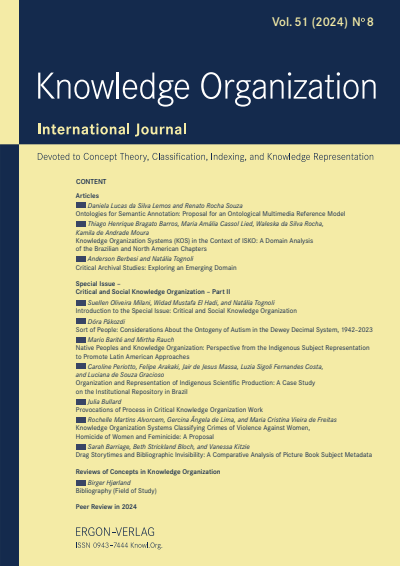
Cover der Ausgabe: KO KNOWLEDGE ORGANIZATION Jahrgang 51 (2024), Heft 8
Ausgabe Vollzugriff
Official Journal of the International Society for Knowledge Organization
Jahrgang 51 (2024), Heft 8
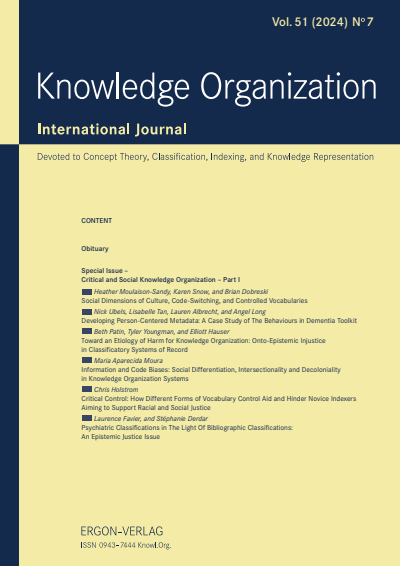
Cover der Ausgabe: KO KNOWLEDGE ORGANIZATION Jahrgang 51 (2024), Heft 7
Ausgabe Vollzugriff
Official Journal of the International Society for Knowledge Organization
Jahrgang 51 (2024), Heft 7
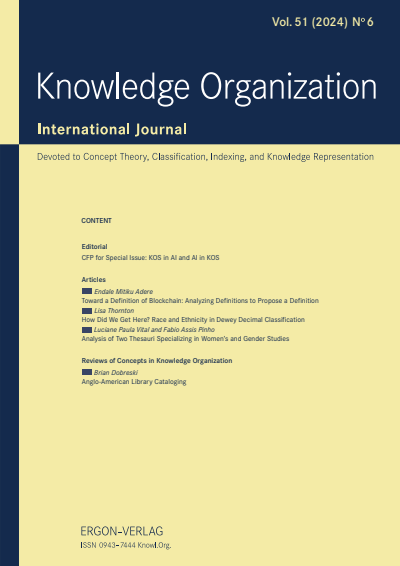
Cover der Ausgabe: KO KNOWLEDGE ORGANIZATION Jahrgang 51 (2024), Heft 6
Ausgabe Vollzugriff
Official Journal of the International Society for Knowledge Organization
Jahrgang 51 (2024), Heft 6
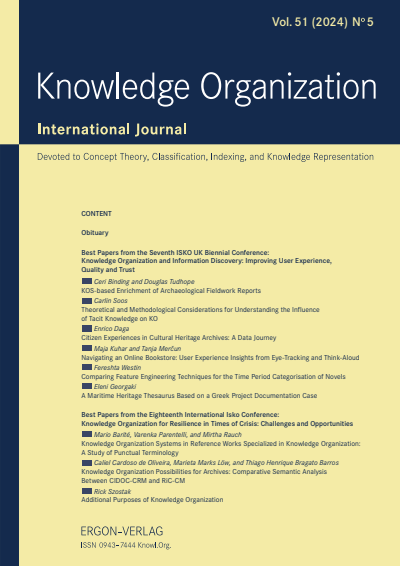
Cover der Ausgabe: KO KNOWLEDGE ORGANIZATION Jahrgang 51 (2024), Heft 5
Ausgabe Vollzugriff
Official Journal of the International Society for Knowledge Organization
Jahrgang 51 (2024), Heft 5
Cover der Ausgabe: KO KNOWLEDGE ORGANIZATION Jahrgang 51 (2024), Heft 4
Ausgabe Vollzugriff
Official Journal of the International Society for Knowledge Organization
Jahrgang 51 (2024), Heft 4