KNOWLEDGE ORGANIZATION is a forum for all those interested in the organization of knowledge on a universal or a domain-specific scale, using concept-analytical or concept-synthetical approaches, as well as quantitative and qualitative methodologies. KNOWLEDGE ORGANIZATION also addresses the intellectual and automatic compilation and use of classification systems and thesauri in all fields of knowledge, with special attention being given to the problems of terminology. KNOWLEDGE ORGANIZATION publishes original articles, reports on conferences and similar communications, as well as book reviews, letters to the editor, and an extensive annotated bibliography of recent classification and indexing literature. KNOWLEDGE ORGANIZATION should therefore be available at every university and research library of every country, at every information center, at colleges and schools of library and information science, in the hands of everybody interested in the fields mentioned above and thus also at every office for updating information on any topic related to the problems of order in our information-flooded times.
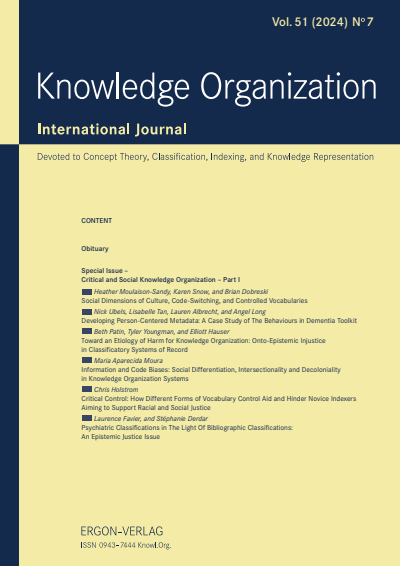
Traditionally, the selection of concepts and terms within a knowledge organization system (KOS) has served to reflect a socially constructed but majority opinion on language and therefore represent the perspectives of dominant groups. Members of a...
Terminology used in dementia care is fiercely contested. Advocates, health care providers, and researchers often have divergent perspectives on how aspects of dementia can and should be described. We created the Behaviours in Dementia Toolkit – a...
This paper traces the impacts knowledge organization systems have upon what can be known through them, the identities they create or deny, and the resulting structure of reality they uphold. We conceptualize classificatory systems of record to...
This study examines the historical perception of knowledge organization systems (KOS) as reinforcing oppressive regimes and epistemicides, particularly regarding issues such as race, gender, sexuality, and feminist studies. Drawing on the concepts...
Controlled vocabularies are widely used in Knowledge Organization Systems (KOS); however; they are criticized for perpetuating biases, being slow to change, and not reflecting the language of many groups and cultures. This paper examines and...
The social stigmatization affecting patients with serious mental disorders, as well as the evolution of patients’ right to information, calls for a more inclusive approach to the production of concepts in classifications. Failing to do so, medical...