KNOWLEDGE ORGANIZATION is a forum for all those interested in the organization of knowledge on a universal or a domain-specific scale, using concept-analytical or concept-synthetical approaches, as well as quantitative and qualitative methodologies. KNOWLEDGE ORGANIZATION also addresses the intellectual and automatic compilation and use of classification systems and thesauri in all fields of knowledge, with special attention being given to the problems of terminology. KNOWLEDGE ORGANIZATION publishes original articles, reports on conferences and similar communications, as well as book reviews, letters to the editor, and an extensive annotated bibliography of recent classification and indexing literature. KNOWLEDGE ORGANIZATION should therefore be available at every university and research library of every country, at every information center, at colleges and schools of library and information science, in the hands of everybody interested in the fields mentioned above and thus also at every office for updating information on any topic related to the problems of order in our information-flooded times.
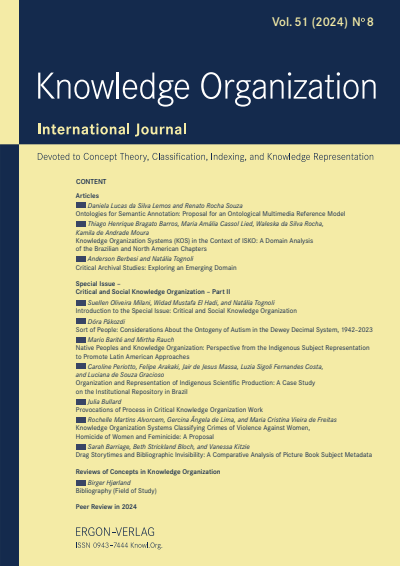
Recent years have seen considerable growth of online multimedia databases, largely due to digitization processes in different sectors of society. Knowledge organization and representation strategies were used to qualify and enrich data and metadata...
Objective: It aims to map, analyze thematically, semantically, and discursively the articles published in the area of Knowledge Organization within the five published volumes of the events of the International Society of Knowledge Organization...
This article explores critical archival studies as an emerging trend in the archival field, analyzing its relationship with domain analysis (DA), a methodological-theoretical approach within knowledge organization (KO). The objectives are: 1) to...
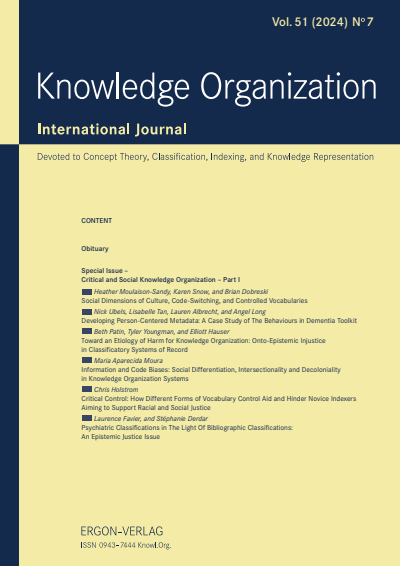
Sort of People: Considerations About the Ontogeny of Autism in the DDC, 1942-2023 traces the ontogeny of autism within the Dewey Decimal System, from the 14th to the 23rd editions. This period marks significant shifts in the psychiatric...
The situation of many indigenous cultures in Australia, North, Central, and South America can be described as one of marginalization or minorization. Subject representation of Indigenous knowledge constitutes one of the contemporary crossroads...
The 2019 United Nations General Assembly declared that the years of 2022 to 2032 will encompass the International Decade of Indigenous Languages. Within this context, information Science (IC) and knowledge organization (OC) play a central role in...
In this paper, I argue that the most provocative work in critical knowledge organization is happening at the level of process. I present three persistent assumptions about knowledge organization work and current provocations that challenge them....
According to the World Health Organization (WHO), one in three women worldwide has experienced some form of physical or sexual violence. In Brazil, in 2022, about 30% suffered some form of gender-based violence, with the number of women's homicides...
Historically, library materials about diverse identities have often been subject to what Gough and Greenblatt (1992) term “systemic bibliographic invisibility,” the use of “outmoded, prejudicial, inadequate, or inappropriate terminology”...
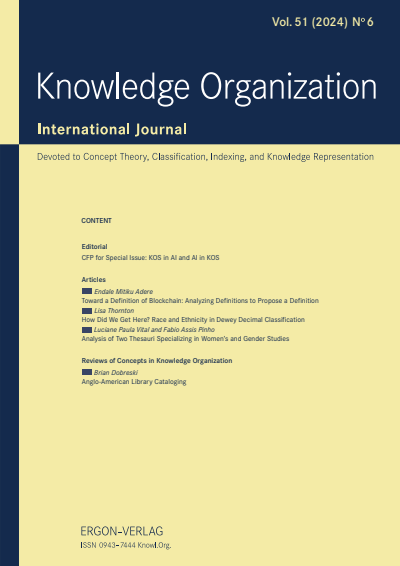
This article presents bibliography as a field of study. It consists of several traditions, of which enumerative (or “systematic”) bibliography is considered most important in relation to information science, but at the same time tends to be...