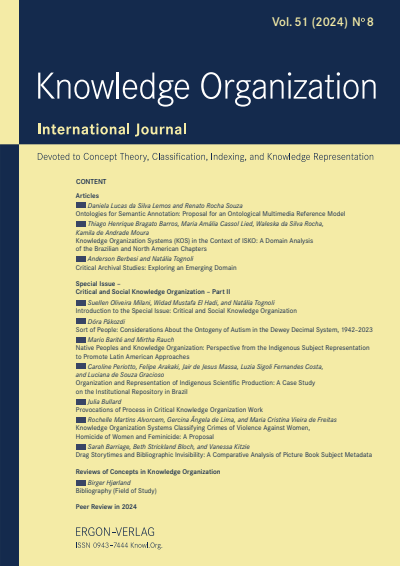
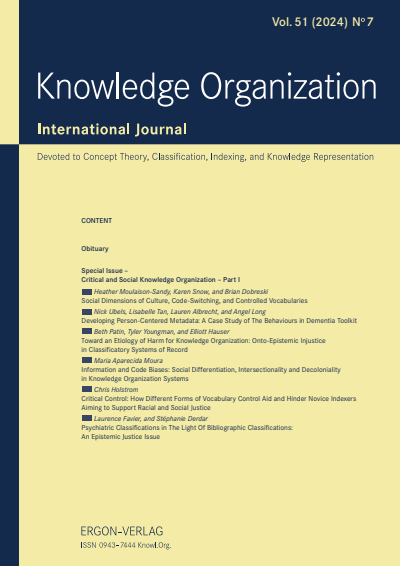
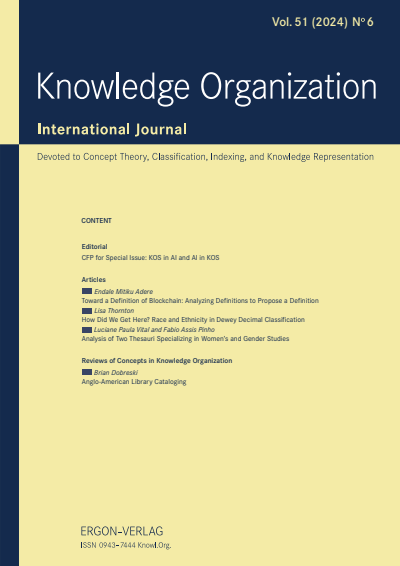
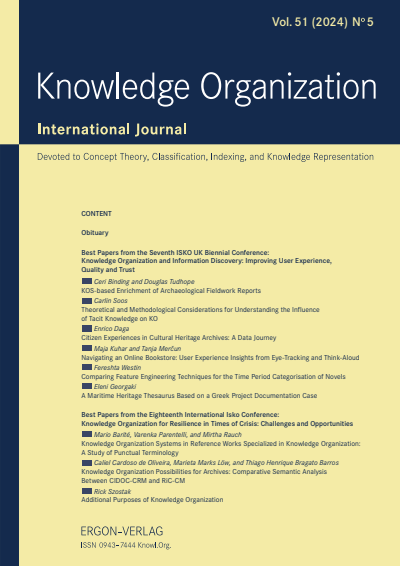
KNOWLEDGE ORGANIZATION is a forum for all those interested in the organization of knowledge on a universal or a domain-specific scale, using concept-analytical or concept-synthetical approaches, as well as quantitative and qualitative methodologies. KNOWLEDGE ORGANIZATION also addresses the intellectual and automatic compilation and use of classification systems and thesauri in all fields of knowledge, with special attention being given to the problems of terminology. KNOWLEDGE ORGANIZATION publishes original articles, reports on conferences and similar communications, as well as book reviews, letters to the editor, and an extensive annotated bibliography of recent classification and indexing literature. KNOWLEDGE ORGANIZATION should therefore be available at every university and research library of every country, at every information center, at colleges and schools of library and information science, in the hands of everybody interested in the fields mentioned above and thus also at every office for updating information on any topic related to the problems of order in our information-flooded times.
Knowledge network construction (KNC) is the essence of dynamic knowledge architecture, and is helpful to illustrate ubiquitous knowledge service in digital libraries (DLs). The authors explore its theoretical foundations and basic rules to elucidate...
In this study, we propose a recognition method of measuring literature topic evolution paths based on K-means-NMF in order to address problems such as the unobvious effect of topic clustering, high degree of mixing in clustering results, and unclear...
In this third part of the trilogy about “science,” Section 6 presents further developments in conceptualizing science. It has been claimed that science has recently changed in profound ways, and the concept of “epochal breaks” has been used...
Section 1 of this article discusses the concept of bibliographical control and makes a distinction between this term, “bibliographical description,” and related terms, which are often confused in the literature. It further discusses the function...