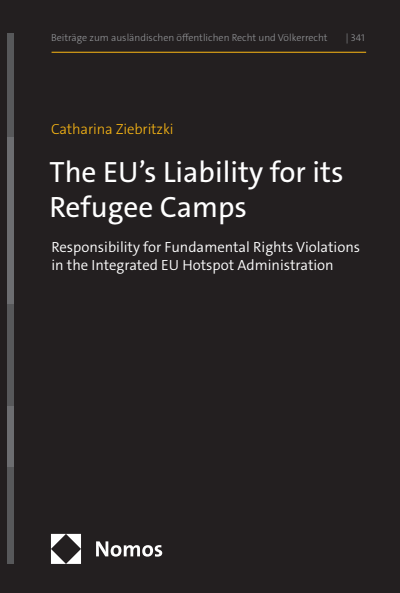
The EU’s Liability for its Refugee Camps
Responsibility for Fundamental Rights Violations in the Integrated EU Hotspot Administration- Autor:innen:
- Reihe:
- Beiträge zum ausländischen öffentlichen Recht und Völkerrecht, Band 341
- Verlag:
- 2025
Zusammenfassung
Die Arbeit argumentiert, dass die EU für Grundrechtsverletzungen in den EU-Hotspots rechtlich verantwortlich ist. Dogmatisch präzise, theoretisch anspruchsvoll und empirisch fundiert liefert sie zunächst einen Überblick über die Rolle der EU in der Europäischen Asylverwaltung seit 2015. Sodann stellt sie die integrierte EU-Hotspot-Verwaltung und deren systemische Defizite dar. Auf dieser Grundlage begründet sie die rechtliche Verantwortung der EU mittels der EU-Haftungsklage, wobei sie die zentralen Fragen der Zurechnung ausführlich diskutiert. Das Werk ist damit von Interesse für alle, die sich wissenschaftlich, journalistisch, anwaltlich, in Verwaltung oder in Politik mit dem Europäischen Asylsystem befassen.
Schlagworte
Publikation durchsuchen
Bibliographische Angaben
- Auflage
- 1/2025
- Copyrightjahr
- 2025
- ISBN-Print
- 978-3-7560-2323-3
- ISBN-Online
- 978-3-7489-4972-5
- Verlag
- Nomos, Baden-Baden
- Reihe
- Beiträge zum ausländischen öffentlichen Recht und Völkerrecht
- Band
- 341
- Sprache
- Englisch
- Seiten
- 411
- Produkttyp
- Monographie
Inhaltsverzeichnis
- Titelei/InhaltsverzeichnisSeiten 1 - 18 Download Kapitel (PDF)
- 1 EU Hotspots as a Critical Challenge to Human Rights
- 2 Europe’s Largest Refugee Camps
- 3 The EU’s Judicial Responsibility (Research Question)
- 4 The EU’s Liability for EU Hotspots (Thesis)
- 5 State of Research and Contribution of this Study
- 6 Typical Case Constellations
- 7 Method
- 1.1 The EU as an ‘Ordinary’ and Ambivalent Public Actor
- 1.2 The EU as a Critical Actor in Asylum Administration
- 1.3 The Failure to Regulate the EU’s Responsibility
- 1.4 The Challenge to Redefine the EU’s Responsibility
- a The Initial EU Hotspot Approach of 2015
- b The EU-Türkiye Statement of March 2016: From Relocation to Return
- c Political Insistence on a Non-Functional Return Policy
- d The EU Hotspot Approach 2.0 of 2020
- a Relevant Informal Rules as EU Soft Law
- b In Search for a Legal Basis in Primary Law
- c Belated Formalisation in National and EU Secondary Law
- d Formalisation of Key Elements in EU Secondary Law and Remaining Regulatory Gaps
- e Persisting Relevance of Informal Rules and Logic of Crisis
- 2.3 EU Hotspots as a Testing Ground
- a The EUAA’s Competences as a Political Compromise
- b The EUAA’s Internal Decision-Making Structure
- a Inter-Agency Cooperation as a Defining Feature of the European Asylum Administration
- b Frontex’s Competences and Internal Decision-Making Structures
- a The Commission’s Administrative Competences under Art. 17 para 1 TEU
- b The Commission’s Internal Decision-Making Structures
- a Reception-Related and Procedure-Related Support
- b Administrative Support and EU Responsibility
- a Operational Supervision as a Consolidated Form of Supervision
- b Monitoring as an Emerging Form of Supervision
- a Factual Conduct as a Strategy to Evade Judicial Review
- b Ensuring Judicial Review by Unfolding the Potential of EU Constitutional Law
- 1.1 A Multitude of Actors
- 1.2 The ‘Migration Management Support Teams’
- a Identification and First Registration
- b Hearing and Examination of Claim
- c Administrative and Judicial Appeals
- d Deportation Procedure
- 1.4 The Agencies’ Reception-Related Support
- 2.1 Belated Consolidation of the Commission’s Supervision
- 2.2 Coordination and Ensuring Legality
- 2.3 Procedure-Related vs. Reception-Related Supervision
- 2.4 Reduced Discretion in Case of Systemic Deficiencies
- 2.5 The Agencies’ Obligation to Assist the Commission
- a The European Regional Task Force (EURTF)
- b The Steering Committee
- c Deployment of Staff to the Ground
- d The Dedicated Task Force Migration Management
- 2.7 The Commission’s Concrete Supervisory Measures
- a The Prohibition of Inhuman or Degrading Treatment (Art. 4 ChFR)
- b The Prohibition of Systemic Detention of Asylum Seekers (Art. 6 ChFR)
- a The Right to Good Administration (Art. 41 ChFR)
- b Specific Procedural Guarantees for Children (Art. 24 and Art. 41 ChFR)
- i Why Türkiye is Not a Safe Third Country
- ii The Administrative Practice in the EU Hotspots
- 3.3. Qualification as Systemic Deficiencies
- 4.1 The EUAA’s Misconduct at Operational Level
- 4.2 Frontex’s Misconduct at Operational Level
- 4.3 The Commission’s Misconduct at Supervisory Level
- 5 EU Responsibility for EU Hotspots?
- 1 Auxiliary Character of Non-Judicial Review
- a The Commission’s Unequal Enforcement Policy
- b Why the Commission’s Practice is Problematic from a Broader Constitutional Perspective
- a Greek Courts’ Failure to Refer Relevant Questions to the CJEU
- b The Illegality of the Non-Referral Practice under Art. 267 para 3 TFEU
- a The Very Limited Potential of the Annulment Procedure and the Action for Failure to Act
- b Challenging Non-Formally Binding Conduct via Art. 263, 265 TFEU?
- 3.1 Preconditions, Potentials and Pitfalls
- a The Legal Protection Gap Argument: A Broad Reading of Art. 340 para 2 TFEU
- b The Action for Damages as a Mechanism for Vigilant Individuals
- a The Relevant Fundamental Rights as Individual Rights
- b A Fundamental Rights Violation as a Sufficiently Serious Breach
- c A Fundamental Rights Violation as a Damage
- a Towards Restitution in Kind and Recognition of Unlawfulness
- b From the Function of Compensation to Declaratory Relief
- c Lowering the Threshold for Liability: A Project De Lege Ferenda
- 4.1 Defining the Potential Trigger for EU Liability
- 4.2 A Sufficiently Serious Breach and Individual Rights
- 4.3 Legal Basis in Case of the Agencies
- 5.1 Concepts of Attribution and Causation
- 5.2 Imputation and the ‘Normative Bridge Function’
- a The Agencies’ Liability for Inherent Violations: A Question of Attribution
- b The Agencies’ Liability for Resulting Violations: A Question of Causation I
- c The Commission’s Liability for Resulting Violations: A Question of Causation II
- 5.4 Non-Applicability of DARS and DARIO
- 5.5 Case Law Relevant to the Doctrine on EU Liability
- 1.1 Public Conduct vs. Ultra Vires Conduct
- 1.2 Union Conduct vs. Intergovernmental Conduct
- 2.1 External Appearance Criterion
- 2.2 Internal Competence Criterion
- 2.3 Relationship Between the Criteria
- 3.1 Attribution of Conduct to the EUAA
- 3.2 Attribution of Conduct to Frontex
- 3.3 The Agencies’ Liability for Inherent Violations
- 1.1 Failure of the Conventional Causation Criterion
- 1.2 Why WS et al. vs. Frontex is No Counterargument
- 2.1 Liability for Administrative Support
- 2.2 Liability for Non-Formally Binding Conduct
- a The First Post-KYDEP Generation – from Geotronics to Camós Grau
- b The Second Post-KYDEP Generation – Tillack and Arizmendi
- c The Third Post-KYDEP Generation – Ledra and Bourdouvali
- 3.1 Liability for Breach of Supervisory Obligation
- a The Doctrinal Shift From Supervisory Obligations Under Secondary Law to Art. 17 TEU
- b The Doctrinal Shift From the Supervisory Obligation to the Supervisory Standard
- 4.1 Degree of Bindingness as Decisive Factor
- 4.2 Degree of Bindingness in Case of Omission
- a Financial Incentives or Pressure
- b Political Authority
- c Superior Technical Expertise or Information
- 5.1 The Agencies’ Individual Recommendations
- 5.2 The Commission’s Failure to Supervise
- 5.3 The EU’s Liability for Resulting Violations
- 1 Doctrinal Analysis in a Politicised Context
- 2 Why WS et al. vs. Frontex Should Not Discourage
- 3 Why Claiming Damages From the EU is Worth a Try
- BibliographySeiten 395 - 411 Download Kapitel (PDF)
Literaturverzeichnis (268 Einträge)
Es wurden keine Treffer gefunden. Versuchen Sie einen anderen Begriff.
- Bibliography Google Scholar öffnen DOI: 10.5771/9783748949725
- Pekka Aalto, Public Liability in EU Law. Brasserie, Bergaderm and Beyond, Hart Publishing 2011 Google Scholar öffnen DOI: 10.5771/9783748949725
- Karin Aberg, „Examining the Vulnerability Procedure: Group-based Determinations at the EU Border“, Refugee Survey Quarterly (2021), p. 1–27 Google Scholar öffnen DOI: 10.5771/9783748949725
- Philip Alston, J. H. H. Weiler, „An ‘Ever Closer Union’ in Need of a Human Rights Policy“, European Journal of International Law 9 (1998), p. 658–723 Google Scholar öffnen DOI: 10.5771/9783748949725
- Georgios Anagnostaras, „The Common European Asylum System: Balancing Mutual Trust Against Fundamental Rights Protection“, German Law Journal 21 (2020), p. 1180–1197 Google Scholar öffnen DOI: 10.5771/9783748949725
- Stine Andersen, The Enforcement of EU Law: The Role of the European Commission, Oxford University Press 2013 Google Scholar öffnen DOI: 10.5771/9783748949725
- H. Audretsch, Supervision in European Community Law, North-Holland 1986 Google Scholar öffnen DOI: 10.5771/9783748949725
- Ino Augsberg, „Art. 340 AEUV (ex-Artikel 288 EGV)“, in Hans von der Groeben, Jürgen Schwarze, Armin Hatje (ed.), Europäisches Unionsrecht. Vertrag über die Europäische Union, Vertrag über die Arbeitsweise der Europäischen Union, Charta der Grundrechte der Europäischen Union, Nomos 2015 Google Scholar öffnen DOI: 10.5771/9783748949725
- Jürgen Bast, „Scharade im kontrollfreien Raum: Hat die EU gar keinen Türkei-Deal geschlossen?“, Verfassungsblog of 03/03/2017 Google Scholar öffnen DOI: 10.5771/9783748949725
- Jürgen Bast, „Transnationale Verwaltung des europäischen Migrationsraums: Zur horizontalen Öffnung der EU-Mitgliedstaaten“, Der Staat 46 (2007), p. 1–32 Google Scholar öffnen DOI: 10.5771/9783748949725
- Jürgen Bast, „Handlungsformen und Rechtsschutz“, in Armin von Bogdandy, Jürgen Bast (ed.), Europäisches Verfassungsrecht. Theoretische und dogmatische Grundzüge, Springer 2009, p. 489–557 Google Scholar öffnen DOI: 10.5771/9783748949725
- Jürgen Bast, Frederik von Harbou, Janna Wessels, Human Rights Challenges to European Migration Policy. The REMAP Study, Nomos 2022 Google Scholar öffnen DOI: 10.5771/9783748949725
- Filipe Brito Bastos, „Derivate Illegality in European Composite Administrative Procedures“, Common Market Law review 55 (2018), p. 101–134 Google Scholar öffnen DOI: 10.5771/9783748949725
- Hemme Battjes, „In Search of a Fair Balance: The Absolute Character of the Prohibition of Refoulement under Article 3 ECHR Reassessed“, Leiden Journal of International Law 22 (2009), p. 583–621 Google Scholar öffnen DOI: 10.5771/9783748949725
- Michael W. Bauer, Stefan Becker, „The Unexpected Winner of the Crisis: The European Commission’s Strengthened Role in Economic Governance“, Journal of European Integration 36 (2014), p. 213–229 Google Scholar öffnen DOI: 10.5771/9783748949725
- Zygmunt Baumann, Strangers at Our Door, Polity Press 2016 Google Scholar öffnen DOI: 10.5771/9783748949725
- Stefan Becker, Michael W. Bauer, „Die Europäische Kommission. Koordinationsbürokratie mit Regierungsanspruch“, in Peter Becker, Barbara Lippert (ed.), Handbuch Europäische Union, Springer 2020, p. 369–389 Google Scholar öffnen DOI: 10.5771/9783748949725
- Werner Berg, „Art. 340 AEUV“, in Ulrich Becker, Armin Hatje, Johann Schoo, Jürgen Schwarze (ed.), EU-Kommentar, Nomos 2019 Google Scholar öffnen DOI: 10.5771/9783748949725
- Felix Biermann, Nina Guérin, Stefan Jagdhuber, Berthold Rittberger, Moritz Weiss, „Political (non-)reform in the euro crisis and the refugee crisis: a liberal intergovernmentalist explanation“, Journal of European Public Policy (2019), p. 246–266 Google Scholar öffnen DOI: 10.5771/9783748949725
- Michael Blauberger, Dorte Sindbjerg Martinsen, „The Court of Justice in times of politicisation: ‘law as a mask and shield’ revisited“, Journal of European Public Policy 27 (2020), p. 382–399 Google Scholar öffnen DOI: 10.5771/9783748949725
- Armin von Bogdandy, „The European Union as a Human Rights Organization? Human Rights and the Core of the European Union“, Common Market Law Review 37 (2000), p. 1307–1338 Google Scholar öffnen DOI: 10.5771/9783748949725
- Armin von Bogdandy, „Grundprinzipien“, in Armin von Bogdandy, Jürgen Bast (ed.), Europäisches Verfassungsrecht. Theretische und dogmatische Grundzüge, Springer 2009, p. 13–71 Google Scholar öffnen DOI: 10.5771/9783748949725
- Armin von Bogdandy, „Principles of a Systemic Deficiencies Doctrine: How to Protect Checks and Balances in the Member States“, Common Market Law Review 57 (2020), p. 705–740 Google Scholar öffnen DOI: 10.5771/9783748949725
- Armin von Bogdandy, The Emergence of European Society through Public Law. A Hegelian and Anti-Schmittian Approach, Oxford University Press 2024 Google Scholar öffnen DOI: 10.5771/9783748949725
- Armin von Bogdandy, Michael Ioannidis, „Systemic Deficiency in the Rule of Law: What it is, what has to be done, what can be done“, Common Market Law Review 51 (2014), p. 59–96 Google Scholar öffnen DOI: 10.5771/9783748949725
- Armin von Bogdandy, Matthias Kottmann, Carlino Antpöhler, Johanna Dickschen, Simon Hentrei, Maja Smrkolj, „Reverse Solange – Protecting the Essence of Fundamental Rights Against EU Member States“, Common Market Law Review 49 (2012), p. 489–520 Google Scholar öffnen DOI: 10.5771/9783748949725
- Armin von Bogdandy, Pál Sonnevend (ed.), Constitutional Crisis in the European Constitutional Area. Theory, Law and Politics in Hungary and Romania, Nomos 2015 Google Scholar öffnen DOI: 10.5771/9783748949725
- Tanja A Börzel, Ulrich Sedelmeier, „Larger and More Law Abiding? The Impact of Enlargement on Compliance in the European Union“, Journal of European Public Policy 24 (2016), p. 197–215 Google Scholar öffnen DOI: 10.5771/9783748949725
- Mark Bovens, „Analysing and Assessing Accountability: A Conceptual Framework“, European Law Journal 13 (2007), p. 447–468 Google Scholar öffnen DOI: 10.5771/9783748949725
- Stephan Breitenmoser, Robert Weyeneth, „Artikel 74 AEUV“, in Hans von der Groeben, Jürgen Schwarze, Armin Hatje (ed.), Europäisches Unionsrecht, Nomos 2015 Google Scholar öffnen DOI: 10.5771/9783748949725
- Hannah Bru, Aikaterini Anastasopoulou, Heini Hyrkkö, „The Circumvention of the Dublin III Regulation Through the Use of Bilateral Agreements to Return Asylum Seekers to Other Member States“, in European Council on Refugees and Exiles (ECRE) (ed.), Research Paper Ghent University 2019 Google Scholar öffnen DOI: 10.5771/9783748949725
- Madalina Busuioc, European Agencies: Law and Practices of Accountability, Oxford University Press 2013 Google Scholar öffnen DOI: 10.5771/9783748949725
- Başak Çalı, Cathryn Costello, Stewart Cunningham, „Hard Protection through Soft Courts? Non-Refoulement before the United Nations Treaty Bodies“, German Law Journal 21 (2020), p. 355–384 Google Scholar öffnen DOI: 10.5771/9783748949725
- Giuseppe Campesi, „Seeking Asylum in Times of Crisis: Reception, Confinement, and Detention at Europe’s Southern Border“, Refugee Survey Quarterly 37 (2018), p. 44–70 Google Scholar öffnen DOI: 10.5771/9783748949725
- Enzo Cannizzaro, „Denialism as the Supreme Expression of Realism. A Quick Comment on NF v. European Council“, European Papers (2017), p. 215–257 Google Scholar öffnen DOI: 10.5771/9783748949725
- Iris Canor, „My brother’s keeper? Horizontal solange: ‘An ever closer distrust among the peoples of Europe’“, Common Market Law Review 50 (2013), p. 383–422 Google Scholar öffnen DOI: 10.5771/9783748949725
- Sergio Carrera, „The 20 years anniversary of the Tampere programme: Securitization, intergovernmentalism and informalization“, Maastricht Journal of European and Comparative Law 27 (2020), p. 3–9 Google Scholar öffnen DOI: 10.5771/9783748949725
- Sergio Carrera, Leonhard Den Hertog, Joanna Parkin, „The Peculiar Nature of EU Home Affairs Agencies in Migration Control: Beyond Accountability versus Autonomy?“, European Journal of Migration and Law 15 (2013), p. 337–358 Google Scholar öffnen DOI: 10.5771/9783748949725
- Sergio Carrera, Leonhard Den Hertog, Marco Stefan, „It wasn't me! The Luxembourg Court Orders on the EU-Turkey Refugee Deal“, CEPS Policy Insights (15/04/2017) Google Scholar öffnen DOI: 10.5771/9783748949725
- Sergio Carrera, Elspeth Guild, „‘Joint Operation RABIT 2010’. FRONTEX Assistance to Greece's Border with Turkey: Revealing the Deficiencies of Europe's Dublin Asylum System“, CEPS Liberty and Security in Europe (2010) Google Scholar öffnen DOI: 10.5771/9783748949725
- Sergio Carrera, Marco Stefan, „Complaint Mechanisms in Border Management and Expulsion Operations in Europe. Effective Remedies for Victims of Human Rights Violations?“, CEPS Policy Insights (2018) Google Scholar öffnen DOI: 10.5771/9783748949725
- Marta Cartabia, „Europe and Rights: Taking Dialogue Seriously“, European Constitutional Law Review 5 (2009), p. 5–31 Google Scholar öffnen DOI: 10.5771/9783748949725
- Federico Casolari, „The EU's Hotspot Approach to Managing the Migration Crisis: A Blind Spot for International Responsibility?“, Italian Yearbook of International Law 25 (2015), p. 109–134 Google Scholar öffnen DOI: 10.5771/9783748949725
- Federico Casolari, „The unbearable lightness of soft law: on the European Unions recourse to informal instruments in the fight against irregular immigration“, in Francesca Ippolito, Gianluca Borzoni, Federico Casolari (ed.), Bilateral Relations in the Mediterranean. Prospects for Migration Issues, Edward Elgar 2020, p. 215–228 Google Scholar öffnen DOI: 10.5771/9783748949725
- Sabino Cassese, „European Administrative Proceedings“, Law and Contemporary Problems 86 (2004), p. 21–36 Google Scholar öffnen DOI: 10.5771/9783748949725
- Andrés Delgado Casteleiro, The International Responsibility of the European Union. From Competence to Normative Control, Cambridge University Press 2016 Google Scholar öffnen DOI: 10.5771/9783748949725
- Mariavittoria Catanzariti, Alexander H. Türk, „EU agencies and the rise of a mixed administration in the EU multi-jurisdictional setting: facing the challenges of the rule of law“, in Miroslava Scholten, Alex Brenninkmeijer (ed.), Controlling EU Agencies. The Rule of Law in a Multi-jurisdictional Legal Order, Edward Elgar 2020, p. 18–38 Google Scholar öffnen DOI: 10.5771/9783748949725
- Merijn Chamon, „Agencification in the United States and Germany and What the EU Might Learn From It“, German Law Journal 17 (2016), p. 119–152 Google Scholar öffnen DOI: 10.5771/9783748949725
- Merijn Chamon, EU Agencies. Legal and Political Limits to the Transformation of the EU Administration, Oxford University Press 2016 Google Scholar öffnen DOI: 10.5771/9783748949725
- B. S. Chimni, „The Geopolitics of Refugee Studies: a View from the South“, Journal of Refugee Studies 11 (1998), p. 350–374 Google Scholar öffnen DOI: 10.5771/9783748949725
- Meltem Ciger-Ineli, „Protecting Syrians in Turkey: A Legal Analysis“, International Journal of Refugee Law 29 (2017), p. 555–579 Google Scholar öffnen DOI: 10.5771/9783748949725
- Françoise Comte, „A New Agency Is Born in the European Union: The European Asylum Support Office“, European Journal of Migration and Law 12 (2010), p. 373–405 Google Scholar öffnen DOI: 10.5771/9783748949725
- Roberto Cortinovis, „The Evolution of Frontex Governance: Shifting from Soft to Hard Law?“, Journal of Contemporary European Research 11 (2015), p. 252–267 Google Scholar öffnen DOI: 10.5771/9783748949725
- Cathryn Costello, „Administrative governance and the Europeanisation of asylum and immigration policy“, in Herwig C.H. Hofmann, Alexander H. Türk (ed.), EU Administrative Governance, Edward Elgar 2006, p. 287–340 Google Scholar öffnen DOI: 10.5771/9783748949725
- Cathryn Costello, „Courting Access to Asylum in Europe: Recent Supranational Jurisprudence Explored“, Human Rights Law Review 12 (2012), p. 287–339 Google Scholar öffnen DOI: 10.5771/9783748949725
- Cathryn Costello, Itamar Mann, „Border Justice: Migration and Accountability for Human Rights Violations“, German Law Journal 21 (2020), p. 311–334 Google Scholar öffnen DOI: 10.5771/9783748949725
- Cathryn Costello, Minos Mouzourakis, „The Common European Asylum System. Where did it all go wrong?“, in Maria Fletcher, Ester Herlin-Karnell, Matera Claudio (ed.), The European Union as an Area of Freedom, Security and Justice, Routledge 2017, p. 263–299 Google Scholar öffnen DOI: 10.5771/9783748949725
- Paul Craig, „Standing, Rights, and the Structure of Legal Argument“, European Public Law 9 (2003), p. 493–508 Google Scholar öffnen DOI: 10.5771/9783748949725
- Paul Craig, EU Administrative Law, Oxford University Press 2018 Google Scholar öffnen DOI: 10.5771/9783748949725
- Paul Craig, „Article 41“, in Steve Peers, Tamara Hervey, Jeff Kenner, Angela Ward (ed.), The EU Charter of Fundamental Rights. A Commentary, Nomos 2021, p. 1125–1152 Google Scholar öffnen DOI: 10.5771/9783748949725
- Astrid Czaja, Die außervertragliche Haftung der EG für ihre Organe, Nomos 1996 Google Scholar öffnen DOI: 10.5771/9783748949725
- Nasiya Daminova, „‘Access to Justice’ and the Development of the Van Gend en Loos Doctrine: The Role of Courts and of the Individual in EU Law“, Baltic Journal of Law & Politics 10 (2017), p. 133–153 Google Scholar öffnen DOI: 10.5771/9783748949725
- Philipp Dann, „Thoughts on a Methodology of European Constitutional Law“, German Law Journal 6 (2005), p. 1453–1474 Google Scholar öffnen DOI: 10.5771/9783748949725
- Gareth Davies, „The General Court finds Frontex not liable for helping with illegal pushbacks: it was just following orders“, europeanlawblog of 11 Sept 2023 Google Scholar öffnen DOI: 10.5771/9783748949725
- Joyce De Coninck, „Shielding Frontex. On the EU General Court’s “WS and others v Frontex”“, Verfassungsblog of 09/09/2023 Google Scholar öffnen DOI: 10.5771/9783748949725
- Maartje de Visser, „The Concept of Concurrent Liability and Its Relationship with the Principle of Effectiveness: A One-Way Ticket into Oblivion“, Maastricht Journal of European and Comparative Law 11 (2004), p. 47–70 Google Scholar öffnen DOI: 10.5771/9783748949725
- Bruno De Witte, Šejla Imamovic, „Opinion 2/13 on accession to the ECHR : defending the EU legal order against a Foreign Human Rights Court“, European Law Review 40 (2015), p. 683–705 Google Scholar öffnen DOI: 10.5771/9783748949725
- Giacinto Della Cananea, „The European Union's Mixed Administrative Proceedings“, Law and Contemporary Problems 68 (2004), p. 187–218 Google Scholar öffnen DOI: 10.5771/9783748949725
- Maarten Den Heijer, Jorrit R Rijpma, Thomas Spijkerboer, „Coercion, prohibition, and great expectations. The continuing failure of the Common European Asylum System“, Common Market Law Review 53 (2016), p. 607–642 Google Scholar öffnen DOI: 10.5771/9783748949725
- Angeliki Dimitriadi, Antonia-Maria Sarantaki, „The refugee ‘crisis’ in Greece: politicisation and polarisation amidst multiple crises“, CEASEVAL Research on the Common European Asylum System 11 (2018) Google Scholar öffnen DOI: 10.5771/9783748949725
- Oliver Dörr, „Art. 263 AEUV“, in Eberhard Grabitz, Meinhard Hilf, Martin Nettesheim (ed.), Das Recht der Europäischen Union, C.H. Beck 2023 Google Scholar öffnen DOI: 10.5771/9783748949725
- ECRE, „Holding Frontex to Account. ECRE's Proposals for Strengthening Non-Judicial Mechanisms for Scrutiny of Frontex“, Policy Paper 7, May 2021 (2021) Google Scholar öffnen DOI: 10.5771/9783748949725
- ECRE, Reception, detention and restriction of movement at EU external borders, Heinrich Böll Stiftung 2021 Google Scholar öffnen DOI: 10.5771/9783748949725
- Hanna Eklund, „Peoples, Inhabitants and Workers: Colonialism in the Treaty of Rome“, The European Journal of International Law 34 (2023), p. 831–854 Google Scholar öffnen DOI: 10.5771/9783748949725
- Mariolina Eliantonio, „Judicial Review in an Integrated Administration: the Case of 'Composite Procedures'“, Review of European Administrative Law 7 (2015), p. 65–102 Google Scholar öffnen DOI: 10.5771/9783748949725
- Mariolina Eliantonio, Nikos Vogiatzis, „Judicial and Extra-Judicial Challenges in the EU Multi- and Cross-Level Administrative Framework“, German Law Journal 22 (2021), p. 315–324 Google Scholar öffnen DOI: 10.5771/9783748949725
- Gerda Falkner, „A Causal Loop? The Commission's New Enforcement Approach in the Context of Non-Compliance with EU Law After CJEU Judgements“, Journal of European Integration 40 (2018), p. 769–784 Google Scholar öffnen DOI: 10.5771/9783748949725
- Kevin Featherstone, „External conditionality and the debt crisis: the ‘Troika’ and public administration reform in Greece“, Journal of European Public Policy 22 (2015), p. 295–314 Google Scholar öffnen DOI: 10.5771/9783748949725
- David Fernandez-Rojo, „The introduction of an individual complaint mechanism within FRONTEX: two steps forward, one step back“, Tijdschrift voor Bestuurswetenschappen en Publiekrecht 4 (2016), p. 225–234 Google Scholar öffnen DOI: 10.5771/9783748949725
- David Fernández-Rojo, EU Migration Agencies. The Operation and Cooperation of FRONTEX, EASO and EUROPOL, Edward Elgar 2021 Google Scholar öffnen DOI: 10.5771/9783748949725
- David Fernández Rojo, „From EASO to the European Agency for Asylum: 'Business as Usual?'“, eumigrationlawblog of 15/10/2018 Google Scholar öffnen DOI: 10.5771/9783748949725
- Francette Fines, „A General Analytical Perspective on Community Liability“, in Ton Heukels, Alison McDonnell (ed.), The Action for Damages in Community Law, Wolters Kluwer 1997 Google Scholar öffnen DOI: 10.5771/9783748949725
- Melanie Fink, Frontex and Human Rights. Responsibility in 'Multi-Actor Situations' under the ECHR and EU Public Liability Law, Oxford University Press 2018 Google Scholar öffnen DOI: 10.5771/9783748949725
- Melanie Fink, „EU Liability for Contributions to Member States' Breaches of EU Law“, Common Market Law Review 56 (2019), p. 1227–1264 Google Scholar öffnen DOI: 10.5771/9783748949725
- Melanie Fink, „The Action for Damages as a Fundamental Rights Remedy: Holding Frontex Liable“, German Law Journal 21 (2020), p. 532–548 Google Scholar öffnen DOI: 10.5771/9783748949725
- Andreas Fischer-Lescano, Timo Tohidipur, „Europäisches Grenzkontrollregime. Rechtsrahmen der europäischen Grenzschutzagentur Frontex“, Zeitschrift für ausländisches öffentliches Recht und Völkerrecht 67 (2007), p. 1219–1276 Google Scholar öffnen DOI: 10.5771/9783748949725
- Thomas Gammeltoft-Hansen, James C. Hathaway, „Non-refoulement in a World of Cooperative Deterrence“, Columbia Journal of Transnational Law 53 (2015), p. 235–284 Google Scholar öffnen DOI: 10.5771/9783748949725
- Klaus Ferdinand Gärditz, „Territoriality, Democracy, and Borders: A Retrospective on the ‘Refugee Crisis’“, German Law Journal 17 (2016), p. 907–922 Google Scholar öffnen DOI: 10.5771/9783748949725
- Martin Gellermann, „Art. 340 AEUV “, in Rudolf Streinz (ed.), EUV/AEUV, C.H. Beck 2018 Google Scholar öffnen DOI: 10.5771/9783748949725
- Giulia Gentile, „Ensuring Effective Judicial Review of EU Soft Law via the Action for Annulment before the EU Courts: a Plea for a Liberal-Constitutional Approach“, European Constitutional Law Review (2020), p. 466–492 Google Scholar öffnen DOI: 10.5771/9783748949725
- María-Teresa Gil-Bazo, „The Charter of Fundamental Rights of the European Union and the Right to be Granted Asylum in the Union's Law“, Refugee Survey Quarterly 27 (2015), p. 33–52 Google Scholar öffnen DOI: 10.5771/9783748949725
- Alberto Gil Ibáñez, The Administrative Supervision and Enforcement in EC Law: Powers, Procedures and Limits, Hart Publishing 1999 Google Scholar öffnen DOI: 10.5771/9783748949725
- Mariana Gkliati, „The first steps of Frontex accountability: Implications for its Legal Responsibility for Fundamental Rights Violations“, eumigrationlawblog of 13/08/2021 Google Scholar öffnen DOI: 10.5771/9783748949725
- Mariana Gkliati, „The Application of the EU-Turkey Agreement: A Critical Analysis of the Decisions of the Greek Appeals Committee“, European Journal of Legal Studies 10 (2017), p. 81–124 Google Scholar öffnen DOI: 10.5771/9783748949725
- Mariana Gkliati, Herbert Rosenfeldt, „Accountability of the European Border and Coast Guard Agency: Recent developments, legal standards and existing mechanisms“, RLI Working Paper 30 (2018) Google Scholar öffnen DOI: 10.5771/9783748949725
- Matthias Goldmann, „Dogmatik als rationale Rekonstruktion: Versuch einer Metatheorie am Beispiel völkerrechtlicher Prinzipien“, Der Staat 53 (2014), p. 373–399 Google Scholar öffnen DOI: 10.5771/9783748949725
- Guy S Goodwin-Gill, Jane McAdam, The Refugee in International Law, Oxford University Press 2007 Google Scholar öffnen DOI: 10.5771/9783748949725
- Barbara Grabowska-Moroz, Dimitry Vladimirovich Kochenov, „The Loss of Face for Everyone Concerned. EU Rule of Law in the Context of the ‘Migration Crisis’“, in V Stoyanova, S Smet (ed.), Migrants’ Rights, Populism and Legal Resilience in Europe, Cambridge University Press 2022, p. 187–208 Google Scholar öffnen DOI: 10.5771/9783748949725
- Scott Greer, „Structural adjustment comes to Europe: Lessons for the Eurozone from the conditionality debates“, Global Social Policy 14 (2013), p. 51–71 Google Scholar öffnen DOI: 10.5771/9783748949725
- Steven Greer, „Is the Prohibition against Torture, Cruel, Inhuman and Degrading Treatment Really ‘Absolute’ in International Human Rights Law?“, Human Rights Law Review 15 (2015), p. 101–137 Google Scholar öffnen DOI: 10.5771/9783748949725
- Elspeth Guild, „The Frontex Push-Back Controversy: Lessons on Oversight (Part I)“, eumigrationlawblog of 19/04/2021 Google Scholar öffnen DOI: 10.5771/9783748949725
- Elspeth Guild, „The Europeanisation of Europe’s Asylum Policy“, International Journal of Refugee Law (2006), p. 630–652 Google Scholar öffnen DOI: 10.5771/9783748949725
- Elspeth Guild, „Does the EU Need a European Migration and Protection Agency?“, International Journal of Refugee Law 28 (2016), p. 585–600 Google Scholar öffnen DOI: 10.5771/9783748949725
- Elspeth Guild, Sergio Carrera, Leonhard Den Hertog, Joanna Parkin, Implementation of the EU Charter of Fundamental Rights and its Impact on EU Home Affairs Agencies. Frontex, Europol and the European Asylum Support Office. Study for the LIBE Committee, European Parliament 2011 Google Scholar öffnen DOI: 10.5771/9783748949725
- Kathleen Gutman, „The Evolution of the Action for Damages Against the European Union and Its Place in the System of Judicial Protection“, Common Market Law Review 48 (2011), p. 695–750 Google Scholar öffnen DOI: 10.5771/9783748949725
- Peo Hansen, Stefan Jonsson, Eurafrica: The Untold History of European Integration and Colonialism, Bloomsbury Academic 2014 Google Scholar öffnen DOI: 10.5771/9783748949725
- James C. Hathaway, „The Emerging Politics of Non-Entrée“, Refugees 91 (1992), p. 40 Google Scholar öffnen DOI: 10.5771/9783748949725
- Katri Havu, „Damages Liability for Non-Material Harm in EU Case Law“, European Law Review 44 (2019), p. 492–514 Google Scholar öffnen DOI: 10.5771/9783748949725
- Ton Heukels, Alison McDonnell, „The Action for Damages in a Community Law Perspective: Introduction“, in Ton Heukels, Alison McDonnell (ed.), The Action for Damages in Community Law, Wolters Kluwer 1997 Google Scholar öffnen DOI: 10.5771/9783748949725
- Chris Hilson, The Role of Discretion in EC Law on Non-Contractual Liability, Common Market Law Review 42 (2005), p. 677-695 Google Scholar öffnen DOI: 10.5771/9783748949725
- Herwig Hofmann, Morgane Tidghi, „Rights and Remedies in Implementation of EU Policies by Multi-Jurisdictional Networks“, European Public Law (2014), p. 147–164 Google Scholar öffnen DOI: 10.5771/9783748949725
- Herwig Hofmann, Alexander Türk, „Legal challenges in EU administrative law by the move to an integrated administration“, in Herwig Hofmann, Alexander Türk (ed.), Legal Challenges in EU Administrative Law, Edward Elgar 2009, p. 355–379 Google Scholar öffnen DOI: 10.5771/9783748949725
- Herwig Ch Hofmann, Liisa Holopainen, Elina Paunio, Laurent Pech, Clara Rauchegger, Debbie Sayers, Angela Ward, „Article 47“, in Steve Peers, Tamara Hervey, Jeff Kenner, Angela Ward (ed.), The EU Charter of Fundamental Rights. A Commentary, Nomos 2022 Google Scholar öffnen DOI: 10.5771/9783748949725
- Herwig C.H. Hofmann, Gerard C. Rowe, Alexander H. Türk, Administrative Law and Policy of the European Union, Oxford University Press 2011 Google Scholar öffnen DOI: 10.5771/9783748949725
- Herwig C. H. Hofmann, Alexander Türk, „The Development of Integrated Administration in the EU and its Consequences“, European Law Journal 13 (2007), p. 253–271 Google Scholar öffnen DOI: 10.5771/9783748949725
- Jens Hofmann, Rechtsschutz und Haftung im Europäischen Verwaltungsverbund, Duncker & Humblot 2004 Google Scholar öffnen DOI: 10.5771/9783748949725
- Rainer Hofmann, Adela Schmidt, „‘EU-Türkei-Deal’ ohne Beteiligung der EU? – Die Beschlüsse des EuG zur Erklärung EU-Türkei vom 18. März 2016“, Europäische Grundrechte-Zeitschrift 44 (2017), p. 317–327 Google Scholar öffnen DOI: 10.5771/9783748949725
- Rainer Hofmann, Adela Schmidt, „Ist die Türkei für Asylantragsteller ein sicherer Drittstaat? – Das Urteil des Hellenischen Staatsrats vom 22.9.2017“, Zeitschrift für Ausländerrecht und Ausländerpolitik 38 (2018), p. 1–6 Google Scholar öffnen DOI: 10.5771/9783748949725
- Alisha C Holland, „Forbearance“, American Political Science Review 110 (2016), p. 232–246 Google Scholar öffnen DOI: 10.5771/9783748949725
- Michael Ioannidis, „Weak Members and the Enforcement of EU Law“, in András Jakab, Dimitry Kochenov (ed.), The Enforcement of EU Law and Values. Ensuring Member States' Compliance, Oxford University Press 2017, p. 476–492 Google Scholar öffnen DOI: 10.5771/9783748949725
- Marc Jacob, Matthias Kottmann, „Art. 340 AEUV“, in Eberhard Grabitz, Meinhard Hilf, Martin Nettesheim (ed.), Das Recht der Europäischen Union C.H. Beck 2023 Google Scholar öffnen DOI: 10.5771/9783748949725
- András Jakab, Dimitry Kochenov (ed.), The Enforcement of EU Law and Values. Ensuring Member States' Compliance, Oxford University Press 2017 Google Scholar öffnen DOI: 10.5771/9783748949725
- Hans Jarass, „Art. 25 Rechte älterer Menschen“, Charta der Grundrechte der EU, C.H. Beck 2021 Google Scholar öffnen DOI: 10.5771/9783748949725
- Hans Jarass, „Art. 41 Recht auf eine gute Verwaltung“, Charta der Grundrechte der EU, C.H. Beck 2021 Google Scholar öffnen DOI: 10.5771/9783748949725
- Hans Jarass, „Art. 47 Recht auf einen wirksamen Rechtsbehelf und ein unparteiisches Gericht“, Charta der Grundrechte der EU, C.H. Beck 2021 Google Scholar öffnen DOI: 10.5771/9783748949725
- Hans Jarass, „Art. 52 Tragweite und Auslegung der Rechte und Grundsätze“, Charta der Grundrechte der EU, C.H. Beck 2021 Google Scholar öffnen DOI: 10.5771/9783748949725
- Anastasia Karatzia, „An Overview of Litigation in the Context of Financial Assistance“, Hungarian Yearbook of International Law and European Law (2016), p. 573–590 Google Scholar öffnen DOI: 10.5771/9783748949725
- Eva Kassoti, Narin Idriz, „The Informalisation of the EU’s External Action in the Field of Migration and Asylum“, in Eva Kassoti, Narin Idriz (ed.), The Informalisation of the EU’s External Action in the Field of Migration and Asylum, Springer 2022, p. 1–12 Google Scholar öffnen DOI: 10.5771/9783748949725
- Daniel Kelemen, Tommaso Pavone, „Where Have the Guardians Gone? Law Enforcement and the Politics of Supranational Forbearance in the European Union“, SSRN (2021) Google Scholar öffnen DOI: 10.5771/9783748949725
- Thorsten Kingreen, „Artikel 25 EU-GRCharta“, in Christian Calliess, Matthias Ruffert (ed.), EUV/AEUV. Kommentar, C.H. Beck 2022 Google Scholar öffnen DOI: 10.5771/9783748949725
- Thorsten Kingreen, „Artikel 52 EU-GRCharta“, in Christian Calliess, Matthias Ruffert (ed.), EUV/AEUV. Kommentar, C.H. Beck 2022 Google Scholar öffnen DOI: 10.5771/9783748949725
- Paul Kirchhof, „Staatliche Souveränität als Bedingung des Asylrechts“, in Georg Jochum, Wolfgang Fritzemeyer, Marcel Kau (ed.), Grenzüberschreitendes Recht – Crossing frontiers. Festschrift für Kay Hailbronner, C.F. Müller 2013, p. 105–121 Google Scholar öffnen DOI: 10.5771/9783748949725
- Karl E Klare, „Legal Culture and Transformative Constitutionalism“, South African Journal on Human Rights 14 (1998), p. 146–188 Google Scholar öffnen DOI: 10.5771/9783748949725
- Dimitry Kochenov, „The Essence of EU Citizenship Emerging From Ten Years of Academic Debate: Beyond the Cherry Blossoms and the Moon?“, The International and Comparative Law Quarterly 62 (2013), p. 97–136 Google Scholar öffnen DOI: 10.5771/9783748949725
- Dimitry Kochenov, „Biting Intergovernmentalism: The Case for the Reinvention of Article 259 TFEU to Make It a Viable Rule of Law Enforcement Tool“, Hague Journal on the Rule of Law 7 (2015), p. 153–174 Google Scholar öffnen DOI: 10.5771/9783748949725
- Christina Last, Garantie wirksamen Rechtsschutzes gegen Maßnahmen der Europäischen Union. Zum Verhältnis von Art. 47 Abs. 1, 2 GRCh und Art. 263 ff. AEUV, Mohr Siebeck 2008 Google Scholar öffnen DOI: 10.5771/9783748949725
- Liora Lazarus, Cathryn Costello, Nazila Ghanea, Katja S. Ziegler, „The Evolution of Fundamental Rights Charters and Case Law. Report for the European Parliament Directorate-General for Internal Policies“, SSRN (2011) Google Scholar öffnen DOI: 10.5771/9783748949725
- Stephen H Legomsky, „Secondary Refugee Movements and the Return of Asylum Seekers to Third Countries: The Meaning of Effective Protection“, International Journal of Refugee Law 51 (2003), p. 567–677 Google Scholar öffnen DOI: 10.5771/9783748949725
- Roman Lehner, „The EU‐Turkey‐‘deal’: Legal Challenges and Pitfalls“, International Migration 57 (2018), p. 176–185 Google Scholar öffnen DOI: 10.5771/9783748949725
- Matthias Lehnert, Frontex und operative Maßnahmen an den europäischen Außengrenzen. Verwaltungskooperation – materielle Rechtsgrundlagen – institutionelle Kontrolle, Nomos 2014 Google Scholar öffnen DOI: 10.5771/9783748949725
- Koen Lenaerts, „La vie après l'avis: Exploring the Principle of Mutual (Yet Not Blind) Trust“, Common Market Law Review 54 (2017), p. 805–840 Google Scholar öffnen DOI: 10.5771/9783748949725
- Sarah Léonard, „EU border security and migration into the European Union: FRONTEX and securitisation through practices“, European Security 19 (2010), p. 231–254 Google Scholar öffnen DOI: 10.5771/9783748949725
- Gaia Lisi, Mariolina Eliantonio, „The Gaps in Judicial Accountability of EASO in the Processing of Asylum Requests in Hotspots“, European Papers 4 (2019), p. 589–602 Google Scholar öffnen DOI: 10.5771/9783748949725
- Tobias Lock, „Is Private Enforcement of EU Law Through State Liability a Myth? An Assessment 20 Years After Frankovich“, Common Market Law Review 49 (2012), p. 1675–1702 Google Scholar öffnen DOI: 10.5771/9783748949725
- Chiara Loschi, Peter Slominski, „The EU hotspot approach in Italy: strengthening agency governance in the wake of the migration crisis?“, Journal of European Integration 44 (2022), p. 769–786 Google Scholar öffnen DOI: 10.5771/9783748949725
- Anna Lübbe, „‘Systemic Flaws’ and Dublin Transfers: Incompatible Tests Before the CJEU and the ECtHR?“, International Journal of Refugee Law 27 (2015), p. 135–140 Google Scholar öffnen DOI: 10.5771/9783748949725
- Francesco Maiani, „Hotspots and Relocation Schemes: The Right Therapy for the Common European Asylum System?“, eumigrationlawblog of 03/02/2016 Google Scholar öffnen DOI: 10.5771/9783748949725
- Francesco Maiani, „The Dublin III Regulation: A New Legal Framework for a More Humane System?“, in Vincent Chetail, Philippe De Bruycker, Francesco Maiani (ed.), Reforming the Common European Asylum System, 2016 Google Scholar öffnen DOI: 10.5771/9783748949725
- Federico Mancini, Democracy and Constitutionalism in the European Union, Hart Publishing 2000 Google Scholar öffnen DOI: 10.5771/9783748949725
- Itamar Mann, „Maritime Legal Black Holes: Migration and Rightlessness in International Law“, The European Journal of International Law 29 (2018), p. 347–372 Google Scholar öffnen DOI: 10.5771/9783748949725
- Luisa Marin, „Frontex and the Rule of Law Crisis at EU Borders“, Verfassungsblog of 05/09/2022 Google Scholar öffnen DOI: 10.5771/9783748949725
- Nora Markard, Helene Heuser, „‘Hotspots’ an den EU-Außengrenzen: Menschen- und europarechtswidrige Internierungslager“, Zeitschrift für Ausländerrecht und Ausländerpolitik (2016), p. 165–172 Google Scholar öffnen DOI: 10.5771/9783748949725
- Thomas Matthies, Relocation. Die Umsiedlung von Asylbewerbern in der Europäischen Union, LIT Verlag 2021 Google Scholar öffnen DOI: 10.5771/9783748949725
- Natasa Mavronicola, „Is the Prohibition Against Torture and Cruel, Inhuman and Degrading Treatment Absolute in International Human Rights Law? A Reply to Steven Geer“, Human Rights Law Review 17 (2017), p. 479–498 Google Scholar öffnen DOI: 10.5771/9783748949725
- Natasa Mavronicola, Francesco Messineo, „Relatively Absolute? The Undermining of Article 3 ECHR in Ahmad v UK“, The Modern Law Review 76 (2013), p. 589–619 Google Scholar öffnen DOI: 10.5771/9783748949725
- Vittoria Meissner, „The European Border and Coast Guard Agency Frontex After the Migration Crisis: Towards a ‘Superagency’?“, in Johannes Pollak, Peter Slominski (ed.), The Role of EU Agencies in the Eurozone and Migration Crisis. Impact and Future Challenges, Palgrave Macmillan 2021, p. 151–174 Google Scholar öffnen DOI: 10.5771/9783748949725
- Joana Mendes, „Bounded Discretion in EU Law: A Limited Judicial Paradigm in a Changing EU“, The Modern Law Review 80 (2017), p. 443–472 Google Scholar öffnen DOI: 10.5771/9783748949725
- Valsamis Mitsilegas, „The Limits of Mutual Trust in Europe's Area of Freedom, Security and Justice: From Automatic Inter-State Cooperation to the Slow Emergence of the Individual“, Yearbook of European Law (2012), p. 319–372 Google Scholar öffnen DOI: 10.5771/9783748949725
- Caterina Molinari, „EU Readmission Deals and Constitutional Allocation of Powers: Parallel Paths that Need to Cross?“, in Eva Kassoti, Narin Idriz (ed.), The Informalisation of the EU’s External Action in the Field of Migration and Asylum, Springer 2022, p. 15–35 Google Scholar öffnen DOI: 10.5771/9783748949725
- Jörg Monar, „Der Raum der Freiheit, der Sicherheit und des Rechts“, in Armin von Bogdandy, Jürgen Bast (ed.), Europäisches Verfassungsrecht. Theoretische und Dogmatische Grundzüge, Springer 2009, p. 749–797 Google Scholar öffnen DOI: 10.5771/9783748949725
- Violeta Moreno-Lax, „Must EU Borders have Doors for Refugees? On the Compatibility of Schengen Visas and Carriers' Sanctions with EU Member States' Obligations to Provide International Protection to Refugees“, European Journal of Migration and Law 10 (2008), p. 315–364 Google Scholar öffnen DOI: 10.5771/9783748949725
- Violeta Moreno-Lax, Europe in Crisis: Facilitating Access to Protection, (Discarding) Offshore Processing and Mapping Alternatives for the Way Forward, Study for the Red Cross, 2015 Google Scholar öffnen DOI: 10.5771/9783748949725
- Violeta Moreno-Lax, Mariagiulia Giuffré, „The Rise of Consensual Containment: From ‘Contactless Control’ to ‘Contactless Reponsibility’ for Forced Migration Flows“, in Satvinder Singh Juss (ed.), Research Handbook on International Refugee Law, Edward Elgar 2019, p. 82–108 Google Scholar öffnen DOI: 10.5771/9783748949725
- Carolyn Moser, Accountability in EU Security and Defence. The Law and Practice of Peacebuilding, Oxford University Press 2020 Google Scholar öffnen DOI: 10.5771/9783748949725
- Carolyn Moser, Berthold Rittberger, „The CJEU and EU (de-)constitutionalization: Unpacking jurisprudential responses“, International Journal of Constitutional Law 20 (2022), p. 1038–1070 Google Scholar öffnen DOI: 10.5771/9783748949725
- Minos Mouzourakis, „All but last resort: The last reform of detention of asylum seekers in Greece“, eumigrationlawblog of 18/11/2019 Google Scholar öffnen DOI: 10.5771/9783748949725
- Anna Mrozek, Grenzschutz als supranationale Aufgabe. Der Schutz der europäischen Außengrenzen unter der Beteiligung der Bundespolizei, Nomos 2013 Google Scholar öffnen DOI: 10.5771/9783748949725
- Christoph-David Munding, Das Grundrecht auf effektiven Rechtsschutz im Rechtssystem der Europäischen Union, Duncker & Humblot 2010 Google Scholar öffnen DOI: 10.5771/9783748949725
- Roberta Mungianu, Frontex and Non-Refoulement. The International Responsibility of the EU, Cambridge University Press 2016 Google Scholar öffnen DOI: 10.5771/9783748949725
- Andrew W Neal, „Securitization and Risk at the EU Border: The Origins of FRONTEX“, Journal of Common Market Studies 47 (2009), p. 333–356 Google Scholar öffnen DOI: 10.5771/9783748949725
- Paul F Nemitz, „Artikel 17 EUV“, in Ulrich Becker, Armin Hatje, Johann Schoo, Jürgen Schwarze (ed.), EU-Kommentar, Nomos 2019 Google Scholar öffnen DOI: 10.5771/9783748949725
- Robert Nestler, Vinzent Vogt, „Dublin-III-reversed. Ein Instrument zur Familienzusammenführung“, Zeitschrift für Ausländerrecht und Ausländerpolitik 37 (2017), p. 21–29 Google Scholar öffnen DOI: 10.5771/9783748949725
- Darren Neville, Amalia Rigon, Sarah Salome Sy, On the frontline: the hotspot approach to managing migration, Study conducted for the European Parliament, Committee on Civil Liberties, Justice and Home Affairs, 2016 Google Scholar öffnen DOI: 10.5771/9783748949725
- Salvatore F. Nicolosi, David Fernandez-Rojo, „Out of control? The case of the European Asylum Support Office“, in Miroslava Scholten, Alex Brenninkmeijer (ed.), Controlling EU Agencies. The Rule of Law in a Multi-jurisdictional Legal Order, Edward Elgar 2020, p. 177–195 Google Scholar öffnen DOI: 10.5771/9783748949725
- André Nollkaemper, Jean d'Aspremont, Christiane Ahlborn, Berenice Boutin, Nataša Nedeski, Ilias Plakokefalos, Dov (collaboration) Jacobs, „Guiding Principles on Shared Responsibility in International Law“, European Journal of International Law 31 (2020), p. 15–72 Google Scholar öffnen DOI: 10.5771/9783748949725
- André Nollkaemper, Dov Jacobs, „Shared Responsibility in International Law: A Conceptual Framework“, Michigan Journal of International Law 34 (2013), p. 359–438 Google Scholar öffnen DOI: 10.5771/9783748949725
- John E. Noyes, Brian D. Smith, „State Responsibility and the Principle of Joint and Several Liability“, Yale Journal of International Law 132 (1988), p. 225–267 Google Scholar öffnen DOI: 10.5771/9783748949725
- Peter Oliver, „Joint Liability of the Community and the Member States“, in Ton Heukels, Alison McDonnell (ed.), The Action for Damages in Community Law, Wolters Kluwer 1997, p. 285–309 Google Scholar öffnen DOI: 10.5771/9783748949725
- Joanna Parkin, The Difficult Road to the Schengen Information System II: The legacy of ‘laboratories’ and the cost for fundamental rights and the rule of law, CEPS Policy Paper 2011 Google Scholar öffnen DOI: 10.5771/9783748949725
- Christopher Paskowski, „Verwaltung ohne Verantwortung. Zur Abweisung der ersten Schadensersatzklage gegen Frontex durch das EuG“, Verfassungsblog of 27/09/2023 Google Scholar öffnen DOI: 10.5771/9783748949725
- Reijer Passchier, Maarten Stremler, „Unconstitutional Constitutional Amendments in European Union Law: Considering the Existence of Substantive Constraints on Treaty Revision“, Cambridge Journal of Internationa and Comparative Law 5 (2016), p. 337–362 Google Scholar öffnen DOI: 10.5771/9783748949725
- Steve Peers, „Building Fortress Europe: The Development of EU Migration Law“, Common Market Law Review 35 (1998), p. 1235–1272 Google Scholar öffnen DOI: 10.5771/9783748949725
- Steve Peers, Marios Costa, „Judicial Review of EU Acts after the Treaty of Lisbon; Order of 6 September 2011, Case T-18/10 InuitTapiriit Kanatami and Others v. Commission & Judgment of 25 October 2011, Case T-262/10 Microban v. Commission“, European Constitutional Law Review 8 (2012), p. 82–104 Google Scholar öffnen DOI: 10.5771/9783748949725
- Anne Peters, „The European Ombudsman and the European Constitution“, Common Market Law Review 42 (2005), p. 697–743 Google Scholar öffnen DOI: 10.5771/9783748949725
- John Peterson, „Juncker’s political European Commission and an EU in crisis“, Journal of Common Market Studies 55 (2017), p. 349–367 Google Scholar öffnen DOI: 10.5771/9783748949725
- Max Pichl, The ‘Moria Complex’. Irresponsibility, Incompetence and Disenfranchisement Five Years After the EU-Turkey Accord and Launch of the Hotspot System. A Study for medico international, 2021 Google Scholar öffnen DOI: 10.5771/9783748949725
- Maria Pichou, „Reception or Detention Centres? The detention of migrants and the EU 'Hotspot' Approach in the light of the European Convention on Human Rights“, Kritische Vierteljahresschrift für Gesetzgebung und Rechtswissenschaft 99 (2016), p. 114–131 Google Scholar öffnen DOI: 10.5771/9783748949725
- Jörg Polakiewicz, Julia Katharina Kirchmayr, „Sounding the Alarm: The Council of Europe As the Guardian of the Rule of Law in Contemporary Europe“, in Armin von Bogdandy, Piotr Bogdanowic, Iris Canor, Christoph Grabenwarter, Maciej Taborowski, Matthias Schmidt (ed.), Defending Checks and Balances in EU Member States, Springer 2021, p. 361–382 Google Scholar öffnen DOI: 10.5771/9783748949725
- Johannes Pollak, Peter Slominski, „Experimentalist but not Accountable Governance? The Role of Frontex in Managing the EU's External Borders“, West European Politics 32 (2009), p. 904–924 Google Scholar öffnen DOI: 10.5771/9783748949725
- Nina Półtorak, „Action for Damages in the Case of Infringement of Fundamental Rights by the European Union“, in Ewa Bagińska (ed.), Damages for violations of human rights. A comparative study of domestic legal systems, Springer 2016, p. 427–441 Google Scholar öffnen DOI: 10.5771/9783748949725
- Anastasia Poulou, „Financial Assistance Conditionality and Human Rights Protection: What is the Role of the EU Charter of Fundamental Rights?“, Common Market Law Review 54 (2017), p. 991–1026 Google Scholar öffnen DOI: 10.5771/9783748949725
- Sacha Prechal, Rob Widdershoven, „Redefining the Relationship between 'Rewe-effectiveness' and Effective Judicial Protection“, Review of European Administrative Law 4 (2011), p. 31–50 Google Scholar öffnen DOI: 10.5771/9783748949725
- Timo Rademacher, Realakte im Rechtsschutzsystem der Europäischen Union, Mohr Siebeck 2014 Google Scholar öffnen DOI: 10.5771/9783748949725
- Timo Rademacher, „Factual Administrative Conduct and Judicial Review in EU Law“, European Review of Public Law 30 (2017), p. 399–435 Google Scholar öffnen DOI: 10.5771/9783748949725
- René Repasi, „Judicial protection against austerity measures in the euro area: Ledra and Mallis“, Common Market Law Review 54 (2017), p. 1123–1156 Google Scholar öffnen DOI: 10.5771/9783748949725
- Michael Rhimes, „The EU Courts Stand Their Ground: Why Are the Standing Rules for Direct Actions Still so Restrictive?“, European Journal of Legal Studies (2016), p. 103–172 Google Scholar öffnen DOI: 10.5771/9783748949725
- Jorrit R Rijpma, „Hybrid Agencifiation in the Area of Freedom, Security and Justice and its inherent tension: The case of Frontex“, in Madalina Busuioc, Martijn Groenleer, Jarle Trondal (ed.), The Agency Phenomenon in the European Union. Emergence, Institutionalisation and Everyday Decision-Making, Manchester University Press 2012, p. 84–102 Google Scholar öffnen DOI: 10.5771/9783748949725
- Jorrit R Rijpma, The Proposal for a European Border and Coast Guard: evolution or revolution in external border management? Study for the LIBE Committee, European Parliament 2016 Google Scholar öffnen DOI: 10.5771/9783748949725
- Ariadna Ripoll Servent, „Failing under the ‘shadow of hierarchy’: explaining the role of the European Parliament in the EU’s ‘asylum crisis’“, in Edoardo Bressanelli, Nicola Chelotti (ed.), The European Parliament in the Contested Union. Power and Influence Post-Lisbon, Routledge 2020, p. 29–47 Google Scholar öffnen DOI: 10.5771/9783748949725
- Isabel Rooms, Ariti Skarpa, „An Insurmountably High Standard for Damage Claims against the EU? Case T-834/17, UPS v Commission“, Journal of European Competition Law & Practice 13 (2022), p. 487–489 Google Scholar öffnen DOI: 10.5771/9783748949725
- Herbert Rosenfeldt, Frontex im Zentrum der Europäischen Grenz- und Küstenwache. Bestandsaufnahme, Unionsrechtmäßigkeit und Verantwortlichkeit, Mohr Siebeck 2021 Google Scholar öffnen DOI: 10.5771/9783748949725
- Matthias Rossi, „Artikel 74 AEUV“, in Christian Calliess, Matthias Ruffert (ed.), EUV/AEUV. Kommentar, C.H. Beck 2022 Google Scholar öffnen DOI: 10.5771/9783748949725
- Matthias Rossi, „Artikel 80 AEUV“, in Christian Calliess, Matthias Ruffert (ed.), EUV/AEUV. Kommentar, C.H. Beck 2022 Google Scholar öffnen DOI: 10.5771/9783748949725
- Gerard C. Rowe, „Administrative supervision of administrative action in the European Union“, in Herwig Hofmann, Alexander Türk (ed.), Legal Challenges in EU Administrative Law, Edward Elgar 2009, p. 179–217 Google Scholar öffnen DOI: 10.5771/9783748949725
- Matthias Ruffert, „AEUV Art. 340 (ex-Art. 288 EGV)“, in Matthias Ruffert, Christian Calliess (ed.), EUV/AEUV, C.H. Beck 2022 Google Scholar öffnen DOI: 10.5771/9783748949725
- Matthias Ruffert, „Artikel 17 EUV“, in Christian Calliess, Matthias Ruffert (ed.), EUV/AEUV. Kommentar, C.H. Beck 2022 Google Scholar öffnen DOI: 10.5771/9783748949725
- Giacomo Rugge, „The Euro Group’s informality and locus standi before the European Court of Justice: Council v. K. Chrysostomides & Co. and Others“, Zeitschrift für ausländisches öffentliches Recht und Völkerrecht (Heidelberg Journal of International Law) (2021), p. 917–936 Google Scholar öffnen DOI: 10.5771/9783748949725
- Charles F. Sabel, Jonathan Zeitlin, „Experimentalist Governance“, in David Levi-Faur (ed.), The Oxford Handbook of Governance, Oxford University Press 2012, p. 169–184 Google Scholar öffnen DOI: 10.5771/9783748949725
- Marek Safjan, Dominik Düsterhaus, „A Union of Effective Judicial Protection: Addressing a Multi-level Challenge through the Lens of Article 47 CFREU“, Yearbook of European Law 33 (2014), p. 3–40 Google Scholar öffnen DOI: 10.5771/9783748949725
- Juan Santos Vara, Laura Pascual Matellám, „The Informalization of EU Return Policy: A Change of Paradigm in Migration Cooperation with Third Countries?“, in Eva Kassoti, Narin Idriz (ed.), The Informalisation of the EU’s External Action in the Field of Migration and Asylum, Springer 2022, p. 37–52 Google Scholar öffnen DOI: 10.5771/9783748949725
- Uwe Säuberlich, Die außervertragliche Haftung im Gemeinschaftsrecht. Eine Untersuchung der Mehrpersonenverhaltnisse, Springer 2005 Google Scholar öffnen DOI: 10.5771/9783748949725
- Johannes Saurer, Der Einzelne im europäischen Verwaltungsrecht, Mohr Siebeck 2014 Google Scholar öffnen DOI: 10.5771/9783748949725
- James D Savage, Amy Verdun, „Strengthening the European Commission's budgetary and economic surveillance capacity since Greece and the euro area crisis: a study of five Directorates-General“, Journal of European Public Policy 23 (2015), p. 101–118 Google Scholar öffnen DOI: 10.5771/9783748949725
- Kim Lane Scheppele, Dimitry Vladimirovich Kochenov, Barbara Grabowska-Moroz, „EU Values Are Law, after All: Enforcing EU Values through Systemic Infringement Actions by the European Commission and the Member States of the European Union“, Yearbook of European Law 39 (2020), p. 2–21 Google Scholar öffnen DOI: 10.5771/9783748949725
- Franz Schimmelpfennig, „European integration (theory) in times of crisis. A comparison of the euro and Schengen crises“, Journal of European Public Policy 25 (2018), p. 969–989 Google Scholar öffnen DOI: 10.5771/9783748949725
- Eberhard Schmidt-Aßmann, „Europäische Verwaltung zwischen Kooperation und Hierarchie. Festschrift für Helmut Steinberger“, in Hans-Joachim Cremer (ed.), Tradition und Weltoffenheit des Rechts, Springer 2002, p. 1375–1399 Google Scholar öffnen DOI: 10.5771/9783748949725
- Eberhard Schmidt-Aßmann, „Einleitung: Der Europäische Verwaltungsverbund und die Rolle des Europäischen Verwaltungsrechts“, in Eberhard Schmidt-Aßmann, Bettina Schöndorf-Haubold (ed.), Der Europäische Verwaltungsverbund. Formen und Verfahren der Verwaltungszusammenarbeit in der EU, Mohr Siebeck 2005, p. 1–23 Google Scholar öffnen DOI: 10.5771/9783748949725
- Miroslava Scholten, Marloes van Rijsbergen, „The Limits of Agencification in the European Union“, German Law Journal 15 (2014), p. 1223–1255 Google Scholar öffnen DOI: 10.5771/9783748949725
- Peter H. Schuck, „The Transformation of Immigration Law“, Columbia Law Review 84 (1984), p. 1–90 Google Scholar öffnen DOI: 10.5771/9783748949725
- Linda Senden, „Soft Post-Legislative Rulemaking: A Time for More Stringent Control“, European Law Journal 19 (2013), p. 57–75 Google Scholar öffnen DOI: 10.5771/9783748949725
- Foroud Shirvani, „Haftungsprobleme im Europäischen Verwaltungsverbund“, Europarecht 46 (2011), p. 619–635 Google Scholar öffnen DOI: 10.5771/9783748949725
- Marta Simoncini, Administrative Regulation Beyond the Non-Delegation Doctrine. A Study on EU Agencies, Hart Publishing 2020 Google Scholar öffnen DOI: 10.5771/9783748949725
- Melanie Smith, „Enforcement, monitoring, verification, outsourcing: the decline and decline of the infringement process“, European Law Review 33 (2008), p. 777–802 Google Scholar öffnen DOI: 10.5771/9783748949725
- Francis Snyder, „The Effectiveness of European Community Law: Institutions, Processes, Tools and Techniques“, The Modern Law Review 56 (1993), p. 19–54 Google Scholar öffnen DOI: 10.5771/9783748949725
- Francis Snyder, „Soft Law and Institutional Practice in the European Community“, in Stephen Martin (ed.), The Construction of Europe. Essays in honour of Emile Noël, Springer 1994, p. 197–227 Google Scholar öffnen DOI: 10.5771/9783748949725
- Oana Ştefan, „Soft Law and the Enforcement of EU Law“, in András Jakab, Dimitry Kochenov (ed.), The Enforcement of EU Law and Values: Ensuring Member States' Compliance, Oxford University Press 2017 Google Scholar öffnen DOI: 10.5771/9783748949725
- Oana Ştefan, „European Competition Soft Law in European Courts: A Matter of Hard Principles?“, European Law Journal 14 (2008), p. 753–772 Google Scholar öffnen DOI: 10.5771/9783748949725
- Eric Stein, „Lawyers, Judges, and the Making of a Transnational Constitution“, American Journal of International Law 75 (1981), p. 1–27 Google Scholar öffnen DOI: 10.5771/9783748949725
- Alexandra Tarzikhan, „The European Union Agency for Asylum: A Promising Improvement or Vestige of the European Asylum Support office?“, Refugee Law & Migration Studies Brief 1 (2022), p. 1–10 Google Scholar öffnen DOI: 10.5771/9783748949725
- Martina Tazzioli, „Refugees' Debit Cards, Subjectivities, and Data Circuits: Financial-Humanitarianism in the Greek Migration Laboratory“, International Political Sociology 13 (2019), p. 392–408 Google Scholar öffnen DOI: 10.5771/9783748949725
- Fabien Terpan, „Soft Law in the European Union. The Changing Nature of EU Law“, European Law Journal 21 (2015), p. 68–96 Google Scholar öffnen DOI: 10.5771/9783748949725
- Daniel Thym, „Muddy Waters: A Guide to the Legal Questions surrounding 'Pushbacks' at the External Borders at Sea and at Land“, eumigrationlawblog of 06/07/2021 Google Scholar öffnen DOI: 10.5771/9783748949725
- Daniel Thym, „Why the EU-Turkey Deal is Legal and a Step in the Right Direction“, Verfassungsblog of 09/03/2016 Google Scholar öffnen DOI: 10.5771/9783748949725
- Daniel Thym, „Artikel 74 AEUV“, in Winfried Kluth, Andreas Heusch (ed.), BeckOK Ausländerrecht, C.H. Beck 2022 Google Scholar öffnen DOI: 10.5771/9783748949725
- Daniel Thym, „Legal Framework for EU Asylum Policy“, in Daniel Thym, Kay Hailbronner (ed.), EU Immigration and Asylum Law. Article-by-Article Commentary, C.H. Beck, Hart Publishing and Nomos 2022, p. 1129–1176 Google Scholar öffnen DOI: 10.5771/9783748949725
- Daniel Thym, European Migration Law, Oxford University Press 2023 Google Scholar öffnen DOI: 10.5771/9783748949725
- A.G. Toth, „The Concepts of Damage and Causality as Elements of Non-Contractual Liability“, in Ton Heukels, Alison McDonnell (ed.), The Action for Damages in Community Law, Wolters Kluwer 1997, p. 179–198 Google Scholar öffnen DOI: 10.5771/9783748949725
- Angeliki Tsiliou, „When Greek judges decide whether Turkey is a Safe Third Country without caring too much for EU law“, eumigrationlawblog of 29/05/2018 Google Scholar öffnen DOI: 10.5771/9783748949725
- Evangelia (Lilian) Tsourdi, „Bottom-Up Salvation? From Practical Cooperation Towards Joint Implementation Through the European Asylum Support Office“, European Papers 1 (2017), p. 997–1031 Google Scholar öffnen DOI: 10.5771/9783748949725
- Evangelia (Lilian) Tsourdi, „Monitoring and Steering through FRONTEX and EASO 2.0: The Rise of a New Model of AFSJ agencies?“, eumigrationlawblog of 29/01/2018 Google Scholar öffnen DOI: 10.5771/9783748949725
- Evangelia (Lilian) Tsourdi, „Holding the European Asylum Support Office Accountable for its role in Asylum Decision-Making: Mission Impossible?“, German Law Journal 21 (2020), p. 506–531 Google Scholar öffnen DOI: 10.5771/9783748949725
- Evangelia (Lilian) Tsourdi, „The New Pact and EU Agencies: An Ambivalent Approach Towards Administrative Integration“, eumigrationlawblog of 06/11/2020 Google Scholar öffnen DOI: 10.5771/9783748949725
- Evangelia (Lilian) Tsourdi, „Beyond the ‘Migration Crisis’: The Evolving Role of EU Agencies in the Administrative Governance of the Asylum and External Border Control Policies“, in Johannes Pollak, Peter Slominski (ed.), The Role of EU Agencies in the Eurozone and Migration Crisis. Impact and Future Challenges, Palgrave Macmillan 2021, p. 175–203 Google Scholar öffnen DOI: 10.5771/9783748949725
- Evangelia (Lilian) Tsourdi, Cathryn Costello, „‘Systemic Violations’ in EU Asylum Law: Cover or Catalyst?“, German Law Journal 24 (2023), p. 982–994 Google Scholar öffnen DOI: 10.5771/9783748949725
- Alexander Türk, Judicial Review in EU Law, Edward Elgar 2009 Google Scholar öffnen DOI: 10.5771/9783748949725
- Alexander Türk, „Judicial review of integrated administration in the EU“, in Herwig Hofmann, Alexander Türk (ed.), Legal Challenges in EU Administrative Law: Towards an Integrated Administration, Edward Elgar 2009, p. 218–256 Google Scholar öffnen DOI: 10.5771/9783748949725
- Alexander H. Türk, „Liability and Accountability for Policies Announced to the Public and for Press Releases“, ECB Legal Conference 2017. Shaping a new legal order for Europe: a tale of crises and opportunities, https://www.ecb.europa.eu/pub/pdf/other/ecblegalconferenceproceedings201712.en.pdf Google Scholar öffnen DOI: 10.5771/9783748949725
- Orcun Ulusoy, Hemme Battjes, „Situation of Readmitted Migrants and Refugees from Greece to Turkey under the EU-Turkey Statement“, VU Migration Law Series (2017) Google Scholar öffnen DOI: 10.5771/9783748949725
- Unisys, Study on the Feasibility of the Creation of a European System of Border Guards to Control the External Borders of the Union (ESBG), conducted for the European Commission, 2014 Google Scholar öffnen DOI: 10.5771/9783748949725
- Helene Urth, Mathilde Heegaard Bausager, Hanna-Maija Kuhn, Joanne Van Selm, Study on the Feasibility and legal and practical implications of establishing a mechanism for the joint processing of asylum applications on the territory of the EU, conducted for the European Commission, 2013 Google Scholar öffnen DOI: 10.5771/9783748949725
- Ilse van Liempt, Maybritt Jill Alpes, Saima Hassan, Sevda Tunaboylu, Orcun Ulusoy, Annelies Zoomers, Evidence-Based Assessment of Migration Deals. The case of the EU-Turkey Statement, 2017 Google Scholar öffnen DOI: 10.5771/9783748949725
- Maarten Vink, Claudia Engelmann, „Informal European Asylum Governance in an International Context“, in Thomas Christiansen, Christine Neuhold (ed.), International Handbook on Informal Governance, Edward Elgar 2012, p. 534–553 Google Scholar öffnen DOI: 10.5771/9783748949725
- Nikos Vogiatzis, The European Ombudsman and Good Administration in the European Union, Palgrave Macmillan 2018 Google Scholar öffnen DOI: 10.5771/9783748949725
- Ellen Vos, „EU Agencies and Independence“, in D Ritleng (ed.), Independence and Legitimacy in the Institutional System of the European Union, Oxford University Press 2016, p. 206–227 Google Scholar öffnen DOI: 10.5771/9783748949725
- Jill Wakefield, Judicial Protection through the Use of Article 288(2) EC, Wolters Kluwer 2002 Google Scholar öffnen DOI: 10.5771/9783748949725
- Angela Ward, „Damages under the EU Charter of Fundamental Rights“, ERA Forum 12 (2012), p. 589–611 Google Scholar öffnen DOI: 10.5771/9783748949725
- Ian Ward, A Critical Introduction to European Law, LexisNexis Buttersworths 1996 Google Scholar öffnen DOI: 10.5771/9783748949725
- Martin Weitenberg, Der Begriff der Kausalität in der haftungsrechtlichen Rechtsprechung der Unionsgerichte, Nomos 2014 Google Scholar öffnen DOI: 10.5771/9783748949725
- Matthias Wendel, „The Refugee Crisis and the Executive: On the Limits of Administrative Discretion in the Common European Asylum System“, German Law Journal 17 (2016), p. 1005–1032 Google Scholar öffnen DOI: 10.5771/9783748949725
- Wouter P. J. Wils, „Concurrent liability of the Community and a Member State“, European law review 17 (1992), p. 191–206 Google Scholar öffnen DOI: 10.5771/9783748949725
- Napoleon Xanthoulis, „Administrative factual conduct: Legal effects and judicial control in EU law“, Review of European Administrative Law 12 (2019), p. 39–73 Google Scholar öffnen DOI: 10.5771/9783748949725
- Jonathan Zeitlin, „EU experimentalist governance in times of crisis“, West European Politics 39 (2016), p. 1073–1094 Google Scholar öffnen DOI: 10.5771/9783748949725
- Catharina Ziebritzki, „A Hidden Success. Why the EU General Court’s Frontex Judgment is Better Than it Seems“, Verfassungsblog of 13/10/23 Google Scholar öffnen DOI: 10.5771/9783748949725
- Catharina Ziebritzki, „Refugee Camps at the EU External Border – Is the Union responsible? The Integrated EU Hotspot Administration and the Potential of EU Public Liability Law“, in Markus Kotzur, David Moya, Ülkü Sezgi Sözen, Andrea Romano (ed.), The External Dimension of EU Migration and Asylum Policies. Human Rights, Development and Neighbourhood Policies in the Mediterranean Area, Nomos 2020 Google Scholar öffnen DOI: 10.5771/9783748949725
- Catharina Ziebritzki, „Warum die ‘Instrumentalisierung’ Asylsuchender kein Argument für die Aussetzung ihrer Grundrechte ist“, Kritische Justiz 55 (2022), p. 152–166 Google Scholar öffnen DOI: 10.5771/9783748949725
- Catharina Ziebritzki, The EU’s Responsibility in the Asylum Administration. Administrative Integration, Judicial Protection and the Case of the EU Hotspots, Dissertation at Frankfurt University, Law Department January 2024 Google Scholar öffnen DOI: 10.5771/9783748949725
- Catharina Ziebritzki, Robert Nestler, „Implementation of the EU-Turkey Statement: EU Hotspots and restriction of asylum seekers' freedom of movement“, eumigrationlawblog of 22/06/2018 Google Scholar öffnen DOI: 10.5771/9783748949725
- Catharina Ziebritzki, Robert Nestler, „‘Hotspots’ an der EU-Außengrenze. Eine rechtliche Bestandsaufnahme“, MPIL Research Paper Series (SSRN) 17 (2017) Google Scholar öffnen DOI: 10.5771/9783748949725