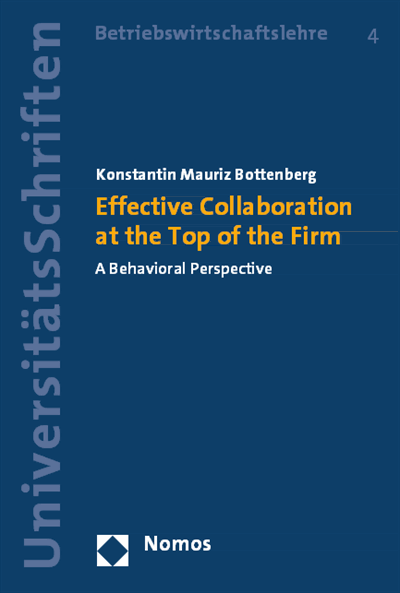
Effective Collaboration at the Top of the Firm
A Behavioral Perspective- Autor:innen:
- Reihe:
- Nomos Universitätsschriften - Betriebswirtschaftslehre, Band 4
- Verlag:
- 2017
Zusammenfassung
Die Arbeit untersucht Grundlagen effektiver Kooperation von Entscheidungsträgern an der Unternehmensspitze und deren Bedeutung für gute Unternehmensführung und langfristigen wirtschaftlichen Erfolg. Basierend auf moderner Managementforschung sowie sozial-psychologischer Theorien wird im Rahmen der Dissertation beispielsweise untersucht, wie individuelle Charakteristika von Aufsichtsräten Strategieprozesse und die langfristige Wertsteigerung von Unternehmen beeinflussen oder wie heterogene berufliche und persönliche Hintergründe von Top-Entscheidungsträgern die Höhe von Investitionen in Forschung und Entwicklung beeinflussen können. Ebenso wird untersucht, wie die Qualität der Kooperation zwischen Entscheidungsträgern und relevanten Stakeholdergruppen in Abhängigkeit des jeweiligen nationalen Governance-Systems variieren kann. Die präsentierten Ergebnisse basieren auf empirischen Daten der größten börsennotierten Unternehmen in Deutschland sowie fallbasierten Analysen.
Publikation durchsuchen
Bibliographische Angaben
- Auflage
- 1/2017
- Copyrightjahr
- 2017
- ISBN-Print
- 978-3-8487-4605-7
- ISBN-Online
- 978-3-8452-8771-3
- Verlag
- Nomos, Baden-Baden
- Reihe
- Nomos Universitätsschriften - Betriebswirtschaftslehre
- Band
- 4
- Sprache
- Deutsch
- Seiten
- 124
- Produkttyp
- Monographie
Inhaltsverzeichnis
- Titelei/Inhaltsverzeichnis Kein Zugriff Seiten 1 - 14
- 1.1 Dissertation Studies Kein Zugriff
- 2.1 Introduction Kein Zugriff
- 2.2.1 Process-related Expertise Kein Zugriff
- 2.2.2 Advisory Process Expertise Kein Zugriff
- 2.2.3 Management Expertise Kein Zugriff
- 2.2.4 Advisory-oriented Board Structures Kein Zugriff
- 2.3.1 Sample and Data Kein Zugriff
- 2.3.2 Variables Kein Zugriff
- 2.3.3 Data Analysis Kein Zugriff
- 2.4 Results Kein Zugriff
- 2.5 Discussion Kein Zugriff
- 3.1 Introduction Kein Zugriff
- 3.2.1 CEO-COB Relation and R&D Investment Strategy Kein Zugriff
- 3.2.2 Interpersonal Differences and Strategic Decision-making Kein Zugriff
- 3.2.3 Career Differences Kein Zugriff
- 3.2.4 Socio-personal Differences Kein Zugriff
- 3.2.5 Time Effects: The Role of Shared Tenure Kein Zugriff
- 3.3.1 Sample and Data Kein Zugriff
- 3.3.2 Variables Kein Zugriff
- 3.3.3 Data Analysis Kein Zugriff
- 3.4 Results Kein Zugriff
- 3.5 Discussion Kein Zugriff
- 4.1 Introduction Kein Zugriff
- 4.2 International Corporate Governance and the Shareholder vs. Stakeholder Debate Kein Zugriff
- 4.3 Corporate Governance in Germany Kein Zugriff
- 4.4 Stakeholder Orientation as a Source of Competitive Advantage? Kein Zugriff
- 4.5 Benefits of Stakeholder Orientation in Germany Kein Zugriff
- 4.6 Towards a Modern Stakeholder Value Approach Kein Zugriff
- 4.7 Discussion Kein Zugriff
- 4.8 Conclusion Kein Zugriff
- 5 General Conclusion Kein Zugriff Seiten 105 - 106
- 6 References Kein Zugriff Seiten 107 - 124
Literaturverzeichnis (302 Einträge)
Es wurden keine Treffer gefunden. Versuchen Sie einen anderen Begriff.
- Adams, J. S. (1965). Inequity in social exchange. In L. Berkowitz (Ed.), Advances in experimental social psychology (Vol. 2, pp. 267-299). New York: Academic Press. Google Scholar öffnen DOI: 10.5771/9783845287713
- Adams, R. B., Hermalin, B. E., & Weisbach, M. S. (2010). The role of boards of directors in corporate governance: A conceptual framework and survey. Journal of Economic Literature, 48(1), 58-107. Google Scholar öffnen DOI: 10.5771/9783845287713
- Adams, R. B., Licht, A. N., & Sagiv, L. (2011). Shareholders and stakeholders: How do directors decide? Strategic Management Journal, 32(12), 1331-1355. Google Scholar öffnen DOI: 10.5771/9783845287713
- Adler, P. S., & Kwon, S.-W. (2002). Social capital: Prospects for a new concept. Academy of Management Review, 27(1), 17-40. Google Scholar öffnen DOI: 10.5771/9783845287713
- Aguilera, R. V., Filatotchev, I., Gospel, H., & Jackson, G. (2008). An organizational approach to comparative corporate governance: Costs, contingencies, and complementarities. Organization Science, 19(3), 475-492. Google Scholar öffnen DOI: 10.5771/9783845287713
- Aguilera, R. V., & Jackson, G. (2003). The cross-national diversity of corporate governance: Dimensions and determinants. Academy of Management Review, 28(3), 447-465. Google Scholar öffnen DOI: 10.5771/9783845287713
- Aguilera, R. V., & Jackson, G. (2010). Comparative and international corporate governance. Academy of Management Annals, 4(1), 485-556. Google Scholar öffnen DOI: 10.5771/9783845287713
- Aguinis, H., & Glavas, A. (2012). What we know and don’t know about corporate social responsibility: A review and research agenda. Journal of Management, 38(4), 932-968. Google Scholar öffnen DOI: 10.5771/9783845287713
- Aiken, L. S., & West, S. G. (1991). Multiple regression: Testing and interpreting interactions. Newbury Park: Sage. Google Scholar öffnen DOI: 10.5771/9783845287713
- Alexiev, A. S., Jansen, J. J. P., Van den Bosch, F. A. J., & Volberda, H. W. (2010). Top management team advice seeking and exploratory innovation: The moderating role of TMT heterogeneity. Journal of Management Studies, 47(7), 1343-1364. Google Scholar öffnen DOI: 10.5771/9783845287713
- Allen, F., Carletti, E., & Marquez, R. (2015). Stakeholder governance, competition, and firm value. Review of Finance, 19(3), 1315-1346. Google Scholar öffnen DOI: 10.5771/9783845287713
- Allen, T. J. (1977). Managing the flow of technology: Technology transfer and the dissemination of technological information within the R&D organization. Cambridge, MA: MIT Press. Google Scholar öffnen DOI: 10.5771/9783845287713
- Amason, A. C. (1996). Distinguishing the effects of functional and dysfunctional conflict on strategic decision making: Resolving a paradox for top management teams. Academy of Management Journal, 39(1), 123-148. Google Scholar öffnen DOI: 10.5771/9783845287713
- Amason, A. C., & Schweiger, D. M. (1997). The effects of conflict on strategic decision making effectiveness and organizational performance. In C. K. W. De Dreu & E. Van de Vliert (Eds.), Using conflict in organizations (pp. 101-115). London: Sage. Google Scholar öffnen DOI: 10.5771/9783845287713
- Amason, A. C., Shrader, R. C., & Tompson, G. H. (2006). Newness and novelty: Relating top management team composition to new venture performance. Journal of Business Venturing, 21(1), 125-148. Google Scholar öffnen DOI: 10.5771/9783845287713
- Anand, N., Gardner, H. K., & Morris, T. I. M. (2007). Knowledge-based innovation: Emergence and embedding of new practice areas in management consulting firms. Academy of Management Journal, 50(2), 406-428. Google Scholar öffnen DOI: 10.5771/9783845287713
- Ancona, D. G., & Caldwell, D. F. (1992). Demography and design: Predictors of new product team performance. Organization Science, 3(3), 321-341. Google Scholar öffnen DOI: 10.5771/9783845287713
- Andres, C. (2008). Large shareholders and firm performance—An empirical examination of founding-family ownership. Journal of Corporate Finance, 14(4), 431-445. Google Scholar öffnen DOI: 10.5771/9783845287713
- Arellano, M., & Bond, S. (1991). Some tests of specification for panel data: Monte Carlo evidence and an application to employment equations. Review of Economic Studies, 58(2), 277-297. Google Scholar öffnen DOI: 10.5771/9783845287713
- Argote, L., & Miron-Spektor, E. (2011). Organizational learning: From experience to knowledge. Organization Science, 22(5), 1123-1137. Google Scholar öffnen DOI: 10.5771/9783845287713
- Balkin, D. B., Markman, G. D., & Gomez-Mejia, L. R. (2000). Is CEO pay in high-technology firms related to innovation? Academy of Management Journal, 43(6), 1118-1129. Google Scholar öffnen DOI: 10.5771/9783845287713
- Bandura, A. (1997). Self-efficacy: The exercise of control. New York: Freeman. Google Scholar öffnen DOI: 10.5771/9783845287713
- Bantel, K. A., & Jackson, S. E. (1989). Top management and innovations in banking: Does the composition of the top team make a difference? Strategic Management Journal, 10(S1), 107-124. Google Scholar öffnen DOI: 10.5771/9783845287713
- Barker III, V. L., & Mueller, G. C. (2002). CEO characteristics and firm R&D spending. Management Science, 48(6), 782-801. Google Scholar öffnen DOI: 10.5771/9783845287713
- Barney, J. (1991). Firm resources and sustained competitive advantage. Journal of Management, 17(1), 99-120. Google Scholar öffnen DOI: 10.5771/9783845287713
- Barney, J. B., & Clark, D. N. (2007). Resource-based theory: Creating and sustaining competitive advantage. Oxford: Oxford University Press. Google Scholar öffnen DOI: 10.5771/9783845287713
- Barney, J. B., & Hansen, M. H. (1994). Trustworthiness as a source of competitive advantage. Strategic Management Journal, 15(S1), 175-190. Google Scholar öffnen DOI: 10.5771/9783845287713
- Baysinger, B., & Hoskisson, R. E. (1989). Diversification strategy and R&D intensity in multiproduct firms. Academy of Management Journal, 32(2), 310-332. Google Scholar öffnen DOI: 10.5771/9783845287713
- Baysinger, B., & Hoskisson, R. E. (1990). The composition of boards of directors and strategic control: Effects on corporate strategy. Academy of Management Review, 15(1), 72-87. Google Scholar öffnen DOI: 10.5771/9783845287713
- Baysinger, B. D., Kosnik, R. D., & Turk, T. A. (1991). Effects of board and ownership structure on corporate R&D strategy. Academy of Management Journal, 34(1), 205-214. Google Scholar öffnen DOI: 10.5771/9783845287713
- Berghoff, H. (2006). The end of family business? The Mittelstand and German capitalism in transition, 1949–2000. Business History Review, 80(02), 263-295. Google Scholar öffnen DOI: 10.5771/9783845287713
- Berle, A., & Means, G. (1932). The modern corporation and private property. New York: Macmillan. Google Scholar öffnen DOI: 10.5771/9783845287713
- Berman, S. L., Down, J., & Hill, C. W. L. (2002). Tacit knowledge as a source of competitive advantage in the National Basketball Association. Academy of Management Journal, 45(1), 13-31. Google Scholar öffnen DOI: 10.5771/9783845287713
- Berman, S. L., Wicks, A. C., Kotha, S., & Jones, T. M. (1999). Does stakeholder orientation matter? The relationship between stakeholder management models and firm financial performance. Academy of Management Journal, 42(5), 488-506. Google Scholar öffnen DOI: 10.5771/9783845287713
- Berrone, P., Surroca, J., & Tribó, J. (2007). Corporate ethical identity as a determinant of firm performance: A test of the mediating role of stakeholder satisfaction. Journal of Business Ethics, 76(1), 35-53. Google Scholar öffnen DOI: 10.5771/9783845287713
- Bhagat, C., Hirt, M., & Kehoe, C. (2013). Tapping the strategic potential of boards. McKinsey Quarterly, (1), 91-98. Google Scholar öffnen DOI: 10.5771/9783845287713
- Bilimoria, D., & Piderit, S. K. (1994). Board committee membership: Effects of sex-based bias. Academy of Management Journal, 37(6), 1453-1477. Google Scholar öffnen DOI: 10.5771/9783845287713
- Black, J. A., & Boal, K. B. (1994). Strategic resources: Traits, configurations and paths to sustainable competitive advantage. Strategic Management Journal, 15(S2), 131-148. Google Scholar öffnen DOI: 10.5771/9783845287713
- Boeker, W. (1997). Strategic change: The influence of managerial characteristics and organizational growth. Academy of Management Journal, 40(1), 152-170. Google Scholar öffnen DOI: 10.5771/9783845287713
- Boivie, S., Graffin, S. D., & Pollock, T. G. (2012). Time for me to fly: Predicting director exit at large firms. Academy of Management Journal, 55(6), 1334-1359. Google Scholar öffnen DOI: 10.5771/9783845287713
- Boyd, B. K. (1995). CEO duality and firm performance: A contingency model. Strategic Management Journal, 16(4), 301-312. Google Scholar öffnen DOI: 10.5771/9783845287713
- Boyd, B. K., Haynes, K. T., & Zona, F. (2011). Dimensions of CEO-board relations. Journal of Management Studies, 48(8), 1892-1923. Google Scholar öffnen DOI: 10.5771/9783845287713
- Braiker, H. B., & Kelley, H. H. (1979). Conflict in the development of close relationships. In R. L. Burgess & T. L. Huston (Eds.), Social exchange in developing relationships (pp. 135-168). San Diego, CA: Academic Press. Google Scholar öffnen DOI: 10.5771/9783845287713
- Brickley, J. A., Coles, J. L., & Jarrell, G. (1997). Leadership structure: Separating the CEO and chairman of the board. Journal of Corporate Finance, 3(3), 189-220. Google Scholar öffnen DOI: 10.5771/9783845287713
- Brown, S. L., & Eisenhardt, K. M. (1995). Product development: Past research, present findings, and future directions. Academy of Management Review, 20(2), 343-378. Google Scholar öffnen DOI: 10.5771/9783845287713
- Brush, T. H., Bromiley, P., & Hendrickx, M. (2000). The free cash flow hypothesis for sales growth and firm performance. Strategic Management Journal, 21(4), 455-472. Google Scholar öffnen DOI: 10.5771/9783845287713
- Byrne, D. E. (1971). The attraction paradigm. New York: Academic Press. Google Scholar öffnen DOI: 10.5771/9783845287713
- Cannella, A. A., Park, J.-H., & Lee, H.-U. (2008). Top management team functional background diversity and firm performance: Examining the roles of team member collocation and environmental uncertainty. Academy of Management Journal, 51(4), 768-784. Google Scholar öffnen DOI: 10.5771/9783845287713
- Cappelli, P., Singh, H., Singh, J., & Useem, M. (2010). The India way: Lessons for the U.S. Academy of Management Perspectives, 24(2), 6-24. Google Scholar öffnen DOI: 10.5771/9783845287713
- Capron, L., & Guillén, M. (2009). National corporate governance institutions and post-acquisition target reorganization. Strategic Management Journal, 30(8), 803-833. Google Scholar öffnen DOI: 10.5771/9783845287713
- Carpenter, M. A., Geletkanycz, M. A., & Sanders, W. G. (2004). Upper echelons research revisited: Antecedents, elements, and consequences of top management team composition. Journal of Management, 30(6), 749-778. Google Scholar öffnen DOI: 10.5771/9783845287713
- Carpenter, M. A., Pollock, T. G., & Leary, M. M. (2003). Testing a model of reasoned risk-taking: Governance, the experience of principals and agents, and global strategy in high-technology IPO firms. Strategic Management Journal, 24(9), 803-820. Google Scholar öffnen DOI: 10.5771/9783845287713
- Carpenter, M. A., & Sanders, W. G. (2009). Strategic management: A dynamic perspective: Concepts and cases. Upper Saddle River: Prentice Hall. Google Scholar öffnen DOI: 10.5771/9783845287713
- Carpenter, M. A., Sanders, W. G., & Gregersen, H. B. (2001). Bundling human capital with organizational context: The impact of international assignment experience on multinational firm performance and CEO pay. Academy of Management Journal, 44(3), 493-511. Google Scholar öffnen DOI: 10.5771/9783845287713
- Carpenter, M. A., & Westphal, J. D. (2001). The strategic context of external network ties: Examining the impact of director appointments on board involvement in strategic decision making. Academy of Management Journal, 44(4), 639-660. Google Scholar öffnen DOI: 10.5771/9783845287713
- Castañer, X., & Kavadis, N. (2013). Does good governance prevent bad strategy? A study of corporate governance, financial diversification, and value creation by French corporations, 2000-2006. Strategic Management Journal, 34(7), 863-876. Google Scholar öffnen DOI: 10.5771/9783845287713
- Castanias, R. P., & Helfat, C. E. (2001). The managerial rents model: Theory and empirical analysis. Journal of Management, 27(6), 661-678. Google Scholar öffnen DOI: 10.5771/9783845287713
- Chang, Y. K., Oh, W.-Y., Park, J. H., & Jang, M. G. (2015). Exploring the relationship between board characteristics and CSR: Empirical evidence from Korea. Journal of Business Ethics, 1-18. Google Scholar öffnen DOI: 10.5771/9783845287713
- Chen, H.-L. (2014). Board capital, CEO power and R&D investment in electronics firms. Corporate Governance: An International Review, 22(5), 422-436. Google Scholar öffnen DOI: 10.5771/9783845287713
- Christmann, P., Day, D., & Yip, G. S. (2000). The relative influence of country conditions, industry structure, and business strategy on multinational corporation subsidiary performance. Journal of International Management, 5(4), 241-265. Google Scholar öffnen DOI: 10.5771/9783845287713
- Cioffi, J. W. (2002). Restructuring “Germany Inc.”: The politics of company and takeover law reform in Germany and the European Union. Law & Policy, 24(4), 355-402. Google Scholar öffnen DOI: 10.5771/9783845287713
- Coff, R. W. (1999). When competitive advantage doesn't lead to performance: The resource-based view and stakeholder bargaining power. Organization Science, 10(2), 119-133. Google Scholar öffnen DOI: 10.5771/9783845287713
- Cohen, W. M., & Levinthal, D. A. (1990). Absorptive capacity: A new perspective on learning and innovation. Administrative Science Quarterly, 128-152. Google Scholar öffnen DOI: 10.5771/9783845287713
- Colbert, B. A. (2004). The complex resource-based view: Implications for theory and practice in strategic human resource management. Academy of Management Review, 29(3), 341-358. Google Scholar öffnen DOI: 10.5771/9783845287713
- Conger, J. A., Lawler III, E. E., & Finegold, D. (2001). Corporate boards: New strategies for adding value at the top. San Francisco: Jossey-Bass/Wiley. Google Scholar öffnen DOI: 10.5771/9783845287713
- Crossland, C., & Hambrick, D. C. (2007). How national systems differ in their constraints on corporate executives: A study of CEO effects in three countries. Strategic Management Journal, 28(8), 767-789. Google Scholar öffnen DOI: 10.5771/9783845287713
- Crossland, C., Zyung, J. Y., Hiller, N. J., & Hambrick, D. C. (2014). CEO career variety: Effects on firm-level strategic and social novelty. Academy of Management Journal, 57(3), 652-674. Google Scholar öffnen DOI: 10.5771/9783845287713
- Culpepper, P. D. (1999). The future of the high-skill equilibrium in Germany. Oxford Review of Economic Policy, 15(1), 43-59. Google Scholar öffnen DOI: 10.5771/9783845287713
- Cyert, R. M., & March, J. G. (1963). A behavioral theory of the firm. Englewood Cliffs, NJ: Prentice Hall. Google Scholar öffnen DOI: 10.5771/9783845287713
- Dacin, M. T., Goodstein, J., & Scott, W. R. (2002). Institutional theory and institutional change: Introduction to the special research forum. Academy of Management Journal, 45(1), 45-56. Google Scholar öffnen DOI: 10.5771/9783845287713
- Daily, C. M. (1996). Governance patterns in bankruptcy reorganizations. Strategic Management Journal, 17(5), 355-375. Google Scholar öffnen DOI: 10.5771/9783845287713
- Daily, C. M., & Dalton, D. R. (1992). The relationship between governance structure and corporate performance in entrepreneurial firms. Journal of Business Venturing, 7(5), 375-386. Google Scholar öffnen DOI: 10.5771/9783845287713
- Daily, C. M., Dalton, D. R., & Cannella, A. A. (2003). Corporate governance: Decades of dialogue and data. Academy of Management Review, 28(3), 371-382. Google Scholar öffnen DOI: 10.5771/9783845287713
- Daily, C. M., & Schwenk, C. (1996). Chief executive officers, top management teams, and boards of directors: Congruent or countervailing forces? Journal of Management, 22(2), 185-208. Google Scholar öffnen DOI: 10.5771/9783845287713
- Dalton, D. R., Daily, C. M., Ellstrand, A. E., & Johnson, J. L. (1998). Meta-analytic reviews of board composition, leadership structure, and financial performance. Strategic Management Journal, 19(3), 269-290. Google Scholar öffnen DOI: 10.5771/9783845287713
- Dalton, D. R., & Dalton, C. M. (2010). Integration of micro and macro studies in governance research: CEO duality, board composition, and financial performance. Journal of Management, 37(2), 404-411. Google Scholar öffnen DOI: 10.5771/9783845287713
- Damanpour, F. (2010). An integration of research findings of effects of firm size and market competition on product and process innovations. British Journal of Management, 21(4), 996-1010. Google Scholar öffnen DOI: 10.5771/9783845287713
- David, P., O'Brien, J. P., Yoshikawa, T., & Delios, A. (2010). Do shareholders or stakeholders appropriate the rents from corporate diversification? The influence of ownership structure. Academy of Management Journal, 53(3), 636-654. Google Scholar öffnen DOI: 10.5771/9783845287713
- Dawson, J. F. (2014). Moderation in management research: What, why, when, and how. Journal of Business and Psychology, 29(1), 1-19. Google Scholar öffnen DOI: 10.5771/9783845287713
- De Clercq, D., Thongpapanl, N., & Dimov, D. (2009). When good conflict gets better and bad conflict becomes worse: The role of social capital in the conflict-innovation relationship. Journal of the Academy of Marketing Science, 37(3), 283-297. Google Scholar öffnen DOI: 10.5771/9783845287713
- de Wit, F. R., Greer, L. L., & Jehn, K. A. (2012). The paradox of intragroup conflict: A meta-analysis. Journal of Applied Psychology, 97(2), 360-390. Google Scholar öffnen DOI: 10.5771/9783845287713
- Der Spiegel. (2009). GM Europe: Opelaner billigen Gehaltsverzicht. [Cited 8 August 2014.] Available from URL: http://www.spiegel.de/wirtschaft/unternehmen/gm-europe-opelaner-billigen-gehaltsverzicht-a-658980.html Google Scholar öffnen DOI: 10.5771/9783845287713
- Deutsch, Y. (2005). The impact of board composition on firms' critical decisions: A meta-analytic review. Journal of Management, 31(3), 424-444. Google Scholar öffnen DOI: 10.5771/9783845287713
- Dezsö, C. L., & Ross, D. G. (2012). Does female representation in top management improve firm performance? A panel data investigation. Strategic Management Journal, 33(9), 1072-1089. Google Scholar öffnen DOI: 10.5771/9783845287713
- Die Welt. (2016). Das bild des ehrbaren kaufmanns ist angekratzt. [Cited 26 June 2016.] Available from URL: http://www.welt.de/wirtschaft/article152231730/Das-Bild-des-ehrbaren-Kaufmanns-ist-angekratzt.html. Google Scholar öffnen DOI: 10.5771/9783845287713
- Dodd, E. (1932). For whom are corporate managers trustees. Harvard Law Review, 45, 1145-1163. Google Scholar öffnen DOI: 10.5771/9783845287713
- Donaldson, T., & Preston, L. E. (1995). The stakeholder theory of the corporation: Concepts, evidence, and implications. Academy of Management Review, 20(1), 65-91. Google Scholar öffnen DOI: 10.5771/9783845287713
- Downing, J. W., Judd, C. M., & Brauer, M. (1992). Effects of repeated expressions on attitude extremity. Journal of Personality and Social Psychology, 63(1), 17-29. Google Scholar öffnen DOI: 10.5771/9783845287713
- Dyer, J. H., & Hatch, N. W. (2006). Relation-specific capabilities and barriers to knowledge transfers: Creating advantage through network relationships. Strategic Management Journal, 27(8), 701-719. Google Scholar öffnen DOI: 10.5771/9783845287713
- Eisenhardt, K. M. (1989). Making fast strategic decisions in high-velocity environments. Academy of Management Journal, 32(3), 543-576. Google Scholar öffnen DOI: 10.5771/9783845287713
- Empson, L., Muzio, D., & Broschak, J. (2015). Oxford handbook of professional service firms. USA: Oxford University Press. Google Scholar öffnen DOI: 10.5771/9783845287713
- Ericsson, K. A., & Charness, N. (1994). Expert performance: Its structure and acquisition. American Psychologist, 49(8), 725-747. Google Scholar öffnen DOI: 10.5771/9783845287713
- European Parliament. (2012). Relations between company supervisory bodies and the management. [Cited 3 July 2016.] Available from URL: http://www.europarl.europa.eu/thinktank/de/document.html?reference=IPOL-JURI_ET(2012)462454 Google Scholar öffnen DOI: 10.5771/9783845287713
- Fama, E. F., & Jensen, M. C. (1983). Separation of ownership and control. Journal of Law and Economics, 26(2), 301-325. Google Scholar öffnen DOI: 10.5771/9783845287713
- Fauver, L., & Fuerst, M. E. (2006). Does good corporate governance include employee representation? Evidence from German corporate boards. Journal of Financial Economics, 82(3), 673-710. Google Scholar öffnen DOI: 10.5771/9783845287713
- Finkelstein, S., & D'aveni, R. A. (1994). CEO duality as a double-edged sword: How boards of directors balance entrenchment avoidance and unity of command. Academy of Management Journal, 37(5), 1079-1108. Google Scholar öffnen DOI: 10.5771/9783845287713
- Finkelstein, S., Hambrick, D. C., & Cannella, A. A. (2009). Strategic leadership: Theory and research on executives, top management teams, and boards. Oxford: Oxford University Press. Google Scholar öffnen DOI: 10.5771/9783845287713
- Finkelstein, S., & Mooney, A. C. (2003). Not the usual suspects: How to use board process to make boards better. Academy of Management Executive, 17(2), 101-113. Google Scholar öffnen DOI: 10.5771/9783845287713
- Fisher, R. (2012). The social psychology of intergroup and international conflict resolution. New York: Springer Science & Business Media. Google Scholar öffnen DOI: 10.5771/9783845287713
- Fiss, P. C., & Zajac, E. J. (2004). The diffusion of ideas over contested terrain: The (non)adoption of a shareholder value orientation among German firms. Administrative Science Quarterly, 49(4), 501-534. Google Scholar öffnen DOI: 10.5771/9783845287713
- Fohlin, C. (2005). The history of corporate ownership and control in germany. In R. K. Morck (Ed.), A history of corporate governance around the world: Family business groups to professional managers (pp. 223-282). Chicago: University of Chicago Press. Google Scholar öffnen DOI: 10.5771/9783845287713
- Forbes, D. P., & Milliken, F. J. (1999). Cognition and corporate governance: Understanding boards of directors as strategic decision-making groups. Academy of Management Review, 24(3), 489-505. Google Scholar öffnen DOI: 10.5771/9783845287713
- Fosstenløkken, S. M., Løwendahl, B. R., & Revang, O. (2003). Knowledge development through client interaction: A comparative study. Organization Studies, 24(6), 859-879. Google Scholar öffnen DOI: 10.5771/9783845287713
- Freeman, R. E. (1984). Strategic management: A stakeholder approach. Boston: Pitman. Google Scholar öffnen DOI: 10.5771/9783845287713
- Freeman, R. E., Harrison, J. S., Wicks, A. C., Parmar, B. L., & De Colle, S. (2010). Stakeholder theory: The state of the art. Cambridge: Cambridge University Press. Google Scholar öffnen DOI: 10.5771/9783845287713
- Freeman, R. E., Wicks, A. C., & Parmar, B. (2004). Stakeholder theory and "the corporate objective revisited". Organization Science, 15(3), 364-369. Google Scholar öffnen DOI: 10.5771/9783845287713
- Friedman, M. (1970, September 13). The social responsibility of business is to increase its profits. The New York Times Magazine, pp. 122-126. Google Scholar öffnen DOI: 10.5771/9783845287713
- Gardner, H. K., Gino, F., & Staats, B. R. (2012). Dynamically integrating knowledge in teams: Transforming resources into performance. Academy of Management Journal, 55(4), 998-1022. Google Scholar öffnen DOI: 10.5771/9783845287713
- Garside, W. R. (2012). Japan's great stagnation: Forging ahead, falling behind. Cheltenham: Edward Elgar Publishing. Google Scholar öffnen DOI: 10.5771/9783845287713
- Gary, M. S., Wood, R. E., & Pillinger, T. (2012). Enhancing mental models, analogical transfer, and performance in strategic decision making. Strategic Management Journal, 33(11), 1229-1246. Google Scholar öffnen DOI: 10.5771/9783845287713
- Glückler, J., & Armbrüster, T. (2003). Bridging uncertainty in management consulting: The mechanisms of trust and networked reputation. Organization Studies, 24(2), 269-297. Google Scholar öffnen DOI: 10.5771/9783845287713
- Godfrey, P. C. (2005). The relationship between corporate philanthropy and shareholder wealth: A risk management perspective. Academy of Management Review, 30(4), 777-798. Google Scholar öffnen DOI: 10.5771/9783845287713
- Golden, B. R., & Zajac, E. J. (2001). When will boards influence strategy? Inclination x power = strategic change. Strategic Management Journal, 22(12), 1087-1111. Google Scholar öffnen DOI: 10.5771/9783845287713
- Gomez-Mejia, L. R., Cruz, C., Berrone, P., & De Castro, J. (2011). The bind that ties: Socioemotional wealth preservation in family firms. Academy of Management Annals, 5(1), 653-707. Google Scholar öffnen DOI: 10.5771/9783845287713
- Goodstein, J., Gautam, K., & Boeker, W. (1994). The effects of board size and diversity on strategic change. Strategic Management Journal, 15(3), 241-250. Google Scholar öffnen DOI: 10.5771/9783845287713
- Gore, A. K., Matsunaga, S., & Eric Yeung, P. (2011). The role of technical expertise in firm governance structure: Evidence from chief financial officer contractual incentives. Strategic Management Journal, 32(7), 771-786. Google Scholar öffnen DOI: 10.5771/9783845287713
- Gorton, G., & Schmid, F. A. (2000). Universal banking and the performance of German firms. Journal of Financial Economics, 58(1–2), 29-80. Google Scholar öffnen DOI: 10.5771/9783845287713
- Gorton, G., & Schmid, F. A. (2004). Capital, labor, and the firm: A study of German codetermination. Journal of the European Economic Association, 2(5), 863-905. Google Scholar öffnen DOI: 10.5771/9783845287713
- Governance Commission. (2015). German corporate governance code. [Cited 03 July 2016.] Available from URL: http://www.dcgk.de//files/dcgk/usercontent/en/download/code/2015-05-05_Corporate_Governance_Code_EN.pdf Google Scholar öffnen DOI: 10.5771/9783845287713
- Grant, R. M. (1996). Toward a knowledge‐based theory of the firm. Strategic Management Journal, 17(S2), 109-122. Google Scholar öffnen DOI: 10.5771/9783845287713
- Graves, S. B., & Langowitz, N. S. (1993). Innovative productivity and returns to scale in the pharmaceutical industry. Strategic Management Journal, 14(8), 593-605. Google Scholar öffnen DOI: 10.5771/9783845287713
- Greene, W. H. (2000). Econometric analysis (4th ed.). Upper Saddle River, NJ: Prentice Hall. Google Scholar öffnen DOI: 10.5771/9783845287713
- Greenwood, R., Li, S. X., Prakash, R., & Deephouse, D. L. (2005). Reputation, diversification, and organizational explanations of performance in professional service firms. Organization Science, 16(6), 661-673. Google Scholar öffnen DOI: 10.5771/9783845287713
- Greve, H. R. (2003). Organizational learning from performance feedback: A behavioral perspective on innovation and change. Cambridge, U.K.: Cambridge University Press. Google Scholar öffnen DOI: 10.5771/9783845287713
- Griffiths, A., & Zammuto, R. F. (2005). Institutional governance systems and variations in national competitive advantage: An integrative framework. Academy of Management Review, 30(4), 823-842. Google Scholar öffnen DOI: 10.5771/9783845287713
- Guthrie, J. P., & Datta, D. K. (1997). Contextual influences on executive selection: Firm characteristics and CEO experience. Journal of Management Studies, 34(4), 537-560. Google Scholar öffnen DOI: 10.5771/9783845287713
- Haas, M. R., & Hansen, M. T. (2005). When using knowledge can hurt performance: The value of organizational capabilities in a management consulting company. Strategic Management Journal, 26(1), 1-24. Google Scholar öffnen DOI: 10.5771/9783845287713
- Hackethal, A., Schmidt, R. H., & Tyrell, M. (2005). Banks and German corporate governance: On the way to a capital market‐based system? Corporate Governance: An International Review, 13(3), 397-407. Google Scholar öffnen DOI: 10.5771/9783845287713
- Hackman, J. (1992). Group influences on individuals in organizations. In M. Dunnette & L. Hough (Eds.), Handbook of industrial and organizational psychology (Vol. 3, pp. 199-267). Palo Alto, CA: Consulting Psychologists Press. Google Scholar öffnen DOI: 10.5771/9783845287713
- Hall, P. A., & Soskice, D. (2001). Varieties of capitalism: The institutional foundations of comparative advantage. Oxford: Oxford University Press. Google Scholar öffnen DOI: 10.5771/9783845287713
- Hambrick, D. C. (2007). Upper echelons theory: An update. Academy of Management Review, 32(2), 334-343. Google Scholar öffnen DOI: 10.5771/9783845287713
- Hambrick, D. C., Cho, T. S., & Ming-Jer, C. (1996). The influence of top management team heterogeneity on firms' competitive moves. Administrative Science Quarterly, 41(4), 659-684. Google Scholar öffnen DOI: 10.5771/9783845287713
- Hambrick, D. C., & Mason, P. A. (1984). Upper echelons: The organization as a reflection of its top managers. The Academy of Management Review, 9(2), 193-206. Google Scholar öffnen DOI: 10.5771/9783845287713
- Hambrick, D. C., Werder, A. v., & Zajac, E. J. (2008). New directions in corporate governance research. Organization Science, 19(3), 381-385. Google Scholar öffnen DOI: 10.5771/9783845287713
- Handelsblatt. (2008). GM vor der Insolvenz - Vorschlaege fuer Opel. [Cited 8 August 2014.] Available from URL: http://www.handelsblatt.com/unternehmen/industrie/gescheitertes-rettungspaket-gm-vor-der-insolvenz-vorschlaege-fuer-opel/3071892.html Google Scholar öffnen DOI: 10.5771/9783845287713
- Handelsblatt. (2013). Roland Berger soll jetzt doch eigenstaendig bleiben. [Cited 8 August 2014.] Available from URL: http://www.handelsblatt.com/unternehmen/handel-dienstleister/kein-verkauf-roland-berger-soll-jetzt-doch-eigenstaendig-bleiben/9228988.html Google Scholar öffnen DOI: 10.5771/9783845287713
- Hansen, L. P. (1982). Large sample properties of generalized method of moments estimators. Econometrica, 50, 1029-1054. Google Scholar öffnen DOI: 10.5771/9783845287713
- Hansmann, H., & Kraakman, R. (2000). End of history for corporate law. Georgetown Law Journal, 89, 439-468. Google Scholar öffnen DOI: 10.5771/9783845287713
- Harris, D., & Helfat, C. (1997). Specificity of CEO human capital and compensation. Strategic Management Journal, 18(11), 895-920. Google Scholar öffnen DOI: 10.5771/9783845287713
- Harrison, D. A., Price, K. H., & Bell, M. P. (1998). Beyond relational demography: Time and the effects of surface-and deep-level diversity on work group cohesion. Academy of Management Journal, 41(1), 96-107. Google Scholar öffnen DOI: 10.5771/9783845287713
- Harrison, J. R. (1987). The strategic use of corporate board committees. California Management Review, 30(1), 109-125. Google Scholar öffnen DOI: 10.5771/9783845287713
- Harrison, J. S., Bosse, D. A., & Phillips, R. A. (2010). Managing for stakeholders, stakeholder utility functions, and competitive advantage. Strategic Management Journal, 31(1), 58-74. Google Scholar öffnen DOI: 10.5771/9783845287713
- Harrison, J. S., & Wicks, A. C. (2013). Stakeholder theory, value, and firm performance. Business Ethics Quarterly, 23(1), 97-124. Google Scholar öffnen DOI: 10.5771/9783845287713
- Hausman, J. A. (1978). Specification tests in econometrics. Econometrica: Journal of the Econometric Society, 1251-1271. Google Scholar öffnen DOI: 10.5771/9783845287713
- Haynes, K. T., & Hillman, A. (2010). The effect of board capital and CEO power on strategic change. Strategic Management Journal, 31(11), 1145-1163. Google Scholar öffnen DOI: 10.5771/9783845287713
- He, J., & Huang, Z. (2011). Board informal hierarchy and firm financial performance: Exploring a tacit structure guiding boardroom interactions. Academy of Management Journal, 54(6), 1119-1139. Google Scholar öffnen DOI: 10.5771/9783845287713
- Heinze, T. (2004). Dynamics in the German system of corporate governance? Empirical findings regarding interlocking directorates. Economy & Society, 33(2), 218-238. Google Scholar öffnen DOI: 10.5771/9783845287713
- Henke, J. W. (1986). Involving the board of directors in strategic planning. Journal of Business Strategy, 7(2), 87-95. Google Scholar öffnen DOI: 10.5771/9783845287713
- Heugens, P., van den Bosch, F., & van Riel, C. (2002). Stakeholder integration building mutually enforcing relationships. Business & Society, 41(1), 36-60. Google Scholar öffnen DOI: 10.5771/9783845287713
- Hillman, A. J., Cannella, J. A. A., & Paetzold, R. L. (2000). The resource dependence role of corporate directors: Strategic adaptation of board composition in response to environmental change. Journal of Management Studies, 37(2), 235-255. Google Scholar öffnen DOI: 10.5771/9783845287713
- Hillman, A. J., & Dalziel, T. (2003). Boards of directors and firm performance: Integrating agency and resource dependence perspectives. Academy of Management Review, 28(3), 383-396. Google Scholar öffnen DOI: 10.5771/9783845287713
- Hillman, A. J., & Keim, G. D. (2001). Shareholder value, stakeholder management, and social issues: What's the bottom line? Strategic Management Journal, 22(2), 125-139. Google Scholar öffnen DOI: 10.5771/9783845287713
- Hillman, A. J., Shropshire, C., Certo, S. T., Dalton, D. R., & Dalton, C. M. (2010). What I like about you: A multilevel study of shareholder discontent with director monitoring. Organization Science, 22(3), 675-687. Google Scholar öffnen DOI: 10.5771/9783845287713
- Hitt, M. A., Bierman, L., Uhlenbruck, K., & Shimizu, K. (2006). The importance of resources in the internationalization of professional service firms: The good, the bad, and the ugly. Academy of Management Journal, 49(6), 1137-1157. Google Scholar öffnen DOI: 10.5771/9783845287713
- Hitt, M. A., Biermant, L., Shimizu, K., & Kochhar, R. (2001). Direct and moderating effects of human capital on strategy and performance in professional service firms: A resource-based perspective. Academy of Management Journal, 44(1), 13-28. Google Scholar öffnen DOI: 10.5771/9783845287713
- Hitt, M. A., Hoskisson, R. E., & Kim, H. (1997). International diversification: Effects on innovation and firm performance in product-diversified firms. Academy of Management Journal, 40(4), 767-798. Google Scholar öffnen DOI: 10.5771/9783845287713
- Hosmer, L. T., & Kiewitz, C. (2005). Organizational justice: A behavioral science concept with critical implications for business ethics and stakeholder theory. Business Ethics Quarterly, 15(1), 67-91. Google Scholar öffnen DOI: 10.5771/9783845287713
- Huckman, R. S., Staats, B. R., & Upton, D. M. (2009). Team familiarity, role experience, and performance: Evidence from Indian software services. Management Science, 55(1), 85-100. Google Scholar öffnen DOI: 10.5771/9783845287713
- Hutchinson, R. W. (1995). The capital structure and investment decisions of the small owner-managed firm: Some exploratory issues. Small Business Economics, 7(3), 231-239. Google Scholar öffnen DOI: 10.5771/9783845287713
- Jackson, G. (2001). The origins of nonliberal corporate governance in Germany and Japan. In W. Streeck, & Yamamura, K. (Ed.), The origins of nonliberal capitalism: Germany and Japan compared (pp. 121-170). Ithaca, NY: Cornell University Press. Google Scholar öffnen DOI: 10.5771/9783845287713
- Jackson, G., & Moerke, A. (2005). Continuity and change in corporate governance: Comparing Germany and Japan. Corporate Governance: An International Review, 13(3), 351-361. Google Scholar öffnen DOI: 10.5771/9783845287713
- James, H. S. (1999). Owner as manager, extended horizons and the family firm. International Journal of the Economics of Business, 6(1), 41-55. Google Scholar öffnen DOI: 10.5771/9783845287713
- Jehn, K. A. (1995). A multimethod examination of the benefits and detriments of intragroup conflict. Administrative Science Quarterly, 40(2), 256-282. Google Scholar öffnen DOI: 10.5771/9783845287713
- Jehn, K. A. (1997). A qualitative analysis of conflict types and dimensions in organizational groups. Administrative Science Quarterly, 42(3), 530-557. Google Scholar öffnen DOI: 10.5771/9783845287713
- Jehn, K. A., & Mannix, E. A. (2001). The dynamic nature of conflict: A longitudinal study of intragroup conflict and group performance. Academy of Management Journal, 44(2), 238-251. Google Scholar öffnen DOI: 10.5771/9783845287713
- Jensen, M., & Zajac, E. J. (2004). Corporate elites and corporate strategy: How demographic preferences and structural position shape the scope of the firm. Strategic Management Journal, 25(6), 507-524. Google Scholar öffnen DOI: 10.5771/9783845287713
- Jensen, M. C. (2002). Value maximization, stakeholder theory, and the corporate objective function. Business Ethics Quarterly, 12(2), 235-256. Google Scholar öffnen DOI: 10.5771/9783845287713
- Jensen, M. C., & Meckling, W. H. (1976). Theory of the firm: Managerial behavior, agency costs and ownership structure. Journal of Financial Economics, 3(4), 305-360. Google Scholar öffnen DOI: 10.5771/9783845287713
- Jensen, M. C., & Murphy, K. J. (1990). Performance pay and top-management incentives. Journal of Political Economy, 225-264. Google Scholar öffnen DOI: 10.5771/9783845287713
- Jiao, Y. (2010). Stakeholder welfare and firm value. Journal of Banking & Finance, 34(10), 2549-2561. Google Scholar öffnen DOI: 10.5771/9783845287713
- Johnson, J. L., Ellstrand, A. E., & Daily, C. M. (1996). Boards of directors: A review and research agenda. Journal of Management, 22(3), 409-438. Google Scholar öffnen DOI: 10.5771/9783845287713
- Johnson, S. G., Schnatterly, K., & Hill, A. D. (2013). Board composition beyond independence social capital, human capital, and demographics. Journal of Management, 39(1), 232-262. Google Scholar öffnen DOI: 10.5771/9783845287713
- Jones, T. M. (1995). Instrumental stakeholder theory: A synthesis of ethics and economics. Academy of Management Review, 20(2), 404-437. Google Scholar öffnen DOI: 10.5771/9783845287713
- Judge, W. Q., & Zeithaml, C. P. (1992). Institutional and strategic choice perspectives on board involvement in the strategic decision process. Academy of Management Journal, 35(4), 766-794. Google Scholar öffnen DOI: 10.5771/9783845287713
- Jürgens, U., Naumann, K., & Rupp, J. (2000). Shareholder value in an adverse environment: The German case. Economy & Society, 29(1), 54-79. Google Scholar öffnen DOI: 10.5771/9783845287713
- Kacperczyk, A. (2009). With greater power comes greater responsibility? Takeover protection and corporate attention to stakeholders. Strategic Management Journal, 30(3), 261-285. Google Scholar öffnen DOI: 10.5771/9783845287713
- Kaczmarek, S., Kimino, S., & Pye, A. (2012). Antecedents of board composition: The role of nomination committees. Corporate Governance: An International Review, 20(5), 474-489. Google Scholar öffnen DOI: 10.5771/9783845287713
- Kakabadse, A. P., Kakabadse, N. K., & Knyght, R. (2010). The chemistry factor in the chairman/CEO relationship. European Management Journal, 28(4), 285-296. Google Scholar öffnen DOI: 10.5771/9783845287713
- Kaplan, S. N. (1997). Corporate governance and corporate performance: A comparison of Germany, Japan, and the US. Journal of Applied Corporate Finance, 9(4), 86-93. Google Scholar öffnen DOI: 10.5771/9783845287713
- Kaplan, S. N., & Minton, B. A. (2012). How has CEO turnover changed? International Review of Finance, 12(1), 57-87. Google Scholar öffnen DOI: 10.5771/9783845287713
- Karaevli, A. (2007). Performance consequences of new CEO ‘Outsiderness’: Moderating effects of pre- and post-succession contexts. Strategic Management Journal, 28(7), 681-706. Google Scholar öffnen DOI: 10.5771/9783845287713
- Karaevli, A., & Zajac, E. J. (2013). When do outsider CEOs generate strategic change? The enabling role of corporate stability. Journal of Management Studies, 50(7), 1267-1294. Google Scholar öffnen DOI: 10.5771/9783845287713
- Kassin, S. (2003). Psychology. USA: Prantice-Hall, Inc. Google Scholar öffnen DOI: 10.5771/9783845287713
- Kesner, I. F. (1988). Directors' characteristics and committee membership: An investigation of type, occupation, tenure, and gender. Academy of Management Journal, 31(1), 66-84. Google Scholar öffnen DOI: 10.5771/9783845287713
- Khanna, P., Jones, C. D., & Boivie, S. (2014). Director human capital, information processing demands, and board effectiveness. Journal of Management, 40(2), 557-585. Google Scholar öffnen DOI: 10.5771/9783845287713
- Khanna, T., Kogan, J., & Palepu, K. (2006). Globalization and similarities in corporate governance: A cross-country analysis. Review of Economics & Statistics, 88(1), 69-90. Google Scholar öffnen DOI: 10.5771/9783845287713
- Kim, C., & Bettis, R. A. (2014). Cash is surprisingly valuable as a strategic asset. Strategic Management Journal, 35(13), 2053-2063. Google Scholar öffnen DOI: 10.5771/9783845287713
- Klarner, P., Sarstedt, M., Hoeck, M., & Ringle, C. M. (2013). Disentangling the effects of team competences, team adaptability, and client communication on the performance of management consulting teams. Long Range Planning, 46(3), 258-286. Google Scholar öffnen DOI: 10.5771/9783845287713
- Klingebiel, R., & Rammer, C. (2014). Resource allocation strategy for innovation portfolio management. Strategic Management Journal, 35(2), 246-268. Google Scholar öffnen DOI: 10.5771/9783845287713
- Kogut, B., & Zander, U. (1993). Knowledge of the firm and the evolutionary theory of the multinational corporation. Journal of International Business Studies, 24(4), 625-645. Google Scholar öffnen DOI: 10.5771/9783845287713
- Kor, Y. Y. (2003). Experience-based top management team competence and sustained growth. Organization Science, 14(6), 707-719. Google Scholar öffnen DOI: 10.5771/9783845287713
- Kor, Y. Y. (2006). Direct and interaction effects of top management team and board compositions on R&D investment strategy. Strategic Management Journal, 27(11), 1081-1099. Google Scholar öffnen DOI: 10.5771/9783845287713
- Kor, Y. Y., & Misangyi, V. F. (2008). Outside directors' industry-specific experience and firms' liability of newness. Strategic Management Journal, 29(12), 1345-1355. Google Scholar öffnen DOI: 10.5771/9783845287713
- Kor, Y. Y., & Sundaramurthy, C. (2009). Experience-based human capital and social capital of outside directors. Journal of Management, 35(4), 981-1006. Google Scholar öffnen DOI: 10.5771/9783845287713
- Korsgaard, M. A., Schweiger, D. M., & Sapienza, H. J. (1995). Building commitment, attachment, and trust in strategic decision-making teams: The role of procedural justice. Academy of Management Journal, 38(1), 60-84. Google Scholar öffnen DOI: 10.5771/9783845287713
- Kotter, J. P., & Cohen, D. S. (2002). The heart of change. Boston: Harvard Business School Press. Google Scholar öffnen DOI: 10.5771/9783845287713
- Krause, R., Semadeni, M., & Cannella, A. A. (2013). External COO/presidents as expert directors: A new look at the service role of boards. Strategic Management Journal, 34(13), 1628-1641. Google Scholar öffnen DOI: 10.5771/9783845287713
- Krause, R., Semadeni, M., & Cannella, A. A. (2014). CEO duality: A review and research agenda. Journal of Management, 40(1), 256-286. Google Scholar öffnen DOI: 10.5771/9783845287713
- Kroll, M., Walters, B. A., & Le, S. A. (2007). The impact of board composition and top management team ownership structure on post-IPO performance in young entrepreneurial firms. Academy of Management Journal, 50(5), 1198-1216. Google Scholar öffnen DOI: 10.5771/9783845287713
- Kroll, M., Walters, B. A., & Wright, P. (2008). Board vigilance, director experience, and corporate outcomes. Strategic Management Journal, 29(4), 363-382. Google Scholar öffnen DOI: 10.5771/9783845287713
- Kutner, M., Nachtsheim, C., & Neter, J. (2004). Applied linear regression models (4th ed.). New York: McGraw-Hill Irwin. Google Scholar öffnen DOI: 10.5771/9783845287713
- La Porta, R., Lopez-de-Silanes, F., & Shleifer, A. (1999). Corporate ownership around the world. Journal of Finance, 54(2), 471-517. Google Scholar öffnen DOI: 10.5771/9783845287713
- Laplume, A. O., Sonpar, K., & Litz, R. A. (2008). Stakeholder theory: Reviewing a theory that moves us. Journal of Management, 34(6), 1152-1189. Google Scholar öffnen DOI: 10.5771/9783845287713
- Lee, M.-D. P. (2008). A review of the theories of corporate social responsibility: Its evolutionary path and the road ahead. International Journal of Management Reviews, 10(1), 53-73. Google Scholar öffnen DOI: 10.5771/9783845287713
- Lewin, A. Y., Massini, S., & Carine, P. (2011). Microfoundations of internal and external absorptive capacity routines. Organization Science, 22(1), 81-98. Google Scholar öffnen DOI: 10.5771/9783845287713
- Liebeskind, J. P. (1996). Knowledge, strategy, and the theory of the firm. Strategic Management Journal, 17(S2), 93-107. Google Scholar öffnen DOI: 10.5771/9783845287713
- Lines, R. (2004). Influence of participation in strategic change: Resistance, organizational commitment and change goal achievement. Journal of Change Management, 4(3), 193-215. Google Scholar öffnen DOI: 10.5771/9783845287713
- Littlepage, G., Robison, W., & Reddington, K. (1997). Effects of task experience and group experience on group performance, member ability, and recognition of expertise. Organizational Behavior and Human Decision Processes, 69(2), 133-147. Google Scholar öffnen DOI: 10.5771/9783845287713
- Lorsch, J., & MacIver, E. (1989). Pawns or potentates: The reality of America's corporate boards, 1989. Boston: Harvard Business School Press. Google Scholar öffnen DOI: 10.5771/9783845287713
- Lublin, J. (2012, June 6). More CEOs sharing control at the top. Wall Street Journal, B1. Google Scholar öffnen DOI: 10.5771/9783845287713
- Manager Magazin. (2015). Warum die interne Kontrolle bei VW erneut versagt hat. [Cited 26 June 2016.] Available from URL: http://www.managermagazin.de/unternehmen/autoindustrie/zwei-gruende-warum-die-interne-kontrolle-bei-vw-erneut-versagt-hat-a-1054967.html. Google Scholar öffnen DOI: 10.5771/9783845287713
- Margolis, J. D., & Walsh, J. P. (2003). Misery loves companies: Rethinking social initiatives by business. Administrative Science Quarterly, 48(2), 268-305. Google Scholar öffnen DOI: 10.5771/9783845287713
- McDonald, M. L., & Westphal, J. D. (2003). Getting by with the advice of their friends: CEOs' advice networks and firms' strategic responses to poor performance. Administrative Science Quarterly, 48(1), 1-32. Google Scholar öffnen DOI: 10.5771/9783845287713
- McDonald, M. L., Westphal, J. D., & Graebner, M. E. (2008). What do they know? The effects of outside director acquisition experience on firm acquisition performance. Strategic Management Journal, 29(11), 1155-1177. Google Scholar öffnen DOI: 10.5771/9783845287713
- McNulty, T., & Pettigrew, A. (1999). Strategists on the board. Organization Studies, 20(1), 47-74. Google Scholar öffnen DOI: 10.5771/9783845287713
- Menon, A., Bharadwaj, S. G., & Howell, R. (1996). The quality and effectiveness of marketing strategy: Effects of functional and dysfunctional conflict in intraorganizational relationships. Journal of the Academy of Marketing Science, 24(4), 299-313. Google Scholar öffnen DOI: 10.5771/9783845287713
- Michel, J. G., & Hambrick, D. C. (1992). Diversification posture and top management team characteristics. Academy of Management Journal, 35(1), 9-37. Google Scholar öffnen DOI: 10.5771/9783845287713
- Morck, R., Shleifer, A., & Vishny, R. W. (1989). Alternative mechanisms for corporate control. The American Economic Review, 79(4), 842-852. Google Scholar öffnen DOI: 10.5771/9783845287713
- Mueller, S. (2012). Works councils and establishment productivity. Industrial & Labor Relations Review, 65(4), 880-898. Google Scholar öffnen DOI: 10.5771/9783845287713
- Nadler, D. A. (2004). Building better boards. Harvard Business Review, 82(5), 102-111. Google Scholar öffnen DOI: 10.5771/9783845287713
- Nadolska, A., & Barkema, H. G. (2014). Good learners: How top management teams affect the success and frequency of acquisitions. Strategic Management Journal, 35(10), 1483-1507. Google Scholar öffnen DOI: 10.5771/9783845287713
- Naranjo-Gil, D., Hartmann, F., & Maas, V. S. (2008). Top management team heterogeneity, strategic change and operational performance. British Journal of Management, 19(3), 222-234. Google Scholar öffnen DOI: 10.5771/9783845287713
- Ndofor, H. A., Sirmon, D. G., & He, X. (2015). Utilizing the firm's resources: How TMT heterogeneity and resulting faultlines affect TMT tasks. Strategic Management Journal, 36(11), 1656-1674. Google Scholar öffnen DOI: 10.5771/9783845287713
- New York Times. (2015). Problems at Volkswagen start in the boardroom. [Cited 26 June 2016.] Available from URL: http://www.nytimes.com/2015/09/25/business/international/problems-at-volkswagen-start-in-the-boardroom.html?_r=0. Google Scholar öffnen DOI: 10.5771/9783845287713
- Nonaka, I., & von Krogh, G. (2009). Perspective-tacit knowledge and knowledge conversion: Controversy and advancement in organizational knowledge creation theory. Organization Science, 20(3), 635-652. Google Scholar öffnen DOI: 10.5771/9783845287713
- Novick, L. R. (1988). Analogical transfer, problem similarity, and expertise. Journal of Experimental Psychology: Learning, Memory, and Cognition, 14(3), 510-520. Google Scholar öffnen DOI: 10.5771/9783845287713
- O'Sullivan, M. (2000). Corporate governance and globalization. The Annals of the American Academy of Political and Social Science, 570(1), 153-172. Google Scholar öffnen DOI: 10.5771/9783845287713
- Ogden, S., & Watson, R. (1999). Corporate performance and stakeholder management: Balancing shareholder and customer interests in the UK privatized water industry. Academy of Management Journal, 42(5), 526-538. Google Scholar öffnen DOI: 10.5771/9783845287713
- Oliver, C. (1992). The antecedents of deinstitutionalization. Organization Studies, 13(4), 563-588. Google Scholar öffnen DOI: 10.5771/9783845287713
- Parker, H. (1990). The company chairman - his role and responsibilities. Long Range Planning, 23(4), 35-43. Google Scholar öffnen DOI: 10.5771/9783845287713
- Phillips, R., Freeman, R. E., & Wicks, A. C. (2003). What stakeholder theory is not. Business Ethics Quarterly, 13(4), 479-502. Google Scholar öffnen DOI: 10.5771/9783845287713
- Ployhart, R. E., & Moliterno, T. P. (2011). Emergence of the human capital resource: A multilevel model. Academy of Management Review, 36(1), 127-150. Google Scholar öffnen DOI: 10.5771/9783845287713
- Pugliese, A., Bezemer, P.-J., Zattoni, A., Huse, M., Van den Bosch, F. A. J., & Volberda, H. W. (2009). Boards of directors' contribution to strategy: A literature review and research agenda. Corporate Governance: An International Review, 17(3), 292-306. Google Scholar öffnen DOI: 10.5771/9783845287713
- Quigley, T. J., & Hambrick, D. C. (2012). When the former ceo stays on as board chair: effects on successor discretion, strategic change, and performance. Strategic Management Journal, 33(7), 834-859. Google Scholar öffnen DOI: 10.5771/9783845287713
- Rindova, V. P. (1999). What corporate boards have to do with strategy: A cognitive perspective. Journal of Management Studies, 36(7), 953-975. Google Scholar öffnen DOI: 10.5771/9783845287713
- Roberts, J. (2002). Building the complementary board. The work of the plc chairman. Long Range Planning, 35(5), 493-520. Google Scholar öffnen DOI: 10.5771/9783845287713
- Roberts, J., & Stiles, P. (1999). The relationship between chairmen and chief executives: Competitive or complementary roles? Long Range Planning, 32(1), 36-48. Google Scholar öffnen DOI: 10.5771/9783845287713
- Roquebert, J. A., Phillips, R. L., & Westfall, P. A. (1996). Markets vs. management: What 'drives' profitability? Strategic Management Journal, 17(8), 653-664. Google Scholar öffnen DOI: 10.5771/9783845287713
- Rousseeuw, P. J., & Leroy, A. M. (2005). Robust regression and outlier detection. New York: John Wiley & Sons. Google Scholar öffnen DOI: 10.5771/9783845287713
- Rumelt, R., Schendel, D., & Teece, D. (1994). Fundamental issues in strategy. Boston, MA: Harvard Business School Press. Google Scholar öffnen DOI: 10.5771/9783845287713
- Sanders, W. G., & Tuschke, A. (2007). The adoption of institutionally contested organizational practices: The emergence of stock option pay in Germany. Academy of Management Journal, 50(1), 33-56. Google Scholar öffnen DOI: 10.5771/9783845287713
- Schaubroeck, J., & Lam, S. S. (2002). How similarity to peers and supervisor influences organizational advancement in different cultures. Academy of Management Journal, 45(6), 1120-1136. Google Scholar öffnen DOI: 10.5771/9783845287713
- Schiehll, E., & Martins, H. C. (2016). Cross‐national governance research: A systematic review and assessment. Corporate Governance: An International Review, 24(3), 181-199. Google Scholar öffnen DOI: 10.5771/9783845287713
- Schneper, W. D., & Guillén, M. F. (2004). Stakeholder rights and corporate governance: A cross-national study of hostile takeovers. Administrative Science Quarterly, 49(2), 263-295. Google Scholar öffnen DOI: 10.5771/9783845287713
- Schweiger, D. M., Sandberg, W. R., & Ragan, J. W. (1986). Group approaches for improving strategic decision making: A comparative analysis of dialectical inquiry, devil's advocacy, and consensus. Academy of Management Journal, 29(1), 51-71. Google Scholar öffnen DOI: 10.5771/9783845287713
- Schweiger, D. M., Sandberg, W. R., & Rechner, P. L. (1989). Experiential effects of dialectical inquiry, devil's advocacy and consensus approaches to strategic decision making. Academy of Management Journal, 32(4), 745-772. Google Scholar öffnen DOI: 10.5771/9783845287713
- Shen, W. (2003). The dynamics of the CEO-board relationship: An evolutionary perspective. Academy of Management Review, 28(3), 466-476. Google Scholar öffnen DOI: 10.5771/9783845287713
- Shen, W., & Cannella, A. A. (2002). Revisiting the performance consequences of CEO succession: The impacts of successor type, postsuccession senior executive turnover, and departing CEO tenure. Academy of Management Journal, 45(4), 717-733. Google Scholar öffnen DOI: 10.5771/9783845287713
- Shen, W., & Cannella, A. A. (2003). Will succession planning increase shareholder wealth? Evidence from investor reactions to relay CEO successions. Strategic Management Journal, 24(2), 191-198. Google Scholar öffnen DOI: 10.5771/9783845287713
- Shleifer, A., & Vishny, R. W. (1997). A survey of corporate governance. Journal of Finance, 52(2), 737-783. Google Scholar öffnen DOI: 10.5771/9783845287713
- Singh, R., & Ho, S. Y. (2000). Attitudes and attraction: A new test of the attraction, repulsion and similarity‐dissimilarity asymmetry hypotheses. British Journal of Social Psychology, 39(2), 197-211. Google Scholar öffnen DOI: 10.5771/9783845287713
- SpencerStuart. (2015). Spencer Stuart board index. Chicago. Google Scholar öffnen DOI: 10.5771/9783845287713
- Sternberg, R. J. (1997). Successful intelligence. New York, NY: Penguin Putnam. Google Scholar öffnen DOI: 10.5771/9783845287713
- Sueddeutsche Zeitung. (2013). Klatten wird Aufsichtsratchefin von SGL Carbon. [Cited 8 August 2014.] Available from URL: http://www.sueddeutsche.de/wirtschaft/quandt-erbin-klatten-wird-aufsichtsratchefin-von-sgl-carbon-1.1662313 Google Scholar öffnen DOI: 10.5771/9783845287713
- Sundaramurthy, C., & Lewis, M. (2003). Control and collaboration: Paradoxes of governance. Academy of Management Review, 28(3), 397-415. Google Scholar öffnen DOI: 10.5771/9783845287713
- Surroca, J., & Tribó, J. A. (2008). Managerial entrenchment and corporate social performance. Journal of Business Finance & Accounting, 35(5-6), 748-789. Google Scholar öffnen DOI: 10.5771/9783845287713
- Tagesschau. (2011). Auferstanden nach der Krise. [Cited 14 January 2016.] Available from URL: https://www.tagesschau.de/wirtschaft/automobilstandort102.html Google Scholar öffnen DOI: 10.5771/9783845287713
- Tajfel, H., & Turner, J. C. (2004). The social identity theory of intergroup behavior. In J. T. Jost & J. Sidanius (Eds.), Political psychology (pp. 276–293). New York: Psychology Press. Google Scholar öffnen DOI: 10.5771/9783845287713
- Teece, D. J., Pisano, G., & Shuen, A. (1997). Dynamic capabilities and strategic management. Strategic Management Journal, 18(7), 509-533. Google Scholar öffnen DOI: 10.5771/9783845287713
- The Economist. (1999). The sick man of the euro. [Cited 8 August 2014.] Available from URL: http://www.economist.com/node/209559 Google Scholar öffnen DOI: 10.5771/9783845287713
- Thomsen, S., Pedersen, T., & Kvist, H. K. (2006). Blockholder ownership: Effects on firm value in market and control based governance systems. Journal of Corporate Finance, 12(2), 246-269. Google Scholar öffnen DOI: 10.5771/9783845287713
- Tian, J. J., Haleblian, J. J., & Rajagopalan, N. (2011). The effects of board human and social capital on investor reactions to new CEO selection. Strategic Management Journal, 32(7), 731-747. Google Scholar öffnen DOI: 10.5771/9783845287713
- Tsui, A. S., Egan, T. D., & O'Reilly III, C. A. (1992). Being different: Relational demography and organizational attachment. Administrative Science Quarterly, 549-579. Google Scholar öffnen DOI: 10.5771/9783845287713
- Tsui, A. S., & O'Reilly III, C. A. (1989). Beyond simple demographic effects: The importance of relational demography in superior-subordinate dyads. Academy of Management Journal, 32(2), 402-423. Google Scholar öffnen DOI: 10.5771/9783845287713
- Tsui, A. S., Pearce, J. L., Porter, L. W., & Tripoli, A. M. (1997). Alternative approaches to the employee-organization relationship: Does investment in employees pay off? Academy of Management Journal, 40(5), 1089-1997. Google Scholar öffnen DOI: 10.5771/9783845287713
- Tuggle, C. S., Schnatterly, K., & Johnson, R. A. (2010). Attention patterns in the boardroom: How board composition and processes affect discussion of entrepreneurial issues. Academy of Management Journal, 53(3), 550-571. Google Scholar öffnen DOI: 10.5771/9783845287713
- Tuggle, C. S., Sirmon, D. G., Reutzel, C. R., & Bierman, L. (2010). Commanding board of director attention: Investigating how organizational performance and CEO duality affect board members' attention to monitoring. Strategic Management Journal, 31(9), 946-968. Google Scholar öffnen DOI: 10.5771/9783845287713
- Turban, D. B., & Greening, D. W. (1997). Corporate social performance and organizational attractiveness to prospective employees. Academy of Management Journal, 40(3), 658-672. Google Scholar öffnen DOI: 10.5771/9783845287713
- Tuschke, A., & Luber, M. (2012). Corporate governance in Germany: Converging towards shareholder value-orientation or not so much? In A. Rasheed & T. Yoshikawa (Eds.), The convergence of corporate governance: Promise and prospects (pp. 75-92). Hampshire, UK: Palgrave Macmillan. Google Scholar öffnen DOI: 10.5771/9783845287713
- Tuschke, A., Sanders, W., & Hernandez, E. (2014). Whose experience matters in the boardroom? The effects of experiential and vicarious learning on emerging market entry. Strategic Management Journal, 35(3), 398-418. Google Scholar öffnen DOI: 10.5771/9783845287713
- Tuschke, A., & Sanders, W. G. (2003). Antecedents and consequences of corporate governance reform: The case of Germany. Strategic Management Journal, 24(7), 631-649. Google Scholar öffnen DOI: 10.5771/9783845287713
- Useem, M. (1984). The inner circle. New York: Oxford University Press. Google Scholar öffnen DOI: 10.5771/9783845287713
- van Essen, M., van Oosterhout, J., & Heugens, P. P. (2013). Competition and cooperation in corporate governance: The effects of labor institutions on blockholder effectiveness in 23 European countries. Organization Science, 24(2), 530-551. Google Scholar öffnen DOI: 10.5771/9783845287713
- van Hook, J. C. (2004). Rebuilding Germany: The creation of the social market economy, 1945–1957. Cambridge: Cambridge University Press. Google Scholar öffnen DOI: 10.5771/9783845287713
- van Veen, K., & Elbertsen, J. (2008). Governance regimes and nationality diversity in corporate boards: A comparative study of Germany, the Netherlands and the United Kingdom. Corporate Governance: An International Review, 16(5), 386-399. Google Scholar öffnen DOI: 10.5771/9783845287713
- Verbeke, A., & Tung, V. (2013). The future of stakeholder management theory: A temporal perspective. Journal of Business Ethics, 112(3), 529-543. Google Scholar öffnen DOI: 10.5771/9783845287713
- von Nordenflycht, A. (2010). What is a professional service firm? Toward a theory and taxonomy of knowledge-intensive firms. Academy of Management Review, 35(1), 155-174. Google Scholar öffnen DOI: 10.5771/9783845287713
- Walls, J. L., Berrone, P., & Phan, P. H. (2012). Corporate governance and environmental performance: Is there really a link? Strategic Management Journal, 33(8), 885-913. Google Scholar öffnen DOI: 10.5771/9783845287713
- Walsh, J. P. (2005). Book review essay: Taking stock of stakeholder management. Academy of Management Review, 30(2), 426-438. Google Scholar öffnen DOI: 10.5771/9783845287713
- Webber, S. S., & Donahue, L. M. (2001). Impact of highly and less job-related diversity on work group cohesion and performance: A meta-analysis. Journal of Management, 27(2), 141-162. Google Scholar öffnen DOI: 10.5771/9783845287713
- Weber, A. (2009). An empirical analysis of the 2000 corporate tax reform in Germany: Effects on ownership and control in listed companies. International Review of Law and Economics, 29(1), 57-66. Google Scholar öffnen DOI: 10.5771/9783845287713
- Weimer, J., & Pape, J. (1999). A taxonomy of systems of corporate governance. Corporate Governance: An International Review, 7(2), 152-166. Google Scholar öffnen DOI: 10.5771/9783845287713
- Wernerfelt, B., & Montgomery, C. A. (1988). Tobin's q and the importance of focus in firm performance. American Economic Review, 246-250. Google Scholar öffnen DOI: 10.5771/9783845287713
- Werr, A., & Stjernberg, T. (2003). Exploring management consulting firms as knowledge systems. Organization Studies, 24(6), 881-908. Google Scholar öffnen DOI: 10.5771/9783845287713
- Westphal, J. D. (1999). Collaboration in the boardroom: Behavioral and performance consequences of CEO-board social ties. Academy of Management Journal, 42(1), 7-24. Google Scholar öffnen DOI: 10.5771/9783845287713
- Westphal, J. D., & Bednar, M. K. (2005). Pluralistic ignorance in corporate boards and firms' strategic persistence in response to low firm performance. Administrative Science Quarterly, 50(2), 262-298. Google Scholar öffnen DOI: 10.5771/9783845287713
- Westphal, J. D., & Fredrickson, J. W. (2001). Who directs strategic change? Director experience, the selection of new CEOs, and change in corporate strategy. Strategic Management Journal, 22(12), 1113-1137. Google Scholar öffnen DOI: 10.5771/9783845287713
- Westphal, J. D., & Milton, L. P. (2000). How experience and network ties affect the influence of demographic minorities on corporate boards. Administrative Science Quarterly, 45(2), 366-398. Google Scholar öffnen DOI: 10.5771/9783845287713
- Westphal, J. D., & Zajac, E. J. (1995). Who shall govern? CEO/board power, demographic similarity, and new director selection. Administrative Science Quarterly, 40(1), 60-86. Google Scholar öffnen DOI: 10.5771/9783845287713
- Westphal, J. D., & Zajac, E. J. (1997). Defections from the inner circle: Social exchange, reciprocity, and the diffusion of board independence in U.S. corporations. Administrative Science Quarterly, 42(1), 161-183. Google Scholar öffnen DOI: 10.5771/9783845287713
- Wiersema, M. F., & Bantel, K. A. (1992). Top management team demography and corporate strategic change. Academy of Management Journal, 35(1), 91-121. Google Scholar öffnen DOI: 10.5771/9783845287713
- Williams, K. Y., & O'Reilly, C. A. (1998). Demography and diversity in organizations: A review of 40 years of research. Research in Organizational Behavior, 20, 77-140. Google Scholar öffnen DOI: 10.5771/9783845287713
- Williamson, O. E. (1985). The economic intstitutions of capitalism. New York, NY: Free Press. Google Scholar öffnen DOI: 10.5771/9783845287713
- Windolf, P., & Beyer, J. (1996). Co-operative capitalism: Corporate networks in Germany and Britain. British Journal of Sociology, 47(2), 205-231. Google Scholar öffnen DOI: 10.5771/9783845287713
- Wooldridge, J. M. (2009). Introductory econometrics: A modern approach (4th ed.). Cincinnati: South-Western. Google Scholar öffnen DOI: 10.5771/9783845287713
- Wu, S., Levitas, E., & Priem, R. L. (2005). CEO tenure and company invention under differing levels of technological dynamism. Academy of Management Journal, 48(5), 859-873. Google Scholar öffnen DOI: 10.5771/9783845287713
- Yoshikawa, T., & Rasheed, A. A. (2009). Convergence of corporate governance: Critical review and future directions. Corporate Governance: An International Review, 17(3), 388-404. Google Scholar öffnen DOI: 10.5771/9783845287713
- Zahra, S. A., & Pearce, J. A. (1989). Boards of directors and corporate financial performance: A review and integrative model. Journal of Management, 15(2), 291-334. Google Scholar öffnen DOI: 10.5771/9783845287713
- Zajac, E. J., & Westphal, J. D. (1996). Who shall succeed? How CEO/board preferences and power affect the choice of new CEOs. Academy of Management Journal, 39(1), 64-90. Google Scholar öffnen DOI: 10.5771/9783845287713
- Zald, M. N. (1969). The power and functions of boards of directors: A theoretical synthesis. American Journal of Sociology, 97-111. Google Scholar öffnen DOI: 10.5771/9783845287713
- Zhu, D. H., & Westphal, J. D. (2014). How directors' prior experience with other demographically similar CEOs affects their appointments onto corporate boards and the consequences for CEO compensation. Academy of Management Journal, 57(3), 791-813. Google Scholar öffnen DOI: 10.5771/9783845287713
- Zona, F., Zattoni, A., & Minichilli, A. (2013). A contingency model of boards of directors and firm innovation: The moderating role of firm size. British Journal of Management, 24(3), 299-315. Google Scholar öffnen DOI: 10.5771/9783845287713