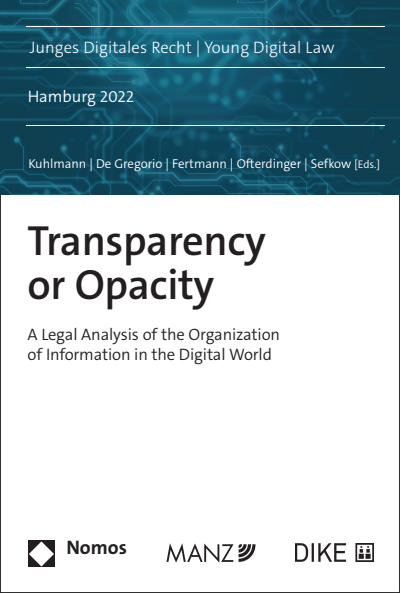
Transparency or Opacity
A Legal Analysis of the Organization of Information in the Digital World- Herausgeber:innen:
- | | | |
- Reihe:
- Junges Digitales Recht | Young Digital Law, Band 1
- Verlag:
- 2023
Zusammenfassung
Die Datafizierung und Digitalisierung von Geschäftsmodellen und Entscheidungsprozessen lassen Forderungen nach mehr Transparenz laut werden, werfen zugleich aber die Frage nach dafür geeigneten Konzepten auf. Die in diesem Band zusammengefassten und verschiedene Rechtsgebiete adressierenden Beiträge untersuchen daher aus rechtswissenschaftlicher Perspektive, ob und unter welchen Bedingungen Transparenz gewährt werden sollte und inwieweit bereits bestehende Transparenzkonzepte fruchtbar gemacht werden können. Sie sind allesamt Diskussionsbeiträge der 2. Konferenz des Forschungsnetzwerkes Junges Digitales Recht, die am 22. und 23.7.2022 an der Universität Hamburg stattgefunden hat. Mit Beiträgen vonMarco Billi, Dr. Jonas Botta, Dr. Gordian Konstantin Ebner, Jun.-Prof. Dr. Elena Freisinger, Joris Krijger, Dr. Tobias Mast, Dr. Juliane Mendelsohn, Paul Nolan, Jun.-Prof. Alessandro Parenti, Kostina Prifti, Dr. Patrick Raschner, Dr. Christopher Rennig, David Schneeberger, Prof. Dr. Evert Stamhuis, Tamara Thuis und Prof. Dr. Thomas Wischmeyer.
Schlagworte
Publikation durchsuchen
Bibliographische Angaben
- Copyrightjahr
- 2023
- ISBN-Print
- 978-3-7560-0027-2
- ISBN-Online
- 978-3-7489-3606-0
- Verlag
- Nomos, Baden-Baden
- Reihe
- Junges Digitales Recht | Young Digital Law
- Band
- 1
- Sprache
- Englisch
- Seiten
- 251
- Produkttyp
- Sammelband
Inhaltsverzeichnis
- Titelei/InhaltsverzeichnisSeiten 1 - 10 Download Kapitel (PDF)
- Autor:innen:Download Kapitel (PDF)
- A. Introduction
- B. History: The common tradition of state secrecy and transparency
- I. Strategic Secrecy
- II. Institutional Secrecy
- III. Fiduciary Secrecy
- I. Defining state secrets
- II. Defining role-based criteria for information access
- III. Defining the substantive scope of information access
- IV. Defining temporal criteria for information access
- E. Outlook
- Autor:innen:Download Kapitel (PDF)
- I. Elektronische Verwaltungsleistungen
- II. Once-Only-Prinzip
- III. Registermodernisierung
- I. Einführung einer Identifikationsnummer
- 1. Öffnungsklausel für nationale Kennziffern (Art. 87 DSGVO)
- 2. Recht auf informationelle Selbstbestimmung (Art. 2 Abs. 1 i.V.m. Art. 1 Abs. 1 GG)
- I. Verfassungsgerichtliche Transparenzanforderungen
- a) Zugang zum Datenschutzcockpit
- b) Angezeigte Daten im Datenschutzcockpit
- c) Speicherort der angezeigten Daten
- a) Erweiterung des Anwendungsbereichs (bei gleichzeitiger Verhinderung eines „information overload“)
- b) Erweiterung der Anwendungsmöglichkeiten
- c) Einheitlicher Datenaustauschstandard
- d) Speicherdauer der Daten
- e) Datenschutzrechtliche Verantwortlichkeit
- III. Notwendigkeit weiterer Schutzmechanismen
- D. Fazit
- Autor:innen:Download Kapitel (PDF)
- A. Einleitung
- B. Hintergründe
- I. Länge der Datenschutzhinweise
- II. Komplexität der Datenschutzhinweise
- III. Rigide Art und Weise der Informationserteilung
- 1. Kürzung
- 2. Komplexitätsreduktion
- a) Schlagworte, Stichpunkte etc.
- b) Visualisierung
- c) Privacy Bots
- 4. Konzeption
- 1. Art. 12 DS‑GVO überarbeitete Fassung
- 2. Art. 13 DS‑GVO neue Fassung
- 3. Art. 14 DS‑GVO neue Fassung
- 4. Art. 15 DS‑GVO neue Fassung
- E. Fazit/Ausblick
- Autor:innen: |Download Kapitel (PDF)
- A. Introduction and Overview
- B. Consumer interaction with algorithms
- I. Consumers as products
- II. Assisted consumers
- III. Algorithmic consumers
- IV. Hypernudged consumers
- V. Hybrid consumers
- I. Transparency
- II. Creating transparency
- I. The aims and rationale of consumer protection law
- II. A brief reflection on autonomy and agency
- III. Towards personalised disclosures and dynamic disclosures?
- IV. Withdrawal rights
- F. Conclusion
- Autor:innen: |Download Kapitel (PDF)
- A. Introduction
- B. Smart Legal Contracts
- C. Intelligibility
- 1. Agreement
- 2. Offer
- 3. Acceptance
- 4. Purchase
- 1. Execution
- 2. Explaining the contract
- E. Conclusion & discussion
- Autor:innen: | | |Download Kapitel (PDF)
- A. Introduction
- I. ADMs and profiling; AI powered or not
- II. Legal obligations for transparency
- III. Abstracting the transparency rationale
- Information problems
- Knowledge problems
- Resources problems
- Manipulation problems
- Enforcement problems
- Public interest problems
- D. Trust and Transparency
- I. Experts, Oversight Institutions and Organizations
- II. Choice Architecture, Developers and Stakeholders
- III. Public
- F. Conclusion and further research
- Autor:innen:Download Kapitel (PDF)
- I. Begründungsfunktionen
- II. Normative Kraft unter dem Vorbehalt des Möglichen
- I. Differenzierung
- II. Herstellungsmängel
- III. Darstellungsmodalitäten
- I. Ansätze
- II. Authentizität
- I. Selbstkontrolle
- II. Befriedung
- III. Ausrichtung zukünftigen Verhaltens
- IV. Rechtsschutz
- V. Entlastung des Justizsystems
- VI. Akzeptanz- und Vertrauenswürdigkeit
- E. Fazit
- Autor:innen:Download Kapitel (PDF)
- A. Introduction
- B. Current AI Developments in Healthcare
- C. AI and The Black Box
- D. Drugs and Other Medical Black Boxes
- I. Rogers v Whitaker
- II. Montgomery v Lanarkshire Health Board
- F. Therapeutic Privilege
- I. Patient-related factors
- II. Information-related factors
- III. Communication-related factors
- IV. Emotional overwhelm
- V. Informational overload
- H. Conclusion
- Autor:innen:Download Kapitel (PDF)
- A. Einleitung
- I. Rechtsgrundlagen
- 1. Diagnoseaufklärung
- 2. Verlaufsaufklärung
- 3. Risikoaufklärung
- I. AIA und Transparenz
- II. KI-Systeme als „Aspirin 2.0“
- III. Stand der Wissenschaft und Black Box
- IV. Generierung von klinischer Evidenz
- V. (X)AI-Entwicklungen
- D. Conclusio
- Autor:innen:Download Kapitel (PDF)
- A. Einleitung
- I. Allgemeines Prinzip
- II. Speziell: Liquidity pool-based lending am Beispiel von Aave
- C. DeFi – „the most transparent financial system in history”?
- I. Geldwäscherecht
- II. Kapitalmarktrechtliche Informationspflichten
- 1. Erfüllung der Transparenzvorgaben der §§ 491 ff. BGB
- 2. Anwendbarkeit der Transparenzvorgaben der §§ 491 ff. BGB
- E. Fazit
- Autor:innen:Download Kapitel (PDF)
- A. Background
- B. Questions and scope
- C. Potential rationales for informing clients around AI use
- 1. Information to clients about the purpose of the suitability assessment
- 2. Ex-post and suitability reporting obligations
- 1. Standardised information requirements
- 2. Requirements for the way in which information is provided
- E. Concluding comments
- List of AuthorsSeiten 249 - 250 Download Kapitel (PDF)
- List of EditorsSeiten 251 - 251 Download Kapitel (PDF)