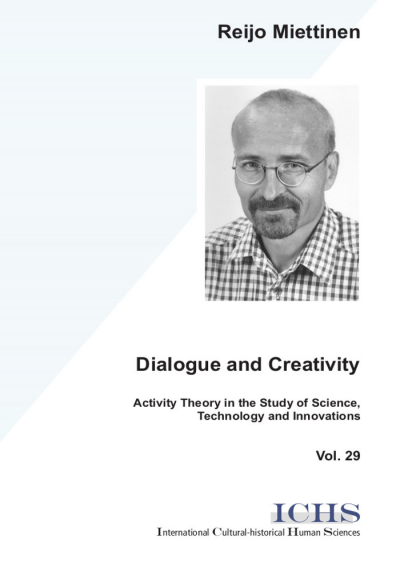
Dialogue and Creativity
Activity Theory in the Study of Science, Technology and Innovations- Autor:innen:
- Verlag:
- 2009
Zusammenfassung
This book is a collection of papers in which cultural-historical activity theory (CHAT) is used to study science, technology and innovations. In the 16 chapters of the book an activity theoretical approach is developed through dialogue with the relevant theoretical approaches of science and technology studies, such as actor network theory, symbolic interactionism and Knorr-Cetinas's theory of objectual cultural practice.The book has three parts. The first one comprises empirical studies on creativity and change in research work and innovations. The cases studied include research groups in analytical chemistry, aerosol physics, biotechnology as well as innovations in medical technology by research-based firms. In making sense of the distributed creation, CHAT is put in dialogue with the systemic view of psychology of creativity, the systemic approach in history of technology as well as sociological theories of creativity.The second part compares systematically the similarities and differences between Deweyan pragmatism and CHAT, and shows how they can be used in a complementary way in empirical research. The third part evaluates actor network theory, constructivist conceptions of learning as well as the concept of routine largely used in organizational studies from the position of CHAT. In addition the concept 'object of activity' central in activity theory is discussed and elaborated in two chapters.The autor:Reijo Miettinen is Professor of Adult Education in the University of Helsinki and he was Vice director of the Center for Activity Theory and Developmental Work Research in 1995-2007.
Schlagworte
Publikation durchsuchen
Bibliographische Angaben
- Auflage
- 1/2009
- Copyrightjahr
- 2009
- ISBN-Print
- 978-3-86541-348-2
- ISBN-Online
- 978-3-86541-673-5
- Verlag
- Lehmanns Media, Berlin
- Sprache
- Englisch
- Seiten
- 398
- Produkttyp
- Monographie
Inhaltsverzeichnis
- CONTENTS Kein Zugriff
- LIST OF THE ORIGINAL PAPERS Kein Zugriff
- INTRODUCTION: THE ROOTS OF THE DIALOGUE Kein Zugriff Seiten 9 - 17
- Introduction Kein Zugriff
- The complementary levels of analysis Kein Zugriff
- The NAA method in the Reactor Laboratory Kein Zugriff
- The stage of environmental research, 1966–1975 Kein Zugriff
- From lunar rocks to uranium analysis, 1975–1979 Kein Zugriff
- The crisis and the orientation towards mass analytics and the instrumental multi-elemental analysis of the geological samples, 1980–1986 Kein Zugriff
- The new crisis and an orientation to other methods, 1985–1990 Kein Zugriff
- 1) Automation of the calculation of results in 1972 Kein Zugriff
- 2) Automation of measurements in 1975 Kein Zugriff
- 3) An automatic gamma spectrometer was obtained in 1982. It both measured and calculated the results Kein Zugriff
- 4) The automatic spectrometers are connected to a central computer and terminals in 1988 Kein Zugriff
- The commercialization of research: “The good old days” lost Kein Zugriff
- The automation of the NAA and the work of the laboratory assistants Kein Zugriff
- The division of labour between the researchers and the laboratory assistants Kein Zugriff
- On the concept of scientific research Kein Zugriff
- Abstract Kein Zugriff
- Introduction Kein Zugriff
- How to study a heterogeneous research agenda? Kein Zugriff
- First phase of the research: Constructing the subject and basic means in 1992–1994 Kein Zugriff
- Second phase: The first application, nanoparticles for cancer diagnostics and treatment in 1994–1997 Kein Zugriff
- Third phase in 1997: Expansion of the research object and formation of the materials team Kein Zugriff
- Controlling the expanding object: Selection of the relevant phenomena Kein Zugriff
- Conclusions Kein Zugriff
- Abstract Kein Zugriff
- Introduction Kein Zugriff
- Neuromag and the MEG device Kein Zugriff
- Local network in transition Kein Zugriff
- User seminar as an intervention in the research process Kein Zugriff
- Level 1. Use value of MEG Kein Zugriff
- Level 2. Theoretical and practical tools of clinical decision making Kein Zugriff
- Level 3. Situated use of MEG: organizing measurement and analysis services Kein Zugriff
- A major contradiction in the transition process: The inability of the network of producers and developers to meet the user expectations of services Kein Zugriff
- Conclusions Kein Zugriff
- Introduction Kein Zugriff
- Genius theory of invention Kein Zugriff
- Multiple discoveries and the theory of cultural maturation Kein Zugriff
- Attributrion theory Kein Zugriff
- Theory of serendipity Kein Zugriff
- The emergence and development of enzyme-aided pulp bleaching Kein Zugriff
- Formulating the idea Kein Zugriff
- Disciplinary background of the idea: Studies on biotechnical pulp bleaching Kein Zugriff
- The decisive impulse: Discovery of ligninases outside the cell Kein Zugriff
- Local factors affecting the idea formation: Hemicellulase research at the VTT Biotechnical Laboratory Kein Zugriff
- Less funding for ethanol research: New applications are sought from the forest products industry Kein Zugriff
- Knowledge on biomass fractionation from Batelle Institute is transmitted to VTT Kein Zugriff
- The social mechanism of preparation Kein Zugriff
- First experiments and the results Kein Zugriff
- The latent period: The users and paper and pulp researchers regard the results as insignificant Kein Zugriff
- Unexpected social processes interfere: Dioxin and chlorine debates as midwives of innovation Kein Zugriff
- Enzyme-aided pulp bleaching gains the status of invention Kein Zugriff
- Theory of cultural maturation: Global or local? Kein Zugriff
- Attribution theory: Attribution by whom and why? Kein Zugriff
- Theory of serendipity: Planned or contingent process? Kein Zugriff
- Introduction Kein Zugriff
- The social history of problem finding: Dilemmas and contradictions of technology use Kein Zugriff
- Sociocultural dimension of inventive work: Dialogue and the mobilization of diverse cultural resources to problem solving and artifact construction Kein Zugriff
- The emergence and early development of the Delfia-technology Kein Zugriff
- The study on the possibilities of the method based on fluorescence polarization Kein Zugriff
- The time-resolved method using fluorochromes Kein Zugriff
- The idea of rare earth metals as a label Kein Zugriff
- The testing of the workability of the probe in the laboratory Kein Zugriff
- The selection of the measurement method Kein Zugriff
- Development of the earth-metal chelate and discovery of the dissociation method Kein Zugriff
- Whose invention? Arguments in the courtroom Kein Zugriff
- Conclusions Kein Zugriff
- Introduction Kein Zugriff
- From individual psychology to a cultural and systemic view of creativity Kein Zugriff
- Contradictions and functional failures of practices as a driving force of creation Kein Zugriff
- Network construction as a means of boundary crossing, problem finding and of the hybridization of cultural resources Kein Zugriff
- Contingency – the unanticipated intertwining of chains of events and the potential multiusability of artifacts Kein Zugriff
- Discussion about the possibility of the management of creativity Kein Zugriff
- Abstract Kein Zugriff
- Introduction Kein Zugriff
- Kolb’s eclectic method and its consequences Kein Zugriff
- (1) The shared societal object of the group is eliminated and the “group interaction as such” becomes the object of analysis Kein Zugriff
- (2) The collection and analysis of the data by the researchers is replaced by the discussion of the recollections of the group members Kein Zugriff
- (3) Individualization of experience Kein Zugriff
- (4) The concept of experience is tied to humanistic anthropology and values Kein Zugriff
- The dynamics of the model of experiental learning Kein Zugriff
- The problem of induction and theory ladenness of observations Kein Zugriff
- Dewey’s naturalistic model of reflective thought and action Kein Zugriff
- (1) The indeterminate situation: the habit does not work Kein Zugriff
- (2) Intellectualization: defining the problem Kein Zugriff
- (3) Studying the conditions of the situation and formation of a working hypothesis Kein Zugriff
- (4) Reasoning – in a narrower sense Kein Zugriff
- (5) Testing the hypothesis by action Kein Zugriff
- The two-edged nature of experience: Empirical and theoretical thought Kein Zugriff
- Hypothesis and models as plans of action Kein Zugriff
- Conclusions Kein Zugriff
- Introduction Kein Zugriff
- Two theories of activity: Instrumentalism and mediation Kein Zugriff
- Activity as a constitutive philosophical category of the two theories Kein Zugriff
- Meanings are not about “things out there” but about activities in which people and things are configured and transformed Kein Zugriff
- Resistance and the objectivity of knowledge Kein Zugriff
- Experimentation and intervention is social research Kein Zugriff
- Conclusions Kein Zugriff
- Introduction Kein Zugriff
- Dualism of Vygotsky? Kein Zugriff
- Subjects and objects as products of activity Kein Zugriff
- The impossibility of ultimate distinctions: Subjective objects and industry as an open book of human psychology Kein Zugriff
- (Dis)continuity and development of higher psychological processes Kein Zugriff
- Motive and activity Kein Zugriff
- Transactional philosophy and empirical research of activity Kein Zugriff
- Dewey, practical activity and concern for the human condition Kein Zugriff
- Abstract Kein Zugriff
- Introduction Kein Zugriff
- Rorty’s critique of Dewey and Garrison’s counterargument suggesting that Dewey’s philosophy is a philosophy of cultural retooling Kein Zugriff
- Habit and situation in Dewey’s logic of experience Kein Zugriff
- Inquiry, continuity and learning: Where are the artifacts? Kein Zugriff
- Concluding discussion Kein Zugriff
- Abstract Kein Zugriff
- Introduction Kein Zugriff
- The object and social organization of the alternative-enterprise studies Kein Zugriff
- Phases and work forms of the alternative-enterprise project Kein Zugriff
- The business plan for the alternative enterprise RaumaTrack as an outline for the zone of proximal development of the partner firm Kein Zugriff
- Conclusions Kein Zugriff
- Abstract Kein Zugriff
- Introduction Kein Zugriff
- About the background and the methdological endeavors of ANT Kein Zugriff
- Activity theory and mediation by artifacts Kein Zugriff
- Production of nature/cultures and co-production of object and subject in activity: Parallel solutions to the problem of dualism Kein Zugriff
- The concept of mediation in ANT and AT Kein Zugriff
- Mediation in analysis of technical artifacts: Distribution or delegation or what? Kein Zugriff
- Artifact and thing as a contradictory unity of the human construction and prehuman natural quality Kein Zugriff
- Mediation in empirical studies of innovations: The three problems of generalized symmetry Kein Zugriff
- How to structure the analysis of a heterogeneous network I: Object construction and the VTT Biotechnology Laboratory Kein Zugriff
- How to structure the analysis of a heterogeneous network II: The network of activity systems constructing the ethanol production Kein Zugriff
- The contribution and resistance of Trichoderma reesei and waste wood Kein Zugriff
- Intentionality mediated by models Kein Zugriff
- Discussion Kein Zugriff
- Introduction Kein Zugriff
- The roots of constructivism in psychology of learning and education: von Glasersfeld’s conception Kein Zugriff
- Psychological constructivism and constructivism as a label for a new learning theory Kein Zugriff
- Extension of the debate: Introduction of community, communication, and culture Kein Zugriff
- Attempts to define the versions of constructivism Kein Zugriff
- Looking for the criteria for differentiating between the theories Kein Zugriff
- The difference between social constructivism and practice-based theories Kein Zugriff
- Conclusions Kein Zugriff
- Abstract Kein Zugriff
- Introduction: The renewed interest in the idea of object-oriented practice Kein Zugriff
- Need, object and motive Kein Zugriff
- Object of activity in the context of studying change and development in work Kein Zugriff
- Complex and contradictory nature of an object of activity Kein Zugriff
- Ethanol from waste wood: Functional complexity of an object and distributed expertise Kein Zugriff
- Desire for recognition and the development of individual object-related motives Kein Zugriff
- Conclusion Kein Zugriff
- Abstract Kein Zugriff
- Introduction Kein Zugriff
- Habits and routines as carriers of organizational knowledge and continuity Kein Zugriff
- Artefacts for reflection and organizational change Kein Zugriff
- Making a practice into an epistemic object: The developmental contradictions of the labour-protection inspector’s work in the 1980s Kein Zugriff
- Analyzing the practice and ist contradictions Kein Zugriff
- Elaboration of the model for an alternative practice Kein Zugriff
- Designing and testing the instruments for the new practice Kein Zugriff
- Reorganizing management to conform to the new object of activity Kein Zugriff
- Conclusion and implications for future work Kein Zugriff
- Introduction Kein Zugriff
- Howard Becker’s reflections on taking sides in social research: Activism or methodological neutralism? Kein Zugriff
- From humanist values and discourse ethics to object-sensitive contributions Kein Zugriff
- Comparing the approaches and the roles of the researchers Kein Zugriff
- Power and mediation – skepticism and commitment Kein Zugriff
- From methods and single research projects to the micropolitics of research, transdisciplinary arenas and networks Kein Zugriff
- REFERENCES Kein Zugriff Seiten 341 - 398