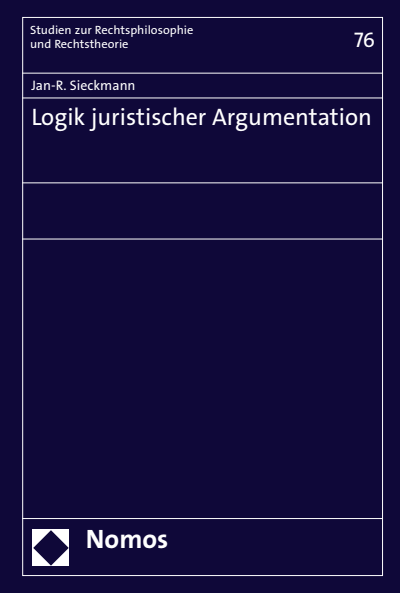
Logik juristischer Argumentation
- Autor:innen:
- Reihe:
- Studien zur Rechtsphilosophie und Rechtstheorie, Band 76
- Verlag:
- 2020
Zusammenfassung
Das Buch entwickelt eine Logik für normative Argumentation in Form der Abwägung normativer Argumente. Eine zentrale These ist, dass das Standardsystem deontischer Logik hierfür inadäquat ist und eine Fragmentierung deontischer Logik gemäß dem jeweiligen Geltungsbegriff notwendig ist. Fundamental ist die Unterscheidung normativer Argumente von normativen Aussagen und den für sie geltenden logischen Regeln. Diese Unterscheidung wird systematisch angewandt auf Normensysteme, normative Positionen, das Verhältnis von Werten und Normen sowie auf die Standardformen juristischer Argumentation. Das Buch wendet sich an alle, die an der Struktur normativer Argumentation interessiert sind.
Publikation durchsuchen
Bibliographische Angaben
- Auflage
- 1/2020
- Copyrightjahr
- 2020
- ISBN-Print
- 978-3-8487-6841-7
- ISBN-Online
- 978-3-7489-0940-8
- Verlag
- Nomos, Baden-Baden
- Reihe
- Studien zur Rechtsphilosophie und Rechtstheorie
- Band
- 76
- Sprache
- Deutsch
- Seiten
- 223
- Produkttyp
- Monographie
Inhaltsverzeichnis
- Titelei/InhaltsverzeichnisSeiten 1 - 16 Download Kapitel (PDF)
- I. Welche Logik?
- II. Ziele der Untersuchung
- I. Deduktive Folgerungen
- II. Interne und externe Rechtfertigung juristischer Entscheidungen
- Struktur der juristischen Entscheidungsbegründung
- IV. Grenzen der Deduktion: Die Struktur der Abwägung
- 1. Objekt- und Metasprache
- 2. Postulate der Widerspruchsfreiheit und Vollständigkeit
- 3. Syntax, Semantik und Pragmatik
- II. Die Sprache der Aussagenlogik
- 1. Das System der Aussagenlogik
- 2. Syntaktische und semantische Folgerungsbeziehungen
- 3. Wahrheitswerttafeln
- 1. Beispiele für Tautologien
- 2. Beispiele für Äquivalenzen
- 1. Deduktive und induktive Schlüsse
- 2. Methode indirekten Beweises
- 1. Subjekte und Prädikate
- 2. Extension und Intension von Begriffen
- 1. Sprache der Prädikatenlogik
- 2. Schlussregeln
- III. Relationen
- I. Grundlagen
- II. Axiomatik
- III. Semantik der Modallogik
- IV. Modale Prädikatenlogik
- I. Begriff
- II. Entwicklung
- 1. Das Standardmodell
- 2. Systeme deontischer Logik auf der Basis einer Mögliche-Welten-Semantik
- 1. Das Problem der Wahrheitsfähigkeit von Normsätzen
- 2.1. Ross' Paradoxon
- 2.2. Paradoxien bedingter Verpflichtung
- 2.3. Guter Samariter-Paradoxon
- 3. Deskriptive und präskriptive Deutungen von Normsätzen
- 4. Die Analogie zur alethischen Modallogik
- 5. Konditionale Normsätze
- V. Fazit
- 1. Normkonzeptionen
- 2. Hyletische und expressive Normkonzeptionen
- 3. Semantisch-pragmatische Normkonzeption
- 1.1. Erlaubnisse als Normen
- 1.2. Die Interdefinierbarkeit deontischer Modalitäten
- 2. Norminhalt: Handlung oder Sachverhalt
- 3. Konditionale Normen
- III. Logik der Normen und Logik normativer Propositionen
- IV. Logik von Normierungen (Präskriptionen)
- V. Logik von Normsätzen
- VI. Fazit
- 1. Kontradiktion und Kontrarität
- 2. Prinzipienkollisionen und Regelkonflikte
- 1. Fuzzy logic
- 2. Nicht-monotone Logik
- III. Fazit
- I. Die Struktur von Abwägungsbegründungen
- II. Die Konzeption einer normativen Begründung
- III. Normative Argumente als reiterierte Geltungsgebote
- 1. Grundnorm normativer Argumentation
- 2.1. Implikationen definitiver Geltung
- 2.2. Implikationen der Geltung als normatives Argument
- V. Fazit
- 1. Folgerungen aus elementaren normativen Argumenten
- 2. Folgerungen aus relationalen normativen Argumenten
- II. Folgerungen aus normativen Urteilen oder Aussagen
- 1. Beziehungen zwischen normativen Argumenten und Handlungen
- Schema quantifizierter Handlungsgebote
- 3. Logische Beziehungen zwischen quantifizierten Handlungsnormen
- IV. Fazit
- 1. Die Anwendung von Systemen deontischer Logik
- 2. Parallelen zur alethischen Modallogik
- 3. Iterierte Modalitäten
- 4. Deontische Logik für normative Systeme
- 5. Deontische Logik für Handlungsnormen
- 1. Schemata rechtlicher Positionen
- 2.1. Struktur rechtlicher Kompetenzen
- 2.2. Kompetenzen und rechtliche Beschränkungen
- 2.3. Kompetenzen und Rechtsänderung
- 2.4. Kompetenz und Erlaubnis
- 1. Werte und prinzipielle Gebote
- 2. Probleme der Interdefinierbarkeit von Werten und Normen
- 3. Universelle und existentielle Normsätze
- 4. Konsequenzen für die Struktur der Normbegründung
- 1. Deduktive Begründung
- 2.1. Argument des notwendigen Mittels
- 2.2. Argument der Förderung des Zwecks
- 2.3. Definitive Gebote der Optimierung
- Struktur der Abwägung:
- 4. Weitere Grundformen?
- 1. Analogie
- 2. Erst-recht-Schluss
- 3. Teleologische Reduktion
- 4. Umkehrschluss (Argumentum e contrario)
- 5. Argumentum ad absurdum
- III. Analogie, erst-recht-Schluss, teleologische Reduktion: gemeinsame Struktur
- RésuméSeiten 182 - 185 Download Kapitel (PDF)
- 1. Die Unterscheidung von Regeln und Prinzipien
- 2.1. Die semantische Konzeption von Normen
- 2.2. Geltungszuschreibungen
- 3.1. Nicht jedes normative Argument ist ein Prinzip
- 3.2. Nicht jedes Prinzip ist ein normatives Argument
- 3.3. Prinzipien als normativer Rahmen autonomer Normbegründung
- 1. Enteignung und die Selbständigkeit von Eigentumsrechten
- 2.1. Die Struktur von Eigentumsrechten
- 2.2. Selbständigkeit und Immunität von Rechtspositionen
- 3. Definitive und prinzipielle Gewährleistungsgehalte
- BibliographieSeiten 205 - 218 Download Kapitel (PDF)
- Personen- und SachverzeichnisSeiten 219 - 222 Download Kapitel (PDF)
- Verzeichnis der verwendeten logischen SymboleSeiten 223 - 223 Download Kapitel (PDF)
Literaturverzeichnis (290 Einträge)
Es wurden keine Treffer gefunden. Versuchen Sie einen anderen Begriff.
- Alchourrón, Carlos E. 1969. Logic of Norms and Logic of Normative Propositions. In: Logique et Analyse 12, 242-268. Google Scholar öffnen DOI: 10.5771/9783748909408
- Alchourrón, Carlos E. 1969. Logic of Norms and Logic of Normative Propositions. In: Logique et Analyse 12 1993. Philosophical Foundations of Deontic Logic and the Logic of Defeasible Conditionals. In: J. Meyer/R. Wieringa (eds.), Deontic Logic in Computer Science, 43-84. Chichester et al.: Wiley & Sons. Google Scholar öffnen DOI: 10.5771/9783748909408
- Alchourrón, Carlos E. 1969. Logic of Norms and Logic of Normative Propositions. In: Logique et Analyse 12 1996a. On Law and Logic. In: Ratio Juris 9, 331-348. Google Scholar öffnen DOI: 10.5771/9783748909408
- Alchourrón, Carlos E. 1969. Logic of Norms and Logic of Normative Propositions. In: Logique et Analyse 12 1996b. Detachment and Defeasibility in Deontic Logic. Studia Logica 57, 5-18. Google Scholar öffnen DOI: 10.5771/9783748909408
- Alchourrón, C.E./Bulygin, Eugenio. 1971. Normative Systems. Wien/New York: Springer. (deutsch Normative Systeme, Freiburg/München; Alber, 1994). Google Scholar öffnen DOI: 10.5771/9783748909408
- Alchourrón, C.E./Bulygin 1981. The Expressive Conception of Norms. In: Hilpinen (ed.), New Essays in Deontic Logic, 1981, 95-124. Google Scholar öffnen DOI: 10.5771/9783748909408
- Alchourrón, C.E./Gärdenfors, P./Makinson, D. 1985. On the Logic of Theory of Change: Partial Meet Contraction and Revision Functions. In: The Journal of Symbolic Logic 50, 510-530. Google Scholar öffnen DOI: 10.5771/9783748909408
- Alchourrón, C.E./Makinson, D. 1981. Hierarchies of Regulations and their Logic. In: Hilpinen (ed.), New Essays in Deontic Logic, 125-148. Google Scholar öffnen DOI: 10.5771/9783748909408
- Alchourrón, C.E./Martino, A. 1990. Logic without Truth. In: Ratio Juris 3, 46-67. Google Scholar öffnen DOI: 10.5771/9783748909408
- Alexy, Robert. 1978. Theorie der juristischen Argumentation, 3. Aufl., 1994, Frankfurt a.M.: Suhrkamp. Google Scholar öffnen DOI: 10.5771/9783748909408
- Alexy, Robert. 1978. Theorie der juristischen Argumentation 1979. Zum Begriff des Rechtsprinzips, in: Rechtstheorie Beih. 1, 59-87 (wiederabgedr. in id., Recht, Vernunft, Diskurs, Frankfurt a.M.: Suhrkamp, 1995, 177-212). Google Scholar öffnen DOI: 10.5771/9783748909408
- Alexy, Robert. 1978. Theorie der juristischen Argumentation 1980. Logische Analyse juristischer Entscheidungen, in: ARSP-Beih. 14, 181-212 (wiederabgedr. in id., Recht, Vernunft, Diskurs, Frankfurt a.M.: Suhrkamp, 1995, 13-51). Google Scholar öffnen DOI: 10.5771/9783748909408
- Alexy, Robert. 1978. Theorie der juristischen Argumentation 1985. Theorie der Grundrechte, 3. Aufl. 1996, Frankfurt a.M.: Suhrkamp. Google Scholar öffnen DOI: 10.5771/9783748909408
- Alexy, Robert. 1978. Theorie der juristischen Argumentation 1987. Rechtssystem und praktische Vernunft, in: Rechtstheorie 18, 405-419, zitiert nach ders., Recht, Vernunft, Diskurs, Frankfurt a.M.: Suhrkamp, 1995, 213-231. Google Scholar öffnen DOI: 10.5771/9783748909408
- Alexy, Robert. 1978. Theorie der juristischen Argumentation 1994a. Begriff und Geltung des Rechts, 2. Aufl., Freiburg: Alber Google Scholar öffnen DOI: 10.5771/9783748909408
- Alexy, Robert. 1978. Theorie der juristischen Argumentation 1995. Recht, Vernunft, Diskurs, Frankfurt a.M.: Suhrkamp. Google Scholar öffnen DOI: 10.5771/9783748909408
- Alexy, Robert. 1978. Theorie der juristischen Argumentation 2000. On the Structure of Legal Principles, in: Ratio Juris 13, 294-304. Google Scholar öffnen DOI: 10.5771/9783748909408
- Alexy, Robert. 1978. Theorie der juristischen Argumentation 2003. On Balancing and Subsumption. A Structural Comparison, in: Ratio Juris 16, 433-449. Google Scholar öffnen DOI: 10.5771/9783748909408
- Alexy, Robert. 1978. Theorie der juristischen Argumentation 2009. Ideales Sollen, in: L. Clérico/J. Sieckmann (Hg.), Grundrechte, Prinzipien und Argumentation, Baden-Baden: Nomos, 21-38. Google Scholar öffnen DOI: 10.5771/9783748909408
- Alexy, Robert. 1978. Theorie der juristischen Argumentation 2010. Two or Three?, in: M. Borowski (ed.), On the Nature of Legal Principles, ARSP-Beiheft 119, 9-18. Google Scholar öffnen DOI: 10.5771/9783748909408
- Allen, L.E. 1996. From the Fundamental Legal Conceptions of Hohfeld to Legal Relations: Refining the Enrichment of Solely Deontic Legal Relations. In: Brown, Mark A./Carmo, José (eds.). 1996. Deontic Logic, Agency and Normative Systems. DEON '96, London et al.: Springer, 1-26. Google Scholar öffnen DOI: 10.5771/9783748909408
- Anderson, Alan Ross. 1956. The Formal Analysis of Normative Systems. In: N. Rescher (ed.), The Logic of Decision and Action, Univ. Pittsburgh 1967, 147-213. Google Scholar öffnen DOI: 10.5771/9783748909408
- Anderson, Alan Ross. 1956. The Formal Analysis of Normative Systems. In: N. Rescher (ed.) 1958. A Reduction of Deontic Logic to Alethic Modal Logic, Mind 67, 100-103. Google Scholar öffnen DOI: 10.5771/9783748909408
- Åquist, Lennart. 1987. Introduction to Deontic Logic and the Theory of Normative Systems, Napoli: Bibliopolis. Google Scholar öffnen DOI: 10.5771/9783748909408
- Åquist, Lennart. 1987. Introduction to Deontic Logic and the Theory of Normative Systems 1998. Prima Facie Obligations in Deontic Logic. A Chisholmian Analysis Based on Normative Preference Structures, in: Fehige, C./Wessels, U. (eds.), Prefe¬rences, Berlin/New York: de Gruyter, 135-155. Google Scholar öffnen DOI: 10.5771/9783748909408
- Åquist, Lennart. 1987. Introduction to Deontic Logic and the Theory of Normative Systems 2002. Deontic Logic. In: Gabbay/Guenther (eds.), Handbook of Philosophical Logic, 2nd. ed., Vol. 8, 147-264. Google Scholar öffnen DOI: 10.5771/9783748909408
- Artosi, A./Governatori, G./Sartor, G. 1996. Towards a Computational Treatment of Deontic Defeasibility. In: Brown, Mark A./Carmo, José (eds.). Deontic Logic, Agency and Normative Systems. DEON '96, London et al.: Springer, 27-46. Google Scholar öffnen DOI: 10.5771/9783748909408
- Atienza, Manuel. 2006. El derecho como argumentación, Barcelona: Ariel. Google Scholar öffnen DOI: 10.5771/9783748909408
- Atienza, Manuel/Ruiz Manero, Juan. 1998. A Theory of Legal Sentences, Dordrecht/Boston/London: Kluwer. Google Scholar öffnen DOI: 10.5771/9783748909408
- Bäcker, Carsten. 2008. Begründen und Entscheiden, Tübingen: Mohr Siebeck. Google Scholar öffnen DOI: 10.5771/9783748909408
- Bailhache, P. 1981. Analytical Deontic Logic: Authorities and Addressees. In: Logique et Analyse 24, 65-80. Google Scholar öffnen DOI: 10.5771/9783748909408
- Barcan Marcus, Ruth. 1966. Iterated Deontic Modalities. In: Mind 75, 580-582. Google Scholar öffnen DOI: 10.5771/9783748909408
- Bailhache, P. 1981. Analytical Deontic Logic: Authorities and Addressees. In: Logique et Analyse 24 1980. Moral Dilemmas and Consistency. In: Journal of Philosophy 77, 121-136. Google Scholar öffnen DOI: 10.5771/9783748909408
- Bartha, Paul. 1999. Moral Preference, Contrary-to-Duty Obligation and Defeasible Oughts. In: McNamara/Prakken (eds.), 93-108. Google Scholar öffnen DOI: 10.5771/9783748909408
- Bayón, Juan Carlos. 2001. Why is Legal Reasoning Defeasible? In: A. Soeteman (ed.), Pluralism and Law, 327-346. Dordrecht: Kluwer. Google Scholar öffnen DOI: 10.5771/9783748909408
- Bayón, Juan Carlos/Rodriguez, Jorge. 2003. Relevancia normativa en la justificación de las decisiones judiciales, Bogota: Unversidad Externado de Colombia. Google Scholar öffnen DOI: 10.5771/9783748909408
- Becker, Oskar. 1952. Untersuchungen über den Modalkalkül, Meisenheim: Hain. Google Scholar öffnen DOI: 10.5771/9783748909408
- Beckermann, Ansgar. 2014. Einführung in die Logik, 4. Aufl., Berlin: de Gruyter. Google Scholar öffnen DOI: 10.5771/9783748909408
- Bellman, R.E./Zadeh, L.A. 1970. Decision Making in a Fuzzy Environment, in: Management Science 17, B141-B164. Google Scholar öffnen DOI: 10.5771/9783748909408
- Bentham, Jeremy. 1789. An Introduction to the Principles of Morals and Legislation, Hafner Library of Classics, New York: Hafner Press, 1948. Google Scholar öffnen DOI: 10.5771/9783748909408
- Berkemann, Jörg. 1974. Zum Problem der Widerspruchsfreiheit in der deontischen Logik. In: Lenk, Hans (Hg.), Normenlogik, Pullach, 166-197. Google Scholar öffnen DOI: 10.5771/9783748909408
- Bondarenko, A./Dung, P.M./Kowalski, R.A./Toni, F. 1997. An abstract, argumentation-theoretic approach to default reasoning. In: Artificial Intelligence 93, 63-101. Google Scholar öffnen DOI: 10.5771/9783748909408
- Böttcher, Harry. 1995/96. Multikriterielle Entscheidungskonzepte in den Sozialwissenschaften, Baden-Baden: Nomos. Google Scholar öffnen DOI: 10.5771/9783748909408
- Brasil, Samuel. 2019. A Mathematical Framework for Modeling Legal Reasoning through Conditional Logic, Miami: FHE Press. Google Scholar öffnen DOI: 10.5771/9783748909408
- Brink, David O. 1994. Moral Conflict and Its Structure. In: Philosophical Review 103, 215-247. Google Scholar öffnen DOI: 10.5771/9783748909408
- Brown, Mark A. 1999. Agents with Changing and Conflicting Commitments: A Preliminary Study. In: McNamara/Prakken (eds.), 109-125. Google Scholar öffnen DOI: 10.5771/9783748909408
- Brown, Mark A./Carmo, José (eds.). 1996. Deontic Logic, Agency and Normative Systems. DEON '96, London et al.: Springer. Google Scholar öffnen DOI: 10.5771/9783748909408
- Brozek, Bartosz. 2008. Analogy in Legal Discourse. In: ARSP 94 (2008), 188-201. Google Scholar öffnen DOI: 10.5771/9783748909408
- Buchwald, Delf. 1990. Die Struktur rationaler juristischer Begründung, Baden-Baden: Nomos. Google Scholar öffnen DOI: 10.5771/9783748909408
- Buck, Brigitte. 1987. Eine deontische Logik auf der Grundlage dynamischer Aussagenlogik, Diss. Kiel. Google Scholar öffnen DOI: 10.5771/9783748909408
- Bulygin, Eugenio. 1997. On Norm Propositions. In: The Reasonable as Rational? On Legal Argumentation and Justification. Festschrift für Aulis Aarnio, Berlin: Duncker & Humblot, 129-134. Google Scholar öffnen DOI: 10.5771/9783748909408
- Carmo, José/Jones, Andrew J.I. 2002. Deontic Logic and Contrary-to-Duties. In: Gabbay/Guenther (eds.), Handbook of Philosophical Logic, 2nd. ed., Vol. 8, 265-343. Google Scholar öffnen DOI: 10.5771/9783748909408
- Castañeda, Hector-Neri. 1981. The Paradoxes of Deontic Logic, in: R. Hilpinen (ed.), New Studies in Deontic Logic, 1981, 37-85. Google Scholar öffnen DOI: 10.5771/9783748909408
- Chellas, B. 1980. Modal Logic. An Introduction, Cambridge: Cambridge Univ. Press. Google Scholar öffnen DOI: 10.5771/9783748909408
- Chisholm, Roderick M. 1963. 'Contrary-to-duty’ Imperatives and Deontic Logic. In: Analysis 24, 33-36. Google Scholar öffnen DOI: 10.5771/9783748909408
- Clérico, Laura. 2001. Die Struktur der Verhältnismäßigkeit, Baden-Baden: Nomos. Google Scholar öffnen DOI: 10.5771/9783748909408
- Cocchiarella, Nino B./Freund, Max A. 2008. Modal Logic. An Introduction to its Syntax and Semantics, Oxford/New York: Oxford University Press. Google Scholar öffnen DOI: 10.5771/9783748909408
- Conte, A./Hilpinen, R./von Wright, G.H. (eds.) 1977. Deontische Logik und Semantik. Wiesbaden. Google Scholar öffnen DOI: 10.5771/9783748909408
- Cornides, Thomas. 1974. Ordinale Deontik. Zusammenhänge zwischen Präferenztheorie, Normlogik und Rechtstheorie, Wien/New York: Springer. Google Scholar öffnen DOI: 10.5771/9783748909408
- Detel, Wolfgang. 2007. Grundkurs Philosophie Bd. 1: Logik, 3. Aufl., Stuttgart: Reclam. Google Scholar öffnen DOI: 10.5771/9783748909408
- Dubislav, W. 1937. Zur Unbegründbarkeit der Forderungssätze. In: Theoria 3, 330-342. Google Scholar öffnen DOI: 10.5771/9783748909408
- Dworkin, Ronald. 1978. Taking Rights Seriously, 2. ed., Cambridge/Mass.: Harvard University Press. Google Scholar öffnen DOI: 10.5771/9783748909408
- Eck, Job A. van. 1981. A System of Temporally Relative Modal and Deontic Predicate Logic and its Philosophical Implications, Ph.D. Thesis, University of Groningen. Google Scholar öffnen DOI: 10.5771/9783748909408
- Eck, Job A. van. 1981. A System of Temporally Relative Modal and Deontic Predicate Logic and its Philosophical Implications 1982. A System of Temporally Relative Modal and Deontic Predicate Logic and its Philosophical Applications. In: Logique et Analyse 25, 249-290, 339-381. Google Scholar öffnen DOI: 10.5771/9783748909408
- Ehrlich, Eugen. 1925. Die juristische Logik, 2. Aufl., Tübingen: Mohr (Neudruck Aalen 1966: Scientia Verlag). Google Scholar öffnen DOI: 10.5771/9783748909408
- Enderlein, Wolfgang. 1992. Abwägung in Recht und Moral, Freiburg/München: Alber. Google Scholar öffnen DOI: 10.5771/9783748909408
- Engisch, Karl. 1963. Logische Studien zur Gesetzesanwendung, 3. Aufl., Heidelberg. Google Scholar öffnen DOI: 10.5771/9783748909408
- Etherington, David W./Kraus, Sarit/Perlis, Donald. 1991. Nonmonotonicity and the scope of reasoning. In: Artificial Intelligence 52, 221-261. Google Scholar öffnen DOI: 10.5771/9783748909408
- Fackeldey, Hubert G. 1992. Norm und Begründung. Zur Logik normativen Argumentierens, Frankfurt/M. et al.: Lang. Google Scholar öffnen DOI: 10.5771/9783748909408
- Ferrer Beltrán, Jordi/Ratti, Giovanni Battista. 2012. Legal Defeasibility. An Introduction, in: Ferrer Beltrán/Ratti (eds.), The Logic of Legal Requirements. Essays on Defeasibility, Oxford/New York: Oxford University Press, 1-7. Google Scholar öffnen DOI: 10.5771/9783748909408
- Fisher, M. 1961. A Logical Theory of Commanding. In: Logique et Analyse 4, 154-169. Google Scholar öffnen DOI: 10.5771/9783748909408
- Føllesdal, Dagfinn/Hilpinen, Risto. 1971. Deontic Logic. An Introduction. In: R. Hilpinen (ed.) 1971. Google Scholar öffnen DOI: 10.5771/9783748909408
- Forrester, J.W. 1984. Gentle murder, or the adverbial Samaritan. In: Journal of Philosophy 81, 193-197. Google Scholar öffnen DOI: 10.5771/9783748909408
- Frege, Gottlob. 1879. Begriffsschrift. Eine der arithmetischen nachgebildete Formelsprache des reinen Denkens, in: ders., Begriffsschrift und andere Aufsätze, Darmstadt: Wissenschaftliche Buchgesellschaft, 1964. Google Scholar öffnen DOI: 10.5771/9783748909408
- Frege, Gottlob. 1879. Begriffsschrift. Eine der arithmetischen nachgebildete Formelsprache des reinen Denkens 1891. Funktion und Begriff, in: ders., Funktion, Begriff und Bedeutung, hg. v. G. Patzig, Göttingen: Vandenhoeck & Rupprecht, 1975, 17-39. Google Scholar öffnen DOI: 10.5771/9783748909408
- Gabbay, Dov M./Governatori, Guido. 1999. Dealing with Label Dependent Deontic Modalities. In: McNamara/Prakken (eds.), 311-330. Google Scholar öffnen DOI: 10.5771/9783748909408
- Gabbay, Dov M./Guenther, F. (eds.). 2002. Handbook of Philosophical Logic, 2nd. ed., Vol. 8, Dordrecht et al.: Kluwer. Google Scholar öffnen DOI: 10.5771/9783748909408
- Gabbay, Dov M./Schlechta, Karl. 2016. A New Perspective on Nonmonotonic Logics, Cham: Springer. Google Scholar öffnen DOI: 10.5771/9783748909408
- Geach, Peter. 1991. Whatever Happened to Deontic Logic? In: id. (ed.), Logic and Ethics, Dordrecht: Kluwer, 33-48. Google Scholar öffnen DOI: 10.5771/9783748909408
- Gethmann, Carl Friedrich. 1982. Proto-Ethik. Zur formalen Pragmatik von Rechtfertigungsdiskursen. In: Ellwein, T./Stachowiak, H. (Hg.), Bedürfnisse, Werte und Normen im Wandel, Bd. 1, München/Paderborn, 113-143. Google Scholar öffnen DOI: 10.5771/9783748909408
- Gethmann, Carl Friedrich. 1982. Proto-Ethik. Zur formalen Pragmatik von Rechtfertigungsdiskursen. In: Ellwein 1984. Art. deontische Logik. In: Mittelstraß, J. (Hg.), Enzyklopädie Philosophie und Wissenschaftstheorie Bd. 2, Mannheim/Wien/Zürich, 636-642. Google Scholar öffnen DOI: 10.5771/9783748909408
- Goble, Lou F. 1966. The Iteration of Deontic Modalities. In: Logique et Analyse 9, 197-209. Google Scholar öffnen DOI: 10.5771/9783748909408
- Goble, Lou F. 1966. The Iteration of Deontic Modalities. In: Logique et Analyse 9 1999. Deontic Logic with Relevance. In: McNamara, P./Prakken, H. (eds.), 331-345. Google Scholar öffnen DOI: 10.5771/9783748909408
- Gordon, Thomas F. 1995. The Pleadings Game. An Artificial Intelligence Model of Procedural Justice. Springer. Google Scholar öffnen DOI: 10.5771/9783748909408
- Gottwald, Siegfried. 1997. Fuzzy-Logik und approximatives Schließen - ein kurzer Überblick. In: G. Meggle (Hg.), Analyomen 2, Vol. I: Logic Epistemology, Philosophy of Science, Berlin/New York: de Gruyter, 78-86. Google Scholar öffnen DOI: 10.5771/9783748909408
- Gowans, Christopher (ed.). 1987. Moral Dilemmas, New York/Oxford: Oxford University Press. Google Scholar öffnen DOI: 10.5771/9783748909408
- Gowans, Christopher (ed.). 1987. Moral Dilemmas 1987. Introduction. Debates about moral disagreements, in: ders. (ed.), Moral Dilemmas, 1987, 3-33. Google Scholar öffnen DOI: 10.5771/9783748909408
- Habermas, Jürgen. 1994. Faktizität und Geltung, 3. Aufl., Frankfurt a.M.: Suhrkamp. Google Scholar öffnen DOI: 10.5771/9783748909408
- Haberstumpf, Helmut. 1982. Bemerkungen zu einigen Paradoxien der deontischen Logik. In: ARSP 68, 407-424. Google Scholar öffnen DOI: 10.5771/9783748909408
- Hage, Jaap. 1997. Reasoning with Rules. An Essay on Legal Reasoning and Its Underlying Logic. Dordrecht/Boston/London: Kluwer. Google Scholar öffnen DOI: 10.5771/9783748909408
- Hage, Jaap. 1997. Reasoning with Rules. An Essay on Legal Reasoning and Its Underlying Logic. Dordrecht/Boston/London 1999. Moderately Naturalistic Deontic Logic. In: McNamara/Prakken (eds.), 55-72. Google Scholar öffnen DOI: 10.5771/9783748909408
- Hage, Jaap. 1997. Reasoning with Rules. An Essay on Legal Reasoning and Its Underlying Logic. Dordrecht/Boston/London 2003. Law and Defeasibility. In: Artificial Intelligence and Law 11, 221-243. Google Scholar öffnen DOI: 10.5771/9783748909408
- Hage, Jaap. 1997. Reasoning with Rules. An Essay on Legal Reasoning and Its Underlying Logic. Dordrecht/Boston/London 2018. Of Norms, in: Bongiovanni, G., et al. (eds.), Handbook of Legal Reasoning and Argumentation, Dordrecht: Springer, 103-138. Google Scholar öffnen DOI: 10.5771/9783748909408
- Hajek, Petr/Novák, Vilém, 2003. The Sorites Paradox and Fuzzy Logic. In: International Journal of General Systems 32, 373-383. Google Scholar öffnen DOI: 10.5771/9783748909408
- Hansen, Jörg. 1999. On Relations between Åquist's Deontic System G and Van Eck's Deontic Temporal Logic. In: McNamara/Prakken (eds.), 127-144. Google Scholar öffnen DOI: 10.5771/9783748909408
- Hanson, W.H. 1966. A Logic of Commands. In: Logique et Analyse 9, 329-343. Google Scholar öffnen DOI: 10.5771/9783748909408
- Hansson, Bengt. 1969. An Analysis of Some Deontic Logic. Nous 4, 373-398 (in Hilpinen (ed.) 1971, 120-147). Google Scholar öffnen DOI: 10.5771/9783748909408
- Hansson, Sven Ove. 2001. The Structure of Values and Norms, Cambridge et al.: Cambridge Univ. Press. Google Scholar öffnen DOI: 10.5771/9783748909408
- Hansson, Sven Ove. 2001. The Structure of Values and Norms 2002. Semantics for more plausible deontic logics, MS DEON'02. Google Scholar öffnen DOI: 10.5771/9783748909408
- Hardy, Jörg/Schamberger, Christoph. 2018. Logik der Philosophie, 2. Aufl., Wien: Böhlau. Google Scholar öffnen DOI: 10.5771/9783748909408
- Hare, Richard M. 1963. Freedom and Reason, Oxford: Oxford University Press. Google Scholar öffnen DOI: 10.5771/9783748909408
- Hart, H.L.A. 1982. Bentham's Of Laws in General. In: ders., Essays on Bentham. Jurisprudence and Political Theory, Oxford: Oxford University Press, 105-126. Google Scholar öffnen DOI: 10.5771/9783748909408
- Hart, H.L.A. 1982. Bentham's Of Laws in General. In: ders. 1982. Legal Rights. In: ders., Essays on Bentham, 162-193. Google Scholar öffnen DOI: 10.5771/9783748909408
- Hart, H.L.A. 1982. Bentham's Of Laws in General. In: ders. 1994. The Concept of Law (1961), 2. Aufl, Oxford: Clarendon Press. Google Scholar öffnen DOI: 10.5771/9783748909408
- Hedenius, Ingemar. 1941. Om Rätt och Moral. Stockholm: Tidens Förlag. Google Scholar öffnen DOI: 10.5771/9783748909408
- Hegselmann, Rainer. 1985. Formale Dialektik. Ein Beitrag zu einer Theorie rationalen Argumentierens, Hamburg, Meiner. Google Scholar öffnen DOI: 10.5771/9783748909408
- Heller, Theodor. 1961. Logik und Axiologie der analogen Rechtsanwendung, Berlin: de Gruyter. Google Scholar öffnen DOI: 10.5771/9783748909408
- Herberger, Maximilian/Simon, Dieter, Wissenschaftstheorie für Juristen, Frankfurt a.M.: Metzner, 1980. Google Scholar öffnen DOI: 10.5771/9783748909408
- Hilpinen, Risto (ed.). 1971. Deontic Logic: Introductory and Systematic Readings, Dordrecht: Reidel (2. Aufl. 1981). Google Scholar öffnen DOI: 10.5771/9783748909408
- Hilpinen, Risto (ed.). 1971. Deontic Logic: Introductory and Systematic Readings 1981. New Studies in Deontic Logic, Dordrecht: Reidel. Google Scholar öffnen DOI: 10.5771/9783748909408
- Hilpinen, Risto (ed.). 1971. Deontic Logic: Introductory and Systematic Readings 1993. Actions in Deontic Logic. In: Meyer/Wieringa (eds.) 1993, 85-100. Google Scholar öffnen DOI: 10.5771/9783748909408
- Hintikka, Jaakko. 1957. Quantifiers in Deontic Logic, Helsinki: Societas Scientiarum Fennica 23. Google Scholar öffnen DOI: 10.5771/9783748909408
- Hintikka, Jaakko. 1957. Quantifiers in Deontic Logic 1969. Models for Modalities, Dordrecht/Boston. Google Scholar öffnen DOI: 10.5771/9783748909408
- Hintikka, Jaakko. 1957. Quantifiers in Deontic Logic 1970. 'Prima facie' obligations and iterated modalities. In: Theoria 3, 232-240. Google Scholar öffnen DOI: 10.5771/9783748909408
- Hintikka, Jaakko. 1957. Quantifiers in Deontic Logic 1971. Some Main Problems of Deontic Logic. In: Hilpinen (ed.) 1971, 59-104. Google Scholar öffnen DOI: 10.5771/9783748909408
- Ho Ngoc Duc. 1997. On a Dilemma of Conditional Obligation. In: G. Meggle (Hg.), Analyomen 2, Vol. I: Logic Epistemology, Philosophy of Science, Berlin/New York: de Gruyter, 93-100. Google Scholar öffnen DOI: 10.5771/9783748909408
- Hoche, Hans-Ulrich. 1992. Elemente einer Anatomie der Verpflichtung. Pragmatisch-wollenslogische Grundlegung einer Theorie des moralischen Argumentierens, Freiburg/München: Alber. Google Scholar öffnen DOI: 10.5771/9783748909408
- Hoche, Hans-Ulrich. 1992. Elemente einer Anatomie der Verpflichtung. Pragmatisch-wollenslogische Grundlegung einer Theorie des moralischen Argumentierens 2001. Eine wollenslogische Weiterentwicklung des Universellen Präskriptivismus und die Begründung der Goldenen Regel. In: Jahrbuch für Recht und Ethik 9, 325-376. Google Scholar öffnen DOI: 10.5771/9783748909408
- Hofstadter, A./McKinsey, J. 1939. On the Logic of Imperatives. In: Philosophy of Science 6, 446-457. Google Scholar öffnen DOI: 10.5771/9783748909408
- Hohfeld, W.N. 1923. Some Fundamental Legal Conceptions as Applied in Judicial Reasoning. In: ders., Fundamental Legal Conceptions as Applied in Judicial Reasoning and Other Legal Essays, New Haven, 23-64. Google Scholar öffnen DOI: 10.5771/9783748909408
- Holländer, Pavel. 1993. Rechtsnorm, Logik und Wahrheitswerte. Versuch einer kritischen Lösung des Jørgensenschen Dilemmas, Baden-Baden: Nomos. Google Scholar öffnen DOI: 10.5771/9783748909408
- Horty, John F. 2001. Deontic Logic and Agency, Oxford: Oxford University Press. Google Scholar öffnen DOI: 10.5771/9783748909408
- Hoyningen-Huene, Paul. 1998. Formale Logik. Eine philosophische Einführung, Stuttgart: Reclam. Google Scholar öffnen DOI: 10.5771/9783748909408
- Hruschka, Joachim. 1986. Das deontische Seckseck bei Gottfried Achenwall im Jahre 1767, Hamburg. Google Scholar öffnen DOI: 10.5771/9783748909408
- Hughes, G.E./Cresswell, M. 1968. An Introduction to Modal Logic, London/New York: Methuen. Google Scholar öffnen DOI: 10.5771/9783748909408
- Joerden, Jan C. 2018. Logik im Recht. Grundlagen und Anwendungsbeispiele, 3. Aufl., Berlin et al.: Springer. Google Scholar öffnen DOI: 10.5771/9783748909408
- Jones, A.J.I./Pörn, I. 1985. Ideality, sub-ideality and deontic logic. In: Synthese 65, 275-290. Google Scholar öffnen DOI: 10.5771/9783748909408
- Jørgensen, Jørgen. 1937-8. Imperatives and Logic. In: Erkenntnis 7, 288-296. Google Scholar öffnen DOI: 10.5771/9783748909408
- Kalinowski, Georges. 1973. Einführung in die Normenlogik, Frankfurt/M.: Athenäum. Google Scholar öffnen DOI: 10.5771/9783748909408
- Kallmeyer, Christoph. 2016. Ideales Sollen. Eine Analyse der Prinzipienkonstruktion, Baden-Baden: Nomos. Google Scholar öffnen DOI: 10.5771/9783748909408
- Kamp, Georg. 2001. Logik und Deontik, Paderborn: mentis. Google Scholar öffnen DOI: 10.5771/9783748909408
- Kanger, Stig. 1957. New Foundations for Ethical Theory, Stockholm (auch in Hilpinen (ed.) 1971, 36-58). Google Scholar öffnen DOI: 10.5771/9783748909408
- Kanger, S./Kanger, H. 1966. Rights and Parliamentarism. In: Theoria 32, 85-115. Google Scholar öffnen DOI: 10.5771/9783748909408
- Kelsen, Hans. 1960. Reine Rechtslehre, Wien: Deuticke. Google Scholar öffnen DOI: 10.5771/9783748909408
- Kelsen, Hans. 1960. Reine Rechtslehre 1979. Allgemeine Theorie der Normen, hg. v. K. Ringhofer/R. Walter, Wien: Manz-Verlag. Google Scholar öffnen DOI: 10.5771/9783748909408
- Keuth, Herbert. 1972. Zur Logik der Normen, Berlin. Google Scholar öffnen DOI: 10.5771/9783748909408
- Keuth, Herbert. 1972. Zur Logik der Normen 1974. Deontische Logik und Logik der Normen. In: H. Lenk (Hg.), Normenlogik, 64-88. Google Scholar öffnen DOI: 10.5771/9783748909408
- Kiesewetter, Benjamin. 2015. Instrumental Normativity: In Defense of the Transmission Principle. In: Ethics 125, 921-946. Google Scholar öffnen DOI: 10.5771/9783748909408
- Kiesewetter, Benjamin. 2015. Instrumental Normativity: In Defense of the Transmission Principle. In: Ethics 125 2018. Contrary-to-Duty Scenarios, Deontic Dilemmas, and Transmission Principle. In: Ethics 129, 98-113. Google Scholar öffnen DOI: 10.5771/9783748909408
- Knuuttila, Simo. 1981. The Emergence of Deontic Logic in the Fourteenth Century. In: Hilpinen (ed.), New Studies in Deontic Logic, 225-248. Google Scholar öffnen DOI: 10.5771/9783748909408
- Klug, Ulrich. 1982. Juristische Logik, 4. Aufl., Berlin: Springer. Google Scholar öffnen DOI: 10.5771/9783748909408
- Koch, Hans-Joachim. 2000. Rechtsprinzipien im Bauplanungsrecht, in: B. Schilcher/P. Koller/B.-C. Funk (Hrsg.), Regeln, Prinzipien und Elemente im System des Rechts, Wien, 245-257. Google Scholar öffnen DOI: 10.5771/9783748909408
- Koch, H.-J./Rüssmann, H. 1982. Juristische Begründungslehre, München: Beck. Google Scholar öffnen DOI: 10.5771/9783748909408
- Kosko, Bart. 1993. Fuzzy-logisch. Eine neue Art des Denkens, Hamburg: Carlsen. Google Scholar öffnen DOI: 10.5771/9783748909408
- Kripke, S. 1959. A Completeness Theorem in Modal Logic. In: Journal of Symbolic Logic 24, 1-14. Google Scholar öffnen DOI: 10.5771/9783748909408
- Kripke, S. 1959. A Completeness Theorem in Modal Logic. In: Journal of Symbolic Logic 24 1963a. Semantical Analysis of Modal Logic I Normal Modal Propositional Calculi. In: Zeitschrift für mathematische Logik und Grundlagen der Mathematik 9, 67-96. Google Scholar öffnen DOI: 10.5771/9783748909408
- Kripke, S. 1959. A Completeness Theorem in Modal Logic. In: Journal of Symbolic Logic 24 1963b. Semantical Considerations on Modal Logic, Helsinki. In: Acta Philosophica Fennica 16, 83-94. Google Scholar öffnen DOI: 10.5771/9783748909408
- Kutschera, Franz. 1973. Einführung in die Logik der Normen, Werte und Entscheidungen, Freiburg/München: Alber. Google Scholar öffnen DOI: 10.5771/9783748909408
- Kutschera, Franz. 1973. Einführung in die Logik der Normen 1977. Das Humesche Gesetz. In: Grazer Philosophische Studien 4, 1-14. Google Scholar öffnen DOI: 10.5771/9783748909408
- Kutschera, Franz. 1973. Einführung in die Logik der Normen 1982. Grundlagen der Ethik, Berlin/New York: De Gruyter. Google Scholar öffnen DOI: 10.5771/9783748909408
- Leibniz, G.W., 1930, Elementa juris naturalis (1671), Sämtliche Schriften und Briefe, Akademie-Ausgabe, Reihe VI/1, Berlin: Akademie Verlag. Google Scholar öffnen DOI: 10.5771/9783748909408
- Lenk, Hans. 1974. Zur logischen Symbolisierung bedingter Normsätze. In: ders. (Hg.), Normenlogik, Pullach: Saur Verlag, 1974, 112-136. Google Scholar öffnen DOI: 10.5771/9783748909408
- Lenk, Hans. 1974. Zur logischen Symbolisierung bedingter Normsätze. In: ders. (Hg.) 1974. Konträrbeziehungen und Operatorengleichungen im deontologischen Sechseck. In: ders. (Hg.), Normenlogik, Pullach: Saur Verlag, 198-206. Google Scholar öffnen DOI: 10.5771/9783748909408
- Lindahl, Lars. 1977. Position and Change. A Study in Law and Logic, Dordrecht: Reidel. Google Scholar öffnen DOI: 10.5771/9783748909408
- Lindahl, Lars. 1977. Position and Change. A Study in Law and Logic 1992. Conflicts in Systems of Legal Norms: A Logical Point of View. In: P.W. Brouwer, et al. (eds.), Coherence and Conflict in Law, Deventer/Boston: Kluwer, 39-64. Google Scholar öffnen DOI: 10.5771/9783748909408
- Linz, Reinhard. 1992. Grundbegriffe für eine Logik über Ereignisse und Normen. Ein semantischer Ansatz auf der Basis von Petrinetzen, Oldenbourg: Wien. Google Scholar öffnen DOI: 10.5771/9783748909408
- Lodder, Arno R. 1998. DiaLaw. On Legal Justification and Dialogical Models of Argumentation, Dordrecht/Boston/London: Kluwer (Diss. Maastricht 1996). Google Scholar öffnen DOI: 10.5771/9783748909408
- Lorenz, Stephan. 2013. Grundwissen Zivilrecht - Das Eigentümer-Besitzer-Verhältnis. In: JuS 2013, 495-499. Google Scholar öffnen DOI: 10.5771/9783748909408
- MacCormick, D.N./O. Weinberger, An Institutional Theory of Law. New Approaches to Legal Positivism, Dordrecht: Kluwer, 1986. Google Scholar öffnen DOI: 10.5771/9783748909408
- Makinson, David. 1981. Quantificational Reefs in Deontic Waters. In: Hilpinen (ed.), New Essays in Deontic Logic, 1981, 87-91. Google Scholar öffnen DOI: 10.5771/9783748909408
- Makinson, David. 1981. Quantificational Reefs in Deontic Waters. In: Hilpinen (ed.) 1983. Individual Actions Are Seldom Obligatory. In: Journal of non-classical logic 2, 7-13. Google Scholar öffnen DOI: 10.5771/9783748909408
- Makinson, David. 1981. Quantificational Reefs in Deontic Waters. In: Hilpinen (ed.) 1993. Five Faces of Minimality. In: Studia Logica 52, 339-379. Google Scholar öffnen DOI: 10.5771/9783748909408
- Makinson, David. 1981. Quantificational Reefs in Deontic Waters. In: Hilpinen (ed.) 1999. On a Fundamental Problem of Deontic Logic. In: McNamara/Prakken (eds.), 29-53. Google Scholar öffnen DOI: 10.5771/9783748909408
- Mally, Ernst. 1926. Grundgesetze des Sollens. Elemente der Logik des Willens, Graz: Leuschner & Lubensky. Google Scholar öffnen DOI: 10.5771/9783748909408
- Malt, Gert-Fredrik. 1985. Deontic Probability. In: Bulygin, E./Gardies, J.-L./Niiniluoto, J. (eds.), Man, Law and Modern Forms of Life, Dordrecht/Boston/Manchester: Reidel, 233-240. Google Scholar öffnen DOI: 10.5771/9783748909408
- Martínez Zorilla, David. 2007. Conflictos constitucionales, ponderación e indeterminación normativa, Madrd: Marcial Pons. Google Scholar öffnen DOI: 10.5771/9783748909408
- Mazzarese, Tecla. 1997. Fuzzy Logic. In: Normative Systems and Legal and Moral Theory, ed. Garzon Valdes, Festschrift für C.E. Alchourrón und E. Bulygin, Berlin 1997, 483-508. Google Scholar öffnen DOI: 10.5771/9783748909408
- McNamara, P. 1999. Doing Well Enough in an Andersonian-Kangerian Framework. In: McNamara/Prakken (eds.), 181-198. Google Scholar öffnen DOI: 10.5771/9783748909408
- McNamara, P./Prakken, H. (eds.). 1999. Norms, Logics and Information Systems. New Studies in Deontic Logic and Computer Science, Amsterdam/Berlin/Oxford/Tokyo/Wa¬shing¬ton D.C.: IOS Press. Google Scholar öffnen DOI: 10.5771/9783748909408
- McNamara, P./Prakken, H. 1999. Introduction. In: id. (eds.). Norms, Logics and Information Systems. New Studies in Deontic Logic and Computer Science, Amsterdam/Berlin/Oxford/Tokyo/Wa¬shing¬ton D.C.: IOS Press, 1-14. Google Scholar öffnen DOI: 10.5771/9783748909408
- Meyer, J.-J./Wieringa, R.J., 1993, Deontic Logic - A Concise Overview. In: dies. (eds.), Deontic Logic in Computer Science, Chichester et al.: Wiley. Google Scholar öffnen DOI: 10.5771/9783748909408
- Meyer, John-Jules Ch./Wieringa, Roel J. (ed.). 1993. Deontic Logic in Computer Science. Normative System Specification, Chichester et al.: Wiley & Sons. Google Scholar öffnen DOI: 10.5771/9783748909408
- Moore, Robert C. 1985. Semantical Considerations in Nonmonontonic Logic. In: Artificial Intelligence 25, 75-94. Google Scholar öffnen DOI: 10.5771/9783748909408
- Moritz, M. 1963. Permissive Sätze, Erlaubnissätze und deontische Logik. In: Philosophical Essays dedicated to Gunnar Aspelin, Lund. Google Scholar öffnen DOI: 10.5771/9783748909408
- Morscher, Edgar. 2012. Normenlogik, Paderborn: mentis. Google Scholar öffnen DOI: 10.5771/9783748909408
- Navarro, Pablo/Rodriguez, Jorge. 2014. Deontic Logic and Legal Systems, Cambridge: Cambridge University Press. Google Scholar öffnen DOI: 10.5771/9783748909408
- Neumann, Ulfrid. 1986. Juristische Argumentationslehre, Darmstadt: Wissenschaftliche Buchgesellschaft. Google Scholar öffnen DOI: 10.5771/9783748909408
- Neumann, Ulfrid. 1986. Juristische Argumentationslehre 2016. Juristische Logik. In: W. Hassemer/U. Neumann/F. Saliger (Hg.), Einführung in die Rechtsphilosophie und Rechtstheorie der Gegenwart, 9. Aufl., Heidelberg: Müller, Kap. 7, 272-290. Google Scholar öffnen DOI: 10.5771/9783748909408
- Nortmann. Ulrich. 1989. Deontische Logik ohne Paradoxien. München/Hamden/Wien: Philosophia Verlag. Google Scholar öffnen DOI: 10.5771/9783748909408
- Nute, Donald (ed.). 1997. Defeasible Deontic Logic, Dordrecht/Boston/London: Kluwer. Google Scholar öffnen DOI: 10.5771/9783748909408
- Nute, Donald (ed.). 1997. Defeasible Deontic Logic 1997. Apparent Obligation. In: ders. (ed.). Defeasible Deontic Logic, 287-316. Google Scholar öffnen DOI: 10.5771/9783748909408
- Nute, Donald (ed.). 1997. Defeasible Deontic Logic 1999. Norms, Priorities, and Defeasibility. In: McNamara/Prakken (eds.), 201-218. Google Scholar öffnen DOI: 10.5771/9783748909408
- Ohlsson, Ragnar. 1993. Who Can Accept Moral Dilemmas? In: Journal of Philosophy 90, 405-415. Google Scholar öffnen DOI: 10.5771/9783748909408
- Patzig, G. 1963. Aristotelische Syllogistik, Göttingen, Vandenhoeck & Rupprecht. Google Scholar öffnen DOI: 10.5771/9783748909408
- Patzig, G. 1963. Aristotelische Syllogistik 1970. Sprache und Logik. Göttingen, Vandenhoeck & Rupprecht. Google Scholar öffnen DOI: 10.5771/9783748909408
- Perelman, C./Olbrechts-Tyteca, L. 2005. The New Rhetoric. A Treaty on Argumentation, Notre Dame (Ind.), University of Notre Dame Press. Google Scholar öffnen DOI: 10.5771/9783748909408
- Pfordten, Dietmar von der. 1993. Deskription, Evaluation, Präskription, Berlin, Duncker & Humblot. Google Scholar öffnen DOI: 10.5771/9783748909408
- Philipps, Lothar. 1999. Approximative Syllogismen mit partikulären Prämissen - Zur Logik des Alltags. In: Nida-Rümelin, J. (Hg.), Rationalität, Realismus, Revision, Berlin/New York: de Gruyter, 735-742. Google Scholar öffnen DOI: 10.5771/9783748909408
- Pollock, J.L. 1987. Defeasible Reasoning. In: Cognitive Science 11, 481-581. Google Scholar öffnen DOI: 10.5771/9783748909408
- Prakken, Henry. 1997. Logical Tools for Modelling Legal Argument. A Study of Defeasible Reasoning in Law (Diss. Amsterdam 1993). Dordrecht/Boston/London: Kluwer. Google Scholar öffnen DOI: 10.5771/9783748909408
- Prakken, Henry/Sartor, Giovanni. 1996. A Dialectical Model of Assessing Conflicting Arguments in Legal Reasoning. In: Artificial Intelligence and Law 4, 331-368. Google Scholar öffnen DOI: 10.5771/9783748909408
- Priest, Graham. 2008. Einführung in die nicht-klassische Logik, Paderborn: mentis. Google Scholar öffnen DOI: 10.5771/9783748909408
- Priest, G./Routley, R. 1989. Systems of Paraconsistent Logic. In: Priest, G./Routley, R./Norman, J. (eds.), Paraconsistent Logic. Essays on the Inconsistent, München/Hamden/Wien: Philosophie Verlag, 151ff. Google Scholar öffnen DOI: 10.5771/9783748909408
- Prior, A.P. 1955. Formal Logic. Oxford: Clarendon Press. Google Scholar öffnen DOI: 10.5771/9783748909408
- Quine, W.V.O. 1964. Einführung in die Logik. Frankfurt a.M.: Suhrkamp. Google Scholar öffnen DOI: 10.5771/9783748909408
- Ratschow, Eckart, 1998, Rechtswissenschaft und formale Logik, Baden-Baden: Nomos. Google Scholar öffnen DOI: 10.5771/9783748909408
- Raz, Joseph. 1979. The Authority of Law. Essays on Law and Morality, Oxford: Clarendon Press. Google Scholar öffnen DOI: 10.5771/9783748909408
- Raz, Joseph. 1979. The Authority of Law. Essays on Law and Morality 1980. The Concept of a Legal System, 2. ed., Oxford: Clarendon. Google Scholar öffnen DOI: 10.5771/9783748909408
- Raz, Joseph. 1979. The Authority of Law. Essays on Law and Morality 1999. Practical Reason and Norms. 3.ed., Oxford: Clarendon. Google Scholar öffnen DOI: 10.5771/9783748909408
- Reiter, Ray. 1980. A Logic for Default Reasoning. In: Artificial Intelligence 13, 81-132. Google Scholar öffnen DOI: 10.5771/9783748909408
- Rescher, Nicholas. 1966. The Logic of Commands, London: Routledge & Kegan Paul. Google Scholar öffnen DOI: 10.5771/9783748909408
- Rescher, Nicholas. 1966. The Logic of Commands (ed.). 1967. The Logic of Decision and Action, University of Pittsburgh. Google Scholar öffnen DOI: 10.5771/9783748909408
- Riehm, Thomas. 2006. Abwägungsentscheidungen in der praktischen Rechtsanwendung, München: Beck. Google Scholar öffnen DOI: 10.5771/9783748909408
- Rödig, Jürgen. 1980. Schriften zur juristischen Logik, hg. v. E. Bund et al., Berlin/Heidelberg/New York: Springer. Google Scholar öffnen DOI: 10.5771/9783748909408
- Rodriguez, Jorge. 2002. Lógica de los sistemas jurídicos. Madrid: Centro de Estudios Políticos y Constitucionales. Google Scholar öffnen DOI: 10.5771/9783748909408
- Röhl, Klaus F. 2001. Allgemeine Rechtslehre, 2. Aufl., Köln et al.: Heymanns Verlag. Google Scholar öffnen DOI: 10.5771/9783748909408
- Rohrbaugh, Eugene. 1997. Scalar Interpretation in Deontic Speech Acts, New York/London: Garland Publishing. Google Scholar öffnen DOI: 10.5771/9783748909408
- Ross, Alf. 1941. Imperatives and Logic. In: Theoria 7, 53-71. Google Scholar öffnen DOI: 10.5771/9783748909408
- Ross, Alf. 1941. Imperatives and Logic. In: Theoria 7 1968. Directives and Norms, London: Routledge & Kegan Paul. Google Scholar öffnen DOI: 10.5771/9783748909408
- Ross, W.D. 1930. The Right and the Good, Oxford: Clarendon Press. Google Scholar öffnen DOI: 10.5771/9783748909408
- Ross, W.D. 1930. The Right and the Good 1987. Prima Facie Duties. In: Gowans (ed.) 83-100. Google Scholar öffnen DOI: 10.5771/9783748909408
- Rotolo, Antonino/Sartor, Giovanni. 2018. Deductive and Deontic Reasoning. In: G. Bongiovanni et al. (eds.), Handbook of Legal Reasoning and Argumentation, Dordrecht: Springer, 243-274. Google Scholar öffnen DOI: 10.5771/9783748909408
- Rott, Hans. 1997. Vom Primat der praktischen Vernunft. Logische Regeln als Regeln rationaler Wahl. In: Meggle, G. (Hg.), Analyomen 2, Vol. I: Logic Epistemology, Philosophy of Science, Berlin/New York: de Gruyter, 138-147. Google Scholar öffnen DOI: 10.5771/9783748909408
- Routley, R./Plumwood, V. 1989. Moral Dilemmas and the Logic of Deontic Notions. In: Priest, G./Routley, R./Norman, J. (eds.), Paraconsistent Logic. Essays on the Inconsistent, München/Hamden/Wien: Philosophie Verlag, 653-690. Google Scholar öffnen DOI: 10.5771/9783748909408
- Royakkers, Lambèr M.M. 1998. Extending Deontic Logic for the Formalisation of Legal Rules. Dordrecht/Boston/London: Kluwer. Google Scholar öffnen DOI: 10.5771/9783748909408
- Ruiter, Dick W. 1993. Institutional Legal Facts. Dordrecht: Springer. Google Scholar öffnen DOI: 10.5771/9783748909408
- Salmon, W.C. 1983. Logik, Stuttgart: Reclam. Google Scholar öffnen DOI: 10.5771/9783748909408
- Sartor, Giovanni. 1993. Defeasibility in Legal Reasoning. In: Rechtstheorie 24, 281-316. Google Scholar öffnen DOI: 10.5771/9783748909408
- Sartor, Giovanni. 1993. Defeasibility in Legal Reasoning. In: Rechtstheorie 24 1994. A Formal Model of Legal Argumentation. In: Ratio Juris 7, 177-211. Google Scholar öffnen DOI: 10.5771/9783748909408
- Sartor, Giovanni. 1993. Defeasibility in Legal Reasoning. In: Rechtstheorie 24 2005. Legal Reasoning. A Cognitive Approach to the Law, A Treatise of Legal Philosophy and General Jurisprudence, ed. by E. Pattaro, Vol. 5, Dordrecht: Springer. Google Scholar öffnen DOI: 10.5771/9783748909408
- Sartor, Giovanni. 1993. Defeasibility in Legal Reasoning. In: Rechtstheorie 24 2018. Defeasibility in Law. In: G. Bongiovanni et al. (eds.), Handbook of Legal Reasoning and Argumentation, Dordrecht: Springer, 315-364. Google Scholar öffnen DOI: 10.5771/9783748909408
- Sayre-McCord, G. 1986. Deontic Logic and the Priority of Moral Theory. In: Nous 20, 179-197. Google Scholar öffnen DOI: 10.5771/9783748909408
- Schlapp, Thomas. 1984. Zur Einführung - Logik und Recht. In: JuS 1984, 505-509 Google Scholar öffnen DOI: 10.5771/9783748909408
- Schneider, E./Schnapp, F.E. 2006. Logik für Juristen, 6. Aufl., München: Vahlen. Google Scholar öffnen DOI: 10.5771/9783748909408
- Schott, P.K./Jennings, R.E. 1981. Non-Kripkean Deontic Logic. In: Hilpinen (ed.), New Essays in Deontic Logic, 1981. Google Scholar öffnen DOI: 10.5771/9783748909408
- Schreiber, Rupert. 1977. Deontische Logik und Geltungstheorie (Die Deskriptionsthese in der deontischen Logik). In: A. Conte/R. Hilpinen/G.H.v. Wright (Hg.), Deontische Logik und Semantik, Wiesbaden: Athenaion, 167-175. Google Scholar öffnen DOI: 10.5771/9783748909408
- Schroeder, Mark. 2010. Noncognitivism in Ethics, London/New York: Routledge. Google Scholar öffnen DOI: 10.5771/9783748909408
- Schüringer, Hubert. 2014. Eine Statustheorie moralischer Rechte, Paderborn, mentis. Google Scholar öffnen DOI: 10.5771/9783748909408
- Schurz, Gerhard. 1994. Eine logische Analyse des Sein-Sollen-Problems. In: Meggle, G./Wessels, U. (Hg.), Analyomen 1, Berlin/New York: de Gruyter, 126-134. Google Scholar öffnen DOI: 10.5771/9783748909408
- Schurz, Gerhard. 1994. Eine logische Analyse des Sein-Sollen-Problems. In: Meggle 1997. The Is-Ought-Problem, Dordrecht et al.: Kluwer. Google Scholar öffnen DOI: 10.5771/9783748909408
- Schwerzel, Ingrid. 1970. Historische und systematische Untersuchungen zur Deontischen Logik, Diss. München 1967. Google Scholar öffnen DOI: 10.5771/9783748909408
- Searle, John. 1978. Prima facie Obligations. In: J. Raz (ed.), Practical Reasoning, Oxford: Oxford University Press, 81-90. Google Scholar öffnen DOI: 10.5771/9783748909408
- Sergot, Marek. 1999. Normative Positions. In: McNamara/Prakken (eds.), 289-308. Google Scholar öffnen DOI: 10.5771/9783748909408
- Sieckmann, Jan-R. 1990. Regelmodelle und Prinzipienmodelle des Rechtssystems, Baden-Baden: Nomos. Google Scholar öffnen DOI: 10.5771/9783748909408
- Sieckmann, Jan-R. 1990. Regelmodelle und Prinzipienmodelle des Rechtssystems 1994a. Logische Eigenschaften von Prinzipien. In: Rechtstheorie 25, 163-189. Google Scholar öffnen DOI: 10.5771/9783748909408
- Sieckmann, Jan-R. 1990. Regelmodelle und Prinzipienmodelle des Rechtssystems 1994b. Semantischer Normbegriff und Normbegründung. In: ARSP 80 (1994), 227-247. Google Scholar öffnen DOI: 10.5771/9783748909408
- Sieckmann, Jan-R. 1990. Regelmodelle und Prinzipienmodelle des Rechtssystems 1997. Zur Analyse von Normkonflikten und Normabwägungen. In: Analyomen II, Bd. 3, 349-356. Google Scholar öffnen DOI: 10.5771/9783748909408
- Sieckmann, Jan-R. 1990. Regelmodelle und Prinzipienmodelle des Rechtssystems 1998. Modelle des Eigentumsschutzes, Baden-Baden: Nomos. Google Scholar öffnen DOI: 10.5771/9783748909408
- Sieckmann, Jan-R. 1990. Regelmodelle und Prinzipienmodelle des Rechtssystems 1999. Zum Verhältnis von Werten und Normen. In: Rationalität, Realismus, Revision, hg. v. J. Nida-Rümelin, Berlin/New York: de Gruyter, 743-750. Google Scholar öffnen DOI: 10.5771/9783748909408
- Sieckmann, Jan-R. 1990. Regelmodelle und Prinzipienmodelle des Rechtssystems 2000. Begriff und Struktur von Regeln, Prinzipien und Elementen. In: B. Schilcher/P. Koller/B.-C. Funk (Hrsg.), Regeln, Prinzipien und Elemente im System des Rechts, Wien: Verlag Österreich, 69-82. Google Scholar öffnen DOI: 10.5771/9783748909408
- Sieckmann, Jan-R. 1990. Regelmodelle und Prinzipienmodelle des Rechtssystems 2003. Why non-monotonic logic is inadequate to represent balancing arguments. In: Artificial Intelligence and Law 11, 211-219. Google Scholar öffnen DOI: 10.5771/9783748909408
- Sieckmann, Jan-R. 1990. Regelmodelle und Prinzipienmodelle des Rechtssystems 2005a. Principles as Normative Arguments. In: Values, Rights and Duties in Legal and Philosophical Discourse, ed. by C. Dahlman/W. Krawietz, Rechtstheorie Beiheft 21, 197-210. Google Scholar öffnen DOI: 10.5771/9783748909408
- Sieckmann, Jan-R. 1990. Regelmodelle und Prinzipienmodelle des Rechtssystems 2005b. Der Begriff der Enteignung. In: R. Alexy (Hg.), Juristische Grundlagenforschung, ARSP-Beiheft 104, 235-250. Google Scholar öffnen DOI: 10.5771/9783748909408
- Sieckmann, Jan-R. 1990. Regelmodelle und Prinzipienmodelle des Rechtssystems 2009. Recht als normatives System, Baden-Baden: Nomos. Google Scholar öffnen DOI: 10.5771/9783748909408
- Sieckmann, Jan-R. 1990. Regelmodelle und Prinzipienmodelle des Rechtssystems 2010. The Theory of Principles. In: M. Borowski (ed.), On the Nature of Legal Principles, ARSP-Beiheft 119, 49-65. Google Scholar öffnen DOI: 10.5771/9783748909408
- Sieckmann, Jan-R. 1990. Regelmodelle und Prinzipienmodelle des Rechtssystems 2011. Prinzipien, ideales Sollen und normative Argumente. In: ARSP 97, 178-197. Google Scholar öffnen DOI: 10.5771/9783748909408
- Sieckmann, Jan-R. 1990. Regelmodelle und Prinzipienmodelle des Rechtssystems 2012. The Logic of Autonomy. Oxford/Portland (Oregon): Hart. Google Scholar öffnen DOI: 10.5771/9783748909408
- Sieckmann, Jan-R. 1990. Regelmodelle und Prinzipienmodelle des Rechtssystems 2013. Is Balancing a Method of Rational Justification sui generis? In: C. Dahlman/E. Feteris (eds.), Legal Argumentation Theory: Cross-disciplinary Perspectives, Heidelberg/New York/London: Springer, 189-206. Google Scholar öffnen DOI: 10.5771/9783748909408
- Sieckmann, Jan-R. 1990. Regelmodelle und Prinzipienmodelle des Rechtssystems 2018. Rechtsphilosophie, Mohr: Tübingen. Google Scholar öffnen DOI: 10.5771/9783748909408
- Sinnott-Armstrong, Walter. 1985. A Solution to Forrester's Gentle Murder Paradox. In: Journal of Philosophical Logic 82, 162-168. Google Scholar öffnen DOI: 10.5771/9783748909408
- Soeteman, Arend. 1989. Logic and Law. Remarks on Logic and Rationality in Normative Reasoning, Especially in Law, Dordrecht: Kluwer. Google Scholar öffnen DOI: 10.5771/9783748909408
- Spaak, Torben, The Concept of Legal Competence, Dartmouth: Aldershot, 1994. Google Scholar öffnen DOI: 10.5771/9783748909408
- Spaak, Torben 2009. Explicating the Concept of Legal Competence. In: J. Hage/D. von der Pfordten (eds.), Concepts in Law, Dordrecht: Springer, 67-80. Google Scholar öffnen DOI: 10.5771/9783748909408
- Stegmüller, Wolfgang. 1987. Hauptströmungen der Gegenwartsphilosophie. Eine kritische Einführung, 8. Aufl., Bd. II, Stuttgart: Alfred Kröner Verlag, 156-175. Google Scholar öffnen DOI: 10.5771/9783748909408
- Stelzner, Werner. 1992. Relevant Deontic Logic. In: Journal of Philosophical Logic 21, 193-216. Google Scholar öffnen DOI: 10.5771/9783748909408
- Stelzner, Werner. 1992. Relevant Deontic Logic. In: Journal of Philosophical Logic 21 1994. Relevanz, Konsistenz & Entailment. In: Meggle, G./Wessels, U. (Hg.), Analyomen 1, Berlin/New York: de Gruyter, 146-167. Google Scholar öffnen DOI: 10.5771/9783748909408
- Stenius, Erik. 1963. The Principles of a Logic of Normative Systems. In: Acta Philosophica Fennica 16, 247-260. Google Scholar öffnen DOI: 10.5771/9783748909408
- Stück, Hege. 1998. Subsumtion und Abwägung. In: ARSP 84, 405-419. Google Scholar öffnen DOI: 10.5771/9783748909408
- Stuhlmann-Laeisz, 1983. Das Sein-Sollen-Problem. Eine modallogische Studie, Stuttgart/Bad Cannstatt: frommann-holzboog. Google Scholar öffnen DOI: 10.5771/9783748909408
- Thomason, Richmond H. 1981. Deontic Logic as Founded on Tense Logic. In: Hilpinen (ed.) 1981, 165-176 Google Scholar öffnen DOI: 10.5771/9783748909408
- Tindale, Christopher W. 2013. Grundkurs Informelle Logik. Begründen und Argumentieren im Alltag und in den Wissenschaften, Paderborn: mentis. Google Scholar öffnen DOI: 10.5771/9783748909408
- Toulmin, Stephen. 1958. The Uses of Argument, Cambridge: Cambridge et al. Google Scholar öffnen DOI: 10.5771/9783748909408
- Tugendhat, Ernst. 1984. Probleme der Ethik, Stuttgart: Reclam. Google Scholar öffnen DOI: 10.5771/9783748909408
- Van der Torre, L.W.N (Leon). 1997. Reasoning About Obligations. Defeasibility in Preference-Based Deontic Logic. Diss. Rotterdam. Google Scholar öffnen DOI: 10.5771/9783748909408
- Van der Torre, Leendert W.N./Tan, Yao-Hua. 1999. An Update Semantics for Deontic Reasoning. In: McNamara/Prakken (eds.), 73-90. Google Scholar öffnen DOI: 10.5771/9783748909408
- Veltman, F. 1996. Defaults in update semantics. In: Journal of Philosophical Logic 25, 221-261. Google Scholar öffnen DOI: 10.5771/9783748909408
- Viehweg, Theodor. 1974. Topik und Jurisprudenz, 5. Aufl., München. Google Scholar öffnen DOI: 10.5771/9783748909408
- Walton, Douglas. 2008. Informal Logic. A Pragmatic Approach, Cambridge: Cambridge University Press. Google Scholar öffnen DOI: 10.5771/9783748909408
- Wang, Peng-Hsiang. 2003. Defeasibility in der juristischen Begründung. Baden-Baden: Nomos. Google Scholar öffnen DOI: 10.5771/9783748909408
- Wedberg, A. 1951. Some Problems in the Logical Analysis of Legal Science. In: Theoria 17, 246-275. Google Scholar öffnen DOI: 10.5771/9783748909408
- Weinberger, Ota. 1970. Rechtslogik, Wien/New York. Google Scholar öffnen DOI: 10.5771/9783748909408
- Weinberger, Ota. 1970. Rechtslogik 1974. Studien zur Normenlogik und Rechtsinformatik, Berlin: Schweitzer. Google Scholar öffnen DOI: 10.5771/9783748909408
- Weinberger, Ota. 1970. Rechtslogik 1992. Moral und Vernunft, Wien/Köln/Weimar: Böhlau. Google Scholar öffnen DOI: 10.5771/9783748909408
- Weinberger, Ota. 1970. Rechtslogik 1996. Alternative Handlungstheorie. Gleichzeitig eine Auseinandersetzung mit Georg Henrik von Wrights praktischer Philosophie, Wien/Köln/Weimar: Böhlau. Google Scholar öffnen DOI: 10.5771/9783748909408
- Weinberger, Christiane/Weinberger, Ota. 1979. Grundzüge der Normenlogik und ihre semantische Basis. In: Rechtstheorie 10, 1-47. Google Scholar öffnen DOI: 10.5771/9783748909408
- Wessels, Ulla. 2002. Die gute Samariterin, Berlin/New York: de Gruyter. Google Scholar öffnen DOI: 10.5771/9783748909408
- Wiederin, Ewald. 1990. Was ist und welche Konsequenzen hat ein Normkonflikt? In: Rechtstheorie 21, 311-333. Google Scholar öffnen DOI: 10.5771/9783748909408
- Wright, Georg Henrik von. 1951. Deontic Logic. In: Mind 60, 1-15. Google Scholar öffnen DOI: 10.5771/9783748909408
- Wright, Georg Henrik von. 1951. Deontic Logic. In: Mind 60 1957. Logical Studies, London: Routledge & Kegan Paul. Google Scholar öffnen DOI: 10.5771/9783748909408
- Wright, Georg Henrik von. 1951. Deontic Logic. In: Mind 60 1963. Norm and Action. A Logical Enquiry, London: Routledge & Kegan Paul. Google Scholar öffnen DOI: 10.5771/9783748909408
- Wright, Georg Henrik von. 1951. Deontic Logic. In: Mind 60 1963. The Varieties of Goodness, London: Routledge & Kegan Paul. Google Scholar öffnen DOI: 10.5771/9783748909408
- Wright, Georg Henrik von. 1951. Deontic Logic. In: Mind 60 1963. The Logic of Preference, Edinburgh: Edinburgh University Press. Google Scholar öffnen DOI: 10.5771/9783748909408
- Wright, Georg Henrik von. 1951. Deontic Logic. In: Mind 60 1964. A New System of Deontic Logic. In: Hilpinen (ed.) 1971, 105-120. Google Scholar öffnen DOI: 10.5771/9783748909408
- Wright, Georg Henrik von. 1951. Deontic Logic. In: Mind 60 1968. An Essay in Deontic Logic and the General Theory of Action. In: Acta Philosophica Fennica 21. Amsterdam. Google Scholar öffnen DOI: 10.5771/9783748909408
- Wright, Georg Henrik von. 1951. Deontic Logic. In: Mind 60 1999. Deontic Logic - as I See It. In: McNamara/Prakken (eds.), 15-25. Google Scholar öffnen DOI: 10.5771/9783748909408
- Wróblewski, Jerzy. 1974. Legal Syllogism and Rationality of Judicial Decision. In: Rechtstheorie 5, 33-46. Google Scholar öffnen DOI: 10.5771/9783748909408
- Zoglauer, Thomas. 1994. Normenkonflikte. Zum Problem deontischer Widersprüche in Normensystemen. In: Meggle, G. /Wessels, U. (Hg.), Analyomen 1, Berlin/New York: de Gruyter, 403-410 Google Scholar öffnen DOI: 10.5771/9783748909408
- Zoglauer, Thomas. 1994. Normenkonflikte. Zum Problem deontischer Widersprüche in Normensystemen. In: Meggle 1998. Normenkonflikte. Zur Logik und Rationalität ethischen Argumentierens, Stuttgart/Bad Cannstatt: frommann-holzboog. Google Scholar öffnen DOI: 10.5771/9783748909408
- Zoglauer, Thomas. 1994. Normenkonflikte. Zum Problem deontischer Widersprüche in Normensystemen. In: Meggle 2008. Einführung in die formale Logik für Philosophen, 4. Aufl., Göttingen, Vandenhoeck & Rupprecht. Google Scholar öffnen DOI: 10.5771/9783748909408
- Zuleta, Hugo. 2008. Normas y justificación. Una investigación lógica. Madrid/Barcelona/Buenos Aires: Marcial Pons. Google Scholar öffnen DOI: 10.5771/9783748909408